BANGKOK — Thailand has proposed tough entry requirements for local punters in casinos as it plans to build a major gaming industry to boost tourism, new draft regulation released on Monday showed, which could potentially dent investor interest.
Thai nationals must have at least 50 million baht ($1.5 million) in fixed deposits for at least six months to be able to enter casinos, according to the draft issued by the Office of the Council of State, which governments consult on legal issues, policy and appointments.
The requirements, which also include an entry fee capped at 5,000 baht, will effectively block large swathes of the population, where per capita gross domestic product is about $7,300, according to government data.
Most forms of gambling are illegal in Thailand but illicit betting is rife. Domestic casino players were seen as an important draw for foreign investors, who are closely watching details of the draft law, analyst say.
A Citi report late last year estimated that about half of people age 20 and more in Thailand could be casino players, providing a base for the country to potentially become the world’s third largest gambling destination.
An entry fee as high as 5,000 baht would restrict casino access to upper middle class and wealthier Thai individuals, said Daniel Cheng, a gaming consultant based in Singapore.
“A further 50 million baht bank deposit requirement would render Thai casinos no better than foreigner-only regimes like South Korea’s,” he said.
Fresh public hearings for the new draft law will be held between Feb. 15 and March 1. After they conclude, the draft law must be approved by Cabinet before being sent to Parliament for deliberation.
Thailand allows gambling in state-controlled horse racing, the lottery and betting on some sports, such as boxing.
Several countries in Southeast Asia have legalized casinos, but only a few like wealthy Singapore has been successful in drawing global giants such as Las Vegas Sands Corp. on the back of robust regulations.
The Thai government, led by the populist Pheu Thai party, hopes to attract at least 100 billion baht ($3 billion) in new investment, for an annual boost to foreign arrivals by 5% to 10% and generate revenue of more than 12 billion baht a year.
Another restriction was that the casino area may only occupy up to 10% of the entire complex space, the draft showed.
Tourism is a key driver of Southeast Asia’s second-largest economy. This year, the government expects 38 million foreign arrivals, closing in on its pre-pandemic record of nearly 40 million tourists.
But an opinion poll last month found that most Thais oppose the casino plan, and some political parties argue that building a gambling industry would worsen social problems. — Reuters
JAKARTA — Indonesia’s parliament on Tuesday passed a bill to revise the country’s mining law, aimed at boosting development of domestic mineral processing industries and regulating mining access for small businesses and religious groups.
The amendment seeks to encourage participations of smaller-scale firms in mining sectors and to ensure ore supply security for mineral processing industries, as resource-rich Indonesia seeks to further develop its domestic metals sector.
Indonesia is a major coal exporter and has rich deposits of tin, copper and bauxite, among other metals. It is the world’s largest source of nickel.
The amended mining law enables priority access for mining concessions for companies that aim to build processing facilities, taking into account the size of their investment, the value addition and job creation.
Religious groups, through a business unit under their control, and small- to medium-sized businesses will also be allowed priority access to certain mining areas.
In the past, such priority access has only been given to state-owned companies.
Universities were previously included in the parties allowed for priority access, but were later removed.
Instead, priority will be given to certain government-controlled or private businesses to manage a mining area for the benefit of the universities, such as for research and scholarship funds.
“This amendment is in line with the government’s aspiration to reform governance of mineral and coal mining,” Energy and Mineral Resources Minister Bahlil Lahadalia told parliament after a plenary vote that passed the bill.
The law revision was also to satisfy a 2021 constitutional court order to revise a number of articles related to mining that the court said were unconstitutional. — Reuters
HONG KONG — A tourist village in China’s southwestern province of Sichuan famed for its scenic snow landscape said it was sorry for using cotton wool and soapy water to create fake snow after online criticism from visitors went viral.
In a post on its official Wechat account on Feb. 8, the Chengdu Snow Village project said during the Lunar New Year holiday at the end of January, the weather was warm and the snow village did not take shape as anticipated.
China is facing hotter and longer heat waves and more frequent and unpredictable heavy rain as a result of climate change, the country’s weather bureau has warned.
“In order to create a ‘snowy’ atmosphere the tourist village purchased cotton for the snow…but it did not achieve the expected effect, leaving a very bad impression on tourists who came to visit,” the Chengdu Snow Village project said in the statement.
After receiving feedback from the majority of netizens, the tourist area began to clean up all the snow cotton.
The village said it “deeply apologizes” for the changes and that tourists could get a refund. The site has since been closed.
Photos on Wechat showed large cotton wool sheets strewn about the grounds, only partially covering leafy areas. A thick snow layer appeared to blanket the houses in the zone but as you got closer, it was all cotton, said one netizen.
“A snow village without snow,” said another user.
“In today’s age of well-developed internet, scenic spots must advertise truthfully and avoid deception or false advertising, otherwise they will only shoot themselves in the foot.” — Reuters
Honor guards raise a Taiwanese flag at the Presidential Palace in Taipei, Taiwan Oct. 10, 2023. — REUTERS
WASHINGTON/TAIPEI — Taiwan is exploring buying arms worth billions of dollars from the United States, sources briefed on the matter said, hoping to win support from the new Trump administration as China continues to apply military pressure on the island.
Three sources familiar with the situation, speaking to Reuters on condition of anonymity given the sensitivity of the situation, told Reuters that Taiwan is in talks with Washington.
The package is meant to demonstrate to the United States that Taiwan is committed to its defense, one of the sources said.
A second source said the package would include coastal defense cruise missiles and HIMARS rockets.
“I would be very surprised if it was less than $8 billion. Somewhere between $7 billion to $10 billion,” the source added.
The White House did not immediately respond to a request for comment. However, US national security adviser Mike Waltz has said he wants to speed delivery of weapons to Taiwan.
Taiwan’s Defense ministry declined to comment on specific purchases but said it is focused on building its defenses.
“Any weaponry and equipment that can achieve those goals for building the military are listed as targets for tender,” it said.
China claims democratically governed Taiwan as its own territory and has never renounced the use of force to bring the island under its control. Taiwan strongly objects to China’s sovereignty claims and says only the island’s people can decide their future.
TRUMP-TAIWAN RELATIONS US President Donald Trump unnerved chip powerhouse Taiwan on the election campaign trail by saying the island stole American semiconductor business. This month, he threatened tariffs on chip imports.
But his administration maintained diplomatic support for the Chinese-claimed island.
Mr. Trump and Japanese Prime Minister Shigeru Ishiba issued a joint statement on Feb. 7 opposing any attempt to change the current situation in the Taiwan Strait through force or coercion. The US State Department also removed language on its website that it does not support Taiwan independence, a move praised by the island’s government. China has urged the US to “correct its mistakes.”
Taiwan plans to propose a special defense budget that prioritizes precision ammunition, air-defense upgrades, command and control systems, equipment for the reserve forces and anti-drone technology, a third source familiar with the matter said.
During his 2017-2021 term, Mr. Trump established regular arms sales to Taiwan, including multibillion-dollar deals for F-16 fighter jets. The Biden administration continued these sales, though often with smaller price tags.
Taiwanese officials see encouraging signs from Mr. Trump’s administration even as tariff threats weigh on that optimism.
Taiwan does not believe Mr. Trump is looking to make a “grand bargain” with Chinese President Xi Jinping to sell out Taiwan’s interests, one of the sources said. Mr. Trump is more concerned with putting tariffs on semiconductors, the source said. — Reuters
The Osteoporosis Society of the Philippines Foundation, Inc. (OSPFI) estimates that by 2050, around 10.2 million Filipinos could be affected by osteoporosis. This so-called “silent disease” typically has no symptoms until a bone is broken. Imagine your loved one, who once enjoyed gardening or playing with grandchildren, now struggling with the simple act of bending or lifting due to fragile bones. Bones affected by osteoporosis may become so fragile that fractures occur spontaneously or from minor falls, such as falling from standing height, which would not normally cause a break in healthy bones. Even everyday stresses like coughing can lead to fractures.
Osteoporosis is a common condition, particularly among older adults and postmenopausal women. It can lead to decreased physical activity and, in severe cases, complications from fractures that could be fatal. Supporting a loved one with osteoporosis involves understanding the condition, promoting a healthy lifestyle, and encouraging adherence to treatment.
As a Valentine’s Day treat for your loved one, why not show your care by helping them take a step towards better bone health? Here’s how you can show your love by helping them stay strong, healthy, and supported:
Educate Yourself About Osteoporosis
Understanding osteoporosis is the first step in providing support. Learn about the cause and risk factors include a family history of the disease, low body weight, certain medical conditions or medications, and lifestyle factors. Knowing the symptoms, which might not be apparent until a fracture occurs, can help you recognize early signs and encourage proactive management.
Encourage a Healthy Lifestyle
A diet rich in calcium and vitamin D is crucial for bone health. Calcium can be found in dairy products like milk, cheese, and yogurt, as well as in leafy greens, almonds, and tofu. Vitamin D, which helps the body absorb calcium, can be obtained from foods like fatty fish, egg yolks, and fortified foods. Encourage your loved one to maintain a balanced diet that supports bone health. Additionally, ensure they stay hydrated, as dehydration can increase the risk of falls.
Weight-bearing and muscle-strengthening exercises can help maintain bone density and overall strength. Encourage your loved one to engage in activities such as walking, dancing, or light weightlifting. Always ensure to consult your doctor before starting any new exercise routine.
Help Create a Safe Home Environment
Falls are a significant concern for individuals with osteoporosis, so creating a safe home environment is vital. Conduct a thorough assessment of the living space to identify potential hazards. Install grab bars in the bathroom, especially near the toilet and in the shower, to provide support. Remove loose rugs and clutter that could cause trips and falls. Ensure adequate lighting throughout the home, particularly in hallways and staircases, to improve visibility. Consider adding non-slip mats in the bathroom and kitchen to further reduce fall risks. These adjustments can make the home a safer place for your loved one to navigate confidently.
Support Medical Treatments
Several treatments are available for osteoporosis, each with specific benefits and administration methods. Bone-building agents like romosozumab and teriparatide are injected monthly and daily, respectively, while treatments like denosumab injections, alendronate tablets, and zoledronic acid infusions can slow down bone breakage. Be supportive by accompanying your loved ones to doctor visits and discussing any side effects they may experience. Encourage your loved one to follow their prescribed treatment plan and attend regular medical checkups.
Provide Emotional Support
Living with osteoporosis can be emotionally taxing, leading to feelings of frustration, anxiety, or depression due to physical limitations. Providing emotional support involves being a compassionate listener and offering reassurance. Regularly check in on their emotional well-being and suggest professional counseling if they struggle with the psychological impacts of their condition.
Supporting a loved one with osteoporosis requires a multifaceted approach that includes education, lifestyle modifications, medical adherence, and emotional backing. By being proactive and empathetic, you can help your loved one manage their condition more effectively and improve their quality of life.
This love month, consider planning a special “Bone Health Date.” Accompany your loved one to a healthcare provider for a bone density test to assess their risk of osteoporosis.
Spotlight is BusinessWorld’s sponsored section that allows advertisers to amplify their brand and connect with BusinessWorld’s audience by publishing their stories on the BusinessWorld Web site. For more information, send an email to online@bworldonline.com.
Join us on Viber at https://bit.ly/3hv6bLA to get more updates and subscribe to BusinessWorld’s titles and get exclusive content through www.bworld-x.com.
TOKYO – Japan’s government approved on Tuesday new targets to cut the country’s greenhouse gas emissions through 2040, alongside a revised energy plan and an updated industrial policy for the same period.
The measures, which seek to bolster long-term policy stability for businesses, focus on promoting decarbonization, ensuring a stable energy supply and strengthening industrial capacity to drive economic growth.
Under the new climate policy, Japan aims to reduce greenhouse gas emissions by 60% from 2013 levels by 2035 and by 73% by 2040, extending its 2030 goal of a 46% cut.
The emissions-cutting target sparked calls for deeper reductions from experts and ruling coalition members when it was first proposed, as the world’s fifth-biggest carbon emitter struggles to reduce its dependence on fossil fuels.
Despite more than 80% of 3,000 public comments supporting a more ambitious target, the environment and industry ministries finalized the goal without changes, citing prior deliberations by climate experts.
As part of global efforts to combat climate change, Japan plans to submit its new target, known as a Nationally Determined Contribution (NDC) under the Paris Agreement, to the United Nations this month.
The revised energy policy aims for renewables to account for up to 50% of Japan’s electricity mix by fiscal year 2040, with nuclear power contributing another 20% as the country pushes for clean energy while meeting rising power demand.
Japanese utilities have struggled to restart nuclear reactors since the 2011 Fukushima disaster, limiting nuclear power to just 8.5% of Japan’s electricity supply in 2023.
The new energy plan removes the previous goal of minimizing reliance on nuclear and calls for building next-generation reactors.
A new national strategy integrating decarbonization and industrial policy through 2040, aligned with the emission target and energy plan, was also approved by the cabinet.
It aims to develop industrial clusters in areas rich in renewable energy, nuclear power, and other low-carbon power sources.
However, uncertainties are emerging around Japan’s policies, as the domestic offshore wind market, a key driver of renewable energy growth, faces headwinds from inflation and high costs, recently prompting Mitsubishi Corp. to review three domestic projects.
Additionally, the decision by U.S. President Donald Trump to withdraw the U.S. from the Paris Agreement and its negative stance on renewable energy have further clouded global expansion efforts. – Reuters
HANOI – Vietnam’s National Assembly will on Tuesday approve a bold bureaucratic reform plan that will slash up to a fifth of government bodies, as it tries to cut costs and improve administrative efficiency.
The assembly earlier on Tuesday passed an amendment to a Law on Organizing the Government, paving the way for a cull of 15% to 20% of the state apparatus that will include five ministries, four agencies and five state television channels, among other cuts.
The move would “not only save money for the state budget but more importantly, boost the efficiency of the system”, General Secretary of Vietnam’s ruling Communist Party, To Lam, told parliament last week.
The planning and investment ministry, which approves foreign investment projects, will join the finance ministry, while the transport ministry and the construction ministry will be merged.
The natural resources and environment ministry and the agriculture ministry will also be merged.
The plan coincides with similar post-pandemic government cost-cutting measures being implemented or pledged across the world, including by Argentina’s libertarian President Javier Milei and U.S. President Donald Trump.
Vietnam’s state media last month reported the restructuring would affect 100,000 state officials. It did not elaborate.
“Poor-performing employees must be removed from the system,” it quoted Deputy Prime Minister Nguyen Hoa Binh, as saying.
“State agencies must not be safe shelters for incompetent officials.” – Reuters
U.S. President Donald Trump and billionaire Elon Musk, one of his closest advisers, have mounted a sweeping campaign to slash the size of the 2.3 million-strong federal workforce, firing at least 9,500 employees in an unprecedented effort that shows no sign of slowing.
The layoffs were primarily aimed at workers with less than a year of service who have fewer job protections than longer-tenured staffers. In addition, about 75,000 workers have accepted buyouts from the Trump administration.
Here are details on some of the layoffs at federal departments and agencies:
DEPARTMENT OF THE INTERIOR
Around 2,300 workers were laid off from the Interior Department, sources said, including about 800 people from the Bureau of Land Management, which manages millions of federally owned acres for uses ranging from oil and gas development to timber harvesting, recreation and cultural preservation.
Overall, the department employs more than 70,000 people and oversees 500 million acres of public lands, including dozens of national parks.
DEPARTMENT OF ENERGY
Around 1,200 to 2,000 workers were laid off at the Energy Department, sources told Reuters. The affected employees included more than 300 at the department’s National Nuclear Security Administration, which manages the U.S. nuclear weapons fleet and works to secure radiological materials around the world, two of the sources said.
Some of those layoffs were partly rescinded to retain essential nuclear security workers, one source said, though it was unclear how many.
The department has approximately 14,000 employees and 95,000 contractors.
DEPARTMENT OF AGRICULTURE
The U.S. Forest Service, a division of the Agriculture Department, has fired 3,400 workers, Politico reported, nearly 10% of its workforce.
In addition, workers at two Agriculture Department research agencies and its farm loan agency were fired, sources told Reuters. The exact number of staff members who lost their jobs was unclear.
The affected research staff worked at the National Institute of Food and Agriculture, which supports agricultural science and technology research, and the Economic Research Service, which produces reports and data on the farm economy.
The department employs nearly 100,000 people in all.
DEPARTMENT OF HEALTH AND HUMAN SERVICES
About 45% of recently hired employees still considered probationary at the Centers for Disease Control and Prevention were laid off, a source told Reuters.
The Associated Press reported on Friday that nearly 1,300 CDC staff members had been fired, comprising one-tenth of the agency’s workforce.
At the National Institutes of Health, 1,165 people, mostly probationary employees, were laid off, according to an internal email seen by Reuters.
Workers at the Food and Drug Administration were also let go, STAT News reported. The exact number of FDA staff members who lost their jobs was unclear.
The Department of Health and Human Services, which oversees the CDC, NIH, FDA as well as Medicare and Medicaid, has more than 80,000 employees. Around 5,200 of them have lost their jobs, STAT News reported.
CONSUMER FINANCIAL PROTECTION BUREAU
The independent Consumer Financial Protection Bureau, which is responsible for consumer protection against banks, debt collectors and other companies in the financial sector, has been largely shuttered after the Trump administration ordered it to halt all activity.
As many as 70 of the agency’s probationary employees have been fired, and notices of termination were also sent to dozens of workers with fixed-term contracts, signaling that Trump officials were moving to lay off broader categories of staffers.
DEPARTMENT OF VETERANS AFFAIRS
More than 1,000 workers were let go from the Department of Veterans Affairs, which provides health and other benefits to millions of military veterans. The department employs more than 450,000 people and oversees more than 1,500 healthcare facilities.
OFFICE OF PERSONNEL MANAGEMENT
All probationary employees at the Office of Personnel Management, which handles human resources for the U.S. government, were fired on Thursday in a group call that included around 100 people, sources said.
SMALL BUSINESS ADMINISTRATION
At least 45 probationary employees at the Small Business Administration were fired in a letter seen by Reuters. The agency, which employs several thousand people, provides support for small businesses and entrepreneurs.
DEPARTMENT OF EDUCATION
At least 160 recent hires at the Department of Education have been notified of their termination, according to a letter seen by Reuters. Trump has called for the dissolution of the entire department and its 4,400 employees, though Congress would need to approve.
While local and state governments hold sway over most educational issues in the United States, the federal department provides billions of dollars in student loans and grants for higher education as well as funding for students with disabilities and economically disadvantaged students. The department also enforces civil rights laws.
GENERAL SERVICES ADMINISTRATION
About 100 employees at the General Services Administration received termination letters, according to sources. The independent agency, which manages the government’s real estate portfolio and oversees most government contracts, has more than 12,000 workers.
INTERNAL REVENUE SERVICE
The Internal Revenue Service is preparing to fire thousands of workers, a source told Reuters. The agency, which collects tax revenue and administers the federal tax code, has more than 80,000 workers.
FEDERAL AVIATION ADMINISTRATION
The FAA fired fewer than 400 employees out of its workforce of 45,000, Transportation Secretary Sean Duffy said on X, as questions rise around air traffic safety amid a spate of recent plane accidents. – Reuters
BEIJING – China’s political, economic and social environment is “very conducive” to the development of the private economy and policies will be implemented to help ease difficulties faced by private firms, an official from the country’s state planner told state broadcaster CCTV on Tuesday.
The comments come after Chinese President Xi Jinping held a rare meeting on Monday with some of the biggest names in China’s technology sector, urging them to “show their talent” and be confident in the power of China’s model and market.
China will further break down investment barriers and will revise its negative list for market access which restricts investment in certain sectors as soon as possible, Zheng Bei, deputy head of the National Development and Reform Commission (NDRC), told CCTV in a program aired on Tuesday.
Measures will be taken to promote more open and fair access to infrastructure in competitive sectors and major national scientific research infrastructure to private enterprises, she added.
At the same time, the NDRC and relevant authorities will work on alleviating some of the urgent challenges such as accessing affordable financing, Zheng said.
Monday’s meeting between Mr. Xi and corporate leaders reflected policymakers’ concerns about a slowdown in growth and efforts by the United States to limit China’s technological development, analysts said.
U.S. tariffs threaten more pressure on the world’s second-largest economy, which has been reeling from weak domestic consumption and a destabilizing debt crisis in the property sector.
In remarks aimed at boosting private sector sentiment, Xi said there are “broad prospects and great promise” in China’s private economy to create wealth and opportunity and China’s governance and the scale of its market give it an inherent advantage in developing new industries.
“Beijing is repositioning the private sector as a pillar of national competitiveness amid economic and geopolitical headwinds,” Robin Xing, Chief China Economist at Morgan Stanley, wrote in a research note.
“But China still needs more consumption-centric reform and stimulus to sustain the return of corporate confidence.”
The private sector in China competes with state-owned companies and contributes more than half of tax revenue, more than 60% of economic output and 70% of tech innovation, official estimates show.
Agribusiness giant New Hope Group founder Liu Yonghao said he was “very excited” to attend Monday’s meeting with Xi.
He said many private enterprises in traditional industries have also new paths for development, but warned challenges still exist in complex domestic and external conditions, according to state-owned news outlet Yicai.
“We must cherish the favorable policies of our nation, not shying away from difficulties nor resigning to inaction amidst complex situations to strive diligently and drive the enterprise towards better transformation and development,” Mr. Liu was quoted as saying. – Reuters
By Steve Jurvetson - https://www.flickr.com/photos/jurvetson/50280652497/, CC BY 2.0, https://commons.wikimedia.org/w/index.php?curid=93666208
U.S. Food and Drug Administration employees reviewing Elon Musk’s brain implant company Neuralink were fired over the weekend as part of a broader purge of the federal workforce, according to two sources with knowledge of the matter.
The cuts included about 20 people in the FDA’s office of neurological and physical medicine devices, several of whom worked on Neuralink, according to the two sources, who asked not to be identified because of fear of professional repercussions. That division includes reviewers overseeing clinical-trial applications by Neuralink and other companies making so-called brain-computer interface devices, the sources said.
Both sources said they did not believe the employees were specifically targeted because of their work on Neuralink’s applications.
The loss of roughly 20 employees will hamper the agency’s ability to quickly and safely process medical device applications of all sorts, including Neuralink’s, according to the sources and outside experts.
“It’s intimidating to the FDA professionals who are overseeing Neuralink’s trial,” said Victor Krauthamer, a former FDA official for three decades, including a stint as acting director of the office that reviews human-trial requests for brain implants.
“We should be worried about the whole trial, and the protection of the people in the trial.”
The FDA, White House and Mr. Musk did not immediately respond to comment requests. Mr. Trump has said that Mr. Musk will excuse himself from any conflicts of interest between his various business interests and his efforts to cut costs for the federal government.
Similar to other government agencies, the cuts affected scientists reviewing medical device applications who were probationary, one of the sources said. Probationary employees typically have less than one year or in some cases less than two years of service and have fewer legal protections.
Neuralink is currently testing its device, which allows paralyzed people to use digital devices solely via thought, in a small number of disabled patients. The company is also working on an implant aimed at restoring vision. Last year, the FDA gave that device a designation aimed at speeding up development and federal review, the company has said.
After spending more than $250 million to get President Donald Trump re-elected, Mr. Musk has been leading a sweeping effort to cut government spending, including at agencies that regulate his companies, such as Tesla and SpaceX.
The dismissal letters sent to the FDA reviewers cited performance reasons, even though the employees had no issues on their prior performance, and had received top-notch rankings several weeks ago, according to the two sources familiar with the matter. The supervisors of the cut employees weren’t consulted before the mass layoffs and found out from their employees, the sources said. – Reuters
The west side of Manhattan is seen from a building in New York, U.S. Sept. 17, 2019. — REUTERS
WASHINGTON – Governor of New York Kathy Hochul said on Monday she will meet key leaders on Tuesday for a conversation about “the goal of ensuring stability” for New York City.
Her comments come amid calls for the resignation of New York City Mayor Eric Adams after President Donald Trump’s Justice Department asked to drop criminal charges against Adams.
“In the 235 years of New York State history, these powers have never been utilized to remove a duly-elected mayor; overturning the will of the voters is a serious step that should not be taken lightly,” Ms. Hochul said in a statement.
“That said, the alleged conduct at City Hall that has been reported over the past two weeks is troubling and cannot be ignored.” – Reuters
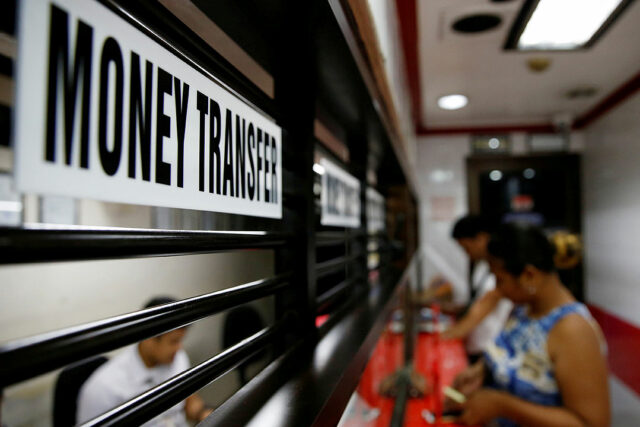
CUSTOMERS receive money from their families working abroad at a remittance center in Makati City in this file photo. — REUTERS
By Luisa Maria Jacinta C. Jocson, Reporter
CASH REMITTANCES from overseas Filipino workers (OFWs) hit an all-time high of $34.49 billion in 2024, data from the Bangko Sentral ng Pilipinas (BSP) showed.
Money sent home by OFWs through banks rose by 3% to $3.38 billion in December from $3.28 billion in the same month in 2023. This was the highest-ever monthly level for cash remittances.
This brought the full-year remittance level to a record-high $34.49 billion, up by 3% from $33.49 billion posted in 2023.
This was in line with the BSP’s 3% remittance growth forecast and its full-year projection of $34.5 billion.
“The increase was observed in remittances from both land-based and sea-based workers,” the BSP said.
In December alone, remittances from land-based workers jumped by 3.7% year on year to $2.71 billion from $2.61 billion.
For the full year, remittances from land-based workers increased by 3.4% to $27.55 billion from $26.64 billion in 2023.
Meanwhile, money sent by sea-based workers inched up by 0.6% to $669.28 million in December and rose by 1.3% to $6.94 billion for the full year.
Personal remittances, which include inflows in kind, rose by 3% to $3.73 billion in December from $3.62 billion in December 2023.
As of end-2024, personal remittances increased by 3% to $38.34 billion from $37.21 billion in the year prior. This also marked an all-time high for personal remittances.
The remittances accounted for 8.3% and 7.4% of the country’s gross domestic product (GDP) and gross national income (GNI), respectively.
“The growth in cash remittances from the United States, Saudi Arabia, Singapore, and the United Arab Emirates, mainly contributed to the increase in remittances in 2024,” the central bank said.
The US was the top source of cash remittances last year, accounting for 40.6% of the total.
This was followed by Singapore (7.2%), Saudi Arabia (6.4%), Japan (4.9%) and the United Kingdom (4.7%).
Other sources of remittances include the United Arab Emirates (4.4%), Canada (3.6%), Qatar (2.8%), Taiwan (2.7%), and South Korea (2.5%).
“The growth in cash remittances in 2024 reflects the continued resilience of OFWs in supporting the Philippine economy,” John Paolo R. Rivera, a senior research fellow at the Philippine Institute for Development Studies, said.
“Sustained economic recovery in the US, Middle East, and Asia-Pacific led to higher wages and employment opportunities for OFWs, boosting remittances,” he added.
Mr. Rivera said the weaker peso in the last few months of the year also increased the value of remittances sent home.
At end-2024, the peso closed at P57.845 against the dollar, depreciating by 4.28% from its end-2023 finish of P55.37. It also fell to the record-low P59-per-dollar level thrice last year.
Rizal Commercial Banking Corp. Chief Economist Michael L. Ricafort said the surge in remittances was also due to seasonal factors amid the holidays.
“December saw a seasonal uptick in remittances as OFWs sent additional funds for holiday-related expenses and family support. The adoption of digital remittance platforms made transfers faster and cheaper, encouraging higher remittance flows,” Mr. Rivera added.
For this year, Mr. Rivera said remittances are likely to remain a stable growth driver.
“Continued overseas labor demand, particularly in healthcare, tech, and skilled trades. More favorable exchange rates could encourage higher remittance volumes. Government agreements and labor deployment policies could open new job markets.”
Mr. Ricafort said remittances have been “growing consistently around 3% year on year in recent months and years and still expected to similarly grow, going forward, being demographic based.”
However, global uncertainties stemming from US President Donald J. Trump’s trade policies could weigh on remittances, Mr. Ricafort said.
“Mr. Trump’s threats of higher tariffs and America-first policies could also slow down global trade, investments, employment including OFW jobs, and overall world economic growth,” he said.
Mr. Trump is eyeing to impose reciprocal tariffs across all US imports. This after slapping a 10% tariff on all Chinese imports into the US, which took effect earlier this month.
Mr. Rivera likewise noted that geopolitical tensions and a possible global economic downturn could dampen the growth in remittances.
“Overall, remittances are expected to maintain modest growth in 2025, barring major economic disruptions. The steady inflows will continue to support household spending, helping drive consumption-led growth,” Mr. Rivera added.
The central bank expects cash remittances to grow by 3% this year.