Home Blog Page 1575

Big Mac Index: How undervalued the Philippine peso is compared with other currencies

The Philippine peso is still undervalued by 50% against the dollar, according to the latest update of the Big Mac Index released by The Economist. As of January 2025, a Big Mac costs $5.79 in the United States compared with P169 in the Philippines. This implies an exchange rate of P29.19 versus the greenback and contrasts with the actual exchange rate of P58.44. The index is based on the theory of purchasing power parity, suggesting that in the long run, exchange rates should adjust to equal the price of a basket of goods and services in different economies. This approach is used to help estimate how much one currency is under- or overvalued relative to another.

Big Mac Index: How undervalued the Philippine peso is compared with other currencies

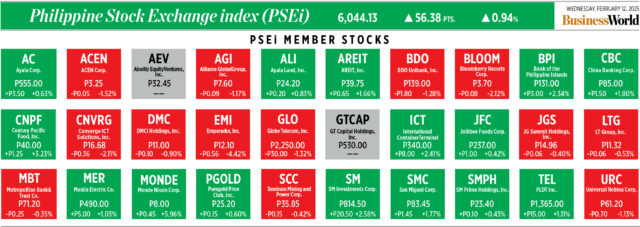
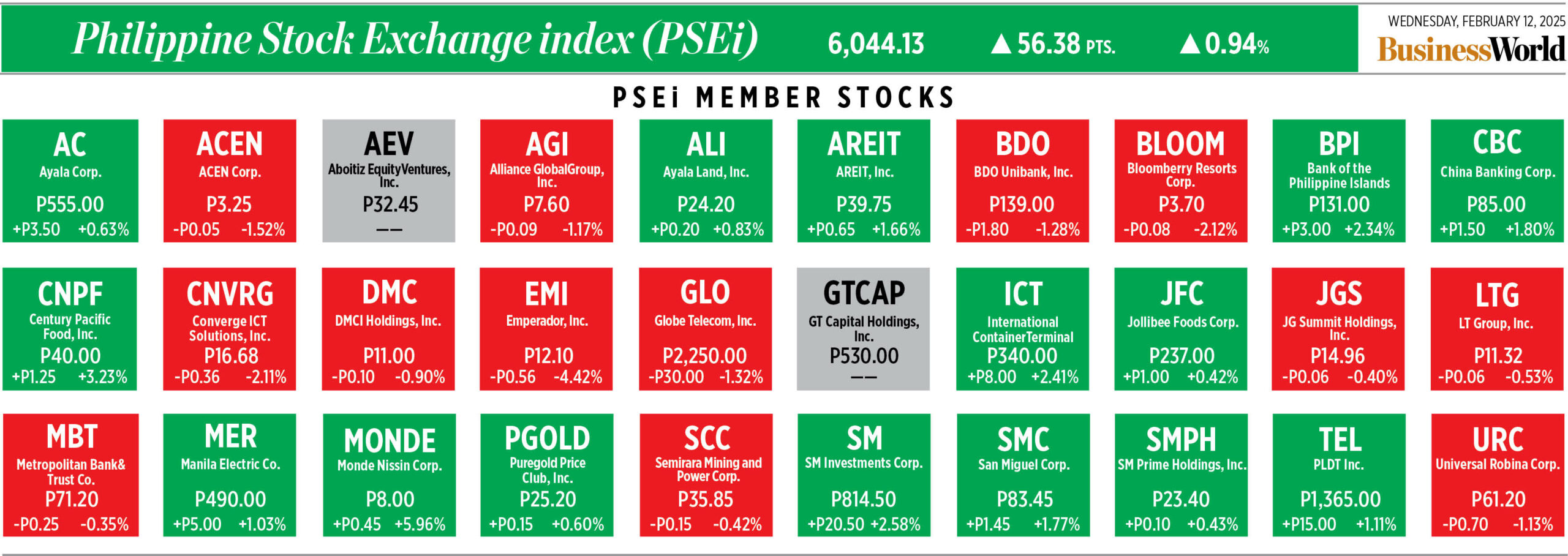
How PSEi member stocks performed — February 12, 2025

Here’s a quick glance at how PSEi stocks fared on Wednesday, February 12, 2025.


Green energy auction attracts bids for 7,500 MW in RE capacity

US DOE PHOTO

THE third green energy auction (GEA-3) attracted 7,500 megawatts (MW) worth of bids to construct renewable energy (RE) plants, exceeding the auction goal of 4,650 MW, the Department of Energy (DoE) said on Wednesday.

“The aggregate capacity of accepted bids underscores the growing confidence of investors and developers in the Philippine RE sector,” the DoE said in a statement on Wednesday.

At the auction on Feb. 11, the DoE received offers totaling 6,700 MW for pumped-storage hydropower projects in Luzon, against the target of 4,000 MW. The auction also hits 250-MW target for pumped-storage hydro in the Visayas.

Pumped storage hydropower can perform as an energy storage facility that can complement generation from variable renewable energy sources such as solar and wind, but can also inject power into the grid.

At present, the only pumped storage hydro facility in the country is the government-owned Kalayaan 1 and 2 plants in Laguna with capacity of over 300 MW.

Impounding hydro projects attracted 550 MW worth of bids, against the target of 300 MW. This technology is a type of hydroelectric power plant that uses a dam to store water in a reservoir.

Meanwhile, geothermal attracted bids for 30.887 MW, well below the 100 MW target.

Overall, the auction round received offers for 14 projects, with delivery periods of between 2025 and 2035.

In an advisory last month, the department identified 12 qualified bidders, including the units of Lopez-led First Gen Corp. and San Miguel Corp., for the 21 power projects on offer.

The DoE said that three qualified bidders withdrew prior to the auction, one did not submit a bid, and three were disqualified due to failure to submit the required documents.

The GEA program promotes renewable energy as a primary source of energy, with bidders undergoing competitive selection. The government is hoping to increase the share of renewable energy in the power mix to 35% by 2030 and to 50% by 2040.

The DoE is hoping to award contracts to the winning bidders starting June 6.

“The GEA underscores the Department’s commitment to creating a fair and competitive environment for RE development, ensuring transparency, innovation, and deployment of cost-effective RE technologies across the country,” the DoE said.

This year, the government is set to conduct two more auctions focusing on integrated renewable energy and energy storage systems and offshore wind power. — Sheldeen Joy Talavera

Procurement Service, SEC to sign agreement on data-sharing next month

BW FILE PHOTO

THE Department of Budget and Management (DBM) and the Securities and Exchange Commission (SEC) are expected to sign an agreement to share data on companies that participate in government procurement.

Budget Undersecretary Goddes Hope O. Libiran said the Data Sharing Agreement will be signed on March 14.

The SEC and the DBM’s Procurement Service will “share relevant information about corporations and other registered/licensed entities that participate in government procurement,” PS Executive Director Genmaries S. Entredicho-Caong, the executive director of PS-DBM told BusinessWorld via Viber.

The data that will be shared with the PS will include beneficial ownership information.

“These data may contain personal information and sensitive personal information such as but not limited to the complete name, specific residential address, date of birth, nationality, tax identification number,” she said.

Also covered by the deal are information on stakes held by incorporators, stockholders, directors, trustees, members, officers, and beneficial owners of registered corporations, or stakes held by partners in the case of partnerships.

The PhilGEPS is administered and managed by PS-DBM.

Ms. Caong said users of the Philippine Government Electronic Procurement System (PhilGEPS), which are procuring entities, suppliers, auditors, and civil society organizations, can access information about bidders and contract awardees, including their beneficial owners.

“We will sign an agreement together with the SEC to share their documents and information,” Budget Secretary Amenah F. Pangandaman said in a television appearance on Money Talks with Cathy Yang. — Aubrey Rose A. Inosante

MAP calls for tax hike freeze, efficient spending

THE Management Association of the Philippines (MAP) urged Congress and President Ferdinand R. Marcos, Jr. to halt tax increases meant to sustaining government expenditure, citing the need to fix what it described as wasteful spending.

MAP rejected the need to raise estate, donor’s, and capital gains taxes on the transfer of property classified as capital assets, which it said is being contemplated by the Department of Finance (DoF).

“Instead of implementing much-needed reforms to cut wasteful expenditures, reduce bureaucratic inefficiencies, and curb corruption, the administration continues to burden law-abiding citizens with higher taxes,” it said in a letter addressed to Mr. Marcos dated Feb. 7.

Finance Secretary Ralph G. Recto in December 2024 pushed for a tweaked fourth package of the Comprehensive Tax Reform Program, which was initiated in 2018.

Mr. Recto also urged legislators to consider the tweaks instead of the now-approved Capital Markets Efficiency Promotions Act (CMEPA), which was ratified by the House of Representatives and Senate last week. The proposal seeks to cut stock transaction tax to 0.1% from 0.6% to boost Philippine capital markets.

The DoF’s Government Revenues Optimization through Wealth Tax Harmonization (GROWTH) proposal could yield about P300 billion by 2030, the DoF said in a letter to the Senate last year.

“The proposed increase in estate and donor’s taxes, as well as the proposed increase in capital gains tax on transfers of real properties classified as capital assets, from 6% to 10%… is not only unjust but also detrimental to economic growth, wealth transfer and the financial well-being of Filipino families,” MAP said in its letter.

“There was a proposal to this effect during the bicameral panel of CMEPA that would have increased estate and donor’s taxes. We jointly decided to set it aside for now,” Albay Rep. Jose Maria Clemente S. Salceda, who heads the House tax panel and is a member of the bicameral conference committee that harmonized the capital markets reform bill, told BusinessWorld via Viber.

The government should instead look at fully implementing the Real Property Valuation and Assessment Reform Act and adjust car users’ tax rates before touching transfer tax rates, he added.

“I will study the GROWTH proposal when it’s forwarded to the House. But right now, there is no constituency for higher transfer taxes,” Mr. Salceda said.

MAP also pushed the government to rein in what it sees as “excessive government spending” before raising taxes.

“Instead of taxing inheritance further, the government should focus on streamlining tax collection, eliminating unnecessary projects, and prioritizing essential services that truly benefit the people,” it said, urging the government to practice “responsible” fiscal management. — Kenneth Christiane L. Basilio

Trade department budgets P800 million for shared-service facilities

PROPAKPHILIPPINES.COM

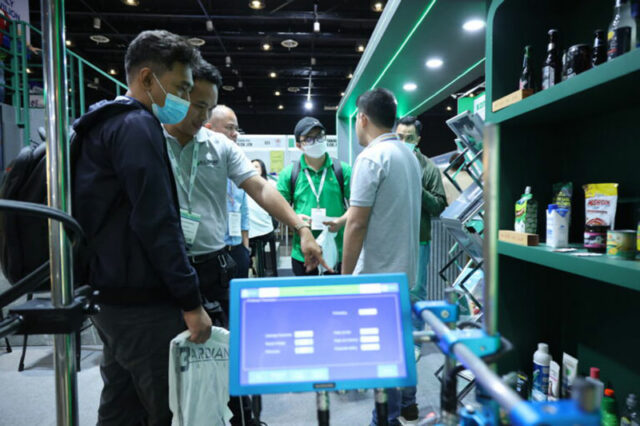
THE Department of Trade and Industry (DTI) said that up to P800 million has been budgeted for shared service facilities (SSF) projects this year.

Trade Secretary Ma. Cristina A. Roque made the remarks on the sidelines of the opening ceremony of Propak Philippines 2025, adding: “Some of the funds have already been used to buy machinery. So now, there is P600 million worth of machinery that needs to be purchased,” she added. 

The SSF program is the DTI’s flagship project to improve the productivity of micro, small and medium enterprises (MSMEs) by giving them access to mechanization and related technology.

“Usually these include packaging, printing, bottling, and so many other machinery,” she added.

Ms. Roque said that Propak Philippines exhibits packaging equipment that its organizers hope will advance industrialization.

She cited concerns about after-sales services and training that need to accompany machinery new to the market.

“For us to be able to buy machinery for shared service facilities, they must have repair and after-sales services.”

“We also need to constantly train the people that will use these machines,” she added.

Asian Packaging Federation President Joseph Ross A. Jocson said: “Sustainability is no longer a trend in packaging; it is a necessity. Consumers are increasingly demanding eco-friendly choices, and businesses are (under) growing pressure to reduce their environmental footprint.”

“This means embracing sustainable packaging solutions that minimize waste, use recycled materials, and are designed for circularity,” he added.

According to Ms. Roque, the Philippine packaging industry is lagging its ASEAN peers.

“If you put (Philippine products and their products) side by side, their packaging is better, but ours taste better,” she said. 

“But since the packaging of our counterparts is nicer, their products are the ones being bought,” she added.

This year’s Propak event is called “Investing in the Future of Sustainable Packaging and Processing through Technology, Innovation, and Thought Leadership.”

Due to run between Feb. 12 and 14, the event is expected to attract 12,000 trade buyers. — Justine Irish D. Tabile

PHL services rules ‘restrictive’; transport deemed a bright spot

PHILSTAR FILE PHOTO

THE PHILIPPINES had some of the most restrictive regulations for trade in services in 2024, particularly in terms of barriers to foreign investment, the Organisation for Economic Cooperation and Development (OECD) said.

The Philippines’ performance in the 2024 OECD Services Trade Restrictiveness Index (STRI), which grades conditions for the services trade across 51 countries and 22 industries, was “above the OECD average and relatively high compared to all countries in the STRI sample.”

In the report, the Philippine score was 0.45 with one being the most restrictive. It was deemed more restrictive than Russia (0.38), Indonesia (0.37), Iceland (0.35), Vietnam (0.34) and Kazakhstan (0.31). The OECD average is 0.19.

“The relatively high average score is explained by the presence of barriers to foreign investment across a number of sectors, including professional services, construction services and distribution services. In addition, economy-wide barriers that affect all services sectors are predominant,” it said.

The OECD study also cited restrictions on foreigners acquiring and using real estate, localization requirements for foreign services, and the application of labor market tests to certain categories of services suppliers.

However, it noted a “progressive effort towards creating a supportive regulatory environment for services trade.”

“Compared to regional partners, the Philippines has a relatively open market for trade in some key transport and logistics services, as well as financial services and some services that underpin the digital economy,” it said.

It added that the barriers in professional services remain above the regional average and could be potential areas for reform.

The report concluded that air transport was least restrictive industry in the Philippines relative to the region.

“Conversely, engineering services, rail freight transport, architecture services and logistics customs brokerage are the sectors with the highest relative score,” it said.

It noted that the Philippines has carried out crucial reforms opening up the air transport, telecommunications, and financial services industries.

Among the reforms is the Public Service Act, which eliminated foreign equity limitations on key public services, including airports, railways, and telecommunications services. — Aubrey Rose A. Inosante

Pork MSRP could be imposed in March

PHILIPPINE STAR/ RYAN BALDEMOR

THE Department of Agriculture (DA) said on Wednesday that it may set a maximum suggested retail price (MSRP) for pork in March, pending results of a market study.

Secretary Francisco Tiu Laurel, Jr. said the DA was due to evaluate the initial findings of an ongoing study of pork prices within the day.

“The earliest (date to impose a price cap) will be in March,” Mr. Laurel said on the sidelines of price monitoring inspection at Commonwealth Market in Quezon City.

He said the DA wants to set a price that is “fair” for all members of the hog industry.

Fresh liempo (pork belly) currently sells for between P380 and P480 per kilo while kasim (shoulder) averages P350 to P420, according to DA price monitors.

Frozen kasim fetches an average of P253.56 per kilo, with frozen liempo at P311.33.

Mr. Laurel have been blaming middlemen for high prices, as well as high gasoline prices, slaughterhouse fees, and the cost to acquire hogs from farms. 

“We will study the entire value chain to analyze it well,” he said.

Mr. Laurel said that the full MSRP study expected to be completed by the end of the month. — Kyle Aristophere T. Atienza

P632-M Tagbilaran port expansion deal awarded

PPA PHOTO

A MANDAUE CITY construction company won the P632.29-million contract to expand the Port of Tagbilaran in Bohol, the Philippine Ports Authority (PPA) said.

In a notice of award dated Feb. 10, PPA said the contract for the expansion project was awarded to BNR Construction and Development Corp., which emerged as the low bidder.

BNR has 720 days to expand and upgrade the port, the PPA said.

According to the PPA bids and awards committee, the other bidders for the project were Bemkar Construction and Supply; Goldridge Construction and Development Corp.; WTG Construction and Development Corp.; Luzviminda Engineering; Sunwest, Inc.; UKC Builders, Inc.; and MRBII Construction Corp.

The PPA has a budget of about P16 billion until 2028 for infrastructure projects, including 14 flagship projects due to be completed before the current government steps down.

This year, the PPA said it expects sustained growth in cargo and passenger volumes due to strong demand. The goal for cargo throughput is 301.47 million metric tons. — Ashley Erika O. Jose

John Hay golf could become public-access course — BCDA

CAMP JOHN HAY GOLF CLUB FACEBOOK

THE Bases Conversion and Development Authority (BCDA) said it hopes to put up for auction this year the operations and maintenance (O&M) contract for the Camp John Hay golf course, which it is considering opening up to public access.

In a statement on Wednesday, the BCDA said it has set in motion plans to improve the facilities in Camp John Hay, in collaboration with the interim managers of the hotels and the golf course.

The BCDA tapped Landco Pacific Corp. and the consortium of Golfplus Management, Inc. (GMI) and DuckWorld Philippines as interim managers of the hotels and the golf course, respectively.

During the interim period, GMI and DuckWorld will assess the condition of the golf course and recommend long-term improvements to the facilities, the BCDA said.

“Among these is the rehabilitation of the irrigation system, which is crucial in the maintenance of the golf course. These recommendations will be implemented by the long-term O&M partner to be tapped by the BCDA,” it added.

BCDA President and Chief Executive Officer Joshua M. Bingcang said the target is to auction off the O&M deal within the year, once BCDA has determined a suitable model for golf operations.

“We want to emphasize that Camp John Hay is not only back in the government’s possession. It is now back with the Filipino people,” he said.

“We want to ensure that all Filipinos can enjoy the world-class leisure destinations within the camp, and we will do that while maintaining and improving the facilities and services,” he added.

According to the BCDA, the plan is to make the golf course available for public use while maintaining quality.

“The objective is to make it the best golf course in the Philippines and keep it accessible to the public,” Mr. Bingcang said.

“That’s the objective — everything should be the best. Not only the golf course, but eventually the facilities like the clubhouse, because that’s part of the whole experience,” GMI President Eduardo P. Arguelles said.

Meanwhile, Landco led the seamless transition of management in the John Hay Hotels to ensure uninterrupted provision of services at the Manor and Forest Lodge.

“Even during a challenging period of transition, the BCDA and Landco Pacific made sure that tourists and hotel visitors were not affected. The hotels remained open, and services did not cease even for a single minute,” Landco Lifestyle Ventures Head Patrick C. Gregorio said.

“We are here to help preserve the charm of Camp John Hay and strengthen Baguio’s tourism industry. And in turn, we are also helping transform local communities and spur economic opportunities so that progress is felt by all,” he added. — Justine Irish D. Tabile

CREATE MORE: A better version of the CREATE law

In November, Republic Act 12066 (otherwise known as CREATE MORE), which amended CREATE, was finally signed into law. The new law seeks to enhance the competitiveness of the Philippines’ incentive regime.

As we anticipate the issuance of the implementing rules in the coming weeks, enterprises registered with Investment Promotion Agencies (IPAs) are curious as to how this new law will potentially affect their registrations and incentives availments going forward.

Today, I’d like to discuss the salient features and significant changes under CREATE MORE that will directly impact registered business enterprises (RBE) insofar as their existing registered and future/new projects are concerned.

One of the notable changes is the coverage of the VAT zero-rating incentive enjoyed by RBEs. A lot of us may recall that before CREATE, all purchases of goods and services of RBEs were entitled to 0% VAT without distinction. However, CREATE limited this by providing that only expenses which are “directly and exclusively used” in the registered activity are entitled to VAT zero-rating. While the limitation was made with the intention of restricting the incentives to those expenses that actually formed part of the registered activities, several issues were raised during its implementation, particularly in determining which expenses or purchases qualified for these incentives. Eventually, this resulted in additional administrative requirements on both the RBEs and their suppliers, as they needed to prove that their expenses qualified for VAT zero-rating.

CREATE MORE now expands the coverage by using the term “directly attributable,” which refers to goods and services that are incidental to and reasonably necessary for the registered project or activity of the RBE. This includes janitorial security, financial, consultancy services, marketing and promotion, and administrative functions such as human resources, legal and accounting. Interestingly, these were the expenses that were previously specifically disallowed for VAT zero-rating in the implementing rules of CREATE. Thus, the amendment brings much relief to both RBEs and their suppliers. The IPA is vested with the authority to determine what is “directly attributable” depending on the registered project or activity of the RBE.

Another significant amendment under CREATE MORE is the reduction of the corporate income tax (CIT) rate applied to RBEs availing of the Enhanced Deductions (ED) incentive. Under CREATE, those under ED were generally subject to the 25% regular CIT. Under CREATE MORE, those availing of ED are now entitled to the lower CIT rate of 20% on income arising from the registered activity/project.

Contrary to some misconceptions, it is worth noting that the reduced CIT rate only applies to the RBEs availing of the ED incentive. Regular corporations not registered with IPAs are not entitled to the lowered CIT rate. The lower CIT rate for ED may have been introduced to make the ED regime a more viable option, along with the 5% Special Corporate Income Tax (SCIT) regime.

A crucial gap that CREATE MORE seeks to address is the imposition of Local Business Tax (LBT) on RBEs that are availing of the Income Tax Holiday (ITH) and ED incentives. While it is settled that those under the SCIT regime are paying the 5% in lieu of national and local taxes, the same is not clearly provided for those under ITH and ED. Even in practice, we have observed that Local Government Units (LGU) have differing views and rules on this issue.

CREATE MORE now includes an item specifically dedicated to RBE Local Tax (RBELT) among the list of incentives under Section 194 (F). Under this newly added provision, LGUs may pass an ordinance imposing an RBELT for those under ITH and ED, at a rate of not more than 2% of the RBE’s gross income. The 2% RBELT shall be in lieu of local fees and charges that the LGU imposes. No RBELT may be collected from RBEs under the SCIT.

As to the order of availment, under CREATE, the ITH should be availed of first, followed by SCIT or ED, with the choice between SCIT and ED required to be made at the start, when the RBE is applying for IPA registration. Under CREATE MORE, SCIT or ED may be availed of outright, without having to go through ITH first. This means that in the first year of commercial operations, the RBE may already enjoy either the SCIT or ED regime. This is expected to give RBEs flexibility especially if directly availing of SCIT or ED will be more beneficial to the company.

With respect to imports, the duty exemption incentive now covers capital equipment, raw materials, spare parts, or accessories “directly attributable” to the registered activity (instead of “directly and exclusively” under CREATE), and goods used for administrative purposes. Also, CREATE MORE now allows imports prior to issuance of the Certificate of Registration (CoR). In the past, registration with the IPA must be completed first, as evidenced by the CoR, before tax and duty-free imports are allowed.

Under CREATE MORE, imports prior to the issuance of the CoR are allowed on the condition that the RBE posts a performance bond or bank guarantee equivalent to the duties and taxes waived. While a performance bond will result in additional cost to RBEs, this is still expected to benefit them as it will reduce the time involved in setting up their facilities in preparation for the start of commercial operations.

In the spirit of Valentine’s Day, let me end this with a quote about hope that is often shared to those who have loved and failed — when love visits you again, may it be safe, secure, genuine and reassuring. May CREATE MORE (as an improved version of CREATE) give RBEs and investors such a level of assurance of the Philippines’ earnest efforts towards improving the investment landscape through the notable positive changes it offers.

The views or opinions expressed in this article are solely those of the author and do not necessarily represent those of Isla Lipana & Co. The content is for general information purposes only, and should not be used as a substitute for specific advice.


Aimee Rose Dela Cruz is a director at the Tax Services department of Isla Lipana & Co., the Philippine member firm of the PwC network.

aimee.rose.d.dela.cruz@pwc.com

+63 (2) 8845-2728

Philippine military eyes upgrades including two ‘dream’ submarines

PHILIPPINE ARMY KALINAW NEWS

By Kenneth Christiane L. Basilio and Adrian H. Halili, Reporters

THE PHILIPPINES is looking to buy more military hardware to modernize its arsenal, including additional BrahMos missiles from India and at least two submarines, the chief of the armed forces said on Wednesday.

The Philippines is on the third phase of its modernization program called “Horizons.” It has earmarked $35 billion for the buildup over the next decade as it aims to counter China’s military might in the region.

“It’s a dream for us to get at least two submarines,” Armed Forces Chief of Staff General Romeo S. Brawner, Jr. said in a speech to key businessmen in Manila.

“We are an archipelago, so we have to have this type of capability because it’s really difficult to defend that entire archipelago without submarines,” he added.

In 2022, the Philippines bought $375 million worth of BrahMos anti-ship missile systems from India, and has orders for more. “We are getting more of this (system) this year and in the coming years,” Mr. Brawner said.

The Philippines earlier said it is eyeing mid-range missiles and at least 40 fighter jets to boost its defense capabilities.

It expects deliveries this year of at least two corvette vessels from South Korea, which last year elevated its ties with Manila to a strategic partnership.

Mr. Brawner said Manila is trying to get South Korea to join the Squad, a multilateral grouping composed of Australia, Japan, the Philippines and the US.

“This year, we’re going to get two corvettes from South Korea, [and] also the BRP Miguel Malvar that will be sailing this March to the Philippines,” he said. “We are getting one more this year. We are also getting two more landing docks and six offshore patrol vessels.”

The Philippines’ military buildup comes as tensions between Manila and Beijing have escalated in the South China Sea, where the two have clashed in recent years.

Mr. Brawner said the military has observed an increase in “illegal, coercive and deceptive” actions by China in the South China Sea. “We have seen also an increase in the number of vessels in the West Philippine Sea on a daily basis,” he added, referring to areas of the South China within its exclusive economic zone.

From 190 vessels in 2021, the Philippines is now seeing a daily average of 286 Chinese ships around Manila’s maritime zone, he said.

The Chinese Embassy in Manila did not immediately respond to a request for comment. Chinese authorities have said their actions in the region were lawful.

Mr. Brawner said a “joint maritime activity” with the US and Canada in Manila’s maritime zone in the South China Sea was under way. He said Manila is also eyeing joint activities with France, Italy and the UK. These activities are meant to ensure an effective presence in the South China Sea, he added.

“We are looking forward to having more of this with other countries such as Italy, the United Kingdom and France,” he told reporters on the sidelines of a security forum. “Before, we didn’t have joint sails with these countries but gradually, other nations such as those from Europe have developed an interest in our country.”

The Philippines started holding joint maritime exercises with foreign navies last year to promote an open Indo-Pacific region amid China’s increasing assertiveness in the South China Sea.

Mr. Brawner said the Philippines on Wednesday started joint sea drills with the US and Canada west of Mindoro province.

“Last week, we conducted our multilateral maritime cooperative activity or joint sails with the US and Japan. Today, we’re doing it with the US and Canada,” he added.

Meanwhile, Washington and Manila have committed to enhance cooperation in military modernization initiatives and defense capabilities, according to US Joint Chiefs of Staff Chairman Charles Q. Brown, Jr.

In a statement, the Joint Chiefs of Staff said Mr. Brown and Mr. Brawner talked on the phone to discuss ways to boost Philippine defense capabilities. They also discussed military sited under their Enhanced Defense Cooperation Agreement (EDCA) and increasing the scope and capacity of joint military exercises in the Philippines.

“The US continues to closely partner with the Philippines and remains committed to maintaining a strong alliance founded upon shared strategic interests and democratic values,” the agency said.

Mr. Brown is the highest-ranking and most senior military officer in the US Armed Forces and is the key military adviser of the President, National Security Council, Homeland Security Council and Defense secretary.

Also on Wednesday, Senator Francis N. Tolentino urged the President to form a separate maritime command focused on the South China Sea to improve the response capabilities of the Philippine Navy and Philippine Coast Guard.

“It is about time, for purposes of implementing the Philippine Maritime Zones law, that we create our own new command which is the West Philippine Sea Command for maritime security,” he told a news briefing. — with Reuters