Home Blog Page 1481

US condemns ‘dangerous’ maneuvers by Chinese Navy in South China Sea

A LANDSAT 7 image of Scarborough Shoal in the West Philippine Sea. — WIKIPEDIA

By Adrian H. Halili and John Victor D. Ordoñez, Reporters

THE US on Wednesday condemned the “dangerous” maneuvers of a Chinese Navy helicopter that endangered the safety of a Philippine government aircraft patrolling a disputed shoal in the South China Sea.

In a post on X, US Ambassador to the Philippines Mary Kay L. Carlson also urged China to “refrain from coercive actions and settle its disputes peacefully in accordance with international law.”

The Philippines on Tuesday said it was “deeply disturbed” by the Chinese navy’s “unprofessional and reckless” flight actions and that it would file a diplomatic protest.

Manila’s coast guard said the Chinese navy helicopter performed dangerous flight maneuvers when it flew close to a government aircraft conducting surveillance over Scarborough Shoal, endangering the lives of its pilots and passengers.

The People’s Liberation Army Navy helicopter flew as close as three meters to the aircraft, which the Philippine Coast Guard said was a “clear violation and blatant disregard” of aviation regulations.

China disputed the Philippines’ account, saying on Tuesday its aircraft “illegally intruded” into China’s airspace and accused its Southeast Asian neighbor of “spreading false narratives.”

Named after a British ship that was grounded on the atoll nearly three centuries ago, Scarborough Shoal is one of the most contested maritime feature in the South China Sea, where Beijing and Manila have clashed repeatedly.

“The Philippines has undeniable sovereignty and jurisdiction over Bajo de Masinloc,” its National Maritime Council said in a statement, using Manila’s name for the shoal.

“China’s illegal, coercive, and aggressive behavior will not deter the Philippines from continuing the conduct of its routine maritime operations in accordance with its sovereignty over the shoal,” it added.

Senator Ana Theresia N. Hontiveros-Baraquel said China has been stirring trouble by routinely disrespecting international laws.

“(China) is a signatory to the United Nations Convention on the Law of the Sea and a contracting member of the International Civil Aviation Organization, and yet it shamelessly ignores these international norms,” she said in a statement.

China claims over 80% of the waterway in the South China Sea, but the Permanent Court of Arbitration voided its claim in 2016. China rejects this claim.

China claims sovereignty over almost the entire South China Sea, a vital waterway for more than $3 trillion of annual ship-borne commerce, putting it at odds with Brunei, Indonesia, Malaysia, the Philippines and Vietnam.

A United Nations-backed tribunal based in the Hague in 2016 voided China’s claim for being illegal, but Beijing does not recognize the ruling.

Meanwhile, President Ferdinand R. Marcos, Jr. has signed into law a bill that will fix the term of the Philippine Coast Guard (PCG) commandant to three years, which is expected to keep the agency’s leadership structure stable amid tensions with China. 

Republic Act No. 12122, which the President signed into law on Feb. 18, gives the PCG chief a three-year term unless relieved from their post.

Senate President Francis G. Escudero earlier said the measure would help the agency secure Manila’s territorial waters and shores.

In October, Mr. Marcos vowed to upgrade the assets and increase the PCG’s fleet to boost maritime domain awareness.

The PCG was under the Department of National Defense before it was transferred to the Office of the President on March 30, 1998 through an order issued by the late President Fidel V. Ramos.

Less than a month later, Mr. Ramos transferred the PCG to the Department of Transportation and Communications, which was split into two separate agencies in 2016 through a law signed by the late President Benigno S.C. Aquino III.

The coast guard launched a transparency campaign in 2023 to expose China’s attacks on its assets, a strategy that has helped Manila gain more support from the international community. — with Reuters
Sandiganbayan dismisses ill-gotten wealth lawsuit against Marcoses

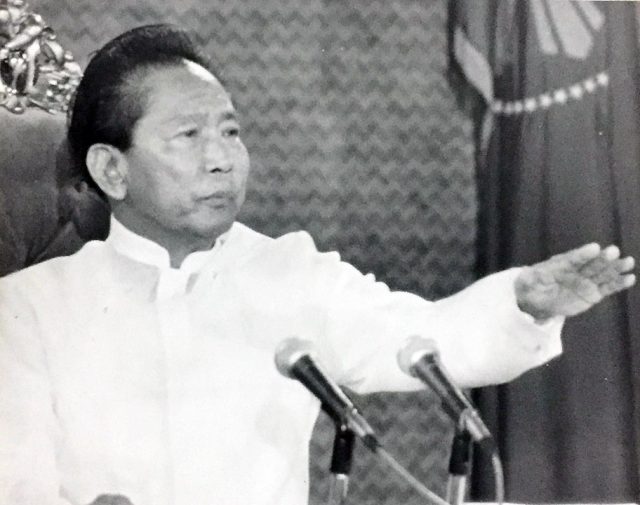
FORMER PRESIDENT FERDINAND E. MARCOS — BW FILE PHOTO

By Kenneth Christiane L. Basilio, Reporter

THE PHILIPPINES’ anti-graft court has dismissed an ill-gotten wealth case against the late dictator Ferdinand E. Marcos, Sr. and his wife Imelda due to decades-long inaction by state prosecutors.

In a 12-page resolution dated Feb. 18, the Sandiganbayan Second Division said the Presidential Commission on Good Government (PCGG) had failed to prosecute the Marcoses for a lawsuit seeking the return of vehicles and household appliances alleged to have been bought with ill-gotten wealth.

“There is no question that the plaintiff (PCGG) has failed to prosecute the case for an unreasonable length of time,” according to a copy of the decision written by Presiding Justice Geraldine Faith A. Econg. “Plaintiff’s unexplained inaction for more than four decades warrants the dismissal of the complaints against the defendant Marcos spouses.”

State prosecutors filed their complaint against the Marcoses in July 1987 seeking the return of 21 cars worth about P5 million and household appliances that were alleged to have been unlawfully acquired.

The Sandiganbayan ordered the forfeiture of the vehicles and appliances to the PCGG in 1989, but this was overturned three years later after Imelda R. Marcos, wife of Mr. Marcos, said in a motion they were not able to respond to the ill-gotten wealth allegations since they had been in exile in the US.

Government prosecutors challenged the anti-graft court’s reversal order in 1992 by lodging petitions before it and the Supreme Court. The motions were quashed in 1993 and 1994, citing Mrs. Marcos’ “meritorious” plea.

“Decades passed and the status of the proceedings was left unsettled. Hence, on Jan. 21, 2025, a case conference was scheduled by the court to put the present complaint to close,” the anti-graft court said.

PCGG lawyers did not object to the termination of the case since they had recovered the assets due to the court’s earlier forfeiture order.

“Even with the partial satisfaction of the writ of execution, there remains an unresolved issue left for adjudication, and a concomitant duty of the plaintiff as a claiming party to prosecute the same,” the court said.

“So viewed, the dismissal of the instant complaint against defendant Marcos spouses for actual, moral, temperate, nominal and exemplary damages and attorney’s fees is proper,” it added.

The late dictator, the father and namesake of the current Philippine President, served as president for two-decades, during which he stole as much as $10 billion (P581 billion) from the Filipino people, according to PCGG estimates.

Government prosecutors tried to go after the ill-gotten wealth of the Marcoses after the late dictator was toppled by a popular street uprising in February 1986. The PCGG had recovered about P280 billion of the assets as of 2023, according to the agency’s audit report posted on its website.

Gov’t think-tank calls for regulatory body, reforms to boost train use, modernization

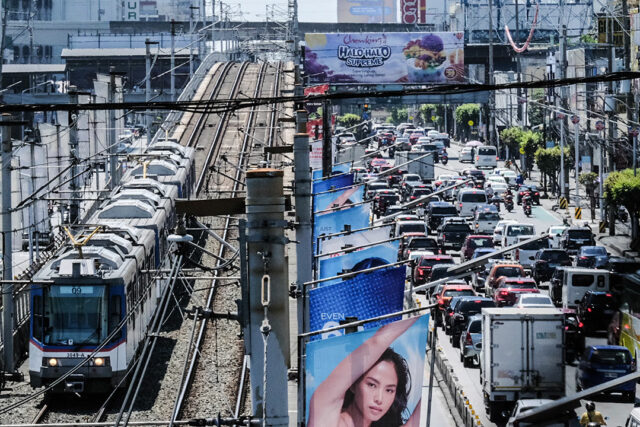
Traffic is seen along EDSA in this file photo. — PHILIPPINE STAR/RYAN BALDEMOR

THE Philippine government should consider establishing a rail regulatory agency to protect commuters from price gouging and ensure that rail transportation infrastructure projects are on-track, according to a congressional think-tank.

Reducing traffic congestion in Metro Manila requires the government to advocate for the use of railway systems further by making train fares cheap, the Congressional Policy and Budget Research Department (CPBRD) said in a February report.

“Leaving the rail sector fully into the hands of the private sector could result in negative externalities and market failures. Lack of market regulation, especially in ensuring competition and addressing anti-competitive practices, will allow private operators to maximize their profits in rail operations without regard to public welfare,” CPBRD author Ricardo P. Mira said in the 27-page discussion paper.

“The government should take the lead in promoting a culture of rail commuting among Filipinos by ensuring fast, safe, reliable, and reasonably-priced rail transport services,” he added.

The Philippines is hard-pressed to decongest heavy traffic in Metro Manila, which the TomTom Traffic Index found to be the 14th most congested city in the world in 2024. Commuters in the city take around 32 minutes to travel 10 kilometers (km) on average, the report noted.

The Southeast Asian nation also has the shortest railway system among its regional neighbors, with only 228 km of total track length, according to 2023 data from the Association of Southeast Asian Nations. It follows Singapore (259 km), Laos (423.5 km), Cambodia (652 km), Malaysia (1,799.4 km), Vietnam (2,646.1 km), Thailand (5,098.2 km), and Indonesia (5,483 km).

Railway operators should also reduce service interruptions caused by technical and operational issues to further boost the use of public trains, the think-tank said. “Successful urban rail development is usually associated with careful planning of network and modal integration.”

Policymakers should also look at regulating private car ownership in Metro Manila to maximize investments in railway upgrades, it added.

“This policy should not only mitigate traffic congestion but also promote rail patronage among vehicle owners.”

Moreover, lawmakers could prioritize proposed amendments to the 2016 Right-of-Way (ROW) Act to help advance railway construction projects amid ROW issues, the think-tank said.

At present, the government is required to relocate residents affected by railway projects and provide compensation for underground boring and construction activities.

November 2024 data from the Department of Transportation (DoTr) showed that only 1,756 out of 50,633 informal settlers have been relocated.

Further, the report noted that the ROW law provided property owners rights to their land up to 50 meters below ground level. This means the government can enter into and use subsurface or subterranean portions more than 50 meters from the surface.

“An important amendment relevant to the rail sector is the proposed reduction of the subterranean ROW from 50 meters to 15 meters from the surface, which could allow the DoTr and other government agencies to build more subterranean infrastructure in the future,” it said.

“This makes economic sense because it will help relieve the government from compensating costly subterranean ROW in future subway projects,” it added.

The House of Representatives approved on third reading its version of the measure in February 2023, with its counterpart proposal in the Senate pending plenary deliberations. — Kenneth Christiane L. Basilio

PHL secures P1-B EU grant

A EUROPEAN UNION’S flag flutters outside the European Commission headquarters in Brussels, Belgium, Oct. 15, 2020. — REUTERS

THE PHILIPPINES has received a P1-billion (€16.5-million) grant from the European Union (EU) for a program that will protect the rights of Filipinos for a responsive justice system, Finance Secretary Ralph G. Recto said on Wednesday.

Mr. Recto said in a statement the grant agreement for the Enabling Justice and Rule of Law in the Philippines of the Justice Sector Coordinating Council was signed on Nov. 22.

The grant aims to contribute to the socio-economic development of the country “by creating a more effective, inclusive, and accountable justice system,” the statement read.

“This agreement is of great importance to us because we recognize that economic progress and the rule of law must go hand in hand,” Mr. Recto said in his opening remarks at the ceremonial exchange of document on Wednesday.

It will improve legal aid services for marginalized groups by boosting the capacities of local justice sector actors and will straighten coordination between the justice institutions. — Aubrey Rose A. Inosante

Immediate action on VP ouster urged

VICE-PRESIDENT SARA DUTERTE-CARPIO — HOUSE OF REPRESENTATIVES OF THE PHILIPPINES FACEBOOK PAGE

A POLITICAL group on Wednesday called on the Philippine Senate to immediately hold the impeachment trial against Vice-President (VP) Sara Duterte-Carpio.

In a position paper, Bayan Muna Chairperson Neri J. Colmenares asked President Ferdinand R. Marcos, Jr. to call for a special session compelling senators to convene as an impeachment court without their permission. The paper was also backed by the impeachment counsel for activists who filed the second ouster charge against the embattled vice-president.

The Senate could also begin soliciting Ms. Duterte’s response to the allegations contained in the impeachment complaint submitted to the Senate in early February, he added, which was signed by more than one-third of congressmen.

“We call for the immediate convening of the impeachment court, and for the speedy disposition of the impeachment case,” Mr. Colmenares said in his eight-page position paper.

The Office of the Vice-President did not immediately respond to an e-mail seeking comment.

Civil society groups, activists and clergymen separately filed three impeachment complaints against Ms. Duterte in December. More than 200 congressmen filed and endorsed a fourth complaint that was directly sent to the Senate before Congress went on a four-month break early this month. — Kenneth Christiane L. Basilio

Comelec warns vs discrimination

FREEPIK

THE Commission on Elections (Comelec) reminded campaigners to not use the election to discriminate against vulnerable sectors, persons with disability (PWDs) and women.

According to the 10-page resolution, violators would be slapped with an election offense.

The resolution will be applied during the election period for the midterm election and the Bangsamoro Autonomous Region of Muslim Mindanao (BARMM) Parliamentary Elections.

The campaign period for senatorial and party-list candidates started on Feb. 11, while local bets will start their campaign on March 28.

Up for grabs in the May 12 elections are 317 congressional seats and thousands of local posts. The biggest battle will be for 12 spots in the 24-seat Senate, a chamber packed with political heavyweights and wielding outsized influence. — Chloe Mari A. Hufana

P2-M drugs seized in Ilocos Norte

PHILSTAR FILE PHOTO

BAGUIO CITY — Ilocos region policemen seized over P2 million worth of crystal meth (shabu) from an alleged big-time drug trader in a San Ildefonso barangay in San Nicolas town, Ilocos Norte on Tuesday afternoon.

The suspect, a 31-year-old welder from Dingras town, according to the Provincial Police Drug Enforcement Unit (PPDEU), is a “high-value individual” monitored for selling drugs in bulk.

At least 300 grams of suspected shabu, valued at P2.040 million on three ice bags, and three heat-sealed transparent plastic sachets were seized from the drug trader.

Ilocos region police director Brig. Gen. Lou F. Evangelista emphasized the importance of intensified anti-drug efforts, especially during the ongoing election period.

He urged everyone to remain vigilant and report any suspicious activities to authorities as part of the collective effort to maintain a safe, drug-free, and fair election environment in the Ilocos Region.

At the start of this week, Mr. Evangelista also reported the arrest of two drug traders in Pangasinan and hauling of a total of P136,000 worth of shabu during a drug raid and sting on Feb. 17 and Feb. 18.

Alaminos City policemen with the Philippine Drug Enforcement Group (PDEG) Special Operations Unit 1 (SOU1) and the Regional Intelligence Division (RID) of the Ilocos region police caught a 35-year-old cellphone technician from Alaminos City after a raid ordered by the Presiding Judge of the Alaminos City Regional Trial Court. The raid yielded 10 grams of shabu contained in six pieces of heat-sealed transparent plastic sachets, valued at P68,000.

Meanwhile, a sting operation in Dagupan City, yielded a 44-year-old suspect from Dagupan City, who sold 10 grams of shabu contained in two heat-sealed transparent plastic sachets worth P68,000. — Artemio A. Dumlao

DSWD, BARMM partner in new food security program

COTABATO CITY — Two government agencies have fused ranks to push forward a food security program in the Bangsamoro Autonomous Region in Muslim Mindanao (BARMM).

Ranking employees of the Department of Social Welfare and Development (DSWD) in Region 12, led by Hajiara L. Pandi and Bangsamoro Labor Minister Muslimin G. Sema, agreed to cooperate in implementing the DSWD’s Walang Gutom Program 2027 in the autonomous region during a dialogue on Tuesday in Cotabato City.

Officials of the Ministry of Labor and Employment (MoLE) in BARMM told reporters on Wednesday that they have offices promoting labor sector welfare, employment generation and prevention of child labor that can be aligned with the DSWD-12’s food security thrusts in the autonomous region.

Ms. Pandi said they will connect with the local communities in Cotabato City and other areas in the autonomous region via the MoLE-BARMM and the regional social services ministry.

Launched in July 2024, the Walang Gutom Program 2027, a state food provision initiative is a new DSWD program aimed at decreasing the incidence of hunger among low-income households.

The program, first implemented in administrative regions, provides qualified beneficiaries with periodic P3,000 monetary assistance through an electronic benefit transfer card. — John Felix M. Unson

EO lowers real property tax for IPPs with BOT projects

By John Victor D. Ordoñez, Reporter

PRESIDENT Ferdinand R. Marcos, Jr. issued an executive order (EO) that will reduce real property tax for independent power producers (IPPs) engaged in build-operate-transfer (BOT) deals with government-owned and -controlled corporations (GOCCs).

The Palace said Executive Order 83 signed by the President on Feb. 13 and made public on Wednesday. The EO grants IPPs an effective reduction in real property tax by setting an assessment level of 15% of the fair market value. It also calls for machinery and equipment to be depreciated at 2% a year.

All interest and penalties on deficiency real property tax liabilities of IPPs will be condoned, according to the EO.

Real property tax payments made by IPPs exceeding the reduced amount will be applied to their property tax liabilities in the succeeding years.

The Local Government Code of 1991 provides that GOCCs engaged in the generation and transmission of electricity are entitled to tax privileges such as a lower real property tax assessed on 10% of market land value, buildings, machinery, and other equipment.

The law also grants the President the authority to condone or reduce these real property taxes for any province, city, or municipality within Metro Manila “when public interest so requires.”

“As the operations of affected IPPs provide an estimated grid capacity of 3,100 megawatts, the closure or non-operation of these IPPs will entail substantial losses to the government and force the public to resort to more costly electric power source alternatives or rotating power outages,” according to the order.

Mr. Marcos said in the EO that the collection of the real property tax from the IPPs last year, which had assessment levels of as high as 80% of fair market value from local government units (LGUs), will “trigger massive direct liabilities” for the National Power Corp. and Power Sector Assets and Liabilities Management Corp.

He said such liabilities would threaten the financial stability of the agencies, disrupt the government’s fiscal consolidation efforts, and upend the stability of energy prices.

“This is good news but only touches on a small part of the permitting and regulatory framework that needs to be improved,” Anne E. Montelibano, president of the Philippine Independent Power Producers Association, Inc. (PIPPA), told BusinessWorld via Viber.

“To effectively make the country an attractive destination for power generators, various issues need to be resolved and addressed,” she added.

The Executive needs to clarify whether the lower property tax and condonation can be implemented without the consent of affected LGUs, since they handle collecting these taxes, Terry L. Ridon, a public investment analyst and convenor of think tank InfraWatch PH, said via Messenger chat.

“In other words, a mere executive order cannot trump the power of local government units to impose and collect real property taxes on properties within their jurisdiction.”

PIPPA last year called on the Energy Regulatory Commission (ERC) to review the implementation of a secondary price cap on prices, which the ERC uses to prevent excessive increases in electricity prices.

Ms. Montelibano has said the cap would discourage investment in the power sector, despite an ERC a resolution providing for additional compensation to power plant generators once a price cap is triggered.

“Taxes can in fact be raised as long as the long-term profits of the power plants are secured,” Leonardo A. Lanzona, who teaches economics at the Ateneo de Manila, said via Messenger chat.

“The effectiveness of tax reduction depends on whether or not there exists forward and backward linkages to the power sector.”

First batch of NFA rice released to San Juan City

PHILIPPINE STAR/MIGUEL DE GUZMAN

THE National Food Authority (NFA) on Wednesday began releasing rice stocks to local government units (LGUs) in response to the declaration of a food security emergency.

Agriculture Secretary Francisco Tiu Laurel, Jr. handed over rice to San Juan City Mayor Francisco Javier Zamora in a ceremony at an NFA’s warehouse in Valenzuela City.

Mr. Zamora heads the Metro Manila Council.

Aside from Metro Manila, 50 more LGUs have expressed their intent to participate in the program, the DA said.

“We expect more local government units to participate in this effort, which will benefit not only consumers but also rice farmers,” according to Mr. Laurel, who chairs the NFA Council.

The NFA seeks to release 25,000 metric tons (MT) of rice every month during the emergency. 

The DA will oversee the selling of rice through state-owned Food Terminal, Inc. (FTI), since the amended Rice Tariffication Law bars the NFA from selling rice directly to the public.

The rice emergency declaration authorizes the FTI to distribute rice directly to LGUs, as well as to government-subsidized markets and participating government agencies.

“With the P9 billion allocated by President Ferdinand Marcos, Jr. for NFA’s rice procurement this year, and the remaining funds from last year’s record purchases, we aim to buy even more palay (unmilled rice) from farmers,” Mr. Laurel said.

He said the NFA’s disposal of stocks will clear the way for storing the upcoming harvest.

The rice will be available for P33 per kilo, or P1,650 per sack, with a suggested retail price of P35 per kilo.

Mr. Laurel said rice sales via LGU channels could commence by Monday.

The DA does not oppose the resale of the NFA rice, but the price should not exceed the suggested retail price of P35 per kilo, Mr. Laurel added.

LGUs can order as much rice as they want as the upcoming harvest is likely to replenish NFA stocks.

“Basically, we need to really unload our stocks as fast as possible,“ he said. “Whatever the LGU requests, we will release. Then, we will stop at 150,000 tons.” — Kyle Aristophere T. Atienza

First vehicles procured via eMarketplace delivered

FACEBOOK.COM/TOYOTAOTISOFFICIAL

BUDGET Secretary Amenah F. Pangandaman said the eMarketplace online procurement portal has processed its first vehicle transactions, covering four units which were delivered in two weeks.

In a statement on Wednesday, Ms. Pangandaman announced that the Department of Budget and Management’s (DBM) Procurement Service witnessed the turnover of vehicles purchased via eMarketplace. The transaction involved four Toyota vehicles.

“Kicking off the first sale under the e-Marketplace, four motor vehicles worth P7.6 million were handed over to the Insurance Commission (IC) at Toyota Otis in Paco, Manila, on Feb. 17,” the DBM said.

IC Supervising Administrative Officer Mark Franklin M. Sanchez said the two-week transaction was much quicker than the four-month wait under the old system.

The following day, the National Tax Research Center took delivery of two motor vehicles valued at P3.3 million.

The DBM said government agencies can now begin ordering motor vehicles under a pilot program for common-use supplies and equipment.

It said more items are being added, including airline tickets, cloud computing services, and various software and licenses.

“We launched it in December, and now, two agencies have already benefited from faster, more efficient, and seamless procurement. ‘Add to cart’ has officially been activated for government procurement,” Ms. Pangandaman said.

The eMarketplace, a feature of the New Government Procurement Act, was signed into law by President Ferdinand R. Marcos, Jr. in July. — Aubrey Rose A. Inosante

CAAP in talks with Air India for direct flights

REUTERS

THE PHILIPPINES is advancing its discussions with India’s flag carrier, Air India, over possible direct air services between the countries, the Civil Aviation Authority of the Philippines (CAAP) said.

In a statement on Wednesday, CAAP said the necessary documentation, technical specifications and procedural framework are all in place to secure flight approvals, CAAP said, adding that the proposed routes and frequencies are now being assessed.

CAAP is committed to facilitating the flight approval process, Director-General Manuel Antonio L. Tamayo said.

CAAP said that Air India has also expressed its optimism on the possible economic and cultural impact of direct services. 

The Transportation department has said that it is looking at expanding flight networks and air talks between the Philippines and various destinations, with consultations ongoing with India, the US, Australia, Thailand, the UK, Uzbekistan, Qatar, Ethiopia, Oman and the Seychelles. — Ashley Erika O. Jose