Home Blog Page 1445

Banks’ nonperforming loan ratio up in January

BW FILE PHOTO

PHILIPPINE BANKS’ asset quality worsened as the industry’s gross nonperforming loan (NPL) ratio rose in January, according to data from the Bangko Sentral ng Pilipinas (BSP).

Preliminary data from the central bank showed the bad loan ratio rose to 3.38% in January from 3.27% in December. This was the highest in two months or since the 3.54% in November.

However, this was lower than 3.44% in the same month in 2024.

Data from the central bank showed the amount of soured loans went up by 2.5% to P512.83 billion in January from P500.43 billion a month earlier.

Year on year, bad loans rose by 11.3% from P460.76 billion.

Loans are considered nonperforming once they remain unpaid for at least 90 days after the due date. These are deemed as risk assets since borrowers are unlikely to pay.

The total loan portfolio of the banking system stood at P15.18 trillion as of end-January, down by 1% from P15.32 trillion at end-December. Year on year, it jumped by 13.4% from P13.38 trillion a year ago. 

Past due loans increased by 4.6% month on month to P633.07 billion from P605.22 billion. It likewise climbed by 10.8% from P571.56 billion a year earlier.

This brought the past due ratio to 4.17%, higher than 3.95% in December but lower than 4.27% a year ago.

Meanwhile, restructured loans inched up by 0.3% to P311.22 billion in January from P310.44 billion in December. It rose by 3.1% from P302 billion in January 2024. 

Restructured loans accounted for 2.05% of the industry’s total loan portfolio, a tad above the 2.03% in the month prior but lower than 2.26% in January 2024.

Banks’ loan loss reserves amounted to P488.48 billion, up by 1.6% from P480.64 billion in December and by 5.7% from P462.12 billion a year ago.

This brought the January loan loss reserve ratio to 3.22% from 3.14% in December and 3.45% in the same month in 2024.

Lenders’ NPL coverage ratio, which gauges the allowance for potential losses due to bad loans, slipped to 95.25% in January from 96.04% in December and 100.29% in 2023.

Rizal Commercial Banking Corp. Chief Economist Michael L. Ricafort said the uptick in the NPL ratio reflects the continued growth in bank loans.

Latest data from the BSP showed bank lending jumped by 12.8% to P13.02 trillion in January, its fastest pace in over two years.

“The higher NPL in January may be reflective of higher loan demand during the holiday season up until the start of 2025 but I don’t think this is a cause for concern on liquidity,” Reinielle Matt M. Erece, economist at Oikonomia Advisory and Research, Inc., said.

“Slow economic growth that we saw in the last quarter may also be a cause of struggle in the repayment of these loans due to slow earnings growth,” he added.

The central bank’s rate-cutting cycle in the latter half of the year also bolstered demand for loans, Mr. Ricafort said.

The BSP began its easing cycle in August last year and slashed borrowing costs for three straight meetings, reducing the key rate by a total of 75 basis points (bps) by end-2024.

“The slight monthly pickup on NPL ratio may have to do with the seasonal slowdown in sales, earnings, and other business activities upon crossing the new year from the Christmas holiday season that is considered one of highest in sales for many businesses,” he added.

For the coming months, Mr. Ricafort said the recent cut in banks’ reserve requirement ratio (RRR) could infuse liquidity into the financial system and boost banks’ loans and investments.

Effective March 28, the BSP will cut the RRR of universal and commercial banks and nonbank financial institutions with quasi-banking functions by 200 bps to 5% from 7%.

It will also reduce the RRR for digital banks by 150 bps to 2.5%, while the ratio for thrift lenders will be lowered by 100 bps to 0%.

Rural and cooperative banks’ RRR has been zero since October, the last time the BSP cut the reserve requirements.

“We expect NPLs to improve in the remaining months of the year as interest rates go down and as faster economic growth supports higher incomes for consumers and businesses alike, helping them meet their obligations,” Mr. Erece added. — Luisa Maria Jacinta C. Jocson

Meralco hikes rates for households this March

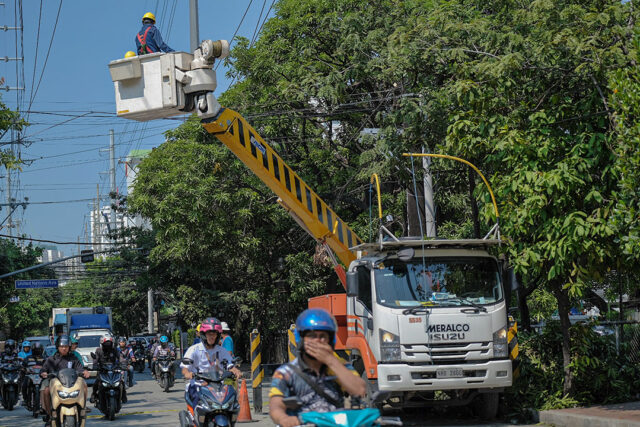
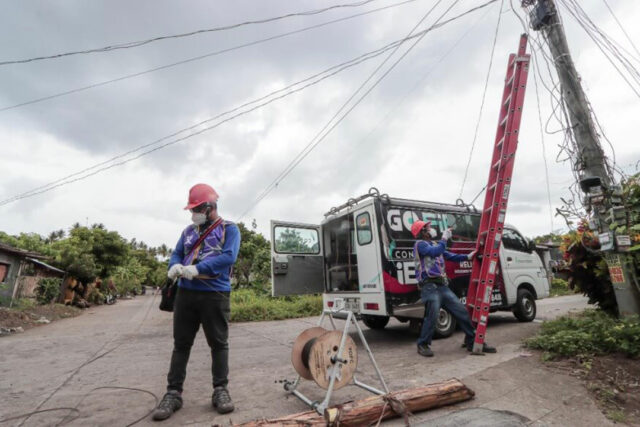
LINEMEN are at work along a street in Ermita, Manila. — PHILIPPINE STAR/RYAN BALDEMOR

TYPICAL HOUSEHOLDS in areas served by Manila Electric Co. (Meralco) can expect higher electricity bills this month as the power distributor is set to hike rates by P0.2639 per kilowatt-hour (kWh) due to higher transmission charge and feed-in tariff allowance (FIT-All).

The upward adjustment pushed the overall rate to P12.2901 per kWh in March from P12.0262 per kWh in February, the company said in a statement on Tuesday.

Households consuming 200 kWh will see their monthly electricity bills go up by around P53. Those consuming 300 kWh, 400 kWh, and 500 kWh will have to pay an additional P79, P106, and P132, respectively.

Meralco attributed the rate increase to the conclusion of the one-time refund on regulatory reset fee, equivalent to P0.2264 per kWh for its customers. The refund was implemented last month as ordered by the Energy Regulatory Commission (ERC).

Also contributing to higher rates was the P0.1294 per kWh increase in transmission charge due to higher ancillary service charges incurred by the National Grid Corp. of the Philippines. The transmission charge for March also covered the second of three monthly collections for the recovery of costs of reserve market suppliers.

The ERC directed the recovery of the remaining 70% of the reserve market settlement fees incurred in March last year. This will be reflected in customers’ bills until April.

Adding to the upward adjustment was the implementation of the new FIT-All rate of P0.1189 per kWh, which was higher than the previous rate of P0.0838 per kWh.

The FIT-All is a uniform charge billed to all on-grid electricity consumers to support the development and promotion of renewable energy.

Other charges, which included taxes, increased by P0.0416 per kWh.

“Such increases were mitigated by the lower generation charge for February supply month that impacted the March billings of Meralco customers. The reduction is almost 17 centavos per kWh in generation charge,” Joe R. Zaldarriaga, Meralco vice-president and head of corporate communications, said in Filipino during a briefing.

The generation charge fell by P0.1686 per kWh to P7.0517 from P7.2203 per kWh last month due to lower costs from Meralco’s supply sources.

The peso appreciation against the US dollar pushed down the charges from independent power producers (IPP) and power supply agreements (PSA) to P1.0143 per kWh and P0.2934 per kWh, respectively. Around 98% of IPP costs and 61% of PSA costs were dollar-denominated.

The peso closed at P57.995 on Feb. 28, strengthening by 37 centavos from its P58.365 finish on Jan. 31.

Charges in the Wholesale Electricity Spot Market (WESM), the trading floor of electricity, decreased by P0.2247 per kWh due to the improved supply situation in Luzon.

IPPs, PSAs, and WESM accounted for 31%, 47%, and 22% respectively of the company’s total energy requirement for the period.

“Pass-through charges for generation and transmission are paid by Meralco to the power suppliers and the grid operator, respectively; while taxes, universal charges, and FIT-All are all remitted to the government,” Meralco said.

The company’s distribution charge has not moved at P0.0360 per kWh since August 2022.

Lawrence S. Fernandez, Meralco vice-president and head of utility economics, said prices at the spot market might shoot up after the declaration of a yellow alert over the Luzon grid last week. 

“Let’s see what will happen for the rest of the month. Demand has moderated a bit after that one time of yellow alert. So, we’ll have to see what the situation will be for the rest of the month,” he said.

Meanwhile, Mr. Zaldarriaga said Meralco’s energy requirements are fully covered by its suppliers as the summer season approaches.

“We entered into an emergency power supply agreement to cover our requirements, especially during peak load come the summer months. Although it has not been officially declared, we already feel the impact of the temperature levels on our demand,” he said.

“So, as long as there will be no unplanned and forced outages from the plants and as long as transmission will be able to supply the load coming from the power plants, we don’t see any problems come the summer months,” he added.

Meralco’s controlling stakeholder, Beacon Electric Asset Holdings, Inc., is partly owned by PLDT Inc. Hastings Holdings, Inc., a unit of PLDT Beneficial Trust Fund subsidiary MediaQuest Holdings, Inc., has an interest in BusinessWorld through the Philippine Star Group, which it controls. — Sheldeen Joy Talavera

Scaling new heights in real estate investments

RCR continues to create value for shareholders through a massive infusion and steady occupancy of assets.

When RL Commercial REIT, Inc. (RCR) entered the market in September 2021, the real estate sector was grappling with the aftermath of COVID-19. The pandemic shook investor confidence, and demand for office spaces declined. Yet, RCR defied expectations.

Incorporated in 1988 as Robinsons Realty and Management Corporation, the company was renamed as RL Commercial REIT, Inc. before going public in 2021. RCR’s public offering raised approximately P23.5 billion, the largest REIT initial public offering (IPO) in the Philippines by far.

At the time of its listing, RCR’s portfolio includes 14 prime office assets. These include the 1. Tera and 2. Exxa-Zeta Towers in Quezon City, 3. Robinsons Equitable Tower, 4. Robinsons Cyberscape Alpha, and 5. Robinsons Cyberscape Beta in Pasig City, 6. Robinsons Cybergate Center 2 and 7. Robinsons Cybergate Center 3 in Mandaluyong City, 8. Robinsons Summit Center in Makati City, and 9. Cyber Sigma in Taguig City. The other office properties were 10. Robinsons Luisita BTS 1 in Tarlac City, 11. Robinsons Cybergate Naga in Naga City, 12. Robinsons Galleria Cebu and 13. Robinsons Cybergate Cebu in Cebu City, and 14. Robinsons Cybergate Delta 1 in Davao City.

Since then, it has significantly expanded its size and reach. In 2022, it added two properties in less than 18 months (ahead of its commitment per REIT Plan), followed by a major infusion in 2024 when it infused 13 additional properties.

RCR diversified beyond office spaces. Initially focused on office spaces, the company’s portfolio now includes 17 office properties and 12 malls across 18 key locations in the Philippines. This expansion brought its total assets to 29, with a strong occupancy rate of 96% as of December 2024.

Stability and sustainability

The growth trajectory of RCR hinges on an Investment Criteria. In determining future investment to expand RCR’s portfolio, the asset to be acquired or infused has to be yield-accretive, has three-year profitability history, has stable occupancy, has to be in a key location and accessible at the same time, has to have a healthy tenant mix (for offices, BPOs are key while for malls, retail affiliates and strong and expanding retail concepts are important), and to extent available, PEZA Registration is an advantage. Such factors ensure that any new asset infusion strengthens the company’s financial standing and enhances value for the shareholders.

RCR executed a landmark asset infusion in 2024. The 13 multi-asset infusion valued at P33.92 billion has been the largest single infusion done by any Philippine REIT company so far. The injection of the mall assets positioned RCR to become a multi-asset class REIT not only limited to offices. The variable rent structure of the malls signifies a potential upside to its current revenue. The malls are considered to be one of the stable real estate classes backed by high consumer spending.

RCR’s strengths also include stable occupancy rates. Both office segment and mall segment had steady occupancy rate of 96% as of December 2024. RCR’s tenant mix is primarily BPO for office segment and Retail Affiliates for its mall segment.

Strong investment option

RCR continues to establish itself as a stable and lucrative investment vehicle with consistently high dividend yields, a growing asset portfolio, and a track record of share price appreciation.

Investing in RCR gives opportunities for those looking for better returns than conventional money market instruments. Typically, a money market investment offers a return of around 6% per year. In contrast, RCR provides dividend yield of approximately 6.67% to 7.10%, making it a more profitable alternative. Dividend yield assumes a share price of P6.00 and following the total dividends per share declared by RCR for CY2024 totaling to P0.4001 without special cash dividends and P0.4261 including the P0.0260 special cash dividends. For instance, an investor who places P100,000 in a money market fund might earn P6,000 annually. Investing the same amount in RCR yields approximately P6,670 to P7,100 in dividends. RCR’s share price has also shown upward momentum, increasing from P5.85 (as of Dec. 27, 2024) to P6.20 (as of Feb. 28, 2025).

If one is an investor of RCR since it went public in 2021, the change in share price, as well as the total dividend earnings to date, results in an overall investment growth of more than 15% — a significantly higher return compared to traditional fixed-income instruments.

Ensuring consistent dividend yields and long-term growth for investors, RCR combines rental revenue, asset appreciation, and sustainability for a winning investment strategy.

Continued growth

In just three years, the company has doubled its total gross leasable area (GLA) from approximately 425,000 square meters (sq.m.) to approximately 828,000 sq.m. This expansion ensures continued profitability for investors, aligning with RCR’s strategy to increase revenue-generating assets.

RCR’s market capitalization is around P97 billion as of Feb. 28, 2025, higher than the P64-billion market capitalization when it listed last Sept. 14, 2021.

RCR is continuously to be on the lookout for potential assets for acquisition. RCR’s Sponsor, RLC alone, currently has more than 1.3 million sq.m. of mall GLA, more than 250 thousand sq.m. office GLA, almost 300 thousand sq.m. of logistics and industrial facilities GLA, and approximately 4 thousand hotel room keys remaining for infusion. Aside from these, RCR is also on the watch for assets from third parties.


Spotlight is BusinessWorld’s sponsored section that allows advertisers to amplify their brand and connect with BusinessWorld’s audience by publishing their stories on the BusinessWorld Web site. For more information, send an email to online@bworldonline.com.

Join us on Viber at https://bit.ly/3hv6bLA to get more updates and subscribe to BusinessWorld’s titles and get exclusive content through www.bworld-x.com.

Conglomerates to see stable earnings this year, say analysts

PHILIPPINE STAR/MIGUEL DE GUZMAN

By Revin Mikhael D. Ochave, Reporter

PHILIPPINE CONGLOMERATES are projected to maintain stable earnings or achieve modest growth this year, as certain business segments face challenges from economic headwinds, according to analysts.   

The real estate businesses of conglomerates could weigh on overall profitability, AP Securities, Inc. Research Head Alfred Benjamin R. Garcia said in a Viber message.   

“Most of the conglomerates have property development units, and this could drag on profits this year. Persistently high interest rates would also keep interest expenses elevated, further impacting the bottom line of conglomerates and possibly limiting their fund-raising,” he said.   

“Overall, our conglomerates have proven to be resilient, so even if it’s unlikely that we’ll see remarkable growth this year, their earnings should at least be stable,” he added.   

Luna Securities, Inc. Research Officer and Market Strategist Annika Gabrielle S. Angeles said conglomerates are expected to post moderate growth as they could benefit from possible interest rate cuts.   

“While we expect these conglomerates to plod along with moderate growth, a half-percentage-point rate cut and improved consumer sentiment could provide a boost,” she said in a Viber message.   

“Profit growth will continue to be difficult because of property, debt, interest rate effects, and shifting consumer habits,” she added.   

The Philippine central bank unexpectedly kept rates steady last month after cutting rates for three consecutive meetings last year. Its next rate-setting meeting is on April 3.   

Ms. Angeles said the ongoing surplus in the property market could dampen demand, hampering the performance of conglomerates’ real estate units.   

“The property market is currently facing a significant surplus, particularly in Metro Manila, where most portfolios are concentrated. Property developers may see a decline in demand and price pressure as a result of this excess,” she said.   

Sy-led conglomerate SM Investments Corp. recorded a 7% increase in its 2024 net income to P82.6 billion, as consolidated revenue rose by 6% to P654.8 billion, driven by stronger banking and property segments.   

Lucio C. Tan-led LT Group, Inc. likewise grew its attributable net income by 14% to P28.92 billion in 2024, as revenue climbed by 11.9% to P129 billion, led by its banking and tobacco businesses.   

On the other hand, Aboitiz Equity Ventures, Inc. reported a 23% decline in its 2024 net income to P18.1 billion after an asset impairment and a weak fourth quarter.   

“In general, it should be better, especially for those conglomerates focused on banking and consumer businesses, because the outlook for economic growth is better this year due to lower inflation and interest rates,” COL Financial Group, Inc. Chief Equity Strategist April Lynn Lee-Tan said in a Viber message.   

Other conglomerates, such as Ayala Corp., Ang-led San Miguel Corp., Gokongwei-led JG Summit Holdings, Inc., Andrew L. Tan-led Alliance Global Group, Inc., Gotianun-led Filinvest Development Corp., and Ty-led GT Capital Holdings, Inc., have yet to disclose their 2024 financial reports.   

“The country’s biggest conglomerates recently posted new record-high earnings, with growth rates outpacing gross domestic product (GDP) growth, which could fundamentally support market valuations, especially if market conditions improve,” Rizal Commercial Banking Corp. Chief Economist Michael L. Ricafort said in a Viber message.   

“Continued benign inflation amid faster Philippine GDP growth — among the fastest in ASEAN and Asia — would lead to further growth in sales and earnings, fundamentally supported by the country’s favorable demographics,” he added.

Maynilad says it poured P25.75B into water infra in 2024

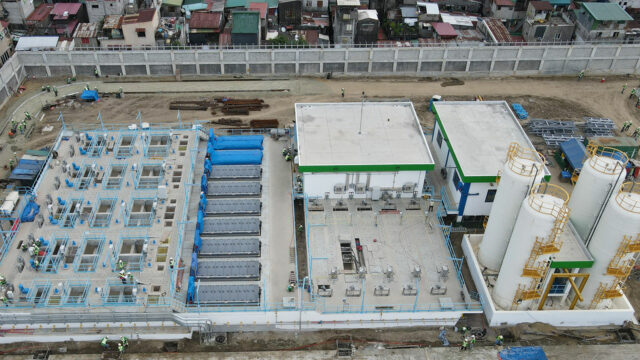
THE CAMANA WATER Reclamation Facility in Maypajo, Caloocan City. — BW FILE PHOTO

MAYNILAD Water Services Inc. said Tuesday that it spent P25.75 billion in 2024 to upgrade water and wastewater infrastructure.

“These infrastructure investments reflect our commitment to delivering safe and reliable water services while ensuring long-term sustainability amid growing demand and climate challenges,” Maynilad President and Chief Executive Officer Ramoncito S. Fernandez said in a media release.

“We remain focused on strengthening our operations and expanding access to clean water and sanitation for our customers,” he added.

The actual figure was lower than the P31 billion Maynilad had initially earmarked for the year.

Of the total capex, the company allocated P7 billion to improving the sewerage system, including constructing and upgrading wastewater facilities. Among these projects is the ongoing construction of water reclamation facilities in Caloocan and Las Piñas, both of which began last year.

Maynilad said it also upgraded seven wastewater treatment facilities in Muntinlupa, Pasay, Quezon City, and Manila to comply with the revised effluent standards (DAO 2021-19) of the Department of Environment and Natural Resources.

It allocated another P6 billion to its non-revenue water reduction program, which included replacing 142 kilometers of aging pipes in 2024. This initiative recovered 158 million liters of water per day, improving distribution efficiency and reducing water losses.

Additionally, Maynilad invested P6.5 billion in constructing and rehabilitating key water facilities, including the Poblacion Water Treatment Plant in Muntinlupa and the Parada Pumping Station in Valenzuela. It also expanded its pipeline network across the west zone, including laying pipelines in Morong, Rizal, in preparation for future water supply from Kaliwa Dam.

Meanwhile, P4.4 billion was allocated to developing small-scale water treatment facilities that tap alternative sources such as dams and rivers in Cavite province, ensuring a more resilient water supply.

The company also dedicated a portion of its 2024 budget to enhancing customer service and information programs.

In January, Mr. Fernandez said the company’s capex budget for 2025 could reach P30 billion or higher as it anticipates a stronger financial year.

Maynilad serves parts of Manila, Quezon City, and Makati, as well as Caloocan, Pasay, Parañaque, Las Piñas, Muntinlupa, Valenzuela, Navotas, and Malabon. It also supplies water to the cities of Cavite, Bacoor, and Imus, and the towns of Kawit, Noveleta, and Rosario in Cavite province.

Metro Pacific Investments Corp., which holds a majority stake in Maynilad, is one of three Philippine units of Hong Kong-based First Pacific Co. Ltd., alongside Philex Mining Corp. and PLDT Inc.

Hastings Holdings, Inc., a unit of PLDT Beneficial Trust Fund subsidiary MediaQuest Holdings, Inc., has an interest in BusinessWorld through the Philippine Star Group, which it controls. — Sheldeen Joy Talavera

Lost and found

EIGHT of the Lost Conversations cassette tapes

Writer Cid Reyes donates tapes of artist interviews to National Museum

AUTHOR, curator, and art critic Cid Reyes has turned over cassette tapes of conversations with late renowned Filipino visual artists to the National Museum of the Philippines. As part of a museum project, the contents of the tapes are now available on YouTube.

The one-on-one interviews, some from 50 years ago, include conversations with National Artists Victorio Edades, Vicente Manansala, Hernando R. Ocampo, Napoleon Abueva, Arturo Luz, Jose Joya, and Ang Kiukok. Other renowned artists on the tapes are Anita Magsaysay-Ho, Mauro “Malang” Santos, Nena Saguil, Juvenal Sanso, and Pacita Abad.

“Lost Conversations,” an event held on March 7 at the National Museum of Fine Arts, formalized the turnover of the materials. It also marked the launch of ArticulatePH, a YouTube channel dedicated to the preservation of the oral history of Filipino visual art, where some of the digitized interviews have been uploaded for public access.

Mr. Reyes, who previously used many of these tapes as source material for his book Conversations on Philippine Art, published in 1989, told the press at the launch that documentation is just as important as the works themselves.

“I have always expressed my disappointment in having missed conversing with Fernando Amorsolo and Botong Francisco. I was able to talk to Professor Edades and that was really the start of this compilation,” he said.

He also explained that digitizing the interviews and putting them on social media through ArticulatePH is vital, as it is “the instrument for communication, for connecting, where there are interactions and contact with the global.”

“Even though we have what you call written history, written by historians after the fact, oral history which is history being lived at every moment, is history, as we say, straight from the artist’s mouth,” Mr. Reyes explained.

At the sidelines of the launch of “Lost Conversations,” the National Museum’s deputy director-general for museums Jorell Legaspi told BusinessWorld how meticulous the turnover process of the physical cassettes will be.

“It’s important for us to have a sit-down with Cid Reyes because, of course, he was a custodian of these tapes for such a long time. For us to continue that work is a very big responsibility because this is such a treasure trove of information,” Mr. Legaspi said.

He added that the tape’s previous storage conditions will inform the “short-term interventions” that the museum will have to do, under their dedicated conservation lab.

In attendance at the launch were officials from the Museum Foundation of the Philippines and heirs of some of the artists whose voices are on the tapes, such as Khristina Manansala and Diwa Abueva. The two granddaughters of National Artists, who are now artists themselves, praised the ongoing “efforts in preserving history for the future generations.”

The event also coincided with Mr. Edades’ 40th death anniversary. With this, Mr. Reyes shared an anecdote of going to Davao where Mr. Edades had retired in the 1970s.

“I was sent by my advertising agency to Davao. It was my opportunity. I looked for Professor Edades, not knowing where he lived. I asked a tricycle driver if he knew and, by some miracle, that driver changed the history of Philippine art and said yes!” Mr. Reyes said.

Their conversation that evening lasted six hours, from 6 p.m. until midnight, then Mr. Edades invited him to come back the next day. “So I came back and brought four cassette tapes. That started it all.”

As for the goal of having the recordings uploaded on ArticulatePH, Mr. Reyes said, “I want young artists to realize the real tradition that has been handed down to them. The value of oral history cannot be underestimated.”

The compilation of “Lost Conversations” is now available via https://www.youtube.com/@articulateph. — Brontë H. Lacsamana

Ayala Land Hospitality targets 8,000 rooms by 2030

Seda Hotels — AYALALAND.COM

AYALA LAND HOSPITALITY (ALH) said it plans to invest $500 million (around P28.63 billion) over the next five years to double its hotel room capacity to 8,000 by 2030, according to its chief executive officer (CEO).   

“We will nearly double the size of our portfolio, close to 8,000 rooms by 2030,” George I. Aquino, president and CEO of Ayala Land Hospitality, said during a briefing on Tuesday.   

“Our capex investment in the next five years is $500 million, and I think what we plan to do is really a combination of different types of hotels, expanding on our homegrown products, but also looking at other brands,” he added.   

ALH, the hospitality arm of property giant Ayala Land, Inc. (ALI), has over 4,000 rooms across its homegrown brands, including Seda Hotels, El Nido Resorts, and Huni Lio, as well as international luxury brands such as Raffles Makati, Fairmont Makati, and the upcoming Mandarin Oriental Makati.   

“In terms of financing, it’s a mix of debt and equity. It’s been a very profitable business line for us, so depending on where we see things over the next few months, but it’s locked in our capex,” ALI Senior Vice-President and Leasing and Hospitality Group Head Mariana Zobel de Ayala told the briefing.   

“[Our] first priority would be where we could add value to our estates, but the second priority is looking at areas where there are direct international flights,” Ms. Zobel de Ayala said.   

The Philippine government is targeting 12 million tourist arrivals by 2028. In 2024, the country welcomed 5.95 million foreign visitors, up 9.15% from 5.45 million in 2023, data from the Department of Tourism showed.   

While ALH is optimistic about the privatization of Ninoy Aquino International Airport, it is also banking on foreign tourist arrivals at airports in Mactan, Cebu, and Clark, to drive more visitors, Ms. Zobel de Ayala said

The company is also considering launching a new brand focused on a “mountain outdoor experience,” according to Ms. Zobel de Ayala.   

“Similarly, we’re working on a product in Mactan, Cebu — a five-star, Filipino-anchored hotel, which again, is more of a beach location,” she said.   

ALH is also planning to renovate Huni Lio Resort in El Nido, Palawan, and build a bar adjacent to the property.   

“Our idea is to then take it to other beach destinations, tourism destinations, and even the city,” ALH Creative Director Paloma Urquijo Zobel de Ayala said.   

In 2024, ALI recorded a 15% increase in net income, reaching P28.2 billion from P24.5 billion in 2023, driven by record-high revenue. — Beatriz Marie D. Cruz

Serious coin for coins

FOUR QUARTOS, 1835

A CEDULA (tax certificate) from the Philippine revolution of 1896, a 1766 Barilla coin minted in Manila, a four-real Mexican coin from the 19th century, and an eight-real coin from the short-lived Iturbide Empire brought excitement to The Westin Manila during Minted MNL’s Summer Show and Auction.

BusinessWorld visited the numismatics (the study of currency and medals) show on March 8, where collectors brought out their wares, including medals, coins from almost every era in the Philippines and globally, and memorabilia from times past: this included a collection of 1900s cigarette wrappers from the Philippines, another seller brought watches.

While this was Minted MNL’s second year to hold shows (last year had the Summer Show and the year ending show in November), the highlight of the day was the auction which was held both live and online, with buyers sending in their bids through the Moreton auction platform. Some of the buyers, though bidding online, were nearby: there were loud whoops heard from the exhibition section of the ballroom when the Isabel II four-real coin sold for $41,000. The most expensive item sold that day was the eight-real coin from the Iturbide Empire of Mexico, the first independent government of Mexico, which existed only between 1821 to 1823. This coin sold for $72,500. Yes, dollars.

Last year’s summer show attracted 1,500 visitors — this year’s drew about 3,000. We noted a number of foreign guests, which Minted MNL founder Sigrid Carandang pointed out was due to the rare coins to be found in the Philippines: more than our own money, colonizer and occupying forces left their own currencies here, besides printing unique bills and minting unique coins to manage a piece of the empire. These include rare pieces from the Spanish Empire, the US, and the Japanese Empire; not to mention money from our Asian neighbors.

“We want to make sure that Minted MNL is not just a platform, but a gateway to the world — in terms of the passion for the arts, the hobby of collecting, and learning more about history and the preservation of it,” said Ms. Carandang during a group interview.

The company was founded in 2016, and is positioning itself as an auction house especially for numismatics. A fan of local auction houses Salcedo Auctions and Leon Gallery, Ms. Carandang notes that their specializations are in art, and Minted is trying to carve a niche of its own. That said, while she says those auctioneers are at par with global standards, she notes that the Philippine market for numismatics needs to step up. Having attended coin shows like the Hong Kong Coin Show and the ones in Orlando and New York, she said, “We’re far behind.”

The historical items (such as the aforementioned cedula) either come from the collection of antiquarian Melvin Lam (as mentioned in the catalog) or are authenticated by him. Mr. Lam has done authentication work for both Salcedo Auctions and Leon Gallery, the National Museum of the Philippines, and has exhibited part of his collection at the Ortigas Foundation Library.

As for the coins, Minted’s focus, these are authenticated by the coin-grading body Professional Coin Grading Service and the Certified Collectibles Group through their Asia offices in Hong Kong.

“We buy items not just because it’s rare, or it’s a gold or silver coin. We buy items because of the story and the historical significance,” said Ms. Carandang.

For more information, visit mintedmnl.com. — Joseph L. Garcia

Converge tops Ookla’s 2024 fixed network speed rankings in PHL

CONVERGE ICT

LISTED fiber internet provider Converge ICT Solutions, Inc. was recognized by Ookla, a global network intelligence and connectivity insights firm, as the fastest fixed network provider for 2024.

“We’ve gone from a change of guard to setting new standards, proving that excellence isn’t just about winning once — it’s about consistently delivering for our customers,” Converge Chief Operating Officer Jesus C. Romero said in a media release on Tuesday.

In the second half of 2024, Converge recorded a speed score of 144.81, ahead of its competitors, the company said.   

Ookla data showed PLDT Inc.’s Home Fiber had a speed score of 116.32, followed by Globe Telecom, Inc. at 109.08 and PLDT at 92.06.   

Converge was identified as the fastest fixed network, logging a download speed of 561.51 megabits per second (Mbps) and an upload speed of 509.08 Mbps.   

It also recorded a video score of 78.17 and a game score of 83.06.   

Converge posted an overall connectivity score of 76.13, while PLDT Home Fiber recorded 73.10, Globe had 70.55, and PLDT logged 68.73.   

Ookla said Converge was also the fastest internet provider in the first half of 2024, with a speed score of 147.77.   

Converge said it aims to maintain high-speed connectivity with the introduction of Super FiberX, featuring Wi-Fi 6 technology for broader coverage. — Ashley Erika O. Jose

A chilling stage adaptation of Kisapmata

How stories reflecting our history evolve over time

By Brontë H. Lacsamana, Reporter

Theater Review
Kisapmata
Presented by Tanghalang Pilipino

IN 1981, one of the best Filipino films ever made captured people’s imaginations. Kisapmata, directed by Mike de Leon and co-written with Clodualdo del Mundo, Jr. and Raquel Villavicencio, disturbed audiences with its twisted premise of a possessive patriarch unwilling to free his daughter from the tyrannical rule of his household.

Though it was based on a real-life crime story by Nick Joaquin called “The House on Zapote Street,” the film reshaped the narrative into a representation of the then ongoing Marcos dictatorship. This year, theater company Tanghalang Pilipino brings Kisapmata to modern audiences, now upfront in grappling with a history at risk of being forgotten.

Within the first few minutes, playwright Guelan Luarca immediately sets the adaptation apart from all versions that preceded it. It opens with Dely (played by Lhorvie Nuevo), the wife numbed to submission from years of living under the iron fist of her husband, ex-policeman Dadong. In neither the Nick Joaquin story nor the film does her character have a voice, but she does here.

The setting of Zapote Street (described by Joaquin in the original story as a residential area in Makati which was once an empty field of tall grass) provides the atmospheric, eerie overtones of the play. Dely opens with retelling how the area was once a silent overgrowth, now taken over by humans, though the grass (or talahiban) remains in the shadows. The elevated platform where the characters move is backgrounded and surrounded by stalks of this grass — the only design element present on the bare stage.

Pagmamahal ang batas (Love is the rule),” Dely whispers many times throughout the play. And this so-called love is enforced only by Dadong (played by Jonathan Tadioan) as he abuses his wife and daughter psychologically.

Compared to the film before it, Tanghalang Pilipino’s Kisapmata leans into the ridiculous yet chilling dynamics of the family’s suffocating household.

The story kicks off when the couple’s only daughter, a medical student named Mila (played by Toni Go), reveals that she is pregnant by her boyfriend Noel (played by Marco Viana). The latter, already a doctor, has been helping her study for her medical board exam. The two ask for permission to marry, though Dadong only agrees on the condition that a dowry is paid — and later, that they do not move out of his house.

One of the points of acclaim for the 1981 film was the production design (recognized at the 7th Metro Manila Film Festival, along with a plethora of major awards), due to the use of the split-level suburban architecture that made the house a perfect instrument for the family’s dysfunctional story. It was also an element described explicitly in Mr. Joaquin’s story, as it was a prevailing style for middle-class families.

The play goes for something completely different. It evokes the rigid rules of the house with a minimalist approach, the square elevated platform the actors move on never changing, no matter where the characters go. Be it indoors, outdoors, the hospital, right at the gate — the four walls of the house are always present.

No other actors appear in its entirety. It is only Mila, Noel, Dadong, and Dely, even if they speak to others on the phone or walk past people in a given scene. No matter where they go or what they do, the house and its unforgiving rules remain. The costumes also evoke this, all of them dressed in beige as if prisoners of their own making.

At the CCP Complex’s Tanghalang Ignacio Gimenez, Kisapmata plays out as a full tragedy, the unease, grace, and defiance in the movements of Toni Go as Mila giving the audience someone to root for. She shines in hopelessness as much as she does in the steadfast attempts to escape the grasp of her father, along with Marco Viana as Noel who gradually becomes desperate to free himself from the household’s intangible prison.

Wholly original, the scenes between mother and daughter are electric, the two women representing separate generations of submission, one who has accepted her doom and another who will fight it to the very end.

Meanwhile, Jonathan Tadioan’s take on the merciless Dadong is trickier to receive by those who’ve watched the film with its enormous performance by Vic Silayan. Tadioan puts his own spin on it, his voice softer and wheezier and his mannerisms more jovial compared to Silayan’s booming presence. But when his quiet, bodily presence is used to full advantage, usually when the character loses his cool, the effect is just as chilling.

The gradual rise of tension and escalation of intimidation tactics used by Dadong carry over strongly to the medium of theater. The anti-Marcos allegory reaches its peak when, in the throes of the character’s physical and sexual abuse of Dely, the screens around the hall flash with news clippings and reels of the oppression suffered during the Marcos dictatorship.

At this point, Nuervo’s haunting, whispery narration and commentary of events is given full context by the horrific beating she endures, similar to that of the Philippines during Martial Law. Creepily, the only props shown in any of the characters’ hands throughout the play are Dadong’s weapons — a gun and a machete — the rest merely pantomimed by the cast, driving home the reality of his rule over them.

The way everything boils over in the end is as impeccably paced as the film and the short story before it. Luarca’s take on Kisapmata also benefits from its tight running time of an hour and a half, with no intermission, leaving the audience barely any time to breathe.

It’s amazing to see a story’s journey from an actual true crime case to a well-written short story by Nick Joaquin, to the horror masterpiece by Mike de Leon, all the way to this gripping theater adaptation by Guelan Luarca. It reminds me of something Ricky Lee once said of the greatest stories in Philippine literature/cinema/theater — palagi iyan manganganak basta’t may dahilan para ikuwento pa rin ang kuwento (it will continue being reborn as long as there is still a reason to tell that story).

Tanghalang Pilipino proves that there are still many reasons to retell Kisapmata today.

Kisapmata runs until March 30 at the Tanghalang Ignacio Gimenez, Cultural Center of the Philippines Complex, Pasay City. It is restricted to audience members 16 years old and above. Regular tickets cost P1,500 while VIP tickets cost P2,000. For more details, visit Tanghalang Pilipino’s social media pages.

BTr fully awards reissued bonds

BW FILE PHOTO

THE GOVERNMENT made a full award of the reissued Treasury bonds (T-bonds) it offered on Tuesday as the papers attracted strong demand amid better risk sentiment and after Bangko Sentral ng Pilipinas (BSP) Governor Eli M. Remolona, Jr. signaled a possible rate cut next month.

The Bureau of the Treasury (BTr) raised P30 billion as planned via the reissued 10-year bonds it auctioned off on Tuesday as total bids reached P81.761 billion or almost thrice as much as the amount on offer.

The bonds, which have a remaining life of seven years and six months, were awarded at an average rate of 6.143%. Accepted bid yields ranged from 6.12% to 6.15%.

“With its decision, the Committee initially raised the full program of P30 billion while accepting further subscription through the tap facility. The total outstanding volume for the series is currently at P358.6 billion,” the Treasury said in a statement.

The average rate of the reissued papers was 17.5 basis points (bps) higher than the 5.968% fetched for the series’ last award on Feb. 11, but 60.7 bps lower than the 6.75% coupon for the issue.

This was also 4.7 bps above the 6.096% quoted for the seven-year bond — the benchmark tenor closest to the remaining life of the papers on offer — but 3 bps lower than the 6.173% seen for the same bond series at the secondary market before Tuesday’s auction, based on PHP Bloomberg Valuation Service Reference Rates data provided by the BTr.

“Strong demand was seen following the drop in US Treasury yields overnight. This morning, BSP Governor Remolona also said a cut is on the table for the April 10 Monetary Board meeting, adding to improvement in risk sentiment,” a trader said in a text message.

Stocks slumped globally on Monday, while US bond yields dropped as investor worries about the potential economic slowdown were exacerbated after President Donald J. Trump did not rule out a recession resulting from his tariffs, Reuters reported.

MSCI’s global stock index fell more than 2% for its biggest one-day drop since August while Nasdaq led Wall Street losses, ending down 4% for its steepest percentage loss since Sept 2022.

Investors had started seeking safety as early as Sunday when Mr. Trump in a Fox News interview talked about a “period of transition” while declining to predict whether his tariffs on China, Canada and Mexico would result in a US recession.

MSCI’s gauge of stocks across the globe fell 19.37 points or 2.27% to 832.73 after touching its lowest level since Jan. 13.

In fixed income, yields fell with US government bonds in demand after the Trump interview cut into investor confidence.

The 2-year note yield, which typically moves in step with interest rate expectations for the Federal Reserve, fell 10.4 bps to 3.898% from 4.002% late on Friday, on track for their largest daily drop since September.

The yield on benchmark US 10-year notes fell 9.3 bps to 4.225%, while the 30-year bond yield fell 6.9 bps to 4.548%.

Meanwhile, Mr. Remolona on Tuesday said a rate cut is “on the table” at the Monetary Board’s policy meeting next month, which has been rescheduled to April 10 from April 3 previously.

He added that the BSP is still on easing mode and expects to slash benchmark borrowing costs by “a few more times” this year.

In a move that surprised the market, the Monetary Board in February paused its nascent rate-cut cycle, which Mr. Remolona said was a “prudent” move amid uncertainty over the trade policies of US President Donald J. Trump and their potential impact on the Philippines.

He earlier said that the central bank will likely continue reducing interest rates by 25 bps at a time, with 50 bps in cuts still on the table this year.

The BSP last year cut benchmark rates by a total of 75 bps via three consecutive 25-bp reductions since it began its easing cycle in August, bringing the policy rate to 5.75%.

The BTr is looking to raise P147 billion from the domestic market this month, or P22 billion from Treasury bills and P125 billion from T-bonds.

The government borrows from local and foreign sources to help fund its budget deficit, which is capped at P1.54 trillion or 5.3% of gross domestic product this year. — A.M.C. Sy with Reuters

Throwing the baby out with the bathwater: Successful USAID-backed projects

JUDE BALLADO-PEXELS

(Part 2)

It is well known that a major obstacle to faster growth and, more importantly, a more equitable distribution of income wealth in the Philippines is the concentration of economic activities in the National Capital Region, which accounts for 40% of GDP. One reason for the very high poverty incidence in the country, which remains at double-digit rates of 16% to 23% (in contrast with single-digit rates among our peers in the ASEAN, e.g., Malaysia which has a poverty incidence that is close to zero), is the utter neglect of rural or countryside development. A very practical program which had been heavily funded by the United States Agency for International Development (USAID) over more than a decade was the Urban Connect project, whose goal was to promote inclusive and resilient economic growth in nine secondary cities within the USAID City Development Initiative framework. The idea was to make these nine secondary urban centers stimulants of growth and development of the rural territories surrounding them. These prospective regional centers of countryside development were Batangas, Iloilo, Cagayan de Oro, Zamboanga, Tagbilaran, Tacloban, Puerto Princesa, General Santos, and Legaspi.

Urban Connect focuses on local economic development and public service delivery. It promotes programs and activities related to investment promotion, the development of Medium Scale, Small and Micro Enterprises (MSMEs) with a focus on digitalization, inter-LGU cooperation, improved public financial system and revenue enhancement measures as well as the establishment of LGU data centers.

I have seen with my own eyes the success stories of the first three secondary cities chosen by the project: Batangas in Luzon, Iloilo in the Visayas, and Cagayan de Oro in Mindanao. The consultants that worked on these first three cities identified them as potential competitors to Metro Manila as domestic, regional, and international ports. They are better located and are much less congested than the port city of Manila. Because of the data provided by the consultants for this initial project, the LGUs and private investors were able to agree on relocating investments that were previously planned for the Metro Manila area. This was especially phenomenal in the case of Iloilo City, which has become an alternative location site for BPO-IT, real estate enterprise, logistics companies, and agribusiness investments in place of Cebu in the Visayas. Like Metro Manila, Cebu is overly congested, and the traffic has reached intolerable proportions.

I have seen a similar phenomenon in my home province, Batangas. Thanks to some of the data provided by the Urban Connect project (and the pro-active leadership of the LGU of the Province), this province, which is part of the Calabarzon region, is turning to be the epicenter of a new metropolitan area with Lipa City as the strategic center. Practically all the major real estate players in the country have constructed industrial economic zones with hundreds of manufacturing enterprises (the pioneer was the Lopez-owned First Philippine Holdings in Sto. Tomas, Batangas).

As a public disclosure, let me state that both my parents were born in Sto. Tomas, Batangas. When I was in high school in the 1950s, it was the sleepiest town in the province. Thanks to all the developments in the last 20 years in the province, even this laid-back town has become so highly urbanized that it now boasts of one of the largest SM Malls in the entire Calabarzon. The Ayalas are developing another Makati in the City of Lipa.

Thanks to the help that USAID extended to these regions through Urban Connect, regional development is no longer just an aspiration but is very real. I expect the same thing to happen in Cagayan de Oro and the other regional centers that have been chosen by the Urban Connect project. I can assure US President Donald Trump that the officials of USAID who conceived of and promoted this project were not “lunatics.”

Then there was the program called Better Access and Connectivity (Beacon). A five-year program that was launched in 2021, Beacon aimed to promote economic growth through better information and communications technology (ICT), helping bridge the digital divide in the Philippines. The COVID-19 pandemic had highlighted the urgent need for expanded digital infrastructure and broadband connectivity. Through Beacon, USAID aimed to help improve the Philippines’ ICT and logistics infrastructure; strengthen the regulatory, business, and innovation environment; and bolster cybersecurity. To help bridge the digital divide in the Philippines, Beacon intended to assist the government in automation and digitization efforts, and support community networks to expand low-cost internet access for underserved communities.

Beacon would have been a perfect complement for the US private business sector to help our country be a leading site for data centers. There is an under-ocean cable that Meta and Amazon have built connecting the US to Pagudpud in Ilocos Norte. Another site endowed with better telecom connections is Baler, Aurora Province. The city that will be especially attractive to those investing in data centers, which are very energy and internet intensive, is Laoag, Ilocos Norte. The region was a pioneer in both solar and wind energy. It has at present an excess production of energy that it is forced to sell to the national grid at a loss. Now that the region also has abundant telecom resources, Laoag can attract investors in data centers and other telecom and energy intensive businesses, in addition to its being a natural destination for tourists from Taiwan and China.

We should also be grateful to US billionaire Elon Musk, who is the head of the Department of Government Efficiency or DOGE under the Trump Administration, for building Starlink satellite facilities in many of our isolated islands.

Not satisfied with its laudable efforts to disperse economic activities to the regions outside of Metro Manila through its Urban Connect project, USAID launched the Cities for Enhanced Governance and Engagement (Change) which sought to strengthen democratic governance in the Philippine by making local governance more responsive to the needs of their constituents. It purported to strengthen the enabling environment for decentralization and governance and building capacity for multi-sector collaboration and collective action.

In addition to the nine Urban Connect cities, the following were added to its geographic coverage: Masbate, San Fernando (La Union), Tagum, Tanjay (Negros Oriental), and Victorias (Negros Occidental). It is worth mentioning here that these efforts for improved local governance can be substantially assisted by the efforts of the Taiwanese Government and private sector to help several Philippine cities become “smart cities.”

Finally, there is the Partnership for Skills, Innovation and Life-Long Learning (Upskill), a five-year project that aims to strengthen the Philippine higher education system for broad-based, inclusive growth. This program works closely with the Commission on Higher Education (CHED) and, given the emphasis of the Marcos Jr. Administration on technical skills, with the Technical Education and Skills Development Authority or TESDA, together with stakeholders in industry in supporting innovation and workforce development of higher education institutions or HEIs, faculty development, and curriculum improvements. It will also increase engagements for HEIs and industry and international partners, as well as bring design-thinking concepts to HEI management and administration.

In this light, especially with the temporary suspension of international aid by the Trump Administration, it would be wise for both government agencies and private groups (like the Philippine Chamber of Commerce and Industry) to turn to other Governments that can supplement the initial efforts of Upskill, especially in technical education. I am referring especially to potential aid donors from Germany, Taiwan, Israel, Australia and others that have advanced technical training programs that can be replicated in the Philippines, like Dualtech in Manila (a German-inspired model) and the Center for Industrial Technology and Enterprise or CITE in Cebu (established with the help of an NGO in Italy).

These examples of projects and programs funded by USAID in the past clearly prove that the assistance we received from the US Government through this agency have benefited numerous citizens of the Philippines, especially those belonging to the lower-income groups. It is hoped that, whether USAID continues to exist as a separate agency or the US State Department takes over its functions, the Philippines will continue to benefit from the generous assistance of the American taxpayers to attaining inclusive and sustainable growth.


Bernardo M. Villegas has a Ph.D. in Economics from Harvard, is professor emeritus at the University of Asia and the Pacific, and a visiting professor at the IESE Business School in Barcelona, Spain. He was a member of the 1986 Constitutional Commission.

bernardo.villegas@uap.asia