Home Blog Page 1445

PBA champion Meralco bows to Shabab Al Ahli in Basketball Champions League in Dubai

MERALCO BOLTS — FIBA.BASKETBALL

MERALCO lost spark after taking an early 11-point lead and bowed to host Shabab Al Ahli, 87-101, at the start of the Basketball Champions League Asia Saturday night in Dubai.

The reigning PBA Philippine Cup titlists got going in the second canto of the Group B duel and unleashed a 17-2 blast to create a 54-43 separation.

But the Bolts failed to sustain the charge, allowing the Red Knights to strike back,10-2, to make it a manageable three-point contest then wrested full control with a 48-31 exchange in the final half.

Deshawndre Washington banged in 40 plus seven rebounds, six assists and four steals for Shabab, which hurt Meralco with its 10-of-18 a from deep (56%) and big advantage in points off transition, 24-14, and in the inside scoring, 50-38.

“They gave us a lot of problems. They shot the ball extremely well from the three-point line, did well in transition as well which partially was our fault,” said Meralco active consultant Nenad Vucinic.

American reinforcements Glynn Watson and Jordon Varnado netted 19 apiece to show the way for the Bolts as main man Chris Newsome produced 15 and Nigerian import John Egbunu had a 12-11 double-double.

Mr. Vucinic rued the lack of jelling between the locals and the three foreign players, who only had days to train together.

“It was difficult for us to get some cohesion because we were just joined by three players recently.  At the moment, we’re playing in the Philippines without any foreign players. We got three good players but it’s very hard to get cohesion. We’re hoping as the tournament goes that we’re going to get better.”

The Bolts would need to get in sync fast, though, as they were slated to face Japanese kingpin Utsunomiya Brex last night, barely 24 hours after the hosts, with their bid for a Last-8 spot on the line. — Olmin Leyba

The scores:

Shabab Al Ahli 101 – Washington 40, Love 22, Alshabebi 15, H. Albreiki 13, Hawley 8, Alameri 3, A. Albreiki 0, S. Alajmani 0, M. Alajmani 0, Alnuaimi 0.

Meralco 87 – Varnado 19, Watson 19, Newsome 15, Egbunu 12, Banchero 11, Almazan 5, Hodge 4, Quinto 2, Cansino 0, Black 0.

Quarterscores: 35-27; 53-56; 79-74; 101-87.

Nolasco, CSB one win away from NCAA Women’s Volleyball crown

PHILSTAR FILE PHOTO

Games on Wednesday
(Filoil EcoOil Arena)
11 a.m. — AU vs Letran (M)
2:30 p.m. — Letran vs CSB (W)

COLLEGE of St. Benilde (CSB) rode on Zam Nolasco’s brilliance as it turned back Colegio de San Juan de Letran, 26-28, 26-24, 25-16, 25-19, on Sunday to move on the cusp of completing a four-peat feat in NCAA Season 100 women’s volleyball at the Filoil EcoOil Arena.

Ms. Nolasco, an MVP candidate, cast her long shadow and unleashed 21 points including 12 on attacks and match-high seven blocks to help power the Lady Blazers to a 1-0 lead in their short but sweet best-of-three title series.

One more win in Game Two on Wednesday will seal CSB its fourth straight championship and fifth overall.

A decider, if necessary, is on Sunday.

The Lady Knights, who were eyeing their first championship in 27 years and ninth overall, appeared headed to seize the opener after snatching the first set and leading, 23-20, in the second.

But Letran faltered while CSB came roaring back to steal the set and tie the count at a set apiece.

That was all the Lady Blazers needed to dominate the last two sets while it proved to have broken the will of the Lady Knights.

Earlier, Arellano University trounced Letran, 27-25, 25-14, 22-25, 25-22, to likewise move on the verge of snaring the men’s crown.

The Chiefs, who were paced by Carl Justin Berdal’s 19 points, are eyeing their breakthrough men’s title while the Knights are hoping to force a Game Three for a crack at a 14th crown that would tie them with the University of Perpetual Help Altas as the most titled in the division. — Joey Villar

Underdogs again

The Thunder had a 97.4% chance to win with two minutes and 52 seconds left in Game One of the National Basketball Association Finals. At that time, newly minted Most Valuable Player awardee Shai Gilgeous-Alexander just made the first of two free throws that had them up by eight. And because they held the lead from opening tip, there was simply no reason for even diehard fans of the Pacers to believe an upset remained in the realm of possibility.

As things turned out, the Pacers still had more than enough fight in them to pull off yet another monumental comeback. With time winding down in the crunch, they chipped away at the deficit, first off two three-pointers sandwiching a Thunder miss, and then off two charities and a follow-up shot to counter a Gilgeous-Alexander basket. And when the latter inexplicably missed on a lightly contested turnaround jumper in the lane, the stage was set for the comeback to be completed.

Needless to say, point guard extraordinaire Tyrese Haliburton was once again responsible for the shocker. He asked for, and received, the ball in the backcourt with under seven ticks remaining, dribbled ahead from left to right, and then calmly stopped to take a midrange stab. Needless to say, leather, iron, and nylon met, giving the blue and gold their only advantage of the contest with three-tenths of a second left in the game clock. An errant lob pass by the Thunder later, he collected his fourth game winner of the 2025 Playoffs. So much for his peers supposedly voting him the most “overrated” player in the league.

How difficult was the Thunder’s veritable rise from the dead? Prior to the contest the other day, all 182 teams trailing by at least nine points heading into the final three minutes of a Finals contest dating back to 1971 wound up with a loss. Meanwhile, the Pacers made like Lazarus in front of 18,203 hostile spectators at the Paycom Center; despite the seemingly insurmountable deficit, they never doubted their capacity to prevail. And why should they have acted otherwise? They faced similarly low odds in each of the first three rounds (0.3%, 2.1%, and 4.1%, respectively), and they came out on top every single time. And the chance of them turning all of the encounters into wins? A ridiculous one in 1.5 million.

At this point, there can be no discounting Haliburton’s importance to the Pacers’ cause. In every round, he has had one result-altering shot in the last 1.1 seconds of a given match. All told, he is six of seven in shots to tie or take the lead over the last 90 seconds of a game through the current postseason to date. That said, it’s fair to argue that the clutch gene runs even in those around him; in the face of his otherwise-pedestrian numbers in Game One, only with a collective effort could they have overcome the commission of 18–yes, 18–more turnovers. Significantly, they likewise took three less free throws and 15 less attempts within four feet of the rim.

Bottom line, the Pacers know what they are capable of. They couldn’t care less if they will once again be the underdogs in sports books today. In fact, it’s exactly how they want to be deemed. As far as they’re concerned, there is no greater joy than proving conventional wisdom wrong.


Anthony L. Cuaycong has been writing Courtside since BusinessWorld introduced a Sports section in 1994. He is a consultant on strategic planning, operations and human resources management, corporate communications, and business development.

RoW legal opinion based on ‘incomplete facts,’ DoTr says

PHILSTAR FILE PHOTO

THE Department of Transportation (DoTr) said it will seek further clarification from the Department of Justice (DoJ) of its legal opinion on right-of-way (RoW) acquisition rules for big-ticket government projects.

“We are actively pursuing various approaches regarding the DoJ legal opinion. As we believe the opinion was issued based on incomplete facts and assumptions, we submitted to the DoJ a request for clarification, where we raised additional facts and new legal arguments,” Transportation Secretary Vivencio B. Dizon said.

Workarounds to the legal opinion will be necessary to ensure that big-ticket railway projects are not delayed beyond 2028, Mr. Dizon said.

The DoJ’s legal opinion held that compensation rules set by development partners for persons displaced by foreign-funded projects apply only if the loan agreement was signed prior to the effectivity of the Right-of-Way Act (Republic Act No. 10752).

“We are also seeking amendments to the current Right-of-Way Act in order to resolve perceived conflicts between the law and our contractual obligations to partners. We are hopeful that an amended law will be passed by the end of the current (19th) Congress, or at least early in the 20th Congress,” he said.

The opinion was issued to clarify the compensation rules governing projects entered into by the DoTr and development partners like the Japan International Cooperation Agency (JICA).

Pending clarification from the DoJ, the DoTr will be proceeding with full payments, Mr. Dizon said. 

“Not only because the DoJ opinion stated that international agreements, such as the loan agreements, enjoy the presumption of validity unless they have undergone the process of judicial review but also, and perhaps more importantly, as a matter of fairness to the people who are affected by the right-of-way acquisition activities for our flagship projects,” he said.

The DoJ said the Right-of-Way Act has its own process for acquiring RoW for national infrastructure projects, including rules for negotiated sales and payment schedules for affected property owners.

The Philippine standard for compensating landowners displaced for government projects, according to the Constitution, is fair market value instead of full replacement cost.

Transportation Undersecretary for Railways Timothy John R. Batan told reporters that RoW acquisition is ongoing and compliant with the conditions set by loan agreements.

The DoJ opinion was issued to clarify the compensation rules governing projects entered into by the DoTr and entities like JICA.

JICA-funded projects must comply with a framework known as the Guidelines for Environmental and Social Consideration, which provides that: “people who must be resettled involuntarily and people whose means of livelihood will be hindered or lost must be sufficiently compensated and supported by project proponents etc. in a timely manner. Prior compensation, at full replacement cost, must be provided as much as possible.”

Major JICA-funded projects currently include the North-South Commuter Railway (NSCR), which is co-financed by the Asian Development Bank, the loan agreement for which was signed in 2023.

The P873-billion NSCR is a 147-kilometer NSCR that will connect Malolos, Bulacan with Clark International Airport, and Tutuban, Manila with Calamba, Laguna. It will have 35 stations and three depots.

The Department of Finance and JICA recently signed the third tranche of the loan agreement worth 150 billion yen (around P57 billion) for the first phase of the Metro Manila Subway Project.

In April, the DoTr said it is expecting to complete the acquisition of the RoW for the Metro Manila Subway project by the first quarter of 2026.

The DoTr is also hoping to award the three remaining contract packages of the Metro Manila Subway project within the year. The remaining contract packages are valued at between P10 billion and P15 billion each.

Contract package (CP) 105 covers the construction of the station in Kalayaan Avenue and Bonifacio Global City; CP 108 covers the Lawton and Senate-DepEd stations; and CP 109 is the Ninoy Aquino International Airport Terminal 3 station. — Ashley Erika O. Jose

Philippines working on code-share deals to expand US services

STOCK PHOTO | Image by L.Filipe C.Sousa from Unsplash

THE PHILIPPINES is working on code-sharing agreements with South Korean and Japanese carriers to expand connectivity between Manila and the US, the Civil Aeronautics Board (CAB) said.

“We just completed air talks with Korea maybe three weeks ago. And then, we are asking for talks with Japan… Some do not have immediate prospects yet,” CAB Executive Director Carmelo L. Arcilla told reporters on the sidelines of an event last week. 

Mr. Arcilla said CAB is in discussion with South Korea for the possibility of a third-country code-sharing agreement to facilitate flights between the US and Philippines.

A third-country code-sharing agreement involves carriers in two countries selling flights on a third country’s airline.

“More than what is necessary, we have a liberal amount of traffic in South Korea. What is being discussed right now is not about the traffic rights but commercial opportunities like third-country code sharing,” Mr. Arcilla said. 

Mr. Arcilla said the Philippine agreement with South Korea will allow seamless travel between the US and the Philippines.

“They were given the right to cooperate with US carriers because… geographically Korea is a very good place for US carriers to stop,” Mr. Arcilla said, adding that South Korean carriers can then carry passengers to Manila. 

“The US market has a very big potential; that agreement with South Korea will enhance the commercial capability of US carriers operating in the Philippines,” Mr. Arcilla said.

Last year, airlines here said they are planning to leverage the increased weekly capacity between the Philippines and South Korea by introducing new routes and possibly expanding services.

In 2024, the Philippines and South Korea signed a bilateral air service agreement which allows an increase in seat capacity for flights between the two countries.

Under the new agreement, the Philippines and South Korea will have an additional 10,000 seats per week to 30,000.

The CAB is working to secure a similar third-country code-sharing agreement with Japan to make it possible for US airlines to operate in the Philippines, Mr. Arcilla said.

Further, the CAB is also in the early stages of negotiating air service agreements with Australia, India and Argentina, Mr. Arcilla said, noting that nothing has been finalized yet at the moment.

Last week, Air India announced the launch of direct flights between Delhi and Manila by October. — Ashley Erika O. Jose

FIRB approves P20.9B in tax subsidy applications

GOVERNMENT institutions have obtained approvals for P20.9 billion worth of tax subsidies from the Fiscal Incentives Review Board (FIRB), the Department of Finance (DoF) reported.

In a statement on Sunday, the DoF said an FIRB technical committee approved 10 applications covering the years 2024 and 2025, as of May 21.

“This move is in line with President Ferdinand R. Marcos, Jr.’s commitment to delivering more responsive public services. These tax subsidies will help accelerate and expand the services of government agencies for the people,” Finance Secretary Ralph G. Recto said.

The DoF said tax subsidies allow the National Government to cover taxes and duties of public institutions to allow them to  “focus on delivering better services to the people.”

For 2025, the Manila International Airport Authority had the highest approved tax subsidies of P7.5 billion, followed by the National Power Corp. with P6 billion.

Also obtaining approvals were the Philippine Deposit Insurance Corp. with P4.5 billion and National Transmission Commission P2 billion.

Also approved were the Armed Forces of the Philippines Commissary and Exchange Service (P305 million), Bureau of the Treasury (P223 million), and the University of the Philippines National Institute of Physics (P6.6 million).

Meanwhile, last year, the Treasury and AFPCES obtained P223.2 million and P58.5 million in tax subsidies, respectively.

The FIRB is the inter-agency government body authorized to approve tax subsidies for state-run firms, government instrumentalities, government commissaries, and state universities and colleges.

This incentives are intended to support public institutions in fulfilling their missions without being burdened by tax obligations. — Aubrey Rose A. Inosante

Australian firms ‘very excited’ about PHL

REUTERS

By Justine Irish D. Tabile, Reporter

THE Australian Embassy in the Philippines is expecting an increase in two-way trade and investments amid a surge in interest from Australian companies.

“I think there is lots of room for further increase to our two-way trade and investment. And Australian companies are very excited about the Philippines,” Australian Ambassador to the Philippines Hae Kyong Yu said on the sidelines of the Philippines-Australia Friendship Festival.

She said that the embassy had been getting more inquiries from Australian firms about trade and investment opportunities in the Philippines.

“You will be seeing more and more Australian investment coming into the Philippines, and hopefully more and more trade between our two countries. Absolutely, we are seeing a real surge in interest and, frankly, in tangible outcomes as well,” she added.

Asked which industries Australian companies are interested in, she said prospective investors will seek to play to Australia’s strengths.

“Those sectors include things like agri-food, we have fantastic produce at very good prices. Other areas that we are focusing on are green energy because that is really important for the Philippines, as well as education,” she said.

“Australia has a fantastic education system. And what is really exciting is that we are exploring different ways to not only take Filipino students to Australia but actually (pursue) transnational education,” she added.

She said the transnational education allows Filipino students to qualify both in Australia and the Philippines.

She said Australian firms are also looking at investing in the Philippine mining and digital economy industries.

“We’ve achieved our prosperity largely thanks to our mining sector, and we want to work with the Philippines to help you really explore the mining sector in a way that is environmentally sustainable and where the profits are shared with the communities as well,” she said.

“We all know President Marcos has a big ambition to digitalize the whole Philippines and ensure that Filipinos are all connected online. And through that, Australian companies have a lot to offer in terms of services and cybersecurity in the digital economy,” she added.

She said that the Australian embassy is coming up with a mining investment and trade mission in the second half of the year.

“There will always be plenty of business missions. We are in fact organizing a mining business mission in the second half of the year,” she said.

“That is actually still being developed. But I suspect certainly every time we do one of these business missions, we have at least 20 to 30 Australian companies coming to the Philippines as part of the mission,” she added.

She said the embassy has been active in pursuing relationships in mining following the lifting of the Philippine ban on new mineral agreements in 2021.

“Australia has a particular interest in it because we are good at mining, and we have a track record in showing the Philippines how mining can be done so that it’s sustainable and responsible and the profits are shared with the community,” she said.

Governance issues raised with privatized reforestation

By Kyle Aristophere T. Atienza, Reporter

GOVERNANCE questions have been raised regarding plans for private investors to take the lead in reforestation efforts.

Environmental advocates said they are alarmed by the potential for conflicts of interest in privately managed reforestation, as opposed to government-directed programs carried out by communities.

The profit motive could erode the imperative that future generations benefit from the earth’s resources, while also undermining the “equitable distribution of resources especially for indigenous communities,” Ateneo School of Government Jennifer S. Oreta said via Facebook Messenger.

“The private sector, by its very nature, is concerned with profit.  Return of investment is the immediate goal; profit maximization is the long-term goal,” she said.

“Profit-seeking on the one hand, and human rights-social justice on the other are fundamentally different concerns.”

The Department of Environment and Natural Resources (DENR) last week said it plans to open 1.2 million hectares of “denuded” forest land to private investors on June 26, shifting away from government-centric reforestation.

Undersecretary Carlos Primo David said the DENR is expecting half of the 1.2 million hectares to be reforested by the private sector under the National Greening Program (NGP). In 2024, the NGP had set a goal of rehabilitating 7.1 million hectares of denuded land by 2028.

“You need to reforest the half, and then you utilize the other half,” Mr. David said, noting that the previous purely conservation-focused approach has not worked.

“If you wait for the government to do reforestation of one million hectares… It will take us many years.”

Companies involved in agriculture and timber production as well as those involved in renewable energy, eco-tourism, and the carbon credit markets are expected to participate in the program, Mr. David said.

“In situations where a choice had to be made, will business choose the nobler agenda of conservation over profit?” Ms. Oreta asked.

“In areas where IP communities will be affected — not necessarily inside their ancestral domain, but in other traditional hunting grounds, or farming areas of IPs — will the IPs be forced out to pave the way for profit-seeking ventures?”

Asked whether private partners will need to obtain free, prior and informed consent, a prerequisite for building on indigenous land, Mr. David, who heads the DENR’s geospatial data office, said: “Half of the 1.2 million hectares is outside IP areas.”

“Since half of the target areas are in IP ancestral domain areas — in parts where mining companies are operating, who will manage the relations/conflict mitigation among IP communities, mining companies, and the business sector?” Ms. Oreta asked.

“Who will manage the social cost of the greening-business venture?  In areas where armed groups are operating, who will manage the security and safety of the various undertaking?”

Cleng Julve, secretary general of AGHAM, an association of scientists, said the government has not clearly defined what lands are classified as “denuded,” adding that which lands get classified as such can be swayed by corporate interests. 

“In practice, the ‘denuded’ label is often applied to productive lands cultivated by farmers or indigenous peoples,” she said.

“Such ambiguity puts these stakeholders at risk of displacement, especially when land is handed over to corporations under the guise of reforestation.”

Ms. Julve said previous projects claimed to be outside IP areas still “spilled over into IP areas, often accompanied by militarization to protect corporate interests.”

The DENR, which seeks to grow five million trees from non-invasive species by 2028, said in March that the national greening program had targeted the planting of 1.5 billion seedlings between 2011 and 2015.

“However, between 2011 and 2023, 1.8 billion seedlings had been planted,” it said. “Sadly, survivability was at best between 60% to 80%.”

Alyansa Tigil Mina said the DENR “deliberately neglects” its primary mandate of “conservation and restoration of our natural resources as required by the 1987 Constitution.”

“To give private and profit-driven corporations millions of hectares of forest land is a betrayal of this mandate,” it said via Viber, adding that the failure of the National Greening Program should not be used as a pretext for giving the private sector the lead.

Ms. Oreta said while the private sector can help in the greening program, “running the show must still remain with the government.”

She said the DENR must have a clearer, long-term conservation plan “that should be borne from consultations with affected communities, stakeholders, and concerned agencies.”

“The strategic plan should also have a broad appreciation on how this combination of “greening-and-business” plan, as proposed by the DENR, impacts the social, cultural, and security dynamics of localities,” she added.

Ms. Julve of AGHAM urged the DENR to focus on confronting “the real drivers of deforestation head-on,” citing large-scale mining, logging, and land use conversion. 

“Genuine forest restoration must be community-led, ecologically sound, and rooted in social and environmental justice,” she said.

“Instead of turning forests into business ventures, the government should support indigenous and local communities who have long protected these ecosystems.”

Mr. David of the DENR said the government will open another one million hectares of land every year until 2027.


Transforming consumer products and retail with AI

IN BRIEF:

  AI can significantly improve operational workflows and enhance consumer interactions within the consumer products and retail sector.

• The effective deployment of AI depends on the active engagement and expertise of human professionals.

• Developing a comprehensive governance framework is crucial for addressing risks related to data privacy, compliance, and ethical considerations.

The artificial intelligence (AI) market is projected to expand at a compound annual growth rate of 30% from 2023 to 2032, potentially exceeding $110 billion by 2032. AI’s ability to create original and realistic content — ranging from images to text — is revolutionizing how businesses engage with consumers, significantly impacting the consumer products and retail (CPR) industry.

According to the EY Future Consumer Index, which has monitored consumer sentiment and behavior over recent years, there is a growing acceptance of AI among consumers in the Asia-Pacific. This growing acceptance can lead to various practical applications within the CPR sector.

This article discusses the transformative potential of AI in enhancing operational efficiency, personalizing consumer experiences, and driving innovation within the industry.

APPLICATIONS OF AI IN CPR
AI has initiated a transformative phase in the CPR industry, altering business operations and enhancing the consumer journey. It facilitates a seamless omnichannel experience, merging online and offline interactions while laying the groundwork for the interactive dimensions of Web 3.0 and the metaverse.

FROM MASS MARKETING TO PERSONALIZED EXPERIENCES
AI signifies a significant shift for consumer-focused businesses, enabling them to move towards genuine personalization. It allows CPR companies to analyze extensive amounts of structured and unstructured data from diverse sources, including consumer behavior, preferences, and social media activity. By utilizing this data, companies can craft targeted experiences and customized content that align with consumer profiles — such as personalized product recommendations, marketing messages, and promotions — thereby enhancing consumer engagement. This technology empowers marketers to gain deeper insights into individual consumers, leading to the creation of highly targeted campaigns that improve conversion rates. AI-driven marketing technology startups in the region are providing integrated digital media workflows, allowing for precise audience targeting and optimized campaigns.

In particular, AI has revolutionized content and ad creation by personalizing content recommendations, and optimizing search engine optimization (SEO) strategies. For instance, a streaming platform uses AI to analyze user data for personalized content suggestions. In advertising, AI enables dynamic ad generation tailored to specific audience segments, as seen with a social media platform’s ad targeting. It also automates A/B testing, which is a method of comparing two versions (A and B) of something such as an ad to see which option performs better, for real-time campaign optimization.

The transformative capabilities of AI extend beyond data analysis; they also revolutionize consumer engagement through virtual try-on technologies. AI supports shopping tools that incorporate virtual try-on features into digital platforms, enabling consumers to visualize clothing on a range of representative models with varying sizes, skin tones, body shapes, and hair types. For example, a Japanese clothing company uses an app that allows its customers to take measurements using their smartphone camera for more accurate sizing options. An Italian luxury fashion company also allows customers to virtually try on the full range of eye and lip colors from its new beauty line through its website.

It may not be long before AI becomes fully integrated with marketing functionalities, allowing businesses to allocate budgets towards other strategic investments that enhance turnover and profitability.

REVOLUTIONIZING INNOVATION
By processing vast amounts of data in various formats, AI can reveal hidden insights and empower companies to generate innovative ideas, explore new avenues, and assess concept feasibility rapidly. Some businesses are already leveraging AI to identify gaps in flavors and taste profiles, which serve as valuable inputs for new product development. For example, a multinational beverage company used AI to develop limited-edition flavors in zero-sugar drinks inspired by gaming, music, and other trends.

As AI becomes integrated into the innovation process, it is anticipated to serve as a catalyst for accelerated and insight-driven innovation. Leading companies are employing AI to support research and development in product design by generating and visualizing design prototypes, conducting simulations, and exploring different configurations for quicker innovation. One Philippine multinational food processing company used AI to create product designs and prototypes for a recent brand and correlated it with focus group discussions to shorten their development timeline significantly. More advanced concepts can be rapidly tested with consumers online, and feedback can be incorporated into the AI system for more targeted innovations.

ENHANCING PRODUCTIVITY
AI can significantly boost employee productivity in various ways. By analyzing large datasets to provide quick insights, it enables employees to make informed and timely decisions, resulting in improved outcomes. This technology also presents opportunities to automate repetitive tasks, allowing staff to focus on more strategic initiatives that drive business growth.

Moreover, AI facilitates true conversational commerce for CPR companies. By utilizing advanced chatbots and virtual assistants powered by AI, businesses can effectively manage consumer interactions. Leading e-commerce platforms have introduced AI chatbots that function as personal shoppers, simplifying consumer engagement and enhancing productivity. This integration not only streamlines operations but also strengthens consumer relationships, ultimately improving efficiency and market competitiveness.

PUTTING HUMANS AT THE CENTER
While AI ushers in a new era of innovation, the role of human involvement remains critical. Leading organizations are redefining human roles by integrating AI into core functions, allowing employees to concentrate on higher-value tasks such as data interpretation and oversight of AI-generated outputs. This shift enables workers to transition from routine responsibilities to more strategic positions, enhancing their contributions to the organization. The concept of Human-in-the-Loop (HITL) emphasizes the importance of human oversight in AI systems, ensuring that human expertise is integrated into decision-making processes, which further enhances the reliability and ethical considerations of AI applications.

The success of AI outputs relies significantly on human interpretation and action. Continuous feedback from employees is crucial for training algorithms and improving the technology’s performance. By engaging with AI, employees can ensure that the outputs align with business goals and consumer expectations, maximizing the technology’s effectiveness. Furthermore, the recent release of the ASEAN Guide on AI Governance and Ethics aims to promote the interoperability of AI frameworks across different jurisdictions. This guide provides CPR companies and other organizations in the region with a valuable resource to foster trust among stakeholders through the responsible design, development, and implementation of AI that adheres to international standards. Locally, the Department of Information and Communications Technology (DICT) has a draft memorandum on the principles and guidelines for the ethical and trustworthy use of AI in the government under deliberation as of April last year.

As the landscape of AI evolves, CPR companies must prioritize human oversight to address risks related to data security, copyright, regulations, and ethical considerations. A comprehensive governance strategy that incorporates human input is vital for managing these risks and establishing clear boundaries for AI applications, ensuring that the technology is used responsibly and effectively.

TRANSFORMING CPR WITH AI
AI offers the CPR industry a chance to reshape operations and enhance the consumer journey. It enables personalized experiences and content for improved consumer engagement, revolutionizes innovation, and boosts employee productivity in various ways.

However, human involvement remains essential to further develop its capabilities, and a comprehensive governance strategy is necessary to manage potential risks for effective adoption.

This article is for general information only and is not a substitute for professional advice where the facts and circumstances warrant. The views and opinions expressed above are those of the author and do not necessarily represent the views of SGV & Co.


Maria Kathrina S. Macaisa-Peña is a business consulting partner and the consumer products and retail sector leader of SGV & Co.

Philippines urged to pursue China FTA on top of diplomatic work on sea code

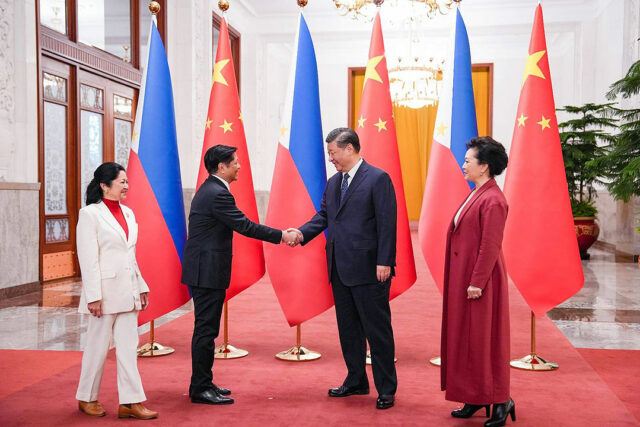
PRESIDENT Ferdinand R. Marcos, Jr. shakes hands with Chinese President Xi Jinping during a welcome ceremony at the Great Hall of the People in Beijing on Jan. 4, 2023. — COURTESY OF THE OFFICE OF THE PRESS SECRETARY WEBSITE

By Chloe Mari A. Hufana, Reporter

THE PHILIPPINES should pursue a free trade agreement (FTA) with China to complement diplomatic work on a legally binding Code of Conduct (CoC) in the South China, according to a diplomacy analyst.

Manila should also explore cooperation with its neighbor on emerging technologies like artificial intelligence (AI) as part of its policy toolkit to manage their relations, said Josue Raphael J. Cortez, a diplomacy lecturer at the De La Salle-College of St. Benilde.

The strategy could deepen their economic and technological engagement and serve national interests without compromising sovereignty, he added, even as he cautioned Manila to proceed with caution.

“Aside from forging a CoC in the South China Sea, which can serve as the cornerstone of promoting peaceful development within the disputed territories, we must also look into the possibility of forging an FTA with China,” he said in a Facebook Messenger chat.

“Given that China is already positioning itself as an alternative for the US, and because it is our largest trading partner, then this agreement is something that our respective governments must explore,” he added.

Mr. Cortez sought intensified people-to-people exchanges in AI, where China is considered a global leader.

“China is the second key player in the global AI race,” he said. “There’s room for collaboration, especially in areas like tech infrastructure.”

However, he cautioned against overreliance on China and cited the need for strategic balance.

“Engaging in these areas offers benefits, but we must be wary of doing so too much or too quickly. A careful balancing act is needed to avoid dependence while leveraging opportunities,” he added.

The Philippines and China are marking the 50th anniversary of their diplomatic relations on June 9.

Formal relations started in 1975, when the late President Ferdinand E. Marcos, Sr. signed a joint communiqué with Chinese Premier Zhou Enlai in Beijing, marking Manila as one of the first Southeast Asian nations to normalize ties with Beijing amid the Cold War.

The Philippines is in the middle of a trade war between Beijing and Washington, caught between two economic giants whose rivalry is reshaping global supply chains and regional alliances.

Hansley A. Juliano, a political science lecturer at the Ateneo De Manila University, said China remains one of the Philippines’ top trading partners.

“This means the bulk of our economic activity is both dependent on access to Chinese markets and the global brands that rely on their supply chains,” he said in a Facebook Messenger chat.

“While we wish to believe China values this as much as we do, hawkish elements of China mean they will keep pushing boundaries if they can afford it and will unironically complain when called out,” he added.

Meanwhile, Rommel C. Banlaoi, president of the Philippine Society for International Security Studies, said China has agreed to conclude negotiations for a legally binding CoC in the South China Sea by 2026, coinciding with the Philippines’ chairmanship of the Association of Southeast Asian Nations (ASEAN).

“Its conclusion will depend on the details of the CoC, as the devil is always in the details,” he said in a Viber chat.

As chairman of the regional bloc next year, a role Mr. Banlaoi called “ministerial,” the Philippines could propose items in the coming ASEAN summits, but noted that it has no control over the outcomes since the bloc works on a consensus.

“The Philippines can use its chairmanship of ASEAN as a platform to raise its voice on various security issues in the region, like the South China Sea disputes,” he said.

Mr. Cortez said ASEAN meetings could be used as a launchpad for bilateral negotiations with China on a separate CoC, if regional consensus remains elusive. A pan-ASEAN-China CoC may take time.

“However, since we are the primary stakeholders in this quest, we can explore the possibility of forging first a bipartite/bilateral treaty with China, and we can use the ASEAN meetings next year as a platform to do initial discussions on how this can be forged,” he added.

But Mr. Juliano said several countries in ASEAN and the Asia-Pacific region have “found it prudent not to align themselves” with China or the US.

“Our divided loyalties complicate this for us, but our anxieties about the democratic backslide of the US are a good opportunity to finally forge an independent and genuine multilateral policy,” he said.

During the 46th ASEAN Summit in Kuala Lumpur last month, Philippine President Ferdinand R. Marcos, Jr., urged his fellow leaders to fast-track the adoption of a legally binding South China Sea CoC, warning that rising sea tensions and uncertainty threaten hard-won regional gains.

The South China Sea remains one of the region’s most volatile flashpoints given competing claims over it by China, the Philippines, Vietnam, Malaysia, Brunei and Taiwan.

While ASEAN and China agreed to work on a Declaration of Conduct in 2002, progress toward a binding framework has been repeatedly delayed by legal, political and strategic differences.

Analysts ask Manila to lure Japanese investors to local defense sector

MEMBERS of the Philippine Coast Guard participate in drills to improve search and rescue collaboration, and enforcement during the first trilateral coast guard exercise between the Philippines, Japan, and the US, at the coast of Bataan in the South China Sea, June 6, 2023. — REUTERS

By Adrian H. Halili, Reporter

THE PHILIPPINES should lure Japanese investors to its defense industry after the Japanese Parliament’s ratification of a reciprocal access agreement (RAA) between Manila and Tokyo, political analysts said.

“They must be viewed as potential investors in the defense industrial sector, which the Self-Reliant Defense Posture law aims to establish,” Michael Henry Ll. Yusingco, a senior research fellow at the Ateneo Policy Center, said in a Facebook Messenger chat. “The RAA with Japan only bolsters the chances of achieving this goal.”

He said the access deal, which lays down the rules for visiting soldiers from both nations during war games, should add urgency for the Marcos government to boost its defense industry.

Republic Act No. 12024 or the Self-Reliant Defense Posture Revitalization Act seeks to boost local production of defense equipment and will let the Philippines develop technologies to counter threats.

Mr. Yusingco said the government should work on the institutional foundation of the country’s self-reliant defense industry. “So far, it appears it is not doing enough towards this end.”

Last week, the Department of Foreign Affairs said Japan’s Diet had approved the RAA.

Manila and Tokyo signed the military pact in July 2024, allowing for the entry of equipment and troops for military drills and disaster response on each other’s soil. The Philippine Senate in December ratified the deal.

“Aside from our military being able to learn best practices from Japan, they will also have an appreciation of state-of-the-art weapons that can be brought here by Japan for military exercises, which the (Armed Forces of the Philippines) may also employ in the near future,” Josue Raphael J. Cortez, a diplomacy instructor at De La Salle-College of St. Benilde’s School of Diplomacy and Governance, said.

Manila is seeking to bolster its defense capabilities amid worsening tensions with Beijing in the South China Sea. It has also increased its defense budget, with about P35 billion allotted to modernize its military in the next decade.

‘SHARED ASPIRATIONS’
The Philippine-Japan access deal is the first of its kind to be signed by Japan in Asia and coincides with increased Chinese assertiveness in the South China Sea, where Beijing’s expansive claims conflict with those of several Southeast Asian nations.

“This agreement adds another layer on how we can reach our shared aspirations for the region, particularly in promoting freedom of navigation,” Mr. Cortez said. “With our region becoming more and more viable in global trade presently, forging such an agreement is integral in ensuring that aside from maintaining our territorial integrity, we can also be a prime mover in ensuring a rules-based order within the open seas in our region.”

Rommel C. Banlaoi, president of the Philippine Society for International Security Studies, said the Philippine-Japan pact could irk China.

“The reciprocal access agreement will solidify US-Japan-Philippine security cooperation because of its juridical status,” he said in a Viber message. “But this will escalate the risk of the Philippines having a serious conflict with China.”

He added that China would not take the agreement lightly since its views it as a mere “containment strategy of the US with its Asian allies.”

This could exert pressure on China since it also has a dispute with Japan over the Diaoyu and Senkaku Islands,” Mr. Cortez said.

“We are achieving trust and reliability from Japan and the US, elevating the scalability of our security cooperation in the region,” Chester B. Cabalza, founding president of Manila-based think tank International Development and Security Cooperation, said via Messenger chat.

He added that China could counter the deal by courting more Association of Southeast Asian Nations (ASEAN) member countries to side with them through diplomatic, economic and military partnerships.

“We will see more by the time Manila chairs the ASEAN Summit next year,” he said.

China claims over 80% of the South China Sea, but a United Nations-backed tribunal in The Hague voided its claim in 2016 for being illegal.

The Philippines and China have repeatedly clashed in the disputed waterway, with both sides accusing each other of raising tensions.

Army officers told to brace for emerging cyberthreats

PHILIPPINE STAR/EDD GUMBAN

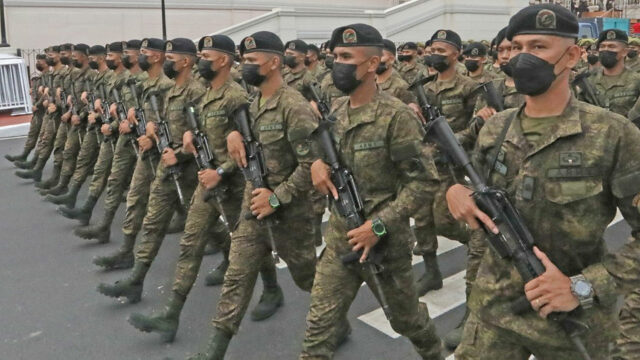
THE PHILIPPINE military last week urged newly commissioned army officers to brace for modern warfare challenges amid volatile conditions.

“We live in a volatile and evolving security environment shaped by both traditional and emerging threats,” Defense Undersecretary Irineo C. Espino said in a Philippine Army statement on Sunday. “Internal conflicts, external incursions, cyberattacks, disinformation and climate-related disasters — these threats span land, sea, air, space and cyberspace.”

President Ferdinand R. Marcos, Jr. in March urged the Philippine Army to modernize its strategies and help address evolving threats that span beyond land warfare, including cyberspace.

Mr. Espino said soldiers should expand their focus beyond land operations, emphasizing their crucial role in the country’s pursuit of an interoperable defense strategy.

The Philippine Army pledged to enhance its adaptability amid evolving security challenges, committing to become more flexible and responsive to unconventional threats, Lieutenant General Roy M. Galido, commander of the Philippine Army, said in the same statement.

“The initiatives driving the Army today are a testament to our ongoing commitment to excellence, ensuring we remain a force that adapts, evolves and leads with purpose in the face of tomorrow’s challenges,” he said. — Kenneth Christiane L. Basilio