Home Blog Page 1431

Philippines should withdraw missile system from South China Sea, Chinese state media

 – Chinese state media on Wednesday called on the Philippines to withdraw the United States’ “Typhon” intermediate range missile from the South China Sea, saying the Philippines had repeatedly broken its promises by introducing the missile system.

“The region needs peace and prosperity, not intermediate range missiles and confrontation,” the newspaper of the governing Communist Party, People’s Daily, said in a commentary. “The Philippines has repeatedly gone back on its word and acted in bad faith … initially promising that it was only a temporary deployment and that the system would be withdrawn,” it added.

The Philippine embassy in Beijing did not immediately respond to a request for comment. – Reuters

UK’s Reeves: ‘All of us must step up’ defense spending

REUTERS

 – British Finance Minister Rachel Reeves said on Tuesday that other European nations must follow in her country’s footsteps and increase their defense spending.

Prime Minister Keir Starmer announced earlier he would increase annual defense spending to 2.5% of GDP by 2027 and target a 3% level last seen just after the Cold War, a signal to U.S. President Donald Trump that Britain can boost Europe’s security.

“This is a generational moment for our continent,” Reeves wrote in the Telegraph newspaper. “All of us must step up and do more on defense.”

Reeves said she would speak to her European counterparts over the coming days at a G20 meeting in South Africa about the “importance of security and defense for our economies, and how we can work together to bolster them”.

The increase would see Britain spending 13.4 billion pounds ($17 billion) a year more on defense in 2027 than it does now, Mr. Starmer said, adding the extra money would help rebuild the country’s industrial base, create jobs and boost growth.

“If we are to protect our borders, then we need to ensure our defense industry is building the equipment and capabilities we need,” Ms. Reeves said. “We need modern capabilities here at home that can also be sold to the world.”

The increase in defense spending from its current 2.3% will be fully paid for by a 40% cut to international aid, a decision humanitarian charities have criticized. – Reuters

Trump floats $5 million ‘gold card’ as a route to US citizenship

RAWPIXEL

 – U.S. President Donald Trump on Tuesday floated the idea of replacing a visa program for foreign investors with a so-called “gold card” that could be bought for $5 million as a route to American citizenship.

Mr. Trump told reporters he will replace the “EB-5” immigrant investor visa program, which allows foreign investors of large sums of money that create or preserve U.S. jobs to become permanent residents, with a so-called “gold card.”

The EB-5 program grants “green cards” to foreigners promising to invest in U.S. businesses.

“We are going to be selling a gold card,” Mr. Trump said. “We are going to be putting a price on that card of about $5 million,” he added.

“It’s going to give you green card privileges plus its going to be a route to (American) citizenship, and wealthy people would be coming into our country by buying this card,” Trump said, adding that details about the scheme will come out in two weeks.

Mr. Trump added it is possible Russian oligarchs could qualify for the gold cards, when asked by a journalist if those people would be eligible. “Yeah, possibly. Hey. I know some Russian oligarchs that are very nice people,” he said.

The EB-5 Immigrant Investor Program, administered by the U.S. Citizenship and Immigration Services, was created by Congress in 1990 to “stimulate the U.S. economy through job creation and capital investment by foreign investors,” according to the USCIS website.

“The EB-5 program … it was full of nonsense, make believe and fraud, and it was a way to get a green card that was low price. So the president said, rather than having this sort of ridiculous EB-5 program, we’re going to end the EB-5 program. We’re going to replace it with the Trump gold card,” Commerce Secretary Howard Lutnick told reporters on Tuesday. – Reuters

Kamuning Bakery Cafe’s secrets to longevity

Kamuning Bakery Café’s staff are like players of a basketball team, its owner Wilson Lee Flores said. Everyone is important.

Interview by Edg Adrian Eva
Video editing by Arjale Queral

PEZA OKs P23-B investments in Feb.

Workers are seen at an electronics manufacturing assembly plant in Biñan, Laguna, April 20, 2016. — REUTERS/ERIK DE CASTRO

THE PHILIPPINE Economic Zone Authority (PEZA) approved P22.78 billion in investment pledges in February, an increase of 130.5% from P9.89 billion worth of pledges approved a year ago.

At a meeting on Feb. 20, the PEZA Board approved 26 new and expansion projects that are expected to generate $241.79 million in exports and create 7,793 jobs.

Nine of the projects are in export manufacturing, while eight are information technology and business process management projects.

Four of the projects are economic zone (ecozone) developments, while three are domestic market projects and two are involved in developing facilities.

The projects are in Metro Manila, Calabarzon, Central Luzon, Central Visayas, Western Visayas, Ilocos Region and Davao Region.

The recent approvals include a P10.45-billion investment to develop an ecozone where South Korean companies can establish their operations.

“With the Philippines-South Korea free trade agreement now in effect, PEZA is collaborating with the Bases Conversion and Development Authority for the creation of this multifaceted ecozone,” PEZA said.

“[It] will accommodate multiple sectors, including manufacturing, agro-industrial, tourism and information technology, further enhancing economic opportunities and sectoral development,” it added.

In the first two months, PEZA approved 39 new and expansion projects worth P52.93 billion. The amount is more than four times the P12.1 billion worth of investment pledges approved a year earlier.

“PEZA’s rising investments reflect its dedication to supporting various sectors and propelling the country’s economic progress,” said PEZA Director-General Tereso O. Panga.

“By attracting projects from priority industries such as emerging technologies in the EMS-SMS (electronics manufacturing services-semiconductor manufacturing services) sector and fostering strategic collaboration with the pharmaceutical industry, among others, PEZA continues to draw investments that stimulate regional economic growth and advance the nation’s industrial landscape,” he added.

PEZA said it is on track to hit its target to approve about P235 billion in investment pledges this year, which is 9-10% higher than the P214.18-billion pledges approved in 2024.

PEZA said investments from domestic market enterprises (DME) have been increasing, accounting for P37.97 billion or 71% of the investment pledges approved in the January-to-February period.

Since 2024, the agency has approved 15 DME projects worth over P130 billion, three of which are expected to enjoy a longer set of incentives after investing over P15 billion.

Meanwhile, Trade Secretary and PEZA Board Chairman Ma. Cristina A. Roque said the higher investment approvals could also be attributed to the Corporate Recovery and Tax Incentives for Enterprises to Maximize Opportunities for Reinvigorating the Economy (CREATE MORE) Act.

“The CREATE MORE Act is a game changer in the entry of foreign direct investments into the country, which encourages more international investors to come given the longer set incentives being offered,” she said.

President Ferdinand R. Marcos, Jr. in November signed the CREATE MORE Act, which seeks to make the country more competitive and attractive to investors.

PEZA said it anticipates the entry of more investments after the CREATE MORE Act’s implementing rules and regulations (IRR) were signed last week.

“The IRR supports PEZA’s core mandate to drive investment growth, create jobs and promote sustainable development, especially in the countryside. We now provide even more benefits to investors who wish to locate in the Philippines,” Mr. Panga said.

The IRR provides clearer guidelines on the transitory rules for pre-CREATE registered business enterprises (RBE) to continue receiving their previously granted tax incentives. The RBEs may also avail themselves of additional incentives or measures under CREATE MORE. — Justine Irish D. Tabile

BSP has room to shift to less defensive FX policy — HSBC

BW FILE PHOTO

THE BANGKO SENTRAL ng Pilipinas (BSP) has space to allow the peso to depreciate and provide much-needed support to exports and investment flows.

“A more competitive peso benefits both exports and foreign direct investment, HSBC economist for ASEAN Aris D. Dacanay and Global FX Strategist Lenny Jin said. “Hence, there is room for the BSP to shift towards a less defensive FX (foreign exchange) policy.”

“Relatedly, the Philippines is not under any strong scrutiny from the US administration regarding trade relationships or currency practices. This gives the BSP room to trim PHP overvaluation by accumulating reserves when USD-PHP falls.”

The peso closed at P57.93 a dollar on Tuesday, weakening by 12.2 centavos from its P57.808 finish on Monday.

HSBC said there are benefits “to letting the Fed go and allowing the peso to depreciate.”

“As trade and investment uncertainties take a toll on growth, a weaker and more competitive currency can help alleviate some of the pains by boosting the economy’s booming services exports,” it added.

HSBC expects the BSP to soon “shift its focus from mitigating the risk of FX volatility to boosting growth.”

“This can be done by becoming more laissez-faire and allowing its policy rate differential with the Fed to narrow,” it added.

However, HSBC said this transition is unlikely to happen in the first half of the year.

“We expect such a shift to happen in the second half. Rates and FX policies will likely coordinate. As a narrower PH-US policy rate buffer pushes USD-PHP up, the BSP may soften its USD-selling intervention.”

BSP Governor Eli M. Remolona, Jr. has said while they are also monitoring the US Federal Reserve’s moves, there is no need to fall in step with the US central bank.

At its January meeting, the Fed kept interest rates steady after slashing a full basis point in 2024. It began its easing cycle in September, a month after the BSP cut rates in August.

HSBC said a weaker currency could boost the economy’s trade competitiveness. A more competitive peso could bring “much-needed support” to exports.

“If, say, the peso depreciates, the goods that the Philippines exports then become cheaper to importers or, potentially, more competitive versus competing exporters,” it said.

Latest data from the local statistics authority showed that the Philippines’ trade-in-goods deficit widened by 3.1% to $54.21 billion 2024, its largest trade gap in over two years.

This as merchandise exports slipped by 0.5% to $73.21 billion, missing the 4% growth assumption by the Development Budget Coordination Committee (DBCC) for the year.

“A competitive currency can help develop one’s ability to manufacture. Manufacturers are the producers of goods, and related to the previous fact, a competitive currency can help manufacturers expand their markets abroad,” it said.

It noted that electronics exports have been deteriorating both volume and value-wise.

In 2024, electronic products, which accounted for more than half of all exports, slumped by 6.7% to $39.08 billion. Semiconductors also fell by 13.5% to $29.16 billion.

“Furthermore, service exports have plateaued. Despite BPO-related exports maintaining their uptrend, tourism exports have failed to sustain above its pre-coronavirus disease 2019 levels. The Philippines needs to not only attract more tourists but also encourage more spending per capita.”

HSBC noted that an uncompetitive currency “can be a hindrance for manufacturing to blast off.”

While there are benefits to narrowing the policy rate differential between the BSP and Fed, the timing will be crucial, it added.

“Though the BSP, like the Fed, treaded carefully and paused its easing cycle in February, the BSP may eventually mull the possibility of going to the unknown, and allow the BSP-Fed policy rate differential to narrow to 50-75 basis points (bps) even amidst a sharp repricing of Fed rates.”

“We think 2025 and 2026 will be a crucial time for this. Apart from fourth-quarter growth undershooting expectations, growth in 2025 appears to be challenging.”

Growth could be dampened by tepid investments amid global trade uncertainties.

“But there is an art to narrowing one’s policy rate differential with the Fed or mitigating volatility in the currency. Slow and gradual is key,” HSBC said.

“In contrast, letting the monetary rein completely loose will stoke too much volatility in the currency, which could then lead to other complications. For instance, too much volatility could stoke FX-induced inflation and, perhaps, stoke financial jitters as balance sheets of firms get stretched.”

However, HSBC said the Philippine economy could also manage any inflationary pressures stemming from peso volatility.

“That being said, we think there is room for the Philippine economy to absorb some volatility in the currency, it’s just a matter of timing,” it said.

Since core inflation remains within target, the BSP has some room when it comes to allowing some FX-induced inflation to occur.

“Though a more hawkish Fed poses an upside risk to our forecasts, the BSP may, eventually, become more tolerant to FX volatility. This means the Fed will likely matter less and less for the BSP in the quarters ahead, with the BSP easing monetary policy even if the Fed doesn’t.”

HSBC expects the BSP to cut rates by a total of 75 bps this year, bringing the key rate to 5% by yearend.

It sees a 25-bp cut each in the second quarter, third quarter, and fourth quarter.

“Though this may lead to some volatility in the peso, growth concerns may eventually outweigh the risks embedded in a volatile currency,” it added. — Luisa Maria Jacinta C. Jocson

PHL hopeful US will continue to support the Luzon Economic Corridor

THE SUN sets over Subic Bay in Zambales. — PHILIPPINE STAR/RYAN BALDEMOR

THE PHILIPPINES is hoping the United States under the Trump administration will continue supporting the Luzon Economic Corridor (LEC), the Office of the Special Assistant to the President for Investment and Economic Affairs (OSAPIEA) said.

“We need to inquire from the Trump administration what their plans are for that. Although we are still very positive, we are still very hopeful,” Secretary Frederick D. Go, who heads OSAPIEA, told reporters last week.

“I think we have been a very good ally of the US, so I believe that they will reciprocate that with tangible economic benefits for our country,” he added.

The Luzon Economic Corridor is being undertaken via a trilateral commitment among the Philippines, US and Japan.

In April 2024, then-US President Joseph R. Biden, then-Japanese Prime Minister Fumio Kishida and Philippine President Ferdinand R. Marcos, Jr., launched a steering committee to drive infrastructure development in the LEC.

The initiative aims to enhance the connectivity of Luzon’s key economic areas — Subic Bay, Clark, Metro Manila and Batangas.

Mr. Go said other countries have also expressed interest in joining the initiatives for the Luzon Economic Corridor.

“While the US and Japan were leading the Luzon Economic Corridor, since that time the UK, Sweden, Korea, and Australia have all signified very serious intent,” he added.

Mr. Go also said funding for the feasibility study of one of the flagship projects of the Luzon Economic Corridor, the Subic-Clark-Manila-Batangas cargo railway, would not be affected by the US government’s pause on foreign aid funding.

After assuming office on Jan. 20, Mr. Trump ordered a 90-day pause on foreign aid to review if these programs are aligned with his “America First” policies.

However, Foundation for Economic Freedom President Calixto V. Chikiamco said the US might pull out of the Luzon Economic Corridor, which was initiated under Mr. Biden.

“It’s a Biden initiative. Most likely it will be scrapped by Trump,” he said in a Viber message.

Rizal Commercial Banking Corp. Chief Economist Michael L. Ricafort said the Luzon Economic Corridor is not consistent with Mr. Trump’s protectionist policies.

“This could partly run counter to Trump’s protectionist policies that encourage American and other global businesses to invest and create more jobs in the US,” he said in a Viber message.

He said Mr. Trump has been cutting costs in the US government, which could threaten US subsidies, grants, and assistance for its closest allies.

“Trump could reverse Biden’s other programs related to this. An exemption would be on US defense cooperation and related spending, which were signaled to be not adversely affected,” he added.

The Luzon Economic Corridor is the first project of the US-initiated Partnership for Global Infrastructure and Investment in the Indo-Pacific.

It seeks to accelerate investments in high-impact infrastructure projects such as railways, ports, clean energy, semiconductor supply chains and agribusiness.

Meanwhile, Finance Secretary Ralph G. Recto said he would support the reduction of tariffs on US-made vehicles under a free trade agreement (FTA) with the US.

“We’re now working on a free trade agreement with the European Union (EU)… We’re open to a free trade agreement also with the United States. I would bat for a reduction in tariffs on US vehicles,” Mr. Recto said in a CNN interview on Tuesday.

The Philippines is in talks with the EU for a free trade deal. Philippine government officials earlier said there appears to be “renewed interest” from the US on a bilateral FTA with the Philippines.

To recall, Mr. Trump during his first term met with then-President Rodrigo R. Duterte in Manila in 2017 and released a joint statement on the FTA deal and agreed to discuss it under the US-Philippines Trade and Investment Framework Agreement.

Mr. Recto said he proposed lower tariffs on US-made vehicles “knowing that President Trump is interested in protecting and promoting US auto makers.”

Mr. Recto reiterated that he is not worried about the implication of Mr. Trump’s aggressive tariff policies considering the Philippine economy is driven mostly by domestic consumption.

The Philippines is unlike China, Vietnam and its other Southeast Asian peers, which are more export-oriented, he said. We have a trade deficit when it comes to goods. We have a robust BPO industry and we feel that that will continue.”

“In fact, they’re more interested in investing in the Philippines’ BPO industry,” he added.

US officials are studying global reciprocal tariffs. Mr. Trump has said he wants to impose tariffs on all countries that have tariffs on US goods.

He has also said he wants to slap 25% tariffs on imports of cars, pharmaceuticals and semiconductors. — Justine Irish D. Tabile and Aubrey Rose A. Inosante

InstaPay, PESONet transactions jump to P1.8 trillion

ROBIN WORRALL-UNSPLASH

By Luisa Maria Jacinta C. Jocson, Reporter

THE VALUE of transactions done via InstaPay and PESONet has increased by 38.2% as of end-January, data from the Bangko Sentral ng Pilipinas (BSP) showed.

Central bank data showed transactions coursed through the two automated clearing houses had jumped to P1.8 trillion as of end-January from P1.31 trillion a year ago.

The combined volume of transactions done via InstaPay and PESONet likewise surged by 58.4% to 160.2 million from 101.2 million a year ago.

The value of PESONet transactions climbed by 32% year on year to P1.05 trillion in January from P797.4 billion last year.

The volume of transactions that went through the payment gateway also rose by 20.6% to 9.6 million from 8 million.

Meanwhile, the value of transactions done through InstaPay jumped by 47.8% to P750.6 billion from P507.8 billion in the previous year.

The volume of InstaPay transactions stood at 150.6 million, higher by 61.6% from 93.2 million in the year-ago period.

PESONet and InstaPay are automated clearing houses that were launched in December 2015 under the central bank’s National Retail Payment System framework.

PESONet caters to high-value transactions and may be considered as an electronic alternative to paper-based checks.

Meanwhile, InstaPay is a real-time, low-value electronic fund transfer facility for transactions up to P50,000 and is mostly used for remittances and e-commerce.

“The consistent strong double-digit growth in transactions in recent months continued to reflect the adoption of online banking and electronic fund transfers including e-wallets by more Filipinos over the years,” Rizal Commercial Banking Corp. Chief Economist Michael L. Ricafort said.

Latest BSP data showed digital payments made up 52.8% of the volume of retail transactions in 2023, higher than the 42.1% share in 2022.

In terms of value, 55.3% of retail transactions in 2023 were done online, higher than the 40.1% the year prior.

The BSP said the increase in digital payments was driven by wider use of online transaction channels among people and businesses, with the coronavirus pandemic accelerating the shift.

“Furthermore, more Filipinos find greater value and convenience in using both of these instead of using checks and other over-the-counter transactions,” Mr. Ricafort said.

“Both of these, using online banking apps and e-wallets also promote further financial inclusion especially in unbanked areas,” he added.

The central bank wants online payments to make up 60-70% of the country’s total retail transaction volume by 2028.

DigiPlus: Where Filipino tradition fuels digital innovation

BingoPlus Studios

Step into any Filipino fiesta, and you’ll hear the cheers around Color Game, the rhythmic bounce of a Drop Ball, or the thrilled calls of a Bingo winner. These games, woven into the country’s cultural fabric, are no longer confined to fairs and carnivals. They’ve gone digital.

Leading the charge in this transformation is DigiPlus, a company that isn’t just part of the online gaming industry — it’s actively shaping it. Blending tradition with technology, innovation with intuition, and excitement with responsibility, DigiPlus has built an ecosystem where digital entertainment feels not just modern, but deeply Filipino.

A digital playground for Filipinos

The rise of DigiPlus’ flagship brands are all about creating a digital space that connects Filipinos to the games they love.

“Innovation drives us, but tradition keeps us grounded. Our goal has always been to bring entertainment that is meaningful, responsible, and reflective of our audience,” said DigiPlus Chairman Eusebio Tanco.

P312-million jackpot winner

The platforms under DigiPlus — BingoPlus, ArenaPlus, GameZone and SpinPlus — don’t just offer thrill; they’ve changed lives. Take the P312-million Bingo Mega jackpot winner, or the daily million-peso winners from Lucky Spin. These aren’t just numbers; they’re stories of everyday Filipinos experiencing life-changing moments.

More than the big wins, DigiPlus has cracked the code on how to make digital entertainment feel both new and familiar at the same time — a space where modern tech meets classic Filipino excitement.

Tradition meets technology

The success of Bingo and carnival games in the digital space isn’t a coincidence. These are games Filipinos grew up with, games they’ve played in town fiestas and family gatherings. Bringing them online isn’t just about nostalgia; it’s about understanding what players truly connect with.

By merging these beloved traditional games with smart technology, DigiPlus has created a high-energy digital playground. The familiarity of the games draws players in, while the tech keeps them coming back.

But innovation doesn’t stop at gameplay. Behind the scenes, DigiPlus’ in-house R&D team ensures a seamless and secure gaming experience. The company invests heavily in advanced gaming infrastructure, and real-time security measures, making sure that every spin, drop, and bet happens in a fair environment.

Beyond the thrill: Gaming with responsibility

With great entertainment comes great responsibility. DigiPlus understands this better than most. The company isn’t just about making gaming accessible — it’s about making it safe.

Key responsible gaming features in DigiPlus’ platforms include:

  • Know Your Customer (KYC) protocols — Ensuring a secure and transparent environment by verifying users.
  • Self-defined limits — Letting players set their own financial boundaries to encourage mindful gaming.
  • Pusta de Peligro — A campaign focused on educating players about responsible betting and financial awareness.

By making these safety measures an integral part of the gaming experience, DigiPlus is setting a new standard in the industry where digital gaming isn’t just thrilling, but also ethical and sustainable.

The game is far from over

DigiPlus is scaling up its tech investments, with Amazon Web Services (AWS) powering its next-gen platforms. It’s also expanding beyond the Philippines, with eyes set on Brazil as the next frontier.

And the real game-changer? New digital entertainment innovations in the works, backed by its in-house R&D powerhouse. Whether it’s enhancing gameplay, integrating smarter security, or developing entirely new formats, DigiPlus is shaping what’s next.

The digital fiesta is just beginning

DigiPlus has proven that digital entertainment doesn’t have to be just about technology — it can be about culture, community, and real impact. From bringing classic Filipino games online to creating millionaires daily, it’s redefining what gaming means in the Philippines.

And if the past is any indication, the most exciting part of DigiPlus’ story is still to come.


Spotlight is BusinessWorld’s sponsored section that allows advertisers to amplify their brand and connect with BusinessWorld’s audience by publishing their stories on the BusinessWorld Web site. For more information, send an email to online@bworldonline.com.

Join us on Viber at https://bit.ly/3hv6bLA to get more updates and subscribe to BusinessWorld’s titles and get exclusive content through www.bworld-x.com.

Betting on the future of digital gaming

MACROVECTOR_OFFICIAL | FREEPIK

By Mhicole A. Moral, Special Features and Content Writer

Technological advancements and the growing accessibility of mobile devices have created new opportunities for social interaction and entertainment. Electronic games are one of these opportunities, which have increasingly become embedded in modern Filipino society.

The rapid growth of online gaming has disrupted the gambling industry and become the largest contributor to gaming taxes in the Philippines since early 2024. In fact, The Philippine Amusement and Gaming Corp. (PAGCOR) reported that its net operating income surged 51% to P84.97 billion in 2024, up from P56.38 billion in 2023. Electronic games and e-bingo generated P48.79 billion, making up 50.03% of PAGCOR’s total gaming revenues. In addition, a recent Morgan Stanley report found that online gaming accounted for 70% of the country’s land-based gross gaming revenue (GGR) by the third quarter of 2024 — up from 40% in the first quarter and 60% in the second.

Gaming operations and license fees remained PAGCOR’s top revenue sources at P97.52 billion, while business income and service fees added P14.2 billion. Although e-gaming led the sector, licensed casinos contributed P33.07 billion, and Casino Filipino venues added P12.67 billion.

PAGCOR Chairman and Chief Executive Officer Alejandro H. Tengco expects e-games to keep growing as technology becomes an even greater part of people’s entertainment habits.

“This impressive performance is a strong indication that the use of modern technology and mobile gadgets in gaming and amusement will continue to play a pivotal role in shaping the future of gaming,” said Mr. Tengco.

Reinventing online games

The rise of electronic gaming has taken even the country’s biggest casino operators by surprise, forcing them to adapt to an increasingly digital landscape. Solaire Resort & Casino has started recruiting for its online gaming team, while NUSTAR Resort and Casino launched NUSTAR Max, its official online gaming platform.

Among the biggest industry players in e-gaming is DigiPlus Interactive Corp. The company overtook Bloomberry in both GGR and earnings before interest, taxes, depreciation, and amortization (EBITDA) in the second quarter of 2024. It now holds a 50% market share, leveraging its over 40 million registered users out of a total adult population of 70 million.

Expanding internationally, DigiPlus secured a license to operate in Brazil. Its stock price surged from P7.93 per share in early 2024 to P28.95 by January 2025, making it one of the year’s best-performing stocks.

According to DigiPlus Chairman Eusebio Tanco, the Philippine online gaming industry is experiencing growth because of improved gaming technologies. “More Filipinos are embracing online gaming and sports betting as part of their entertainment choices,” he told BusinessWorld in an e-mail.

He credited the sector’s momentum to a well-regulated environment that ensures fair play and responsible gaming. Regulatory bodies provide both players and operators with a secure and transparent platform.

Unlike some of its Southeast Asian counterparts, the Philippines has built a structured and transparent regulatory framework for online gaming. “The Philippines stands out as one of the most structured online gaming markets in Southeast Asia, with clear regulations that provide both stability and growth opportunities,” Mr. Tanco explained.

He noted that the shift from traditional media to interactive gaming reflects global trends, as audiences seek dynamic, participatory experiences instead of one-way content.

“Online gaming has transformed entertainment by shifting consumer habits from passive content consumption to interactive, social, and immersive experiences,” Mr. Tanco said. “Filipinos are increasingly engaging with digital gaming platforms, real-time sports betting, and livestreamed games, making gaming a mainstream form of entertainment.”

Investment boom in online gaming

The DigiPlus executive added that investment opportunities in the sector are strongest in technology-driven innovations, personalized gaming experiences, and digital infrastructure expansion.

Furthermore, one of the most significant trendne of the most significant trends in the Philippine online gaming landscape is the integration of artificial intelligence (AI). AI-powered gaming platforms enhance user engagement by offering personalized recommendations and adaptive gameplay. Developers use machine learning algorithms to analyze player behavior, delivering customized content that keeps users engaged.

Data analytics also refine gaming experiences, as companies collect and analyze player data to understand preferences and habits. This approach allows them to create more engaging content and offer targeted in-game promotions.

“Investors are looking at AI integration, enhanced mobile gaming platforms, and data-driven player engagement to improve user experience. With a growing market and a clear regulatory framework, the Philippines remains an attractive destination for sustainable investments in digital gaming,” Mr. Tanco said.

Strengthening regulations

Despite the industry’s rapid expansion, concerns over responsible gaming have pushed stakeholders to enforce stricter safeguards.

Last year, PAGCOR blocked 5,793 of the 7,747 identified illegal gaming sites to curb illicit online gambling. These sites accounted for 74.78% of detected illegal operations, including offshore gaming platforms, unregulated e-sabong, and unauthorized games spreading through social media ads, mobile apps, and spam messages.

However, thousands of illegal sites remain active. PAGCOR Senior Vice-President for Security Monitoring Ret. Gen. Raul Villanueva said combatting these entities goes beyond website blocking, requiring sophisticated strategies to disrupt their financial transactions.

PAGCOR has partnered with major local financial platforms such as GCash and Maya, which have committed to tracking and eliminating illicit transactions. The agency has also urged tech giants, including Google Play and Apple App Store, to remove illegal gambling applications from their platforms.

While these efforts have led to a reduction in Facebook advertisements promoting illicit gaming, operators have shifted their activities to alternative platforms such as Telegram.

PAGCOR estimated that unregulated gaming causes economic losses of P200 billion to P250 billion. Without oversight, these revenues evade government taxation, benefiting only illegal operators.

In addition, the ongoing Senate discussions on the Anti-Online Gambling Act aim to create a more structured and transparent online gaming industry in the Philippines. Proposed measures include stricter licensing requirements, stronger regulatory mechanisms, and enhanced consumer protections to prevent addiction and financial exploitation.

Meanwhile, DigiPlus has reinforced significant steps to reinforce consumer protection. “Responsible gaming is a priority for us at DigiPlus,” said Mr. Tanco. “Our platforms, including BingoPlus, ArenaPlus, and GameZone, adhere to strict KYC (Know Your Customer) protocols, requiring government-issued IDs to verify a player’s identity and age.”

DigiPlus has also implemented self-defined deposit, bet, and loss limits, allowing players to manage their gaming activity responsibly. The company offers self-exclusion programs and real-time responsible gaming reminders to prevent excessive gambling.

Beyond internal policies, DigiPlus collaborates with PAGCOR and mental health organizations to strengthen responsible gaming measures.

“As gaming preferences shift toward more interactive and socially connected experiences, the market will see increased demand for digital platforms that offer both entertainment and responsible engagement,” said Mr. Tanco.


BingoPlus: Building a player base through trust and reliability

Online and electronic gaming are easily accessible ways for Filipinos to relieve stress, have fun, and relax after a long, busy day. However, when there is money involved, as it is with online betting applications, building trust and earning reliability is crucial in attracting and keeping players on the platform.

In recent years, BingoPlus has become a household name in the Philippines amassing a player base of over 38 million Filipinos by offering exciting digital bingo experiences, engaging promotions, and seamless gaming accessibility through its online platform.

According to AB Leisure Exponent, Inc. President Jasper S. Vicencio, this meteoric rise is a testament to the trust and enjoyment that Filipinos have found in the company, motivating BingoPlus to continuously strengthen its credibility through various initiatives.

“Our players are one of the reasons why BingoPlus is here and why we are the leading digital gaming provider in the country. For that reason, we don‘t stop cementing our credibility and we are very much active in partnering and sponsoring events to show the brand‘s reliability and credibility,” he explained.

Among the events that BingoPlus has supported include the Miss Universe Philippines, LIV Golf League, Sinulog Festival, Dinagyang Festival, and MassKara Festival. Additionally, the company has maintained strong partnerships with media agencies nationwide proving that BingoPlus is a partner that can be relied on.

Beyond sponsorships and partnerships, Mr. Vicencio also noted how BingoPlus prioritizes transparency and responsible gaming by working closely with regulatory agencies and implementing stringent measures to ensure fairness, credibility, and compliance.

“All our collaterals or advertising materials undergo the strict screening process of the Ad Standard Council (ASC) making all our claims truthful… PAGCOR is [also] a great help in establishing the quality and performance of our brand. Being a PAGCOR-licensed gaming platform certifies that we are adhering to the government‘s guidelines and regulations,” he said.

Similarly, Mr. Vicencio mentioned BingoPlus‘ commitment to safeguarding their players‘ privacy through the expansion of their customer service and hiring of skilled IT professionals. In this manner, he believes their players can have peace of mind while playing, and their users‘ concerns are immediately addressed.

“As we grow our user base, we make sure to prioritize their data privacy by maintaining a platform that is firm and a system with integrity. We ensure this by implementing a variety of security measures. User personal data is contained behind secured networks and is only accessible by a limited number of employees who have special access rights to such systems, and is required to keep the personal data confidential,” he asserted.

Technical issues such as glitches and errors on both the website and application are also an area of concern for players who want to enjoy their game continuously. These issues are a natural part of any digital platform, according to Mr. Vicencio. However, he assures users that their team is working tirelessly to deliver a hassle-free, top-tier experience for every Filipino player.

“We have a dedicated IT support team in place, ensuring that any technical concerns are swiftly and efficiently addressed. We only hire the best, because we also want our users to get the best experience on our platform. We bring in only skilled and passionate individuals to work with us. We empower all our workers to better serve our growing users. Thus, by regulating our system, we can meet our goal which is to prioritize the user‘s gaming experience and data security,” he said.

A part of being reliable is the ability to be approachable on issues and address them quickly. For Mr. Vicencio, BingoPlus warrants this reliability due to its efforts in disseminating information to its following on all social media platforms as well as its live chat feature where players can immediately share their concerns in the app.

“To be fair and transparent to our users, our team‘s communication system and processes should be coherent. Thus, we strengthen our operations in order for us to convey our message across different platforms clearly,” he explained.

BingoPlus’ commitment to transparency and user protection extends beyond platform security and customer service — it also encompasses responsible gaming initiatives aimed at fostering a safer and more sustainable gaming environment for all players.

Through the BingoPlus Foundation, the company has launched information campaigns to raise awareness and promote responsible gaming. Mr. Vicencio noted that “responsible gaming is the foundation of a sustainable gaming industry.”

Recently, the foundation launched a campaign called ‘Pusta de Peligro‘. Three resonant short films are at the center of the campaign, each created to encourage self-reflection and mindful gaming choices. These relatable films challenge viewers to recognize when gaming turns from a fun activity into a risky one.

Furthermore, responsible gaming features have also been added across platforms of DigiPlus, the company behind BingoPlus. These features empower players to manage their gaming habits, giving them the ability to set daily gaming durations, customize specific gaming schedules, and set daily loss limits.

“DigiPlus and BingoPlus Foundation are elevating the campaign by sharing it across digital platforms and encouraging communities to spread the message of responsible gaming. In addition to digital advocacy, on-ground initiatives like community workshops and live events can provide a significant boost in empowering more players to make balanced and mindful decisions,” he commented on the campaign.

To conclude, Mr. Vicencio acknowledged that BingoPlus deals with players who are somehow carrying a dream with them or wishing to win one of their many prize pools in order for them to change their lives. With the company‘s commitment to trust, transparency, and responsible gaming, it has become a trusted partner for millions of Filipinos seeking entertainment, excitement, and the thrill of winning.

“Our players have different stories to tell, and knowing these, we can‘t afford to lose their trust,” he said.


Spotlight is BusinessWorld’s sponsored section that allows advertisers to amplify their brand and connect with BusinessWorld’s audience by publishing their stories on the BusinessWorld Web site. For more information, send an email to online@bworldonline.com.

Join us on Viber at https://bit.ly/3hv6bLA to get more updates and subscribe to BusinessWorld’s titles and get exclusive content through www.bworld-x.com.

Next prospects for global and local gaming

bs_k1d | Freepik

In a world that has become more interconnected, gaming has taken over digital screens. This gaming obsession is only expected to grow stronger as consumers around the world continue to keep on playing in the next few years or so.

Gaming has become one of the fastest-growing segments in entertainment and media. In a report, PricewaterhouseCoopers (PwC) projects the gaming industry will exceed $300 billion, making up 9% of the entertainment and media market by 2028.

The growth of the gaming market has created a positive cycle, drawing in more people into gaming media and products across all genres. This surge has resulted in a rise of high-quality games and an increase of gaming-related content worldwide.

Along with this boom, the online games gaining the most traction are app-based social and casual games. Some examples include Pokémon Go, Animal Crossing, and Roblox, among others, which keep users hooked and engaged. Projections for 2028 indicated a 5.15% increase of revenue from this segment, accounting for 75% of the global video games and e-sports market.

Among regions, Southeast Asia is leading with a massive player base and a dominating share in the global gaming revenue. The report revealed that this region is expected to generate $181-billion revenue, which will make up 54% of the global gaming segment in 2028.

Moreover, on a global scale, the electronic gaming segment is experiencing critical growth, amplified by continuous technological advancements. A 2024 TGM Research report revealed that, across 34 countries, 39% of respondents engage in sports betting activities and gambling, with approximately 17.6 million adults participating. Notably, the report indicated that 21% of these gamers tend to play online sports betting a few times a week, with a preference of playing via the internet or in mobile apps instead of going at casinos or sportsbooks. In the Philippines, there are several online gaming platforms available, such as BingoPlus, Casino Plus, Okada Online Casino, and Solaire Online.

Sports betting and casino games have also spurred online betting and gambling to reach new heights in recent years. Business consulting firm Grand View Research valued the online gambling market at $63.53 billion in 2022 and predicted the sector’s compound annual growth rate (CAGR) to grow by 11.7% from 2023 to 2030. This rapid growth is driven by the legalization of online gambling in various regions, the rise of live dealer games, and e-sports which have attracted a broader audience, making online gambling more interactive and engaging than ever before.

Furthermore, according to a Boston Consulting Group (BCG) report, from 2017 to 2021, gaming grew at an impressive annual rate of 13%. This growth was primarily driven by innovative advancements that attracted more players and increased engagement.

However, in the following years, the double-digit growth slowed down significantly. In its 2024 report, growth rate from 2021 to 2023 dropped to 1%, and this single-digit growth is expected to continue until 2028, with an annual growth of 5%.

One of the challenges the industry faces is the rising costs of game development. Between 2017 and 2022, budgets increased by 6%, and it will continue to increase to 8% from 2022 to 2028, the report said. Because of this shift, the industry can experience reduced investments in game development, job losses, and studio closures.

To adapt to these changes, the industry must navigate the evolving landscape. Despite slow growth, opportunities still exist for the gaming industry. The report highlighted key trends and drivers, such as “embracing artificial intelligence (AI) and automation, developing a subscription strategy, taking a nuanced approach to price increases, monetizing emerging markets, exploring advertising, and focusing on untapped demographics.”

“The gaming industry is at a pivotal moment, with everyone asking the same question, how do we regain momentum; while a groundbreaking innovation may shape the long-term future, the near-term path to grow lies in embracing new monetization strategies and reaching untapped markets and demographics. Although returning to pre-pandemic growth rates may be challenging, gaming remains the most immersive and enduring entertainment medium,” Ernesto Pagano, managing director and partner at BCG, said in the report.

In the Philippines

The world of online gaming has firmly established itself, with the Philippines right in the digital mix, driven by active online users and high internet penetration rates.

www.pagcor.ph

The country’s electronic gaming segment has been pretty big. Most players boast strong interest in mobile gaming, e-sports, and role-playing games (RPGs). This surge in online gaming has firmly placed Filipinos on the global gaming map.

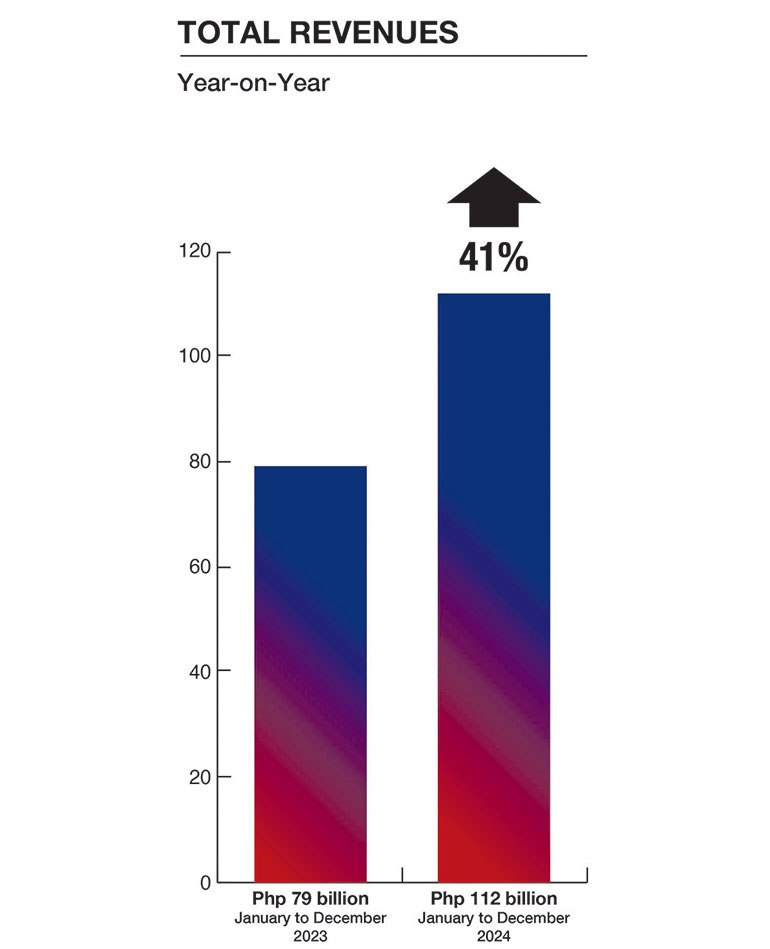
According to the Philippine Amusement and Gaming Corp. (PAGCOR), the gaming revenue for the Philippines saw robust performance in 2024. It saw a 41% increase, which generated a record-high of P112-billion gross gaming revenue. According to PAGCOR data, gaming operations and license fees stood at P97.52 billion. Key contributors to this growth are e-games and e-bingos, which brought P48.79 billion, or 50.03% of gaming revenues, for the year.

“The continuous growth of the e-games sector is the key driver of PAGCOR’s record-breaking performance. It reflects the increasing popularity of digital gaming platforms and the transformative impact of technology on the industry,” Alejandro H. Tengco, chairman and chief executive officer of PAGCOR said in a statement.

Furthermore, the figures showed that gaming operations generated a total revenue of P97.52 billion. Contributing to this total, e-bingo, e-games, and bingo guarantees accounted for 50% (P48.79 billion), licensed casinos for 33% (P33.07 billion), Casino Filipino venues for 12% (12.67 billion), and offshore gaming operations for 3.07% (P2.99 billion).

Looking ahead, e-games remains a significant sector in the Philippines. This year, the electric gaming sector is only going to get bigger and better, with projections indicating it will reach P160 billion in gross gaming revenue. This follows impressive 2024 figures, showing a 51% increase and a P16.77-billion year-on-year net income, according to PAGCOR’s data.

Additionally, the gaming regulator is reducing its fee rates for e-games from 35% to 30%. This change is intended to create a favorable regulatory environment, encouraging online gaming operators to join the legal market. With lower rates, the number of licensed e-games operators is expected to rise, and operators will gain more resources for marketing.

Statista, meanwhile, forecasts $28.32 million of online gaming revenue to be achieved in 2025. The number of users is expected to grow to 18.2 million by 2029, with user penetration estimated at 14% this year, and increasing slightly to 14.2% by 2029. — Angela Kiara S. Brillantes and JAMC