Home Blog Page 1430

Peso dips as Trump tariff vs EU fans trade war fears

BW FILE PHOTO

THE PESO dipped against the dollar on Thursday after US President Donald J. Trump said he would slap a 25% tariff on the European Union (EU), which vowed to counter “firmly and immediately,” fanning fears of an escalating trade war.

It closed at P57.91 a dollar, three centavos weaker than its P57.88 finish on Tuesday, according to Bankers Association of the Philippines data posted on its website.

The peso opened at P57.87 against the dollar, weakened to as much as P57.92 and strengthened to as much as P57.85. Volume fell to $1.07 billion from $1.09 billion on Tuesday.

“The peso weakened from safe-haven demand after US President Trump announced 25% tariffs for the European Union,” a trader said in an e-mail.

The US leader on Wednesday said he plans to slap cars and other goods from the European Union a 25% tariff. The EU vowed to counter “firmly and immediately.”

The dollar-peso also traded cautiously as players awaited key US data to be released overnight, including initial jobless claims and durable goods, in addition to US GDP, another trader said by telephone.

The second trader expects the peso to weaken further on Friday on expectations of an upbeat report on US durable goods.

The first trader expects the peso to trade from P57.70 to P58.10 a dollar, while the second trader sees it at P57.80 to P58.05.

The dollar firmed in Asia on Thursday and Treasury yields ticked higher as investors assessed the outlook for tariffs and the economy under Mr. Trump.

Asian stocks were weaker overall in volatile trading, with tech shares around the region getting little steer from earnings of heavyweight US chipmaker and artificial intelligence darling Nvidia.

Cryptocurrency Bitcoin languished near the $85,000 mark, while safe-haven gold steadied some $64 an ounce below its record high as trade war worries kept market sentiment fragile.

Mr. Trump clouded the outlook for looming levies on top trading partners Canada and Mexico on Wednesday by signaling they would take effect on April 2, which would be another month-long extension.

However a White House official later said the previous March 2 deadline for the levies remained in effect “as of this moment,” stirring further uncertainty about US trade policy.

US two-year Treasury yields rose to 4.09%, finding their footing after a slump to the lowest since Nov. 1 at 4.065% in the prior session. The 10-year yield rose to 4.2809% from a low of 4.245% on Wednesday, a two-and-a-half-month trough.

The dollar and US yields have been under pressure in recent weeks as a run of soft economic indicators have combined with growth worries arising from Mr. Trump’s tariff plans.

Traders have raised bets for Federal Reserve interest rate cuts in recent days, now seeing two quarter-point reductions this year, with the first likely in July and the next as early as October.

Markets will look at GDP and durable order data due on Thursday for any stronger signs of slowdown, while the Fed’s preferred inflation gauge, the personal consumption expenditure index, is due on Friday.

“Markets are starting to feel less confidence about US growth,” said Shoki Omori, chief global desk strategist at Mizuho Securities. “US data surprises will continue to be towards the downside,” although as economists start to adjust their forecasts toward weaker outcomes, and with inflation still “sticky,” 10-year Treasury yields are unlikely to fall below 4%, he added.

The dollar index, which measures the currency against six major rivals, rose 0.24% to 106.7, continuing its climb off a two-and-a-half-month low of 106.12, reached earlier this week. — Aaron Michael C. Sy with Reuters


The undeniable impact of Bob Dylan

A Complete Unknown (2024)

By Brontë H. Lacsamana, Reporter

Movie Review
A Complete Unknown
Directed by James Mangold

YET ANOTHER biopic of a beloved musician has hit the big screen, this time inviting longtime Bob Dylan fans to revisit their favorite songs, and younger audiences to get to know the 1960s icon.

This picture of a mysterious counterculture legend, who arrives to fame in New York as if out of nowhere (well, actually, Minnesota), employs the usual storytelling devices we’ve all seen before in other music biopics. While Bob Dylan is a uniquely singular personality, Mr. Mangold’s standard filmmaking renders this supposedly revolutionary character and intriguing arc within folk music, a bit flat.

One thing must be made clear, though. This is not a dig at all at Timothée Chalamet’s acting ability. Taking on the physicality, mannerisms, and distinct voice of Mr. Dylan with ease, he embodies the self-absorbed, nonchalant energy that made him appealing to people at the time. Perhaps the only criticism of his performance is that he’s too well-known to millennials and Gen Zs at this point so it’s difficult to disentangle Mr. Chalamet’s boyish charm from that of young Mr. Dylan’s. He never truly “disappears” into the role, as is the expectation with biopics. While his descent into the spirit of the freewheelin’ folk rock icon is clear and admirable, many may argue that there is no point recreating the man’s singular enigmatic charm, except to reshape the existing one that Mr. Chalamet has, as best he could. In any case, the Academy has deemed his performance Oscar nomination-worthy, and the Screen Actors Guild recently awarded him Best Actor for it, in a milestone that Mr. Chalamet said he considers part of his “pursuit of greatness.”

Made for those who already know what a legend Bob Dylan is, the film wastes no time in letting us know that he has unimaginable depths to him that are futile to explore — and so, we must focus on the impact of his music on the world, and of his stubborn personality on the people around him.

Of course, there’s nothing inherently wrong with this approach, except for the fact that we’ve already seen it done in a more creative, truly ambitious way with Todd Haynes’ 2007 take on Mr. Dylan’s multifaceted character in I’m Not There, where six different actors portrayed various aspects of his life and music (namely Christian Bale, Cate Blanchett, Heath Ledger, Ben Whishaw, Richard Gere, and Marcus Carl Franklin). There are also the two excellent, deep-dive documentaries on Mr. Dylan made by Martin Scorsese — 2005’s No Direction Home and 2019’s Rolling Thunder Revue.

Stacked against a larger-than-life music figure whose tale has been told masterfully many times before, Mr. Mangold instead paints a clean, detailed picture of the vibrant folk music scene, and how it interweaves with the cultural upheaval that was going on in 1960s America. Armed with a guitar and a pen that would eventually be used to create extremely poignant (and later Nobel Prize-winning) pieces of music, the contrarian Bob Dylan and his path to stardom becomes a transformation into an agent of change for the tumultuous times.

Aside from Mr. Chalamet’s decent portrayal, praise must be heaped on Monica Barbaro, who is radiant as singer-songwriter Joan Baez, an icon herself that becomes the all-to-pretty foil to Mr. Dylan’s contrarian ways. Another supporting character to note is Edward Norton’s take on Pete Seeger, who starts off as a gentle, nurturing pillar of folk music — until he subverts expectations and his resentment towards the uncontrollable force of nature that is Bob Dylan grows and grows. The beautiful Elle Fanning as Sylvie Russo (a character based on his then-girlfriend Suze Rotolo) turns in a heartbreaking performance of a woman caught in the crosshairs, failed romantically by a man occupied with seemingly greater things.

A realization about Mr. Chalamet’s casting is that his real-life persona as a serious, sensitive artist and heartthrob really channels that aspect of Mr. Dylan more than other depictions before this. Female audience members who are attracted to self-absorbed, noncommittal artsy types with disheveled hair and clothes must beware, for this film captures that energy perfectly. This allows Barbaro, Norton, and Fanning, as actors portraying the people on the other ends of his unpredictable relationships, to have their brief moments to shine.

Being based on the 2015 book Dylan Goes Electric! by Elijah Wald provides the film with a solid backbone of the musician’s journey experimenting with the folk genre. Mr. Mangold and Jay Cocks’ adapted screenplay leans into the sense of this enigmatic man making waves, as a newcomer and then as a star, with the people at the time caught in the trajectory of his impact. Those deep into Bob Dylan lore will also find it apt that the film is bookended by brief moments of meeting his real-life inspiration, Woody Guthrie (played by Scoot McNairy), shown on his deathbed throughout the events that take place.

Memorable tunes such as “Like a Rolling Stone,” “Mr. Tambourine Man,” and “The Times They Are a-Changin,’” with Mr. Chalamet’s voice imitating Mr. Dylan’s, convey a thoughtful attempt to distill the original music in the recreation. “It’s All Over Now, Baby Blue” is a personal favorite, along with all of Dylan and Baez duets, especially “Don’t Think Twice, It’s All Right” and “It Ain’t Me, Babe,” but what it most successfully does is inspire audiences to listen to the real stuff afterward and bask in just how great the music is.

It’s beguiling to watch the quieter scenes of Mr. Chalamet’s Dylan writing songs at night, hair tousled with his old guitar in hand, either in his New York flat or after a night with Barbaro’s Baez (the inexplicable pull between the two in this fleeting affair simply electric to behold). All of this, in contrast to the sociopolitical and cultural turmoil that often swirled around them, in the streets or on TV reports, drive home just how serendipitous it is that Bob Dylan had such resonant music that came forth right at a time the world needed it. Even if it has a biographical approach that feels too safe to appropriately mirror the evocative nature of Mr. Dylan’s life and work, A Complete Unknown is proof of his impact that people still like to remember today.

A Complete Unknown is now showing in Philippine cinemas nationwide.

Spain’s Repsol acquires 40% stake in Unioil Lubricants

UNIOIL.COM

MADRID-BASED multinational energy and petrochemical company Repsol S.A., through its subsidiary, has acquired a 40% stake in the lubricant manufacturing and distribution arm of the Unioil Group of Companies. 

In a statement on Thursday, Unioil Group said it had entered into a joint venture agreement with Repsol Downstream Internacional, S.A.U. to invest in Unioil Lubricants, Inc. (ULI).

ULI will be responsible for manufacturing and distributing a diverse range of products, including Unioil, Idemitsu, and Repsol lubricants.

The partnership aims to leverage both companies’ strengths to enhance product offerings and expand market reach. 

“This collaboration not only strengthens our position in the lubricants market but also allows us to offer a wider range of high-quality products to our customers. We are confident that this partnership will drive significant growth and innovation for Unioil Lubricants, Inc.,” ULI President Manuel Soriano said in a statement.

Established in 1966 by the Co family, Unioil started as a re-refiner of base oil before expanding to manufacture its own branded lubricants. The company later ventured into fuel trading, distribution, and retailing. It operates 165 retail stations and four storage terminals across the Philippines. 

This latest acquisition marks Unioil’s second foreign partnership this month, following its recently announced deal with Saudi Arabian oil giant Aramco. 

Unioil and Aramco entered into definitive agreements for the latter’s acquisition of a 25% stake for an undisclosed amount.

As part of the partnership, Unioil will introduce Aramco’s brands and Valvoline-branded lubricants to Filipino consumers.

The deal comes 17 years after Aramco, widely considered the world’s largest oil producer, exited the Philippines following the sale of its 40% stake in Petron Corp. In 1994, Aramco had invested in Petron when the Philippine government privatized the company. — Sheldeen Joy Talavera

NGCP eyes completion of P8.1-B Tuy-Dasmariñas project by Q4

PHILSTAR FILE PHOTO

POWER TRANSMISSION operator National Grid Corp. of the Philippines (NGCP) expects to complete its P8.1-billion Tuy-Dasmariñas 500-kilovolt (kV) project by the fourth quarter (Q4) of this year. 

“One big project is [the] Tuy-Dasmariñas 500-kV backbone in South Luzon, and this is for completion this year. It’s a major transmission [project],” Redi Allan Remoroza, NGCP’s assistant vice-president and head of transmission planning, told reporters on Wednesday. 

The Tuy-Dasmariñas 500-kV Transmission Line involves the construction of a 49-kilometer double-circuit overhead transmission line, initially to be energized at the 230-kV voltage level. 

The new transmission line is expected to accommodate the entry of an additional 5,215.55 megawatts of proposed generation capacity near Calaca, Batangas.

Alongside the construction of the overhead transmission line, NGCP will also build a new substation in the town of Tuy, Batangas. 

The Tuy 500/230-kV Substation Project Stage 1 was approved by the Energy Regulatory Commission in October last year, with an approved cost of P8.1 billion, according to NGCP. 

The Tuy-Dasmariñas 500-kV Line is part of NGCP’s major grid development under its Transmission Development Plan. 

In November last year, the grid operator said it is allocating more than P600 billion in capital expenditures for over 100 transmission projects in its pipeline. — Sheldeen Joy Talavera

BDO, Shizuoka Bank expand tie-up to boost service to Japanese companies

PHILIPPINE STAR/IRRA LISING

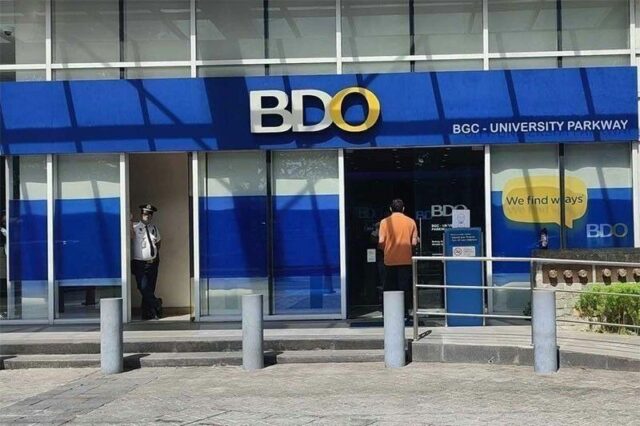
BDO UNIBANK, Inc. has expanded its partnership with Shizuoka Bank Ltd. to boost trade and investment with Japanese companies in the country.

“The expanded partnership with Shizuoka Bank enables companies to connect with the right partners, streamline financial transactions and navigate regulatory landscapes,” it said in a statement on Thursday.

“This demonstrates BDO’s commitment to accelerate trade and investments and strengthen vital industries contributing to the nation’s economic development,” it added.

The parties signed a memorandum of understanding to enhance the business alliance and support Japanese firms in the Philippines.

Under the expanded partnership, Shizuoka Bank expects a bigger client base in the Philippines through additional investments and business matching initiatives.

“With Japan increasing its demand for skilled Filipino workers, BDO and Shizuoka Bank will provide the needed support to overseas Filipino workers including technical intern trainees, specified skilled workers and professionals employed in Japan,” BDO said.

Shizuoka Bank has 177 branches and 26 subbranches in the Shizuoka Prefecture, as well as in Japan’s three major economic hubs — Tokyo, Osaka and Nagoya.

The lenders partnered in 2016 to provide financial solutions to Japanese customers.

BDO’s attributable net income climbed 11.73% to P82.02 billion last year on the back of the solid performance of its core businesses.

Its shares went up P2.10 to close at P150.50 each. — Aaron Michael C. Sy

Actor Gene Hackman and wife found dead at home

Gene Hackman in a scene from the 2003 film Runaway Jury.

GENE HACKMAN, the intense character actor who won two Oscars in a more than 60-year career, has died alongside his wife, pianist Betsy Arakawa, and their dog at home, the sheriff’s office in Santa Fe, New Mexico, said on Thursday.

The county sheriff’s office said deputies had found the 95-year-old actor and Ms. Arakawa, 64, deceased on Thursday afternoon at around 1:45 p.m.

“Foul play is not suspected as a factor in those deaths at this time, however exact cause of death has not been determined. This is an active and ongoing investigation by the Santa Fe County Sheriff’s Office,” it said.

Mr. Hackman, a former Marine known for his raspy voice, appeared in more than 80 films, as well as on television and the stage during a lengthy career that started in the early 1960s.

He earned his first Oscar nomination for his breakout role as the brother of bank robber Clyde Barrow in 1967’s Bonnie and Clyde. He was also nominated for best supporting actor in 1971 for I Never Sang for My Father.

It was his turn as Popeye Doyle, the rumpled New York detective chasing international drug dealers in director William Friedkin’s thriller The French Connection, that assured his stardom and a best actor Academy Award.

He also won a best supporting actor Oscar in 1993 as a mean sheriff in the Clint Eastwood western Unforgiven, and was nominated for an Academy Award for his turn as an FBI agent in the 1988 historical drama Mississippi Burning.

Mr. Hackman could come across on the screen as menacing or friendly, working with a face that he described to the New York Times in 1989 as that of “your everyday mine worker.”

A method actor, he drew from his personal experience to flesh out a role. His characters were sometimes raw and violent and ranged from a small-town basketball coach in the 1986 sports film Hoosiers to Superman’s archrival Lex Luthor.

He retired in his 70s, saying the parts he was offered were too grandfatherly. His last substantial role was in the 2004 comedy Welcome to Mooseport.

Living outside Santa Fe, New Mexico, Mr. Hackman was married twice and had three children — Christopher, Elizabeth Jean and Leslie Anne, with his late ex-wife, Faye Maltese, who died in 2017. He married Ms. Arakawa in 1991. — Reuters

PXP Energy cuts net loss to P30.9M in 2024 on higher sales, cost reductions

PXPENERGY.COM.PH

PANGILINAN-LED PXP Energy Corp. narrowed its attributable net loss to P30.9 million for 2024 from P97 million a year earlier, driven by higher petroleum sales volume, reduced overhead costs, and lower net interest expenses.

The company’s core net loss stood at P33.3 million during the period, lower than the P42.5 million recorded in 2023, PXP said in a statement on Thursday.

The reduction was attributed to “higher volume lifted, a reduction in overhead, and lower net interest expense.”

Petroleum revenues rose by 6% to P67 million, driven by higher output sold at 498,126 barrels of oil. This was partially offset by a slight decline in the average crude oil price to $79.97 per barrel from $80.50 per barrel previously. The crude was sourced through Service Contract (SC) 14C-1 Galoc. 

SC 14C-1 is a block containing the producing Galoc Oil Field, situated offshore Northwest Palawan. The oil field has yielded approximately 24.2 million barrels since production began in October 2008, according to PXP.

Costs and expenses declined by 10.5% to P91.8 million, primarily due to significant reductions in both production costs and recurring overhead, which fell to P37.5 million and P54.4 million, respectively.

Amid ongoing geopolitical tensions, PXP and Forum Energy Limited reiterated their commitment to SC 72 and SC 75 despite the extended force majeure on both blocks.

The company holds a 50% operating interest in SC 75, located in Northwest Palawan. Forum Energy, through its wholly owned subsidiary Forum (GSEC 101) Limited, has a 70% operating interest in SC 72 Recto Bank, offshore West Palawan. 

PXP Chairman Manuel V. Pangilinan said the company remains unable to proceed due to the moratorium.

“We can’t do anything when the moratorium is there because we don’t own the asset. It’s owned by the government. Service contracts [are] given to us by the government as [a] concessionaire,” Mr. Pangilinan told reporters on Monday. 

He added that the company could initiate discussions with China National Offshore Oil Corp. (CNOOC), China’s state-owned oil producer, to explore possible action.

“Probably, there has to be some, I guess, some conversation between the Chinese government first. But what we might be able to do is we’ll talk to CNOOC, our counterpart, because it’s an enterprise-to-enterprise [arrangement] as [the] private sector,” he said.

PXP and CNOOC previously held talks on a potential joint oil and gas development in the South China Sea.

Meanwhile, PXP and its joint venture partners are anticipating the imminent awarding of two pre-determined areas (PDAs) offered by the government for petroleum exploration. 

A joint venture comprising PXP, The Philodrill Corp., Sunda Energy Plc (United Kingdom), and operator Triangle Energy (Global) Limited (Australia) has submitted bid documents for petroleum exploration in two PDAs located in the Sulu Sea Basin.

“The company is also actively assessing the feasibility of SC 40’s Dalingding prospect, located onshore in northern Cebu, and will continue to evaluate other oil and gas projects within the Philippines.”

SC 40, also known as the North Cebu Block, is situated in the Visayan Basin, which the Department of Energy considers among the “most prospective in the country,” second only to the producing Northwest Palawan Basin. — Sheldeen Joy Talavera

No, celebrities are not the problem

PHILIPPINE STAR/EDD GUMBAN

RECENT pre-election surveys indicate a significant shift in the Philippine political landscape, with media celebrities poised to secure a substantial number of Senate seats in the upcoming May 2025 elections. According to data from the Philippine Center for Investigative Journalism (PCIJ), if current trends persist, 11 out of the 24 Senate seats could be occupied by popular figures from the news, entertainment, and sports sectors.

Notably, incumbents such as actors Robin Padilla and Jinggoy Estrada, along with broadcaster and YouTuber Raffy Tulfo, are expected to retain their positions. News broadcasters Erwin and Ben Tulfo (Raffy Tulfo’s brothers) and former Senate President (and former TV comedian) Vicente Sotto III are leading in recent Pulse Asia surveys, with over 50% of respondents expressing support for their candidacies.

This trend underscores a growing voter preference for candidates with a strong media presence and public recognition, challenging traditional notions of political qualifications. Yet, instead of reckoning with this reality, Filipino liberals continue to react with frustration, repeating the same tired complaint: Why do we keep electing actors and artists into the Senate?

This reaction isn’t just condescending — it’s politically shortsighted. The assumption that actors are inherently unqualified ignores both the nature of electoral politics and the reality that voters aren’t looking for policy technicians; they’re looking for leaders who resonate with them. By refusing to adapt to this political psyche, Filipino liberals widen the gap between their brand of politics and the mass electorate, leaving a vacuum that conservatives and populists readily exploit.

It’s time to rethink this outdated, elitist view. The problem isn’t that actors enter politics — it’s that Filipino liberals refuse to understand why they win.

POLITICS IS ABOUT POWER
There’s a common misconception that senators should be policy experts. In truth, legislative work is a collective effort, involving legal teams, think tanks, and technical advisors. What matters in electoral politics isn’t whether a candidate can draft a bill from scratch but whether they have the influence and political capital to push policies forward.

This is why actors and media personalities make effective politicians: they already understand how to communicate, how to command public attention, and how to shape narratives. These are essential political skills — arguably more crucial in a democracy than technical expertise.

This isn’t a uniquely Filipino phenomenon either. Around the world, actors have transitioned into politics and left significant legacies.

In the US, Ronald Reagan evolved from an actor to the Governor of California before becoming one of the most impactful US presidents. Arnold Schwarzenegger similarly leveraged his fame to win California’s governorship, where he championed bipartisan policies on climate change and infrastructure. In the UK, Oscar-winning actress Glenda Jackson became a Labor MP, advocating fiercely for social justice and public housing. Meanwhile, Volodymyr Zelenskyy, once a comedian portraying a fictional president, now leads Ukraine through one of the most consequential wars of the 21st century.

None of these figures were dismissed outright for their backgrounds in entertainment. They were instead evaluated on their ability to mobilize public support and navigate power structures. Filipino liberals, in contrast, still cling to a narrow definition of “qualification” that isolates them from the realities of electoral politics.

HOW CONSERVATIVES EXPLOIT THIS LIBERAL BLIND SPOT
This elitist attitude does more than alienate voters — it also plays right into the hands of conservative populists. By positioning themselves as the defenders of “serious” politics, liberals reinforce the idea that they are disconnected from ordinary Filipinos, while populists and right-wing figures brand themselves as the true representatives of the people.

UP Diliman research conducted by Dave Centeno on parasocial relationships — where audiences develop one-sided emotions and bonds with celebrities — suggests that these figures resonate with voters because they feel personally connected to them. A study on Philippine political campaigns found that celebrities bring an added level of emotional engagement that traditional politicians struggle to replicate.

This is exactly how figures like Donald Trump weaponized mass appeal against political elites in the US. His critics mocked his reality TV background, but that same media savvy made him an unstoppable force in modern politics. The more traditional politicians dismissed him, the more he gained credibility as an anti-elite figure.

In the Philippines, conservatives and populists use a similar strategy. Every time a liberal intellectual scoffs at an actor running for Senate, it feeds the narrative that the opposition is a club for the privileged few — disconnected from the masses and allergic to popular culture.

STOP COMPLAINING AND START ADAPTING
If Filipino liberals want to remain relevant, they need to stop looking down on the electorate and start learning how to engage with them. Instead of dismissing celebrity candidates outright, they should be asking: What makes these figures resonate with voters? How can we harness the same emotional and cultural power in our own political messaging?

Filipino liberals need to abandon the lazy complaint that actors shouldn’t be in politics. Electoral politics is about power, influence, and decision-making — not just drafting bills. The real question isn’t whether actors should run, but why liberal candidates fail to match their appeal.

If liberals continue to operate within an intellectual bubble, they will keep losing elections and ceding ground to populists. The challenge isn’t to shame voters into rejecting celebrities — it’s to meet them where they are, understand what moves them, and build a political movement that embraces both competence and charisma.


Jam Magdaleno is a political communications expert and the head of the Information & Communications unit at the Foundation for Economic Freedom, a Philippine-based policy think tank.

Chinabank posts record 2024 net income

BW FILE PHOTO

CHINA Banking Corp.’s (Chinabank) net income rose 12.7% to a record P24.8 billion last year, amid sustained core business growth.

Its common equity tier 1 ratio was 15.3%, while total capital adequacy ratio was 16.2%, the Philippine lender said in a statement on Thursday.

The publicly listed lender did not provide financial figures for the fourth quarter.

“Our ongoing business transformation as well as solid fundamentals will allow us to sustain our growth in the coming years,” Chinabank President and Chief Executive Officer Romeo D. Uyan, Jr. said.

The bank’s full-year performance translated to a return on equity of 15.6% and return on assets of 1.6%, according to its financial statement.

Net interest income rose 18.7% year on year to P63.54 billion due to asset base expansion. Net interest margin stood at 4.5%. Revenue increased 21.1% to P65.49 billion.

Operating expenses went up 20.43% to P30.07 billion amid continued investments in manpower and technology, and volume-related taxes. Its cost-to-income ratio was 47%.

Gross loans rose 18.55% to P916.23 billion from a year earlier as demand from all segments increased.

“Taking a more proactive stance against portfolio risks despite the easing of its nonperforming loan (NPL) ratio to 1.6%, the bank also increased its credit provisions to P3.3 billion,” Chinabank said. “The resulting NPL coverage was higher at 139%.”

Total deposits rose 12.2% to P1.33 trillion from 2023, while assets expanded 11.4% to P1.65 trillion. Total capital went up 12.2% to P168.5 billion.

The lender’s liquidity coverage ratio fell to 110.67% from 127.02%.

“With ample liquidity and a solid capital structure, we can confidently support our institutional and retail customers and advance our growth strategies, while ensuring financial stability through market volatilities and economic challenges,” Chinabank Chief Finance Officer Patrick D. Cheng said in the statement.

The bank doubled its stock price last year due to its strong performance and investor confidence, it said. Book value per share rose 12% to P62.61.

Chinabank shares fell five centavos to close at P86.50 each. — Aaron Michael C. Sy

Buffy the Vampire Slayer’s Michelle Trachtenberg, 39

MICHELLE TRACHTENBERG, an American actor known for her roles in the television series Buffy the Vampire Slayer and Gossip Girl, died on Wednesday, according to her public relations team.

“It is with great sadness to confirm that Michelle Trachtenberg has passed away. The family requests privacy for their loss. There are no further details at this time,” the statement said.

The cause of Ms. Trachtenberg’s death is not known.

The actor was born on Oct. 11, 1985, in New York City to Jewish immigrant parents.

As a child, Ms. Trachtenberg got her start in Hollywood when she was three years old in commercials and her television debut was in the Nickelodeon series The Adventures of Pete & Pete in 1994.

At 10 years of age, she landed her first title role in the 1996 movie Harriet the Spy.

She had roles in several Nickelodeon productions leading up to her being cast in the cult classic EuroTrip in 2004 when she was in her early twenties.

Then came the roles she is best known for, including the character Dawn Summers in the WB supernatural drama Buffy the Vampire Slayer in 2000 and as Georgina Sparks on the CW television series Gossip Girl in 2007.

Some of her other roles include television films Killing Kennedy, Sister Cities, and the science fiction film The Scribbler.

Ms. Trachtenberg also appeared in music videos from emo-rock band Fall Out Boy for their song “This Ain’t a Scene, It’s an Arms Race,” and the Joaquin Phoenix-directed music video for “Tired of Being Sorry” by Ringside. — Reuters

Higher costs cut Philex Mining’s 2024 profit to P810M, down 20%

PHILEXMINING.COM.PH

PANGILINAN-LED Philex Mining Corp. saw its attributable net income decline by 20% to P810 million in 2024 from P1.02 billion a year earlier, as higher costs outpaced revenue growth.

Core net income also dropped 22% to P746 million from P963 million, the company said in a disclosure.

While revenues grew 6% to P8.18 billion from P7.73 billion, operating costs and expenses climbed 9% to P7.3 billion, driven by higher production costs, increased depletion and depreciation, and rising administrative expenses.

Philex reported that depletion, amortization, and depreciation expenses surged to P904.6 million from P698.4 million in 2023.

Production costs increased to P5.61 billion from P5.21 billion, while excise taxes and royalties edged up to P523.98 million from P522.5 million. General and administrative expenses also rose to P260.39 million from P242.42 million.

Despite these cost pressures, the company said higher global gold and copper prices helped offset some of the impact. Gold prices reached $2,419 per ounce in the fourth quarter, while copper peaked at $4.57 per pound before settling at an average of $4.32 per pound for the year.

Philex also noted that its total tonnage milled in 2024 was slightly lower at 6.81 million tons, compared with 6.85 million tons in 2023.

Meanwhile, the company reported progress on its Silangan Project in Surigao del Norte, saying that the underground main access decline has reached the Santa Barbara 1 ore body. Key processing equipment, including a SAG mill and atmospheric leach feed thickener, has been delivered and is ready for installation.

“In 2025, we will navigate the challenges of operating an old yet viable mine like Padcal and commissioning a new mine like Silangan,” Philex Mining President and Chief Executive Officer Eulalio B. Austin, Jr. said.

Philex Mining shares closed 1.99% lower at P4.93 apiece on Thursday. — Kyle Aristophere T. Atienza

A growing appetite: 5 lessons to learn before jumping into the restaurant business

FACEBOOK.COM/MAMALOUS

There’s something about the restaurant biz that calls out to Filipinos. In my many conversations with entrepreneurs, restaurateurs and aspiring entrepreneurs and restaurateurs, their passion for food always rises to the forefront. It’s a testament to how rich Filipino food culture is, that so many of us want to put up a restaurant or food business based on their special secret recipe or their lola’s iconic dish.

With such a deep and strong food culture, the food service industry in the Philippines is booming. Our appetite for new cuisine is bottomless, and the industry is expected to grow at a compound annual growth rate of 13% between 2022 to 2027.

Evidence of this growth is all around us. It seems that there is no end to the new restaurants opening almost every week. But before we all quit our day jobs to pursue that passion of starting our own cafe or launching “The Potato Corner of X,” just how hard is it to succeed in the highly competitive restaurant business? And is there a recipe for success?

Recently, I spoke to restaurateur David Sison, the co-founder of Mama Lou’s and president of the Restaurant Owners of the Philippines. He has such a wealth of experience in establishing restaurants — and, more importantly, succeeding with each. With Mama Lou’s he grew a humble Italian pizza parlor into a restaurant chain with 29 locations and five more on the way this year. Expanding beyond Italian cuisine, he is now venturing into Filipino, halal-certified, Cantonese, and even brewery concepts. His businesses include Famu, Nonna’s, Fatima Halal, Braubass, and more. David’s journey offers invaluable business lessons for aspiring restaurateurs.

LESSON 1: FAILURE IS A STEPPING STONE TO SUCCESS
David wasn’t always in the restaurant business. Before finding success with Mama Lou’s, he dabbled in various businesses, from an internet café to buy-and-sell ventures. These early entrepreneurial efforts, however, ended in failure.

Despite these setbacks, David remained committed to learning and improving. When he saw the potential in Mama Lou’s, he took a different approach, crafting a solid business plan and securing investors rather than simply borrowing money. His early failures taught him that business success requires not just passion but also proper financial planning and operational discipline.

LESSON 2: FINDING THE RIGHT BUSINESS OPPORTUNITY
David attributes much of Mama Lou’s success to identifying the right market gaps. At the time of its expansion, there were few Italian restaurant brands offering authentic, high-quality ingredients at scale.

“I saw that there were not a lot of Italian restaurants that had scale. Many were focused on what was readily available rather than sourcing the best possible ingredients,” David explained. By emphasizing authentic flavors and consistent quality, Mama Lou’s carved out a strong niche in the competitive restaurant industry.

LESSON 3: THE IMPORTANCE OF PROFESSIONALIZING A BUSINESS
In the early years of Mama Lou’s, David recognized a critical challenge: inconsistency. The restaurant’s success relied heavily on the chef, leading to fluctuations in food quality. To address this, he applied what he learned from his Master’s in Entrepreneurship at De La Salle University — building standardized systems and processes.

“The pandemic really taught us to professionalize the business, to focus on the foundation, and to build systems,” David shared. This approach enabled the company to scale efficiently, ensuring that quality and customer experience remained consistent across multiple locations.

LESSON 4: PEOPLE ARE THE HEART OF THE BUSINESS
While food quality is crucial, David believes the real secret to restaurant success is people — both customers and employees. “Business is really all about life. It’s all about how you make people feel,” David said, citing renowned restaurateur Danny Meyer.

Mama Lou’s built its reputation not just on great food but on a warm, hospitable dining experience. David ensures that his team is composed of individuals who embody kindness, empathy, and optimism. To institutionalize this, he developed a hiring framework based on five “gifts of hospitality”: eye contact, genuine smiles, enthusiasm, welcoming hand gestures, and confident posture.

“When you scale so fast, you tend to compromise. You may get managers who can hit numbers, but if they don’t align with your values, your customer service suffers,” David emphasized. He learned that hiring the right people from the start is crucial to maintaining the company’s culture as it grows.

LESSON 5: STRATEGIC PLANNING IS NON-NEGOTIABLE
David admits that his natural inclination is to juggle multiple projects at once, sometimes leading to burnout for himself and his team. He learned the hard way that execution without a clear plan leads to failure.

“The lack of planning leads to stress. You cannot execute well if you don’t have a plan,” David noted. Before expanding, he conducted thorough market research, and it is this level of preparation that made Mama Lou’s expansion a calculated, strategic move rather than a leap into the unknown.

David Sison’s journey is a masterclass for Filipinos who want to get into the restaurant business. Entrepreneurs can learn much from David’s story: start with a strong foundation, invest in systems, and above all, prioritize people.


RJ Ledesma (www.rjledesma.com) is a Hall of Fame Awardee for Best Male Host at the Aliw Awards, a multi-awarded serial entrepreneur, motivational speaker, and business mentor, podcaster, an Honorary Consul, and editor-in-chief of The Business Manual. Mr. Ledesma can be found on LinkedIn, Facebook and Instagram. The RJ Ledesma Podcast is available on Facebook, Spotify, Google and Apple Podcasts.

ledesma.rj@gmail.com