Home Blog Page 1417

Man who stabbed novelist Salman Rushdie guilty of attempted murder

SALMAN RUSHDIE — COMMONS.WIKIMEDIA.ORG

MAYVILLE, New York — Hadi Matar, the man who stabbed and partially blinded the novelist Salman Rushdie onstage at a New York arts institute, was found guilty on Friday of attempted murder.

Mr. Matar, 27, can be seen in videos of the 2022 attack rushing the Chautauqua Institution’s stage as Mr. Rushdie was being introduced to the audience for a talk about keeping writers safe from harm, some of which were shown to the jury during the seven days of testimony.

Mr. Rushdie, 77, was stabbed with a knife multiple times in the head, neck, torso, and left hand, blinding his right eye and damaging his liver and intestines, requiring emergency surgery and months of recovery.

The writer was among the first to testify at the Chautauqua County Court in Mayville, calmly describing to jurors how he believed he was going to die and showing them his blinded eye by removing his adapted spectacles with a blacked-out right lens.

Mr. Matar was found guilty of attempted murder in the second degree and assault in the second degree for stabbing Henry Reese, the co-founder of Pittsburgh’s City of Asylum, a non-profit group that helps exiled writers, who was conducting the talk with Mr. Rushdie that morning.

He will be sentenced on April 23, and faces up to 25 years in prison.

Speaking after the verdict, Chautauqua County District Attorney Jason Schmidt praised the scores of audience members who rushed to Mr. Rushdie’s aid when he was attacked.

“The Chautauqua Institution community, which I believe saved Mr. Rushdie’s life when they intervened, I would say to you that this entire community deserved swift justice here, and I’m glad that we were able to achieve that for them.”

Nathaniel Barone, a public defender representing Mr. Matar, said his client was disappointed by the verdict.

“The video, I think, was extremely damaging to Mr. Matar,” Mr. Barone said outside the courtroom, referring to the video of the attack that was shown repeatedly to jurors, sometimes in slow motion. “It’s that old expression, a picture is worth a thousand words.”

Mr. Rushdie, an atheist born into a Muslim Kashmiri family in India, has faced death threats since the 1988 publication of his novel The Satanic Verses, which Ayatollah Ruhollah Khomeini, then Iran’s supreme leader, denounced as blasphemous.

After the knife assault, Mr. Matar told the New York Post that he had traveled from his home in New Jersey after seeing the Rushdie event advertised because he disliked the novelist, saying Mr. Rushdie had attacked Islam.

Mr. Matar, a dual citizen of his native US and Lebanon, said in the interview that he was surprised Mr. Rushdie had survived, the Post reported.

Mr. Matar did not testify at his trial. His defense lawyers told jurors that the prosecutors had not proved beyond reasonable doubt the necessary criminal intent to kill needed for a conviction of attempted murder, and argued that he should have been charged with assault.

Mr. Matar also faces federal charges brought by prosecutors in the US attorney’s office in western New York, accusing him of attempting to murder Mr. Rushdie as an act of terrorism and of providing material support to the armed group Hezbollah in Lebanon, which the US has designated as a terrorist organization.

Mr. Matar is due to face those charges at a separate trial in Buffalo. — Reuters

Manila Water says profit jumped to P10.5B in 2024

MANILA WATER

RAZON-LED Manila Water Co., Inc. reported an attributable net income of P10.5 billion for 2024, up 88% from the previous year, driven by higher revenues from its East Zone concession and substantial contributions from its non-East Zone businesses.

Revenues increased by 19% to P36.6 billion, fueled by higher billed volume and the implementation of tariff adjustments in the East Zone concession and several non-East Zone Philippines businesses, the company said in a media release on Monday. 

The majority of its topline, or P36.65 billion, came from water and wastewater services. 

Meanwhile, costs and expenses rose by 9% to P11.8 billion.

“The solid foundation laid in recent years allowed us to achieve remarkable results in 2024. I am particularly buoyed by the solid growth of our Non-East Zone businesses, which more than tripled earnings to surpass the P2-billion mark,” Manila Water President and Chief Executive Officer Jose Victor Emmanuel “Jocot” A. de Dios said.

Manila Water provides water supply, wastewater, and sanitation services to over 7.3 million customers in 23 cities and municipalities in the East Zone of Metro Manila and Rizal province. 

Outside the East Zone, Manila Water operates in Laguna, Clark, Boracay, and Estate Water. The company said it had “a banner year” in 2024, with earnings surging more than threefold to P2.3 billion from P750 million in the prior year.

“This impressive performance was fueled by an 8% increase in billed volume, tariff adjustments, and stronger contributions from key business units, pushing revenues past P9 billion,” Manila Water said.

On the other hand, its international business recorded lower contributions from minority investments in Thailand and Vietnam. The company said it continues to assess its international portfolio while exploring opportunities for long-term value creation.

For 2024, group capital expenditures reached P26.3 billion, with the East Zone concession accounting for 90% of the total. — Sheldeen Joy Talavera

Exiting the FATF grey list and getting credit ratings to ‘A’

FREEPIK

Last week, on Feb. 21, the Philippines was taken off the Financial Action Task Force’s (FATF) grey list. That is good. The FATF is the global anti-money laundering watchdog, and the Philippines has been on the FATF grey list since June 2021.

Department of Finance (DoF) Secretary Ralph G. Recto is correct in his exuberance saying that “This is a landmark achievement of the Marcos Jr. administration. It’s a seal of good housekeeping that strengthens public confidence in our financial system. This will directly benefit our remitting overseas Filipino workers, businesses, and the Filipino people… we will attract more foreign direct investments and expand more trade partnerships that will help accelerate economic growth. With this momentum, our next goal is clear — a credit rating upgrade within the Marcos Jr. Administration.”

The DoF is a member of the National Anti-Money Laundering (AML) Coordinating Committee (NACC), Counter-Terrorism Financing (CTF), Counter-Proliferation Financing (CPF) — the inter-agency body responsible for overseeing the National AML/CTF/CPF Strategy (NACS) and guiding its implementation across relevant agencies.

On this development, see these related reports in BusinessWorld: “Investor sentiment likely to improve as Philippines is removed from ‘gray list,’” by Luisa Maria Jacinta C. Jocson (Feb. 24), and “Philippines exits global watchdog’s dirty money ‘gray list’” (Feb. 23).

The prevalence of Philippine Offshore Gaming Operators (POGO) in recent years was the main factor for the Philippines’ inclusion in the grey list. The POGOs were involved in lots of money laundering activities, so when President Ferdinand “Bongbong” Marcos, Jr. banned them last year, it was a good move.

The next entry point of big money laundering in the country would be illicit trade in tobacco, oil, jewelry, and other consumer goods — with hundreds of billions of pesos yearly lost in foregone taxes. The government should crack down on these to avoid landing on the grey list again someday.

Recently, both the Bureau of Customs (BoC) and Bureau of Internal Revenue (BIR) issued separate but related statements on illicit trade. “BoC Chief Rubio vows heads will roll after discovery of attempted resale of seized cigarettes” (Feb. 22), and “Commissioner Lumagui orders nationwide destruction of P2.1B worth of illicit cigarettes” (Feb. 24). These statements were about the attempted resale of P270 million worth of BoC-seized contraband cigarettes from Capas, Tarlac, and P2.1 billion of BIR-seized illicit tobacco. These two incidents alone would need large-scale money laundering schemes before the funds could be happily enjoyed by the smugglers and criminal groups. The BoC and BIR are both under the DoF, so they must have seen the Finance department’s clear signal to avoid getting on the FATF grey list again.

GETTING AN ‘A’
The economic team has targeted making the Philippines get an “A” rating from any of the three big ratings agencies — Fitch, Moody’s, and S&P.

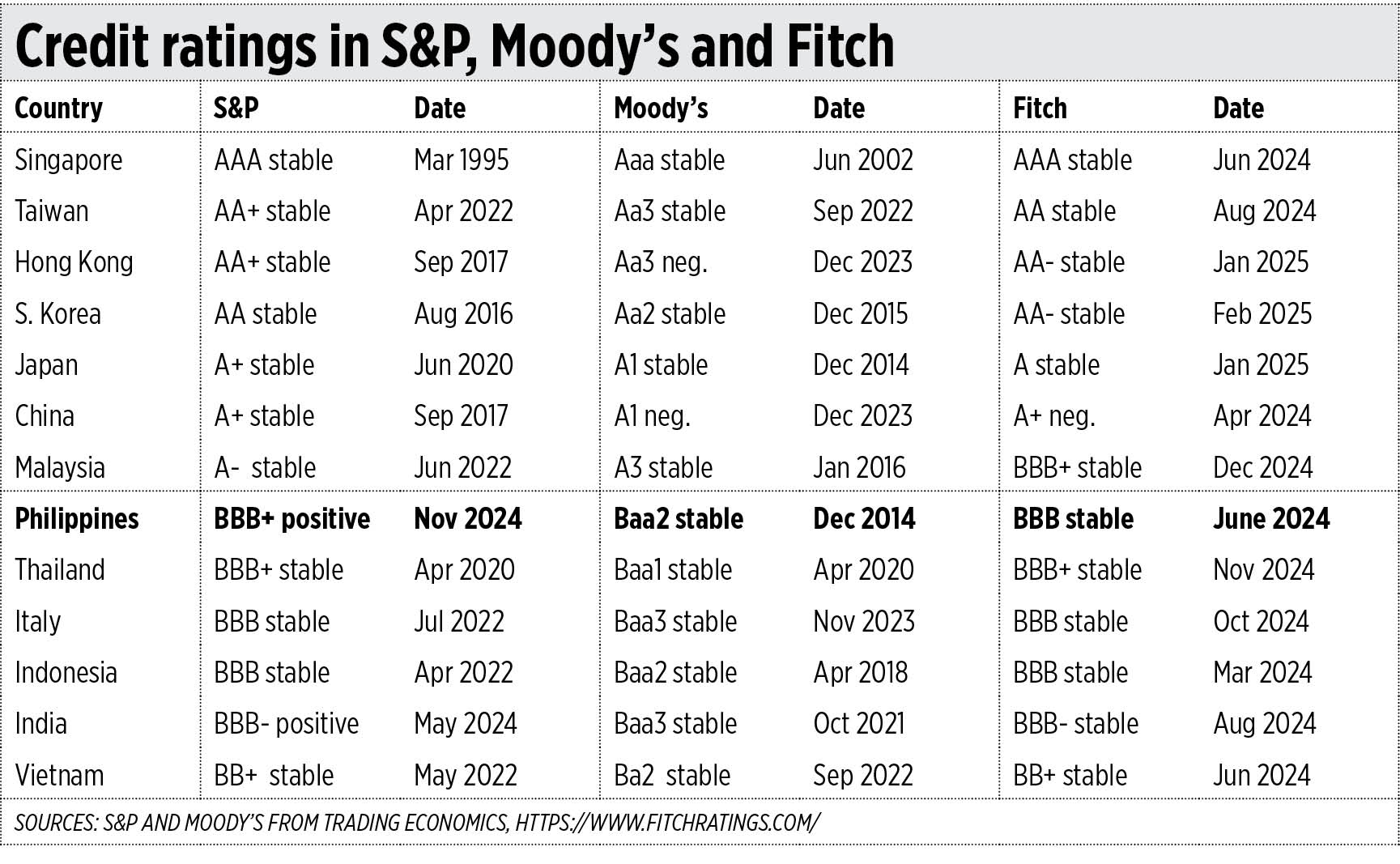
I reviewed the latest credit ratings of major East Asian economies. The Philippines is “BBB+ positive” according to S&P or just one step from “A,” is “Baa2 stable” with Moody’s or two steps away from “A3,” and “BBB stable” as per Fitch or two steps from “A-.”

And the Philippines has higher ratings than Thailand and even Italy under S&P. Surprisingly, Vietnam and India, which were the two fastest growing major economies in the world in 2023 and 2024, have lower credit ratings (see the table).

Budget Secretary Amenah F. Pangandaman said in a Viber message that “a Philippines ratings upgrade to ‘A’ from any of those three agencies would mean lower cost of borrowings for us to help finance the budget deficit and finance important social and infrastructure projects.”

This is a reiteration of her previous position as reported here, “Public-finance roadmap to help elevate PHL to ‘A’ credit rating — Budget dep’t” (BusinessWorld, Sept. 17, 2024).

Of course, I would prefer that we significantly cut expenditures, cut the yearly deficit, and hence cut the need for more borrowing whether at low or high interest rates. But in the absence of this scenario, low-cost borrowings via a ratings upgrade to “A” is preferable.


Bienvenido S. Oplas, Jr. is the president of Bienvenido S. Oplas, Jr. Research Consultancy Services, and Minimal Government Thinkers. He is an international fellow of the Tholos Foundation.

minimalgovernment@gmail.com

Pueblo de Oro invests P3.7B in Batangas residential project

REAL ESTATE developer Pueblo de Oro has allocated P3.7 billion for the development of a 13-hectare (ha) residential project in Batangas City.

“Pueblo de Oro Westwoods Heights is set to become the preferred address in Batangas City, offering unparalleled accessibility, scenic views, modern amenities, and timeless architecture,” it said in a Feb. 18 statement.

The low-density residential project, located in Barangay Tinga Itaas, Batangas City, is expected to generate approximately P6 billion in revenues, the developer said in an e-mail.

Pueblo de Oro Westwoods Heights will comprise 548 units, including 475 house-and-lot units and 73 open lots. Buyers may choose between single-attached or single-detached homes, both designed for flexibility and customization.

The project’s distinctive house designs and hillside lots maximize scenic views and the natural topography, according to the developer.

The single-attached homes will have a lot area of 88 square meters (sq.m.) and a floor area of 66 sq.m., with a selling price of approximately P4.04 million and a total contract price of P4.81 million.

Meanwhile, the single-detached homes will have a lot area of 110 sq.m. and a floor area of 66 sq.m., priced at P4.48 million, with a total contract price of P5.34 million.

Around 40% of the developable area will be dedicated to open spaces, including pocket parks and roads.

Amenities will include a linear park, a clubhouse with a function hall, an activity room, an administrative and security office, a swimming pool, a children’s playground, a basketball court, and jogging lanes.

“Westwoods Heights is also an idyllic option for families from further south, including Mindoro, seeking a home in Batangas City or near Lipa City,” it said.

The area is less congested than other urban centers in the region while offering access to schools, employment opportunities, and commercial establishments.

Westwoods Heights is strategically situated along the Southern Tagalog Arterial Road (STAR) Tollway, just 2.7 kilometers from Jose P. Laurel Highway, providing convenient access to key cities such as Lipa, Tanauan, and Sto. Tomas.

The upcoming Tinga Itaas Exit is expected to reduce travel time from the STAR Tollway to Tinga Itaas from over 20 minutes to just five minutes, significantly improving connectivity to Metro Manila. — Beatriz Marie D. Cruz

GSIS net income climbs 21% to P135.7 billion in 2024

GSIS FACEBOOK PAGE

THE GOVERNMENT Service Insurance System’s (GSIS) net income from operations climbed by 21% to P135.7 billion in 2024 from P112.1 billion in 2023.

“Total income increased to P326.86 billion, a 10.29% rise year on year, fueled by strong returns on investments and insurance operations,” GSIS said in a statement on Monday.

Gains from its investments included P13.27 billion from foreign exchange, P11.24 billion from global private equity investments through external fund managers, and P3.09 billion from local equity investments, it said.

“We maintain a prudent investment strategy, allocating 70% of our portfolio to government securities and other fixed-income instruments. The remaining 30% is strategically placed in higher-yielding investments, including equities, real estate, and other vehicles, all managed within our strict risk parameters,” GSIS President and General Manager Jose Arnulfo A. Veloso said.

“This balanced approach ensures both stability and growth, supporting our fund life, which extends until 2058.”

It added that its insurance business showed “significant strength” last year, with gross premiums written reaching P10.6 billion, above its P8.5-billion target.

“The organization maintains its position as the largest state insurer, boasting a net worth of P62 billion,” GSIS said.

It also disbursed P179.92 billion in claims and benefit payments.

Meanwhile, administrative expenses went down to P8.92 billion in 2024 from P10.14 billion a year prior. “This improved the administrative cost ratio from 3.7% to 3%, even as GSIS successfully filled 91% of its authorized positions,” GSIS said.

The state-run pension fund’s assets expanded by 9.23% to P1.83 trillion at end-2024. Its financial assets went up by P101.6 billion, while cash and cash equivalents rose by P30.54 billion, it said.

Total loans to GSIS members grew to P370.65 billion in 2024, with a 98.6% loan collection efficiency as of the third quarter.

It disbursed P315 billion in loans to 1.5 million members through its Multi-Purpose Loan (MPL) Flex and Lite programs.

“Beyond the numbers, these programs represent our commitment to provide support at critical moments. Whether it is helping fund a child’s education, addressing urgent medical needs, or ensuring financial stability during challenging times, these loans make a real difference,” Mr. Veloso said.

Meanwhile, it also extended P2.84 billion in assistance via its housing initiatives like the Lease with Option to Buy program.

“The GSIS remained strongly committed to improve lives in 2024… With prudent financial management and strategic investments, the GSIS remains in a strong position to fulfill its mandate, securing the future of its members while strengthening its role in the national economy,” the state pension fund for government workers added. — A.M.C. Sy

Argentina court clears 3 accused in singer Liam Payne’s death

AMAZON.COM

BUENOS AIRES, — An Argentine court has cleared three of the five people accused of their alleged involvement in singer Liam Payne’s death, local media reported on Thursday.

The court dismissed charges against businessman Rogelio Nores, a friend of Mr. Payne’s who reportedly acted as his manager, and two employees of the hotel where Mr. Payne died, according to local outlet Infobae.

The court also upheld the pre-trial detention of an employee of the same hotel and a waiter at a local restaurant, who have been detained since the beginning of last month.

Both are accused of plying Mr. Payne, who shot to fame as part of the boyband One Direction, with cocaine during his stay in Buenos Aires, and face up to 15 years in prison if convicted.

Mr. Payne fell to his death from a hotel balcony in October.

The court did not immediately respond to a Reuters request for comment. — Reuters

Bloomberry Resorts names Gregory Hawkins as acting COO

BLOOMBERRY.PH

Razon-led Bloomberry Resorts Corp. has appointed Gregory Francis Hawkins as the company’s acting chief operating officer (COO).

In a stock exchange disclosure on Monday, Bloomberry said its board of directors had designated Mr. Hawkins as acting COO, effective Feb. 21.

His appointment follows the resignation of Thomas Arasi as the company’s president and COO, effective Dec. 18 last year.

Mr. Hawkins, who currently heads Solaire North, was also appointed acting COO of Bloomberry’s subsidiary, Bloomberry Resorts and Hotels, Inc. (BRHI), after Mr. Arasi resigned from the board of directors of Bloomberry Resorts, BRHI, and all other positions in the company’s subsidiaries.

Bloomberry is the operator of Solaire Resort & Casino.

The company recorded an attributable net loss of P472.43 million for the third quarter of 2024, a reversal from a net income of P1.86 billion in the same period a year earlier.

Gross revenue for the third quarter reached P13.67 billion, rising 27.3% from P10.74 billion in the comparable period in 2023.

Total expenses climbed to P11.67 billion, up 55.2% from P7.52 billion in the third quarter of 2023.

For the January-to-September period, Bloomberry Resorts’ attributable net income fell 57.5% to P3.52 billion from P8.28 billion a year earlier.

During the same period, gross revenue increased 5.9% to P38.26 billion from P36.11 billion in 2023, while total expenses surged 27.1% to P29.96 billion from P23.58 billion.

At the stock exchange, Bloomberry’s shares closed 0.85% higher at P3.58 apiece. — Ashley Erika O. Jose

That online investment scam is a geopolitical problem

FREEPIK

ONLINE SCAMS are a huge business. In fact, more than that, they have become a full industry with sophisticated supply chains of services, equipment, and labor. Key groups in this sector also have direct connections to nations such as Russia, China, and North Korea. What has long seemed just a lot of low-level crime has grown into a global, geopolitical problem.

You are still your own best defense against losing money to online scammers, but the volume and sophistication of attacks are only increasing. Governments must do more to help defend their people, companies, and institutions. Cybercrime is a national security issue, and the entire system, from major hacking attacks to everyday phishing, should be taken as seriously as drug trafficking or terrorist financing.

To be fair, the problems haven’t been completely ignored, but national efforts have tended to focus on large-scale and direct ransomware attacks on states themselves, or their biggest services, such as health care. But these are just the tip of a massive iceberg.

Worldwide losses are hard to track, but potentially huge. The Global Anti-Scam Alliance, a group formed of technology and finance companies as well as specialist consultants, estimates that in the past couple of years consumers have lost more than $1 trillion each year to scammers. That’s the same as Switzerland’s gross domestic product.

“The amounts being lost and the harm being done grows every year,” Jorij Abraham, managing director of the group, tells me. “The proceeds are used to fund other types of crime but also are reinvested in better technologies to improve the scam, using for example AI, or to increase the reach of the scam, with marketing budgets of millions being used to advertise scams.”

The Google Threat Intelligence Group, part of Alphabet, Inc., reported on the links between cybercriminal groups and state interests for last weekend’s Munich Security Conference. Some state-sponsored groups have crime as a sideline to supplement their budgets, and some crime organizations are used by government on a casual basis for specific, larger-scale attacks, data thefts, or espionage. All are part of the same underground industry.

In the past few years, Abraham says researchers have seen a sharp rise in crime syndicates across the globe with a strong specialization in one type of scam, for example online shopping, investment, romance,  subscriptions and many others. Criminals continuously improve their schemes and document how they can best be executed. And then export the tools, scripts, and methods around the world.

Victims can often get hit repeatedly, too. In 2020-2021, while talking to victims of binary options trading scams, one truly shocking aspect I often heard was people’s stories of being contacted by supposed law firms with offers to help recover their losses, which turned out to be yet another drain on the savings of those who fell for it.

At that time, Abraham’s group was gathering reports about a then-new trend of mainly Taiwanese and Chinese citizens being duped by offers of well-paid work in Southeast Asia, only to find themselves trafficked as indentured labor for scam groups. “On arrival, their passports are taken, and they are sold to different groups and forced to work in offices running illegal phone or online scams,” Abraham’s global scam report for 2022 notes. “Taiwan authorities say almost 5,000 citizens have been recorded travelling to Cambodia and not returning.”

Things have gotten worse: A recent podcast series from the Economist interviewed people who had been trafficked from the Philippines, countries in Africa and elsewhere, who described their lives in a walled-off “scam town” deep in the Myanmar countryside. Relatively well-off Westerners being bilked out of their savings aren’t the only victims. 

Part of the reason governments and security services have been slow to react may be that most fraud cases are individually small, so the cost of investigating them isn’t worth it. But those small incidents still add up to big profits for the industry. In the UK, for example about 82% of cases are worth less than £1,000 ($1,260) each, but in total they still account for 12% of all losses, according to data from UK Finance, a trade group. Cases worth more than £10,000, meanwhile, make up less than 3% by number but nearly 60% of proceeds.

A major worry is that artificial intelligence (AI) tools will make all of this easier and cheaper for criminals — and will make large-scale high-value scams even more difficult to stop. Last year, an employee at a Hong Kong-based company was tricked into sending $26 million to thieves that used an AI filter on a video call to disguise themselves as the company’s chief financial officer.

Battling scams has mainly been left up to banks, which have spent heavily on compensating customers and investing in education and warning systems in countries like the UK. Finance companies in turn have been crying out for more help from internet and social media companies to track and block bad actors. AI and the spread of crypto are making these efforts less effective.

The Google Threat Intelligence Group’s recommendations for governments include stronger education and awareness campaigns to help people defend themselves as well as potentially more powers for banks and technology companies to act directly against criminal groups. In truth, countries need to start treating scams and other cybercrime like they do drug trafficking and terror. That means international cooperation on intelligence and enforcement where possible as well as choking the financial flows through banking networks and crypto exchanges.

What’s most troubling is that just as the US is turning its back on exactly this kind of cooperation and enforcement, it’s also promising to unshackle crypto and potentially diluting banks’ defenses against dirty money. Other countries will be tempted to follow suit. If that continues, criminals and unfriendly states will get rich and win, while the citizens of America and other countries will foot the bill.

BLOOMBERG OPINION

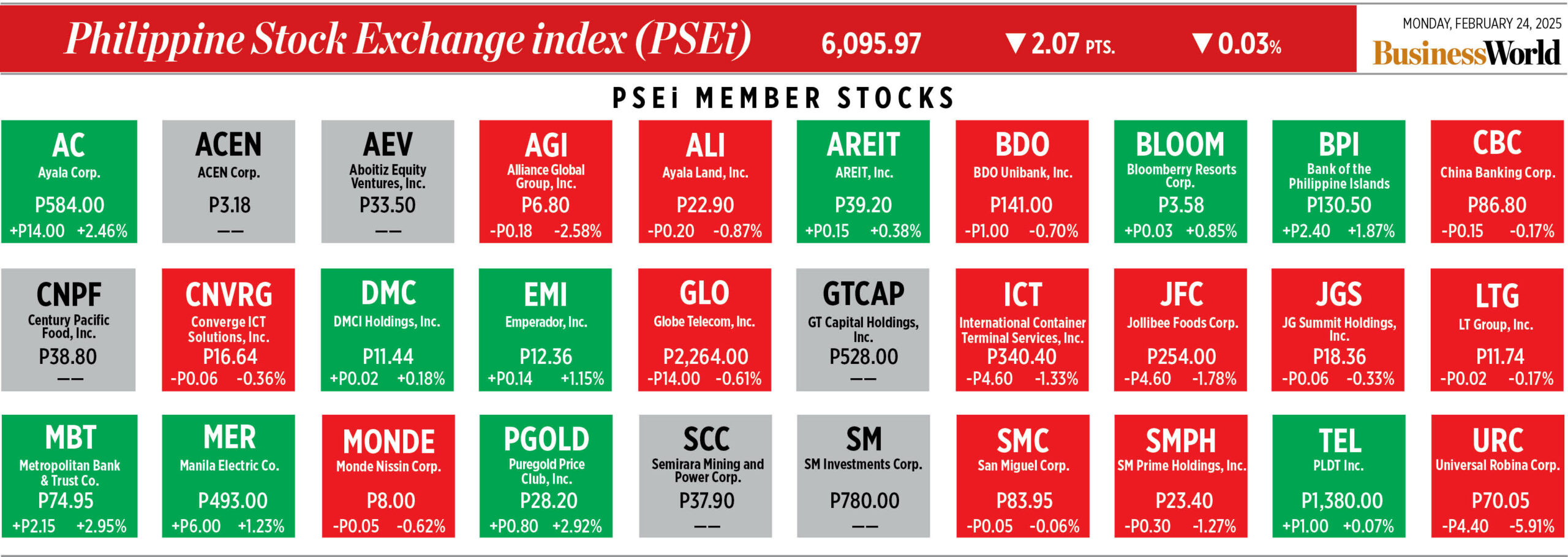
How PSEi member stocks performed — February 24, 2025

Here’s a quick glance at how PSEi stocks fared on Monday, February 24, 2025.


ACLED: Philippines remains 2nd deadliest place in East and Southeast Asia

The Philippines retained its ranking of 29th out of 244* countries and territories in the December 2024 release of the Conflict Index by Armed Conflict Location and Event Data (ACLED). The index uses four indicators of conflict that rate how deadly a country is. The country tied with Afghanistan.

ACLED: Philippines remains 2<sup>nd</sup> deadliest place in East and Southeast Asia

Peso strengthens to over 2-month high vs dollar

BW FILE PHOTO

THE PESO surged to an over two-month high on Monday on broad dollar weakness due to the euro’s strength and easing global oil prices.

The local unit closed at P57.808 per dollar on Monday, strengthening by 13.2 centavos from its P57.94 finish on Friday, Bankers Association of the Philippines data showed.

This was the peso’s strongest finish since its P57.735-per-dollar close on Dec. 6, 2024.

The peso opened Monday’s session stronger at P57.90 against the dollar. Its strongest was at P57.77, while its worst showing was at P57.95.

Dollars exchanged went down to $1.17 billion on Monday from $1.33 billion on Friday.

“The US dollar was dragged by the appreciation of the euro-dollar currency pair as a result of the election in Germany,” a trader said in a phone interview.

The dollar was generally weaker on Monday as global crude oil prices slipped, Rizal Commercial Banking Corp. Chief Economist Michael L. Ricafort added in a Viber message.

For Tuesday, the trader expects the peso to move between P57.70 and P58.10 per dollar, while Mr. Ricafort said it could range from P57.70 to P57.90.

The euro marched higher on Monday after Germany’s opposition conservatives won the national election as expected, while the dollar tumbled to its weakest in more than two months on mounting worries over the growth outlook of the US economy, Reuters reported.

Friedrich Merz was set to become Germany’s next chancellor after his party emerged victorious in Sunday’s election, though he faces complex and lengthy coalition negotiations after the far-right Alternative for Germany surged to a historic second place in a fractured vote.

The euro extended gains from early in the session to touch a one-month high of $1.0528 and last traded 0.5% firmer at $1.0512.

In the broader market, the dollar slid ahead of a busy week packed with US economic data and speeches from various Federal Reserve officials.

Trading was thin on Monday with Japanese markets closed for a public holiday.

Sterling pushed to a two-month top of $1.2690 due to the weaker greenback, while the yen similarly peaked at 148.85 per dollar, its strongest level since early December.

Against a basket of currencies, the dollar fell to a more than two-month low of 106.12.

The greenback has slid more than 3% from its January peak as traders reasoned the start of US President Donald J. Trump’s second term has been mostly bluster on tariffs, leaving little appetite for them to load up on fresh dollar holdings.

Also adding to headwinds for the dollar were falling US Treasury yields on heightened bets of more Fed cuts this year, amid growing concerns over the outlook for the world’s largest economy.

Later this week, investors will get the second estimate of fourth quarter growth figures in the US and January’s core personal consumption expenditures price index data.

Meanwhile, oil prices extended last week’s losses on Monday as investors awaited clarity on talks to end the war in Ukraine and weighed up the prospect of a resumption in crude exports from northern Iraq, Reuters reported.

Brent futures were down 14 cents or 0.2% at $74.29 barrel by 0843 GMT, while US West Texas Intermediate (WTI) crude futures lost 21 cents or 0.3% to $70.19.

Both Brent and WTI dropped by more than $2 on Friday, registering weekly declines of 0.4% and 0.5% respectively.

All eyes remain on efforts to end Russia’s war on Ukraine, which enters its fourth year on Monday. Officials said on Sunday that European Union leaders will meet for an extraordinary summit on March 6 to discuss additional support for Ukraine and European security guarantees. — A.M.C. Sy with Reuters

PHL shares inch down after Wall Street sell-off

PHILIPPINE STAR/KRIZ JOHN ROSALES

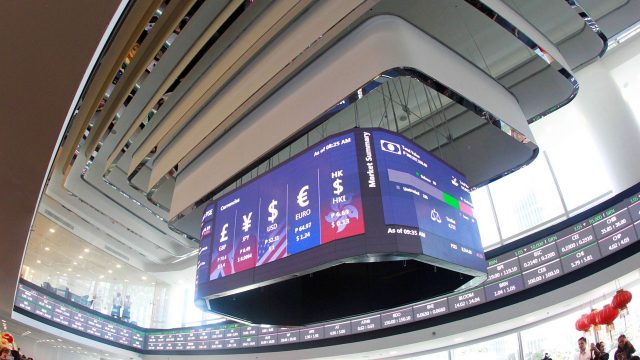
PHILIPPINE SHARES slipped on Monday following the sell-off in US markets on Friday due to tariff concerns and as investors looked for fresh catalysts.

The bellwether Philippine Stock Exchange index (PSEi) inched down by 0.03% or 2.07 points to close at 6,095.97 on Monday, while the broader all shares index declined by 0.14% or 5.28 points to end at 3,655.

“Philippine shares got off to a muted start, as the RRR (reserve requirement ratio) cut decision of the Bangko Sentral ng Pilipinas was offset by the selloff in the US last Friday,” Regina Capital Development Corp. Head of Sales Luis A. Limlingan said in a Viber message.

Seedbox Securities, Inc. Equity Trader Jayniel Carl S. Manuel said in a Viber message that the PSEi edged down as turnover was “modest.” Value turnover declined to P4.47 billion on Monday with 1.38 million shares traded from the P4.71 billion with 1.69 million issues that changed hands on Friday.

“The country’s exit from the Financial Action Task Force’s grey list provided a positive macro backdrop, reflecting progress in anti-money laundering and counter-terrorism financing efforts… However, the market is likely to remain range-bound in the short term as investors weigh ongoing economic factors and corporate performances,” Mr. Manuel said.

US stocks tumbled on Friday, extending their selloff in the wake of dour economic reports and closing the book on a holiday-shortened week fraught with new tariff threats and worries of softening consumer demand, Reuters reported.

Last week, US President Donald J. Trump said he will soon announce new tariffs covering lumber and forest products, in addition to previously announced plans to impose duties on imported cars, semiconductors and pharmaceuticals.

The Dow Jones Industrial Average fell 748.63 points or 1.69% to 43,428.02; the S&P 500 lost 104.39 points or 1.71% to 6,013.13; and the Nasdaq Composite lost 438.36 points or 2.20% to 19,524.01.

Mr. Limlingan said investors are awaiting fresh leads, including the release of US personal consumption expenditures data this week, which could affect the US Federal Reserve’s policy outlook.

“Several Fed officials are also scheduled to speak, potentially providing further insights on monetary policy. Locally, investors are anticipating the release of the latest trade balance and budget balance data, which could offer clues about the country’s fiscal and external position,” he said.

Most sectoral indices ended in the red. Industrials dropped by 0.87% or 76.76 points to 8,748.45; services went down by 0.86% or 17.17 points to 1,964.13; property declined by 0.72% or 16.29 points to 2,216.93; and mining and oil slipped by 0.05% or 4.49 points to 8,274.25.

Meanwhile, financials rose by 0.86% or 19.53 points to 2,286.16 and holding firms went up by 0.40% or 20.59 points to 5,129.78.

Decliners outnumbered advancers, 111 versus 73, while 54 names closed unchanged.

Net foreign selling went down to P632.57 million on Monday from P423.38 million on Friday. — S.J. Talavera with Reuters