Home Blog Page 1394

Sustainability, flexibility key to addressing demand for quality office spaces in Metro Manila — experts

ROBINSONSLAND.COM

By Beatriz Marie D. Cruz, Reporter

OFFICE DEVELOPERS in Metro Manila are now adjusting to market changes by prioritizing sustainability and flexibility to meet the growing demand for modern, high-quality office spaces, according to industry leaders.

“As companies increasingly adopt a flight-to-quality approach — prioritizing well-designed, thoughtfully curated, and future-ready office spaces — Robinsons Offices remains committed to elevating its portfolio to meet and exceed these expectations,” Jericho P. Go, Robinsons Land Corp. (RLC) senior vice-president and Robinsons Offices general manager, said in an e-mail.

Office transactions in Metro Manila dropped by 57% year on year in the fourth quarter, driven by the impacts of the US presidential elections and the ban on Philippine offshore gaming operators, according to property consultancy firm Colliers Philippines.

With this, office developers are called to refurbish or reinstate their office spaces to increase their marketability, Colliers said in its latest property market report.

According to Mr. Go, the competitiveness of an office space is driven by several factors, including its location, accessibility, quality and reliability of design and equipment, developer reputation, availability of space, sustainability, and its registration in the Philippine Economic Zone Authority.

In response, Robinsons Offices continues to adopt sustainability practices in its developments, he added.

“Our commitment to sustainability is evident through various green features, such as green certifications (LEED or Leadership in Energy and Environmental Design and the EDGE or the Excellence in Design for Greater Efficiencies), solar panels, electric vehicle charging stations, and hydroponics,” Mr. Go said.

Demand for RLC’s office spaces is also driven by its proximity to malls, residential properties, and transportation hubs, Mr. Go said. It has also been renovating its office buildings aged 10 years and above to support old tenants while attracting new ones.

“By integrating cutting-edge advancements in building design, office layouts, and sustainable features, we ensure our developments remain competitive, modern, and conducive to productivity,” he added.

RLC has office buildings in Mandaluyong, Pasig, Makati, Taguig, and Quezon City.

NEO OFFICES
Meanwhile, office developer NEO leverages sustainability and tenants’ well-being to ensure the attractiveness of its seven certified green office buildings in Bonifacio Global City.

“We implement strict quality control measures and ensure compliance with safety standards, often exceeding building codes through third-party certifications,” Gie Garcia, co-managing director and chief sustainability officer at NEO, said in a separate text message.

After construction, NEO monitors its buildings and seeks tenant feedback,  to understand their need and requirements, Ms. Garcia added.

NEO also organizes activities focused on employees’ wellness and productivity. These include sportsfests, competitions, seminars, and workshops.

“By being creative and flexible, we work hard to provide the space solutions that tenants need and want. This has helped us achieve a market-leading vacancy of below 4% for our portfolio,” Raymond Rufino, chief executive officer of NEO, said in a text message.

Mr. Rufino said the office market in the Philippine capital is fueled by its labor pool and infrastructure.

“As long as we work alongside our fellow office owners and developers to deliver this consistently to tenants, demand for office space will continue to grow as companies scale and expand,” Mr. Rufino said.

Some US consumers stockpile goods ahead of Trump’s new tariffs

PUSHING a shopping cart down the aisle of a Walmart Supercenter, Thomas Jennings, 53, loaded up on juices, condiments and whatever he could think of.

“I’m buying double of whatever — beans, canned goods, flour, you name it,” he said. His strategy is to stock up as much as possible before the Trump administration’s latest round of import tariffs takes effect on Wednesday.

Earlier at Costco, Mr. Jennings bought flour, sugar and water in bulk. “There’s a recession coming and I am preparing for the worst,” he said.

Like a growing number of U.S. shoppers, Mr. Jennings believes retail prices will soon rise because of Trump’s tariffs. The Tax Foundation, a nonpartisan, nonprofit research group, said the new levies will cost Americans $3.1 trillion over the next 10 years, amounting to a roughly $2,100 tax increase per household in 2025 alone.

Even as many shoppers take a wait-and-see approach, some fear that any panic would trigger a stockpiling frenzy that intensifies on expectations of even worse inflation, they told Reuters.

Manish Kapoor, founder of GCG, a supply chain management firm outside Los Angeles, said the tariffs are reawakening fears of empty store shelves encountered during the pandemic, when supply chain disruptions led to product shortages and inflation.

“We saw this during COVID as well, where everybody frantically went and grabbed everything on store shelves, whether they needed it or not,” Mr. Kapoor said.

“It’s not to that level, but people are worried that the cost (of goods) is going to go up and, you know, let’s stock up.”

Walmart and Costco did not immediately respond to requests for comment.

Angelo Barrio, 55, a retired garment industry professional, said Trump’s tactics of “muddying the water and causing chaos” have worried him and his friends about the economy’s direction.

Mr. Barrio began buying goods with long shelf lives in November as he feared retailers would pass on tariff costs to their customers.

At Costco this week, he stocked up on Crest toothpaste, soap, water and rice to fill six canisters already stuffed with canned goods in his temperature-controlled basement.

At Walmart, he grabbed two more bottles of olive oil, bringing his total stockpile to 20 bottles. “You can never be sure how much you’ll need,” he said.

CHINA TARIFFS
Mr. Barrio is sympathetic towards China, which Trump threatened on Monday with an additional 50% tariff if Beijing does not withdraw its retaliatory tariffs on the United States.

“They are simply getting penalized for no fault of their own,” he said. “I have always been happy that they are able to provide us things at such low prices.”

Maggie Collins, who is in her mid-60s, said she is “shaking in my boots” as she worries about Trump’s tariffs and their impact on senior citizens.

At a Walmart in North Bergen, New Jersey, Collins filled her cart with items like shower gels and sanitary pads, favoring Walmart brands that are cheaper than those from Procter & Gamble and Unilever.

“I look at all the prices closely because I live on a fixed income,” said Ms. Collins, a health aide at a senior living facility. “Paying a higher price somewhere means making adjustments to some other budget.”

On a recent visit to Shoprite, where Collins bought chopped meat to cook for her grandchildren, her typical 3 lb (1.36 kg) meat purchase cost $16, forcing her to take the $8 version instead.

How would the younger generation cope, she wondered. “They are just getting out into this world where it has become so tough to survive.”

At Valley Subaru in Longmont, Colorado, business has spiked in recent weeks. General Sales Manager Nic Chuenchit said he was unsure how much of that was due to consumers’ concerns about the 25% tariffs, which took effect on fully imported cars on April 3.

“Customers are talking about the tariffs, customers are asking us questions about them,” Mr. Chuenchit said. “I do think some of our customers who were planning to buy a car have done it sooner rather than later because of the talk about tariffs.”

Mr. Chuenchit was optimistic as he recalled selling cars after the 2008 recession and during the pandemic.

“This business is resilient. Car sales have always been there,” he said. “People will still buy cars, even if there are tariffs. It’s just going to cost consumers more.” — Reuters

Musk’s X reaches deal to drop Twitch from lawsuit over ad spending

STOCK PHOTO | Image by Julian Christ from Unsplash

ELON MUSK’S X has reached an agreement to resolve claims that live streaming service Twitch conspired with other companies and an advertising industry group to boycott the social media platform, causing it to lose ad revenue.

In a court filing on Monday, X told a federal judge in Texas that it signed a “memorandum of understanding” to drop its case against Twitch if the Amazon.com subsidiary meets certain unspecified conditions by the end of the year.

X sued Twitch in November as part of a larger lawsuit alleging about a dozen companies violated antitrust law by withdrawing advertising on the site. Twitch had not yet responded to the lawsuit.

Amazon, Twitch and X did not immediately respond to requests for comment.

The deal was at least the second by a defendant in the lawsuit, after X dismissed consumer goods giant Unilever from the case in October.

London-based Unilever said in a statement then that X as part of the agreement “committed to meeting our responsibility standards to ensure the safety and performance of our brands on the platform.”

X’s lawsuit accused the World Federation of Advertisers and some of its corporate members of conspiring to withhold billions of dollars in advertising revenue from X, previously known as Twitter.

Advertising expenditure on X slumped for months after Mr. Musk bought the platform in October 2022.

Some advertisers had been wary of buying ads on X following Mr. Musk’s acquisition amid concerns their brands would appear next to harmful content, such as racist or false posts, that under prior management might have been removed.

Other defendants remaining in the lawsuit include CVS, Pinterest and Colgate-Palmolive. They did not immediately respond to requests for comment.Reuters

Security Bank launches MSME support program

SECURITY BANK CORP. Business Banking Head John David G. Yap at the launch of the Business Elite program on March 27. — SECURITY BANK CORP.

SECURITY BANK Corp. has launched a specialized program to provide financing and other banking services to micro, small, and medium enterprises (MSMEs).

The listed bank’s Business Elite program was launched on March 27 and caters to its MSME clients, it said in a statement on Wednesday.

“We developed the Business Elite Program with a clear focus on the needs of our high-value MSME clients. MSMEs are a critical driver of the Philippine economy, and we want to provide them with the right mix of financial and operational tools to support their growth,” Security Bank Senior Vice-President and Business Banking Head John David G. Yap said.

“Building a best-in-class proposition for MSMEs requires a deep understanding of their unique challenges, a commitment to simplicity and value, and the agility to evolve with their needs. These principles guided us in building Business Elite to help MSMEs grow, compete, and thrive,” Security Bank First Vice-President and Customer Value Proposition Head Leo Xerxes C. Cimagala said.

MSME clients must maintain a monthly average daily balance of P2 million to be eligible for the program.

The Business Elite program offers tailored financial solutions, operational support, and other benefits to help businesses scale and compete, the bank said.

These include waived fees on below-maintaining balance requirements and business loan processing as well as preferential rates for banking products.

Security Bank will also provide a Business Elite relationship manager to eligible MSME clients.

Through the program, businesses can tap service providers offering data analytics, tax filing assistance, business registration support, payroll management, and legal consultation services at exclusive rates.

They can also get nonlife insurance coverage in partnership with Philippine British Assurance Co., Inc.

“The program addresses key challenges faced by MSMEs, such as access to financing, cash flow management, and administrative burdens,” the bank said.

Security Bank’s attributable net income rose by 23.4% to an all-time high of P11.24 billion in 2024, driven by record revenues. — A.M.C. Sy

Is there a brand Philippines?

MICHAEL RIVERA/ RODION KUTSAIEV-UNSPLASH

ASIDE from personal experiences in a country, it’s not just tourism or airline destination ads that shape the brand of the country. Projections of the travel industry focus on places and their allure including beaches, temples and landmarks like in other countries, the Big Ben or the Parthenon.

How does a country establish its global image? Is there a brand Philippines?

A negative profile can come from news items and word of mouth from visitors with nasty local encounters. Travel advisories can also highlight the negatives. There are tourist stories of bag-snatching, planting bullets in the suitcase, mugging in the subway and even political turmoil. With social media, the negative news ripples can extend even further.

The diaspora of over two million OFWs can also shape the traits associated with the country and its people. Why are there even that many countrymen leaving the country? If one includes those who have acquired citizenship in other countries, the number of emigrants (and the image they create) can be more widespread. Of course, the inward remittances of Filipinos abroad have contributed to the foreign exchange revenues of the country and raised the consumption levels in the GDP.

How can we define the brand of the country? A focus group may be organized to include foreigners. What branding can emerge from such a process? Of course, with a small sample, this may be an unreliable approach, much like those ubiquitous surveys of likely winners of the electoral contest coming up. How accurate are surveys anyway? Incentive, not methodology, can determine results.

Here’s how the focus group can work. Start with a word-association test from the participants. What words come to mind when we talk of the Philippines? Words and phrases tumble out to create a personality or parts it that contribute to the country’s brand.

Hospitality, politeness and courtesy, sunny beaches, laughter, Spanish influence, jeepneys, zigzagging motorcycles, heavy traffic, good restaurants, lively night life, golf courses, dark unlighted avenues, bouncing checks, big families, service with a smile, vintas, western work ethic, good accountants, English-speaking (sort of), food for every meeting. (How often do these people eat?)

The brand image to be projected from the results of the word-association exercise may change too, depending on the target audience. Business investment and tourism may use different approaches.

The appeal of a country can be diverse, when it is even on the subject’s radar. (Where exactly is that country?) Even with over a hundred million inhabitants, with over eight million representative OFWs in every country on earth, the Philippines as a brand can still draw a blank. (What language do they speak there?)

A country is not seen as a single personality with a defined personality. It is usually thought of as different persons, depending on who’s looking, much like the elephant defined diversely by each of the three blind men. Even a country at its worst can have some attraction for certain types of visitors, as the Gaza strip for war journalists.

What is the Philippines’ brand?

Hitting on the right “ownable” image to project can click with countries as well as products. (We cannot claim to be the center for AI development.) A country’s image not only attracts a certain kind of tourist or investor; it also determines the kind of media stories that will frame its context. Thus, Hong Kong is often a commercial more than a lifestyle story. Israel is more political than business. The Hague is not advertised for its scenery and landmarks. It’s more famous for its courts.

While brand managers are struggling with the image that can contribute to brisk business for the country, the enduring brand that persists, perhaps because of the archipelago and those 7,100 islands, is the obligatory, white-sanded beach.

Maybe, there is the beautiful woman walking along white sands unmindful of her scanty attire, and holding a mobile phone, with a beautiful sunset on the background glimmering against the water. The caption can read… “The Philippines, text capital of the world.”


Tony Samson is chairman and CEO of TOUCH xda

ar.samson@yahoo.com

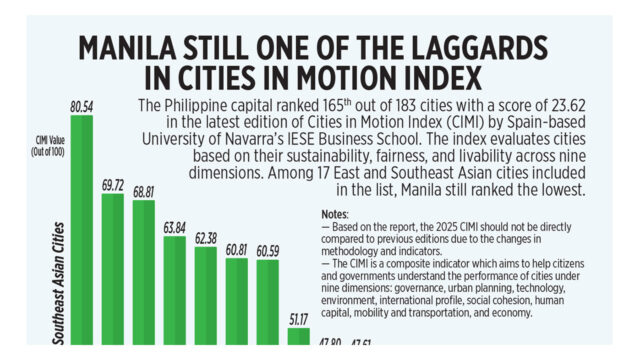
Manila still one of the laggards in Cities in Motion Index

The Philippine capital ranked 165th out of 183 cities with a score of 23.62 in the latest edition of Cities in Motion Index (CIMI) by Spain-based University of Navarra’s IESE Business School. The index evaluates cities based on their sustainability, fairness, and livability across nine dimensions. Among 17 East and Southeast Asian cities included in the list, Manila still ranked the lowest.

Manila still one of the laggards in Cities in Motion Index

BSP rate cut hopes may support PHL shares’ rise

BW FILE PHOTO

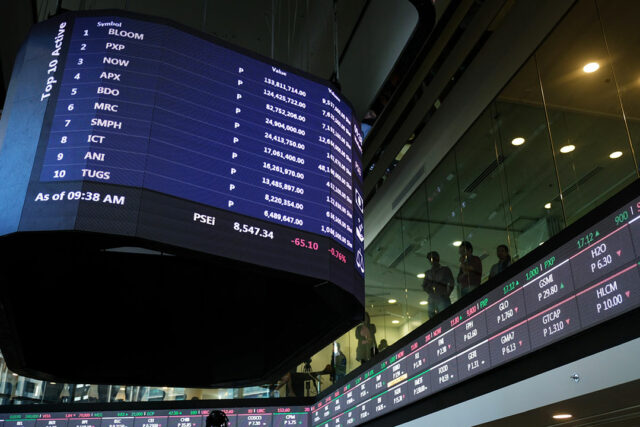
PHILIPPINE STOCKS could sustain their uptrend when trading resumes on Thursday as the Bangko Sentral ng Pilipinas (BSP) is widely expected to deliver a rate cut and with markets still hoping for tariff negotiations between the United States and its trading partners.

On Tuesday, the bellwether Philippine Stock Exchange index (PSEi) climbed by 3.15% or 183.49 points to close at 6,006.34, while the broader all shares index increased by 2.46% or 86.03 points to 3,582.80.

The market was closed on Wednesday, April 9, for the Day of Valor holiday.

Bargain hunting helped the Philippine market rebound from Monday’s rout that saw the PSEi plummet to 5,822.85, which was its worst finish in over two-and-a-half years or since it closed at 5,783.15 on Oct. 3, 2022. The bloodbath was due to trade war fears stemming from the US’ move to impose sweeping tariffs on its trading partners.

US President Donald J. Trump’s “reciprocal” tariffs on dozens of countries took effect on Wednesday, including massive 104% duties on Chinese goods, deepening his global trade war and spurring more widespread selling across financial markets, Reuters reported.

Mr. Trump’s punishing tariffs have shaken a global trading order that has persisted for decades, raised fears of recession and wiped trillions of dollars off the market value of major firms.

Mr. Trump has shrugged off the market rout and offered investors mixed signals about whether the tariffs will remain in the long term, describing them as “permanent” but also boasting that they are pressuring other leaders to ask for negotiations.

First Metro Investment Corp. Head of Research Cristina S. Ulang said in a Viber message that Philippine stocks may continue to rise on Thursday in a technical rebound “as the market cheered Trump’s hinting of flexibility on reciprocal tariffs.”

Meanwhile, the BSP’s policy meeting will also be a key trading driver, with prospects of further monetary easing expected to boost sentiment, Rizal Commercial Banking Corp. Chief Economist Michael L. Ricafort said in a Viber message.

“The possible 25-basis-point (bp) local policy rate cut at the next BSP rate-setting meeting on April 10 and total possible local rate cuts of 50 bps or 75 bps for 2025, as signaled by local monetary officials recently, would be an offsetting positive factor,” Mr. Ricafort said. He put the PSEi’s support at 5,820 and immediate resistance at 5,901-6,053.

A BusinessWorld poll last week showed that all 17 analysts surveyed expect the Monetary Board to slash its target reverse repurchase rate by 25 bps to 5.5% from the current 5.75% at its policy meeting on April 10 (Thursday).

The Monetary Board has brought down borrowing costs by a cumulative 75 bps since it began its easing cycle in August last year.

BSP Governor Eli M. Remolona, Jr. has said that they could cut rates by up to 75 bps this year to support the economy. — R.M.D. Ochave with Reuters

US taking ‘bold new steps’ to quicken progress of alliance with Philippines

PRESIDENT Ferdinand R. Marcos, Jr. is flanked by US Deputy Chief of Mission Y. Robert Ewing and Japanese Ambassador Endo Kazuya at commemoration rites of Day of Valor in Bataan on April 9, 2025. — PPA POOL/NOEL B PABALATE

By Kenneth Christiane L. Basilio and Adrian H. Halili, Reporters

THE US is taking bold new steps to accelerate its military partnership with the Philippines, an American envoy said on Wednesday, citing the alliance as a “pillar of security” in the Indo-Pacific region.

“As Secretary of Defense Hegseth announced a few weeks ago, we are taking bold new steps to accelerate the progress of the alliance,” US Deputy Chief of Mission Y. Robert Ewing said in a speech at a Day of Valor ceremony in Bataan province livestreamed on Facebook.

“Today, the US-Philippine alliance stands as a pillar of security and stability in the Pacific. Our forces work shoulder to shoulder, 365 days a year to advance our shared goal of a free and open Indo-Pacific where international law is respected,” he added.

The Day of Valor, a national holiday, commemorates the fall of Bataan and the resistance on Corregidor Island against Japanese troops during World War II.

Mr. Ewing said the shared experience of the US and Philippines during and after the war forged unbreakable bonds. “These bonds are now the foundations of the ironclad US-Philippine alliance.”

Last month, US Defense Secretary Peter Brian Hegseth visited Manila where he vowed to help arm the country with deterrence capabilities by deploying advanced weaponry, such as an anti-ship missile system and unmanned sea vessels to counter China’s aggression in the South China Sea.

Mr. Ewing said the US is also keen on deepening cooperation on cyber-defense to reduce the Philippines’ vulnerabilities, increase security and enable more advanced operational cooperation.

US and Philippine forces are set to hold Balikatan (shoulder-to-shoulder) exercises later this month until the first week of May.

For his part, Japanese Ambassador to the Philippines Endo Kazuya said the Philippines holds a critically strategic position for Japan and the entire region because it is situated in “a vital sea lane and a crossroad of geopolitical significance.”

“The current global security landscape is fraught with challenges,” Mr. Endo said in a speech at the same event. “Unilateral attempts to change the status quo by force continue to intensify, creating a complex and uncertain environment.”

He added that Japanese and Philippine relations have reached “unprecedented levels,” demonstrated by their shared efforts to enhance security and law enforcement capabilities.

China and the Philippines have been at loggerheads over confrontations near disputed features in the South China Sea, with Manila accusing China’s coast guard of aggression and Beijing furious over what it calls repeated provocations and incursions.

A United Nations-backed tribunal based in The Hague in 2016 voided China’s claim to more than 80% of the South China Sea, where more than $3 trillion worth of trade passes through each year, for being illegal.

At the same event, Philippine President Ferdinand R. Marcos, Jr. cited the need to boost peace-building cooperation with other countries to stop more wars from happening.

“The lessons we have learned teach us that the solution to war is not more war, but peace,” he said in a speech. “Peace cannot be attained by a single person or a single country. We must bring together all parties involved. These are the lessons we hope to have learned.”

PHL-AUSTRALIA TALKS
Meanwhile, top generals of the Philippine and Australian armies concluded on Tuesday a two-day meeting in Manila, where they discussed ways to deepen security ties, including possible joint military exercises in the next two years.

In a statement, the Philippine Army said they held talks with their Australian counterparts to boost defense cooperation and security ties amid China’s expansive claim in the South China Sea.

Philippine Army acting Chief-of-Staff Ferdinand B. Napuli met with Australian Army Deputy Chief-of-Staff Chris Smith and Australia’s defense attache to the Philippines Emma McDonald-Kerr at Fort Bonifacio, the army’s headquarters in the Philippine capital.

The military officials discussed activities that the Philippines and Australian armies could do in the next two years, such as “combined arms training” to help enhance interoperability.

“The activity’s outcome reflects both armies’ shared commitment and collaborative efforts and will serve as a powerful reminder of the importance of regional unity in ensuring security and stability,” Mr. Napuli said in the statement.

The meeting between the Philippines and Australia came on the heels of Manila’s recent string of defense engagements with Canada, Japan and coincided with ongoing joint military drills between Philippine and US forces ahead of the annual Balikatan exercises.

Australia’s Defense department on Monday said military training activities between Manila and Canberra’s forces are set to increase this year, signaling deeper military ties between the two nations.

The Armed Forces of the Philippines and Australian Defense Force will conduct more than 20 training drills and military exchanges in a program called the Joint Australian Training Team-Philippines this year, “more than doubling the number delivered in 2024,” it added.

“The Philippines is one of Australia’s most important regional defense partners, and we share a commitment to a peaceful, stable and prosperous Indo-Pacific region,” Australia Defense department Chief of Joint Operations Justin Jones said in the statement.

The Philippines is boosting security ties with western nations and regional allies in the eastern hemisphere, including Australia, as they grapple with tensions involving China, such as Manila’s sea disputes and Canberra’s spying concerns.

Philippine forces have repeatedly sparred with Chinese ships and aircraft in the South China Sea over competing claims on Spratly Islands and Scarborough Shoal, among other sea features. Beijing asserts sovereignty over almost the entire sea based on a 1940s nine-dash line map that overlaps with the maritime zones of the Philippines, Brunei, Malaysia, Taiwan and Vietnam.

Australia expressed concerns with China in February after the People’s Liberation Army Navy conducted live-fire drills in international waters within the Tasman Sea — more than 8,000 kilometers away from Hainan Island, China’s nearest major landmass — which separates Australia and New Zealand.

China did not inform the Australian government of its planned exercise, leading to some commercial planes having to change their flight plans, Reuters reported.

Political analysts said the Philippines could benefit from deeper security ties with Japan and the US, as the country seeks to modernize its armed forces.

“As a security partner, the Philippines will have preferential treatment to procurement and acquisition of military material to improve our military modernization,” Chester B. Cabalza, founding president at think tank International Development and Security Cooperation in Manila, said in a Facebook Messenger chat.

He said Manila would benefit from both countries’ advanced weapon system, war experience, interoperability and strategies.

Philippine President Ferdinand R. Marcos, Jr. earlier said he would ensure funding to fast-track the country’s military modernization program before his term ends in 2028. The government has allotted $35 billion in the next decade for its modernization plan.

“The US and Japan can help the Philippines more in the South China Sea by pursuing functional cooperation and the peaceful settlement of disputes with China and other parties,” Rommel C. Banlaoi, chairman of the Philippine Institute for Peace, Violence and Terrorism Research, said in a Viber message.

The Philippines has been seeking more foreign defense deals with countries like the US, Japan, Australia and Canada amid worsening tensions with Beijing in the South China Sea.

“The trilateral defense cooperation with Japan and the US is founded on common security, confidence building mechanisms, and treaty alliance to allow reciprocal and visiting military forces,” Mr. Cabalza said.

Michael Henry Ll. Yusingco, a fellow at the Ateneo de Manila Policy Center, said the Philippines should learn to be more self-reliant in its defense capabilities instead of relying on alliances.

“The national security narrative should be shifting now,” he said via Messenger chat. “The public’s attention should be focused on the challenges that must be overcome to establish a self-reliant defense posture. The constant edifying of these defense alliances fosters a dependency mentality amongst the population.”

He added that for the Philippines to be fully independent, taxpayers should “accept the burden of paying for the cost of establishing a self-reliant defense posture.”

“Taxpayers, in particular, should now accept that they will have to shoulder the bill for this initiative to be truly successful,” Mr. Yusingco said. “This is the fact that is always lost when defense pacts with stronger nations are elevated to a higher status in the public discourse.”


PCG to send 17,000 officers to safeguard Holy Week travels

PHILIPPINE COAST GUARD

THE Philippine Coast Guard (PCG) will deploy 17,000 officers to secure the sea travels of more than a million Filipinos heading to the provinces during Lenten break, its chief said on Wednesday.

The PCG personnel will coordinate with the Transportation department’s maritime offices to prevent maritime incidents and casualties, PCG Commandant Ronnie Gil L. Gavan said in a statement.

The coast guard will conduct a round-the-clock monitoring of sea lanes of the country’s western and eastern seaboards and inter-island routes, while deploying its K-9 units and security teams at seaports, where they will also conduct vessel inspections, he added.

The predominantly Catholic nation observes the week leading up to Easter Sunday as a religious tradition, with many Filipinos flocking to major transportation hubs such as seaports so they can head home.

The Philippine Ports Authority expects to see 1.73 million passengers next week, it said in a statement on Tuesday, 3.5% higher than the 1.67 million it logged last year. About 3 million Filipinos already went to ports in March alone, the port regulator said.

“This influx presents challenges, such as overcrowding, vessel overloading and heightened risks of maritime-related crimes,” Mr. Gavan said.

President Ferdinand R. Marcos, Jr. on Tuesday ordered the Transportation department and its attached agencies to inspect terminals, ports and airports to ensure the safety and convenience of all passengers, according to Presidential Communications Office Undersecretary Clarissa A. Castro.

Mr. Gavan will place its PCG stations, substations and districts on a “heightened alert” status from April 13 to 20 to help personnel manage the influx of port passengers.

“Maritime crimes, such as robbery incidents, are still a prevalent threat considering the influx of passengers across ports… necessitating heightened security in busy ports and anchorages,” he said.

Coast guard rescue units will help lifeguards in seaside tourist destinations, while ships will conduct regular coastal patrols within their assigned jurisdictions, Mr. Gavan said. “PCG seaborne patrol units also prepare for possible search and rescue missions.” — Kenneth Christiane L. Basilio

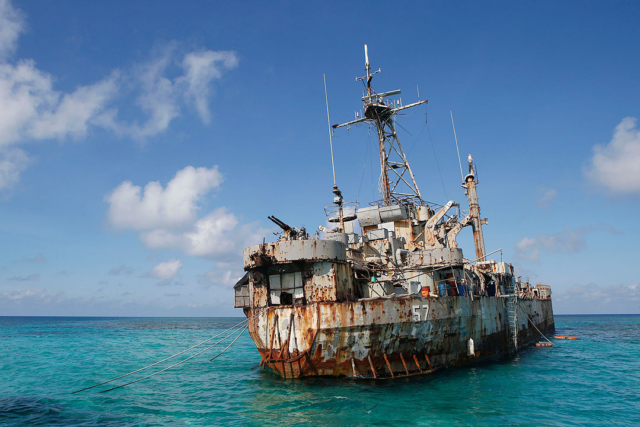
Philippines completes resupply at Second Thomas Shoal

BRP SIERRA MADRE, a marooned transport ship which Philippine Marines live in as a military outpost, sits on the disputed Second Thomas Shoal, part of the Spratly Islands in the South China Sea. — REUTERS

THE PHILIPPINE military on Wednesday said it had completed a routine resupply mission to its marooned naval ship at Second Thomas Shoal, a hotly contested maritime feature in the South China Sea where the Philippines and China had clashed.

The Armed Forces of the Philippines carried out its routine troop rotation and resupply mission to its beached vessel alongside the coast guard “without any untoward incident,” it said in a statement.

A handful of Filipino marines are stationed on the BRP Sierra Madre, a World War II-era warship that Manila grounded at the shoal in 1999 to assert its sovereignty.

Philippine forces conduct resupply missions about every two months to rotate stationed troops and bring in provisions. China had in the past tried to block Philippine ships from resupplying BRP Sierra Madre before Manila and Beijing agreed on a “provisional agreement” to de-escalate tensions in July last year.

The Philippines and China have been at loggerheads over disputed features in the South China Sea, which Beijing claims almost in its entirety. A United Nations-backed tribunal based in The Hague in 2016 voided China’s claim for being illegal. — Kenneth Christiane L. Basilio

House bill eyes higher taxes on pre-mixed alcoholic drinks to limit use

EESHAN GARG-UNSPLASH

A BILL that seeks to curb the Philippines’ alcohol consumption by increasing the taxes on pre-mixed alcoholic beverages was filed at the House of Representatives last week.

House Bill No. 11493, filed by Party-list Rep. Percival V. Cendaña on April 2, seeks to reclassify pre-mixed alcohols as fermented liquors instead of distilled spirits under the Philippine Tax Code. That means a P252 tax per liter of alcoholic content by 2031, according to a copy of the bill obtained by BusinessWorld.

Pre-mixed alcoholic drinks are described as beverages with less than 10% alcohol content and are made by combining them with fruit juices or carbonated water.

“The adjustment in excise tax rates on pre-mixed alcoholic beverages aims to reduce the harmful effects of alcohol consumption by discouraging excessive drinking, particularly among the youth and vulnerable sectors,” Mr. Cendaña said in the bill’s explanatory note.

A 2024 World Health Organization report said alcohol consumption contributes to 2.6 million deaths each year globally, with about 400 million people having alcohol use disorders, including 209 million living with alcohol dependence.

The Philippines ranked fifth in alcohol consumption compared with its regional peers, with Filipinos drinking at least six liters of alcoholic drinks in 2023, according to a Southeast Asia Stats report last year.

Pre-mixed alcoholic beverages in the Philippines are subject to a 22% ad valorem tax on top of a P69.60 specific tax per proof liter, according to excise tax rates on the Bureau of Internal Revenue’s (BIR) website.

“This bill seeks to reclassify pre-mixed alcoholic beverages as fermented liquors, imposing a revised excise tax structure that progressively increases specific tax rates from P82 per proof liter in 2026 to P252 per proof liter in 2031, with a 6% annual increase thereafter,” Mr. Cendaña said.

The proposed specific tax schedule for pre-mixed drinks is set to increase to P103 in 2027, P129 in 2028, P161 in 2029, and P201 in 2030, according to the bill.

All manufacturers or importers of pre-mixed alcoholic beverages must report their total sales and unshelved products to the BIR so the government could keep track of their inventory.

Establishments that inaccurately report their data to the BIR face the risk of having their business permits revoked. They may also be required to pay deficiency taxes with interest.

“Any person liable for any of the acts or omissions prohibited under this section shall be criminally liable and penalized,” according to the bill. Foreigners who violate the proposed law could be immediately deported after serving their criminal sentence. — Kenneth Christiane L. Basilio

BARMM electoral code could serve as model to curb political dynasties

BW FILE PHOTO

By Chloe Mari A. Hufana, Reporter

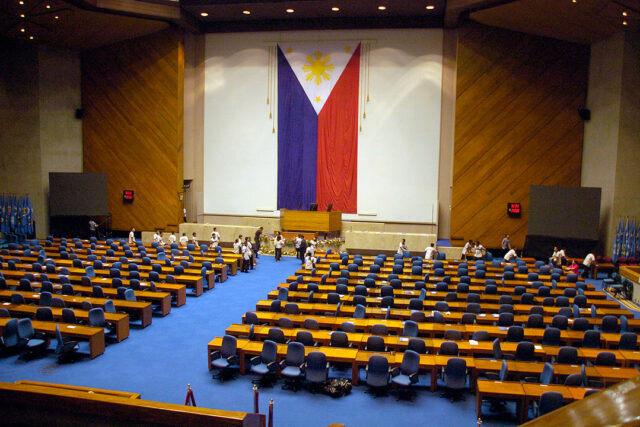
THE Bangsamoro Autonomous Region in Muslim Mindanao (BARMM) could serve as a legislative model for the National Government in curbing political dynasties, a political analyst said, following the Supreme Court’s (SC) move to compel both chambers of Congress to respond to petitions pushing for the enactment of an anti-dynasty law.

“There’s precedent for the BARMM law to be the jump-off point for anti-dynastic legislation,” Hansley A. Juliano, political science lecturer at the Ateneo de Manila University, told BusinessWorld in a Facebook Messenger chat on Wednesday. “Local legislation and policies have been borrowed by national policy multiple times.”

The Bangsamoro Electoral Code, signed into law on March 8, 2023, includes a provision that prohibits nominees of regional parliamentary political parties from being related within the second degree of consanguinity or affinity. 

This means that individuals such as children, siblings, parents, or spouses of other nominees cannot be nominated by the same party.

However, Mr. Juliano noted the need to observe at least one or two more electoral cycles before assessing the law’s full impact, noting the differences in the implementing rules and regulations.

BARMM is set to hold its first parliamentary elections on Oct. 13, after being postponed from May 12 due to Sulu’s exclusion from the region.

In an October 2024 report, the Philippine Center for Investigative Journalism found that 216 of 253 districts are represented by individuals who at least have one other relative previously or currently elected in public office, or hoping to get elected in 2025.

Also, among the candidates gunning for a Senate seat are the two brothers of Senator Rafael T. Tulfo, reelectionist Senator Pilar Juliana S. Cayetano, and the sister of Senator Mark A. Villar, whose term-limited mother is running for Las Piñas City’s district representative. Should they win, there will be a total of nine senators who are siblings, including the Ejercito-Estrada brothers.

Mr. Juliano also weighed in on the growing clamor for judicial intervention to bypass legislative inertia on the national level, following the High Court’s order on Tuesday.

“Judicial intervention is definitely understandable at this point — it’s much delayed, even,” he noted. “So far, judicial intervention based on petitioner filings does not seem to violate separation of powers, at least compared to judicial activism (i.e., making case decisions that will compel jurisprudence to be imposed on legislation).”

Still, Mr. Juliano emphasized that the biggest obstacle lies not in legality but in political will.

“Of course, the real block here is the good faith of the actors involved. With the bulk of the House still comprised of dynasties or aspiring dynastic politicians, it’s like asking the turkeys to vote for Thanksgiving.”

The SC en banc on Tuesday gave the Senate and the House of Representatives a non-extendible period of ten days from notice to comment on the consolidated petition filed by Kapatiran Party (Alliance for the Common Good) and, Wilfredo Trinidad, and 1Sambayan Coalition.

The Kapatiran Party earlier argued that the failure of Congress to pass an enabling law for over three decades constitutes a grave abuse of discretion.

Citing Article II, Section 26 of the 1987 Constitution, the petition emphasizes that the provision, which sought to “prohibit political dynasties,” is not merely aspirational but imposes a clear directive on the legislature to act.

The petitioners asked the SC to order both chambers of Congress to enact the necessary law and to recognize that the legislature’s long-standing inaction has effectively nullified a constitutional safeguard intended to promote equal access to public service and prevent the monopolization of political power.

Following this, the 1Sambayan Coalition filed a similar petition, which likewise asserted that the continued failure of lawmakers to define and prohibit political dynasties represents a constitutional violation.

1Sambayan also highlighted the detrimental impact of dynastic politics on governance, accountability, and social mobility in the country. Their petition strengthens the argument for judicial intervention, stressing that the legislative gridlock can no longer be tolerated given its far-reaching consequences on democratic processes.