
Headline and Rice Inflation Rates in the Philippines
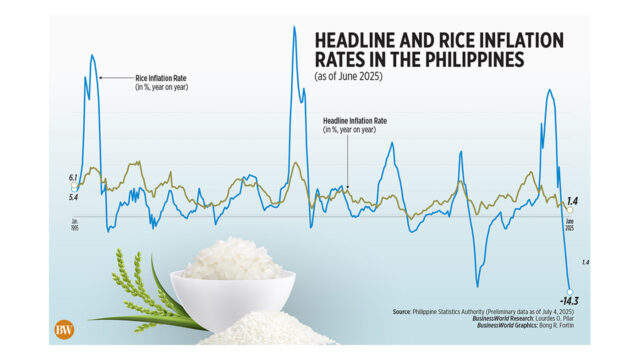
Headline inflation slightly inched up in June, driven by higher costs of utilities and education, the Philippine Statistics Authority reported on Friday. Read the full story.

Headline inflation slightly inched up in June, driven by higher costs of utilities and education, the Philippine Statistics Authority reported on Friday. Read the full story.

SECURITY BANK Corp. has partnered with Euronet to roll out automated teller machines (ATM) that will serve businesses and their employees, as the lender tries to lure more corporate clients.
“Through this initiative, we aim to better serve our payroll and corporate clients by offering on-site access to cash, right at their offices,” Security Bank Executive Vice-President and Chief Operating Officer Lucose T. Eralil said in a statement on Sunday.
“It’s a practical, forward-thinking solution that simplifies everyday banking and brings financial services closer to where they’re needed most,” he added.
Under the partnership, Security Bank will use Euronet’s ATM infrastructure and Ren payment platform to deliver banking services to its business clients and their employees.
The partners will launch co-branded, white-label ATMs in office spaces and commercial hubs to improve access to cash and financial services for payroll and corporate accounts.
The ATMs will give employees easier access to their salaries, expand ATM coverage in underserved and high-traffic areas and provide payroll services with built-in cash management features. Employers, in turn, are expected to benefit from reduced cash handling and improved operational efficiency.
“This strategic alliance positions the ATM as a key channel for expanding our payroll services, attracting new corporate clients and delivering faster, more reliable access to cash,” said Security Bank Senior Vice-President and Retail Channel head Myla R. Untalan.
“With Euronet’s wide ATM network, we’re enhancing both reach and service quality for our clients,” said added.
Security Bank said the tie-up supports its push to boost its payroll and corporate banking portfolio while attracting more business clients.
The lender posted a 7.32% increase in net income to P2.82 billion in the first quarter, driven by steady growth in loans and deposits. — Aaron Michael C. Sy

Here’s a quick glance at how PSEi stocks fared on Friday, July 4, 2025.



By Revin Mikhael D. Ochave, Reporter
PHILIPPINE shares could get a lift this week if the country secures a trade deal with the US ahead of the July 9 deadline on US tariff talks with its trade partners.
“The PSEi flirted anew to touch the 6,500 zone, although supply pressure emerged after a slight uptick in Philippine June inflation at 1.4%,” online brokerage 2TradeAsia.com said in a market note.
Positive developments ahead of the tariff deadline could buoy investor sentiment, Japhet Louis O. Tantiangco, research manager at Philstocks Financial, Inc., said.
“An established trade deal between the US and the Philippines or an extension of the negotiation deadline may give the market a boost,” he said in a Viber message. “Market sentiment will be cautious next week as investors await a trade deal.”
On Friday, the Philippine Stock Exchange Index (PSEi) fell 1.13% or 73.41 points to close at 6,395.57, while the broader all-share index dropped 1.01% or 38.62 points to 3,764.71. Week-on-week, the PSEi dipped by 0.2% or 12.7 points.
US President Donald J. Trump on July 4 said he had signed letters to 12 countries containing proposed tariff levels, which would be delivered as “take it or leave it” offers. He did not name the countries.
In April, the US paused its planned reciprocal tariffs for 90 days, with the deadline set for July 9. A blanket 10% tariff remains in effect, but Mr. Trump had warned that duties could go as high as 70%, with most tariffs taking effect on Aug. 1.
Mr. Tantiangco said prospects of further easing by the Bangko Sentral ng Pilipinas (BSP) could support the market after softer inflation in June.
The Philippine Statistics Authority reported that inflation rose to 1.4% in June from 1.3% in May due to higher prices in utilities and the education sector. The rate was still below the 3.7% in June 2024 and the central bank’s 1.1% to 1.9% forecast.
BSP Governor Eli M. Remolona, Jr. has hinted of two more policy rate cuts this year as inflation remains tame. In May, the BSP lowered its target reverse repurchase rate by 25 basis points to 5.25% amid an easing inflation outlook and weaker-than-expected first-quarter economic growth.
Michael L. Ricafort, chief economist at Rizal Commercial Banking Corp., in an e-mail put the PSEi’s immediate major support at 6,105 to 6,200 and resistance at 6,500.
2TradeAsia.com placed immediate support at 6,300 and resistance at 6,500 to 6,550.
“While a broad re-rating is still constrained by global uncertainty, we underscore that local fundamentals have since been more constructive relative to global peers,” the brokerage said.
“The ongoing BSP easing, while mitigating local borrowing costs, also highlights potential carry opportunities for foreign capital into Philippine securities, which could spill over into high-quality equities,” it added.
It said the best way to find strong investment opportunities is by analyzing individual companies. However, because the cost of borrowing is changing and the economy is growing cautiously, it might make sense to slowly start buying stocks.
Mr. Tantiangco said the PSEi might continue to test the 6,400 level.
“Chart-wise, the local market closed last week below the 6,400 line after failing to hold above its 200-day exponential moving average (EMA),” he said.
This shows that the market is still struggling to rise past a key level, he said, adding that it might try again to go above 6,400. If it fails, it could drop further to the next level where it might find support.

LONDON — Seven-times champion Novak Djokovic scored his 100th match win at Wimbledon and led the march of the old guard into the last 16 on Saturday while an ailing Barbora Krejcikova’s title defense ended in defeat and tears.
World number one Jannik Sinner was at his ruthless best yet again as the Italian gathered momentum in his quest for a maiden All England Club title while American Ben Shelton and Australian Alex de Minaur announced themselves as dark horses.
Djokovic is on an altogether different plane as he looks to capture his eighth title to match Roger Federer’s record on the pristine lawns of London and his 25th major overall to surpass Margaret Court on the all-time list of champions.
The 38-year-old showed exactly why Wimbledon could be his best chance of achieving the elusive targets when the 2023 and 2024 runner-up dismantled Davis Cup teammate Miomir Kecmanovic 6-3, 6-0, 6-4 in a little under two hours.
A ton of victories put him among elite company as the sixth seed became only the third player to achieve that feat at the tournament after nine-times champion Martina Navratilova and Swiss great Federer.
“Wimbledon is a favorite and a dream tournament for not just myself, but probably the majority of players. Growing up, most of the kids dream of playing here and winning here,” Djokovic said.
“I’ve been blessed to do it multiple times. Any history that I make in my favorite tournament, I’m blessed.”
Grigor Dimitrov, the Bulgarian 34-year-old, also scored his 100th match win across the four Grand Slams when he quelled the challenge of Austrian Sebastian Ofner 6-3, 6-4, 7-6(0).
Joining him was fellow veteran Marin Cilic, the Croatian 36-year-old getting past spirited Spaniard Jaume Munar 6-3, 3-6, 6-2, 6-4 to book a meeting with Italian 22nd seed Flavio Cobolli who took apart big-serving Czech teenager Jakub Mensik 6-2, 6-4, 6-2.
While Cobolli may not be relishing a meeting with the tricky Cilic, his compatriot Sinner will welcome the chance to test his metronomic hitting against Dimitrov’s elegant approach in what promises to be a classic.
SUBLIME SINNER
A sublime Sinner booked that clash with a 6-1, 6-3, 6-1 hammering of Pedro Martinez. The top seed, who has lost just 17 games in his first three matches, equaled the professional era record for fewest games dropped to make the Wimbledon fourth round along the way.
“About the games lost, this is whatever,” Sinner said, his grounded nature coming into sharp focus.
“I’m not looking on these kind of records. I know everything can change very quickly from one round to the other.”
After the unexpected high of last year’s title triumph, Krejcikova came crashing down when she was beaten 2-6, 6-3, 6-4 by American 10th seed Emma Navarro in a disjointed Court One contest.
The distressed 29-year-old Czech, who has endured her share of injuries this season, was in tears as she prepared to serve to stay in the tournament at 3-5 in the deciding set before eventually crashing out.
“It was tough, neither of us played our best tennis, she was dealing with some injuries and I was dealing with whatever I was dealing with,” Navarro said, adding that it was difficult to focus when her opponent was struggling.
“It’s not easy to be composed. Part of you is saying just put a bunch of balls in the court and that’s all you need to do. But then you trick yourself into not playing the way that you want to play.”
Krejcikova’s exit and 2022 champion Elena Rybakina’s 7-6(6), 6-3 defeat by Danish powerhouse Clara Tauson means a first-time women’s champion will be crowned at the Grand Slam for the eighth consecutive year.
Iga Swiatek will hope she can be the one after the five-times major champion secured a 6-2, 6-3 victory over American Danielle Collins, whose compatriot Hailey Baptiste crashed to 18-year-old Russian Mirra Andreeva 6-1, 6-3.
Shelton gave Americans something to smile about when the powerful left-hander made quick work of Hungarian lucky loser Marton Fucsovics 6-3, 7-6(4), 6-2 while De Minaur swatted aside Dane August Holmgren 6-4, 7-6(5), 6-3 to go through. — Reuters
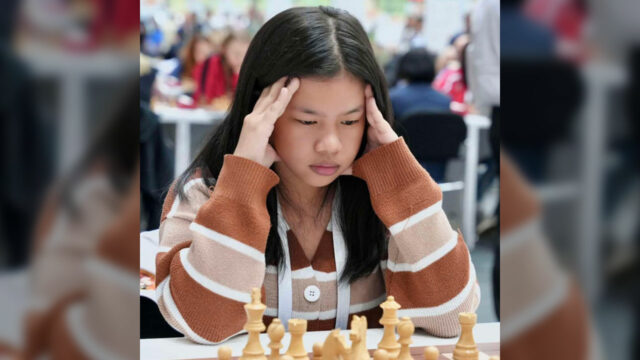
FILIPINA dynamo Ruelle Canino sets out as the country’s biblical David against the planet’s Goliaths of the sport as she battles Woman Grandmaster (WGM) Anna Shukhman in the first round of the Women’s Chess World Cup that unfurled on Sunday night in Batumi, Georgia.
Ms. Canino, 17, practically flew to the Georgian capital as an underdog after having been ranked 102nd of the 107 participants with a FIDE rating of 2004.
Russians Aleksandra Goryachkina and Alexandra Kosteniuk head the ultra competitive field after they topped the last two editions of this biennial meet in 2021 in Sochi, Russia and 2023 in Baku, Azerbaijan, respectively.
The Cagayan de Oro lass is a year older than Ms. Shukhman, a Russian representing the FIDE refugee flag, but the reigning world and European champion should be the favorite with a 27th-ranked rating of 2413.
They will play two games of standard time control.
Ties will be broken by two-game rapid time control, and if it’s tied again match after match, will be subsequently resolved by two games of blitz and, finally, a one-game Armageddon duel.
It will be a difficult path to glory for Ms. Canino as the tournament will implement a seven-round knockout format with the eventual top three finishers gaining outright spots to next year’s Women’s Candidates Matches.
Despite the overwhelming odds, Ms. Canino had shown she can bring down the best of them after having slew two WGMs in Argentine Claudia Amura and Romanian Carmen Voicu-Jagodzinsky in last year’s Budapest Olympiad where the country snared a historic Group B gold.
And that gives Ms. Canino hope. — Joey Villar

AZURA STEVENS and Kelsey Plum anchored the Los Angeles Sparks to a narrow 89-87 victory over the Indiana Fever on Saturday night in Indianapolis.
Stevens made a key free throw with 3.1 seconds to put the visitors ahead by two, finishing with a double-double of 21 points and 12 rebounds. Plum added 20 points, hitting four 3-pointers for the Sparks (6-13).
Aliyah Boston (23 points, 12 rebounds) notched her ninth double-double of the season but missed a potential game-tying jumper from the top of the key at the buzzer for the Fever (9-9).
Natasha Howard had 21 points and nine rebounds in the loss.
Indiana’s Aari McDonald stole the ball off an errant pass from Julie Allemand with 30.1 seconds remaining and the Fever trailing 88-87. On the next possession, however, Lexie Hull rebounded an off-the-mark 3-pointer by McDonald but missed a jumper with 4.2 seconds to go that would have given the Fever the lead.
Rickea Jackson capped off a 9-3 run with a pair of aggressive layups and a free throw to give the Sparks the lead for good, 88-87, with 58 seconds left.
The Fever went ahead 60-52 after an midrange jumper by Howard a little more than midway through the third quarter. However, the Sparks rallied to take a one-point lead into the final period thanks to an 18-7 spurt that was capped with a layup and a 3-pointer by Plum.
The largest advantage before halftime was a 32-26 lead for the Fever after a pair of free throws by Howard with 6:25 left in the second quarter.
Plum, though, brought Los Angeles back by draining a stepback 3-pointer to give the Sparks a 36-34 lead. While she landed awkwardly on the shot, Plum was able to remain in the game.
After the Sparks knotted things up 40-40 with 1:45 left in the first half, Boston flashed her handles with a downhill, off-hand layup that put the Fever up by two. The Fever led 45-42 at the end of a back-and-forth first half that featured a combined nine ties and lead changes.
Fever guard Caitlin Clark (left groin strain) sat out her fifth consecutive game.
LYNX HANDLE VALKYRIES
Napheesa Collier scored 22 points on 8-for-11 shooting from the field, and the Minnesota Lynx held on for an 82-71 win over the Golden State Valkyries on Saturday night in Minneapolis.
Courtney Williams added 15 points for Minnesota (16-2), which has won back-to-back games since losing the WNBA Commissioner’s Cup title game against the Indiana Fever on Tuesday. Kayla McBride contributed 12 points, and Jessica Shepard had eight points to go along with a team-high 10 rebounds off the bench.
Tiffany Hayes scored 23 points on 8-for-11 shooting to lead Golden State (9-8). Kayla Thornton notched a double-double with 13 points and 10 rebounds, and Stephanie Talbot scored 10.
Minnesota edged Golden State in part because of its assist-to-turnover ratio. The Lynx finished with 25 assists and nine turnovers, while the Valkyries had 19 assists and 10 turnovers.
A pesky defense helped the Lynx prevent the Valkyries from mounting a fourth-quarter comeback. Minnesota held Golden State scoreless for the first 4:33 of the final quarter until Hayes finally made a 3-pointer to trim the deficit to 75-63. — Reuters

EAST RUTHERFORD, New Jersey — Real Madrid edged past Borussia Dortmund 3-2 in a dramatic Club World Cup quarterfinal on Saturday to set up a last-four clash with Paris Saint-Germain (PSG).
The Spanish giants stamped their authority on the match early at the MetLife Stadium, dominating possession and opening a two-goal lead thanks to strikes by Gonzalo and Fran Garcia in the 10th and 20th minutes.
Gonzalo, the 21-year-old forward continuing his breakout tournament, opened the scoring with a close-range volley from Arda Guler’s cross.
Ten minutes later, Garcia doubled Real’s lead, arriving at the far post to turn in Trent Alexander-Arnold’s low delivery after an incisive move down the right.
Jude Bellingham and Vinicius Jr. squandered chances to extend Real’s lead before halftime, while Aurelien Tchouameni came closest in the second half, rattling the crossbar with a curling effort from the edge of the box.
Despite the reduced intensity of play in New Jersey’s scorching heat, Real comfortably saw out the match, leaving Dortmund unable to mount a comeback until the game exploded into life in 10 minutes of mayhem in added time.
Substitute Maximilian Beier pounced on a rebound in the 93rd minute to pull one back for Dortmund, but a minute later Kylian Mbappe restored Real’s two-goal cushion with a stunning volley.
Dortmund refused to back down, however, and Serhou Guirassy’s pace saw him break through Real’s defense only to be pulled down in the box by Dean Huijsen.
The defender was shown a straight red card, ruling him out of the semifinal, and Guirassy coolly converted the resulting spot-kick to reduce the deficit to 3-2.
Dortmund came within inches of forcing extra time when in the ninth minute of added time Thibaut Courtois produced a sensational save to deny Marcel Sabitzer’s powerful strike.
“We were doing really well and the match looked under control but then in the last 10 minutes things got crazy,” Real manager Xabi Alonso told DAZN.
“We have lost a little bit our focus and intensity when we didn’t have the ball and luckily nothing else happened. But overall we have had good 80 minutes and the last 10 minutes to improve.”
Real Madrid now turn their attention to PSG, who defeated Bayern Munich 2-0 to book their place in the semifinals. The winners of that clash will face Fluminense or Chelsea, who meet on Tuesday, in the final. — Reuters
LIONEL MESSI scored twice to help Inter Miami to a 4-1 win against host CF Montreal on Saturday.
Miami (9-3-5, 32 points), playing its first Major League Soccer (MLS) match in over a month, has won three straight.
Prince Owusu scored the lone goal for Montreal (3-13-5, 14 points), which had won two of its previous three.
Owusu gave Montreal a 1-0 lead in the second minute. Messi missed on a pass attempt and an uncovered Owusu collected the ball at the top of the box before putting a strike through goalkeeper Oscar Ustari’s legs into the back of the net.
Miami went more than 10 minutes before registering its first shot attempt, but once it finally did, it couldn’t beat Montreal’s Jonathan Sirois. He got his hands up to deny the visitors off a corner in the 13th minute and two minutes later got his fingertips on a Jordi Alba chance to send it off the right post and out.
In the 20th minute, Sirois came off his line to the penalty area and slid to deny Tadeo Allende of a quality opportunity, and in the 27th minute came out to the top of the box to steal a chance from Telasco Segovia. — Reuters

Alas Pilipinas’ campaign at the 2025 VTV Cup did not end with a coveted medal, but it did send a powerful message all the same — one that tells all and sundry the team is no fluke, no flash-in-the-pan experiment, and certainly no pushover on the regional stage. The loss to Chinese Taipei in the bronze medal match — 17-25, 24-26, 22-25 — hurts, no doubt. Then again, the final score tells only part of the story.
It’s easy to zero in on the missed opportunities. A 23-22 lead in the second set that slipped away. A 22-21 edge in the third, followed by a string of costly miscues — mental lapses under pressure, the kind that separate medalists from mere contenders. Still, to focus solely on the failure to claim a podium finish would be to miss the bigger picture. After all, the team isn’t even supposed to be this good yet.
In 2024, the Philippine delegation to this same tournament barely made noise. Represented by National University, the red, white, and blue finished 10th — replete with resolve, but nonetheless an afterthought. Fast forward a year, and Alas Pilipinas, as a unified and more cohesive national squad, got to push perennial contenders to their limits and found itself close to taking home the hardware.
Yes, the errors at the end of the medal round set-to were painful. Alas Pilipinas’ bright hopes couldn’t convert when it mattered most. All the same, they did battle throughout; they very nearly turned a 0-2 deficit into the start of a momentum builder. That kind of pressure? You can’t fake it. You can’t simulate it. You just have to live through it and grow from it.
Lest we forget, this is only the beginning. The VTV Cup was a test run. The real goals are still to come — namely, the SEA V.League in August and the 33rd Southeast Asian Games in December. Meanwhile, coach Jorge Souza de Brito and the Philippine Volleyball Federation leadership will need to sharpen the roster in acknowledgement that while the team is already in a good place, it has to be much, much better.
True, Alas Pilipinas returns home empty-handed. Still, it does so with pride. This isn’t the end of a campaign. It’s the start of a reckoning, and the competition should take notice.
Anthony L. Cuaycong has been writing Courtside since BusinessWorld introduced a Sports section in 1994. He is a consultant on strategic planning, operations and Human Resources management, corporate communications, and business development.

THE Board of Investments (BoI) has set a target of submitting the 2025-2028 Strategic Investment Promotion Plan (SIPP) to the Office of the President by the third quarter.
“It is scheduled for the Fiscal Incentives Review Board (FIRB) presentation on July 16,” said BoI Investment Policy and Planning Service Director Sandra Marie S. Recolizado said via Viber.
“If approved by the FIRB, it will still have to be approved by the BoI board and then submitted to the Office of the President,” she added.
The updated SIPP is set to rationalize the sector and tier list, with the aim of including projects that have a high impact on job creation, value creation, and moving up the value chain.
According to the BoI, the P3.38 trillion worth of investments approved under the SIPP from June 2022 to December 2024 are expected to generate 132,000 jobs.
“A substantial portion of the projected employment will be in administrative and support services, power, and manufacturing sectors,” BoI said in a statement over the weekend.
Power accounted for 76.33% of approved investments under SIPP, followed by information and communication, transport and storage, and mining and quarrying.
“These investments translate into tangible benefits by providing livelihoods and strengthening the country’s economic resilience,” Trade Secretary and BoI Chairman Ma. Cristina A. Roque said.
“As we work to attract strategic projects, our focus remains on translating these into real opportunities for our people,” she added.
BoI Managing Head Ceferino S. Rodolfo said the SIPP positions the Philippines as a hub for innovation and green growth.
“We are committed to ensuring that these investments drive not only economic gains but also inclusive development,” he said.
“Moving forward, the DTI is working closely with investment promotion agencies, the FIRB, other government agencies, and private sector stakeholders to ensure that the next SIPP reflects evolving national priorities and global economic trends,” the BoI said. — Justine Irish D. Tabile

THE Konektadong Pinoy bill needs to be accompanied by a comprehensive regulatory framework that screens entrants to minimize national security risks, the Philippine Chamber of Commerce and Industry (PCCI) said.
In a statement over the weekend, the PCCI said it supports the passage of the bill, also known as the Open Access in Data Transmission Act, particularly its removal of the legislative franchise requirement for telecommunications operators, but called for safeguards to ensure that “only capable and responsible entities are allowed to operate.
“Open access must not come at the cost of our national security or the integrity of our critical digital infrastructure,” it added.
The PCCI said the implementing rules and regulations must be prepared with “transparency and foresight.”
It also supported strong oversight powers for the National Telecommunications Commission with clear criteria for approving and monitoring service providers.
The PCCI committed “to ensure that the Open Access in Data Transmission Act becomes a cornerstone for inclusive, secure, and sustainable digital connectivity.” — Justine Irish D. Tabile
