Home Blog Page 1333

Rates of T-bills, bonds to move sideways before Fed meeting

BW FILE PHOTO

RATES of the Treasury bills (T-bills) and Treasury bonds (T-bonds) to be auctioned off this week may be mixed before the US Federal Reserve’s policy meeting.

The Bureau of the Treasury (BTr) will auction off P22 billion in T-bills on Monday, or P7 billion each in 91- and 182-day papers and P8 billion in 364-day papers.

On Tuesday, the government will offer P30 billion in reissued 10-year T-bonds with a remaining life of eight years and 10 months.

T-bill and T-bond rates could track the mixed movements in the secondary market last week amid expectations that the US central bank can resume its easing cycle this year amid slowing inflation despite the uncertainties brought by the Trump administration’s policies, Rizal Commercial Banking Corp. Chief Economist Michael L. Ricafort said in a Viber message.

The T-bond offer could see “good demand” and fetch rates ranging from 6.175% to 6.225%, a trader said via e-mail.

“The Federal Open Market Committee meeting [this] week will be the next catalyst,” the trader said.

At the secondary market on Friday, the 91-, 182-, and 364-day T-bills eased by 2.03 basis points (bps), and 0.6 bp, and 0.21 bp week on week to end at 5.2499%, 5.5675% and 5.792%, respectively, based on PHP Bloomberg Valuation Service Reference Rates data published on the Philippine Dealing System’s website.

Meanwhile, the 10-year bond rose by 2.04 bps week on week to close at 6.2301%.

The US central bank will review its policy settings on March 18-19. Fed policy makers are universally expected to leave rates in their current 4.25%-4.5% range when they meet this week, and traders are also betting against a rate cut at their May meeting, Reuters reported.

Investors will pay particularly close attention to the Fed’s own projections for inflation, unemployment and the path of rates, due to be published at the end of their two-day policy-setting meeting. In December Fed policy makers forecast two interest-rate cuts this year.

Pricing of short-term interest-rate futures still reflects an expectation for a June start to Fed rate cuts, with likelier than not a total of three quarter-point reductions by the end of the year.

Last week, the BTr raised P30.8 billion from the T-bills it auctioned off, higher than the P22-billion plan, as total bids reached P90.598 billion, more than four times as much as the amount on offer.

The strong demand prompted the government to double the accepted noncompetitive bids for the 91- and 182-day securities to P5.6 billion and to P6.4 billion for the 364-day T-bill.

Broken down, the Treasury borrowed P9.8 billion via the 91-day T-bills, higher than the P7-billion plan, as tenders for the tenor reached P35.628 billion. The three-month paper was quoted at an average rate of 5.178%, declining by 10.5 bps from the previous auction, with the BTr only accepting bids with this yield.

The government also made a P9.8-billion award of the 182-day securities, above the programmed P7 billion, as bids stood at P30.05 billion. The average rate of the six-month T-bill was at 5.48%, 13 bps lower than the yield fetched in the previous week, with accepted rates ranging from 5.49% to 5.568%.

Lastly, the Treasury raised P11.2 billion via the 364-day debt papers, more than the P8 billion placed on the auction block, as demand for the tenor totaled P24.92 billion. The average rate of the one-year debt inched up by 0.3 bp to 5.773%, with bids accepted carrying yields of 5.755% to 5.779%.

Meanwhile, the T-bonds to be auctioned off on Tuesday were last offered on Feb. 18, where the BTr raised P30 billion as planned at an average rate of 6.118%, lower than the 6.25% coupon rate.

The Treasury is looking to raise P147 billion from the domestic market this month, or P22 billion from T-bills and P125 billion from T-bonds.

The government borrows from local and foreign sources to help fund its budget deficit, which is capped at P1.54 trillion or 5.3% of gross domestic product this year. — A.M.C. Sy with Reuters

Louis Vuitton to branch into beauty products, taps makeup star Pat McGrath

PARIS — Louis Vuitton, the world’s biggest fashion label, will begin selling beauty products this fall and has tapped British makeup artist Pat McGrath to lead creative direction for the new venture, expanding its offer as the industry seeks new avenues of growth to offset a current slump.

The move by the LVMH-owned label, announced in a statement on Wednesday last week, comes as the fashion industry, including LVMH, faces its slowest sales in years, struggling in particular to reignite interest from younger, inflation-weary shoppers.

A number of high-end fashion houses including Hermes, Valentino, and Celine, which is also owned by LVMH, have branched out in recent years into makeup, which even at the high end, where lipsticks can cost over $50, is more affordable than fashion handbags that are priced upwards of $1,000.

Ms. McGrath, whose makeup company Pat McGrath Labs sells concealers in over 30 color shades, is well-known for her influence in the fashion industry.

For John Galliano’s Maison Margiela fashion show last year, one of the industry’s buzziest runway outings in recent years, she famously made models look like dolls, adding a glossy sheen to their faces that resembled porcelain.

Vuitton, which already sells perfumes, will launch 55 lipsticks, 10 lip balms, and eight eyeshadows in over 100 brand stores around the world.

Production will be in France and the label will also make leather goods for the products. Vuitton made vanity cases in the 19th century and in the 1920s sold powder compacts, brushes, and mirrors. — Reuters

BSP bills fetch mixed rates

BW FILE PHOTO

YIELDS on the Bangko Sentral ng Pilipinas’ (BSP) short-term securities ended mixed on Friday, with rates moving sideways and both tenors going oversubscribed.

The BSP bills fetched bids amounting to P176.724 billion on Friday, above the P140-billion offer and the P172.312 billion in tenders for the P130 billion auctioned off in the previous week. The central bank made a full P140-billion award of its offer.

Broken down, tenders for the 28-day BSP bills reached P58.659 billion, higher than the P50-billion offer and the P52.228 billion in bids for the same volume auctioned off the week prior. The central bank awarded P50 billion in one-month papers as planned.

Accepted yields ranged from 5.825% to 5.89%, narrower than the 5.809% to 5.9% band seen a week earlier. This caused the average rate of the one-month securities to inch up by 0.96 basis point (bp) to 5.857% from 5.8474% previously.

Meanwhile, bids for the 56-day bills amounted to P118.065 billion, above the P90-billion offering but lower than the P120.084 billion in tenders for the P80-billion offered by the central bank in the previous week. The BSP made a full P90-billion award.

Banks asked for yields ranging from 5.84% to 5.874%, narrower and lower than the 5.85% to 5.9% margin seen a week prior. With this, the average rate of the securities dropped by 1.87 bps to 5.8576% from 5.8763% logged in the previous auction.

The central bank uses the BSP securities and its term deposit facility to mop up excess liquidity in the financial system and to better guide market rates.

The BSP bills were calibrated to not overlap with tenors of the Treasury bills and term deposits also being offered weekly.

Data from the central bank showed that around 50% of its market operations are done through the short-term BSP bills.

Short-term instruments offer more stability and predictability, the BSP has said. These are also considered high-quality liquid assets, giving banks more flexibility.

BSP securities can also be traded in the secondary market. — Luisa Maria Jacinta C. Jocson

CTA denies Green Cross’ P118-M tax refund petition

CTA.JUDICIARY.GOV.PH

THE COURT OF TAX APPEALS (CTA) has denied Green Cross, Inc.’s tax refund claim, affirming the imposition of excise taxes and related value-added tax (VAT) on its taxable goods, totaling nearly P118 million.

The court en banc affirmed an earlier ruling that denied Green Cross’ request for a refund of P117,973,507.78 covering November 2018 to December 2019.

It ruled that the company’s cologne products and splash colognes qualify as “toilet waters” and are subject to excise tax under prevailing tax laws.

The tribunal held that the repeal of Revenue Regulations (RR) No. 8-84 — which defined “toilet waters” as scented preparations with more than 3% essential oils — was implicitly superseded by subsequent amendments to the National Internal Revenue Code (NIRC) of 1977, particularly Executive Order (EO) No. 273 in 1987.

EO No. 273 reclassified the tax on “perfumes and toilet waters” from a percentage tax to an excise tax.

The court said the rules and regulations governing the percentage tax under the old law are inconsistent with the policy framework for excise tax under Section 150(b) of the NIRC of 1997.

“Since the language of the statute is plain and unambiguous, there is no need for further interpretation or to examine legislative intent,” the 22-page ruling promulgated on March 3, 2025, read.

“The law must be applied as written. Following the valid and binding interpretation made by the CIR in RMC No. 17-02, cologne products and splash colognes are considered ‘toilet waters,’ which are non-essential goods subject to the 20% excise tax imposed by Section 150(b) of the NIRC of 1997, as amended,” it added.

The ruling was penned by Presiding Judge Roman G. Del Rosario.

The tribunal reiterated that colognes are classified as “non-essential goods” under the tax code.

It emphasized that Section 150 of the NIRC explicitly imposes an excise tax on toilet waters, which are categorized as “non-essential goods” without any price-based qualifications. The common understanding of “non-essential goods” refers to their function rather than their market value.

The case originated when Green Cross, Inc. filed a Petition for Review on May 8, 2024, seeking to reverse the Decision dated Nov. 22, 2023, and the Resolution dated April 16, 2024, issued by the CTA Special Second Division.

These prior rulings had denied Green Cross’ Petition for Review, which sought the refund of P117,973,507.78 for alleged erroneously paid excise taxes on the removals of cologne products and splash colognes, as well as VAT imposed on these excise taxes.

Green Cross argued that its cologne products should not be taxed as “toilet waters” under Section 150(b) of the NIRC of 1997, as amended, asserting that the older definition under RR No. 8-84 should still apply.

The Bureau of Internal Revenue (BIR) maintained that Green Cross was liable for these taxes based on BIR Ruling No. 043-2000, which classified colognes as “toilet waters” subject to excise tax.

After the CTA Special Second Division denied Green Cross’ refund claim, the company elevated the case to the CTA en banc, which ultimately upheld the ruling. — Chloe Mari A. Hufana

The growing youth epidemic of alcohol, tobacco, and vape use: A call for higher health taxes

WILD VIBES-UNSPLASH

On March 5, leading doctors and public health advocates gathered at the Philippine Medical Association (PMA) headquarters in Quezon City to sound the alarm on the growing epidemic of alcohol, tobacco, and vape consumption among Filipino youth. With the 2025 elections looming, they issued a challenge to aspiring lawmakers: Will they stand for public health, or will they allow industries that profit from harm and addiction dictate policy?

The evidence presented at the event was nothing short of alarming. According to data from the National Nutrition Survey data, alcohol and tobacco consumption among adolescents aged 10 to 19 doubled between 2021 and 2023. This means hundreds of thousands more Filipino youths are picking up smoking, vaping, and alcohol drinking at an early age. They are falling prey to industries that market these harmful substances.

The human toll of addiction and disease as expressed in the economic cost of alcohol and tobacco consumption is staggering. Action for Economic Reforms’ (AER) research estimates that the total economic burden of these harmful products reaches P1.05 trillion, or 5% of GDP annually. This cost stems from direct healthcare expenditures for treating diseases caused by alcohol and tobacco, the larger impact of lost productivity due to illness and premature death, and the broader social consequences of alcohol, including road crashes, domestic and community violence, and law enforcement costs.

To put this number into perspective, P1.05 trillion is larger than the combined 2025 budgets for the departments of Education and Health. It is a cost borne not just by those who consume alcohol and tobacco, but by every Filipino taxpayer who funds public hospitals, subsidizes healthcare programs, and deals with the economic burden caused by preventable diseases.

Despite this immense financial burden, excise tax collections from alcohol and tobacco in 2021 amounted to only P266.6 billion — barely a quarter of the damage these industries inflict on our economy and society. Companies that manufacture and market alcohol and tobacco products should be held accountable and taxed accordingly. The revenue from these taxes should then be funneled directly into Universal Health Care, as well as treatment and cessation programs to break the cycle of addiction.

Aggressive marketing tactics are a major factor behind the rising prevalence of alcohol and tobacco use among young people. Flavored vape products, cheap alcohol, and celebrity- and influencer-driven promotions are all designed to attract and hook young people. Without stronger regulations and higher excise taxes, the next generation will continue to be the primary target of these industries.

Time and again, the evidence has shown that higher excise taxes on alcohol and tobacco reduce consumption, especially among price-sensitive groups such as young people. Increasing these taxes is a dual-purpose policy: it deters use and generates much-needed revenue for healthcare services.

Yet despite overwhelming evidence supporting higher taxes, current policymakers remain hesitant — largely due to industry pressure.

The recent House Bill 11360 (which has been criticized as the Sin Tax Sabotage Bill), threatens to roll back hard-won gains by making cigarettes more affordable. If passed, the bill could lead to an additional 1.86 million smokers over the next decade while costing the government at least P176.5 billion in lost revenues.

What we need is increasing sin taxes. Tax rates must reflect the true cost from consumption of alcohol, tobacco, and vape products reflect their true cost to society.

With the elections fast approaching, voters must demand accountability from candidates. Where do they stand on Sin Taxes? Will they prioritize the health and well-being of the Filipino people, or will they bow to corporate interests?

This is a public health issue. It is also an issue of governance, integrity, and leadership.

To those running for office in 2025: Stand with the people, not with the industries profiting from harm. Support higher taxes on alcohol, tobacco, and vapes. Protect our youth. Safeguard the future of our nation.


AJ Montesa is a program officer for research and heads the tax policy team of Action for Economic Reforms.

JMC Philippines to bring in electrified sub-brand

PHOTO FROM ASTARA PHILIPPINES

JMC PHILIPPINES, backed by global mobility leader Astara, said it is “taking a bold step into the future of mobility” by introducing a line of electric cars to the market under the JMEV (Jiangxi Jiangling Group New Energy Vehicle Co., Ltd.) sub-brand. “This expansion marks a significant milestone, as JMC broadens its lineup beyond its renowned Grand Avenue and Vigus pickups to include sustainable EV options,” the company continued in a release.

JMEV features electric pickups and electric sedans — said to highlight a “balance of advanced technology, efficiency, and reliability.” These will be seen as complementing the existing lineup of JMC in the Philippines through “a versatile selection for both eco-conscious drivers and those who demand rugged performance.”

Astara Philippines promised to announce model details for the Philippine market “soon.” JMEV currently offers models such as the EV2, EV3, and E Light in global markets, including China and Europe.

For more information, visit https://jmcph.com/ or follow the official social media accounts of JMC Philippines on Facebook and Instagram (jmcpickupsph).

Gucci’s pick of Demna as new design chief unsettles Kering investors

PARIS/MILAN — Kering lost around $3 billion in stock market value on Friday after the group chose in-house talent Demna to reinvigorate its Gucci label rather than hiring one of fashion’s big-ticket names as chief designer.

Kering’s shares fell by up to 13% in morning trade in Paris and were on track for their worst day in almost a year following the appointment of Balenciaga designer Demna.

Although widely praised for his streetstyle-inspired looks and attention-grabbing showmanship at Balenciaga, many analysts said 43-year-old Demna — who was born in Georgia and is known by one name — was a risky pick for much larger label Gucci with its reputation for timeless elegance.

The fashion world had been eagerly anticipating news of the new design chief at Gucci, which generates nearly half of Kering group sales and two-thirds of operating profit, after the brand fired Sabato de Sarno in February as sales of its handbags, loafers, and dresses kept sliding.

“This in-house solution might appear to have been taken in lack of better options, but is also a bold move given Balanciaga’s success. Time will tell,” said Ariane Hayate, European Equity Fund Manager at investment bank Edmond de Rothschild.

Kering did not immediately reply to a Reuters request for comment.

“Some investors are wondering: ‘Who is driving the bus?’” Bernstein analyst Luca Solca said, citing a string of bad news at the group including expensive brand and real estate acquisitions, several profit warnings and now the upheaval around Gucci’s design chief.

Barclays analysts said choosing Demna rather than a famous external candidate like Hedi Slimane, Maria Grazia Chiuri, or Pier Paolo Piccioli — three of the most-cited names by fashion watchers for the job — appeared as an attempt to make the label a global trend setter again.

PROLONGED SALES DECLINE
Gucci’s prolonged sales decline, including a 24% drop in revenue in the fourth quarter of 2024 alone, has heavily weighed on Kering, with group shares down around 40% year-on-year while a European sector benchmark index was down only nearly 6% over the same period.

The group also recently lost Matthieu Blazy, its star designer at Bottega Veneta, who left to lead Chanel.

Sacking De Sarno was the first major decision under Gucci’s new chief executive, Stefano Cantino, who took over the helm in January.

De Sarno’s shift to minimalist and more timeless styles failed to gain traction with shoppers.

Kering executives said last month De Sarno helped the century-old label shift its focus back to more classic elegance, leaving a clean slate for his successor.

Demna now needs to redefine Gucci’s artistic direction and reinvigorate shoppers and retail buyers in Europe, the United States and China, which has been a struggle for the label since Alessandro Michele’s departure in 2022.

In China, where Gucci is highly exposed and suffered heavily from a recent slowdown in consumer spending, Demna’s appointment was met with mixed reaction.

“The appointment has generated significant media attention and digital buzz in China, but early indicators suggest a divergence between excitement and skepticism,” said Alexis Bonhomme, CEO of China-based luxury consultancy Trinity Asia.

“Demna’s hype-driven, streetwear-centric playbook made Balenciaga a sensation in China, but Gucci’s broader audience and deeper heritage necessitate a more refined approach,” he added.

At Gucci’s main store in Milan, shopper Elena Cucchi was puzzled. “I don’t understand why they made this change and put in this new designer who to me, seems a bit over the top.”

The fact Demna is set to take over the helm only in July also raised questions.

“It is unclear whether his imprint on the brand will already be evident at Gucci’s September Milan fashion show. Or whether we will have to wait until 2026,” Jeffries analysts said.

Demna’s appointment was the latest reshuffle at the top of luxury fashion and came a day after Donatella Versace stepped down as Versace’s main designer, with Dario Vitale taking over. The industry’s slowdown has also triggered designer changes at other houses including Maison Margiela, Valentino, and LVMH-owned Fendi and Celine.

Demna grew up in Soviet-era Georgia and studied economics before migrating to Germany and then Belgium where he became a designer. He has mocked modern consumer culture, creating a Balenciaga bag that resembled one from IKEA, but sold for €2,000 ($2,180.20). He has also voiced support for Ukraine in its war against Russia.

“I read the news,” Demna was quoted as saying by the New Yorker in a 2023 portrait. “I can’t disconnect from reality.”

At Balenciaga, Demna had also sparked a major backlash in 2022 over ad campaigns involving children, which he later said was the “wrong artistic choice.” Kering kept him in the role, where he carefully managed the brand’s exposure and ramped up sales. — Reuters

PayMongo could raise fresh capital early next year

PAYMONGO Philippines, Inc. could look to raise fresh capital again by 2026, its top official said, with its current war chest still sufficient for its expansion plans this year.

“We want to make sure that 2025 remains steady, but the growth will justify that next move. There’s been a lot of interest to raise money… and the company is still going through major changes. So, we don’t know to what extent we will be able to grow the business,” PayMongo President and Chief Executive Office Elmer M. Malolos told BusinessWorld on Friday.

The company’s last fundraising round was in 2022 through which it was able to raise a total of $31 million. Mr. Malolos said this was enough to last them for two years.

PayMongo plans to use the fresh capital to expand overseas likely in Southeast Asia, the official said.

“That has always been the plan, but it commands a different type of consideration because we need to understand what will be required of us when we go to this country — how much is the license and all that. If we have this much money to run the operation for 24 years, will I be willing to cut it to 12 years? So, those are those are considerations I need to make,” Mr. Malolos said.

“It will have to be in Southeast Asia. It will have to be in areas where we can maximize our partnership with Stripe, which is our major shareholder, and also with some of the partners that we are looking at,” he added.

PayMongo could also breakeven within the next two years as they expect strong gross profit growth, Mr. Malolos said.

“We will probably breakeven, the earliest will be maybe in the first quarter of 2026. Although I’m projecting that at the current run rate, it could be faster.”

Last year, the company’s gross profit increased by 240% year on year. Mr. Malolos said in a separate speech on Friday.

He added that gross profit growth this year will be faster than the pace seen in previous years. They also expect total payment volume coursed through PayMongo to grow to $1.7 billion this year from $1.1 billion last year.

The company will also partner with more digital banks to scale its small business lending, Mr. Malolos said.

“We’re also partnering with banks. We’re also partnering with financial institutions that all have licenses to basically lend money so we don’t lend ourselves, because we don’t have a license to lend money. But they use our rates to get to our customers,” he said.

PayMongo expects partner merchants that actively borrow from the company to grow further this year, he added.

“We have about 20,000 merchants. We have 7,000 actively engaged,” Mr. Malolos said.

The company on Friday unveiled a full-scale financial operating system (OS) with dynamic onboarding as part of its sixth anniversary.

The expanded financial platform will “streamline business payments, provide instant access to funding, and enable software platforms to embed financial tools seamlessly,” the company said.

It will offer instant settlement capabilities, embedded finance infrastructure, comprehensive payment assistance, advanced fraud prevention compliance, and PayMongo Capital, which will give partner merchants access to funding.

“We’re not just changing our look, we’re redefining how businesses access financial power,” said Luis Sia, chairman and co-founder of PayMongo. “With our upcoming dynamic onboarding and new Financial OS, businesses will soon be able to start accepting digital payments faster than ever. PayMongo Capital further ensures they have the resources to scale seamlessly.” — Aaron Michael C. Sy

PHL seeks easier Japan access for banana exports

ANFLOCOR.COM/TADECO

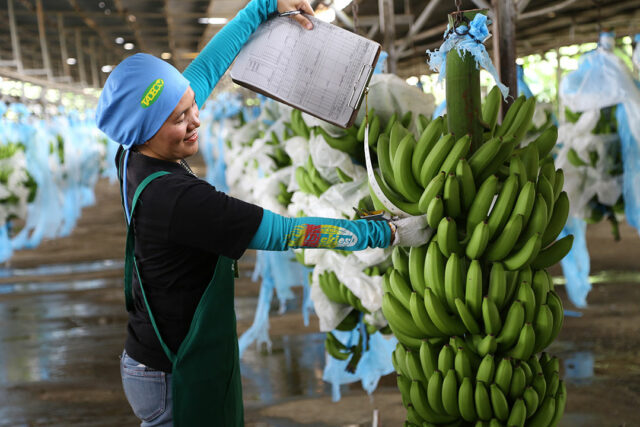
THE Philippine embassy in Tokyo said visiting Department of Agriculture (DA) officials have asked Japan to lower tariffs on Philippine bananas, citing the need to keep the industry afloat and aid in the development of Mindanao, the primary growing area.

The embassy, in a statement, said Agriculture Secretary Francisco Tiu Laurel, Jr. made the case for lowering tariffs imposed by Japan “to sustain and expand this industry.”

“This will not only attract greater investment in banana production but also drive poverty alleviation, job creation, and security in Mindanao,” he was quoted as saying.

In 2024, Philippine bananas had a 75% market share in Japan, the embassy said, though this was off the high of 90% more than a decade ago.

Philippine domestic production has also declined, as reflected in a decline in overall exports of 2.97% to 2.28 million metric tons (MT) in 2024, losing its position as the third-leading banana exporter.

China’s banana imports from the Philippines hit a 15-year low in 2024 of 463,306 MT, according to the International Trade Centre, an arm of the World Trade Organization.

Vietnam’s banana exports to China, meanwhile, rose 24% to 625,166 MT.

In Japan, Mr. Laurel met with Hirofumi Takinami, State Minister of Agriculture, Forestry and Fisheries, and Hiroshi Moriyama, the Liberal Democratic Party Secretary General and Japan-Philippines Parliamentary Friendship League Chairman.

Former Agriculture Undersecretary Fermin Adriano earlier told BusinessWorld that the Philippines was bound to lose its position as China’s largest supplier of bananas after China started improving rail links to mainland Southeast Asia, reducing logistics costs for banana suppliers like Vietnam.

“We already knew that this would happen in 2018 because China was then building a trans rail system passing through Myanmar, Laos, Cambodia, Thailand and Vietnam,” he said.

China in 2022 launched a new rail network connecting Chengdu and Chongqing to Hanoi, bringing shipment times down to five days from 20, according to ASEAN Briefing.

Laos and China in 2021 also opened a 414-kilometer rail line connecting Vientiane to its network.

Mr. Adriano said the DA has failed to invest significantly in banana research amid threats from Panama disease or fusarium wilt, first detected in Davao City in 2009.

“Our banana farms were hit by fusarium wilt or Panama disease, particularly small growers who cannot afford biosafety measures costs,” he said. “The DA did not heavily invest in banana research to respond to fusarium because all its focus and more than half of its budget goes to rice.”

Ties have also soured with China over territorial disputes, he said.

China is the Philippines’ largest source of imports and the second-biggest market for its exports, with total trade of $41 billion in 2023.

Federation of Filipino Chinese Chambers of Commerce and Industry, Inc. President Cecilio Pedro said while market diversification moves are needed, the sheer size of the Chinese market cannot be ignored. — Kyle Aristophere T. Atienza

SEC sets 2025 deadlines for AFS, GIS filing

ALEXANDER GREY-UNSPLASH

THE Securities and Exchange Commission (SEC) has set the deadlines for filing corporate annual financial statements (AFS) and general information sheets (GIS) for 2025.

The schedule is outlined in Memorandum Circular (MC) No. 1, issued on March 3, the SEC said in an e-mail statement over the weekend.

“Filing of reportorial requirements is mandatory and must be faithfully complied with every year. We urge all corporations to keep track of the deadlines to avoid getting fined for noncompliance,” SEC Chairperson Emilio B. Aquino said.

“The SEC is likewise authorized to suspend or revoke the corporate registration of duly registered companies for repeated failure to submit reports. We will be strictly implementing this authority as part of our efforts to enhance regulatory oversight over the corporate sector,” he added.

Entities required to submit audited AFS include stock and nonstock corporations with total assets or total liabilities of at least P600,000; stock and nonstock foreign corporations with assigned capital or total assets, respectively, of at least P1 million; and regional operating headquarters of foreign corporations with total revenues of P1 million or more.

“Corporations that do not meet the aforementioned threshold may submit their AFS duly certified by their treasurer or chief financial officer,” the SEC said.

Under the MC, corporations with fiscal years ending on Dec. 31, 2024, must file their AFS according to the last digit of their SEC registration or license number. Those ending in 1 and 2 must file on May 2, 5, 6, 7, 8, 9, 12, 13, 14, 15, and 16; in 3 and 4 on May 19, 20, 21, 22, 23, 26, 27, 28, 29, and 30; in 5 and 6 on June 2, 3, 4, 5, 6, 9, 10, 11, and 13; in 7 and 8 on June 16, 17, 18, 19, 20, 23, 24, 25, 26, and 27; and in 9 and 0 on June 30, July 1, 2, 3, 4, 7, 8, 9, 10, and 11.

Corporations whose fiscal years do not end on Dec. 31, 2024, must file their AFS within 120 calendar days from the end of their fiscal year.

Annual reports of brokers and dealers with fiscal years ending on Dec. 31, 2024, must be filed by April 30. Those with different fiscal year-end dates must submit their reports within 110 calendar days after closing.

The SEC said corporations with listed securities on the Philippine Stock Exchange (PSE), those with registered but non-PSE-listed securities, public companies, and entities covered under Section 17.2 of Republic Act No. 8799 or the Securities Regulation Code must submit their AFS within 105 calendar days from the end of their fiscal year, as an attachment to their annual reports.

“Corporations whose AFS are being audited by the Commission on Audit (CoA) are exempted from the aforementioned deadlines, provided they attach to their AFS a duly signed affidavit attesting that they timely provided the CoA with the financial statements and supporting documents and that the CoA audit has just been concluded, as well as a letter from the CoA confirming such information,” the SEC said.

The SEC requires the GIS to be filed within 30 calendar days from the date of the annual stockholders’ meeting for stock corporations, from the date of the actual annual members’ meeting for nonstock corporations, and from the anniversary date of the SEC license issuance for foreign corporations.

“One-person corporations are not required to submit the GIS. However, they must submit the SEC Form for Appointment of Officers within 15 days from the date of issuance of their certificate of incorporation or within five days from any subsequent changes,” the SEC said.

All stock and nonstock corporations must submit their AFS and GIS online through the SEC Electronic Filing and Submission Tool. The SEC will not accept submissions over the counter or via courier, in compliance with Republic Act No. 11032 or the Ease of Doing Business and Efficient Government Service Delivery Act. — Revin Mikhael D. Ochave

What Duterte’s arrest means to the world

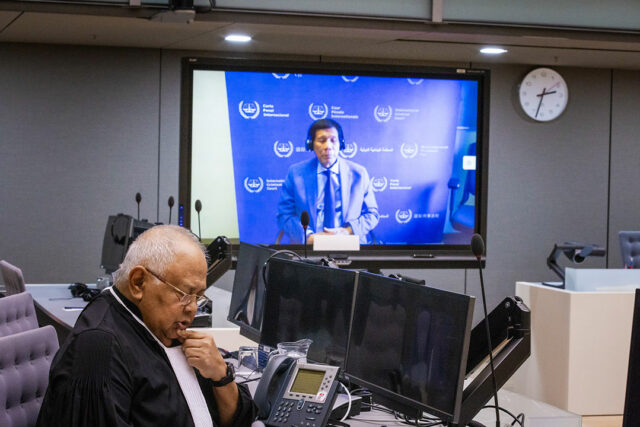
FORMER PRESIDENT Rodrigo Roa Duterte’s initial appearance took place on Friday, March 14, at 2 p.m. (The Hague local time), before Pre-Trial Chamber I of the International Criminal Court. — INTERNATIONAL CRIMINAL COURT / COUR PÉNALE INTERNATIONALE

RODRIGO DUTERTE built his presidency on a promise: to wage a war on drugs so ruthless that the fish in Manila Bay would “grow fat” from the bodies of the dead. By the time he left office in 2022, thousands had been killed — many executed in the streets by police and vigilantes emboldened by his words. Now, the former Philippine president faces the prospect of answering for those crimes for the first time.

By issuing an arrest warrant for Duterte, the International Criminal Court (ICC) has done more than seek justice for the thousands killed in his brutal war on drugs. It has sent a signal — however tenuous — that despite the rising tide of nationalism and authoritarianism, the rules-based global order (RBO) still holds sway. At a time when multilateral institutions are increasingly dismissed as toothless, and when figures like Donald Trump, Vladimir Putin, and Jair Bolsonaro have worked to undermine international norms, Duterte’s indictment is a rare moment where international justice appears to function as intended.

For the past decade, global governance has been in retreat. The ICC itself has been dismissed as a Western tool, with major powers like the United States, China, and Russia refusing to submit to its jurisdiction. Donald Trump openly sanctioned ICC officials for investigating potential American war crimes in Afghanistan. Putin, indicted by the ICC for war crimes in Ukraine, continues to operate with impunity, shielded by Russia’s geopolitical heft. Israeli Prime Minister Benjamin Netanyahu has brushed off the ICC’s investigations into alleged war crimes in Gaza, with full-throated backing from Washington. The arrest of a former head of state like Duterte, then, is an anomaly — one that forces a question: Does this signal a revival of international law, or is it merely an exception in a world that increasingly favors raw power over legal constraints?

The modern international legal order was built on a simple yet ambitious idea: that law, rather than brute force, should govern relations between states. Rooted in the Enlightenment philosophy of Immanuel Kant, who envisioned a “perpetual peace” based on republican governance and collective security, the project gained real momentum in the 20th century. Woodrow Wilson’s League of Nations, though ultimately a failure, laid the groundwork for the United Nations and the post-World War II multilateral institutions that would form the backbone of the RBO: the ICC, the International Court of Justice (ICJ), and the World Trade Organization, among others.

These institutions were designed to constrain power — ensuring that even the most powerful nations would be subject to common rules. In practice, however, enforcement has always been selective. The ICC has successfully prosecuted figures like former Yugoslav President Slobodan Milošević, Liberian warlord-turned-president Charles Taylor, and Sudanese strongman Omar al-Bashir. But it has largely failed to hold leaders from the most powerful nations accountable. The United States has repeatedly undermined the very institutions it helped build. Despite positioning itself as a global enforcer of democracy, it has refused to recognize the ICC’s authority while using its influence to shield allies from prosecution.

Duterte’s arrest comes at a time when the world is shifting away from the ideals of the post-war liberal order and toward a far more cynical, power-driven system. The past decade has seen an erosion of trust in global institutions, with populist and nationalist leaders actively working to dismantle or discredit them. Trump’s “America First” doctrine weakened NATO and withdrew the US from multilateral agreements, including the Paris Climate Accord. Putin’s full-scale invasion of Ukraine in 2022 marked a blatant rejection of the UN Charter’s principles on sovereignty. Bolsonaro’s presidency openly dismissed international norms on environmental protections, leading to catastrophic deforestation in the Amazon. Netanyahu has ignored UN resolutions and rejected ICC scrutiny of Israel’s military actions, leveraging US support to deflect accountability.

In this climate, Duterte’s arrest is a striking departure from the trend. Unlike these figures, he does not benefit from great power immunity. The Philippines, while strategically significant, lacks the geopolitical leverage to resist the ICC indefinitely. Duterte’s successor, Ferdinand Marcos, Jr., has distanced himself from his predecessor’s bloody drug war, and while the Philippines formally withdrew from the ICC in 2019, the court still holds jurisdiction over crimes committed while the country was a signatory.

Duterte’s case raises uncomfortable questions about the selective nature of international justice. It is easier to prosecute leaders from smaller states than to hold superpowers accountable. The ICC’s credibility problem will persist as long as it appears to apply the law unevenly — aggressively pursuing African and Asian leaders while avoiding confrontations with figures in Washington, Beijing, or Moscow.

Yet, even a flawed system is preferable to no system at all. The alternative is a world where might makes right, where state leaders operate with absolute impunity, and where justice is no longer even aspirational. The arrest of Duterte does not solve these problems, but it offers a counterpoint to the prevailing narrative that global governance is dead. If anything, it proves that even in an era dominated by realpolitik, institutions like the ICC can still land a punch.

Whether this moment marks the beginning of a resurgence for international law or is merely an outlier in a declining system remains to be seen. But for the victims of Duterte’s drug war, and for those who still believe in a world governed by principles rather than power, it is a rare moment of accountability — one that should not be dismissed.


Jam Magdaleno is a political communications expert and the head of the Information and Communications unit at the Foundation for Economic Freedom, a Philippine-based policy think tank.

Jetour opens Quezon Avenue dealership, previews T2 Panda

Jetour Quezon Avenue’s spacious showroom can accommodate up to 12 vehicles. — PHOTO FROM JETOUR AUTO PHILIPPINES

JETOUR AUTO Philippines, Inc. (JAPI) officially inaugurated the newest addition to its growing network of dealerships. Jetour Auto Quezon Avenue — located at 133 Quezon Ave., Sto. Domingo, District 1, Quezon City — is a five-level dealership that spans 4,000 sq.m., and boasts a spacious showroom that can accommodate 10 to 12 vehicles.

During the grand opening recently, guests were treated to a preview of the Jetour T2 Panda Edition, along with a view of Jetour’s extensive lineup. The 3S center is equipped with seven regular service bays and three dedicated electric vehicle (EV) work bays, “ensuring seamless maintenance and repair services for both traditional and electric-powered vehicles,” said JAPI in a release.

“This marks not just the opening of a new dealership, but the expansion of the Jetour family. It’s not only about adding new spaces and more vehicles to our lineup, but about creating meaningful connections with the Filipino people. It’s not just about providing you with great cars, but also ensuring that you have an exceptional experience long after you drive off from the showroom. We are about pushing boundaries, embracing transformation, and always striving to exceed expectations,” expressed JAPI Managing Director Miguelito Jose.

The five-level building also boasts training rooms, a café, and an audio and video room/lounge for customers. JAPI’s flagship dealership in Quezon Avenue becomes the latest in its growing network that provides an integrated service model covering pre-sales consultations, vehicle deliveries, and after-sales support.