Home Blog Page 1298

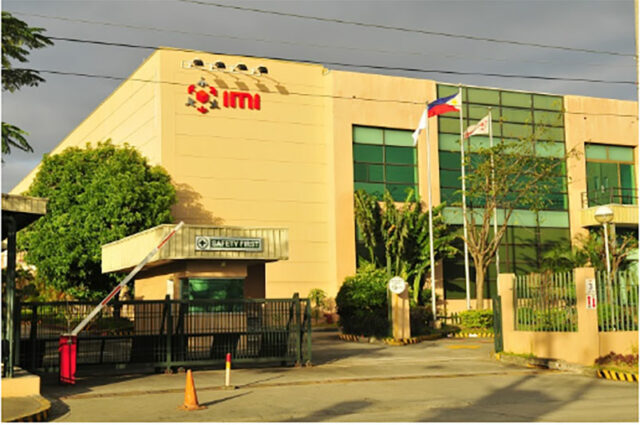
Ayala-led IMI says Trump tariffs pose no threat to company

GLOBAL-IMI.COM

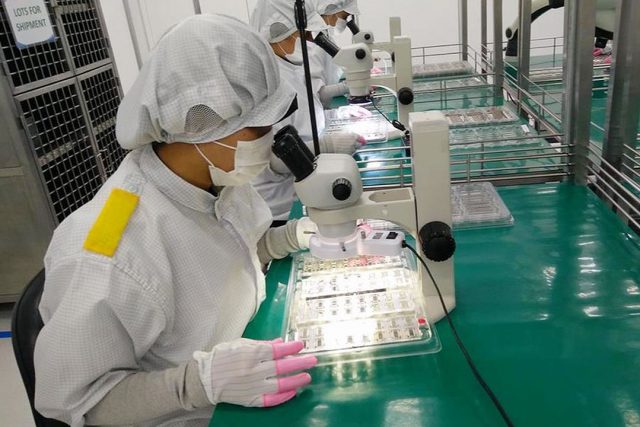
AYALA-LED listed chip producer Integrated Micro-Electronics, Inc. (IMI) said the tariffs imposed by US President Donald J. Trump have “no effect” on the company.

“It has no effect. Our customers pay the tariff… At the end of the day, this is all about us just keeping our heads down, focusing on what’s important,” IMI Chief Executive Officer Louis Sylvester Hughes said during the Money Talks with Cathy Yang program on One News on Thursday.

“That’s executing with sourcing and supply chain, getting things done within our four walls on the factory floor, and shipping on time with the highest degree of quality. If we continue to do that, we will win,” he added.

Mr. Hughes said it has been “business as usual” for IMI amid global trade uncertainty.

“For the Philippines, it’s really good news because other countries in Southeast Asia saw much higher tariffs. So, if anything, this has been a good thing for IMI over the last few weeks,” he said.

On Wednesday, Mr. Trump said he would temporarily pause the higher tariffs imposed on dozens of countries for 90 days.

However, the White House said a 10% blanket duty on almost all US imports would remain in effect.

Mr. Trump also said the tariff on Chinese imports would be increased to 125% from the previous 104%.

Prior to the temporary relief, the US imposed an 18% reciprocal tariff on Philippine goods, among the lowest in Southeast Asia. Other Southeast Asian countries faced higher tariffs, such as Cambodia (49%), Vietnam (46%), and Myanmar (44%).

Mr. Hughes said IMI has seen more companies diversifying their operations outside of China amid trade tensions.

“More of the transformation is moving out of China to places like Southeast Asia and Mexico… This has been really beneficial for us because we do have a footprint that allows us to help customers deliver goods into the US, either duty-free through the US-Mexico-Canada Agreement in Mexico, or at a very low duty compared to others out of the Philippines,” he said.

Meanwhile, Mr. Hughes said the Philippines remains competitive in terms of manufacturing compared to other countries, due to an English-speaking population and low labor costs.

“The Philippines offers us and our customers an incredible advantage when it comes to executing and building complex, high-mix electronics products,” he said.

For 2024, IMI reduced its attributable net loss by 53% to $49.79 million, driven by restructuring initiatives. Revenue declined by 17.2% to $1.1 billion, as its wholly owned subsidiaries continued to be affected by “prolonged recovery challenges in the automotive and industrial markets.”

IMI shares increased by 6.47% or 11 centavos to P1.81 per share on Thursday. — Revin Mikhael D. Ochave

Local delicacies galore: DTI food fair showcases Filipino products

DEPARTMENT OF TOURISM OFFICIAL PHOTO

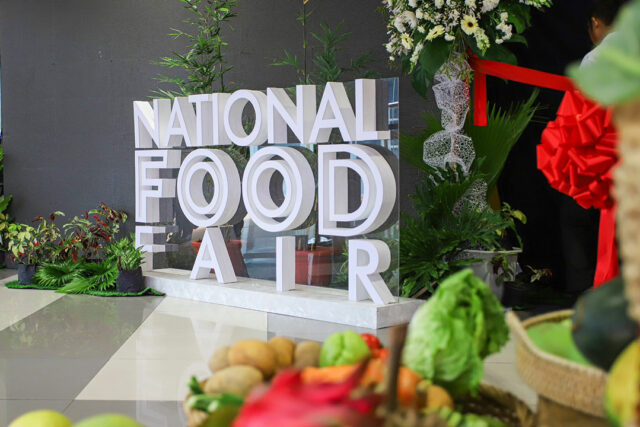
REGIONAL specialties, delicacies, and products have been gathered in one giant hall for the Department of Trade and Industry’s (DTI) Bagong Pilipinas National Food Fair.

The fair runs for four days, from April 9 to 13, at the Megatrade Halls 1 through 3 of SM Megamall in Mandaluyong City.

During the opening ceremony on the Day of Valor, April 9, President Ferdinand R. Marcos, Jr. discussed the importance of showcasing local products. “This national food fair is more than a gastronomic celebration of our rich and diverse culinary heritage. It is a testament to the incredible talent, ingenuity, and industry of our local farmers and artisans who bring pride and honor to our country,” he said in a speech.

Aside from opening the fair, he led the launch of DTI’s nationwide e-commerce platform, the Bagong Pilipinas Marketplace, which is “the largest business-to-business (B2B) online platform that aims to connect local enterprises with global institutional buyers.”

At the fair there are over 250 exhibitors offering items ranging from bottled laing (taro leaves cooked in coconut milk) from Daraga, Albay through HML Food; Penn’s gourmet tinapa (smoked fish) from Calbayog, Samar; and flavored chicharon (pork cracklings) by Ellynes Pasalubong from General Santos City, South Cotabato. Products we bought were pili nut delicacies by Lola Tina’s from Camarines Norte, and Potter’s Hand buro (fermented fish or shrimp) from Tarlac City.

The fair also features personal care products like virgin coconut oil from Cocoplus Aquarian, based in San Pablo, Laguna. Many people were drawn to the woven placemats made by Crissandder Enterprises from Baclayon, Bohol; handloom-woven rugs and pillows from Zamboanga; and various forms of bamboo craft from La Paz, Abra.

Food lovers had many options to choose from to eat on the spot, with crowd favorites on opening day being rabbit meat sausages by Easter Joy from Angono, Rizal; and Empanada ni Behang, which saw long lines of people craving Ilocos Norte-style empanada (turnovers).

DTI made sure to represent all the regions, be it through coffee from the Cordillera region, artisanal chocolate from Mindanao, or fruit wines and vinegars hailing from Visayas, said DTI secretary Cristina Roque.

“The products here today are compliant and registered, so people can buy whether retail or wholesale,” she explained to the press. “We really encourage wholesale, so we invite hotels, restaurants, supermarkets, and also consolidators to make sure that we can distribute them locally and globally.”

This is improved on by the Bagong Pilipinas Marketplace which the event also launched. Ms. Roque said that this will help support micro, small, and medium enterprises (MSMEs) in the food processing industry, which are “the backbone of the Philippine economy.”

“It’s a sector we definitely cannot ignore,” she added. DTI will be organizing more trade fairs throughout the year to provide MSMEs more platforms to showcase their products.

According to a statement, last year’s National Food Fair generated P57.83 million in sales, combining cash, bookings, and pending orders.

Mr. Marcos said that Filipinos can expect more government support moving forward. “With these efforts to strengthen our local industries, we are indeed positioning the Philippines as a prime investment destination. Let this event serve as an open invitation to more potential investors both Filipinos and foreigners alike to take part in the opportunities that Philippine markets offer,” he said.

The National Food Fair is open to the public and admission is free. Aspiring entrepreneurs can join future DTI fairs through their local DTI Office. — Brontë H. Lacsamana

IC allows insurers to invest in pooled funds, structured notes

PHILSTAR FILE PHOTO

INSURANCE COMPANIES, professional reinsurers, and mutual benefit associations (MBA) will now be allowed to invest in more instruments and entities under new guidelines issued by the Insurance Commission (IC).

IC Circular Letter (CL) 2025-09 dated April 8 lays out the new omnibus guidelines on investments of IC-regulated entities (ICREs), which consolidate and supersede previous related issuances to streamline and update the framework for these firms’ allowable investments.

“The new Circular Letter aims to enhance investment adaptability of insurers, reinsurers, and MBAs to respond to the dynamic investment market environment. It aims to further empower the commission’s regulated entities to make well-informed investment decisions with the aim of ensuring the stability and growth of their respective financial assets while safeguarding the interests of their policyholders,” Insurance Commissioner Reynaldo A. Regalado said in a statement on Thursday.

“By issuing these new Omnibus Guidelines, we are addressing the bottlenecks that hinder timely investment decisions and strain regulatory resources,” he said.

Under the guidelines, ICREs can now invest in structured products like credit-, bond- or equity-linked notes, debt securities issued by supranational organizations, and investment vehicles, which include pooled funds like mutual, exchange-traded, unit investment trust, and money market funds, as well as real estate investment trusts.

This is in addition to admissible investments under previous IC issuances, which include securities issued by the government and corporates, loans, real estate, derivatives, and infrastructure projects under the Philippine Development Plan, among others.

“While these investments do not require prior approval by the commission under the new issuance, regulatory safeguards are provided to ensure that ICREs will be able to maximize returns, subject to prudent levels of risk,” the IC said.

“Specifically, the new CL mandates that each new allowable investment must meet minimum credit rating requirements or be listed on recognized exchanges, which provides a layer of transparency and market oversight.”

ICREs will likewise be allowed to make certain peso- and foreign currency-denominated investments without prior IC approval, provided that these “meet accepted market-wide standards and have gone through external review processes and scrutiny, such as credit rating and listing on recognized exchanges, among others,” the regulator said.

The guidelines also include the list of investment limitations per instrument or entity and enumerate non-admitted assets of insurers, professional reinsurers, and MBAs in the determination of their financial condition.

The IC said it will conduct a regular review of insurers, reinsurers and MBAs to ensure that their investment activities and portfolios comply with its regulations.

“Further, the commission may, at any time, implement appropriate regulatory measures for prudential reasons if the ICRE failed to maintain an adequate risk management system and conducted business in an unsafe and unsound manner,” it said.

“The commission reserves the right to issue warnings, order liquidation of investments, non-admit assets, and suspend, modify, downgrade, limit or revoke any ICRE’s investment authority, among others.”

Companies must submit regular reports on their investments to the regulator, with a separate report required for those with investments in complex instruments.

The insurance industry’s premium income rose by 12.82% to P440.39 billion in 2024, latest IC data showed. Its combined net income grew by 15.88% to P56.29 billion. — A.M.C. Sy

The other casualty of Trump

THE NOW TIME/UNSPLASH

After about a week of debating how US President Donald Trump violated trade rules and economic common sense, and this is now becoming more apparent, the world now realizes, as Trump must have designed it, we all might have to either grin and bear it or fight it off. It’s humanly impossible to drill sense into the man.

JP Morgan CEO Jamie Dimon could not have been clearer about his warning that Trump’s tariff policy is likely to raise prices, drive the global economy into a possible recession, and weaken America’s standing in the world. As he stressed over CNN early this week, America’s “extraordinary standing” was precisely anchored on its strong economy, military, and morals. These three foundational truths are increasingly being eroded at the White House, begging for a reprieve.

But Trump would not have any of that because he wanted to exact a pound — perhaps a ton — of flesh from the world for making America not so great anymore.

He is now engineering to “Make America Great Again” by high tariff walls which would make US imports more expensive for the American people. Nobody thought that to make America great again is to make the American people pay more for their groceries, electronic gadgets, and even cars. If the US Fed is to be true to its job of keeping price stability, monetary easing might have to take a back seat, and it might instead consider a possible reversal. Thus, the American people might be facing higher interest rates for auto and housing loans, and with the stock market crash, their wealth dissipated. The US is impoverishing, rather than empowering, its own people. We can see more people shortly queuing up in the social security offices across the United States.

He is also planning to use a 1996 law to fine and seize migrant workers if they refuse to “self deport and leave the country.” If migrants fail to pay the fine of $998 a day, their properties could be seized. Implementing this sweeping immigration crackdown is bound to affect some 1.4 million migrants who have in their own small way helped mitigate the US’ tight labor market by offering cheap labor and special talents in technology and the arts. There has been a climb in mixed marriages making the US truly a melting pot of color, religion, race, and social standing that has made it more dynamic and, yes, more democratic. Is the US really serious in shooting itself in the foot?

Nobody can ever question that Trump’s tariff and immigration policies will hurt the poor more. It’s funny but painfully sad that the New York Times’s Paul Krugman should write that Trump’s blue-collar base is feeling “brutally scammed.” Many of them thought that “America First” would bring back jobs to the land of the free through reshoring, restructuring the domestic economy, and allowing massive use of technology to boost productivity and redistribute the labor force into new frontiers.

Instead, it’s fast becoming a live show where the US will be all alone.

Trump looks and sounds dead serious in pursuing this policy shift, but as many are now convinced, the point of the two-time US head of state is not really to enforce the law, but rather to project and instill fear in the global community.

Our own proposition is that Trump realizes, and I hope we are right, that America’s trade deficit of more than $1 trillion, the one singular basis of his so-called reciprocal tariffs, is not caused by the rest of the world, whom he claimed, has looted, raped, pillaged, and plundered the United States. The country’s current account shortfall is invariably symptomatic of the US’ excessive spending beyond its means. It’s no different from someone who finances his frivolous lifestyle by using his credit card more and more until he is hopelessly buried in debt.

But Trump has to have a whipping boy.

Allies and non-allies will be subjected to at least 10% universal tariffs. On top of that, the US is also imposing variable tariffs due to what it refers to as “tariffs charged against the US” due to so-called currency manipulation and trade barriers. Nobody knows how the calculus was developed. Yet, as Jeffrey Sachs wrote last week, “Trump’s tariffs will not close the trade deficit…” Instead, we reiterate that such tariffs will make Americans poor and harm the rest of the world.

But Trump and his advisers must be looking for a way to fund the third pillar of his announced three-pronged policy: massive tax cuts for the rich and powerful in American society. Cutting taxes for the social elite means the federal government would have to take stock of alternative solutions to the ever-increasing fiscal deficit and subsequently federal debt. The US’ wars in the Middle East and Eastern Europe are also draining the federal budget of funding.

But who does not know, as The Guardian reported the other day, that Trump 1.0 enabled 11 of the biggest US consumer goods corporations “to spend more than three times as much on share buybacks as they did on taxes,” using their savings from the 2017 Trump tax cuts to “supercharge purchases that enriched investors instead of lowering prices on goods essential to daily life.” This was based on the recent report prepared by Groundwork Collaborative, an economic think tank.

In the spirit of the Lenten season next week, Trump will be penalizing the consumers to resurrect the same tax cuts — now amounting to some $5 trillion in corporate tax cuts that could lead again to more buybacks. We don’t know how those tariff increases will offset the expected decline in domestic demand and sustain fiscal sustainability. But we are very certain that PepsiCo, ComCast, United Healthcare, Kimberley Clark, and other corporations’ $500 billion in profits following the first tax cuts were an enormous opportunity loss for the federal government. While they paid some $140 billion in taxes, that was just peanuts to their profit gains.

We don’t need AI to realize that buybacks are a company’s purchase of its outstanding shares in the equities market. With such buybacks, the number of shares available to the public is reduced and bolsters stock value and, yes, investors’ wealth. One estimate, as cited by The Guardian, puts publicly traded companies spending as much as 90% of their earnings on buybacks which could have been instead funneled back into the company to keep prices down and increase workers’ wages.

As Groundwork argued “this is how you get the staggering wealth inequality in this country.”

Trump 1.0 has transitioned to Trump 2.0 and with such a transition, the spirit of the 2017 Tax Cuts and Jobs Act (that dropped the corporate tax from 35% to 21%) is very much alive. Trump 2.0 is about to reduce the corporate tax further to 17% and most of company windfall, estimated at some $50 billion annually, will likely end up buying back company shares instead of promoting stronger purchasing power of consumers.

To rub it in, some Republicans are now thinking of slashing Medicaid and other social service programs which benefit the marginalized and the poor to fund — you guessed it right — the massive tax cuts. It’s no different from our recent experience with the Philippine Congress that defunded PhilHealth and other critical social service projects to finance non-critical but profitable infrastructure like road widening and river dredging projects, the congressional budget in the forthcoming mid-term election, and the President’s intelligence and confidential funds.

Trump’s downsizing of the federal bureaucracy is also ill-advised. It’s fiscal profligacy that is the real root of the problem, not the salaries of civil servants or the bigger budget for research and development (R&D). Civil servants deliver public services. R&D sustains America’s competitiveness in technology. As Sachs claimed, the US needs to rethink the existence of some 750 overseas military bases, the bloated CIA and other intelligence budgets, and, of course, massive payments on America’s soaring debt.

Trump 2.0, in no uncertain terms, is therefore showing us that the other casualty in Trump’s trade war is the battle against poverty and inequality in the US and the American people are clearly losing ground. It is those with corporate control that stand to benefit from this series of missteps and absurdities. Unfortunately, the global community is right in the line of fire.

To support this proposition, and as we prepared this column Thursday morning, we received news that once again, Trump flip-flopped and reversed his reciprocal tariff regime by hitting the pause button for three months. It is obvious that the bloodbath in the US government bond markets — usually a safe haven for investors and corporates — must have somewhat convinced Trump to go slow. Not that his heart had changed like that of Paul on the road to Damascus, but his wealthy advisers must have realized that the outcome could be more catastrophic. Recent sell offs of US bonds mean less opportunity to fund the federal deficit and US wars everywhere.

We caution the Philippines not to allow itself to be entertained by the prospect drawn by some analysts saying the impact of the tariffs on the Philippines is manageable and perhaps the least in the region. We have such things as second-order effects which could be worse than their first-order sibling.


Diwa C. Guinigundo is the former deputy governor for the Monetary and Economics Sector, the Bangko Sentral ng Pilipinas (BSP). He served the BSP for 41 years. In 2001-2003, he was alternate executive director at the International Monetary Fund in Washington, DC. He is the senior pastor of the Fullness of Christ International Ministries in Mandaluyong.


BYD Cars Philippines sets sights on expanding market share this year

BW FILE PHOTO

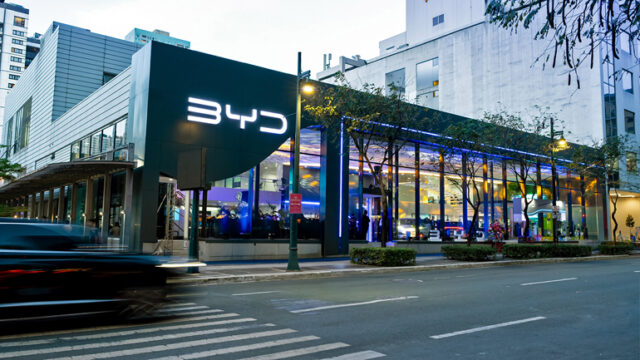
BYD CARS PHILIPPINES said it is targeting higher sales and additional dealership openings this year as more consumers shift to new energy vehicles, a company official said.

“We are targeting a lot (of sales). Definitely higher than last year. We will be aggressive as we would like to have a good market share as well,” said Bob Anthony Y. Palanca, managing director at BYD Cars Philippines, on the sidelines of the Manila International Auto Show (MIAS) on Thursday.

Last year, the company sold 4,780 passenger vehicles, representing an 8,900% growth from 2023 and an 82% share in the new energy vehicle market.

The company also plans to expand its dealership network amid expected sales growth.

“We are already in Luzon, Visayas, and Mindanao, and we will further strengthen that position. We had 25 dealerships as of December 25, 2024, and as of the end of March, we have 33,” he said.

“We are opening more; I think almost every month we will have an opening,” he added.

Mr. Palanca said the company sees significant year-on-year growth in the sale of new energy vehicles, particularly plug-in hybrids and battery electric vehicles (BEVs), due to competitive pricing.

“The market is actually now shifting towards BEVs, not only because of sustainability, but of course, they also have benefits, such as color coding. That’s an advantage because instead of having two cars, you only need one car,” he said.

“We had customers that had two cars in the past and sold both to get one hybrid electric vehicle (HEV), because it is coding exempt, plus they get savings as they spend less on fuel,” he added.

In line with this, BYD Cars Philippines launched its all-electric eMAX 7 Standard and eMAX 7 Superior Captain, which will be sold at P1.498 million and P1.748 million, respectively.

“I believe that the industry will be driven by electrified mobility. The growth of plug-in HEV and BEV (sales) will be significant, and this will be a driver for our industry growth,” he added. — Justine Irish D. Tabile

Viola Davis makes younger self proud as US president in G20

LOS ANGELES — For Viola Davis, seeing her first images of a “badass Black woman on television” when she was growing up became an inspiration for her role as the US president in the thriller film G20.

The 1974 American crime drama series Get Christie Love! starring Teresa Graves as an undercover detective immediately captivated Ms. Davis.

“Whenever she would arrest someone, she was like ‘You’re under arrest, baby!,’ and I was like ‘Oh my God! Oh my goodness!’ and she would throw men off balconies,” Ms. Davis told Reuters.

“When you see it, you can believe it. When you see it, you can see yourself in it and there’s something about being seen that forces you to see yourself,” she added.

G20, which arrived on Amazon Prime Video on Thursday, is directed by Mexican director Patricia Riggen and follows Ms. Davis’ character US President Danielle Sutton, who protects her family and other world leaders when a G20 summit in Cape Town, South Africa is infiltrated by terrorists.

The movie also stars Anthony Anderson as Danielle’s husband and first gentleman Derek Sutton, Black-ish actor Marsai Martin as their daughter Serena Sutton, and Christopher Farrar as their son Demetrius Sutton.

Ms. Davis specifically requested Mr. Anderson to play her movie husband because of their close bond.

“We’ve always had a great relationship, just in the same network, traveling in the same circles, having the same friends,” Mr. Anderson said.

However, both Ms. Davis and Mr. Anderson admitted that their biggest bonding experiences came from collecting free items together at gifting suites.

“I didn’t want to mention that. We like the free stuff,” said Ms. Davis, triggering a fit of laughter from both of the actors.

Another thing about the movie that amused Ms. Davis was thinking about how her younger self would be ecstatic to see her playing the role of Danielle.

“That six-year-old Viola has been serving me. My job is to make her squeal. My job is to make her really excited about who she’s going to become,” Viola said.

Ms. Davis is known for her EGOT status, which stands for a winner of the Emmy, Grammy, Oscar and Tony awards, and is one of the highest honors for a performer in Hollywood. — Reuters

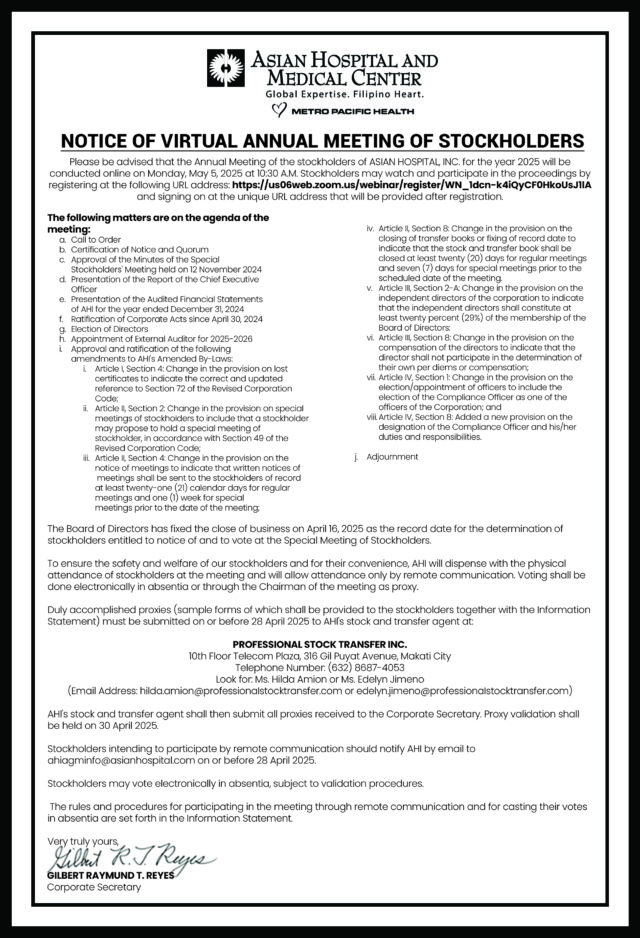
Asian Hospital, Inc. announces 2025 Annual Meeting of Stockholders to be conducted online on May 5


Spotlight is BusinessWorld’s sponsored section that allows advertisers to amplify their brand and connect with BusinessWorld’s audience by publishing their stories on the BusinessWorld Web site. For more information, send an email to online@bworldonline.com.

Join us on Viber at https://bit.ly/3hv6bLA to get more updates and subscribe to BusinessWorld’s titles and get exclusive content through www.bworld-x.com.

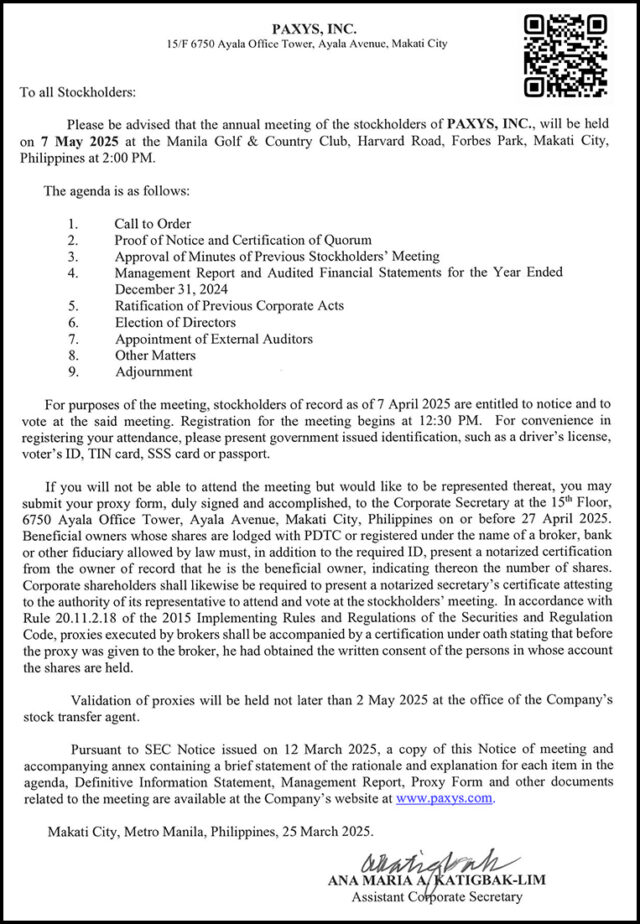
Paxys, Inc. set to hold 2025 annual meeting of stockholders on May 7


Spotlight is BusinessWorld’s sponsored section that allows advertisers to amplify their brand and connect with BusinessWorld’s audience by publishing their stories on the BusinessWorld Web site. For more information, send an email to online@bworldonline.com.

Join us on Viber at https://bit.ly/3hv6bLA to get more updates and subscribe to BusinessWorld’s titles and get exclusive content through www.bworld-x.com.

US tariffs offer ‘window’ to raise PHL job quality

PHILSTAR FILE PHOTO

By Chloe Mari A. Hufana, Reporter

LABOR LEADERS said the government has a window of opportunity to improve job quality and “decent employment” while recalibrating its trade strategy in response to the US tariffs.

Federation of Free Workers President Jose Sonny G. Matula said the US tariffs could inadvertently open doors for labor-rich economies like the Philippines, particularly in electronics manufacturing and subcontracting.

The Philippines was initially set a 17% tariff by the US, though the White House has since paused the new tariff for 90 days as delegations from countries that did not retaliate head to Washington to negotiate new rates.

In 2024, the Philippines exported $12.14 billion worth of goods to the US, over half of which ($6.43 billion) consisted of electronics.

With manufacturers looking to diversify away from China, Mr. Matula noted the opening for the Philippines to absorb some of the electronics manufacturing exiting the Mainland, describing the industry as labor-intensive with strong growth potential.

“The Philippines, being part of the global electronics supply chain, could see increased subcontracting, particularly in component assembly and semiconductor packaging,” Mr. Matula said via Viber.

To fully prepare the Philippines and its workforce, Mr. Matula urged the government to curb electricity prices, ensure a just transition to renewable energy, and cut red tape for agro-industrial development.

“We need these improvements not just to attract foreign direct investment but to proactively support our own micro, small and medium industries,” he added.

He emphasized the need to ensure that jobs created are decent work, not precarious, low-wage employment.

He called for upskilling, particularly in electronics assembly, robotics, automation, and precision engineering.

“Smart manufacturing is becoming the standard. Workers must be digitally literate, adaptable, and AI-ready. Government, employers, and labor groups need to collaborate now to align training programs with these needs,” he said.

University of the Philippines Diliman School of Labor and Industrial Relations Assistant Professor Benjamin B. Velasco said the lower tariffs will open a window for more production in the country for electronics and apparel.

“It can lead to more investment and more employment,” he told BusinessWorld via Facebook Messenger chat.

“However, the reason the Philippines got slapped lower tariffs compared to other Southeast Asian countries is that we have a lower trade surplus with the US due to the fact that we import a lot from them,” he added. “Meaning, we are a dependent and weak economy compared to Southeast Asian neighbors.”

Over 75 countries contacted the US Trade Representative to negotiate new tariffs Treasury Secretary Scott Bessent said.

While the initially announced tariffs remain on the books, their actual enforcement will be delayed until mid-July, pending further review and consultations.

Balancing sustainability and affordability in the Philippine transit system

PHILIPPINE STAR/JOHN RYAN BALDEMOR

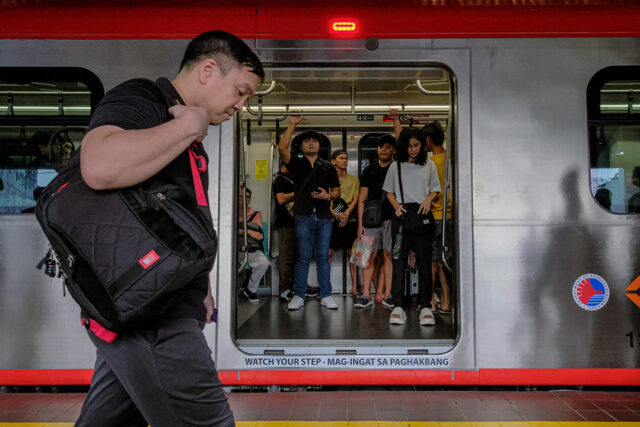
The just imposed fare increase for the Light Rail Transit Line 1 (LRT-1) has been described by critics as “unfair,” “anti-poor,” and “untimely,” as the increase sparked outrage among commuters and labor groups. The Trade Union Congress of the Philippines (TUCP) and Bayan Muna, among others, have denounced the increase, arguing it adds to the burden of minimum wage workers already grappling with.

For its part, Akbayan threatened mass demonstrations if the Department of Transportation (DOTr) does not intervene to halt the fare increase. Others have blamed the privatization deal between the Light Rail Manila Corp. (LRMC) and the government as the root cause of what they say is exorbitantly steep price hikes.

But in the midst of such criticism, we also need to zoom out and see the broader context: the operating sustainability of LRT-1 and the improvements that have been made since LRMC started to manage it as early as 2015.

Since the assumption of LRMC in operating the line, the LRT-1 system has become significantly more efficient and much more reliable. For one, it has made significant improvements by rehabilitating the existing system and extending the LRT-1 system at a cost of P36.3 billion. Among others, the private sector partner of the Department of Transportation has increased the number of functional light rail vehicles from 77 to 144 trains; there is almost 100% system reliability in operating LRT-1 which shows that LRMC provides continuous, smooth and safe operations to all commuters; it has updated the 40-year-old operating systems; and the biggest improvement is the completion of Phase 1 of the Cavite Extension Project, which expands LRT-1’s reach, relieving traffic congestion in the metropolis.

FARE HIKE’S SUSTAINABILITY IMPACT
This most recent fare adjustment — approved by DOTr and which took effect on April 2 — is just the second fare hike granted within the life of the agreement between LRMC and the DOTr. Based on records, LRMC has already spent sizable investments upgrading the LRT-1 system and yet it has only increased fares once since 2015. This fare hike will enable LRMC to continue with its current initiatives to further upgrade the transit system, through enhancements to station amenities, train maintenance, and infrastructure developments that will serve the riding public.

Clearly and simply put, if you don’t have enough money, you can’t sustain those improvements. Commuters, especially those who use the service on a daily basis, would once again have to deal with longer waiting times, more frequent breakdowns, and old facilities, which were the sorry state of affairs before LRMC stepped in, when fares were not calibrated correctly.

But critics say the fare increase unfairly hit poor and working-class commuters, and this misses the point about the long-term value of a good functioning railway system. In reality, it is the ordinary daily passengers of the LRT-1 service, particularly those who utilize the train as their main mode of transport, who bear the brunt of any disruption. Ordinary commuters would benefit from a more efficient LRT-1 that runs on time — and are not forced to take time-consuming, less efficient, more costly modes of transportation such as buses or jeepneys.

On a short-term basis, fare increases may be financially strenuous for passengers, but they lead to the provision of more dependable service in the long run which results in savings and decreases in costs. A reliable train network leads to less surprises in your trip time, shorter wait times, and less reliance on taxis or buses as alternative transportation, all of which lead to more predictable and cheaper commuting costs.

As previously reported, many protest groups believe privatization is also the primary reason for the fare hikes and have requested a review of LRMC’s contract. They say government control of the railway would end what they consider price-gouging. But this claim does not account for inefficiencies in the way operations are run when government-run rail systems are underfunded.

While these sectors claim that the fare hike will simply redound to serve the corporate interests of the company, the hard truth is that the added revenue will mainly directly support and sustain LRMC’s capacity and ability to provide necessary system maintenance, expansion, and service quality improvements.

Evidently, improvements would not have been possible under purely government-controlled operations, given the inefficiencies and red tape historically associated with state-run transport systems. Privatization ensures long-term investments, improved service quality, and system sustainability — something that would not be achievable under a purely government-subsidized model.

From this vantage point, the opposition to privatization is ideological, not practical. If we remove private sector participation, where will the government find the funding to maintain and expand our transit infrastructure? Relying on government subsidies alone is unrealistic and will only lead to delays, mismanagement, and a return to the inefficient, breakdown-prone system of the past.

Additionally, government-run transit systems in developing countries often suffer from mismanagement, bureaucratic bottlenecks, and political interference. LRMC, as a private operator, prides itself on working under a performance delivery framework whereby profitability is directly related to an efficient and high-quality service. This way, you can combine financial discipline with the public spirit, which guarantees that everything remains sustainable and accountable — as opposed to the slow-moving, government-run machine of the past.

It should also be noted that LRMC cannot unilaterally increase fares. Fares may change with DOTr approval and are always considered closely before being implemented. The belief that “privatization results in fare hikes” fails to take into account the role of regulatory oversight in shaping fare-setting policies and is therefore an oversimplification.

Ultimately, the government and its private sector partners walk a tightrope of sustainability and affordability.

Even at a time when the focus should be on affordability, the push toward sustainable operations is critical, and the fare increase is one of the main steps in that direction. The LRT-1 is an efficient mode of transport for many thousands of daily commuters and thus serves the purpose of decongesting the roads and reducing carbon emissions through decreased dependence on cars.

Though it may not endear the LRT-1 to the riding public, the fare increase has become necessary to maintain and improve service on the LRT-1. But to keep the LRT-1 operational, it’s not all about increases in fare; it’s about empowering the riding public with superior, agile, and responsive transport in the light of the deteriorating mass transit situation of Metro Manila commuters.


Dr. Ron F. Jabal, APR, is the CEO of PAGEONE Group (www.pageonegroup.ph) and founder of Advocacy Partners Asia (www.advocacy.ph).

ron.jabal@pageone.ph

rfjabal@gmail.com

Fed officials signal no plans to ride to the rescue with rate cuts

BW FILE PHOTO

US FEDERAL RESERVE policy makers worry US President Donald J. Trump’s trade policy could deal a blow to economic growth, but are signaling they will not be quick to ride to the rescue with interest rate cuts because they expect higher tariffs to boost inflation.

The minutes of the US central bank’s mid-March meeting, released on Wednesday, showed that Fed officials already felt they were operating in a thickening cloud of uncertainty that had the potential to slow consumer spending and business investment and also called for a cautious approach on rate-setting.

That was before Mr. Trump’s April 2 announcement of sweeping tariffs triggered a global stock market rout on fears of recession and a sharp rise in Treasury yields that raised alarm bells about potential financial market instability.

Mr. Trump’s stunning reversal on Wednesday, walking back a chunk of those big tariffs, ignited a powerful relief rally in stock markets. But it did little to deliver the clarity policy makers say they need to act.

“Uncertainty over trade will persist,” economists at Citi wrote after Trump abruptly lowered tariffs to 10% for many countries for the next 90 days, even as he ratcheted up levies on Chinese imports to 125%.

Some of the price and growth dynamics set in train by Mr. Trump’s earlier actions may not be reversed so quickly, including indications of slowed business investment and hiring and household spending. Fed officials have flagged early indications that tariffs were already pushing some goods prices higher.

“Risky” is how both St. Louis Fed President Alberto Musalem and Minneapolis Fed President Neel Kashkari on Wednesday described treating tariff-driven price hikes as one-time events that central bankers can safely ignore.

Their concerns that price increases from tariffs, along with retaliation by other nations, could potentially translate into more persistent inflation appeared to have been widely shared even before Mr. Trump announced his latest, now-paused round of import duties last week.

At the same time, they worry that slowing growth could raise unemployment, a situation the Fed would otherwise want to counter with easier monetary conditions.

With just one main policy tool — control over short-term borrowing costs — the Fed could be forced to choose between fighting high inflation and fighting high unemployment, each at the expense of the other, a point policy makers including Fed Chair Jerome H. Powell have been highlighting.

The minutes of the Fed’s March 18-19 meeting showed policy makers even then were worried about the “difficult tradeoffs” they could face if inflation proves persistent but growth also slows.

Trump’s change of course underscores the message that Fed policy makers have also hammered home in recent weeks — with so much unclear about the actual policies of the Trump administration, let alone their effects, they are firmly in wait-and-see mode.

US stocks surged Wednesday afternoon to close sharply higher and financial markets pulled back on earlier bets on aggressive Fed rate cuts.

BELOW-TREND GROWTH
Policy makers mapping out their options do not see a clear path to a soft landing, in which inflation slows without a damaging recession or sharp rise in unemployment. That scenario last year seemed increasingly in reach.

As firms and households adjust to prices driven higher by the new import levies, economic growth will likely slip “materially” below trend and the unemployment rate will rise over the year, Musalem told Reuters in an interview.

“I don’t have a baseline of recession,” he said, but “I’m thinking growth is probably going to come in materially below trend,” which he estimated at around 2%.

“You’re getting risk on both sides materializing,” with higher-than-anticipated tariffs putting pressure on prices as declining confidence, a blow to household wealth from the recent sharp drop in equity markets that could depress spending, and the impact of higher prices all combine to slow growth, Mr. Musalem said.

How monetary policy responds will depend on how inflation and unemployment evolve in the coming months, whether the price shock appears to be persistent, and whether inflation expectations remain consistent with the Fed’s 2% inflation target, said Mr. Musalem, who is a voting member of the Fed’s policy-setting committee this year.

Mr. Kashkari, in an essay released early on Wednesday, said that for him, “the hurdle to change the federal funds rate one way or the other has increased due to tariffs.”

Given how critical it is to keep expectations for ever-higher prices from getting embedded in the mindset of Americans, “the bar for cutting rates even in the face of a weakening economy and potentially increased unemployment is higher,” Mr. Kashkari wrote.

But given the likely drop in investment also due to the tariffs, he said, “policy is getting somewhat tighter on its own, reducing the immediate need to raise the federal funds rate to keep long-run inflation expectations anchored.”

The Fed’s policy rate has been in the 4.25%-4.5% range since last December. Until Mr. Trump’s surprise announcement on Wednesday, markets had been betting heavily that the central bank would respond to the tariffs with a series of rate cuts starting next month.

“If you’re driving in really dense fog, there are two things you don’t want to do. And one is to step on the gas because you don’t know who’s in front of you. And one is step on the brake because you don’t know who’s behind you” Richmond Fed President Thomas Barkin told the Economic Club of Washington, D.C.

Mr. Barkin said he is most focused on the risk that consumers, exhausted by recent inflation and tapped out of the extra savings they had accumulated during several rounds of pandemic-era government stimulus, could sharply slow spending in the face of high prices. — Reuters

Mercury Drug President Vivian Que-Azcona, 69, passes away

VIVIAN QUE-AZCONA — FACEBOOK.COM/MERCURYDRUGPH.TIF

VIVIAN QUE-AZCONA, president of Mercury Drug Corp., passed away on April 5 at the age of 69.

In a Facebook post on Thursday, pharmaceutical company Unilab Group extended its condolences on the passing of Ms. Que-Azcona.

“She was a visionary leader and a dedicated partner who has left an indelible mark on the Mercury Group of Companies, the healthcare industry, and the country,” it said.

“We believe her meaningful work uplifted millions of lives through the years, leaving a legacy that will be remembered for generations to come.”

As the largest shareholder of Mercury Drug Corp., a drugstore chain established in 1945, Ms. Que-Azcona was instrumental in the company’s growth and success.

Under her leadership, Mercury Drug expanded its presence across the Philippines, with a network of over 1,200 stores nationwide and more than 15,000 employees. — Justine Irish D. Tabile