Home Blog Page 1298

90,000 suffer from power outages

MERALCO’S FACEBOOK ACCOUNT

AROUND 90,000 customers of Manila Electric Co. (Meralco) are affected by power outages as of 2 p.m. brought by heavy rains caused by southwest monsoon.

In a statement on Tuesday, Meralco said that the number has been reduced from over 167,000 affected, as of 7 a.m.

Most of the affected customers reside in Metro Manila, Cavite, and Bulacan, while the rest are in Rizal, Quezon, Laguna, and Batangas. Around 86% of affected customers are in flooded areas, Meralco said.

“We continue to actively monitor the weather situation in light of persisting rains in parts of our franchise area. We ask our customers for patience and understanding as we have to prioritize safety during the conduct of power restoration activities,” Meralco Vice-President and Head of Corporate Communications Joe R. Zaldarriaga said.

Meralco said that its crews are working round-the-clock to restore power service as soon as it is safe to do so.

Meanwhile, in its energy situation report, the Department of Energy said that restorations are ongoing with two electric cooperatives in the Cordillera Administrative Region: Benguet Electric Cooperative, Inc. and Abra Electric Cooperative, Inc. — Sheldeen Joy Talavera

Koreans concerned over PHL safety

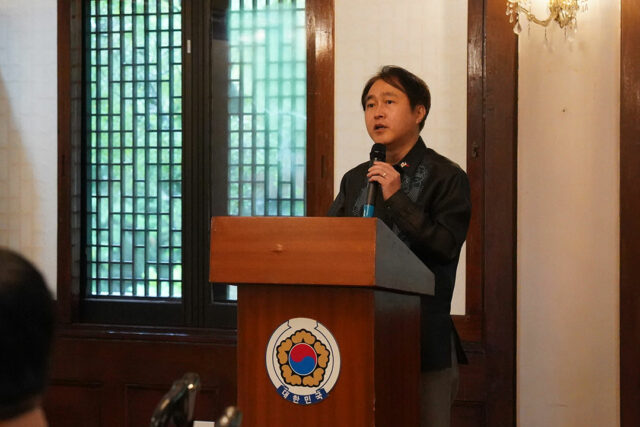
REPUBLIC of Korea Ambassador to the Philippines Lee Sang-hwa spoke before journalists at a South Korean embassy event in Makati City on Tuesday.

CONCERNS have been raised over the safety and security of Korean tourists in the Philippines after an incident involving a Korean, who was shot dead in Pampanga, the Korean ambassador to Manila said.

“We are a bit concerned about the safety and security of tourists,” Republic of Korea Ambassador Lee Sang-hwa told journalists at a South Korean embassy event in Makati City on Tuesday.

“Early part of this year, there were some unfortunate incidents involving Korean tourists. So, that affects tourism,” he added.

In April, a video involving a South Korean tourist who was robbed and killed in Angeles City, Pampanga, went viral in South Korea.

This led to the decline in Korean tourist arrivals in the country. From January to April, the Department of Tourism said 468,337 South Korean nationals traveled to the Philippines, down 18% from the 571,384 recorded in the same period last year.

Following the incident, Mr. Lee said he went to Angeles City with National Bureau of Investigation Director Jaime B. Santiago “to alleviate the concerns over the safety situation on the ground.”

“The swift and full cooperation from the Philippine authorities in ensuring the safety and security of foreigners, including Koreans, is our top priority,” he added, noting that he is confident Korean tourists will regain their confidence and trust in the Philippines.

Last month, Tourism Secretary Ma. Esperanza Christina Garcia Frasco vowed to prioritize the safety and security of South Korean tourists, saying that the government has a “zero-tolerance policy” on crimes targeting foreign tourists.

“Any person who commits a crime against a tourist should be punished to the fullest extent of the law because the consequences are devastating. It does not just affect the victim, it affects the entire economy,” she said.

Mr. Lee commended the Philippine government’s swift action toward the case and its efforts to teach Filipino police officials the Korean language.

“I went to Bohol in May. I saw tourist-centered policemen who were assisting the foreign tourists in Bohol,” the Korean ambassador said.

“Through the Korean Cultural Center and KOICA, we are more than willing to increase the number of policemen who will be willing to learn Korean.”

Meanwhile, Mr. Lee reaffirmed South Korea’s interest in joining the Philippines’ plans for the Luzon Economic Corridor following the United States’ backing.

“We are pleased that since the Trump administration, there was a clear indication from Washington (that) the Luzon Economic Corridor will continue,” Republic of Korea Ambassador Lee Sang-hwa told journalists at a South Korean embassy event in Makati City on Tuesday.

“Last year in November, Korea and a few other countries’ embassies were invited to the third steering committee of the Luzon Economic Corridor. That showed that Korea stands a good chance in making a collaboration and partnership with the founding countries, the US, Japan, and the Philippines.” — Katherine K. Chan


GSIS officer-in-charge named

GSIS FACEBOOK PAGE

THE GOVERNMENT Service Insurance System (GSIS) has appointed Executive Vice- President for Support Services Juliet M. Bautista as the state pension fund’s officer-in-charge (OIC) following the suspension of GSIS President and General Manager Jose Arnulfo “Wick” A. Veloso.

“Bautista will temporarily assume the responsibilities of President and General Manager to provide steady leadership and assure continued service to all members and pensioners,” GSIS said in a statement on Tuesday.

Ms. Bautista was appointed as the OIC during a special board meeting on Monday.

She is a certified public accountant with more than 20 years of experience in auditing, accounting, and financial systems.

She previously led GSIS’s Internal Audit Services Office, where she helped achieve international service quality (ISO 9001) and data protection (ISO 27001) certifications.

Ms. Bautista holds a Master’s in Business Administration from the Ateneo de Manila University and a degree in Accountancy from the University of Santo Tomas.

“The GSIS Board underscores that safeguarding the institution’s integrity and protecting members’ funds remain its highest priorities. Investments in governance reforms and strong internal controls are ongoing to further reinforce system resilience and transparency,” GSIS said.

The Office of the Ombudsman placed Mr. Veloso and six other officials under preventive suspension without pay for six months for purchasing preferred shares from AlterEnergy Holdings Corp. worth P1.45 billion under a private placement.

Mr. Veloso on Tuesday said on Money Talks with Cathy Yang on One News, that he has filed a counter-affidavit with the Office of the Ombudsman.

The Ombudsman said that its investigation found the shares, which were acquired on Nov. 7, 2023, were purchased without the approval of the GSIS board of trustees, or endorsement from the assets and liabilities committee and the risk oversight committee.

The investigation also found that the perpetual preferred shares were not listed with the Philippine Stock Exchange at the date of the transaction.

It also found the investment was not compliant with the minimum market capitalization and exceeded the free float market capitalization cap. — Aaron Michael C. Sy

House ready to back outcome of Marcos’ US visit with legislative action

PRESIDENT FERDINAND R. MARCOS, JR. — PHILIPPINE STAR/NOEL PABALATE

A CONGRESSMAN on Tuesday said the House of Representatives is prepared to file measures aimed at helping the country capitalize on the outcomes of President Ferdinand R. Marcos, Jr.’s trip to the US, including potential tariff reductions by Washington.

“If the President can secure even a pathway toward tariff relief or a fairer trade deal, we in Congress are ready to do our part,” Leyte Rep. Ferdinand Martin G. Romualdez said in a statement. “We will file legislative proposals that will help our farmers, workers, and entrepreneurs so that the nation’s livelihood can rise.”

Mr. Marcos left the Philippines for an official trip to the American capital earlier this week, as he held investment talks and trade negotiations on the tariff placed by the US on the Southeast Asian nation.

“As the President builds bridges across borders, our role in Congress is to build ladders of opportunity here at home,” said Mr. Romualdez. — Kenneth Christiane L. Basilio

PHL foreign policy reliant on US

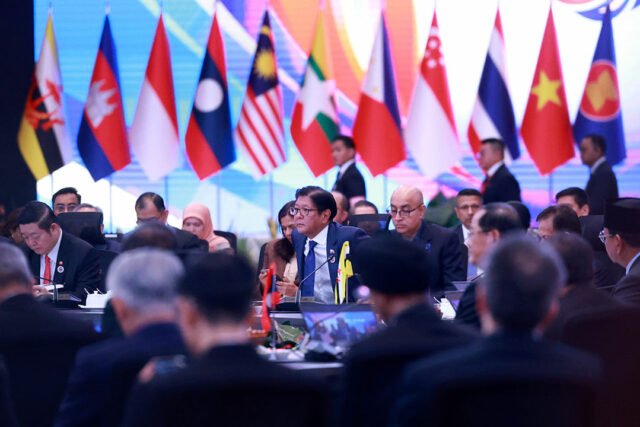
PRESIDENT Ferdinand R. Marcos, Jr. attends the 2nd ASEAN-Gulf Cooperation Council Summit during the 46th Association of Southeast Asian Nations Summit in Kuala Lumpur, May 27. — MARK BALMORES/PPA POOL

THE ADMINISTRATION of President Ferdinand R. Marcos, Jr. has been heavily relying on United States for its foreign policy and defense capabilities as tensions rise in the South China Sea, the think tank Center for People Empowerment in Governance (CenPEG) said.

“Marcos definitely is locked into this illusion that the future of the Philippines lies in the strong military alliance with the US and other so-called allies,” CenPEG Director for Policy Studies Bobby M. Tuazon told an online forum on Tuesday.

According to Mr. Tuazon, the President has adopted a foreign policy that retains China as an economic partner, while also tapping the US for defense capabilities.

“(He) maintains a dual balancing foreign policy, meaning maintaining economic ties with China, while turning over the Philippines to the US for defense against China,” he said.

Relations between Manila and Washington have strengthened under the Marcos administration, who has taken a more assertive stance against Beijing’s assertion into the Philippines’ exclusive economic zone.

“Under Bongbong Marcos more war drills were conducted between the Philippines and the US and other so-called allies since 2022 to the present,” Mr. Tuazon said. “(These included) Balikatan war exercises, joint patrol operations in the South China Sea, and also war exercises near Honolulu, Hawaii.”

The Marcos government has expanded joint military exercises with US forces, opened additional sites under their Enhanced Defense Cooperation Agreement (EDCA), and pursued stronger ties with other foreign partners.

The US is the Philippines’ major security partner, with a 1951 Mutual Defense Treaty compelling both nations to defend each other in case of an armed attack.

Mr. Tuazon added that the Philippines’ close relations with the US had made the country lose economic partnerships with China.

“We have lost opportunities. In fact, many presidents tend to tilt toward spending time more in military alliances, oblivious of the fact that what the Philippines need then and now is economic wealth,” he said.

In 2023, Manila backed out of Beijing’s global infrastructure scheme, as China became unresponsive to its funding requests for railway projects.

Tensions between the two countries have escalated in recent years due to their dispute in the South China Sea. — Adrian H. Halili

MRT-7 denies causing flood along Commonwealth Avenue

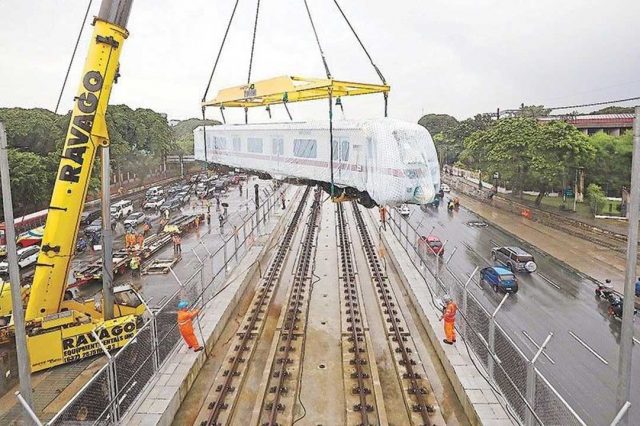
PHILSTAR FILE PHOTO

SAN MIGUEL CORP. (SMC) through the management of Metro Rail Transit Line 7 (MRT-7) has denied that it is responsible for Commonwealth Avenue flooding.

“Its facilities near Batasan Station on Commonwealth Avenue are not the cause of the flooding that occurred in the area, following renewed statements linking the incident in part to the ongoing project,” MRT-7 Project Management Office said in a statement on Tuesday.

This came after the Department of Transportation said that the contractors of the MRT-7 project were ordered to clear blockages along Commonwealth Avenue.

SMC, through its wholly owned unit SMC MRT-7 Corp. holds the concession to build, operate, and maintain the MRT-7.

The company said all MRT-7 structures in the area, including columns and footings, were built outside of the existing drainage lines and do not obstruct the water flow.

“These were constructed with full consideration of the drainage layout and in compliance with approved engineering plans,” it said, adding that the construction of the project was fully coordinated with the Department of Public Works and Highways.

It also added that its engineers inspected the area and pointed out that the drainage outlets were clogged with plastic waste and debris.

“This significantly reduced the system’s capacity to carry rainwater, which likely contributed to surface flooding,” it said. — Ashley Erika O. Jose

Disaster resilience bill refiled

PHILIPPINE STAR/MIGUEL DE GUZMAN

A SENATOR on Tuesday said he had refiled a bill that seeks to create a government agency for disaster preparedness and a network of food banks.

In a statement on Tuesday, Senator Jose “Jinggoy” P. Ejercito Estrada said that he had refiled the Disaster Resilience Bill that seeks to create a government agency that coordinates, enhances, and expedites operations related to disaster preparedness, response, and recovery.

He had also refiled the Disaster Food Bank and Stockpile Bill, which seeks to create local food and non-food stockpiles to ensure urgent relief and humanitarian assistance for families displaced by natural calamities and emergencies.

“Disaster resilience begins long before the typhoon hits or the ground shakes. It starts with smart planning, readiness, and rapid response capabilities,” he said. “These two proposed laws aim to address the gaps that often lead to avoidable loss of lives, hunger, and delayed recovery.”

The Philippines, which lies along the typhoon belt in the Pacific, experiences about 20 storms each year.

It also lies in the so-called Pacific Ring of Fire, a belt of volcanoes around the Pacific Ocean where most of the world’s earthquakes strike. — Adrian H. Halili

Benguet lawmaker calls for online learning contingency

La TRINIDAD, Benguet — Benguet Representative Eric Go Yap is pressing for online learning contingency amid class suspensions during typhoons and monsoon rains.

Hoping to help curve learning crisis across the country, “it is high time to develop an online learning contingency for suspended classes,” Mr. Yap said.

“We should consider adding a category to shift to online learning when in-person classes are suspended. Not always, because sometimes internet connections are affected,” he added in mixed English and Filipino.

Mr. Yap further proposed a possible shift to online learning could be one way of reducing educational crisis in the country, as some students in both private and public schools struggle to recover from lost lessons due to limited remedial programs and the absence of consistent alternatives during suspensions.

While acknowledging that implementation will be difficult, he stressed the urgency of starting the transition, which could help preserve the academic calendar, reduce backlogs, and maintain learning momentum, even amid frequent disruptions.

The Department of Education in the Cordillera Administrative Region (CAR) reported they recorded 35 class disruptions in 2024 alone, accounting for the highest number of school days lost in the country, mainly due to natural disasters and calamities.

“We are facing a learning crisis. Frequent class suspensions will not help address this. We are a disaster-prone country. Not to mention, we have a lot of national and local holidays. There are way too many disruptions,” Mr. Yap said. — Artemio A. Dumlao

P1.7-M drugs seized in PDEA-BARMM operation

COTABATO CITY — Agents of the Philippine Drug Enforcement Agency (PDEA) and policemen seized P1.7 million worth of crystal meth (shabu) from two peddlers entrapped in one of the barangays in this city on Monday.

Senior city officials and Moro traditional leaders who helped the PDEA-Bangsamoro Autonomous Region in Muslim Mindanao (BARMM) plan the successful sting confirmed to reporters on Tuesday, that plainclothes anti-narcotics agents had seized from the two male suspects during a tradeoff at the Martinez area in Barangay Poblacion 4 in Cotabato City.

Gil Cesario P. Castro, director of the PDEA-BARMM, said on Tuesday that the two suspects are now locked in their detention facility, to be prosecuted for violation of the Comprehensive Dangerous Drugs act of 2002 using the 250 grams of shabu confiscated from them as evidence.

The suspects were immediately frisked and cuffed by PDEA-BARMM agents and policemen under Cotabato City’s police director, Col. Jibin M. Bongcayao, after selling their illegal merchandise.

Mr. Castro said the operation that led to their arrest was supported by the office of Cotabato City Mayor Bruce D. Matabalao. — John Felix M. Unson

Shares inch up ahead of Marcos-Trump meeting

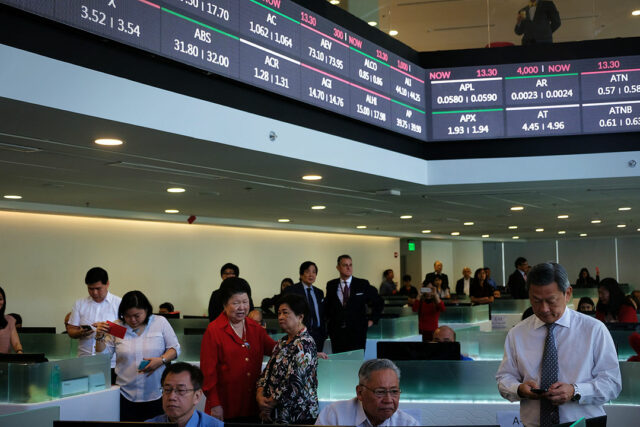
BW FILE PHOTO

PHILIPPINE SHARES edged up on Tuesday as investors await updates on bilateral talks between the Philippines and the United States and on expectations of further monetary easing at home.

The benchmark Philippine Stock Exchange index (PSEi) inched up by 0.04% or 2.95 points to end at 6,355.69, while the broader all shares index rose by 0.1% or 3.76 points to 3,757.20.

“The PSEi corrected higher for the third consecutive trading day as President Ferdinand R. Marcos, Jr. is scheduled to meet US President Donald J. Trump on July 22 (US time) that could lead to a possible trade deal,” Rizal Commercial Banking Corp. Chief Economist Michael L. Ricafort said in a Viber message.

“The market also improved after the latest dovish signals from Finance Secretary Ralph G. Recto on possible 50-basis-point (bp) rate cuts for the rest of 2025…,” he added.

Mr. Marcos is in the US from July 20-22. He had a meeting with US Secretary of Defense Pete Hegseth at the Pentagon on the first day of his three-day working visit.

Mr. Marcos is also set to meet with Mr. Trump to discuss trade and security. Mr. Trump earlier announced a 20% “reciprocal” import tariff on Philippine products starting Aug. 1, higher than the initial 17% duty set in April.

Meanwhile, Mr. Recto, who sits on the central bank’s policy-setting Monetary Board, said last week that the Bangko Sentral ng Pilipinas (BSP) has room for two more 25-bp cuts this year amid subdued inflation.

Last month, the BSP delivered a second straight 25-bp cut to bring its policy rate to 5.25%. The Monetary Board has three more meetings this year.

“The PSEi remains above the 6,350 mark, holding modest gains as sentiment showed slight improvement despite lower than usual market volume,” Regina Capital Development Corp. Head of Sales Luis A. Limlingan added in a Viber message. “Technical setups hint at renewed confidence while still cautious after last week’s dip, most likely awaiting the development of the trade discussions in Washington this week and upcoming corporate earnings.”

Majority of sectoral indices rose on Tuesday. Mining and oil climbed by 0.89% or 81.67 points to 9,199.41; property increased by 0.69% or 16.41 points to 2,391.26; financials went up by 0.64% or 14.37 points to 2,248.90; and industrials inched up by 0.11% or 10.40 points to 9,140.11.

Meanwhile, holding firms dropped by 0.61% or 33.11 points to 5,397.20 and services went down by 0.13% or 2.79 points to 2,139.35.

Value turnover decreased to P5.01 billion on Tuesday with 1.07 billion shares traded from the P5.79 billion with 1.14 billion shares exchanged on Monday.

Advancers edged out decliners, 97 versus 96, while 45 names were unchanged.

Net foreign selling went down to P14.67 million on Tuesday from P36.3 million on Monday. — Revin Mikhael D. Ochave

BPOs wary of ‘indirect’ effects of US tariffs

STOCK PHOTO | Image by DC Studio from Freepik

By Justine Irish D. Tabile, Reporter

THE IT & Business Process Association of the Philippines (IBPAP) said US tariffs may result in disruptions to global investment flows that could ultimately affect its industry.

IBPAP President and Chief Executive Officer Jonathan R. Madrid said no direct impact is expected on the information technology and business process management (IT-BPM) industry, which is also known as the Business Process Outsourcing (BPO), because it supplies services and not goods.

“(Nevertheless), we are closely monitoring the broader economic and investment impacts this may indirectly bring,” he told BusinessWorld.

US President Donald J. Trump announced a 20% tariff on the Philippines this month, higher than the 17% reciprocal tariff he initially imposed in early April.

Mr. Madrid said the government has responded to the US tariff decisions promptly, with a diplomatic push by President Ferdinand R. Marcos, Jr., who is visiting Washington for “a strategic dialogue.”

“Their efforts reflect a strong commitment to investment promotion and economic diplomacy at a critical time,” he added.

He said sustained engagement and collaboration with the US will help “ensure that the Philippine economy remains resilient and attractive to global investors, especially with US counterparts.”

Mr. Marcos and tariff negotiators are in the US to negotiate a lower rate.

Mr. Marcos was due to meet Mr. Trump on Tuesday, Washington time, becoming the first head of state from the Association of Southeast Asian Nations to meet the US President during his second term.

IBPAP said it still expects a 5% increase in industry revenue this year and between 4% and 5% workforce growth.

“For 2025, we are going to show growth. I think we will touch $40 billion in revenue as an industry and should touch 1.9 million in terms of number of workers,” Mr. Madrid said.

Biodiesel blend changes suspended amid high global prices of coco oil

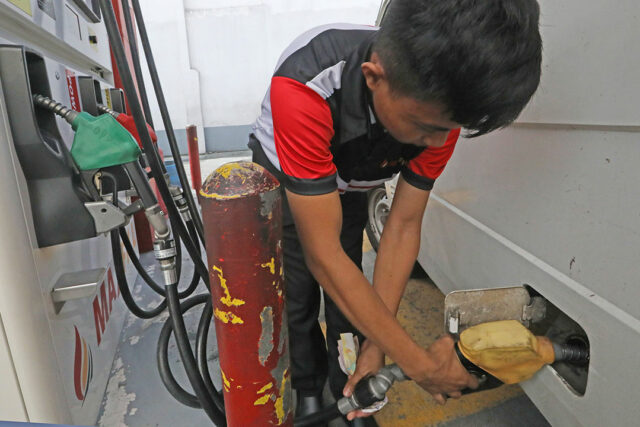
An attendant fills up a vehicle at a gasoline station in Manila, Sept. 18, 2023. — PHILIPPINE STAR/EDD GUMBAN

THE Department of Energy (DoE) said it suspended the planned increase in the coco methyl ester (CME) component of biodiesel, citing the potential impact on pump prices.

In an advisory dated July 17, the DoE informed the downstream oil industry, biodiesel producers, and other stakeholders of the suspension of the CME hike in the biodiesel blend.

The increase to 4% biodiesel blend (B4) was due to be implemented on Oct. 1, going to B5 a year later.

National Biofuels Board (NBB) issued a resolution in May to suspend changes to the biodiesel blend due to “anticipated significant impact on pump prices and the potential inflationary effects on the national economy.”

Energy Undersecretary Alessandro O. Sales said last month cited the current high cost of coconut oil, a primary feedstock for CME.

Mr. Sales said that the global price of coconut oil at the start of the year was about $1,100 per metric ton. This increased to over $3,000 per metric ton at the time of the NBB decision.

“Moving forward, the NBB shall regularly assess and recommend appropriate market interventions to help stabilize the price of biodiesel and its feedstock,” the DoE said.

The DoE will issue a directive to resume the upward adjustments once the NBB gives its approval.

The Biofuels Act of 2006 requires that all liquid fuels for motors and engines contain locally sourced biofuel components.

Under the law, the NBB is tasked with monitoring the implementation of the National Biofuel Program as well as the supply and usage of biofuels and biofuel blends.

The CME blend in diesel was raised to 3% on Oct. 1, 2024 from 2% previously. The blending of biofuels was originally intended to decrease dependence on imported fuel, reduce greenhouse gas emissions, and support the biodiesel industry. — Sheldeen Joy Talavera

ADVERTISEMENT
ADVERTISEMENT