Home Blog Page 1232

Dining In/Out (04/03/25)


Singapore’s Chef Fung opens at World Kitchens

CHEF Fung Chi Keung, the man behind restaurants like Taste Paradise, Kai Garden, and Kai Duck, is opening Chef Fung Private Kitchen at World Kitchens in Gateway Mall 2, Cubao, Quezon City. As Group Executive Chef for the Paradise Group, he launched award-winning concepts and earned top honors including a Gold Medal at the Food and Hospitality Asia’s Imperial Challenge in 2012. While the full menu of Chef Fung Private Kitchen is still under wraps, expect some of Chef Fung’s signature dishes to reach Manila including his Peking Duck, served with five unique wraps and five dipping sauces. This dish is enjoyed with a choice of Original, Pumpkin, Spinach, Bamboo Charcoal, or Beetroot wraps, and Traditional, Black Pepper, Sesame, Seafood, or Special Mixed sauces. Another signature dish to watch out for is Classic Superior Shark’s Fin, a hot bowl of flavorful Supreme Broth accompanied with a crispy spring roll and served in a stone pot. Chef Fung Private Kitchen is opening soon at World Kitchens, located at Gateway Mall 2 in Araneta City.


Okada gives a peek of Executive Lounge

NESTLED on the 19th floor of Okada Manila, the Executive Lounge in the resort offers views of Manila Bay, world-class amenities, and a curated ambiance. Access to the Executive Lounge is available to guests staying in the Executive Suite, Garden Suite, Manila Bay Suite, Celebrity Suite, Presidential Suite, or Villas. “Our Executive Lounge is just one of the many reasons why Okada Manila is a six-time Forbes five-star integrated resort,” said Rob Scott, vice-president for hotel operations. “This unique and exclusive space offers guests exceptional service and topnotch amenities which empower them to work and unwind seamlessly.” This 600-square-meter space has floor-to-ceiling windows which frame the sunset. There one can have breakfast, all-day snacks, and evening cocktails, and on select nights there are live music performances. The Executive Lounge’s meeting rooms can be booked for intimate meetings, while extra guests can also enjoy the lounge with an add-on rate for each person. For inquiries, e-mail RestaurantReservation@okadamanila.com or call 8555-5799.


Starbucks and Peanuts join forces

STARBUCKS and Peanuts have come together to launch a global brand partnership that celebrates kindness, coffee, and community. Starbucks stores are introducing an exclusive line of Peanuts-inspired merchandise, food and beverages. This collaboration will feature the Peanuts gang, as well as the Snoopy persona, Joe Kind Snoopy, available exclusively at Starbucks. The Joe Kind Snoopy encourages people to connect through the simple, everyday acts of kindness. The collaboration is available throughout April, which is Starbucks Global Month of Good. For the past 15 years, Starbucks employees have dedicated their time to volunteering with local non-profit organizations throughout April. In stores across the Philippines, Starbucks customers will enjoy new beverages, merchandise, and an exclusive Starbucks card. Starbucks customers are encouraged to join the kindness movement on social media with #GlobalMonthofGood. The global partnership between Starbucks and Peanuts, features exclusive, limited-edition Joe Kind Snoopy merchandise including reusable cups, tumblers, water bottles, tote bags, and gift cards. Special drinks are the Joe Kind Snoopy Chocolate and Caramel Oatmilk Frappuccino, a creamy blend of vanilla syrup and chocolate chips with a combination of chocolate and caramel sauces, topped with whipped cream, chocolate sauce, and a Joe Kind Snoopy chocolate topper (available in blended coffee and cream formats); and the Joe Kind Snoopy Chocolate and Caramel Oatmilk Latte, built with an espresso base, a drizzle of caramel and chocolate sauces on the sides of the cup, milk and topped with whipped cream, chocolate sauce, and a Joe Kind Snoopy chocolate topper (available in hot and iced).


Watermelon cocktail tops drink tilt

BARTENDER Clyde Ferrer bested over 20 other professional beverage contenders to claim the Dewar’s Highball Challenge National Championship title in the Philippines. Mr. Ferrer, from the Hospitality Management Program of the De La Salle-College of Saint Benilde (DLS-CSB) School of Hotel, Restaurant, and Institution Management, topped the contest with an innovative cocktail dubbed “What if…” The winning drink, headlined by Dewar’s 12-year-old scotch whiskey, has carbonated watermelon juice, lemon extract, watermelon seed orgeat, and balsamic vinegar. “It takes inspiration from my childhood, wherein watermelons as a snack became a cherished ritual as my parents opted for healthier options rather than junk food,” he said. The drink is called so because, “What if 50 years from now, I can no longer taste the real watermelon I loved as a kid?” he said. “What if, in the future, watermelons are engineered or faked, and that pure, natural sweetness is lost?” He represented Fat Cat, a jazz and cocktail bar in Makati, at the competition. He was mentored by its owner, Ron Cruz, and bar manager and head bartender Vernie Peña. “The drink revolves on how I can focus on the flavors of a watermelon with a twist of sustainability,” he explained. As the Philippine titleholder, Mr. Ferrer received a cash prize plus the opportunity to represent the country at the special Dewar’s Highball Challenge tour in Tokyo, together with fellow national champions from India, Malaysia, and Thailand.


Healthy Options’ 35th store has fresh market concept

HEALTHY OPTIONS opens its 35th store at the Greenhills Mall, where it is introducing a fresh market concept designed by the French agency, Stories. Adding to the store’s modern vibe are Healthy Options’ first self-checkout counters. San Juan mayor Francis Zamora led the ribbon-cutting, joined by founder and Chief Executive Officer Romy Sia and Chief Operating Officer Belle Sison. Baking Therapy, the all-natural bakery by Healthy Options, unveiled its largest café inside the new Greenhills store. They offer a wide variety of guilt-free options, including artisanal gluten-free bread, no-sugar-added pastries, and other wholesome treats. The new store is located on the ground floor of Greenhills Mall, across Hoshino Coffee.


Jollibee offers treats for summer

JOLLIBEE is now offering Summer Saya Treats, rolling out the campaign with a series of sulit (bargain) offers and must-try deals. Ongoing until April 30 is the Summer Delights with Umbrella Promo in which customers can get a limited-edition Jollibee Umbrella for P149 with any value meal purchase paired with choice of Summer Delights: Mango Jelly Sundae, Cookies & Cream Sundae, or Iced Mocha. It is available at participating Jollibee stores nationwide via dine-in, take-out, and drive-through. Also available until April 30 at all branches, customers can get a Free Soda Float upgrade when they buy a Crunchy Chicken Sandwich with Fries & Drink for P125 (saving P25 in the process). From April 1 to 20, Jollibee offers Lenten Deals with the Visita Iglesia Digital Map. For those observing Lenten traditions, Jollibee offers a meat-free option with its Tuna Pie with Fries & Drink for P145 (saving P12). Plus, consumers can access Jollibee’s Visita Iglesia Digital Map featuring recommended and notable churches.

Lost in translation?

BW FILE PHOTO

That the quality of lawmakers has deteriorated over decades has been the topic of discussions ad nauseam, with one social media post, for example, noting that the first Senate in 1916 included a medical doctor, a diplomat, an Islamic theologian, a teacher, and a revolutionary general, among others.

But the task of educating voters, on whom elective hopefuls pin their hopes, remains a timeless task that is crucial for the preservation and growth of any democratic system faced with shifting sands like the misuse of artificial intelligence of late.

While our country has been known for maintaining a vibrant (or just plain noisy?) political system, it has chalked merely “mid-range performance” in international metrics, including:

• The 2024 “Global State of Democracy” report published by Stockholm-based intergovernmental organization International Institute of Democracy and Electoral Assistance in October last year, which tracks the state and quality of democracy worldwide, placed the Philippines 90th out of 173 countries, as well as 96th, 104th, and 64th, respectively, in the areas of representation (free and equal access to political power), rights (individual liberties and resources), rule of law (predictable, equal enforcement to the law and limitation of government power), and participation (instruments for and realization of political involvement, particularly through election and civil society).

• The “Freedom in the World 2025” report that was released by Washington, DC-based Freedom House in February, which rates people’s access to political rights and civil liberties in 208 countries and territories, classified the Philippines as “partly free,” retaining an overall score of 58/100 (the higher the number, the better), as well as 25/40 for political rights and 33/60 for civil liberties, for the past three years, though down from 55/100 in 2022.

“Democracy Index 2024” published by London-based Economist Intelligence Unit (EIU) early in March, still described the Philippines as a “flawed democracy” even as it rose two spots to 51st out of 167 countries, though with an overall score of 6.63 (out of 10, which is the best) that was the worst in three years and the second straight annual drop (meaning many others saw a bigger score reduction, since we still bested averages of 5.31 for Asia and Australasia and 5.17 for the world). EIU’s study gave us the highest scores in electoral process and pluralism (8.75), political participation (8.33), and civil liberties (7.06), and our lowest grades in functioning of government (4.64) and political culture (4.38).

Not exactly the picture our politicians would want to paint when they trumpet the merits of our democratic system.

Free fair elections are both a bedrock and barometer of a healthy democracy. And quality of an electorate — besides a supportive system — lies at its core.

In terms of framework: target reforms range from the push for a genuine party system (with some quarters noting that, unfortunately, it seems that only the communist party has a solid platform and program) to a ban on political dynasties (members of civil society groups like 1SAMBAYAN Coalition, SANLAKAS, Advocates for National Interest as well as former senior government officials and church leaders on March 31 asked the Supreme Court to compel Congress to pass a law that will define “political dynasty” in order to operationalize the ban enshrined in Article II, Section 26 of the 1987 Constitution). Reform gains have been few and far between, but hopefully this move vs dynasties will finally bear fruit nearly 40 years after the Constitution banned these political monopolies (notably: the Bangsamoro Autonomous Region in Muslim Mindanao, or BARMM, spells out an anti-dynasty provision in both its Bangsamoro Electoral Code and its Bangsamoro Local Governance Code1, as does Republic Act No. 10742, or the SK Reform Act, which provides that kin of elected/appointed officials within the second civil degree of consanguinity — by blood, or affinity — and by marriage, are prohibited from seeking seats in the Sangguniang Kabataan2.)

NOT ENOUGH VOTER EDUCATION
A few civil society groups have also taken up the task of voter education in cooperation with the Commission on Elections (Comelec), including the National Citizens’ Movement for Free Elections (Namfrel), the Parish Pastoral Council for Responsible Voting (PPCRV), the Legal Network for Truthful Elections, Kontra Daya, the Philippine Social Science Council, the Center for Liberalism and Democracy, and the Student Christian Movement of the Philippines, among others. Comelec and these groups have sought to inform the electorate on election processes, rights and responsibilities, as well as irregularities like vote-buying and misinformation/disinformation like Deepfakes.

Namfrel Secretary General Eric Jude O. Alvia — who joined the group as a volunteer in the mid-1980s and observed the 1993 Cambodian, 1999 Indonesian, and the 2009 Afghan presidential/general elections — said in a recent chat that the watchdog has sought to convince the public on the “importance of getting involved” even after elections by pushing for good governance and accountability in their own communities. Namfrel conducts voter education in both face-to-face and online settings, including on Meta, YouTube, TikTok, X, and its own mobile app. Key performance indicators it tracks include an increase in voter turnout, particularly among the marginalized; greater citizen involvement in safeguarding the electoral process; confidence in the integrity of vote counts; fair, orderly conduct of campaigns; and that citizens mobilize and monitor the performance of elected officials.

With decades of such initiatives, one would think that we would have seen results by now, particularly the election of more officials for whom good governance is second nature.

Well, no such luck (for now, one can count known good governance advocates among national and local officials with the fingers of two hands), meaning these efforts clearly lack something.

I recall good governance advocate Jesus P. Estanislao, a former Finance and Socioeconomic Planning chief, as ruing a backsliding to “the old ways” of government just when one would have thought that inroads and progress had been made in this regard. The bolt that should have secured hard-earned governance gains lies with the electorate who, as the governed, ought to keep holding elected officials accountable.

BETTER MESSAGING NEEDED
So, how can voter education be taken a step further?

For one, it may be time for the various civil society groups to pool or at least coordinate efforts with one another, thus ensuring more effective distribution and delivery of a more coherent message. Mr. Alvia said that Namfrel focuses on areas with a high concentration of marginalized groups, including in the BARMM, while PPCRV concentrates on Catholic parishes.

There are enough studies showing that, given the right mix and conditions, more brains drawing from a wider bank of experiences should yield better solutions3 — in this case, sharpen messages and their delivery, as well as come up with a system that would cover more communities nationwide. These groups do not have to hold a public summit to exchange notes — at least not at the outset — but, clearly, much of our country’s future is at stake in being able to improve efforts to upgrade the knowledge and attitude of our electorate.

Such messages may range from simple, pointed questions for voters in the run up to elections, e.g., something like the Rotary Club’s The Four Way Test — has the candidate authored substantive laws/have a track record of actually improving the lives of constituents? — plus pointers on where to find such information, to other facets of voter education, e.g., how to keep officials on their toes until the next elections.

And as any marketer will tell you, one should observe prescribed message form and delivery according to platform — whether one-site/in-person, television, radio, virtual meeting, or on social media, as well as across the various social media platforms — else, one risks messages getting lost in translation.

HOLY GRAIL
Another element to consider is the composition of the audience: a Pulse Asia survey put classes D and E at 78% and 14% of registered voters, respectively.4

That, says Namfrel’s Mr. Alvia, dictates the content and form of messaging. “These people want certainty and stability,” he said, noting that their families’ difficult circumstances top all other factors in shaping their voting preferences (hence, one cannot convincingly talk about the evils of selling votes in exchange for P500-P1,000 to those seeking desperately to put the next meal on the table).

Thus, voter education results have so far been a mixed bag, Mr. Alvia said, noting “some success among the youth sector” though campaigns have not been “as successful with the older generation and the D/E [classes] since they are most vulnerable… to their soc[io]/eco[nomic] plight…”

Any message harping on the need for “good governance” and “integrity” will likely fall on deaf ears in this segment. Indeed, one wonders how such abstract ideals fly in the face of nearly three out of 10 Filipino families (27.2% or about 7.5 million households, according to a March 15-20 Social Weather Stations, or SWS, survey) who grew hungry “at least once in the past three months” — the worst level since the record-high 30.7% recorded as the COVID-19 pandemic picked up in September 2020.5

While lofty principles are, to be sure, most crucial to improving our electoral system — well, to these, perennial skeptics would argue: “Eh, hindi naman nakakakain ang prinsipyo (One cannot eat principles).” So, such advocacy should be creatively designed to show how they address gut issues that are ever-present and always immediate to the poor.

That goes for election candidates as well, by the way.

Campaign strategist Alan S. German said over ABS-CBN News Channel late last week that candidates will do well to focus messages on health, education, livelihood, peace and order, and social services (HELPS), if they expect voters to remember them. He noted that survey top-notcher Senator Christoper Lawrence “Bong” T. Go clearly learned that secret early on, choosing since 2019 to focus on his Malasakit Centers which, from local government accounts, have actually been helping the poor, thus, sealing his moniker, “Mr. Malasakit.”

That view is backed by a Feb. 15-19 SWS survey showing that voters would choose candidates who they perceive would increase jobs, develop agriculture and enhance food security, reduce poverty and hunger, strengthen healthcare, provide equal access to education, and control the prices of basic services and goods.6

Similarly, a group bearing the same acronym as the government’s conditional cash transfer program — the Pagtibayin at Palaguin ang Pangkabuhayang Pilipino (Strengthen and Grow the Filipino Economy), or 4Ps — has been topping the SWS survey of 156 party-list groups.7

Actually, this is not something new, as I recall one prominent economist who, addressing a then newly elected president who asked how he could do a good job, replied: “Mr. President, just focus on helping the poor get jobs or start a livelihood, put food on the table and a roof over their heads, and you will do just fine.”

Until those seeking to sway voters — whether Comelec, watchdogs, political parties/candidates — get this right, connecting with most of them will remain a holy grail.

1 https://tinyurl.com/2chvyrgn

2 https://tinyurl.com/269aeyup

3Anita Williams Woolley, Ishani Aggarwal and Tomas W.  Malone, “Collective Intelligence and Group Performance,” Current Directions in Psychological Science, Association for Psychological Science, SAGE Publishing, 2015, https://tinyurl.com/25sx8u5j and https://tinyurl.com/29o9px6m

James Surowiecki, The Wisdom of Crowds, Doubleday, 2004

4 https://tinyurl.com/2auex2lz

5 https://tinyurl.com/2283j43o

6 https://tinyurl.com/285f66ym

7https://tinyurl.com/243av87w


Wilfredo G. Reyes was editor-in-chief of BusinessWorld from 2020 through 2023.

Term deposit yields inch higher as market awaits US’ reciprocal tariffs

BW FILE PHOTO

YIELDS on the Bangko Sentral ng Pilipinas’ (BSP) term deposits inched higher on Wednesday as the offer went undersubscribed, with the market preferring to stay on the sidelines ahead of the Trump administration’s announcement of its planned reciprocal tariffs.

The central bank’s term deposit facility (TDF) fetched bids amounting to P155.35 billion on Wednesday, below the P200 billion placed on the auction block but higher than the P123.96 billion in tenders for the P140-billion offer a week ago. The BSP accepted all bid submissions for both the one- and two-week tenors.

Broken down, tenders for the eight-day papers reached P77.355 billion, lower than the P100 billion auctioned off by the central bank but higher than the P49.504 billion in bids for the P70-billion offer of seven-day deposits the previous week.

Accepted yields were from 5.69% to 5.799%, wider than the 5.7% to 5.795% band seen a week ago. This caused the average rate of the one-week deposits to inch up by 0.09 basis point (bp) to 5.7623% from 5.7614% previously.

Meanwhile, bids for the 14-day term deposits amounted to P77.995 billion, lower than the P100-billion offering but above the P74.422 billion in tenders for the P70 billion auctioned off on March 26.

Banks asked for yields ranging from 5.72% to 5.8%, narrower than the 5.7% to 5.8% margin seen a week ago. With this, the average rate for the two-week deposits increased by 0.11 bp to 5.7657% from 5.7646% logged in the prior auction.

The BSP has not auctioned off 28-day term deposits for more than four years to give way to its weekly offerings of securities with the same tenor.

Both the TDF and BSP bills are used by the central bank to mop up excess liquidity in the financial system and to better guide market rates.

Term deposit yields rose ahead of the Trump administration’s announcement of new tariffs dubbed as “Liberation Day,” Rizal Commercial Banking Corp. Chief Economist Michael L. Ricafort said in a Viber message.

US President Donald J. Trump was poised to impose sweeping new reciprocal tariffs on global trading partners on Wednesday, upending decades of rules-based trade, threatening cost increases and likely drawing retaliation from all sides, Reuters reported.

Details of Mr. Trump’s “Liberation Day” tariff plans were still being formulated and closely held ahead of a White House Rose Garden announcement ceremony scheduled for 4 p.m. Eastern Time (2000 GMT). The new duties are due to take effect immediately after Mr. Trump announces them, White House spokesperson Karoline Leavitt said on Tuesday, while a separate 25% global tariff on auto imports will take effect on April 3.

Mr. Trump for weeks has said his reciprocal tariff plans are a move to equalize generally lower US tariff rates with those charged by other countries and counteract their non-tariff barriers that disadvantage US exports. But the format of the duties was unclear amid reports that Mr. Trump was considering a 20% universal tariff. — Aaron Michael C. Sy with Reuters

Enterprises must boost identity verification to combat deepfakes

VECSTOCK-FREEPIK

PHILIPPINE BUSINESSES must ramp up their investments in identity verification technology as fraud schemes involving deepfakes become more prevalent, according to biometric solutions company iProov.

“The criminals aren’t going to take a lot of notice of what regulation is put in place in the Philippines or in the United States or anywhere else in the world because they’re going to break the law anyway,” Dominic Forrest, chief technology officer at iProov, said in an interview last month.

“Putting in place the technology, the people, and the processes to protect against this is going to be critical for us going forward, because the cost of not doing so is just going to be immense,” Mr. Forrest said.

The Department of Information and Communications Technology (DICT) recently said it is pushing for more stringent social media regulations amid the rise of deepfakes.

The Cybercrime Investigation and Coordinating Center, an attached agency to the DICT, said it receives up to 300 deepfake incidents daily, Executive Director Alexander K. Ramos said.

According to Mr. Forrest, criminal organizations readily share their fraudulent tactics, increasing the likelihood of deepfake related scams.

“One of the things we have identified is that the criminal organizations share ways to create deepfakes for bad purposes, whether it’s to attack banks, whether it’s just to mislead on social media, whatever it is — the information about how to do that is shared globally,” he said.

iProov’s latest Threat Intelligence Report showed the growing number of attacks against identity verification measures.

Face swap attacks, which involve superimposing another person’s face to an existing video or livestream, surged by a 300% year on year in 2024, iProov said in the report.

Digital injection attacks, or the impersonation a bona fide user to gain unauthorized access to their accounts or systems, jumped by 783% last year, it added. Native virtual camera attacks, or those involving putting pre-recorded or fake videos into verification streams, also skyrocketed by 2,665% year on year.

For 2025, trends that organizations must watch out for include the continued rise of native virtual camera injections, face swaps, online attack-as-a-service communities, iProov said.

Image-to-video conversion tools can also be used to trick vulnerable liveness detection systems, it added.

“This technique transforms static images into convincing video content that could pose very significant challenges for most remote identity verification systems.” — Beatriz Marie D. Cruz

Megawide targets to finish Carbon Market’s Block-2 by 2026

THE FREEMAN FILE PHOTO

LISTED infrastructure conglomerate Megawide Construction Corp. said it targets completing the construction of Block-2 of the ongoing Carbon Market redevelopment in Cebu by the first quarter of 2026.

The project, valued at approximately P1.1 billion, involves the design and build contract for the Block-2 vertical structure, including piling works, structural development, architectural, mechanical, electrical, plumbing, and fixtures, as well as the supply and installation of pre-cast products, Megawide said in a regulatory filing on Wednesday.

Block-2 of the Carbon Market will be a multi-level, mixed-use development that will house specific sections of the existing public market.

Other floors will feature various offerings, including food and beverage products, handicrafts, and other special items.

Once completed, Block-2 will complement existing attractions in Carbon Market, such as The Barracks (Cebu’s first hawker center), the Sto. Niño Chapel, Freedom Park, and the ongoing Puso Village.

In 2020, Megawide’s subsidiary Cebu2World Development, Inc. won the 50-year contract to construct and operate the Carbon Market.

The project is under a lease agreement with the Cebu local government, which seeks to preserve the cultural heritage of the site while promoting it as a tourist destination.

Megawide shares rose by 4.88%, or 10 centavos, to P2.15 per share on Wednesday. — Revin Mikhael D. Ochave

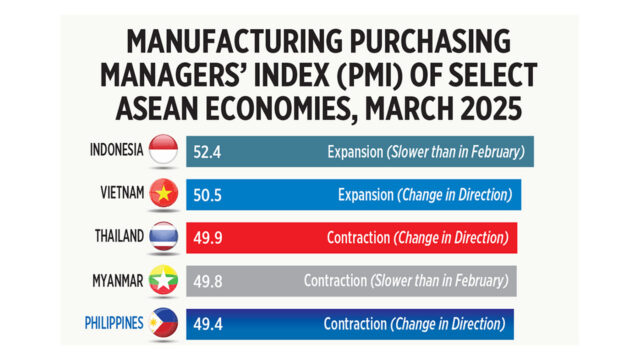
Manufacturing Purchasing Managers’ Index (PMI) of select ASEAN economies, March 2025

FACTORY ACTIVITY in the Philippines unexpectedly contracted for the first time in 19 months in March, as manufacturers cut output amid uncertainty surrounding US tariff policies. Read the full story.

Manufacturing Purchasing Managers’ Index (PMI) of select ASEAN economies, March 2025

Actor Val Kilmer, star of Batman Forever, 65

Val Kilmer in 1991’s The Doors.

VAL KILMER, the California-born, Juilliard-trained actor who starred in films including Top Gun, The Doors, Tombstone, and Batman Forever and earned a reputation as a Hollywood bad boy, has died, the New York Times reported. He was 65.

The cause of death was pneumonia, the paper said, citing his daughter Mercedes Kilmer.

Mr. Kilmer was one of Hollywood’s most prominent leading men in the 1990s before numerous spats with directors and co-stars and a series of flops dented his career. Over the years, Mr. Kilmer gained a reputation as temperamental, intense, perfectionistic, and sometimes egotistical.

“When certain people criticize me for being demanding, I think that’s a cover for something they didn’t do well. I think they’re trying to protect themselves,” Mr. Kilmer told the Orange County Register newspaper in 2003.

“I believe I’m challenging, not demanding, and I make no apologies for that.”

He made his film debut starring in the spy spoof Top Secret! (1984) before appearing in the goofy comedy Real Genius (1985). He rocketed to stardom as Tom Cruise’s co-star in the 1986 smash hit Top Gun, playing naval aviator Tom “Iceman” Kazansky, and decades later appeared alongside Mr. Cruise again in the 2022 sequel Top Gun: Maverick.

Mr. Kilmer starred in director Ron Howard’s fantasy Willow (1988) and married his British co-star Joanne Whalley, with whom he had two children before divorcing.

One of his most challenging roles came in director Oliver Stone’s The Doors (1991) in which he played Jim Morrison, the charismatic and ultimately doomed lead singer of the influential rock band The Doors.

To try to persuade Stone to cast him, Mr. Kilmer put together an eight-minute video of himself singing and looking like Morrison at various points in his life. Mr. Kilmer’s own singing voice is used in the film.

The Doors ushered in the highest-profile years of his career. In the 1993 Western Tombstone, he played Old West gunfighter Doc Holliday. He had two commercial successes in 1995, co-starring with Al Pacino and Robert De Niro in the crime drama Heat and succeeding Michael Keaton as the Caped Crusader in Batman Forever, the third installment in the Batman series.

The noisy, bloated, and plodding Batman Forever was received tepidly by critics, and Mr. Kilmer was upstaged by co-stars Tommy Lee Jones and Jim Carrey. Mr. Kilmer pulled out of the next Batman movie. Director Joel Schumacher called Mr. Kilmer “the most psychologically troubled human being I’ve ever worked with.” — Reuters

Yellow box reboot

FREEPIK

To restore order on our streets, we must prioritize enforcing rules on counterflow, yellow box violations, no-parking/no-waiting/obstruction, and jaywalking. Other rules can receive secondary attention for now. I believe that priority should be on violations that significantly disrupt traffic flow.

Equally important, these infractions are relatively easy to detect and monitor, especially through the no-contact apprehension program (NCAP). Motorists and pedestrians usually evade penalties in areas lacking traffic enforcers, making NCAP an essential solution, once the Supreme Court allows its resumption.

I believe counterflow ranks among the most hazardous violations motorists commit. It can lead to collisions, injuries, and even fatalities. Counterflow forces oncoming traffic to halt or swerve unexpectedly, increasing accident risks. Pedestrians are especially vulnerable to vehicles moving against traffic.

Yellow box violations, meantime, create gridlocks and slow down or halt traffic flow. They cause long, disruptive chain reactions that often require manual intervention from traffic enforcers to untangle. Yellow box infractions are particularly difficult since they can involve multiple lane obstructions.

Ironically, traffic enforcement tends to overlook yellow box obstructions and counterflow violations — particularly from two-wheeled vehicles — during rush hours and heavy traffic conditions. But isn’t it precisely during peak traffic that motorists should demonstrate greater compliance?

News reports frequently highlight that Metro Manila loses billions of pesos daily in productivity and economic output due to prolonged traffic gridlocks and delayed movements of people and goods. However, the question remains: How much has Metro Manila invested to address this issue?

Has it been allocating sufficient resources to solve traffic problems effectively? Excluding infrastructure such as roads and bridges, how much funding goes specifically into traffic management and administration to mitigate economic losses from congestion? Or does money go mostly to salaries of traffic enforcers?

If financial constraints hinder better traffic management through technological means, then we should encourage private sector involvement. NCAP, notably, received support from a private project proponent operating on a revenue-sharing model based on collected fines.

Traffic penalties and fines collected by the Metropolitan Manila Development Authority, better known as the MMDA, and local governments could be primarily allocated to technological improvements for traffic management. Similarly, portions of vehicle registration fees were previously designated for road safety initiatives.

A concerted effort to rigorously enforce penalties, especially for yellow box and counterflow violations, could generate substantial revenue dedicated to traffic management. Enforcement technology and apprehension costs would likely be minimal compared to the fines collected, particularly considering Metro Manila’s chronic congestion.

Yellow box and counterflow violations are straightforward to detect. If a vehicle remains within the yellow box when the traffic signal turns red, this clearly constitutes a violation. Likewise, if a motorist is caught on camera in the lane designated for oncoming traffic, particularly in no-overtaking zones, it clearly represents another violation.

Once NCAP resumes operations, local governments, even without a national NCAP law, can review and adjust fines for yellow box and counterflow infractions. Revenue collected from these penalties can directly fund improvements in camera-based and technology-driven enforcement systems.

Transport for London (TfL), which is responsible for Greater London’s transport system, has been enforcing yellow box junction regulations for many years. In the 2017-2018 financial year, it issued approximately £16 million in fines for such violations. That’s equivalent to roughly P1.2 billion in one year.

And then in 2018-2019, local authorities in London and Cardiff reported a collection of £58.2 million (about P4.3 billion) from moving traffic offenses, including yellow box violations — a 25% increase from £46.7 million in 2016-2017.

In 2023, drivers in London paid £24.7 million (roughly P1.8 billion) in fines for entering yellow box junctions, with over 154,000 penalty charge notices (or traffic citation tickets) issued.

Reports also indicate that the yellow box at the intersection of London’s Bagleys Lane and New King’s Road generated £2.7 million (about P200 million) in fines between 2011 and 2012, averaging 111 violations per day. Clearly, the initial investment and operational costs for maintaining cameras in that junction represent a small fraction of the generated revenue.

In my opinion, implementing similarly effective technology-based enforcement through NCAP in Metro Manila and other cities would significantly enhance traffic discipline, reduce gridlock, and generate considerable funds for sustained traffic management improvements.

But stiff fines also raise the issue of how much is too much, and whether yellow box fines or traffic violation penalties in general — at roughly P3,000 per violation when NCAP was implemented — are fair and ethical. Should socioeconomic status be considered? Higher penalties for wealthier violators?

In theory, fines can be proportional. In practice, this can be difficult. Moreover, it requires proper data on each motorist with respect to income and taxes paid. But countries like Finland, Switzerland, and Sweden do make use of income-based or proportional fines, to ensure fairness.

Cities like London and Sydney also allocate fines back into road safety improvements, enhancing public acceptance and trust. I believe we should do the same here, with traffic fines collected by cities being earmarked for traffic enforcement technology, road safety, and driver education programs.

More important, as noted in previous column, there is a need for a dedicated traffic adjudication board or courts to allow fair dispute resolution. Dedicated traffic courts should efficiently and transparently handle appeals, if only to improve public trust in enforcement systems.

High fines will also have to complemented by driver education programs, to address bad motoring behavior. Automated, impartial enforcement through NCAP removes biases and corruption, and ensures accountability. But it does little in terms of further educating motorists on right and wrong.

And on the topic of motorist behavior, periodic assessment of penalties ensures fines remain fair, effective, and aligned with economic realities. Indexation to inflation is just one aspect. Changes in driver behavior patterns is the other. Fines need to be adjusted according to resulting changes in driver behavior.

Bottomline, authorities need to balance deterrence, fairness, transparency, and effectiveness. With the spate of traffic altercations of late, with road rage leading to shooting incidents and death, I believe technology-based enforcement can help. That is, if the Supreme Court will allow the NCAP to proceed. Meantime, we should start looking for workarounds and alternatives.


Marvin Tort is a former managing editor of BusinessWorld, and a former chairman of the Philippine Press Council

matort@yahoo.com

RCBC looks to redeem $300-M Tier 1 notes

PHILSTAR FILE PHOTO

RIZAL COMMERCIAL Banking Corp. (RCBC) is looking to buy back $300 million in securities qualifying as Tier 1.

The bank’s board of directors on Monday approved the redemption of the five-year non-cumulative subordinated additional Tier 1 capital securities, which are callable starting Aug. 27, RCBC said in a disclosure to the stock exchange on Wednesday.

“The redemption of the capital securities remains subject to Bangko Sentral ng Pilipinas (BSP) approval and the terms and conditions of the capital securities,” it said.

RCBC in August 2020 raised $300 million from the Tier 1 notes, which carry a rate of 6.5%.

The proceeds were used to support and finance medium-term to long-term asset growth and other general corporate purposes, and to comply with and maintain sufficient buffers above the minimum capital thresholds required by the central bank.

RCBC’s attributable net income declined by 22.08% year on year to P9.52 billion in 2024 due to foreign exchange losses and the absence of one-off gains from the sale of assets a year earlier.

The listed bank’s shares rose by 30 centavos or 1.11% to close at P27.30 apiece on Wednesday. — Aaron Michael C. Sy

Alsons Dev eyes P2-billion sales from Davao residential project

ALSONSDEV.COM

DAVAO-BASED property developer Alsons Development and Investment Corp. (Alsons Dev) said it has invested P800 million in the development of its latest residential project, Mahogany South.

The first phase, which will cover 13 hectares (ha) within a 33-ha property, is expected to generate around P2 billion in net sales, Alsons Dev Vice-President and General Manager Eric D. de la Costa said in an e-mail.

Situated along Tugbok District in Davao City, Mahogany South is Alsons Dev’s third project under its mid-cost housing brand, Nutura.

The development will feature a total of 594 housing units with Modern Asian-inspired architecture, Alsons Dev said.

The first batch of units will be turned over by the fourth quarter of 2027, while the entire project is expected to be fully completed by Dec. 31, 2032, said Jolla Angelica A. Soriaga, assistant vice-president for business development & operations at Alsons Dev.

The Bungalow model, its first housing option, is a single-attached home with a floor area of 40.28 square meters (sq.m.) on a 100-sq.m. lot. It includes two bedrooms, two bathrooms, and a provision for a carport.

The Loft model has a larger floor area of 64.85 sq.m. and includes a loft and storage on a 100-sq.m. lot.

Investors can also design and build their own homes on the available open lots inside the village, the developer added.

The project is “designed to bring nature closer to home” with tree-lined streets and a 2-hectare park, which includes a dedicated space for pets.

The gated community offers round-the-clock security to ensure residents’ safety and peace of mind.

Its Community Center features a cabana, a children’s playground, a multipurpose court, and swimming pools for both kids and adults.

“Mahogany South is expected to attract strong demand due to its secure, nature-integrated living environment and high-quality homes,” Ms. Soriaga said.

“Strategically located with easy access to schools, healthcare facilities, commercial hubs, and recreational spaces, it offers a residential setting that seamlessly blends convenience with tranquility.” — Beatriz Marie D. Cruz

If AI doesn’t kill your company, it will make it stronger, study shows

Artificial Intelligence words are seen in this illustration taken March 31, 2023. — REUTERS/DADO RUVIC/ILLUSTRATION/FILE PHOTO

FRANKFURT — If a company can survive the upheaval caused by the adoption of artificial intelligence (AI), AI will help it thrive in the longer run, a study presented at a European Central Bank (ECB) conference has found.

Its authors, who used data from the US Census Bureau and surveys covering the period between 2017 and 2021, found early adopters of AI in the manufacturing sector saw their productivity drop as they replaced human workers with robots.

Their findings go against prevailing narrative suggesting that AI makes work more productive and “augments” jobs in many cases rather than automating them away.

“In the short term, we see a lot of pain,” Kristina McElheran, one of the authors of the paper, told the conference.

She explained the drop in productivity as a side-effect of AI interfering with manufacturers’ established practices, such as keeping low inventories.

Over time, however, these firms began outperforming on all counts — sales growth, productivity and employment — provided that they managed to make it through the upheaval.

“Surviving this seems like part of the problem,” Ms. McElheran, a researcher at the University of Toronto, said.

She said this rebound did not generally happen at older companies, which also tend to be larger, and “struggle to get this done.”

Ms. McElheran and colleagues worked on a sample of 30,000 firms among which AI adoption rose from 7.5% to 9.1% over the course of the study period.

Introducing the conference earlier, ECB President Christine Lagarde had said between 23% and 29% of workers in Europe were highly exposed to AI but this need not herald a “job apocalypse” because new roles were likely to be created while old ones are destroyed. Reuters

Ghibli effect: ChatGPT usage hits record after rollout of viral feature

REUTERS

THE FRENZY to create Ghibli-style AI art using ChatGPT’s image-generation tool led to a record surge in users for OpenAI’s chatbot last week, straining its servers and temporarily limiting the feature’s usage.

The viral trend saw users from across the globe flood social media with images based on the hand-drawn style of the famed Japanese animation outfit, Studio Ghibli, founded by renowned director Hayao Miyazaki and known for movies such as Spirited Away and My Neighbor Totoro.

Average weekly active users breached the 150 million mark for the first time this year, according to data from market research firm Similarweb.

“We added one million users in the last hour,” OpenAI Chief Executive Officer Sam Altman said in an X post on Monday, comparing it with the addition of one million users in five days following ChatGPT’s red-hot launch more than two years ago.

Active users, in-app subscription revenue and app downloads reached an all-time high last week, according to SensorTower data, after the AI company launched updates to its GPT-4o model, enabling advanced image generation capabilities.

Global app downloads and weekly active users on the ChatGPT app grew 11% and 5%, respectively, from the prior week, while in-app purchase revenue increased 6%, the market intelligence firm said.

However, the chatbot has been hit with a series of glitches and low-scale outages over the past week as it deals with a spike in traffic due to the popularity of its image-generating tool.

“We are getting things under control, but you should expect new releases from OpenAI to be delayed, stuff to break, and for service to sometimes be slow as we deal with capacity challenges,” the OpenAI co-founder said on Tuesday.

LEGAL UNCERTAINTY
The extensive use of the AI tool for the Ghibli effect has also led to questions about potential copyright violations.

“The legal landscape of AI-generated images mimicking Studio Ghibli’s distinctive style is an uncertain terrain. Copyright law has generally protected only specific expressions rather than artistic styles themselves,” said Evan Brown, partner at law firm Neal & McDevitt.

OpenAI did not immediately respond to a request for comment on the data used to train its AI models and the legality surrounding its latest feature.

Studio Ghibli co-founder Mr. Miyazaki’s comments from 2016 on AI-generated images resurfaced after the trend blew up last week.

“I am utterly disgusted,” Mr. Miyazaki had said after being shown an early render of an AI-generated.

“I would never wish to incorporate this technology into my work at all.” Reuters