Home Blog Page 1231

Debt yields inch lower as focus turns to data

YIELDS on government securities (GS) were mixed last week as focus turned to local economic data, with the market continuing to monitor global trade developments amid ongoing tariff negotiations with the United States.

GS yields, which move opposite to prices, inched down by an average of 0.54 basis point (bp) week on week, according to the PHP Bloomberg Valuation Service Reference Rates as of May 2 published on the Philippine Dealing System’s website.

At the short end of the curve, the 91- and 182-day Treasury bills (T-bills) rose by 5.88 bps and 6.24 bps to yield 5.5146% and 5.6713%, respectively. Meanwhile, the rate of the 364-day tenor declined by 1.79 bps to 5.7183%.

At the belly, rates of the two- and three-year Treasury bonds (T-bonds) went up by 1.22 bps (to 5.7668%) and 0.07 bp (5.7967%), respectively. Meanwhile, yields on the four-, five-, and seven-year tenors declined by 0.71 bp (to 5.8446%), 1.66 bps (5.9081%), and 4 bps (6.0528%), respectively.

At the long end, yields went down across all tenors. Rates of the 10-, 20-, and 25-year bonds dropped by 8.01 bps (to 6.2603%), 1.63 bps (6.3054%), and 1.54 bps (6.3024%), respectively.

GS volume traded amounted to P29.46 billion on Friday, lower than the P35.62 billion traded a week earlier.

“We continued to see rates stabilize after that volatile start to April with the ‘Liberation Day’ tariff announcements,” a bond trader said in a Viber message.

ATRAM Trust Corp. Chief Investment Officer Alessandra P. Araullo said that while the market continued to monitor the ongoing trade policy developments and their potential impact the global economy, expectations of easing inflation at home supported bond yields.

“Local drivers were more influential than external factors. Despite the external pressures, the local bond market rallied, with the new 10-year bonds averaging lower by 8-9 basis points since their launch on Monday. The local bond market remained well-supported amid expectations of further rate cuts from both the Federal Reserve and BSP (Bangko Sentral ng Pilipinas). Risk appetite returned post the 10-year auction, allowing the curve to normalize. Overall, the local bond market showed resilience and positive performance, driven by both local and external factors,” Ms. Araullo said in a Viber message.

“The inflation print for April is expected to match the previous month’s print and remain below the BSP target range. This moderation in inflation supports a positive tone for local bonds and reinforces expectations of a more accommodative monetary policy… Overall, the sustained inflation rates and supportive monetary policy created a favorable environment for the local bond market.”

Philippine headline inflation likely remained below 2% for a second straight month in April amid lower food prices, analysts said.

A BusinessWorld poll of 14 analysts yielded a median estimate of 1.8% for the April consumer price index (CPI). This is within the BSP’s 1.3% to 2.1% forecast for the month.

If realized, April inflation would be steady from the March print and be sharply slower than the 3.8% clip logged in the same month in 2024. This would also mark the ninth straight month that inflation settled within the BSP’s 2-4% target range.

The Philippine Statistics Authority will release April inflation data on May 6 (Tuesday).

The Monetary Board last month cut benchmark borrowing costs by 25 bps to bring the policy rate to 5.5%, putting its easing cycle back on track after an unexpected pause in February.

The central bank has now slashed benchmark rates by a cumulative 100 bps since it kicked off its easing cycle in August last year.

BSP Governor Eli M. Remolona, Jr. has said that they are considering further reductions this year in “baby steps” or increments of 25 bps. The Monetary Board’s next policy review is scheduled for June 19

Meanwhile, the government raised a total of P300 billion from its offering of new 10-year fixed-rate Treasury notes, 10 times the initial P30-billion program. The issuance was listed on the Philippine Dealing & Exchange Corp.’s fixed-income board on April 28.

The Bureau of the Treasury (BTr) borrowed an initial P135 billion from the benchmark papers at the rate-setting auction on April 15 and held a public offer that ended on April 23.

The notes fetched a coupon rate of 6.375%. Accepted bid yields ranged from 6% to 6.4%, resulting in an average rate of 6.286%.

For this week, the release of April inflation data will take center stage, both analysts said.

“The local bond market is expected to trade with a downward bias, supported by the benign inflation outlook and growing policy support. The local bond market is likely to continue its positive performance, driven by the moderation in inflation and expectations of further rate cuts,” Ms. Araullo said.

“Investors need to remain vigilant against external shocks, as these could impact the local market despite the supportive local factors.”

The trader added that the market could stay range-bound and react to the US jobs data released on Friday as well as the BTr’s auction of reissued 10-year bonds on Tuesday.

US job growth slowed marginally in April and employers continued to hoard workers, but the outlook for the labor market is increasingly darkening as President Donald J. Trump’s protectionist trade policy heightens economic uncertainty, Reuters reported.

Nonfarm payrolls increased by 177,000 jobs last month after rising by a downwardly revised 185,000 in March, the Labor department’s Bureau of Labor Statistics said. Economists polled by Reuters had forecast 130,000 jobs added after a previously reported 228,000 advance in March.

The survey of establishments also showed February’s payrolls count was revised down by 15,000 jobs to 102,000. — Pierce Oel A. Montalvo with Reuters

Lifelong Immunization: A cost-effective investment in public health

FREEPIK

Immunization is one of the most cost-effective public health interventions in history. Backed by extensive global and local data, the impact of vaccines on healthcare systems and populations is clear and compelling. In the Philippines, every P100 invested in vaccination programs can yield as much as P5,400 in healthcare savings — a powerful return that benefits Filipino families, healthcare institutions, and the broader economy.

Recognizing this, the biopharmaceutical industry — composed of leading vaccine manufacturers — has launched a new campaign called “IBA ang BAKUNADO.” The initiative underscores the value of timely and lifelong immunization and aims to protect Filipinos at every stage of life.

In partnership with the government, the medical community, and patient organizations, the campaign seeks to close immunization gaps, expand access to existing and new vaccines, and raise awareness about broader protection for all age groups. Launched during World Immunization Week, the campaign aligns with the Department of Health’s (DoH) 2025 theme: “Magpabakuna: Bakuna para sa lahat, kayang-kaya!” (Get Vaccinated: Vaccines for all, is easily doable!)

Routine immunization remains one of the most effective tools in preventing over 30 infectious diseases, including measles, polio, pertussis, influenza, pneumococcal disease, hepatitis, cervical cancer, and emerging respiratory illnesses. The campaign also reinforces the message that being vaccinated goes beyond individual protection — it contributes to collective immunity and community resilience.

Pharmaceutical and Healthcare Association of the Philippines (PHAP) President Dr. Diana Edralin emphasized the need for life-course immunization and healthcare modernization. “Investing in immunization across the lifespan, adopting new vaccines, and future-proofing our systems are essential to safeguarding public health,” she said.

Member companies of PHAP — including Abbott, GSK, MSD, Pfizer, Sanofi, Takeda, and Zuellig Pharma — are working to ensure timely vaccine access by supporting scientific innovation, bolstering partnerships, and strengthening supply chains.

In addition to traditional vaccines, the industry is advocating for the introduction of new, internationally approved vaccines against diseases such as dengue, shingles, invasive meningococcal disease (MenB), and respiratory syncytial virus (RSV). These can provide crucial protection to vulnerable populations, particularly children, the elderly, and those with underlying health conditions.

Modernizing the country’s immunization infrastructure is also essential. This includes leveraging digital tools for real-time vaccine tracking, identifying and addressing coverage gaps, and ensuring equitable distribution. Prioritizing access for high-risk groups — pregnant women, seniors, persons with comorbidities, and frontline workers — can significantly enhance the effectiveness of immunization programs.

The lessons from the COVID-19 pandemic remain fresh. As PHAP Vaccines Task Force Chairperson Loreann Villanueva noted, “Vaccines not only save lives — they protect communities and strengthen economies. The pandemic showed us the power of collaboration. We’ve seen what’s possible when sectors unite, and we must build on that momentum.”

PHAP’s history of collaboration with the DoH and key partners like the Philippine Medical Association (PMA), the Philippine Foundation for Vaccination (PFV), and the Philippine Alliance of Patient Organizations (PAPO) underscores the importance of multi-sectoral engagement. These organizations remain steadfast in their mission to promote vaccine confidence and improve health outcomes.

Dr. Maria Rosario Capeding, president of PFV, emphasized the role of accurate information in empowering families. “Our goal is to ease the burden on public health systems and enhance the quality of life for Filipinos — one vaccine at a time,” she said.

PMA President Dr. Hector Santos affirmed the medical community’s commitment: “Vaccination is a fundamental right. As physicians, we are dedicated to ensuring no Filipino is left behind in the fight against preventable diseases.”

PAPO President Karen Alparce-Villanueva echoed these sentiments, advocating for universal access to healthcare, particularly preventive services. “By improving health literacy and building confidence in vaccines, we empower patients to lead healthier lives,” she said.

Through sustained collaboration, science-based policies, and a whole-of-society approach, expanding access to immunization across all life stages is not only possible — it is imperative for a healthier, more resilient Philippines.


Teodoro B. Padilla is the executive director of Pharmaceutical and Healthcare Association of the Philippines which represents the biopharmaceutical medicines and vaccines industry in the country. Its members are in the forefront of research and development efforts for COVID-19 and other diseases that affect Filipinos.

UAAGI now carries ‘new energy vehicle’ specialist Radar

At the distributor agreement signing of Radar and the United Asia Automotive Group, Inc. (UAAGI) are (seated, left) Radar International General Manager Qin Yang and UAAGI Brand Head Franz Decloedt; standing are (left) Radar International CEO Ling Shiquan and UAAGI Chairman Rommel L. Sytin. — PHOTO FROM UAAGI

MULTI-BRAND AUTOMOTIVE distributor United Asia Automotive Group, Inc. (UAAGI) added a new brand to its roster, new energy vehicle (NEV) specialist Radar. “This strategic move further solidifies UAAGI’s commitment to providing the Filipino motoring public with cutting-edge, new energy mobility options,” said the company in a release.

UAAGI Chairman Rommel L. Sytin revealed, “Radar has quickly emerged as a significant player in the NEV pickup segment. Notably, Radar holds a commanding position in its segment, capturing over 50% of the Chinese market share from 2023 to the present day. This impressive market dominance underscores the brand’s innovation, quality, and appeal to consumers seeking sustainable and versatile transportation solutions.”

With the entry of Radar, UAAGI reported that it is “not only expanding its portfolio but also contributing to the growth of the NEV market in the country.”

Radar is said to have established “a strong presence in over 50 countries and regions worldwide,” in markets including Eastern Europe, the Middle East, Asia-Pacific, Central America, and South America. This, added UAAGI, “demonstrates the brand’s international appeal and competitiveness.”

Radar CEO Dr. Ling Shiquan declared, “In 2025, Radar will enter a new phase of global cooperation. The brand will strengthen its presence in other mature markets, aiming for 30,000 units in global sales in 2025, and NEV pickup market leadership in every region.”

The core product in Radar’s global expansion is reported to be the RD6 pickup flagship model. “It combines the comfort and performance of an electric SUV with the utility of a pickup truck, while surpassing other traditional pickup platforms in terms of power, intelligent technology, and multi-functionality. The RD6, and other modern utility solutions from Radar, underscore the company’s thrust to expand its product portfolio to include even more new energy platforms,” stated UAAGI.

“With the arrival of Radar in the Philippines, UAAGI is poised to redefine the pickup truck segment, offering a compelling blend of performance, sustainability, and advanced technology. This exciting development promises to empower Filipino drivers with more choices and contribute to a greener, more mobile future. The automotive landscape in the Philippines is on the cusp of a significant transformation, and UAAGI is at the forefront, driving this change,” it concluded.

The brand is expected to launch in the Philippines this year.

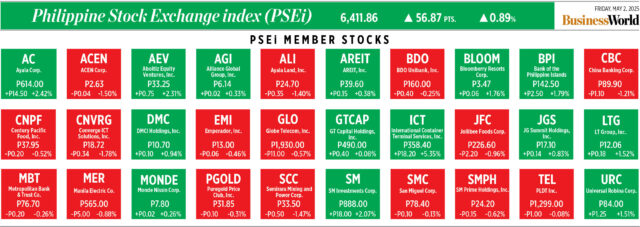
How PSEi member stocks performed — May 2, 2025

Here’s a quick glance at how PSEi stocks fared on Friday, May 2, 2025.


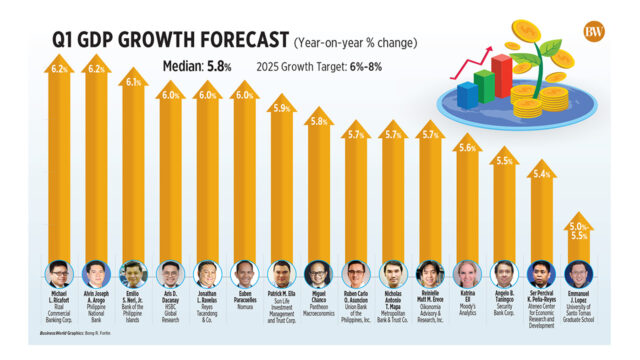
Q1 GDP growth forecast

PHILIPPINE ECONOMIC growth may have picked up in the first quarter thanks to cooling inflation and faster government spending ahead of the election ban, a BusinessWorld poll showed. Read the full story.

Q1 GDP growth forecast

Peso may stay at P55 level with dollar still under pressure due to tariff jitters

COLLAGE OF BWORLD PHOTO AND FREEPIK

THE PESO may stay at the P55 level this week as the dollar may remain under pressure as markets await developments in the ongoing tariff negotiations between the United States and its major trading partners.

The local unit closed at P55.57 per dollar on Friday, up by 27 centavos from its P55.84 finish on Wednesday, Bankers Association of the Philippines data showed.

This was the peso’s best close in more than a year or since its P55.53-a-dollar finish on March 15, 2024.

Week on week, the peso surged by 69.5 centavos from its P56.265 close on April 25.

The peso was stronger on Friday following weak US gross domestic product (GDP) and manufacturing data due to the Trump administration’s shifting policies, a trader said in a phone interview.

The US economy contracted for the first time in three years in the first quarter, swamped by a flood of imports as businesses raced to avoid higher costs from tariffs and underscoring the disruptive nature of President Donald J. Trump’s often chaotic trade policy, Reuters reported.

Economists anticipated the economy would rebound in the second quarter as the drag from imports fades, but probably not enough to avoid a recession or a period of tepid growth and high inflation, commonly referred to as stagflation. Resolving the uncertainty caused by the Trump administration’s ever-shifting tariffs position was crucial, they said.

Gross domestic product decreased at a 0.3% annualized rate last quarter, the first decline since the first quarter of 2022, the Commerce department’s Bureau of Economic Analysis said in its advance estimate of first-quarter GDP.

It was also weighed down by a decline in federal government spending, likely linked to the White House’s aggressive funding cuts, marked by mass firings and shuttering of programs.

The report captured activity before Mr. Trump’s “Liberation Day” tariffs announcement, which ushered in sweeping duties on most imports from the United States’ trade partners, including jacking up duties on Chinese goods to 145%, sparking a trade war with Beijing.

Economists polled by Reuters had forecast that GDP increased at a 0.3% pace in the January-March period.

A separate report showed US manufacturing contracted further in April, while tariffs on imported goods strained supply chains, lifting prices paid for inputs and keeping the narrative on stagflation alive and well.

The Institute for Supply Management’s manufacturing purchasing managers’ index (PMI) dropped to a five-month low of 48.7, which was slightly higher than expected, compared with a reading of 49.0 in March. A PMI reading below 50 indicates contraction. Economists polled by Reuters had forecast the PMI declining to 48.

The peso was also supported by increased remittances from overseas Filipinos before the start of a new school year in the coming weeks, Rizal Commercial Banking Corp. Chief Economist Michael L. Ricafort added in a Viber message.

For this week, US nonfarm payrolls data released on Friday could drive peso-dollar trading, the trader said.

US job growth slowed marginally in April and employers continued to hoard workers, but the outlook for the labor market is increasingly darkening as Mr. Trump’s protectionist trade policy heightens economic uncertainty, Reuters reported.

The Labor department’s closely watched employment report published on Friday, which also showed the unemployment rate held steady at 4.2% last month, helped to assuage fears that the economy was nearing recession after GDP contracted in the first quarter amid a tariff-induced flood of imports. Nonetheless, it is too early for the labor market to show the impact of Mr. Trump’s on-and-off again tariff policy.

Nonfarm payrolls increased by 177,000 jobs last month after rising by a downwardly revised 185,000 in March, the Labor department’s Bureau of Labor Statistics said. Economists polled by Reuters had forecast 130,000 jobs added after a previously reported 228,000 advance in March.

“The market will also be closely monitoring trade talks between the US and China,” the trader added.

The release of April Philippine inflation data on Tuesday and the Federal Open Market Committee’s policy meeting this week could also affect the local unit, Mr. Ricafort said.

He said the peso could move between P55.40 and P55.90 per dollar this week, while the trader expects it to range from P55.50 to P56.

A BusinessWorld poll of 14 analysts yielded a median estimate of 1.8% for the April consumer price index (CPI). This is within the Bangko Sentral ng Pilipinas’ (BSP) 1.3% to 2.1% forecast for the month.

If realized, April inflation would be steady from the March print and be sharply slower than the 3.8% clip logged in the same month in 2024.

This would also mark the ninth straight month that the CPI settled within the BSP’s 2-4% target range. — A.M.C. Sy with Reuters

Stocks may rise before PHL inflation, GDP data

PHILIPPINE STAR/KRIZ JOHN ROSALES

PHILIPPINE STOCKS may extend their climb this week on hopes for positive inflation and gross domestic product (GDP) data.

On Friday, the bellwether Philippine Stock Exchange index (PSEi) rose by 0.89% or 56.87 points to end at 6,411.86, while the broader all shares index climbed by 0.37% or 13.82 points to 3,741.12.

This was the PSEi’s best close in nearly four months or since the 6,496.32 finish on Jan. 10.

Week on week, the PSEi surged by 2.28% or 143.11 points from its 6,268.75 finish on April 25, marking its third straight week of gains.

Online brokerage 2TradeAsia.com said in a market note that strong corporate results supported the market last week.

Growing bets for an earlier-than-expected rate cut by the Federal Reserve following weak US GDP data also helped in the PSEi’s rise, it added.

“The US economy contracted by 0.3% in the first quarter of 2025… Markets were caught off-guard, having expected modest growth, and are now recalibrating expectations for the Fed, with rate cuts back on the table as early as third quarter,” 2TradeAsia.com said.

For this week, the market will focus on the release of Philippine April inflation data on May 6 (Tuesday) and the GDP report on May 8 (Thursday), analysts said.

“Investors are expected to look forward to our April inflation rate for clues. An inflation print biased to the lower end of the BSP’s (Bangko Sentral ng Pilipinas) 1.3%-2.1% projection is expected to give sentiment a boost,” Philstocks Financial, Inc. Senior Research Analyst Japhet Louis O. Tantiangco said in a Viber message.

A BusinessWorld poll of 14 analysts yielded a median estimate of 1.8% for April headline inflation. If realized, the April consumer price index (CPI) would be steady from the March print and be slower than the 3.8% clip logged in the same month in 2024.

This would also mark the ninth straight month that the CPI settled within the BSP’s 2-4% annual target.

“Investors are also expected to continue monitoring the situation on global trade. Progress towards trade negotiations with the US are also expected to drive optimism in the local bourse,” Mr. Tantiangco added.

“The local market is expected to test the validity of its breach of the 6,400 resistance level. If it manages to establish its ground at the said line, it will be converted into a support while next resistance would be at the 6,800 level.”

Rizal Commercial Banking Corp. Chief Economist Michael L. Ricafort put the PSEi’s minor support at 6,205-6,300 and minor resistance at 6,490.

For its part, 2TradeAsia.com placed the benchmark’s support at 6,000 and resistance at 6,400.

“The market remains in a consolidation phase, but not without opportunity. Domestic flows remain healthy, volatility is lower than in regional peers, and entry positions have established a ‘safer’ technical base,” it said. — Revin Mikhael D. Ochave

FDA expects speedier drug permit process

REUTERS

THE new Food and Drug Administration (FDA) application procedures are expected to reduce the drug permit process by as much as half, an official said.

“With these three policies, the processes will really be shortened … maybe cut in half,” FDA Director General Samuel A. Zacate told reporters on the sidelines of the launch of the first pharmaceutical economic zone, Victoria Industrial Park.

“We are on track; it is just a matter of time. We just have to follow normal bureaucracy because it is a process,” he added.

Mr. Zacate said that the FDA is set to sign the implementing rules and regulations (IRR) for the registration of drugs and biologicals this month.

“This is a new process. It will be signed this month, we are just fixing it because it has to run through public consultation. The stakeholders and the drug companies must also have a say on the policy, on what the hurdles are, and on what is slowing down the process,” he added.

He said that the new IRR will be presented for public consultation by the third week of May, with signing also due this month.

Meanwhile, he said that a new policy on exporting drugs was approved last year and is currently being implemented.

“We are trying to consolidate everything and streamline the process,” he said.

He said the new policy on exporting drugs will also undergo streamlining by removing the bioavailability and bioequivalence (BABE) study requirement.

“Before, there was duplication — we do BABE here, which takes six months, and then another BABE in the receiving country, which also takes six months,” he said.

“What we did is, as long as the product is only for export, we left it to the receiving country to test it,” he added.

He also cited the Facilitated Registration Pathways, approved last year, which will involve accepting approvals issued by a foreign drug regulator thought to be thorough in its evaluation process. 

“The process of approval is reduced because we do not have to evaluate the product; we will just rely on (the foreign regulator’s) evaluation,” he added.

Greenstone Pharmaceutical HK, Inc. Chief Executive Officer Melissa Y. Yap said that the Philippines should move faster in terms of building up its capacity to host pharmaceutical manufacturers.

“We need to move fast because of the trade wars and everything. Other countries are moving so much faster than us,” she said.

Greenstone, which is the manufacturer of Katinko oil and ointment, is the developer of the Victoria Industrial Park.

She said that the company is planning to expand the pharma zone after seeing how fast the first 30 hectares attract locators.

During the launch, the company signed memoranda of understanding and agreement with 14 companies setting up shop at the Victoria Industrial Park.

“There are some big and exciting names that are coming that I cannot name yet; hopefully they (will come) within the next couple of months,” she said.

Besides expanding the pharma zone, she said that Katinko is also looking at expanding its manufacturing capacity.

“We have earmarked around P2 billion,” she said, noting that the expansion will cover its cosmetics and home care products.

“We need to build factories … because our research and development lab create small batches, and we need to move faster,” she added.

Asked if the company is planning to mount an initial public offering, she said there are no plans at the moment, “maybe in five years, but I do not know yet.” — Justine Irish D. Tabile

Rice prices retreat in mid-April

PHILIPPINE STAR/KRIZ JOHN ROSALES

PRICES rose for most major agricultural commodities in mid-April except for rice, according to the Philippine Statistics Authority (PSA).

A kilo of regular-milled rice posted a national average retail price of P44.44 during the April 15-17 monitoring period, which the PSA refers to as the second phase of April.

In the first phase of April (April 1-5), rice averaged P44.92 per kilo. In the second phase of March (March 15 to 17), prices had averaged P46.02.

The government has stepped up efforts to lower rice prices of the food staple ahead of the midterm elections.

On May 1, Cebu province saw the rollout of a P20-per-kilo rice program, subsidized by both the local and National Governments.

Agriculture Secretary Francisco Tiu Laurel, Jr. said on Friday that the pilot program is being suspended to comply with the May 2-12 ban on the distribution of government aid during election season.

Said state-backed minimarkets, known as Kadiwa stores, will also be prohibited from launching the P20-per-kilo rice program until after the midterm polls on May 12.

However, Kadiwa stores will continue to sell P29-per-kilo rice, which is covered by an exemption that the Department of Agriculture (DA) had sought.

The DA said at least 19 Kadiwa centers will start offering rice at P20 per kilo beginning May 13.

Meanwhile, the PSA said the average retail price of fresh bone-in pork during the second phase of April rose to P330.13 per kilo from P327.17 in the first phase of April and P327.22 in the second phase of March.

Sellers continue to defy the maximum suggested retail price for pork set in March of P300 per kilo for fresh carcasses, P350 for kasim and pigue (shoulder and rear leg), and P380 for liempo (belly).

The Department of Science and Technology’s Philippine Council for Agriculture, Aquatic and Natural Resources Research and Development (PCAARRD) said in a report on May 2 that retail prices for livestock and poultry products have been increasing since January 2024, “with a noticeable surge starting in December 2024.”

Pork cuts such as chops, kasim, and liempo recorded the “steepest increases,” ranging from 9.58% to 10.01% compared to the previous year, it said.

“Beef prices rose moderately, while chicken prices remained relatively stable until early 2025 when they experienced a slight uptick.”

The PCAARRD said African Swine Fever continues to disrupt domestic supply of pork.

Meat prices would remain high “due to ongoing supply constraints and strong global demand,” it said.

It said FMD-related bans on imports from affected countries could further constrain beef, pork, and dairy supplies.

Meanwhile, the PSA said the average retail price of galunggong (round scad) rose to P229.11 per kilo during the second phase of April from P219.64 in the first phase of April. In the second phase of March, the average price had been P237.80.

The average price of cabbage rose to P86.03 per kilo during the second phase of April from P81.70 per kilogram in the first phase and P82.19 per kilo in the second phase of March a year earlier.

Calamansi averaged P97.43 during the second phase of April, against P92.53 in the first phase of April and P91.77 per kilo in the second phase of March.

The PSA said the average retail price of cooking oil rose to P175.08 per liter during the second phase of April from P173.99 in the first phase and P172.15 in the second phase of March. — Kyle Aristophere T. Atienza

Hyundai truck distributor sets 700-unit sales target

HARI

HARIPHIL ASIA Resources, Inc. (HARI), the Philippine distributor of Hyundai trucks and buses, said it hopes to sell 700 units this year, driven by the government’s public transport modernization program.

“Last year, we achieved 27% growth … and this year we are looking at 700 units for all the models that we have launched,” HARI President and Chief Executive Officer Maria Fe Perez-Agudo told reporters on Friday.

“But as you very well know, we are also dependent on the support of the government for the modernization program. If the funding is released earlier, then we could move faster with our orders from the cooperatives,” she added.

As of May, she said that the company has achieved 25% of its target due to challenges with the modernization program.

“We believe that the Department of Transportation is working on a resolution because we have a queue of orders from cooperatives that are sufficient to hit more than 100% (of the target),” she said.

“So far, we have a queue of over 1,000 units, but as I have said, the screening process is very meticulous. It really is a test of financing capability and, of course, the credibility of the cooperatives” in paying off their loans, she added.

On Friday, the company introduced its lineup of electric commercial vehicles, led by the Hyundai Mighty Electric and Hyundai County Electric, alongside a locally assembled internal combustion engine-powered commercial vehicle, known as the HARI Cab.

“We just launched the electric vehicles (EVs) today, and we will continue to promote and create more awareness of the significance of moving to EVs,” she said.

“We expect an amazing acceptance of our Hari Cab. So the sales report by the end of June will capture the performance of the Hari Cab,” she added.

She said that the company is also planning to introduce more EV variants, though it will take time before EVs capture a bigger share in the truck segment.

“It will take time. The government has its conservative and aggressive targets. But as you have seen in the passenger car, it is already moving; it has captured a certain market share, but the infrastructure rollout remains slow,” she said.

“We will progress as the infrastructure grows. That’s the challenge for the private and public sectors — to improve the logistics and infrastructure development, which is the charging stations,” she added.

She said the success of its EV lineup will also depend on the government’s 5-10% quota for EVs in corporate and government vehicle fleets.

“We hope that the government will increase that target as the infrastructure continues to increase because there should be some sense of balance between infrastructure development and availability of EVs,” she added.

Asked if the company is planning to manufacture the cars in-country, she said that the focus should first be on the battery.

“I think everybody should concentrate on batteries right now because even if you manufacture these cars, if there is no battery supply, then it will be challenging … The issue is how to resolve range anxiety,” she said.

“The Philippines is well-placed right now to take advantage of some other issues that are happening around the world and capture business from other parts of the world,” she added. — Justine Irish D. Tabile

DTI programs can address tariff impact — DBM

OSAPIEA

BUDGET Secretary Amenah F. Pangandaman said the Department of Trade and Industry (DTI) is sufficiently funded to support exporters affected by US tariffs.

In an e-mail interview with BusinessWorld, Ms. Pangandaman said the DTI’s budget this year can extend support should the tariffs result in a “reduction in profit margins for exporters.”

“In this regard, under the FY 2025 General Appropriations Act (GAA), the DTI was provided with P902.30 million for its Exports and Investments Development Program for the development, facilitation and promotion of exports and investments, as well as the formulation of strategic plans and policies thereon,” she said.

The Philippines has been assigned a 17% tariff by the US, which have been placed on hold pending negotiations on more definitive tariffs in Washington. Representing the Philippines are Special Assistant to the President for Investment and Economic Affairs Frederick D. Go and Trade Secretary Cristina A. Roque.

The US is charging most trading partners a 10% baseline tariff after suspending the reciprocal tariffs announced in early April.

Top Philippine exports to the US are electronic products, ignition wiring sets, other wiring assemblies used in vehicles, aircraft and ships, coconut oil, machinery and transport equipment, pineapple and pineapple products.

Ms. Pangandaman also cited the budgetary provisions for the DTI’s Micro, Small, and Medium Enterprises (MSMEs) Development Program, which aims to enhance the growth and global competitiveness of MSMEs.

“This program includes projects such as the establishment of Negosyo Centers (P454.3 million) and the Shared Service Facilities (SSF) Project (P646.7 million),” she said.

The Negosyo Centers will provide business registration assistance, business advisory services, business information, and advocacy services, including product development, trade promotion, and financing facilitation assistance to MSMEs. 

Other allocations include the P500-million Pondo sa Pagbabago at Pag-asenso (P3) Program.

The DTI said this program will set up common service facilities and assist small enterprises in improving their productivity and efficiency.

It will provide eligible small enterprises with shared machinery, equipment, tools, accessories, and other items.

John Paolo R. Rivera, senior research fellow at the Philippine Institute for Development Studies, said the government can also provide tax incentives, soft loans, or production subsidies for exporters of vulnerable products such as electronics components, automotive parts, and agriculture-based goods.

“It would be prudent for National Government to earmark a specific allocation in the 2026 budget to support sectors affected by the US tariffs,” he told BusinessWorld via Viber.

Mr. Rivera added that a “dedicated budget line possibly under the DTI, Department of Agriculture, or a special inter-agency fund” would demonstrate the government’s dedication to safeguarding jobs and competitiveness. — Aubrey Rose A. Inosante

The CFO as a value architect: Long-term value in the ‘Age of And’

IN BRIEF:

• CFOs are transitioning into Value Architects, integrating sustainability and leveraging AI to enhance long-term value creation and innovation.

• The adoption of advanced technologies is empowering CFOs to refine both financial and non-financial reporting, yielding deeper insights and promoting sustainable business practices.

• Value Architects must craft a compelling value narrative, outline a business case, and establish a new operating model.

In a world defined by complexity, uncertainty, and transformation, the role of the Chief Financial Officer (CFO) is being reinvented. No longer confined to the realm of compliance and financial stewardship, today’s CFOs are stepping forward as Value Architects — leaders who build and shape the future of organizations by integrating sustainability, harnessing the power of AI, and driving long-term strategic value.

Welcome to the “Age of And,” where CFOs must deliver short-term performance and long-term value, financial returns and non-financial impact, shareholder gains and societal progress.

FROM SCOREKEEPER TO STRATEGIST
Traditionally, the CFO has been viewed as the company’s financial guardian — tasked with ensuring regulatory compliance, managing risks, and delivering quarterly results. But in a landscape disrupted by climate risk, digital innovation, and shifting stakeholder expectations, that legacy definition is no longer enough.

Today, CFOs are stepping beyond the finance function to shape enterprise-wide strategy. This evolution — from scorekeeper to strategist — is not just a role shift; it’s a mindset shift. The modern CFO must be a translator between the language of numbers and the language of value. CFOs are becoming the “business copilot,” guiding decisions that determine future competitiveness and resilience.

SUSTAINABILITY: THE NEW VALUE-CREATION MANDATE
Sustainability has moved to the heart of corporate strategy. It’s not just about ethics or regulatory compliance — it’s about creating durable, future-fit business models. CFOs are uniquely positioned to lead this shift.

With the introduction of stringent new reporting regulations — such as the EU’s Corporate Sustainability Reporting Directive (CSRD) and frameworks like the ISSB and TNFD — organizations are being held to a higher standard of non-financial transparency. This places the CFO at the center of an evolving disclosure ecosystem.

A recent EY survey of corporate leaders reveals that 92% of European companies are significantly transforming their approach to sustainability reporting. And 80% of institutional investors now support ESG investments — even when they impact short-term financial targets. This is a powerful signal: the market is demanding sustainable value, not just fast profits.

AI AND THE RISE OF THE AUGMENTED CFO
At the same time, AI is radically reshaping the finance function. Tasks that were once manual and time-consuming — such as reconciliations, data processing, and basic reporting — are now being automated. This frees up CFOs to focus on higher-value work: forecasting, strategic planning, scenario modeling, and insight generation.

But AI’s potential goes far beyond efficiency. It enables the integration of financial and non-financial data in real time, empowering CFOs to make more informed, holistic decisions.

According to the 2024 EY Corporate Reporting Survey, 87% of finance leaders are already using or piloting AI to enhance ESG and financial reporting. More than 60% of ESG-leading companies believe AI presents a major opportunity for long-term value creation. The opportunity is clear — but so is the responsibility. Ethical use, bias mitigation, and transparency will be essential as AI becomes more deeply embedded in finance.

THE EVOLVING ROLE OF THE CFO: A FOUR-STAGE JOURNEY
The shift from traditional CFO to Value Architect unfolds across four stages:

Scorekeeper (Yesterday): Focused on compliance, cost control, and historical reporting.

Business Copilot (Today): Collaborates across functions, supports ESG compliance, and brings insights to leadership.

Value Creator (Tomorrow): Aligns short-term results with long-term vision, integrates ESG into investment decisions, and uses AI for decision-making.

Value Architect (Beyond): Designs value for all stakeholders, leads convergence of ESG and financial reporting, and embeds sustainability at the core of strategy.

This is not a theoretical exercise. Companies that proactively empower CFOs to evolve along this trajectory are more likely to thrive.

AN ACTION AGENDA FOR CFOs
To step fully into the Value Architect role, CFOs must lead with clarity, ambition, and action. Here are three critical imperatives:

Design a value story that resonates. Today’s stakeholders — investors, customers, regulators, and employees — are asking tough questions about how companies create value for the long term. CFOs must help craft a narrative that explains how financial performance and sustainability go hand in hand.

• Embed ESG into investor communications

• Articulate how non-financial performance supports financial outcomes

• Lead sustainable financing initiatives (e.g., green bonds, climate-linked loans)

Build a business case for integrated value. Sustainability investments often require up-front cost, but they also unlock long-term value. CFOs must champion robust, data-backed business cases that show how ESG drives RoI.

• Include sustainability metrics in capital allocation

• Implement internal carbon pricing

• Link ESG to financial planning, budgeting, and forecasting

Redesign the finance function. Finance teams must be equipped to manage and report on integrated value. That means transforming the operating model, investing in technology, and building new skills.

• Upskill finance professionals in ESG and data science

• Adopt AI tools for forecasting and scenario planning

• Establish audit-ready ESG reporting systems

THE CFO: A CEO-IN-WAITING?
As the CFO role becomes more strategic, it also becomes a more natural stepping stone to the CEO position. CFOs who master the art of long-term value creation, cross-functional leadership, and stakeholder engagement are increasingly viewed as future CEOs.

Organizations that embrace this shift will not only strengthen their leadership pipeline but also future-proof their strategy and governance models.

THE FUTURE OF FINANCE IS THE FUTURE OF VALUE
The CFO’s transformation into a Value Architect is both a challenge and a calling. It requires courage, capability, and a willingness to rethink the foundations of finance. But the rewards — for the organization, its stakeholders, and society — are profound. In the Age of “And,” CFOs must deliver earnings and impact, manage risk and drive innovation, honor shareholders and serve broader societal goals.

As Julie Linn Teigland, EY EMEIA Area Managing Partner, aptly puts it: “Since sustainability is intrinsically linked to value creation, and the CFO plays a key role in financial value creation, it is a natural progression for the CFO to have a more holistic view of value.” The time to embrace that progression is now.

This article is for general information only and is not a substitute for professional advice where the facts and circumstances warrant. The views and opinions expressed above are those of the author and do not necessarily represent the views of SGV & Co.


Aris C. Malantic is the Financial Accounting Advisory Services (FAAS) leader of SGV & Co.