Home Blog Page 1215

Cleaner air in East Asia may have driven recent acceleration in global warming, our new study indicates

STOCK PHOTO | Image from Freepik

Global warming has picked up pace since around 2010, leading to the recent string of record warm years. Why this is happening is still unclear, and among the biggest questions in climate science today. Our new study reveals that reductions in air pollution — particularly in China and east Asia — are a key reason for this faster warming.

Cleanup of sulphur emissions from global shipping has been implicated in past research. But that cleanup only began in 2020, so it’s considered too weak to explain the full extent of this acceleration. NASA researchers have suggested that changes in clouds could play a role, either through reductions in cloud cover in the tropics or over the North Pacific.

One factor that has not been well quantified, however, is the effect of monumental efforts by countries in east Asia, notably China, to combat air pollution and improve public health through strict air quality policies. There has already been a 75% reduction in east Asian sulphur dioxide emissions since around 2013, and that cleanup effort picked up pace just as global warming began accelerating.

Our study addresses the link between east Asian air quality improvements and global temperature, building on the efforts of eight teams of climate modelers across the world.

We have found that polluted air may have been masking the full effects of global warming. Cleaner air could now be revealing more of the human-induced global warming from greenhouse gases.

In addition to causing millions of premature deaths, air pollution shields the Earth from sunlight and therefore cools the surface. There has been so much air pollution that it has held human-induced warming in check by up to 0.5°C over the last century.

With the cleanup of air pollution, something that’s vital for human health, this artificial sunshade is removed. Since greenhouse gas emissions have kept on increasing, the result is that the Earth’s surface is warming faster than ever before.

MODELING THE CLEANUP
Our team used 160 computer simulations from eight global climate models. This enabled us to better quantify the effects that east Asian air pollution has on global temperature and rainfall patterns. We simulated a cleanup of pollution similar to what has happened in the real world since 2010. We found an extra global warming of around 0.07°C.

While this is a small number compared with the full global warming of around 1.3°C since 1850, it is still enough to explain the recent acceleration in global warming when we take away year-to-year swings in temperature from natural cycles such as El Niño, a climate phenomenon in the Pacific that affects weather patterns globally.

Based on long-term trends, we would have expected around 0.23°C of warming since 2010. However, we actually measured around 0.33°C. While the additional 0.1°C can largely be explained by the east Asian air pollution cleanup, other factors include the change in shipping emissions and the recent accelerated increase in methane concentrations in the atmosphere.

Air pollution causes cooling by reflecting sunlight or by changing the properties of clouds so they reflect more sunlight. The cleanup in east Asian air pollution influences global temperatures because it reduces the shading effect of the pollution over east Asia itself. It also means less pollution is blown across the north Pacific, causing clouds in the east Pacific to reflect less sunlight.

The pattern of these changes across the North Pacific simulated in our models matches that seen in satellite observations. Our models and temperature observations also show relatively strong warming over the North Pacific, downwind from east Asia.

The main source of global warming is still greenhouse gas emissions, and a cleanup of air pollution was both necessary and overdue. This did not cause the additional warming but rather, removed an artificial cooling that has for a time helped shield us from some of the extreme weather and other well-established consequences of climate change.

Global warming will continue for decades. Indeed, our past and future emissions of greenhouse gases will affect the climate for centuries. However, air pollution is quickly removed from the atmosphere, and the recent acceleration in global warming from this particular unmasking may therefore be short-lived.

THE CONVERSATION VIA REUTERS CONNECT


Laura Wilcox is a professor, National Centre for Atmospheric Science at the University of Reading. Bjørn H. Samset is a senior researcher in Climate and Atmospheric Sciences at the Center for International Climate and Environment Research – Oslo.


DFNN eyes recovery through new products

DFNN.COM

LISTED gaming technology provider DFNN, Inc. is banking on its recently launched LottoMatik platform and other technology products such as electronic gates (e-gates) to support its rebound after reporting a wider negative equity as of end-March.

The company aims to scale its business verticals, including LottoMatik, which was launched in February, DFNN President and Chief Executive Officer Ricardo F. Banaag said in a regulatory filing on Wednesday.

“The company aims for LottoMatik to achieve deployment parity with existing land-based lotto outlets, expanding its footprint to match traditional distribution channels and serve a wider segment of the population,” Mr. Banaag said.

The LottoMatik is a portable point-of-sale device that streamlines the process of buying lotto tickets.

Mr. Banaag said this as the Philippine Stock Exchange sought the company’s recovery plan and future actions after a wider negative equity, which puts it at risk of involuntary delisting.

DFNN posted P403.15 million in negative equity as of end-March, wider than the P273.21 million in negative equity as of end-2024.

LottoMatik is a platform that aims to digitalize and modernize the lottery experience and reach underserved markets across the country.

In addition, Mr. Banaag said DFNN has allocated the capital raised from private placements worth P450 million to settle existing obligations, invest in cybersecurity and artificial intelligence (AI), and cover regulatory listing expenses.

He added that DFNN is planning to increase its authorized capital stock, which would convert debt into equity and reduce the company’s liabilities.

Mr. Banaag also said DFNN is set to receive a boost from the e-gates project of its information technology subsidiary, Intelligent Wave Philippines, Inc. (iWave), at the Ninoy Aquino International Airport (NAIA).

“The rollout of the e-gates system is strategically aligned with the scheduled rehabilitation of NAIA Terminals 1 and 3, where the system will be installed,” he said.

“This timeline reflects our coordination with airport authorities and infrastructure readiness, ensuring operational deployment within the year 2025,” he added.

Mr. Banaag said iWave continues to build on its strengths in biometric systems, AI, unified messaging, and the Internet of Things.

“We remain confident that the outlined strategies form a solid foundation for DFNN’s continued viability and growth in the years ahead,” he said.

DFNN shares dropped by 2.08% or four centavos to P1.88 per share on Wednesday. — Revin Mikhael D. Ochave

Uber partners with China’s Baidu to deploy self-driving taxis in global markets

REUTERS

UBER and China’s Baidu will partner to deploy thousands of Baidu’s Apollo Go autonomous vehicles on the Uber platform across several international markets outside the US and mainland China, the companies said on Tuesday.

The first rollouts are expected in Asia and the Middle East later this year.

The tie-up brings together Uber’s massive ride-hailing network with Baidu’s fleet of more than 1,000 fully driverless vehicles across the world.

It is the latest in a series of efforts by Uber to compete in the burgeoning market as tech companies race to overcome regulatory and engineering hurdles to deploy self-driving taxis at a commercial scale.

Last month, Uber launched autonomous ride-hailing services in Atlanta, expanding its partnership with Alphabet’s Waymo, while also signing deals with autonomous vehicle companies including Pony AI and May Mobility.

Tesla rolled out its long-awaited robotaxis in Austin, Texas last month, in their first public test.

Meanwhile, China’s robotaxi firms have been increasingly eyeing global expansion; Apollo Go is now present in 15 cities, including Dubai and Abu Dhabi, and, as of May, had completed more than 11 million rides.

In May, Pony AI became the third Chinese autonomous vehicle company after Baidu and WeRide to unveil an agreement to deploy its vehicles in the Middle East.

Robin Li, co-founder and chief executive officer of Baidu, said on Tuesday that “the partnership with Uber represents a major milestone in deploying our technology on a global scale.”

Baidu has been running its Apollo Go robotaxi services commercially in several Chinese cities since 2022. Reuters

Dining In/Out (07/17/25)


Tagaytay Food Festival kicks off

THE Tagaytay Food Festival 2025 is happening from July 18 to 20, with a finale event on Aug. 3. With the theme “Food That Binds,” the festival is anchored at Taal Vista Hotel, the festival’s official home. The experience begins on July 18, with the Festival Fair & Farmer’s Market at Taal Vista Hotel. This is followed by the Drinks Fest in the afternoon, then the Grand Tasting in the evening, a signature dinner featuring a lineup of chefs. Expect dishes normally not found on menus — and moments that won’t be repeated. July 19 deepens the experience with Food Talks — a full-day series of conversations and demos featuring some of the country’s most respected voices in the industry. From sustainability and reinvention to heritage and hospitality, the day brings together Thirdy Dolarte, Chaele Dee, Ryan Cruz, Stephane Duhesme, and Tina Legarda. The sessions will be powered by Pickup Coffee and Cold Storage. On the same day, there will be a Cavite City Food Heritage Tour, an immersive journey through Cavite City’s culinary and cultural history, under the guidance of writer Ige Ramos. The festival also offers a lunch experience that day at The Fatted Calf featuring One Michelin Star Restaurant Fiz Singapore, made possible through the festival’s official banking partnership with RCBC (the lunch is exclusive to the bank’s clients). Festival guests, however, can try the Veranda Heritage Lunch at Taal Vista’s al fresco area (offered on both Saturday and Sunday) for a relaxed, open-air dining experience that revisits Filipino heirloom recipes. After the talks, there will be Sunset Sessions at the Taza Fresh Table at 4 p.m. For dinner, Food That Binds at The Fatted Calf welcomes a cross-border exchange between Restaurant Fiz Singapore and chefs Rhea and Jayjay SyCip. On July 20, the day begins with brunch, a New Menu Launch at Samira by Chele in the Anya Resort Tagaytay. Later that day, there will be the Anzani Sunday Lunch. Mediterranean Flair brings together Marco Anzani of Cebu and his peers for a refined lunch experience, offering a take on coastal gastronomy. This intimate eight-hands collaboration is a preview of Anzani’s upcoming restaurant at Ville Sommet in Alfonso, Cavite. The evening closes with Sinta: A Collaboration Dinner at 6 p.m., featuring chefs Ariel Manuel, Bettina Arguelles, and chefs from the PYC Foods Group. The festival concludes on Aug. 3 with the Creative Bulalo Challenge at Skyranch Tagaytay. For tickets, call 0917-611-9808 or 0977-643-7477. Tickets to the Grand Tasting are priced at P3,950 per person. Premium dining experiences have limited seating — early booking is encouraged. Follow @tagaytayfoodfestival for more details.


Italian Journey Tasting Menu at Solaire Resort North

FINESTRA has a new offer for dinner — the Italian Journey Tasting Menu. This is a five-course set menu featuring some of Finestra’s signature dishes for P4,200++ per head. It opens with a new addition to Finestra’s a la Carte menu, the Zuppa di Cipolla (charred onion consommé and Parmesan cheese), Calamari and Ravioli del Plin (a squid-based dish paired with fava beans and an edamame salad), and a homemade beef ravioli drizzled with jus. For the main course, Finestra prepares a Tagliata di Wagyu M5 made from Australian M5 Wagyu beef steak marinated in peppercorn sauce and paired with glazed mushrooms, or a Merluzzo composed of fresh Patagonian toothfish with browned butter and King Oyster mushrooms. Dessert is Finestra Tiramisu, a chocolate brownie blended with Mascarpone cream and sprinkled with fine cocoa powder. For more details, reservations, and inquiries, visit the Solaire Resort North website at sn.solaireresort.com, or contact them at 8888-8888 or via e-mail at sn.reservations@solaireresort.com or snrestaurantevents@solaireresort.com.


Dinner and a show at Gateway

AT THE NEW World Kitchens Platinum Cinema on Level 4 of Gateway Mall 1, Araneta City, Cubao, Quezon City, one can have a one-of-a-kind cinematic offering while partaking in a gastronomic feast featuring World Kitchen’s globally renowned chefs. “Following the opening of Wolfgang’s Premiere Lounge, the World Kitchens Platinum Cinema brings something new to the table — taking the joy of watching a movie and taking it up a notch by pairing it with global culinary favorites,” said Irene Jose, chief operating officer of Uniprom. World Kitchens Platinum Cinema features 40 La-Z-Boy recliners, Digital Dolby Surround Sound, and a state-of-the-art screen. While enjoying the film, customers can choose from a selection of treats from any of World Kitchens’ show kitchens. Every ticket comes with a choice of a main dish from World Kitchens, and a bottle of water. These include chicken teppanyaki from Shinshima, lasagna from Dario’s Pizza, braised pork belly Chinese bao from HK Ma’s Bistro, maze soba from The You No Men, calamari from Unagi Yukimitsu, Papad crusted crispy chicken from Prana, Conchinillo Queso El Sandwich from Asador de Manila, burger sliders with fries from Chef Jessie, and salmon samurai roll from Kuro Maguro. Additional dishes are available for order as add-ons through the à la carte menu at the cinema lounge for an extra charge. The lounge also doubles as a waiting area or a hangout spot. The bar menu offers alcoholic and non-alcoholic beverages, including a wine list, imported beers, and specialty juices. Each ticket is priced at P990. Book through the Araneta City app, available on Google Play and the Apple App Store. One may also purchase tickets directly from the ticket booth. To know more about the show schedules, deals, and updates, visit https://www.gatewaycineplex18.com/.


Dine & Style at Estancia

UNTIL JULY 31, Ortigas Land invites foodies and fashion lovers to join Dine & Style, a social media challenge that pairs one’s outfit with their order. Customers can wear an outfit that matches their meal or drink, snap a creative shot or reel, and post it on Instagram and Facebook. “We wanted to transform the everyday experience of dining out into something playful and expressive — giving customers a chance to showcase their unique fashion sense, too. By collaborating with influencers, we’re adding a fresh and creative twist that stands out from traditional restaurant promos,” said Annelle Lansangan, Ortigas Land’s corporate marketing manager. Dine & Style also highlights Capitol Commons and Estancia. Participating restaurants include the likes of James & Daughters, Angkan Coffee, and Tiong Bahru, with more to be announced on their official social media pages. To join the contest, customers can dine at any participating restaurant at Estancia or Capitol Commons and match their outfit with their order. Participants must publicly post a photo or reel on Instagram and Facebook along with a short explanation of the outfit-meal connection. Posts must tag @capitolcommonsph_ and @estanciaph and include the official campaign hashtags: #DineandStylePH, #DineandStyleCapitolCommonsEstancia, #CapitolCommons, #Estancia, and #OrtigasLand. Participants must also tag two friends in the caption to invite others to join. Each entry must be submitted via the official Google Form, accessible through the official Dine & Style campaign post on social media. Participants are required to include the link to their public post and upload a copy of their photo or reel as part of their entry. Reels earn additional points, and multiple submissions are allowed, provided each features a different outfit and food pairing. Entrants must ensure their accounts are set to public. All entries will be reviewed per Ortigas Land’s data privacy policy. Three winners will be selected based on creativity, aesthetic appeal, relevance to theme, social impact, and brand compliance. The top scorer will win P7,500 worth of SM gift certificates and P7,500 worth of Bistro Group gift certificates. Second place will take home P5,000 worth of SM GCs and P5,000 worth of Bistro Group GCs, while third place will receive P2,500 worth of GCs from each brand. Winners will be announced via @capitolcommonsph_ and @estanciaph on or before Aug. 8. For contest details and submission link, follow @capitolcommonsph_ and @estanciaph on Instagram and Facebook.

Only 50% of Filipino adults have financial accounts — World Bank

REUTERS

ONLY 50% of Filipino adults had financial accounts at end-2024 even as 78% own mobile phones, according to the World Bank.

The World Bank said in The Global Findex Database 2025 report released on Wednesday that 50.2% of approximately 82 million Filipinos aged 15 years old and above had financial accounts in 2024, lower than the 51.4% recorded in 2021 but higher than 26.6% in 2011.

This is below the 83.3% average account ownership rate for East Asia and Pacific (EAP) and the 70.4% for lower middle-income countries.

The EAP region is composed of the Philippines, Cambodia, China, Indonesia, Lao People’s Democratic Republic, Malaysia, Mongolia, Myanmar, Thailand, and Vietnam.

Worldwide, 78.7% of adults had financial accounts in 2024, up from 73.8% in 2021 and 50.6% in 2011.

The study is based on surveys conducted in 141 economies in 2024 and includes financial inclusion indicators such as access to formal and nonformal financial services, payments, and saving and borrowing behavior, among others.

The 2025 report also includes new data on ownership of mobile phones and internet use from the inaugural Global Findex Digital Connectivity Tracker.

“Mobile phones and the internet are revolutionizing financial inclusion, enabling more people to access and use digital financial services to manage their financial lives. From mobile money accounts accessible on basic phones to bank-account-linked wallets used on smartphones, digital services are fulfilling their promise of being more accessible and affordable than alternatives that are not digitally accessible, bringing benefits such as the ability to make daily savings deposits using local agents, to manage loan disbursements and repayments using an app, and to purchase pay-as-you-go renewable electricity directly from a phone, to name just a few,” the World Bank said.

“The data show high levels of phone ownership and internet use and increased ownership and usage of mobile-enabled accounts in every region of the world. Mobile platforms in particular have given millions of people, including those who were previously too difficult or too expensive to reach, access to financial services, dramatically boosting not just account ownership, but also formal saving and digital payments, while in addition enabling a range of nonfinancial digital activities.”

In the Philippines, 78% of adults had personal mobile phones in 2024, below the 94% average in East Asia and Pacific but slightly above the 75.1% average for lower middle-income economies.

Meanwhile, 69% of Filipino adults had personal smartphones, lower than the EAP average of 85.8% but higher than the 50% for lower middle-income countries.

The data showed that 33.5% of Filipino adults had accounts with banks or similar formal financial institutions, while 28.8% had mobile money accounts. Some 32.7% said they had digitally enabled accounts, or those used with a card or phone.

Per sector, account ownership rates among Filipino adults stood at 57.1% for women, 34.4% for those in the poorest 40% of households, 41.3% for those out of the labor force, and 46.5% of those in rural areas. All of these were below the averages seen for both the East Asia and Pacific region and lower middle-income economies.

According to the report, 53.6% of Filipino respondents said they saved formally and informally in the past year, with 23.9% of them saving formally using a financial account, up from the 2021 figure of 20.8%. Meanwhile, 6.3% said they saved informally using a savings club or through a person outside of their family.

“More than 20% of adults saved using a mobile money account in Malaysia, the Philippines, and Thailand as well,” the World Bank said.

As for borrowing, 72% of Filipino adults said they borrowed in the past year, with only 12% doing so via formal channels.

Meanwhile, the report showed a slight decrease in the use of digital payments in the Philippines. It said that 40.3% of Filipino adults made or received digital payments in the past year, down from 43.5% in 2021. This is also well below the EAP region average of 80.2% in 2024.

Those who made digital merchant payments stood at 13.4%, lower than 18.5% in 2021.

“Overall, in low- and middle-income economies, 36% of adults bought something online. Of these online shoppers, nearly 20% paid for their online purchases exclusively using cash on delivery,” the World Bank said.

“East Asia and Pacific had the highest share of online shoppers at 65% of all adults, with 87% of shoppers also paying for their purchases online. Yet as with the overall trends in digital merchant payments in the region, rates of adoption of online payment are driven mostly by high usage levels in China. When data for China are excluded, online shopping rates for East Asia and Pacific drop to 34% of adults, with just over half of them, 18%, paying cash on delivery,” it added. “Rates of this behavior are particularly high in certain of the region’s economies. For instance, in Malaysia and Thailand, between 30% and 40% of adults making online purchases pay cash on delivery; in Indonesia and the Philippines, more than half do.”

The World Bank said while growing digital connectivity has driven the increase in financial account ownership and use worldwide, efforts to improve inclusion remain important.

“Dedicated financial inclusion efforts are still critical, however, to address two key challenges. The first is reaching the remaining adults without accounts, primarily women and poor adults, through focused, context-appropriate initiatives. The second is developing programs, policies, and products that help everyone improve their financial health so that they can more effectively mitigate sources of financial worry, increase their financial resilience, and more effectively pursue their goals,” it said.

“Any effort to further expand digital and financial inclusion should take into account the broader context to ensure that the necessary infrastructure and consumer protections are in place. Governments and providers of financial services have a responsibility to establish strong rules ensuring consumer protection and implement them throughout the product design, sales, onboarding, and user experience processes. In this way, they can play a role in designing the next wave of efforts toward financial inclusion for people who remain underserved.” — BVR

Dash it all

STOCK PHOTO | Image from Freepik

THE SHORT DASH is a punctuation mark called the hyphen. As punctuation marks go, this dash seems to be getting overworked.

Dashes were previously used on analog typewriters mostly to break up words that continue beyond the end of a fixed line of text. This was before computers rearranged spacing to dispense with such a requirement as words no longer need to be broken up when they can be “justified right.”

Still, a series of words strung together as a single modifier, as in “devil-may-care” attitude can describe a world leader’s blasé attitude to treaties and global alliances. The combination of words joined by a hyphen also delivers a bigger punch as in “pie-in-the-sky” optimism to capture the spirit of most commencement exercise speeches.

Political correctness in identifying ethnicity has generated a slew of hyphenated words like African-American, instead of the previously acceptable “black” designation. Especially in a country where immigrants, illegal or not, are being flushed out and sent back to their countries of origin, the ethnic hyphen is a red flag.

The entry of foreign-born or expatriate recruits for local sports, including women’s volleyball, has now revived the hyphen to denote ethnic origins of star athletes. The Fil-Ams have been joined by other countries and have acquired the generic tag of Fil-For to embrace all shades of gray.

Of course, there are the usual (ho-hum) local players in a team that do not get too much attention or advertising billboard exposure. The native breed needs no hyphen, as in Phil-Phil if both parents are locals. A simple Filipino appellation suffices, or the regional origin at most.

It must be noted that the hyphen is different from a slash (or virgule). The hyphen connects ideas while the virgule separates them in a multiple bundle. Those partial to the slash exhibit multi-tasking tendencies when they put in their calling cards such positions as “physical therapist/event planner/landscape architect.” This demonstration of versatility does not always imply proficiency in the claimed areas of endeavor.

The German language dispenses with the hyphen or the virgule. Words can cram different ideas together to form a single word however long this form takes, like schadenfreude — which literally translates into “joy in misery,” referring to the delight in discovering somebody else’s discomfiture. Another example is weltanschauung or world view. (Try pronouncing that.)

French, like American and English, is not averse to the hyphen at all, as in tête-à-tête (literally, head-to-head) for a pleasant conversation of two parties, usually informal and maybe over coffee. In describing a type of duet performance, the French can use the ballet sequence of the pas de deux (or step of two) with no hyphens needed. This can be graceful and elegant.

Hyphens are like the joints of a train, keeping the different coaches apart but still in a single line so they don’t veer off the rails. The hyphen is a short dash and does not require a pregnant pause, just a speed bump between words. The double dash which the computer sometimes converts to a long dash is a hiatus that introduces a new trend of thought or an unconnected side comment. (He smiled broadly — without showing his teeth.)

The hyphen is often used as a modifier when a single adjective does not quite do the job. “Reckless” as a single word can be more accurately captured as “driving-without-brakes-up-to-the-edge-of-the-cliff” attitude. A cliffhanger (a single word) may follow this type of adventure.

As a form of address, the hyphen is also used to introduce a new surname for a now married woman. The unhyphenated name suggests that the woman is unmarried or merely hanging on to her old name which may be more recognizable than that of the new partner, not necessarily a fortune hunter.

The hyphenated name has become an identifying badge for the career woman, seeming to challenge male counterparts to wield a longer name in his calling card. Even with a second name, men employ just a single space as separation, as in a first name like Jaime Augusto. The last name here is also not hyphenated.

This hyphen ventilating may turn off the “punctuations-don’t-keep-me-awake-at-night” type of person. (Is this grammatical outing of interest to anyone at all?)

A single-word modifier may possibly describe the indifferent reader. But can a “skip-to-the-next-page” attitude be more descriptive?


Tony Samson is chairman and CEO of TOUCH xda

ar.samson@yahoo.com

AC Health sets up Healthway Foundation

AYALA Healthcare Holdings, Inc. (AC Health) has launched Healthway Foundation, Inc., a nonprofit arm intended to provide medical and financial support to underserved communities.

Healthway Foundation, which is part of the Healthway Medical Network, was created to support AC Health’s goal of transforming health for every Filipino, beginning with broader access to cancer care.

In its initial years, the foundation will provide medical and financial assistance that gives current and future cancer patients access to the full standard of care, consisting of diagnostics, management, treatment, and supportive services, AC Health said in an e-mail statement on Wednesday.

The foundation will also tap into AC Health’s ecosystem of hospitals, clinics, and pharmacies to ensure that beneficiaries receive end‑to‑end care and support.

“By launching this foundation, we are moving beyond healthcare infrastructure to provide direct and meaningful support to those who need it most — beginning with cancer and expanding to other diseases that place a heavy toll on Filipino families,” AC Health President and Chief Executive Officer (CEO) Paolo Maximo F. Borromeo said.

AC Health said that 189 out of every 10,000 Filipinos are battling cancer, with expenses ranging from P120,000 to P1.5 million per patient.

“Many Filipinos diagnosed with cancer forego or delay life‑saving treatment because of cost. Healthway Foundation allows us to overcome that barrier and extend our clinical expertise to cancer patients and their families,” Healthway Medical Network President and CEO Jaime “Jimmy” E. Ysmael said.

Healthway Foundation said it is also committed to supporting studies on best patient care, training medical professionals to address evolving patient needs, and conducting community outreach and advocacy for cancer screening and disease awareness campaigns.

Meanwhile, AC Health, through its Healthway Cancer Care Hospital, has partnered with BYD Cars Philippines to promote cancer care support through the limited-edition BYD Seagull in Seashell Pink.

BYD Cars Philippines, a subsidiary of ACMobility, will donate a portion of the proceeds from every limited-edition Seashell Pink BYD Seagull to the Healthway Foundation’s Cancer Care Hero Fund, which will provide financial assistance to Filipino cancer patients.

As part of each pink BYD Seagull purchase, Healthway Cancer Care Hospital will also offer customers discounted women’s health screenings, vaccinations, and executive check-ups.

Co-branded pink umbrellas and car stickers will also be given to vehicle buyers as symbols of solidarity.

AC Health is the healthcare subsidiary of listed conglomerate Ayala Corp. Its portfolio includes the generic retail pharmacy chain Generika Drugstore; pharmaceutical importer and distributor IE Medica and MedEthix; Healthway Medical Network, which operates multi-specialty clinics, ambulatory centers, and full-service hospitals; and retail pharmacy chain St. Joseph Drug. — Revin Mikhael D. Ochave

X hit by complaints to EU over user data and targeted advertising

STOCK PHOTO | Image by Julian Christ from Unsplash

BRUSSELS — Elon Musk’s X social media platform has been hit by complaints by nine civil society organizations to European Union (EU) and French regulators over what they say is its use of users’ data for targeted advertising that may breach EU tech rules.

The organizations — AI Forensics, the Centre for Democracy and Technology Europe, Entropy, European Digital Rights, Gesellschaft für Freiheitsrechte e.V. (GFF), Global Witness, Panoptykon Foundation, Stichting Bits of Freedom and VoxPublic — said they took their complaint to the European Commission and the French media regulator Arcom on Monday.

They urged both regulators to take action under the Digital Services Act (DSA) which prohibits advertising based on sensitive user data such as religion, race and sexuality.

X, the Commission and Arcom did not immediately respond to e-mailed requests for comment.

“We express our deep concern regarding the use by X of users’ sensitive personal data for targeted advertisements,” the organizations said in a statement.

They said their concerns were triggered after they looked into X’s Ad Repository which is a publicly available database set up by companies as part of a DSA requirement.

“We found that major brands as well as public and financial institutions engaged in targeted online advertising based on what appear to be special categories of personal data, protected by Article 9 of the GDPR, such as political opinions, sexual orientation, religious beliefs and health conditions,” they said.

The group called on the regulators to investigate X. GDPR refers to the EU data privacy law. Reuters

Knorr Professional introduces new powder

KNORR PROFESSIONAL proudly introduces its Team Sure Lasap. (L-R: Ninong Ry, Chef Pipo Aluning, Chef Ken Cacho, Chef Boy Logro, Chef Rosebud Benitez-Velasco, Chef JR Royol)

THE COOKING vlogger Ninong Ry (Ryan Reyes off-camera) gave a lesson on consistency and made fried rice with the help of the new Knorr Professional Sure Lasap seasoning powder.

On June 24 at Makati’s Whitespace Manila, Ninong Ry, at a kitchen setup, sprinkled the powder on his fried rice. Meanwhile, at other stations, chefs Rosebud Benitez-Velasco, JR Royol, and Boy Logro (also known for their online and TV stints) made other stir-fry dishes like pancit (sauteed noodles) and stir-fried seafood. The four will serve as ambassadors under the brand as well as make up Team Sure Lasap (sure taste).

Mr. Reyes looked back on his days in a restaurant, recalling products that were not consistent, thus changing a dish’s taste, regardless of how closely one follows a recipe. “Para maging consistent ka, kailangan iyong mga pinapasok mo, consistent rin (so you could be consistent, your ingredients must be consistent as well),” he said about the new seasoning powder.

Monica Reyes, country marketing manager of Unilever Food Solutions Philippines, said in a speech, “At Unilever Food Solutions, our mission has always been clear: to support food professionals with real practical solutions that empower them to thrive.”

One notes that the powder’s list of ingredients includes iodized salt, flavor enhancers (monosodium glutamate (MSG) and ribonucleotide), sugar, nature-identical and natural flavors, garlic, spice, cornstarch, anti-caking agent (silicon dioxide), chicken fat, soy sauce powder, yeast extract, and caramel color. Speaking about the nutritional content, Ms. Reyes told BusinessWorld, “It’s aligned with one of the main concerns of Filipinos now, which is sodium — salt. We make sure that we minimize the added sodium; there is no added MSG. There’s naturally occurring MSG, as with many other foods, but we make sure to maximize that naturally occurring MSG to bring out the maximum flavor.”

Speaking about Knorr as an instant food brand in the face of a newfound health consciousness around the world, she said, “It’s been embedded in Knorr and with Unilever’s persona from the start that we really make sure that we’re putting out nutritious ingredients and nutritious food there. We didn’t actually have to change so much of what’s in our food products, because we’ve always been committed to lower sodium, no added MSG, lower sugar.”

“Now, we’re just making that a lot more available for everyone.”

To know more about Knorr Professional and Unilever Food Solutions, visit www.ufs.com. — JLG

Peso plunges to P57 level on US CPI

BW FILE PHOTO

THE PESO plunged back to the P57-per-dollar level on Wednesday as faster-than-expected US consumer inflation data for June dampened bets of further rate cuts by the US Federal Reserve.

The local unit closed at P57.085 per dollar, sinking by 35.5 centavos from its P56.73 finish on Tuesday, Bankers Association of the Philippines data showed. This was a fresh three-week low for the peso as this was its lowest close since it ended at P57.16 on June 24.

The peso traded weaker than Tuesday’s close the entire session as it opened lower at P56.85, which was already its intraday best. Its worst showing was at P57.095 against the greenback.

Dollars exchanged rose to $1.58 billion on Wednesday from $1.28 billion on Tuesday.

“The dollar-peso continued its upward trend due to higher US inflation released overnight,” a trader said in a phone interview.

Rizal Commercial Banking Corp. Chief Economist Michael L. Ricafort said in a Viber message the hotter-than-expected US CPI data for June reduced expectations of rate cuts by the US central bank this year.

For Thursday, the trader expects the peso to move between P56.80 and P57.30 per dollar, while Mr. Ricafort sees it ranging from P56.95 to P57.15.

US consumer prices increased by the most in five months in June amid higher costs for some goods, suggesting tariffs were starting to have an impact on inflation and potentially keeping the Federal Reserve on the sidelines until September, Reuters reported.

The consumer price index (CPI) increased 0.3% last month after edging up 0.1% in May, the Labor Department’s Bureau of Labor Statistics said on Tuesday. That gain was the largest since January, and also reflected higher rental costs.

In the 12 months through June, the CPI advanced 2.7% after rising 2.4% in May. Economists polled by Reuters had forecast the CPI would climb 0.3% and rise 2.6% on a year-over-year basis.

Economists generally expect the tariff-induced rise in inflation to become more evident in the July and August CPI reports, arguing that businesses were still selling merchandise accumulated before President Donald J. Trump announced sweeping import duties in April.

Mr. Trump last week announced higher duties would come into effect on Aug. 1 for imports from a range of countries, including Mexico, Japan, Canada and Brazil, and the European Union.

The US central bank tracks personal consumption expenditures (PCE) price index data for its 2% target. The Fed is expected to leave its benchmark overnight interest rate in the 4.25%-4.5% range at a policy meeting later this month. Minutes of the central bank’s June 17-18 meeting, which were published last week, showed only “a couple” of officials said they felt rates could fall as soon as the July 29-30 meeting.

CPI inflation readings came in on the low side in February through May, leading to demands by Mr. Trump for the Fed to lower borrowing costs. Mr. Trump persisted on Tuesday, writing on his Truth Social media platform, “Consumer Prices LOW. Bring down the Fed Rate, NOW!!”

Stocks on Wall Street were mixed. The dollar rose against a basket of currencies, hitting a 15-week high versus the Japanese yen. US Treasury yields rose. — AMCS with Reuters

How PSEi member stocks performed — July 16, 2025

Here’s a quick glance at how PSEi stocks fared on Wednesday, July 16, 2025.


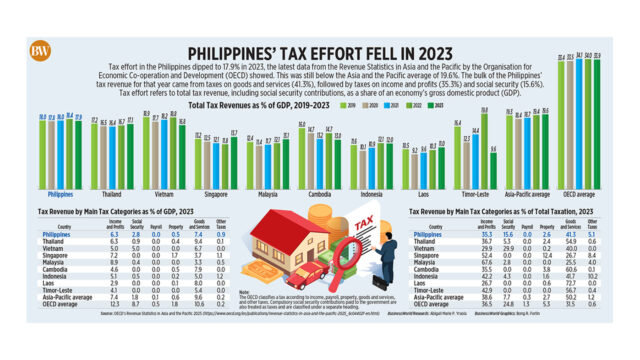
Philippines’ tax effort fell in 2023

Tax effort in the Philippines dipped to 17.9% in 2023, the latest data from the Revenue Statistics in Asia and the Pacific by the Organisation for Economic Co-operation and Development (OECD) showed. This was still below the Asia and the Pacific average of 19.6%. The bulk of the Philippines’ tax revenue for that year came from taxes on goods and services (41.3%), followed by taxes on income and profits (35.3%) and social security (15.6%). Tax effort refers to total tax revenue, including social security contributions, as a share of an economy’s gross domestic product (GDP).

Philippines’ tax effort fell in 2023