Home Blog Page 1077

ATI Q2 profit soars 48.5% to P1.5B on higher cargo volumes

ASIANTERMINALS.COM.PH

ASIAN TERMINALS, INC. (ATI) saw its second-quarter attributable net income climb 48.5% to P1.5 billion on higher revenues for the period, driven by a surge in cargo volumes.

For the April-to-June period, ATI logged gross revenues of P4.87 billion, 22.05% higher than the P3.99 billion in the same period a year ago.

Total expenses for the three months ending June rose 21.52% to P2.88 billion from P2.37 billion in the second quarter of 2024.

For the six-month period, the listed port operator’s attributable net income surged 65.34% to P2.96 billion from P1.76 billion previously, driven by higher revenues for the period.

ATI’s total revenue for the January-to-June period increased to P9.61 billion, up 28.82% from P7.46 billion in the same period last year.

Broken down, revenues from South Harbor (SH) international containerized cargo and Batangas Container Terminal (BCT) rose 31.8% and 19.2%, respectively, on higher container volumes.

ATI, the operator of the Batangas port, said its operations in Batangas saw higher topline during the first semester, mainly driven by increases in international roll-on/roll-off cargo and higher passenger traffic for the period.

On Wednesday, the Philippine Ports Authority (PPA) said that it had temporarily suspended its review of ATI’s petition for an adjusted terminal fee at the Batangas port while Oriental Mindoro remains under a state of calamity.

ATI had earlier proposed to collect a higher terminal fee of P100 from P30 at the Batangas port, citing that the increase in fees is a recovery measure after improvements at the port and will help the company maintain the terminal.

In 2024, ATI launched the opening of a new and modernized passenger terminal building at the Batangas Port — one of the country’s busiest terminals.

The government’s share in the company’s total revenue for the six months ending June also rose 17.4% to P3.91 billion from P3.33 billion last year.

Total expenses for the first semester expanded 23.5% to P5.73 billion from P4.64 billion last year, citing increases in depreciation and amortization, as well as higher labor and fuel costs, according to its financial statement.

In March, ATI expanded its capacity at Manila South Harbor with the commissioning of two additional ship-to-shore (STS) cranes, aimed at improving handling capacity and operational efficiency.

These complement the terminal’s existing fleet of 11 STS cranes, rubber-tired gantries, and other cargo-handling equipment, aligned with its ongoing modernization efforts.

For full-year 2024, ATI handled nearly 1.6 million twenty-foot equivalent units (TEUs), reflecting a 4% increase from the previous year.

With recent infrastructure upgrades and new equipment deployment, ATI said it is now capable of handling close to 2 million TEUs annually.

At the local bourse on Thursday, shares in ATI closed 30 centavos, or 1.11% higher, at P27.30 apiece. — Ashley Erika O. Jose


Elizabeth Banks: grit, pies, and safety nets

How time flies. It feels just like yesterday when Jaime, a curious toddler with bright eyes, was running around at family gatherings. He recently graduated from the Wharton School of the University of Pennsylvania with a double major in Finance and Management, along with a graduate certificate in Film and Media Studies. The only son of GMA7 director Joel Jimenez and award-winning children’s book author Gidget, Jaime’s journey from Manila to the Ivy League is not just a personal triumph — it is a powerful story of grit, faith, and family love.

Elizabeth Banks, a renowned Hollywood actress, director, producer, and UPenn alumna was the commencement speaker at Jaime’s graduation. Witty, candid, and down-to-earth — a good match for Jaime’s dual interests in business and the creative arts. Ms. Banks shared stories of growing up in a working-class family, navigating Ivy League life on scholarships, and never taking opportunities for granted. She spoke about three powerful ideas: grit, pies, and safety nets.

Her words on grit reminded me of the graduation of Jaime’s sister Bianca from UPenn years ago. The speaker then was psychologist Angela Duckworth, author of the book “Grit: The Power of Passion and Perseverance,” who said: “Grit is working on something you care about so much, you’re willing to stay loyal to it. Grit is not just doing what you love but actively staying in love.”

Ms. Banks echoed this spirit, sharing how rejection shaped her and how she kept going even when the doors didn’t open. “Failure is a great motivator,” she said — and how true that is. Jaime’s own journey reflects this kind of quiet perseverance. From helping build Uber in the Philippines — only for it to be shut down — to later being given the opportunity to lead a product team for Uber in the US, he showed resilience and patience. As leadership expert John Maxwell writes in “Failing Forward,” failure is not final — it’s a stepping stone to growth.

Then came Ms. Banks’ metaphor: the pie. Many people grow up thinking success is a limited pie — if someone else gets more, there’s less for you. But she challenged this mindset: “If there is no more pie, make your own.” What a powerful call to action! She urged the graduates, “Stop waiting for someone to give you your slice. Go and bake your own. And when you do, you make space for others too.”

That idea of expanding the pie struck a chord. I remember back in 2010 when my sister Ate Kay’s grandchildren asked me for gardening tips. I wanted to give them a children’s gardening book but couldn’t find one in local stores. So, Jaime’s mom Gidget and I created one: “The Secret is in the Soil,” which is for ages nine and up. We didn’t realize it then, but we were “baking our own pie,” too.

Ms. Banks also emphasized the importance of safety nets — the people who guide, encourage, pray for, and believe in you. Behind Jaime stands a strong, loving net: his parents Joel and Gidget, who raised their children with discipline, grace, and purpose; his grandparents Carolina “Kay” (known as the Bamboo Queen) and Menardo Jimenez, Sr., (former GMA7 President) firm in their Christian values and open-hearted generosity; and his sisters Bianca and Sofie, both Ivy League graduates themselves, each with accomplishments of their own. Actually, all their other granchildren from children Menard, Jr. ”Butch”, Laurie (Westfall) and Carmen (Ong) are all God-fearing and achievers.

This is no coincidence. The Jimenez children shine because of a foundation built on faith and love. Joel, beyond his professional work, serves as the pro-bono president of The Potter and Clay Christian School in Sanciangco, Malabon, Rizal — a reflection of his family’s heart for service. And in his quiet testimony, Joel always points to the source of it all: God.

As Jaime returns to the Philippines, he brings with him not just a world-class education, but the spirit of Ms. Banks’ challenge: be a builder — of careers, of opportunities, of more pies and better futures.

Jaime’s story is a reminder of what truly matters: grit despite difficulties, creativity that expands the pie, and the steady hands of faith and family holding the safety net below. Congratulations, Jaime. May you lead with courage, share your blessings generously, and continue to walk boldly under the grace of the God who has been faithful every step of the way.

The views expressed herein are the author’s own and do not necessarily reflect the opinion of her office as well as FINEX.


Flor G. Tarriela is a banker and an environmentalist/gardener. She founded Flor’s Garden in Antipolo, an accredited ATI National Extension Service Provider.

Auto Sales (July 2025)

NEW VEHICLE SALES declined in July, as bad weather disrupted retail operations, a joint report by the Chamber of Automotive Manufacturers of the Philippines, Inc. (CAMPI) and Truck Manufacturers Association (TMA) showed. Read the full story.

Auto Sales (July 2025)

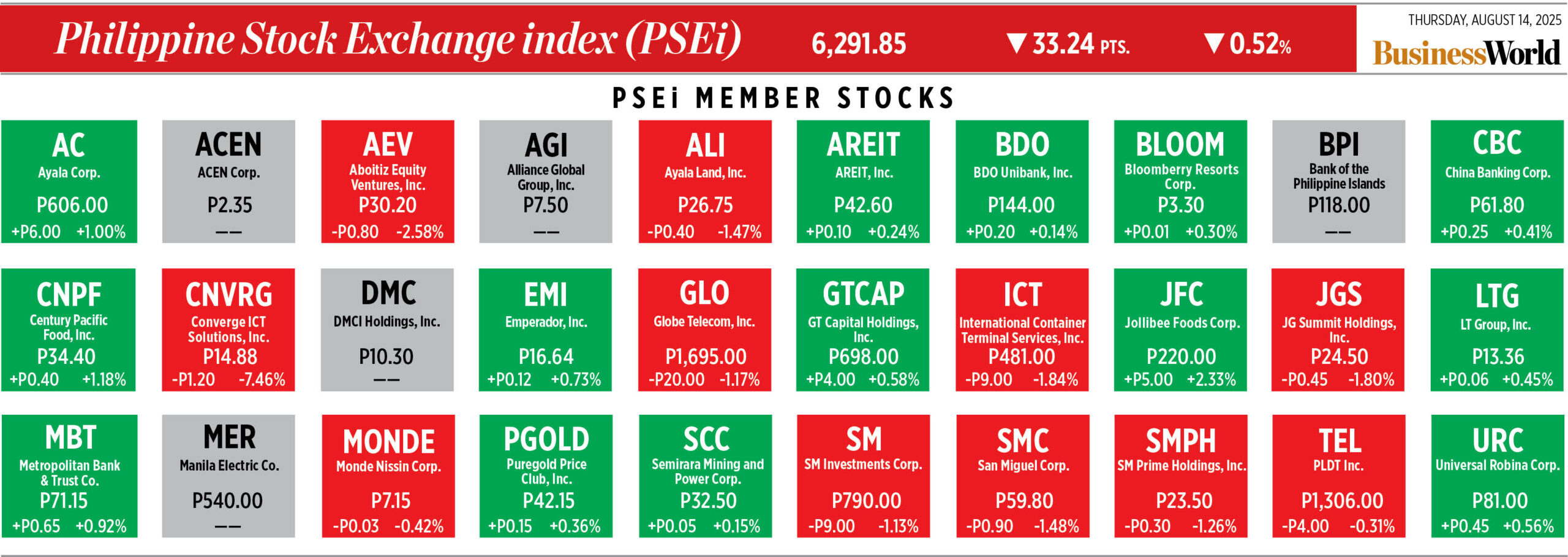
How PSEi member stocks performed — August 14, 2025

Here’s a quick glance at how PSEi stocks fared on Thursday, August 14, 2025.


Light, smart, and surprisingly capable — Two weeks with the Xiaomi Band 10

Photo by Jino Nicolas, BusinessWorld

by Jino Nicolas, BusinessWorld

Source: Xiaomi

Smart bands have come a long way from just counting a person’s steps. Today, they’re compact wellness companion that enable you to monitor sleep quality, workouts, and even stress levels, all while staying light and easy on the eyes.

I’ve worn quite a few over the years, from the earliest of smart bands, to the modern, feature-packed smart watches, but the Xiaomi Band 10 offered me a great balance between comfort, style, and functionality.


FIRST IMPRESSIONS

Photo by Jino Nicolas, BusinessWorld

The Xiaomi Band 10 makes a strong case for minimalism done right. Out of the box, it clearly is not just another fitness tracker. It’s small form factor and design lets it blend through whatever attire, and it’s so compact and lightweight that it doesn’t hinder or bother one’s actions.

In fact, I wore it while sleeping for several nights that it felt so seamless and unobtrusive that I forget I was still wearing it. That level of comfort really enhances its effectiveness as a health tracker.

The responsiveness of the user interface (UI) also stands out to me. Swipes and taps register instantly, and the animations are smooth thanks to the 60Hz refresh rate. It’s a subtle, but welcome upgrade that helps interactions with the device feel more refined.

Switching from one screen to another and checking notifications feel smooth and intuitive.


“Fit in Style”

The design philosophy of the Xiaomi Band 10 is certainly evident in its efficient, minimalistic form.

The 1.72″ AMOLED display is vibrant and crisp, making it easily readable in bright outdoor conditions. The thin bezels give it a sleek, modern look, and the moisture resistant touch control ensures usability during light to heavy workouts, or even under the rain.

I was provided with the black variant of the Band 10, and I have to say, its understated look blends effortlessly with any outfit. The minimalist design adds to its modern look without drawing too much attention, which I believe is something those who prefer subtle tech would appreciate.

Source: Xiaomi Store on Shopee

Accessorizing or personalizing the Band 10 is also simple as there are an abundance of choices. From quick-release straps in silicone, leather, and metal finishes, to pendant-style straps that provides an elegant, tech-savvy alternative to this wearable health tracker.

Metal frames and protective cases are also available not just for style but also for durability, shielding the device from scratches and bumps.

Of course, clock faces are also easily accessible through the Mi Fitness app.


WELLNESS TRACKING

The Xiaomi Band 10 honestly punches above its weight. The device supports tracking of 150+ workout modes, and automatically detects common, popular activities such as walking, running, and cycling.

Admittedly, I am not an overly active person, but the heart rate broadcast feature I found particularly useful. It syncs seamlessly with my phone and allows real-time heart rate readings while I’m on my treadmill.

Photo by Jino Nicolas, BusinessWorld

Given the traffic experienced in Metro Manila, it’s difficult not to notice the increased heart rate — whether it’s from the stress of gridlock or the adrenaline of dodging motorcycles. The Band 10’s real-time heart rate monitoring doesn’t just track workouts; it captures the daily cardio of surviving EDSA.

Sleep tracking has also become more advanced as it goes beyond basic duration and stages. The Band 10 now measures sleep efficiency and distribution, offering a more holistic view of the quality of rest.

Also, the 21-day sleep improvement program that is backed by global sleep authorities like the World Sleep Society, adds a lot of credibility and depth to the device’s function.

Other wellness features include:

  • Swim mode
  • 24/7 heart rate, SpO₂, stress, and menstrual cycle tracking
  • VO₂ max, training load, and recovery time for performance insights
  • Relax reminders and stress monitoring for mental wellness


Source: Xiaomi

ECOSYSTEM INTEGRATION

Admittedly, I was not able to test the Band 10 while paired with a smartphone running HpyerOS 2, but it is said to integrate into the Xiaomi Smart Hub, allowing control over smart home devices directly from the band. This kind of synergy with other smart devices is quite rare at this price point.

Notifications are timely and customizable. Sync calendars, respond to calls, send quick replies, and even mute a paired smartphone discreetly. The Band 10 provides feedback that feels premium, and vibration patterns can be tweaked for different alerts.

Battery life is also another win:

  • Up to 21 days in typical use
  • 9 days with Always-on Display
  • Fast charging in about an hour

For the past two weeks of testing, the Band 10 only required charging twice. That’s quite a difference to some wearables in the market that need charging every other day.


Photo by Jino Nicolas, BusinessWorld

WELL-ROUNDED, STYLISH, ACCESSIBLE

The Xiaomi Band 10 strikes an impressive balance between comfort, aesthetics, and functionality. Thoughtfully designed for both active and casual users, it offers a robust suite of health and wellness features without compromising on style or ease of use.

Its minimalist form blends effortlessly into daily life, while the vibrant display, responsive interface, and long battery life make it a reliable companion for wellness tracking and smart notifications. Despite its accessible price point, the Band 10 delivers a premium experience that rivals more expensive alternatives — making it a standout choice for anyone seeking a fashionable, feature-rich wearable.

Stocks go down on profit taking, fiscal concerns

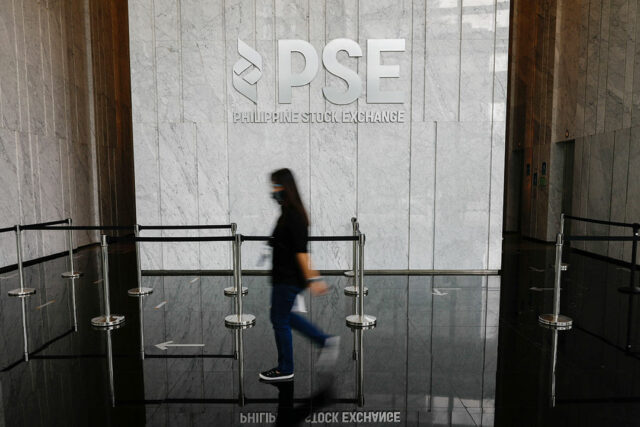
The lobby of the Philippine Stock Exchange in Taguig City, Sept. 30, 2020. — REUTERS

PHILIPPINE STOCKS dropped on Thursday on profit taking after the market’s two-day climb and concerns over the country’s fiscal health.

The Philippine Stock Exchange index (PSEi) fell by 0.52% or 33.24 points to close at 6,291.85, while the broader all shares index sank by 0.57% or 21.61 points to 3,743.03.

“The local market declined as investors took profits following two days of rallying,” Philstocks Financial Inc. Research Manager Japhet Louis O. Tantiangco said in a Viber message.

“Concerns over the outlook of the Philippines’ fiscal position also dampened sentiment as the government’s outstanding debt is projected to hit P19.06 trillion by end-2026,” he added.

The 2026 Budget of Expenditures and Sources of Financing showed that the National Government’s (NG) outstanding debt is expected to increase by 9.78% to a record P19.06 trillion by end-2026 from the revised P17.36-trillion estimate for end-2025.

Finance Secretary Ralph G. Recto said NG debt is still manageable, noting the economy will be worth roughly P31.8 trillion by 2026.

As of June, the Philippines’ outstanding debt hit a fresh high of P17.27 trillion, up 11.5% from P15.48 trillion in the same month in 2024.

This brought the debt-to-gross domestic product (GDP) ratio to 63.1% at the end of June, the highest ratio since 2005. This is above the 60% debt-to-GDP threshold considered by multilateral lenders to be manageable for developing economies.

“The market slipped today as some investors may have already taken profits following the index’s series of uptrends this week,” Regina Capital Development Corp. Head of Sales Luis A. Limlingan said in a Viber message.

“Furthermore, investors are likely still waiting for developments in stock market news that could influence the overall market, along with the upcoming implementation of the PSEi rebalancing,” he added. The rebalancing will take effect on Aug. 18.

Sectoral indices ended mixed on Thursday. Services dropped by 2.42% or 56.03 points to 2,259.55; property retreated by 1.02% or 24.97 points to 2,413.58; and holding firms declined by 0.64% or 34.63 points to 5,302.24.

Meanwhile, industrials climbed by 0.38% or 34.23 points to 8,961.63; financials rose by 0.09% or 1.97 points to 2,152.02; and mining and oil edged up by 0.09 point to 9,330.87.

“Jollibee Foods Corp. was the top index gainer, climbing 2.33% to P220. Converge ICT Solutions, Inc. was the main index laggard, plunging 7.46% to P14.88,” Mr. Tantiangco said.

Value turnover went down to P8.41 billion on Thursday with 2.09 billion shares exchanged from the P10.61 billion with 893.55 million shares traded on Wednesday.

Market breadth was negative as decliners outnumbered advancers, 106 to 84, while 46 names were unchanged.

Net foreign buying went down to P100.92 million on Thursday from P973.04 million on Wednesday. — Revin Mikhael D. Ochave

Indian group to invest P4B in New Clark WTE project

THE Bases Conversion and Development Authority (BCDA) said on Thursday that an Indian company will lead a consortium that will invest P4 billion in a waste-to-energy (WTE) facility in New Clark City.

The investment was among the deals secured by President Ferdinand R. Marcos, Jr. in his five-day state visit to India last week.

It will be developed by Indian engineering firm Uttamenergy Ltd. and its local partners Global Heavy Equipment and Construction Corp. and ATD Waste-to-Energy Corp.

“The deal will pave the way for the Philippines’ most advanced waste-to-energy facility in New Clark City, Capas, Tarlac,” the BCDA said in a statement. 

“The facility will process 600 metric tons of municipal solid waste daily and generate 12 megawatts (MW) of electricity, enough to power over 10,000 homes,” it added.

The group hopes to begin construction within two years and start commercial operations within three years of contract signing.

The project will be built initially on a four-hectare site, later expanding to six hectares.

“The expansion could bring in several billion pesos more in follow-on investment and significantly increase processing capacity and energy output,” BCDA said.

Around 300 jobs are expected to be generated from the project’s construction, and over 100 jobs are expected to be created during its operations.

“Projects like this are not just about infrastructure. They create ecosystems of opportunity, like jobs for skilled workers, contracts for small businesses, and long-term value for local governments managing waste sustainably,” BCDA President and Chief Executive Officer Joshua M. Bingcang said.

According to the BCDA, the project is eligible for incentives under the Corporate Recovery and Tax Incentives for Enterprises to Maximize Opportunities for Reinvigorating the Economy (CREATE MORE) Act.

The site lease is 25 years, renewable for a maximum of 25 more years. — Justine Irish D. Tabile

Regional remittances expected to drop next year, Visa survey finds

US dollar bills are seen at a money exchange office. — REUTERS

OVERSEAS WORKERS sending funds back to home countries in the Asia Pacific expect to cut down on their remittance over the next 12 months, with remittance recipients in the region also expecting a drop-off, according to Visa, Inc., citing the results of a survey.

Visa noted all countries surveyed in the Asia-Pacific showed a decline in expectations to send/receive remittances over the next 12 months.

Visa surveyed 44,000 remittance senders and receivers from 20 countries, including the Philippines.

Only 7% of Filipino respondents said they expect to send remittances over the next 12 months, while 44% expect to receive remittances.

In May, cash remittances coursed through Philippine banks rose 2.9% year on year to $2.658 billion.

This was the lowest level of monthly remittances since May 2024.

Within the Asia-Pacific, China posted the steepest expected remittance decline, with those expecting to remit funds at 26%, down 25 percentage points, and those expecting to receive at 21%, down 15 percentage points.

The corresponding figures for Japan were send 3%, receive 4%; India send 18%, receive 28%; and Australia send 25%, receive 22%.

In the Philippines, 41% of respondents said they sent or received remittances due to unexpected needs, while 39% reported receiving regular remittances.

Digital apps remained the most popular method to send or receive remittances in the Asia-Pacific. In the Philippines, 74% of senders and 66% of receivers cited a preference for digital apps.

“In all markets surveyed, second to digital apps (were) digital remittances from a physical location,” Visa said. — Aaron Michael C. Sy

Sept. LEDAC to determine priority status of military pension reform

PHILIPPINE STAR/EDD GUMBAN

THE Legislative-Executive Development Advisory Council (LEDAC) meeting next month will determine whether military and uniformed personnel (MUP) pension reform remains on the priority legislation list, Budget Secretary Amenah F. Pangandaman said.

“We’ll find out during our LEDAC meeting. It’s scheduled for September. There, we will check if it’s still included among the priority legislation,” Ms. Pangandaman said during the Kapihan sa Manila Bay briefing on Thursday.

Asked if the government is still pushing for pension reform, she said, “Yes, I think,” adding that “the Department of Finance (DoF) is the one in charge.”

“There really is no fiscal space. It is still the same allotment. We don’t know what will happen with the bill. The bill is still pending,” she said.

According to the 2026 National Expenditure Program (NEP), the government allocated P197.99 billion for the pension and gratuity fund, up 36.80%.

Finance Secretary Ralph G. Recto has said the government is unlikely to revive the MUP reform bill due to cost constraints.

Last year, Mr. Recto sought changes in the MUP pension scheme applicable only to new personnel.

In 2023, the House of Representative approved House Bill No. 8969, which sets a member contribution rate of 9% of monthly salary for new entrants and a 12% top-up from the government.

The Senate version of the MUP reform bill has been awaiting second reading approval since November 2023.

Senate Bill No. 2501 seeks to set monthly retirement pay at 50% of the base pay for the last position held by retired MUPs. It also requires new MUPs to contribute to their pension. — Aubrey Rose A. Inosante

Chamber backs Ang proposal for private sector-led flood control

RAMON ANG — SANMIGUEL.COM.PH

THE Federation of Filipino Chinese Chambers of Commerce and Industry, Inc. (FFCCCII) said it supported a proposal by San Miguel Corp. (SMC) Chairman Ramon S. Ang to lead a private-sector initiative to build flood-control projects in Metro Manila.

“We fundamentally endorse such visionary private sector initiatives that directly address critical national challenges,” FFCCCII President Victor Lim said.

“This proposal arrives at a pivotal moment, promising not merely infrastructure intervention but a transformative commitment to safeguarding our capital’s communities, securing livelihoods, and fortifying the region’s economic vitality,” he added.

Earlier this month, Mr. Ang volunteered to help solve the flooding problem in Metro Manila at no cost to the government.

“Mr. Ang’s vision — centered on the pragmatic, scientifically grounded approach of removing critical obstructions from vital river systems — resonates deeply with the urgent need for sustainable solutions,” Mr. Lim said. 

“His emphasis on holistic remediation, including the conscientious relocation of affected communities and institutions, demonstrates leadership that harmonizes ambitious engineering with profound social responsibility,” he added.

He said the chamber is confident of Mr. Ang’s ability to deliver on this project, noting the success of SMC’s Skyway project and the privatization of the Ninoy Aquino International Airport.

“The FFCCCII views Mr. Ang’s offer not merely as commendable philanthropy but as a potent catalyst for resilience. His proven track record in delivering massive infrastructure projects provides a compelling foundation for trust,” Mr. Lim said.

“We recognize in this initiative the potential to unlock significant economic benefits by mitigating the devastating, recurring costs of flooding,” he added. — Justine Irish D. Tabile

Entire sugar harvest to be classified for domestic use

PHILSTAR FILE PHOTO

THE Sugar Regulatory Administration (SRA) on Thursday said all sugar that will be produced in the coming crop year will be classified in the “B” category (for domestic use) to stabilize prices.

The classification will cover the entire milling season that starts on Oct. 1 or the nearest Monday, SRA Administrator Pablo Luis S. Azcona said in a statement.

Since Oct. 1 falls on a Wednesday, milling will open on Sept. 29, the SRA noted.

It added via Viber that it has classified sugar as B since 2022 “because  despite growth, we are still below demand.”

In his report to the industry, Mr. Azcona said as of July 27, raw sugar production amounted to 2.084 million metric tons (MMT) on input of nearly 26 MMT of cane harvested over 405,000 hectares.

Mr. Azcona said Mindanao farmers were this year’s “heroes of the sugar industry,” after they posted the strongest production growth.

“Mindanao will likely be our last frontier in our road towards sustainability,” he said, without providing details.

The SRA is seeking an P8-billion budget for soil rejuvenation and small-scale irrigation covering about 160,000 hectares over three years.

It is also seeking P1.2 billion for a 20,000-hectare site to propagate plantlets of a high-yielding variety.

“Our productivity in the past three years was largely due to the distribution of high-yielding cane and the SRA intends to focus on this along with other scientific approaches to farming that we have been learning from our foreign partners towards our self-sustainability,” Mr. Azcona said.

Mr. Azcona said the sugar industry could receive P1 billion in the next year from funding authorized by the Sugar Industry Development Act (SIDA).

He noted the industry’s efforts to seek the amendment of SIDA to raise from P2 billion a year to P5 billion “considering the substantial contribution of the sugar industry to the national coffers.” — Kyle Aristophere T. Atienza

MSRP will remain during freeze on rice imports

PHILSTAR FILE PHOTO

THE maximum suggested retail price (MSRP) for imported rice will remain in place during the two-month suspension of rice imports ordered by President Ferdinand R. Marcos, Jr., the Department of Agriculture (DA) said on Thursday.

“We will maintain the MSRP even during the two-month rice import ban,” Agriculture Secretary Francisco P. Tiu Laurel, Jr. said.

The MSRP for 5% broken-grain imported rice was reduced to P43 per kilo from P45 on July 16.

Mr. Marcos suspended rice imports between September and October to stabilize palay (unmilled rice) prices, which have reportedly fallen to as low as P8 per kilo in parts of the country. The DA said farmers cannot recover their production costs at this level.

The DA said the duration of the import freeze may be adjusted depending on price movements and the outcome of the main harvest in the coming months.

Specialty rice varieties, such as Japanese, black, and basmati rice are exempt from the ban.

The Bureau of Plant Industry reported that imported rice landed between January and July amounted to 2,443, 337.556 metric tons, with pending Sanitary and Phytosanitary Import Clearances covering an estimated 300,000 metric tons.

Philippine consumption is roughly 9.8 kgs of rice per person per month (325.5 grams/day), according to the Philippine Statistics Authority.

Under the Rice Tariffication Law, Mr. Marcos has the authority to halt rice imports to provide relief to farmers and stabilize market prices.

The DA said it “remains prepared to adjust policies if supply tightens.” — Kyle Aristophere T. Atienza