
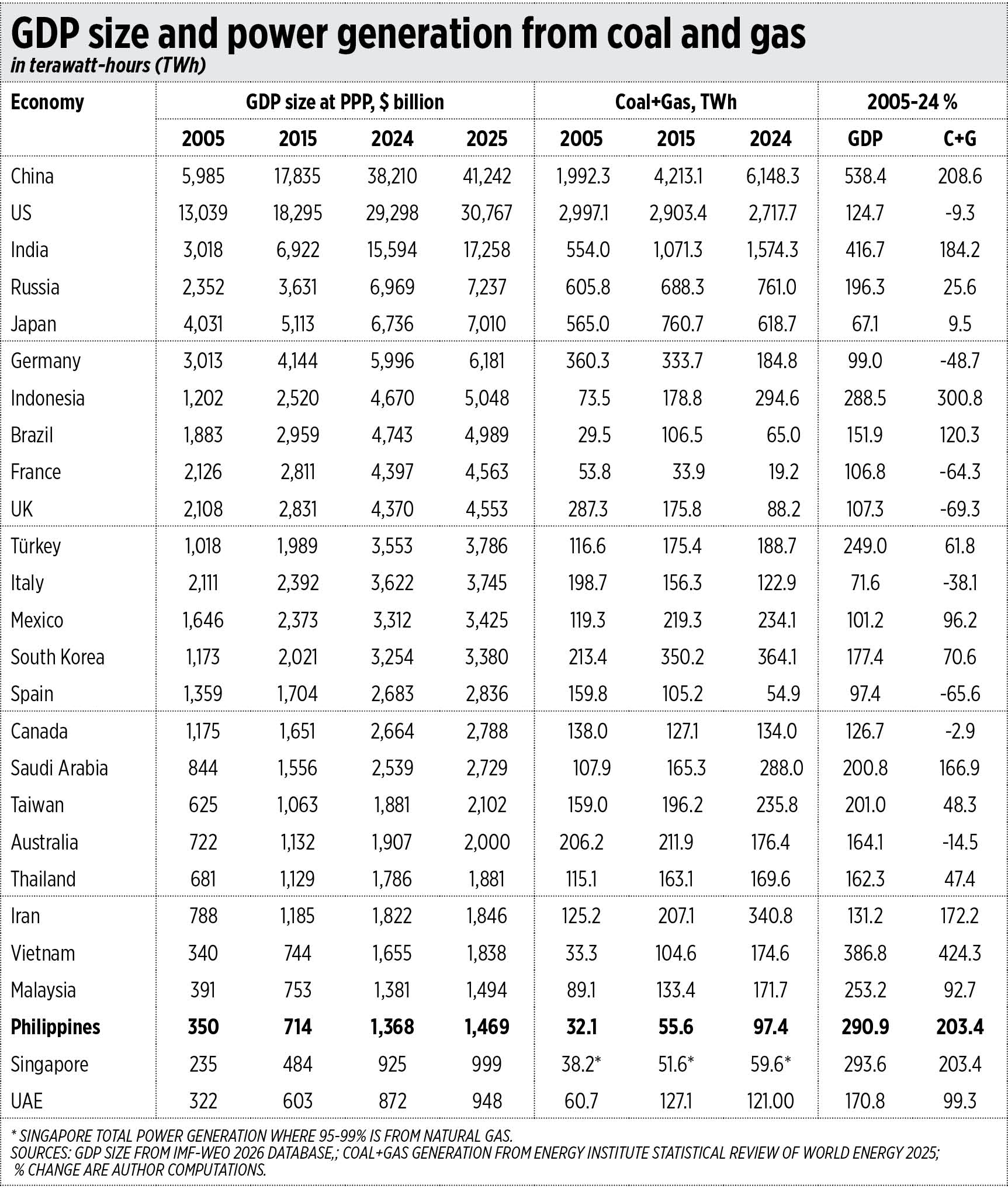
Last week the International Monetary Fund (IMF) released the World Economic Outlook (WEO) 2026, so I downloaded the database Excel files. For this column, I will focus on the GDP size of countries at purchasing power parity (PPP) values. And since there is plenty of noise and lobbying now that we should hasten the transition from fossil fuels (oil, gas, and coal) to renewables (mainly solar and wind power), I compared the power generation from coal and gas of major economies.
Among the notable numbers I saw below are the following.
1. China’s GDP size in 2025 was $10.5 trillion larger than that of the US, 6.7 times larger than Germany’s, 5.9 times larger than Japan’s, and 5.7 times larger than Russia’s. India had the second largest expansion in GDP size from 2005 to 2024 next to China.
2. Countries which expanded their use of coal by at least 48% in their coal and gas power generation from 2005 to 2024 also saw the expansion in GDP size by at least 100% over the same period. More specifically China, India, Indonesia, South Korea, Malaysia, Vietnam, the Philippines, Thailand, Taiwan, Iran, Turkey, Brazil, and Mexico.
3. Countries that saw a contraction in their coal and gas generation, or saw growth in these of a low 10%, also saw low expansion in their GDP size. More specifically the US, Japan, France, Germany, the UK, Italy, Spain, and Canada (see the table).
The main lesson from the ongoing Middle East conflict is that humanity will keep using oil, gas, and coal. Oil and gas do not only mean gasoline, diesel, kerosene, LPG, and LNG. It also means paint, varnish, plastic, synthetic rubber, asphalt, fertilizers, pharmaceuticals, petrochemicals, and thousands of industrial manufacturing products. Solar and wind cannot produce these commodities, only oil and gas can.
Coal not only generates cheap and stable electricity; the coal ash is also used for cement production, resulting in zero waste.
The Department of Energy should stop the endless expansion of solar and wind beyond the committed projects. It should stop particularly the irrational and expensive development of offshore wind and instead expand our baseload and mid-merit power requirement from coal and gas plus nuclear.
We should target to expand our GDP size to at least $2.2 trillion by 2030, expand our overall power generation from 130 terawatt-hours (TWh) in 2024 to at least 200 TWh by 2030. This instead of targeting 35% renewable energy by 2030 and 50% by 2050.
Three energy conglomerates which have both big coal plants and LNG plants are on the side of useful economic expansion — Aboitiz Power, Meralco PowerGen (MGEN), and SMC. MGEN in particular is very explicit in targeting running nuclear power plants soon.
Planet Earth has experienced a natural climate cycle of warming and cooling for the past 4.6 billion years. Nothing catastrophic occurred as humanity has modernized and adapted to such a multi-decadal climate cycle.
Renewable energy targeting is based on catastrophe fiction and climate alarmism. GDP size targeting is based on economic needs and energy realism.
Bienvenido S. Oplas, Jr. is the president of Bienvenido S. Oplas, Jr. Research Consultancy Services, and Minimal Government Thinkers. He is an internationa fellow of the Tholos Foundation.