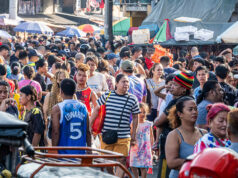

The collective conscience is formed by “conscious agreements in society that make societal cohesion possible — the realm of shared traditions, laws, and cultural norms,” according to social scientists. True, the collective conscience sometimes “nods” in sleepy disinterestedness, and it might take a while for current events and thought processes to gel into “shared traditions, laws and cultural norms” before society “nods” its approval and agreement to the “new normal” that is constantly in flux.
The term “collective conscience” was introduced by the French sociologist Émile Durkheim in 1893. His idea of collective consciousness refers to beliefs and sentiments common to average members of society, forming a determinate system that has its own life. There is a collective conscience that would drive society’s future directions.
What does the collective conscience think and feel, in the mad whirl of changing “shared traditions, laws, cultural norms” and even principles and values, in the world and in our country today?
Some political leaders with questionable integrity and inelegant character have been elected into public office by an unexpected majority. And when public trust is betrayed by corrupt public officials, why does the collective conscience allow and abet the scandalous anomalies that steal the wealth of the country and deny the poor their very sustenance and survival?
The US-based Journal of Public Economics (March 2004) posits a theory of the quality (competence and honesty) of elected officials: “Our theory offers three main insights. Low-quality citizens have a ‘comparative advantage’ in pursuing elective office, because their market wages are lower than those of high-quality citizens (competence), and/or because they reap higher returns from holding office (honesty). Hence, voters may find themselves supply constrained of high-quality candidates. Second, bad politicians generate negative externalities for good ones, making their rewards from office increasing in the average quality of office holders. This leads to multiple equilibria in quality. Third, incumbent policymakers can influence the rewards of future policymakers, leading to path dependence in quality: bad governments sow the seeds for more bad governments.”
The Guardian article by Dean Burnett (“Democracy vs Psychology: why people keep electing idiots,” April 2015) offers a mercilessly frank analysis. “Unfortunately, there are several psychological mechanisms that lead to apparent idiots being elected into powerful positions,” Burnett says, with a disclaimer that not all elected officials are bad or are idiots. “But plenty are,” he says with acerbic humor: “The US seems particularly afflicted with them.”
“Logically, you’d want an intelligent person who understands the best approach and methods for running a country in the best possible way. But no, people seem drawn to demonstrations of questionable intellectual abilities. There are a wide variety of ideological, cultural, social, historical, financial and other factors involved, because politics incorporates all of these things, but there are also some known psychological processes that may contribute to this phenomenon.
“The Dunning-Kruger effect reveals that less-intelligent people are usually incredibly confident. More intelligent people, by contrast, aren’t at all. Self-appraisal is a useful metacognitive skill, but one that requires intelligence; if you don’t have much of it, you don’t consider yourself flawed or ignorant, because technically you don’t have the ability to do so. This may explain the negative image of politics, which is mostly a series of confident individuals making big promises and failing miserably to keep them.
“People are often put off by intellectual and complex subjects and discussions in any case. They may have no experience with the issue, or may find it too daunting to want to engage with, because doing so successfully would require a lot of time and effort. Parkinson’s law of triviality, says that people will spend far more time and effort focusing on something trivial that they do understand than something complicated that they don’t. (Thus, many winning politicians are those with high exposure in popular media — film stars, sports heroes, celebrities in otherwise non-political scenes.)
“The majority of people are prone to numerous subconscious biases, prejudices, stereotyping and prefer their own ‘groups.’ None of these things are particularly logical and invariably are not supported by actual evidence and reality, and people really don’t like being told things they don’t want to hear. People are also keenly aware of social status; we need to feel we are superior to others in some way to maintain our sense of self-worth. As a result, someone more intelligent saying complicated things that contain uncomfortable (but accurate) facts isn’t going to appeal to anyone, but someone demonstrably less-intelligent is not challenging to someone’s perceived social status, and if they’re going to say simple things that support inherent prejudices and deny uncomfortable facts, then so much the better.”
Socio-political analyst-writer Randy David taunts the Filipino collective conscience: “Why do we keep electing bad leaders?” (randydavid.com/2000/02). “We do so because our attention is focused on changing persons rather than institutions. The system by which we recruit the leaders of our nation is deeply flawed. This is immediately evident in the premium we place on the personal popularity of candidates rather than on their capacity to articulate and defend a national plan. We place little value on debate and on educational campaigns to create intelligent voters. By our failure to stop vote-buying and electoral fraud, we allow politicians to prey upon the hunger of impoverished voters and the vulnerability of election workers. We permit candidates to raise unlimited amounts of campaign contributions from undisclosed sources, unmindful of the graft and corruption that follows when politicians start paying back every peso they received from expectant financiers.”
Corruption watcher Transparency International (TI) in its 2025 report gives the Philippines a score of 32 out of the perfect 100 zero-corruption; the Philippines is a dismal No. 120 out of 180 countries ranked (with No. 1, Denmark, as least corrupt country of all), meaning we are in the last group, the 1/3 most corrupt countries in the survey.
TI identifies two recent major corruption cases that have cast the Philippines into the shameful lot of the most corrupt countries:
1. Fraud in the flood control projects that have drained over P1 trillion from government funds (February 2026)
2. Bribery in the failed Climate Change projects (September 2021).
The collective consciousness must awaken, and not relent on the punishment of those found guilty of corruption in government, and must insist on the restitution of stolen wealth.
The flood control investigations have been in the news since anomalies in the Department of Public Works and Highways (DPWH) were exposed by no less than President Ferdinand Marcos, Jr. in his State of the Nation (SONA) in July 2025. The finger-pointing and the denials by “suspects” in the massive systemic fraud have been “dribbled” between evidently politically opposed sectors, confusing and tiring the collective conscience.
So also, is the collective consciousness sated to stupor on three other major issues of conscience constantly discussed in media:
1. The ICC case on Rodrigo Duterte. On March 11, 2025, former Philippine president Rodrigo Duterte was arrested by the Philippine National Police and Interpol in Operation Pursuit under an International Criminal Court (ICC) warrant charging him with crimes against humanity related to the Philippine drug war: the murders of 76 people between 2013 and 2018. Fifty-seven of the killings took place during his presidency, and the other 19 occurred during his term as mayor of Davao City. The hearing for confirmation of charges is scheduled for Feb. 23, 24, 26 and 27 at the ICC in The Hague, Netherlands. Supporters of Rodrigo Duterte continue to actively protest against the ICC arrest and trial.
2. The impeachment of Vice-President Sara Duterte. On Feb. 5, 2025, 215 members of the House of Representatives signed an impeachment complaint against Sara Duterte on charges that include corruption, plotting to assassinate President Marcos Jr., involvement in extrajudicial killings and incitement to insurrection and public disorder. The Senate failed to act on the impeachment complaint in time, and remanded the case back to the House, whereupon the Supreme Court (SC) declared the complaint unconstitutional because of the one-year filing technicality. The impeachment complaint was re-filed by the House on Feb. 6, this year, as the SC wanted. Sara Duterte announced on Feb. 18 that she will be running for president in the 2028 elections.
3. The intrusion and territorial claims of China in the West Philippine Sea. Chinese foreign information manipulation and interference (FIMI) operations linked to the West Philippine Sea are expected to persist through the 2028 national elections, Philippine security officials said (inquirer.net, Feb. 20). The South China Sea dispute is a complex, long-standing territorial conflict involving overlapping claims by China, Taiwan, Vietnam, Malaysia, Brunei, and the Philippines over islands (mainly the Spratly and Paracel groups), reefs, and surrounding waters. China claims roughly 90% of the area via its “nine-dash line,” which was rejected by a 2016 international tribunal ruling. Key issues involve control of strategic shipping lanes, oil/gas reserves, and fisheries, with escalating tensions driven by China’s artificial island construction and military buildup (BBC, July 7, 2023).
So many issues now trouble the mind and heart of this small, struggling country. Why is the collective conscience seeming to drift towards indifference to the moral and social-economic costs of corruption and injustice in society? Why have the principles and values fought for during the 1986 EDSA People Power Revolution faded in the compromises and accommodations for survival and individualistic objectives in a fast-changing world?
“EDSA at 40: Moral fatigue threatens Philippines,” The Philippine Star headlined, ahead of the 40th anniversary of the EDSA People Power revolt on Feb. 25. Catholic Bishops’ Conference (CBCP) president and Lipa Archbishop Gilbert Garcera said during his Thursday Mass at the National Shrine of Mary, Queen of Peace in Quezon City: “The greatest danger today is not only historical distortion, but moral fatigue. When freedom is treated merely as a memory and not a duty, the spirit of EDSA slowly dies.” Bishop Garcera said: “moral fatigue arises when freedom is remembered only as a memory, faith becomes devotion without courage, and peace is sought without justice.”
The collective conscience nods, in recognition and acceptance of its sacred duty to uphold and defend peace and justice among fellowmen.
Amelia H. C. Ylagan is a doctor of Business Administration from the University of the Philippines.