MANUFACTURING output growth accelerated to a more than two-year high in March, as manufacturers began bracing for the economic fallout of the Middle East crisis, the Philippine Statistics Authority (PSA) said.
Citing preliminary results from the Monthly Integrated Survey of Selected Industries, the PSA said factory output, as measured by the volume of production index (VoPI) grew 7.8% year-on-year in March.
This reversed the downwardly revised 0.6% decline in March 2025 and exceeded the upwardly revised 3.1% expansion in February.
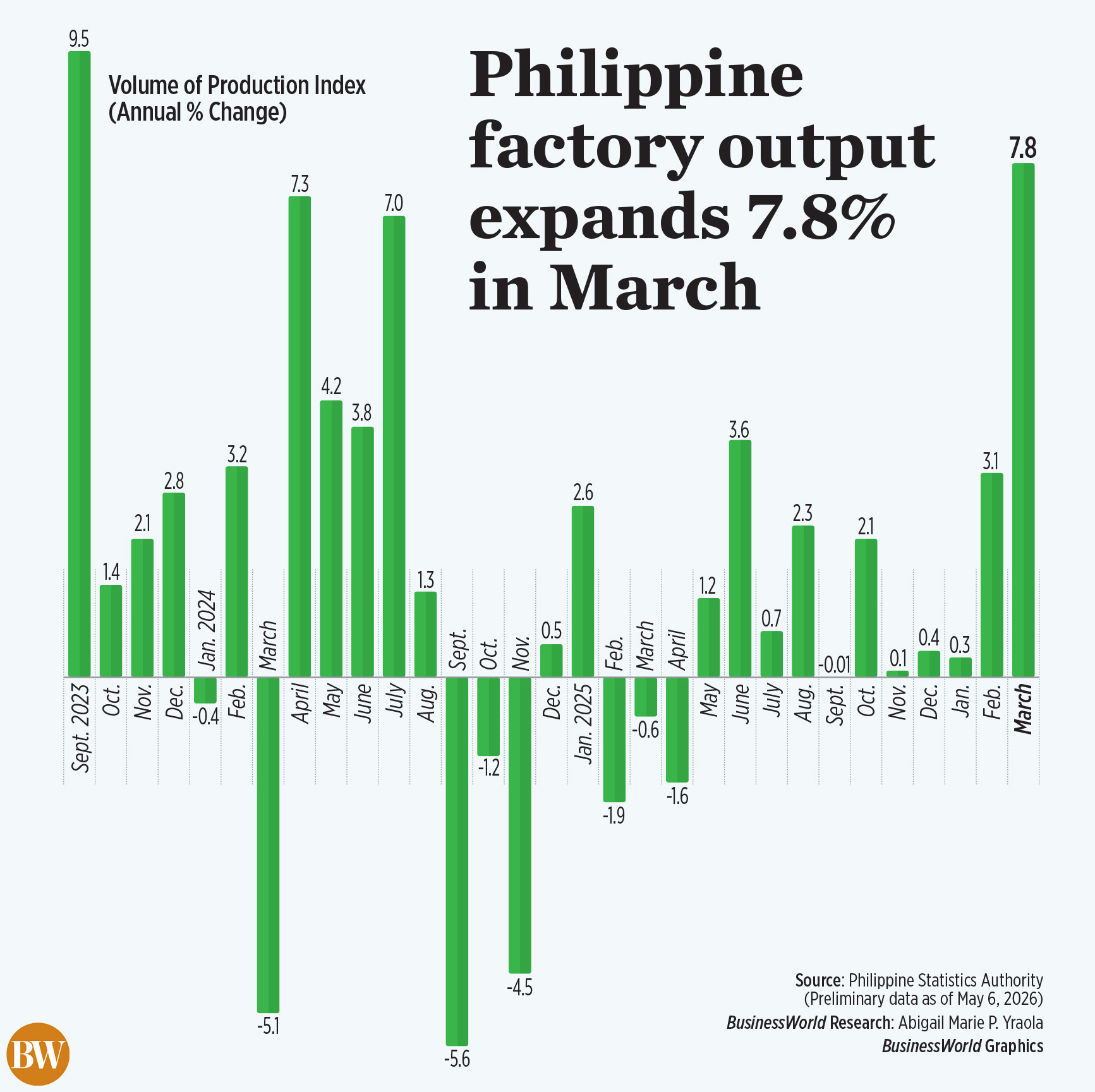
The March reading was the strongest since the 9.5% logged in September 2023. It also marked the 11th straight month the VoPI was in positive territory.
First-quarter factory output growth averaged 3.7%.
Month-on-month, factory output in March grew 6.9%, a turnaround from the 1.6% drop in February.
Stripping out seasonal factors, it rose 1.4%.
In contrast, the Philippine performance on the S&P Global Manufacturing Purchasing Managers’ Index weakened to a three-month low of 51.3 in March from 54.6 in February.
A reading above 50 separates expansion from contraction in purchasing activity, which is deemed a leading indicator for the volume of manufacturing weeks or months down the line when the ordered raw materials for processing arrive.
Meanwhile, average capacity utilization, or the extent to which industry resources are used in producing goods, rose to 78.5% in March, higher than the revised 76.4% posted a year earlier, and the revised 77.6% logged in February.
“All industry divisions reported capacity utilization rates of more than 65% during the month,” the PSA said.
The PSA attributed the VoPI reading that month to upticks in subindices for basic metals (36.2% in March from 28.2% in February), transport equipment (6.3% from 1.2%), and a moderated decline in coke and refined petroleum products (-4.4% from -19.5%).
Six other divisions logged declines while the remaining 13 posted expansions.
The PSA added that the top three industry divisions that contributed to the overall year-on-year growth in the VoPI were basic metals, transport equipment and computer, electronic and optical products (14.7% in March from 11.4% in February).
Cid L. Terosa, an associate professor at the University of Asia and the Pacific’s School of Economics, attributed the increase in VoPI to base effects after last year’s decline, alongside steady interest rates and mild inflation.
“The month was marked by unchanged interest rates and by moderate inflationary pressure, both of which stimulated manufacturing industries to front-load important production inputs and produce goods while the Iran war escalated,” Mr. Terosa said in an e-mail.
He added that businesses were encouraged to stockpile and accelerate production to prepare for a potential worsening of the Middle East crisis.
Sergio R. Ortiz-Luis, Jr., honorary chairman and treasurer of the Philippine Chamber of Commerce and Industry, said by telephone that despite global disruptions, some sectors remained resilient.
On March 26, the Bangko Sentral ng Pilipinas (BSP) kept its policy rate unchanged at 4.25% during an off-cycle meeting.
BSP Governor Eli M. Remolona, Jr. noted that the off-cycle policy action was meant to be assuring for the market, which has grappled with uncertainty arising from the fighting in the Middle East.
The outlook for the coming months remains cautious as the Middle East conflict begins to weigh on investment and costs.
Mr. Ortiz-Luis said companies and investors are waiting to see how the conflict in the Middle East unfolds.
Mr. Terosa, meanwhile, said he expects VoPI in the coming months to “show more production declines across industries as inflation surges, exerting upward pressure on interest rates.”
He added that heavy import dependency increases the vulnerability to crises in the Middle East, with their potential to roil exchange rates. — Heather Caitlin P. Mañago