Digital economy share of GDP steady at 9.8%

THE digital economy accounted for 9.8% of gross domestic product (GDP) in 2025, unchanged from a year earlier, the Philippine Statistics Authority (PSA) said, citing preliminary data.
The 9.8% reading remains the lowest share of GDP since the PSA started compiling the indicator in 2018.
In terms of gross value added (GVA), the digital economy grew 5.4% to P2.74 trillion last year.
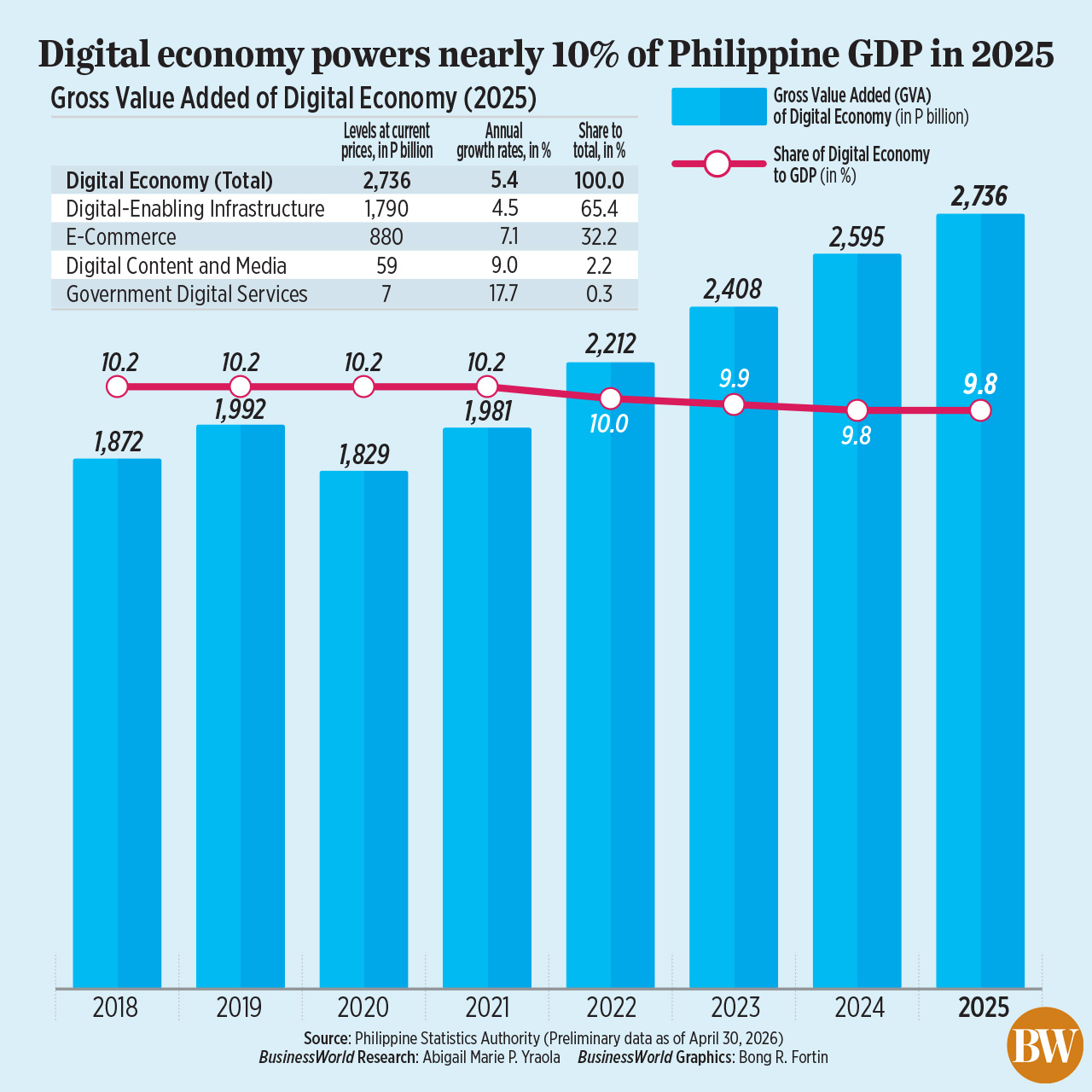
This represented a slowdown from the 7.7% rate posted in 2024, making it the weakest expansion in five years, or since the 8.2% contraction in 2020 at the height of the pandemic.
“The moderation in the digital economy may be in line with the general moderation of Philippine GDP for the year. Other factors that may have contributed to the slower pace of expansion could be base effects after expanding strongly in the previous year,” Metropolitan Bank & Trust Co. Chief Economist Nicholas Antonio T. Mapa said in an e-mail.
In 2025, the economy grew 4.4%, slowing from the 5.7% growth booked in 2024. This was also the weakest economic expansion since GDP contracted by 9.5% in 2020.
John Paolo R. Rivera, a senior research fellow at the Philippine Institute of Development Studies, said the digital sector’s performance “reflected normalization after post-pandemic surges, alongside softer consumer demand and tighter financial conditions that affected e-commerce, digital services, and tech investments.”
The PSA’s definition of the digital economy covers digital-enabling infrastructure, e-commerce, digital media and content, and government digital services.
Digital-enabling infrastructure accounted for 65.4% of the industry’s GVA in 2025, equivalent to P1.79 trillion.
E-commerce accounted for 32.2% share or P880.46 billion.
This was followed by digital content and media (2.2% or P58.84 billion) and government digital services (0.3% or P6.86 billion).
Digital industries employed 10.39 million workers last year, up 1.2%.
Last year, employment in the e-commerce industry accounted for 75.8% of the industry total, or 7.87 million workers. This was followed by digital-enabling infrastructure (23.3% or 2.42 million workers), digital content and media (0.8% or 85,000), and government digital services (0.1% or 6,000).
For this year, Mr. Rivera expects growth of the digital economy to remain positive but at a moderating pace.
“Expansion will be supported by continued digital adoption, fintech, and platform services but constrained by cost pressures, global uncertainty, and the need for stronger digital infrastructure and skills,” he said.
Mr. Mapa also sees moderate expansion in the digital economy this year “as overall economic activity is expected to slow due to the fallout from the conflict in the Middle East.” — Isa Jane D. Acabal