
THE PHILIPPINES improved in two of the three pillars in the World Bank’s Women, Business, and the Law (WBL) 2026 report, with scores surpassing the global and East Asia and Pacific averages.
The report, released on Tuesday, measures how laws, policies, and practices shape women’s economic opportunities. It studied 190 economies’ performance in three indices: legal frameworks, supportive frameworks, and enforcement perceptions.
In the 2025 report, the Philippines scored 72.53 in legal frameworks, 77.43 in supportive frameworks, and 53.97 in enforcement perceptions.
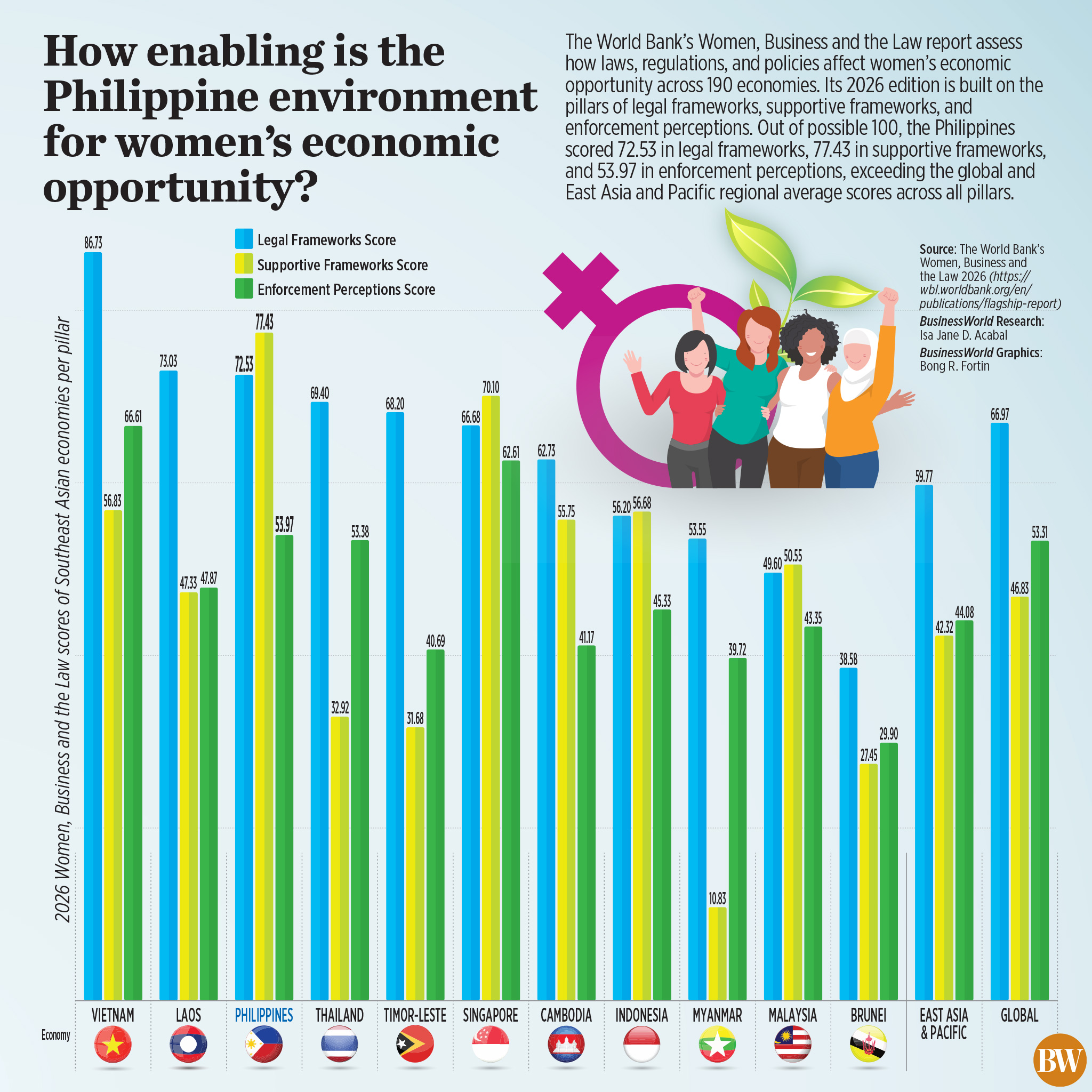
Compared to 2024, the Philippines scored higher in both legal frameworks and supportive frameworks, from 70 and 54.2 points, respectively. Its score fell in enforcement perceptions from 58.8 two years ago.
“In the Philippines, the legal frameworks score is 73, the supportive frameworks score is 77, and the enforcement perceptions score is 54, showing that gaps still persist between law and practice,” the World Bank said.
Nevertheless, the Philippines’ performance outperformed global and the East Asia and Pacific averages across all pillars and topics, except for mobility, marriage, and childcare.
The report covered 10 topics — safety, mobility, work, pay, marriage, parenthood, childcare, entrepreneurship, assets, and pension.
“On paper, most countries are doing reasonably well: the average country scores 67 out of 100 on the adequacy of laws to enable economic equality between women and men,” said Indermit Gill, World Bank chief economist and senior vice-president for development economics.
“But when it comes to enforcing the laws, the average score drops to 53. And when the systems needed to implement those rights are assessed, the adequacy score is just 47,” he added.
He said lower averages in law enforcement and implementation “reflect huge opportunity gaps.”
On the WBL 1.0 index, the Philippines scored 81.9 in 2026, higher than 78.8 in 2024. It measures 35 data points across 8 indicators.
This score is middle-of-the-road in Southeast Asia, exceeded by Vietnam (88.1), Timor Leste (86.3), Cambodia (84.4), Singapore (82.5), and Laos (82.5) but better than Thailand (78.1), Indonesia (70.6), Myanmar (61.9), Malaysia (60.06), and Brunei (53.1).
The report also found that the Philippines was the only economy to have enacted reform toward legal gender equality on the topic of mobility, via the Philippine Passport Act.
“The Philippine Passport Act allows married women to choose whether to adopt their husband’s surname, removing the blanket requirement for all married women to present a marriage certificate,” the World Bank said.
In total, the report tallied 68 economies that have implemented reforms toward legal gender equality from 2023 to 2025.
“Over the past two years, 68 economies enacted 113 positive legal reforms across most areas of women’s economic life, with the greatest progress in entrepreneurship and safety from violence,” the World Bank said.
“Seven countries also expanded paternity leave to help redistribute caregiving and support women’s employment,” it added.
Women, Business, and the Law assesses the global state of women’s economic participation across 10 key areas, including safety from violence, access to childcare, entrepreneurship, employment protections, asset ownership, and retirement security.
Norman Loayza, director of the World Bank Policy Indicators Group, said the report identifies safety from violence as a key shortcoming, as it makes women less able to work consistently.
“True equality begins with safety. Whether at home, at work, or in public, women deserve protection to thrive,” he said.
“Globally, we’re falling short. We have only a third of the safety laws we need, and even then, enforcement is failing 80% of the time,” he added. — Justine Irish D. Tabile