Philippine startup turns coastal litter into artwork
By Almira Louise S. Martinez, Reporter
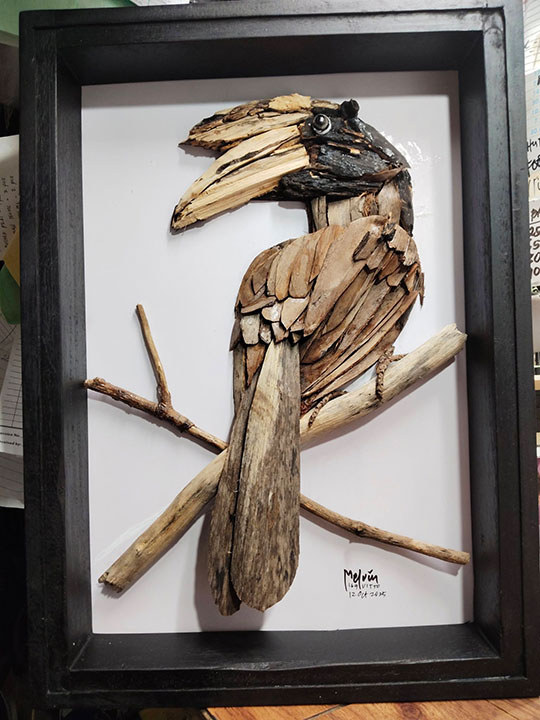
A SMALL ENTERPRISE in Marinduque province south of the Philippine capital is converting driftwood and coastal litter into saleable artwork, offering an alternative use for marine waste while providing income to seaside communities.
Melvin Upcycled Coastal Litter Handicrafts, founded by Melvin M. Vitto, collects discarded materials such as driftwood and dried leaves — much of it washed ashore during typhoons — and turns them into portraits and decorative pieces.
“I’m the only person who likes a typhoon because I get to collect my materials,” Mr. Vitto told BusinessWorld in Filipino.
The initiative reflects a shift in how coastal cleanups are approached. Instead of discarding collected debris, the business treats biodegradable waste as raw material for craft production.
“We’ve changed the way we used to do coastal cleanups,” he said. “We’ve turned biodegradable trash into something more valuable.”
Mr. Vitto, who works at the Municipal Environment and Natural Resources Office in Marinduque, said the idea came from the volume of driftwood that accumulates along the province’s coastline after storms.
He began experimenting with driftwood in 2022 but initially struggled to secure support. Government programs could not help while the activity remained outside a formal business structure, he said.
The venture was launched in 2025 with an initial capital of P5,000. Since then, Mr. Vitto has produced customized portraits of politicians and pets using assembled pieces of wood shaped and arranged to form detailed images.
Support followed once the activity became a registered enterprise. “When it became a business, that’s when they helped us,” he said, referring to assistance from the Department of Trade and Industry.
Still, Mr. Vitto said products tied to environmental advocacy could be difficult to market.
“Businesses with good advocacy sometimes remain just ideas,” he said. “If it’s not widely promoted, it’s hard to sell.”
The enterprise also creates a secondary income stream for coastal residents. Locals collect driftwood and other usable debris, which the business buys at about P500 per sack.
This model links waste recovery with livelihood, particularly in areas where income opportunities are limited.
Marine litter remains a persistent issue in the Philippines. Data from the International Coastal Cleanup showed more than 306,600 kilos of waste were collected across 298 coastal sites nationwide in 2025. Metro Manila accounted for more than 135,000 kilos, while Central Visayas collected about 42,000 kilos. The Mimaropa region, which includes Marinduque, collected more than 12,000 kilos.
Mr. Vitto said changing perceptions of waste remains a challenge, noting that reusable materials are often still discarded.
“What’s hard with trash is even if it’s reusable, people still see it as waste,” he said.
For him, driftwood carries symbolic value beyond its commercial use.
“After everything it went through, it gets a new life,” he said.