Peso rebounds from record low on profit taking, rate hike hopes
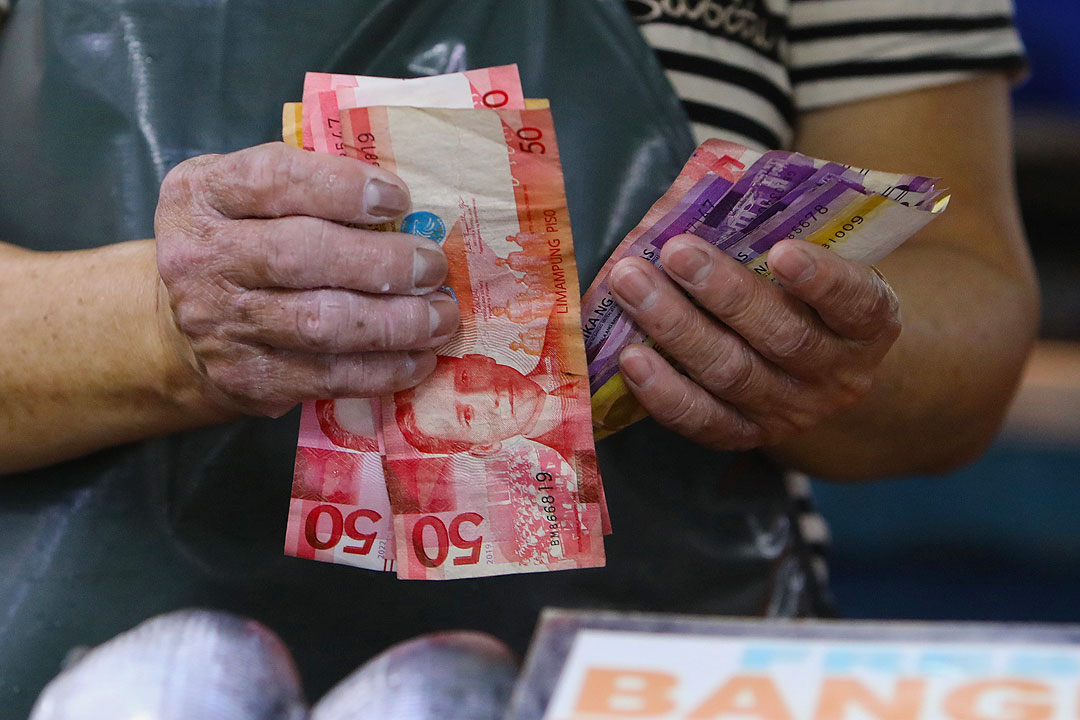
THE PESO rebounded against the dollar on Thursday despite touching a new record low during the session on profit taking and expectations of more Bangko Sentral ng Pilipinas (BSP) rate hikes amid a worsening inflation outlook.
The currency closed at P61.485 a dollar, rising by 8.2 centavos from its record-low finish of P60.567 on Wednesday, according to Bankers Association of the Philippines data posted on its website.
It opened Thursday’s trading session slightly weaker at P61.651 against the greenback and hit an intraday low of P61.75, which is now the weakest level ever reached by the peso. Meanwhile, it climbed to as high as P61.35.
Dollars traded surged to $2.487 billion from $1.609 billion in the previous session.
The peso corrected higher following Wednesday’s all-time low close and amid possible “smoothening activities,” Rizal Commercial Banking Corp. Chief Economist Michael L. Ricafort said in a Viber message.
The local unit tested new lows early in the session as global crude oil prices jumped to a four-year high after the United States announced possible attacks on Iran, but it recouped its losses due to profit-taking, the first trader said in phone interview.
Brent crude prices jumped to a fresh four-year high on Thursday on concerns that the US-Iran war could worsen and lead to a protracted Middle East oil supply disruption that could hurt global economic growth, Reuters reported.
US President Donald J. Trump is slated to receive a briefing on Thursday on plans for a series of military strikes on Iran in hopes it will return to negotiations on its nuclear program, according to an Axios report late on Wednesday.
“The peso appreciated after the higher BSP inflation outlook for April fueled hawkish policy expectations,” the second trader said via Viber.
Philippine inflation likely quickened in April and settled between 5.6% and 6.4% due to soaring prices of fuel, electricity and food, as well as the weak peso, the Bangko Sentral ng Pilipinas (BSP) said on Thursday.
This would be faster than the 1.4% clip in the same month a year ago and 4.1% in March.
At the upper end of the forecast, inflation may have accelerated to its fastest pace in three years or since the 6.6% in April 2023. At the bottom end, this would be the fastest print since the 6.1% clip in September 2023.
BSP Governor Eli M. Remolona, Jr. last week signaled further rate hikes after increasing borrowing costs for the first time since October 2023 amid worsening inflation expectations brought by the global oil shock.
The Monetary Board last week raised benchmark rates by 25 basis points, bringing the policy rate to 4.5% and marking its first hike in over two years.
Palace Press Officer Clarissa A. Castro, quoting the Department of Economy, Planning and Development (DEPDev), attributed the peso’s weakness to the Iran war.
DEPDev Secretary Arsenio M. Balisacan said the unusually strong US dollar, pulls capital toward US assets and away from emerging markets like the Philippines. Sharp global oil price spikes and our dependence on imports also affects the peso.
“This causes the country’s demand for dollars to spike, the trade and current account deficits to rise and in turn, the peso to weaken,” Ms. Castro told a briefing, quoting Mr. Balisacan.
“In short, the peso depreciation reflects the rise of the demand for dollars faster than the supply of dollars.”
She said the BSP has ample reserves and a range of policy tools to mitigate excessive volatility in the foreign exchange market.
Philippine markets are closed on May 1 (Friday) for the Labor Day holiday. — Aaron Michael C. Sy with Chloe Mari A. Hufana