Television Review
Lord of the Flies
Netflix
(Warning: plot and surprise twists in book and TV series discussed in explicit detail.)
I REMEMBER reading William Golding’s 1954 debut novel as a teen and having nightmares about running through the jungle with other boys in pursuit, waving sticks sharpened at both ends — it did not help the development of my socialization skills, lemme tell you.
The book comes off as a fable, the premise just this side of credible, the characters barely sketched-in symbols, the theme clear enough for literature majors to chew over and write lengthy theses over: humans have this ingrown tendency to violence, and we flirt with or ignore it at our peril. It’s really that simple, the novel’s chief virtue and key weakness, and folks who seek to adapt it flirt with this fact or ignore it at their peril.
Take Netflix’s 2026 miniseries, where writer Jack Thorne (Adolescence) reconceived the book in four chapters, taking up the points of view of different characters: Piggy (David McKenna), Jack (Lox Pratt), Simon (Ike Talbut), Ralph (Winston Sawyers). Thorne gives each a backstory: Jack is ignored by his parents and fears being seen as weak; Simon has a bond of loneliness with Jack who ignores him when with others, in which case he spends the rest of his time hearing voices; Ralph’s mother was sickly and died not long ago.
Right off Jack is a problem. That innate savagery hiding in all of us is actually — fear of abandonment by parents? Simon, the mystic who hears otherworldly voices is really — insane? Everything that happened might have been prevented by therapy, maybe some Thorazine? Odd that Piggy has no backstory, save for the constant tales of his aunt — if you can believe he has one, if his stories aren’t made up on the fly (possibly Thorne felt Piggy was too valuable a plot function to fiddle with).
I understand the desire to cast Ralph as mixed-race and Sawyers is a charismatic talent no doubt about it… but I’ve always thought of Golding’s fable as a warning directed at the ascendant race on this planet, the European Caucasian (and his wealthier more powerful cousin, the American Caucasian); warning people who are already aware of said Caucasians’ barbarism (having often been at receiving end) is — well, a waste of good platform.
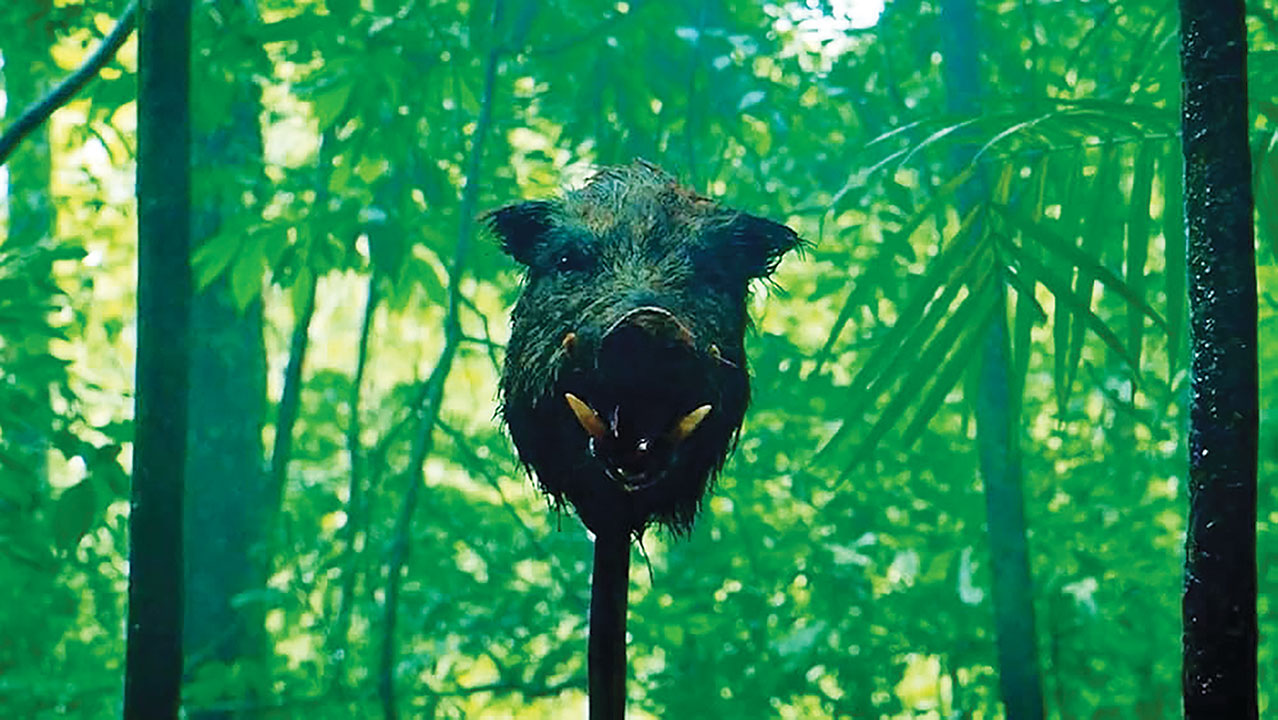
But my biggest problem with the miniseries is Marc Munden’s direction. I understand the temptation to digitally turn the island into a rainbow of colors, from brilliant lemon green to deep fire-blood red to bleak ashy grey… but Golding’s novel is already an abstracted fable with huge improbabilities. Pigs on an uninhabited island? Boys who learn to build a fire and kill a pig in so many days? In 1965, six Tongan boys from 13 to 19 years old survived on their own for over a year on an island, they ate wild chicken and, when desperate, bird’s blood) — can’t 30 British boarding school students? (“Well,” a sly voice whispers in my ear as I write this, “that’s because they’re Caucasian…”). Trying to sell the book’s contrived premise as being halfway plausible is already an uphill task, do we need the bells and whistles of a digital paint job to make matters harder?
Throw in a few other minor details that irked: learning to make flint spearheads and mounting them on wooden shafts isn’t an easy skill to master (in the novel they used sharpened sticks) — and after all that trouble, they swing the spears instead of stabbing? And succeed at killing their prey? Wild boars, incidentally, don’t give up just like that; they can outrun any human, no matter how young or healthy, and they will kill anyone who comes between them and their babies. But okay, okay, a fable.
To be fair, Munden does offer effective moments — the tenderness between Jack and Simon is moving (even if I feel the idea of their having this hidden friendship feels wrong — Simon the mystic needs to be isolated, if not mysterious); of the cast I’d cite not just Sawyers and McKenna (who was nominated for a Gotham Award) but Pratt as the volatile self-doubting Jack — though again while you’re moved by his predicament, the fact that he harbors doubts tends to flatten the threat of his presence.
Piggy’s lingering end as opposed to the sudden one in Golding’s novel does result in more quality time between him and Ralph, and I appreciate all the Groucho Marx quotes, but watching Ralph drag a barely conscious Piggy away from Jack’s spear-waving boys, to successfully escape and hide — at some point your willingness to believe seizes up and you’ve got to laugh at the visual idiocy. Couldn’t Jack order his boys to stand back and let the two walk? Couldn’t Thorne and Munden just stick to the book?
For all the flaws, I prefer this to the 1990 version which couldn’t overcome the gimmick of turning the kids American (with British boarding schools you appreciate the shock value of watching the kids be corrupted; with American schools… well let’s just say I’ve seen things that make William Golding’s novel feel like a chess tournament).
Even more bizarre is Lupita Aquino-Kashiwahara’s 1975 Alkitrang Dugo (Clotted Blood, 1975) which transposes the story to a Filipino island. Again, my thesis: didn’t Golding direct this fable towards white folks (And again, that sly voice: “But upper-class Filipinos think they’re white—!”)? Aquino-Kashiwahara does well enough with a tiny budget and her jungle (basically the rain forests of Quezon Province) is more lush and claustrophobic than anything seen onscreen so far; in the film’s final moments she pivots and turns the tale into an allegory about strongman rule, and I can actually buy her variation of Golding’s basic message: hidden inside all of us is an embryonic fascist, ready to emerge.
Finally there’s Peter Brook’s 1963 black-and-white version, where the director takes on the problem of 30 inexperienced kids and how to make a screen adaptation from their collective performances: he simply shoots them over and over again, 60 hours’ worth of footage, then trims that enormous pile of improvised material down to a viewable 90-minute feature.
I think it works: the stark black-and-white, the unaffected performances, the young voices that shout and shriek the way British boys do, in a weekend adventure gone horribly wrong, on an island blessedly free of digital manipulation. Yes, Golding has done better (he’s said his favorite among his books is The Inheritors, I say his best is the surreally perverse Darkness Visible); arguably this was the perfect choice to adapt to the big screen, its crude schema lending to easy translation, Brook’s severe approach pruning in turn the book’s more self-absorbed self-indulgent passages.
Is it possible to adapt Golding’s most famous novel to the big screen? I think so: a simplistic message but one too important not to deliver at least once, loud and clear, and Brook pulled it off a mere nine years after the book’s publication. I submit we didn’t need any other.