Empowering women through their sanitary pads
A woman who just wanted to get rid of her period rash is now embarking on an advocacy to help prevent period poverty.
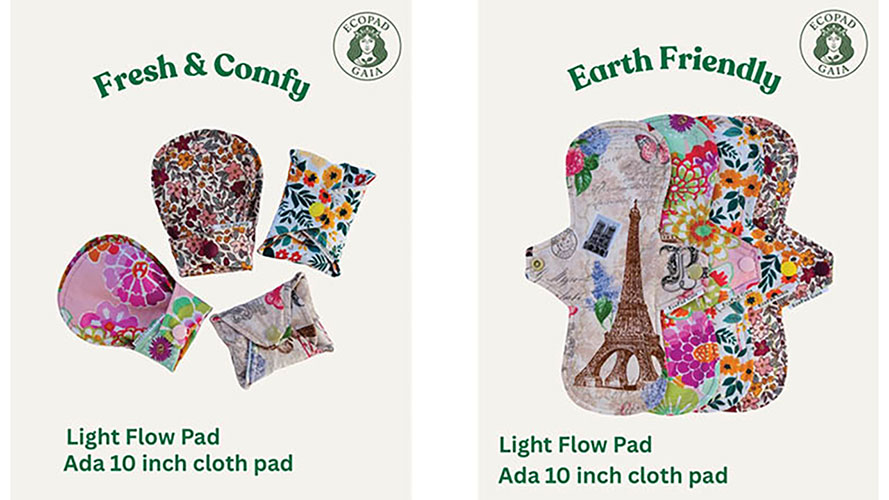
We met up with Adeline Bondoc, the founder of EcoPad Gaia during the Department of Trade and Industry Fair this past weekend at the Megatrade Hall in SM Megamall. Ms. Bondoc makes washable sanitary pads (made of deadstock fabrics with prints that she liked) that attach to underwear with snaps.
She gave us advice on how to use them: one, change your pads three to four times a day, and, two, attach them to undies that fit snug, in order to help the absorption (through an absorbent fabric layer in between the pads). “Not ’yung old underwear, na bacon na siya (that has wrinkled).” Three, after washing (without using a fabric conditioner, because it leaves a slick film that hinders the absorbency), make sure to dry them thoroughly to avoid mildew and possible hygiene issues.
Her pads are washable, reusable, and biodegradable. According to her research, sanitary pads can take hundreds of years to break down into microplastics, while cloth pads take just about 20 years. Her pads are designed to last two to three years with 75 washes each, but with enough pieces on rotation, they can last maybe five, up to 10 years.
She partners with schools, nongovernment organizations, and corporations to supply these pads, noting that they’re also distributed in health kits during disaster relief operations. About the contents of care packages given to disaster-stricken evacuees, pointed out that they’ve included more than just food in recent years. “Kahit naman na-disaster ’yung babae na ’yan, magme-mens pa rin ’yan (even in a disaster, a woman will still get her period).”
The pads start at P115 for a tiny liner, though the prices get higher as the pads get bigger (her biggest is for overnight use). She sells them at a lower price for her partnerships, from P58 to P60. She compares these with standard sanitary pads which may cost up to P9 for single-use, calculating that a woman spends almost P6,000 every three years on sanitary pads. Moreover, they contribute to waste. According to her research, a woman can use up to 11,000 pads on average, from when they start their periods up to when they reach menopause. “Saan napupunta ’yon (where does that go)? Hindi naman tatawid ng Saturn (it’s not like we can dump them on Saturn),” she said.
Before sanitary products became mainstream in the mid-20th century, women had to make do with scrap cloth. “Hindi appealing,” she said. Now, “Meron ka nang print na gusto, naka-snap button, may leakproof pa. Dati ’di ba walang leakproof? Hindi ka makalabas ng bahay. (You have prints you like, they have snap buttons, and there are leakproof options. Back in the day, there were no leakproof options. You could not leave the house.)”
What started out as a way to have more comfortable periods has become a full-blown crusade for her.
She was a casino worker before the pandemic, and noted that she would get rashes during her periods — it turned out the commercial sanitary pads were irritating her. She bought cloth pads and no longer got rashes, and found out her daughter had the same problem. So she started making the pads in earnest (studying how through YouTube tutorials) when she lost her job during the pandemic.
“Doon ko na-realize na hindi lang pala ako ’yung babaeng nagkaka-rashes (That’s when I realized I wasn’t the only woman who got rashes from commercial pads),” she said. She noted: “May stigma surrounding the period. Pwede namin siraan ang mga boyfriend at asawa namin, but we don’t talk abour our periods (we can talk trash about our husbands and boyfriends, but we don’t talk about our periods). Ganon ang mga girls (that’s how girls are).”
She talked about how she watched videos and read papers about period poverty. From what she read from the UN, she found out about girls and women who could not buy sanitary products for their periods. That leads to missed classes, then ending schooling, then teen pregnancy, and entering the cycle of poverty.
“Hindi lang pala rashes ’yung naso-solve (It wasn’t just rashes that these products could solve),” she said.
Since then, she’s begun to teach classes at group homes and schools, so girls can make their own cloth pads — and may also begin to have their own livelihood. “Kaya niyo talagang gumawa (you can really do something),” she tells the girls she teaches.
She also talks about some special cases that her products have helped: a cancer patient started using her products to help with her continuous bleeding that lasted for months, and due to her use of commercial napkins, developed a rash. “Imbis na cancer pa niya yung iniintindi niya, iniintindi niya pa ’yung rashes niya. Months! Eh kami nga one week lang nagrereklamo na kami (Instead of focusing on the cancer, she had to think about the rashes. For months! We would complain about dealing with this for one week,)” she said. “Ang laki pala ng tulong (It was such a big help).”
Since her business allows her to reach many kinds of women with varying problems, she’s learned more about being a woman during her journey. “Ang woman pala talaga, siya ’yung may nurturing heart. Siya talaga ang may attention to detail. Some men, hindi nila nare-recognize ’yung mga maliliit na bagay. (It turns out that a woman, really, is the one with a nurturing heart. She is the one with attention to detail. Some men, they do not recognize the small stuff.)
“Kapag in-empower ko pala ’yung babae, manganganak siya ng empowered children,” she said. “May hope.” (It turns out that when you empower a woman, she has empowered children. There is hope.)
Visit Adeline Bondoc’s page at Instagram @ecopadgaia or call her at 0921-211-6969. She also has an online store in Shopee. — Joseph L. Garcia