Meat industry wants hike in tariffs as January imports rise
By Vonn Andrei E. Villamiel, Reporter
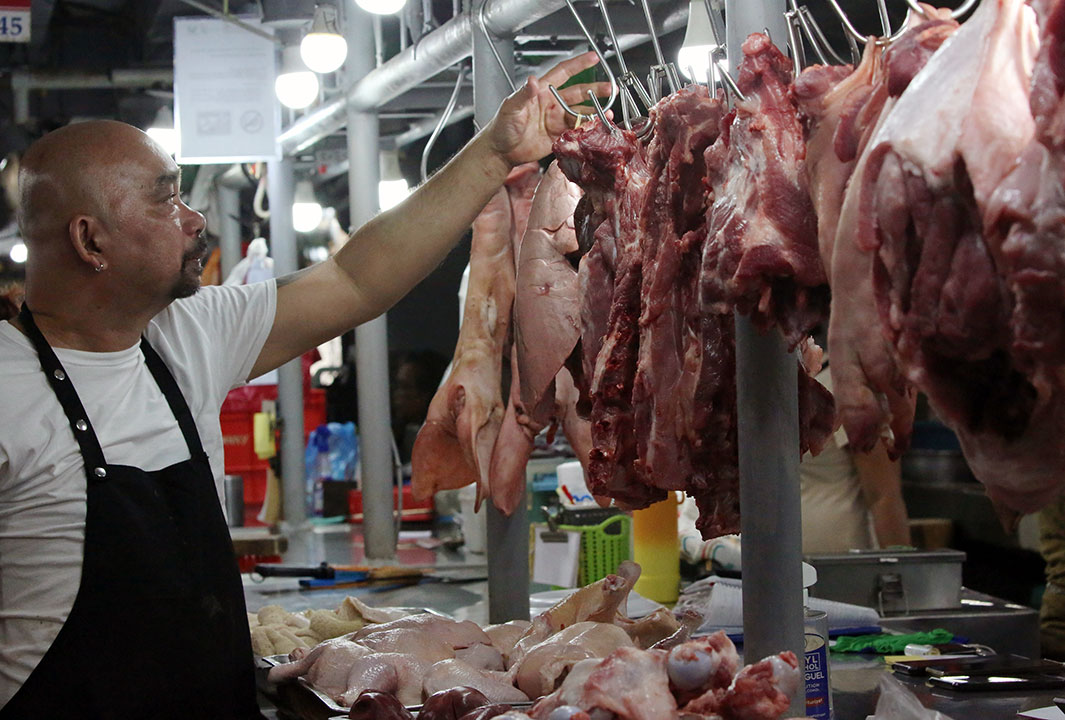
HOG AND POULTRY raisers called for higher tariffs on imported meat after January inbound shipments rose 4.23% year on year, intensifying pressure on farmers already struggling with low farmgate prices.
The Bureau of Animal Industry (BAI) reported that meat imports in January amounted to 143.84 million kilos.
Alfred Ng, vice chairman of the National Federation of Hog Raisers, told BusinessWorld that the swine industry is struggling to keep up with the surge of cheap pork imports.
“Current liveweight prices are below production cost, and farmers are losing money. The landed cost of these imported pork is P120 per kilo, which is lower than our production cost,” he said via Viber.
Mr. Ng is urging the government to limit imports and restore higher tariffs on pork products.
“We therefore request the government to bring back tariffs to the original levels of 35% to 45% from 15% to 25% currently, (and to) control and limit pork importation to the actual deficit of pork supply in the country,” he said.
Rosendo O. So, chairman of the Samahang Industriya ng Agrikultura (SINAG), said pork imports this year should be reduced to around 550,000 metric tons, after carryover stock from earlier imports left a “substantial oversupply.”
Mr. So said import volumes should be managed in the same way rice imports were restricted last year, when an influx of cheaper foreign rice led to significant losses for farmers.
“The government saw that situation with rice, so the same approach should be applied to pork,” he was quoted as saying in a SINAG statement on Sunday.
Meanwhile, Elias Jose M. Inciong, chairman of the United Broiler Raisers Association, said the surge in chicken imports shows that current tariff rates are not sufficient to protect the poultry industry.
“If you look at the declared transaction values for imported chicken, and even if you apply a 40% tariff, it is still cheaper,” he told the plenary session at the International Farmers Summit last week.
Despite an increase in domestic poultry production, chicken imports rose 8.92% year on year in January to 49.7 million kilos.
Mr. Ng also flagged the surge in imports of whole chicken, which he said are usually less preferred over other chicken cuts.
“Before, there were no inbound shipments of whole chicken because they were more expensive. However, prices have dropped to almost $1.70 to $1.80 (per kilo),” he said.
According to the BAI, shipments of whole chicken in January grew to 884,414 kilos from 83,732 kilos a year earlier.
Separately, Mr. Inciong told BusinessWorld that the poultry industry is at a disadvantage against heavily subsidized competitors.
“We are being compelled to compete with countries that have received serious domestic support for decades. In contrast, it is only now that agriculture (in the Philippines) is taken seriously because of supply chain disruptions and climate change,” he said via Viber.
SINAG Executive Director Jayson H. Cainglet said the government should immediately establish fully equipped first-border inspection facilities at all major ports to protect the livestock and poultry industries against biosecurity threats.
“We seek the support of the government to strengthen biosecurity, enhance food security regulations for food safety and public health, and prevent the entry of contaminated or disease-affected meat through 100% inspection at the port of entry,” Mr. Cainglet said in his presentation at the International Farmers Summit.
He also called on the government to implement stricter measures to prevent misdeclaration and undervaluation of meat imports.
Mr. Ng also urged the DA to implement strict inspection systems in planned biosecurity facilities. He said an earlier DA presentation for planned cold examination facilities in agriculture (CEFA) in Manila, Subic, and Davao proposed only five-minute X-ray inspections.
“When it was presented to us, they said the X-ray inspection would last only five minutes. We are concerned that they want the goods to pass quickly. We should have a real inspection,” Mr. Ng told reporters.
The DA is currently constructing CEFAs to prevent the entry of plant pests and economically significant animal diseases. Operations of the facilities are expected to commence by 2027.
Mr. Ng said the facilities must include laboratory tests to detect animal diseases. “How can they detect that if it’s just X-ray? The only thing they’ll be able to check is misdeclaration,” he said.
Agriculture Secretary Francisco P. Tiu Laurel, Jr. told reporters in December that the CEFAs will feature laboratories to test for diseases. He did not immediately respond to a query seeking clarification.