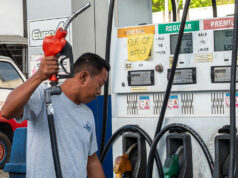
Marcos orders power, fuel cuts as war threatens supply
PRESIDENT Ferdinand R. Marcos, Jr. has ordered government agencies to sharply cut power and fuel consumption as the Middle East war threatens global energy supplies and raises the risk of shortages in the Philippines.
In a statement, Executive Secretary Ralph G. Recto said compliance with the directive is mandatory across the bureaucracy, including state‑owned and ‑controlled companies. The measures are aimed at curbing demand as supply chains remain vulnerable amid the Iran war.
Energy monitors have inspected more than 1,000 government offices in the first week of enforcement, Mr. Recto said. Checks covered air‑conditioning use, lighting systems and office equipment, as the administration pushed for immediate and measurable reductions in consumption.
Under the order, agencies must limit electricity use, while fuel consumption is being curbed by restricting the use of government vehicles. Only vehicles assigned to public safety, emergency response and health services are exempt.
Mr. Marcos also ordered energy‑saving measures tied to the Philippines’ hosting of the Association of Southeast Asian Nations (ASEAN) this year. Spending has been cut, meetings scaled down and nonessential events canceled.
The President said ASEAN activities would be “bare‑bones,” with discussions focused on oil prices, food costs and migrant workers. The ASEAN Summit scheduled for May will proceed.
Earlier this month, the Executive branch shifted to a four‑day workweek as part of conservation efforts. The Senate adopted a five‑day work from home setup, while the House of Representatives implemented a hybrid arrangement with three days onsite and one day remote. Malacañang said private firms may adopt similar measures, echoing policies used during the COVID‑19 pandemic.
The Philippines is under a one‑year state of national energy emergency — the first such declaration globally — as the country faces the risk of fuel supply disruptions. As a net oil importer, the Philippines remains highly exposed to global price swings.
Fuel prices have surged, feeding through to food and transport costs. Economic Planning Secretary Arsenio M. Balisacan has warned that sustained oil price increases could push inflation beyond the government’s 4% target and weigh on economic growth.
Congress has granted Mr. Marcos emergency powers to cut or suspend excise taxes on fuel, though analysts have said the impact on pump prices could be limited.
In the meantime, the government has rolled out fuel and cash subsidies to cushion the impact on vulnerable sectors, including transport workers and low‑income households.
Meanwhile, Senator Paolo Benigno A. Aquino IV has filed a bill that seeks to classify petroleum products as basic necessities, a move that would allow the government to intervene in fuel pricing amid surging costs.
Mr. Aquino in the explanatory note of Senate Bill No. 2011, which will amend Republic Act No. 7581 or the Price Act, said the law fails to address gasoline and diesel as major drivers of inflation because these remain deregulated.
“The Philippines is in the midst of a fuel price crisis, and Filipino families are feeling the strain,” he said in a statement. “Rising diesel and gasoline prices have pushed up transportation costs, food prices and the cost of basic goods.”
The proposal would expand the list of basic necessities to include petroleum products, giving the government authority to impose price ceilings during emergencies. It also seeks to extend the period of government price control to 30 days from 15 days.
Mr. Aquino said workers, small business owners, farmers and ordinary households are bearing the brunt of high fuel costs, which ripple across the economy.
Under the Price Act, only liquefied petroleum gas and kerosene are classified as basic necessities. Mr. Aquino said the law no longer reflects the structure of household and business expenses.
He also urged economic agencies to revisit the 12% value-added tax (VAT) on fuel. Mr. Aquino said suspending the VAT could lower pump prices by roughly P20 per liter.
This is one of the fastest tools the government could use to ease the burden on consumers, he pointed out.
Several fuel-related bills have been filed following the escalation of war involving the US, Israel and Iran, including proposals for a national petroleum reserve, amendments to the Biofuels Act and the repeal of the Oil Deregulation Law.
Fuel prices have climbed sharply, with diesel at P144.20 per liter, gasoline at P102.50 and kerosene at P166.
The Department of Energy said fuel inventories remain sufficient until late April, while Executive Secretary Ralph G. Recto said 1.04 million barrels of diesel are set to arrive this week. — Chloe Mari A. Hufana and Kaela Patricia B. Gabriel