Marcos still sees 6% growth by 2028
PRESIDENT Ferdinand R. Marcos, Jr. said economic targets will have to be revised to reflect the impact of the Middle East conflict but remains confident the Philippine economy will grow by 6% by the end of his term in mid-2028.
“With the war in the Middle East, those (targets) have to be redrawn — everything has to be redrawn,” Mr. Marcos said in an exclusive interview with Bloomberg Television’s Haslinda Amin in Manila on Tuesday.
“If the war stopped today, the adjustment isn’t going to be instantly back to $70 per barrel. The uncertainty and the lack of stability is going to factor into that — the general risk factor is still there. And that’s not going to diminish immediately. That’s going to taper off. We hope that it tapers off over a relatively short period,” he added.
The government set a 5-6% gross domestic product (GDP) growth target for this year, 5.5-6.5% for 2027, and 6-7% for 2028.
Asked if 6% growth is attainable by 2028, Mr. Marcos replied: “I think so, yes. We should be able to do that.”
However, the President said the initial 8% GDP growth target by 2028 will be a “tough number to get to” amid recent shocks.
Mr. Marcos said investments and a young workforce will help drive economic growth.
“We have restructured even our tax incentives for investors, the ease of doing business is something we’ve been working hard on… (And) what we always consider our greatest asset is our workforce. We have a relatively young workforce… (and) relatively well-trained,” he said.
ABOVE 4% INFLATION
Meanwhile, the Department of Economy, Planning, and Development (DEPDev) Secretary Arsenio M. Balisacan said inflation will likely quicken above 4% this year even under the least severe scenario where oil prices average $100 per barrel for 60 days.
“The government is assuming 2-4% for 2026 and beyond, but those are going to be breached in any of those scenarios,” he said during a Senate hearing. “So, we will see faster inflation.”
DEPDev sees full-year inflation accelerating to 4% to 8.6% this year, depending on the average price of Dubai crude.
It projected that elevated domestic fuel prices combined with the impact of reduced remittances and tourist arrivals, GDP growth could be lower by 0.15 to 1.95 percentage points (ppts) to bring full-year growth to between 3.5% and 5.3%.
At the Senate hearing, the DEPDev presented simulations of various scenarios of the impact of the price of Dubai crude and the duration of the war on the Philippine economy.
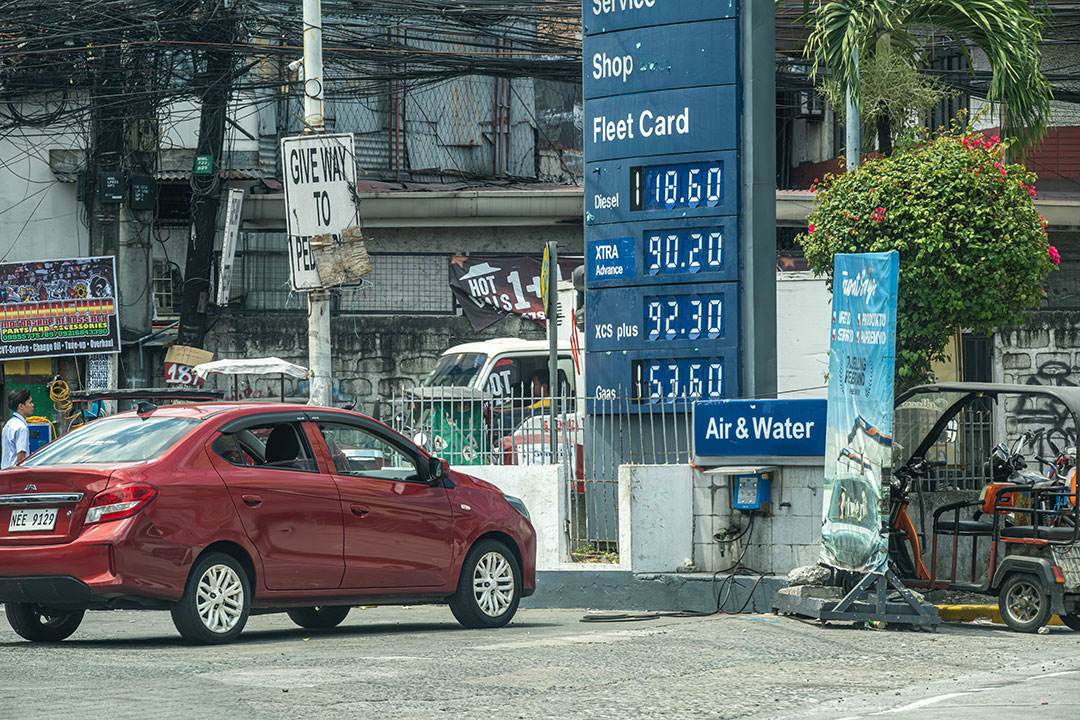
It estimated that domestic diesel prices could rise by 33-86% from the prewar baseline estimates in March, 16.5-160% in April and 9.33-176.49% in May.
It projected domestic gas prices could jump by 27-71% in March, by 13.5-133% in April, and 7.63-146.85% in May.
In the least severe scenario where oil prices average $100 per barrel for 60 days, inflation is expected to range from 4.9-5.7% in March and 4.7-5% in April, bringing the full-year average to 4-4.2% for 2026.
Under a scenario where oil averages $100 per barrel for 90 days, inflation may quicken to 5.6-6.4% in March and 5.2-5.7% in April, bringing the full-year average to 4.2-4.4%.
However, if oil averages $150 a barrel for 90 days, inflation may accelerate to 6-7% in March and 8.7-10.6% in April, while the full-year average will settle at 5.1-5.6%.
If $150 per barrel of oil holds for 120 days, inflation may quicken to 6.5-7.6% in March and 9.5-11.6% in April, with full-year inflation at 5.5-6.2%.
“These scenarios are scary if they happen because they could bring us to double-digit inflation, which we never had in the last couple of years,” Mr. Balisacan said.
These scenarios assume sustained and heavy damage to the critical infrastructure in the Middle East, he added.
In the most severe scenario when oil would average $200 per barrel for 180 days, inflation may surge to 7.4-8.9% in March and 11.4-14.3% in April, bringing the full-year average to 7.3-8.6%.
However, Mr. Balisacan said the likelihood that the most severe scenario will happen is “quite low.”
“The likely source of inflation in the next two years would be non-food because services outputs, for example, are very much oil-dependent, like transport and logistics,” he said.
“Nonetheless, there is a major disruption of fertilizers globally… and that could disrupt local production,” he added.
Under the severe scenario, non-food inflation is expected to reach 8.5-10% in 2026 and 4.7-5.1% in 2027, while food inflation is expected to settle at 4.9%-6.1% in 2026 and 3.3-3.5% in 2027.
In the least severe scenario, non-food inflation is projected at 4.4-4.6% in 2026 and 3.7-3.8% in 2027, while food inflation is expected to be at 3.3%-3.5% in 2026 and 2.8-2.9% in 2027.
OFW REMITTANCES
Meanwhile, Mr. Balisacan said that depending on the level of overseas Filipino worker (OFW) repatriation, the remittances could decline between P63.3 billion and P167.45 billion.
“Remittances, nevertheless, could decline by 41% versus 2025 values, assuming that these scenarios hold, and that would represent 7.5% of the total remittance, so that is quite a sharp decline,” he said.
In 2025, cash remittances jumped by 3.3% to a record high of $35.634 billion.
“The faster inflation and the lower remittance inflows resulting from the conflict may drag economic growth by roughly 1.5 to 2 ppts in the worst-case scenario,” said Mr. Balisacan.
In the severe scenario, GDP growth is expected to settle between 3.5% and 4%, while GDP is seen to expand by 5.3-5.35% in the least severe scenario.
To address the possible impact of the war on inflation and remittances, DEPDev recommended measures including fuel conservation, fuel subsidies to vulnerable groups, promotion of renewable energy use, encouraging innovation, and enabling infrastructure for active mobility. — Justine Irish D. Tabile with Bloomberg