Philippines remains an underperformer among Asian peers — ANZ

By Katherine K. Chan, Reporter
NEW ZEALAND-BASED ANZ Research expects slower growth for the Philippines as it sees the country underperforming amid a continued decline in infrastructure spending.
In a report on Tuesday, the think tank trimmed its Philippine gross domestic product (GDP) growth forecast for 2026 to 4.7% from 5% previously.
“We expect the Philippines to remain the underperformer in the region, similar to the pattern in the previous two quarters,” ANZ Research Chief Economist for Southeast Asia and India Sanjay Mathur said in a report on Tuesday. “The deceleration in public infrastructure spending has permeated through household confidence and corporate investment plans.”
Economic growth sharply slowed to a post-pandemic low of 4.4% in 2025 amid a flood control corruption scandal, wherein some Public Works officials, lawmakers and private contractors allegedly received kickbacks from some infrastructure projects.
Government spending has consistently declined annually in the last six months. Based on the latest data, expenditures fell by 23.9% to P303.5 billion in January from P398.8 billion a year earlier.
Infrastructure spending alone fell 45.2% year on year to P48 billion in November, marking the fifth consecutive month of annual contraction.
Mr. Mathur said the government has to catch up on its infrastructure spending to help spur domestic growth, instead of relying on monetary policy easing.
“Suppressed growth in the Philippines likely warrants further rate cuts, but their efficacy in lifting growth appears very limited,” he said. “The appropriate remedy is a resumption of public infrastructure spending, the outlook for which is unclear.”
Still, ANZ Research maintained its Philippine GDP growth estimate for 2027 at 5.6%.
COMPLICATED POLICY PATH
Meanwhile, analysts are divided on whether the Bangko Sentral ng Pilipinas (BSP) will opt for a pause or completely reverse its monetary policy amid rising inflationary pressures from the Middle East war.
For Maybank Securities, Inc. analysts, the BSP may stand pat throughout the year as high oil prices and a weak peso weigh on inflation.
“For our estimates, we already expect the BSP to not cut rates anymore this year (from another 25-bp (basis-point) cut expectation),” they said in a report on Tuesday.
However, Bank of the Philippine Islands (BPI) Lead Economist Emilio S. Neri, Jr. is anticipating a rate hike next month should benchmark oil prices remain well above $100 per barrel (/bbl).
“If by April oil prices remain where they are, we think BSP will need to reverse course and hike (at) their April (23) meeting,” he told BusinessWorld in a Viber message.
GlobalSource Partners Principal Advisor Diwa C. Guinigundo also noted that oil may stay costly, likely pushing inflation past the central bank’s target.
“Pretty soon, they would be reflected in oil pump prices as they are now, and consequently, price of transport and energy, and ultimately, consumer prices,” Mr. Guinigundo told BusinessWorld via Viber. “We shall be seeing the second-round effects of such a severe supply shocks that would require a monetary response.”
“Everybody now expects price levels and ultimately inflation could reach beyond targeted levels,” he added.
However, Mr. Guinigundo said they cannot yet determine what level oil prices would have to reach to trigger monetary policy tightening from the BSP, though noted that the Philippines had one of the highest pump price adjustments in Southeast Asia.
BSP Governor Eli M. Remolona, Jr. earlier left the door open to raising interest rates if oil price at above $100/bbl drives inflation beyond 4%, with Finance Secretary Frederick D. Go noting separately that such a move could come as early as April if oil price remains elevated.
The Monetary Board has eased borrowing costs by 225 bps since August 2024, lowering the key policy rate to 4.25%.
For ANZ Research, headline inflation may average 3% by yearend, faster than its 2.4% earlier projection and the midpoint of the BSP’s 2%-4% target. It also raised its inflation forecast for 2027 to 3.2% from 3%.
Risks of higher inflation, Mr. Guinigundo noted, complicates the central bank’s monetary policy, especially as the country still confronts growth concerns from the flood control mess fallout last year.
“If the BSP were to tighten monetary policy that could help stabilize inflation expectations but not necessarily lick inflation because of the strong influence of the supply shocks on consumer prices. At the same time, that could also increase the cost of money and the cost of credit, which could frustrate economic growth,” he said.
“We have reached that point when monetary policy is (at) a crossroads, with both options leading to possible lower growth and higher inflation,” he added.
PESO PRESSURES
Meanwhile, Mr. Guinigundo noted that the BSP could pause or even tighten amid the peso’s depreciation and the US Federal Reserve’s latest policy decision.
“Weak peso, given the exchange rate pass through to inflation, as well as the Fed’s decision to stay could put additional pressure for the BSP to consider a pause, or even symbolic tightening,” he said.
Last week, the Fed left its benchmark rates unchanged at the 3.5%-3.75% range for a second straight meeting amid mounting economic woes worsened by the Middle East war. It has so far delivered 175 bps in cuts since September 2024.
BPI’s Mr. Neri said the central bank may also consider lifting its policy rate to prevent the peso from weakening over 5% year on year against the dollar.
“BSP is watching this very closely… A policy rate adjustment will likely be considered to temper excessive PHP (maybe more than 5% year on year) weakening vs the USD,” he said.
Uncertainties over threats between the US and Iran brought the peso to a new all-time low close of P60.30 against the greenback on Monday, breaking its previous record of P60.10 on Thursday.
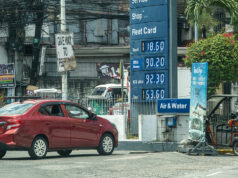
Oil supply disruptions have led to energy price shocks globally, with the Philippines, a net oil importer, facing continued oil price hikes as the three-week-old war drags on.