Manila’s slow response to oil price spike exposes economy to energy shock
By Chloe Mari A. Hufana, Reporter
THE PHILIPPINE government’s slow response to surging oil prices risks worsening the economic impact of the latest energy shock, analysts said, as elevated global crude costs begin to filter through to transport fares and supply chains.
This as President Ferdinand R. Marcos, Jr. on Sunday said discussions regarding oil supply with China, South Korea, India, Thailand, Brunei and Japan are “going well.”
“It’s a good thing we have truly built strong friendships with them and that they are willing to help us,” he said in a video message in Filipino, without giving details.
Mr. Marcos had earlier said the government is looking for alternative sources of petroleum products as global supply was disrupted by the conflict in the Middle East.
“The government is moving too slowly,” Noel M. Baga, co-convenor of the Center for Energy Research and Policy think tank, said via Facebook Messenger.
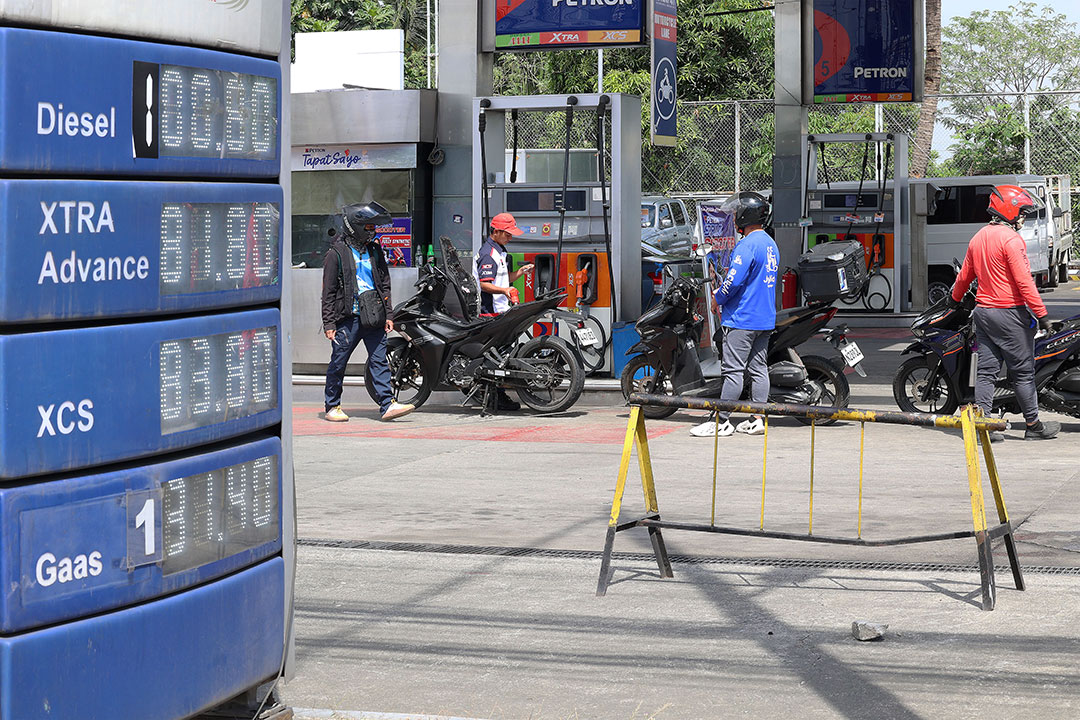
Dubai crude oil has traded between $130 and $153 per barrel in recent weeks, far exceeding the $80 threshold set by the government, while local diesel prices have climbed to as high as P114 per liter.
The oil price surge, driven by the Iran war, is beginning to push up the cost of basic goods and expose gaps in the government’s response framework.
As an oil importer, the country is vulnerable to external shocks, as global price swings, driven by supply-demand imbalances, geopolitical tensions and the Organization of the Petroleum Exporting Countries’ decisions, directly impact domestic fuel costs and inflation.
Despite certifying as urgent a bill granting him emergency powers to suspend excise taxes on petroleum products, Mr. Marcos last week said he was unsure whether he would use them.
He pointed to the uncertainty of global oil prices, saying there are “complicated calculations” that must be made before he uses such power.
Analysts said the hesitation could delay relief measures at a time when higher fuel costs are already feeding into inflation through transport and logistics.
Clarity from the Executive branch is now essential, according to Mr. Baga.
“The President must also be clear about his timeline: at what price level and when will the government move from monitoring to acting,” he said, adding that a suspension on fuel taxes alone will not be sufficient.
“The President must immediately declare a state of emergency and impose oil price ceilings under the Price Act and the Disaster Risk Reduction and Management Act.”
Malacañang last week said there is no need to declare a national state of emergency, as the supplies of basic goods are enough, and the government is maintaining constant communication with industry players.
If Mr. Marcos declares a national state of calamity, several immediate and legal consequences would follow, designed to give the government greater flexibility to respond to emergencies.
Josue Raphael J. Cortez, a diplomacy lecturer at De La Salle-College of St. Benilde, said regional coordination is emerging as a critical pillar of the Philippines’ forward strategy.
As this year’s chair of the Association of Southeast Asian Nations (ASEAN), Mr. Cortez said the bloc’s shared exposure to supply disruptions underscores the urgency of joint action.
“ASEAN can undoubtedly play an integral role in coordinating energy security,” he said via Facebook Messenger, noting that the bloc has convened foreign and economic ministers as the crisis unfolds.
He noted that 60% of ASEAN’s oil needs pass through the Strait of Hormuz, a critical waterway controlled by Iran.
“Information sharing and looking into alternatives together is certainly of the essence in these dire times,” he added, pointing to initiatives such as the ASEAN Power Grid as part of a longer-term solution.
The Philippines is also expected to pursue a more pragmatic supplier diversification strategy, even as it maintains its independent foreign policy stance, according to Mr. Cortez.
“The fact that our relations politically with these two (Russia and China) heavily allied countries are in the colder scheme of things, yet we are still open to collaborating with them economically, goes to show that our conduct of foreign policy is not merely limited to political lines,” he added.
Still, Mr. Cortez emphasized that diversification should not be misconstrued as a geopolitical pivot.
“Diversification of suppliers cannot be fully depicted as a foreign policy maneuver as well,” he said, adding that “our course of action is merely rooted in the context we are presently facing, which is highly economic in nature.”
TALKS WITH POWER GENERATORS
At the same time, Mr. Marcos said the National Government is also in talks with local power generators to boost grid capacity for the next 60 days, with 23 projects totaling 900 megawatts set to come online, alongside efforts to maximize Malampaya gas field output to shore up electricity supply.
The Philippine government has resorted to government subsidies and fare discounts to cushion Filipinos from the impact of the Iran war.
While Mr. Marcos suspended a planned fare increase among public utility vehicles, he vowed that transport workers would receive more support from the government, including agricultural workers.
Over two million overseas Filipino workers (OFWs) still reside in the war-stricken Middle East, even as waves of repatriation continue.
“Many of them will be returning to the Visayas and Mindanao. That’s why we ensured they could stay in hotels first and booked them on flights to their home provinces. We are making sure they are well taken care of,” Mr. Marcos said.
He reported that over 1,400 OFWs and 332 dependents have already returned to the country as of March 17. A third government-chartered flight arrived last March 18 with 153 more OFWs, 114 dependents and 50 stranded Filipinos.