Fertility rate in PHL steadily declines to record low of 1.7 — PSA
THE Philippines’ total fertility rate (TFR) reached a record low of 1.7 children per woman in the 2023-2025 period, the Philippine Statistics Authority (PSA) reported on Monday.
Preliminary data from the National Demographic and Health Survey (NDHS) by the PSA showed that the TFR in the three years leading up to the 2025 survey dipped from the 1.9 TFR recorded in 2022.
This was the lowest recorded TFR since tracking began in 1993, and a continuation of a downward trend in the rates throughout all releases of the NDHS.
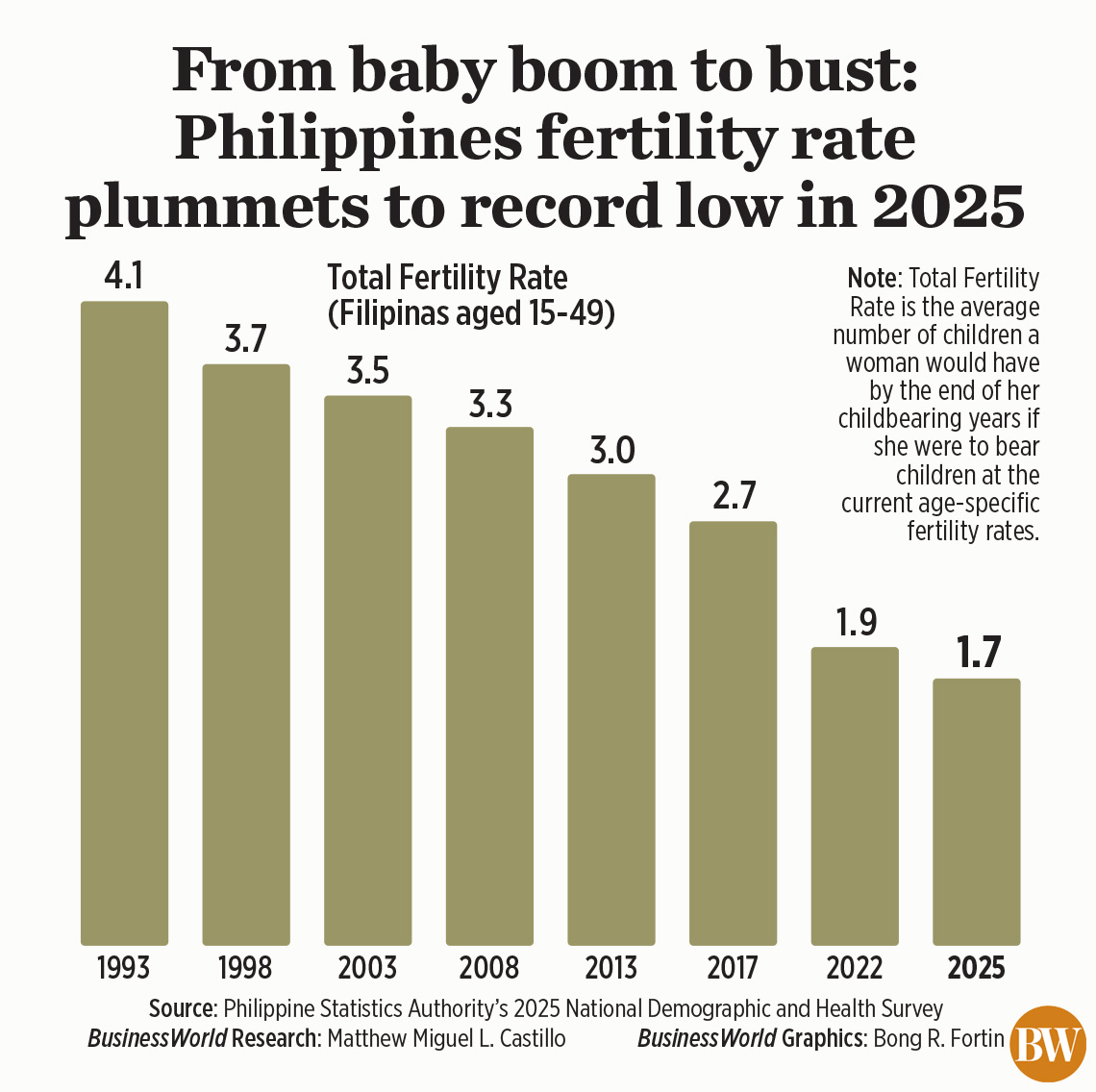
The PSA defines the TFR as the number of a woman’s children by the end of her childbearing years.
By region, the Bangsamoro Autonomous Region of Muslim Mindanao logged the highest fertility rate at 2.4, followed by the Zamboanga Peninsula at 2.3, and Caraga at 2.2.
Meanwhile, the lowest TFR was recorded in Calabarzon at 1.3, followed by Metro Manila and the Negros Island Region at 1.4.
By educational attainment, women who have an elementary-level educational attainment had the highest TFR with 3.1 childbirths inching up from 3 in 2022.
This was followed by those with junior high school-level attainments and no attainments with 2.3 (from 2.5 in 2022), and then by those with senior high school-level attainments with 1.8 (from 2.7 in 2022).
Categorized by wealth quintile, those at the lowest wealth quintile had the highest TFR with 2.8 births from 3.1 in 2022.
This was followed by the second wealth quintile with 2.1 (from 2.2 in 2022), and the middle wealth quintile with 1.7 (from 1.9).
Age-specific fertility rates, which pertain to births per 1000 women over the three-year period covered, were highest in the 25 to 29-year-old age group with 94 births.
This was followed by those aged 30-34 years old with 84 births, and the 20 to 24-year-olds with 67 births.
The percentage of women who said they no longer want children rose to 49.4% from 48.8% in 2022.
By region, the largest share of women with this sentiment was highest in Bicol with 57%, followed by Mimaropa with 56.9%, and the Negros Island Region at 56.7%.
The NDHS is conducted every three years and provides data to guide policies and programs to improve the health and development of Filipinos.
It is also aligned with indicators on the Sustainable Development Goals and the Philippine Development Plan 2023-2028, covering fertility, family planning, maternal and child health, and domestic violence. — Matthew Miguel L. Castillo