Mateship and bayanihan: PHL and AUS’s resilient partnership
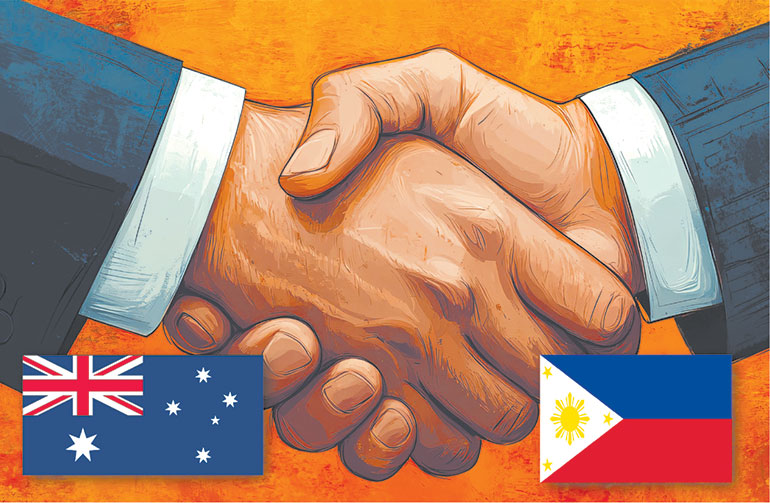
The relationship between the Philippines and Australia stands as one of Asia-Pacific’s enduring bilateral relationships. Spanning eight decades of formal diplomatic engagement, the Philippines-Australia relations are rooted in shared history, mutual interests, and gradual deepening of cooperation across economic, social, cultural, and security dimensions.
Today, this partnership is not only resilient but rapidly evolving to meet regional and global challenges.
Although official diplomatic relations were inaugurated in 1946, historical connections between the Philippines and Australia predate this milestone by at least a century.
Commercial exchanges between Manila and Sydney trace back to the 1800s when Australia imported sugar, coffee, and hemp from the Philippines, then under Spanish colonial rule. These early economic interactions laid a commercial foundation that would later be formalized and expanded.
The modern diplomatic relationship officially began with Australia’s establishment of its first Consulate General in Manila in May 1946, shortly after the Philippines obtained full independence. This move marked the start of official bilateral cooperation and set the stage for sustained engagement in the later decades.
Beyond commerce, the shared experience of World War II deepened ties.
The Philippine-Australia relationship has often been characterized through the complementary concepts of bayanihan and “mateship,” which are both grounded in friendship, solidarity, and mutual support.
These cultural values have undergirded many facets of engagement, from people-to-people links through migration and education, to collaborative efforts in times of crisis.
Shared democratic values and respect for human rights have further solidified the foundation of trust between the two countries.
Diaspora and education
People-to-people links form a core pillar of the Philippines-Australia relations. Australia is home to a vibrant Filipino community, one of the country’s largest migrant groups, with hundreds of thousands of Australians of Filipino heritage.
Education and academic exchange represent another critical dimension. In 2024, nearly 40,000 Filipino students were enrolled in Australian programs, making the Philippines one of the largest sources of international students in Australia.
Trade and investment
The Philippines has been a key trade and investment partner for Australia, with the Philippine economy growing at an average of 6% per year — one of the fastest-growing economies in Asia.
In 2024, two-way trade between the Philippines and Australia reached approximately A$10.7 billion, reflecting strong commercial engagement.
Currently, there are more than 250 major Australian companies that operate in the Philippines, employing more than 41,000 Filipinos in the business process outsourcing, infrastructure, banking, telecommunications, energy, and education sectors.
Philippine enterprises are also expanding in Australia, with notable investments in infrastructure and packaging sectors. Joint ventures and commercial partnerships have diversified the economic linkages beyond traditional goods into services and strategic sectors.
Australia’s trade relationship with the country is underpinned by the ASEAN-Australian-New Zealand Free Trade Agreement (AANZFTA) and the Regional Comprehensive Economic Partnership (RCEP), with the goal of facilitating a more liberal and transparent regional market and investment regimes.
Defense and security
Strategic and security cooperation between the Philippines and Australia is often viewed as a relatively modern part of the relationship, but its roots extend back more than a century.
One of the earliest symbolic markers of this connection dates back to 1922 when Rear Admiral John Saumarez Dumaresq CB CVO, the captain HMAS Sydney during the final years of World War I and the Australian-born commander of the Australian fleet, was accorded the equivalent of a State Funeral in Manila. The gesture reflected early recognition of shared maritime and defense ties.
These bonds were further forged during World War II. Amid the fight for Philippine liberation, eight Australian servicemen who escaped from Sandakan in Sabah joined Filipino guerillas in Tawi-Tawi in 1943.
Security cooperation continued into the post-Cold War era. Filipino personnel served in the Australian-led International Force East Timor (INTERFET) in 1999, supporting East Timor’s transition to independence.
Australia’s security role became especially visible during the 2017 Marawi siege, when Canberra supported the Armed Forces of the Philippines (AFP) through Operation Augury-Philippines, providing intelligence-sharing and expertise on urban counterterrorism.
Australia also contributed post-conflict recovery, partnering with interagency bodies such as Task Force Bangon Marawi to strengthen civil-military coordination in reconstruction efforts.
Today, defense cooperation continues to expand. Australia works closely with the Philippine government to provide training and education to the Philippine Coast Guard (PCG) and the Department of National Defense (DND) with around 100 Australian personnel participating annually.
Established in 2019, the Enhanced Defense Cooperation Program places the bilateral defense relationship on a long-term trajectory, prioritizing military professionalism, counterterrorism, humanitarian assistance and disaster relief, and maritime security.
This cooperation was further demonstrated in November 2023, when both nations conducted joint sea and air patrols in the South China Sea, a tangible expression of their commitment to regional stability and rules-based maritime order.
Development assistance
Beyond diplomacy and defense, the Philippines has been among the largest recipients of Australian development assistance, reflecting Canberra’s strategic commitment to supporting inclusive growth.
Australia’s aid engagement with the Philippines dates back more than 50 years, making it one of Australia’s longest-standing development partnerships in the region. Over this period, Australian assistance has supported initiatives, from poverty reduction and basic service delivery to institutional reform, disaster risk management, and peace-building in conflict-affected areas, particularly in Mindanao.
Flagship programs such as the Philippine-Australia Community Assistance Program (PACAP) have emphasized community-driven development, empowering local governments, civil society organizations, and grassroots communities to design and implement projects that correspond to local needs.
In recent years, Australia’s development assistance has increasingly aligned with Philippine national priorities. Under the Australia-Philippines Development Partnership Plan 2024-2029, cooperation focuses on economic growth, strengthening governance and institutions, enhancing disaster resilience, and supporting peace and stability.
From early trade links and wartime solidarity to a modern strategic partnership, the Philippines-Australia relations reflect a rich tapestry of shared history, values, and practical cooperation.
With roots deeply embedded in mutual respect and cultural connection, the partnership has matured into a comprehensive alliance that spans economic growth, social bonds, and regional security.
As both nations look to the future, their longstanding friendship continues to evolve and flourish, grounded in a shared commitment to peace, prosperity, and collective progress. — Krystal Anjela H. Gamboa