Home Blog Page 925

GSIS continuously reviewing investment policies, Veloso says

GSIS FACEBOOK PAGE

THE GOVERNMENT Service Insurance System (GSIS) will continue to review its policies for investments after the agency’s president and officials were investigated for purchasing shares in a listed company.

“Policies will continuously be reviewed. But it will never change the result. For me, we will continue to find opportunities to grow the GSIS fund and ensure we follow our investment policy guidelines,” reinstated GSIS President and General Manager Jose Arnulfo “Wick” A. Veloso said in a briefing on Wednesday.

In an order dated Sept. 18, the Office of the Ombudsman lifted the preventive suspension on Mr. Veloso and four other officials as there was “insufficient ground to believe that their continued stay in office may prejudice the investigation of the case filed against the respondents.”

In July, the Office of the Ombudsman ordered the preventive suspension without pay for six months against Mr. Veloso and six other GSIS officials for purchasing P1.45 billion in preferred shares from AlterEnergy Holdings Corp. (AHC) under a private placement.

Mr. Veloso said on Wednesday that GSIS made “calculated” investments in AHC. He added that GSIS’ P1-billion investment in DigiPlus Interactive Corp. was able to yield P139 million in returns.

He added that GSIS will continue to invest in companies as long as they can generate returns.

“As long as it continues to pay dividends, as long as their business allows them to operate profitably, then we continue to generate money. And if our government says that that is no longer a legal investment, then we will immediately abide.”

Mr. Veloso said that 19% of the state-run pension fund’s income comes from equities, which is dependent on the performance of the stock market. Meanwhile, 5% comes from private equity, 40% from government securities, 20% from loans to members, 4% from cash and cash equivalents, and 12% from property investments.

He added that GSIS is looking to invest in properties in Metro Manila to boost its property portfolio.

It will continue to hold discussions for the construction of a transport hub in Quezon City, which is expected to rise on a three-hectare GSIS property at the corner of Elliptical Road and Commonwealth Avenue that it expects to boost its profit.

GSIS is also in talks with the Manila City Government for a housing project at the Manila pier. It also wants to help in the development of the Pasig River transport system, with plans to build an asset within the system such as a terminal.

The pension fund is also eyeing a development in the Jai Alai building across Rizal Park in Manila.

As of end-June, GSIS reported a net income of P77 billion, up by 30% year on year. — AMCS
National Government Fiscal Performance

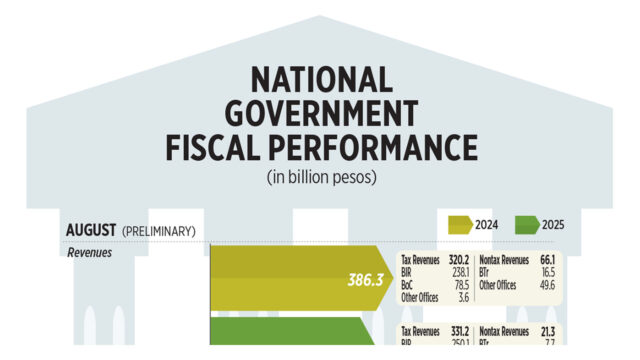
THE PHILIPPINES’ budget deficit widened in August as revenues fell faster than spending, adding pressure on the government to borrow more and keep within its deficit ceiling. Read the full story.

National Government Fiscal Performance

MacroAsia invests P64.47M in Cebu joint venture

MACROASIACORP.COM

MACROASIA CORP., through its unit MacroAsia New Ventures, Inc. (MNVI), has initially invested P64.47 million for a 49% stake in its joint venture with Princess Jolliant Corp., the listed aviation-support and food service provider said Wednesday.

In a stock exchange disclosure, MacroAsia said it signed a joint venture agreement with Princess Jolliant to establish and operate a food commissary business in Cordova, Cebu.

The company said the transaction is pending approval from regulatory bodies for the formation and operational setup of the joint venture.

“Cebu has always been a vital center for trade, tourism, and economic activity… Expanding here will allow us to serve more customers, support local businesses, and create jobs, all while bringing MacroAsia’s expertise in food services to the region. This move is not just about expansion—it is about building long-term partnerships in Visayas,” MacroAsia President Eduardo T. Luy told the stock exchange on Tuesday.

The partnership will allow MacroAsia to expand its footprint in Visayas through MNVI. The joint venture is set to operate Princess Jolliant’s existing commissary while also developing a facility in Cebu to serve institutional clients and the quick-service restaurant sector.

MacroAsia said the tie-up is part of its food segment expansion program and will build a strong presence in Cebu.

Profit sharing will be based on equity participation, and the two parties will jointly decide on management and operations.

It described the investment as income-accretive in the near term, as MNVI takes a 49% stake in the joint venture.

MacroAsia said the partnership would also enable Princess Jolliant to expand its production capacity and services, making Cebu its hub.

Princess Jolliant is engaged in manufacturing, preserving, packing, distributing, and selling food products.

“Recognizing MacroAsia’s strong track record and expertise in Luzon, the company invited MacroAsia Corporation to become a strategic partner in its Visayas expansion,” MacroAsia said.

The listed company said the joint venture is a brownfield investment, taking over operations of an existing commissary with an established clientele.

MacroAsia said its optimism in Cebu stems from the continuing development of Mactan-Cebu International Airport and strong airline activity in the region, making it a strategic location for its food business.

For the second quarter, MacroAsia’s attributable net income fell 15.26% to P365.78 million as higher expenses and lower revenues weighed on results.

Gross revenue declined 3.53% to P2.46 billion from P2.55 billion, while combined expenses rose 10.95% to P2.33 billion from P2.10 billion.

MacroAsia’s core businesses include aircraft maintenance, repair, and overhaul (MRO), airline and institutional catering, ground handling, property development and leasing, and water utility services.

At the local bourse on Wednesday, MacroAsia shares closed one centavo, or 0.24% higher, at P4.26 apiece. — Ashley Erika O. Jose

Alibaba launches Qwen3-Max AI model with more than 1 trillion parameters

BEIJING — Chinese e-commerce giant Alibaba announced on Wednesday its largest ever artificial intelligence (AI) language model, the Qwen3-Max, doubling down on AI as a core business strategy.

The model, Alibaba’s most powerful to date, contains more than 1 trillion parameters, or variables that determine how an AI system processes information, and shows particular strength in code generation and autonomous agent capabilities, Zhou Jingren, chief technology officer at Alibaba Cloud, said at the company’s annual conference.

Autonomous agent capabilities mean the AI system requires fewer human prompts than a chatbot like ChatGPT, and can make decisions and take action independently towards a goal set by the human user.

Alibaba cited third-party benchmarks, such as Tau2-Bench, saying the model outperformed rival products including Anthropic’s Claude and DeepSeek-V3.1 in certain metrics.

Alibaba has made AI a priority alongside its traditional e-commerce operations. Earlier this year, the company announced plans to invest 380 billion yuan ($53.40 billion) in AI-related infrastructure over the next three years as competition to develop advanced AI capabilities intensifies among Chinese tech firms.

During the conference, Alibaba CEO Eddie Wu said the company would increase spending further, though he did not specify the amount.

“The speed of AI industry development has far exceeded our expectations, and the industry’s demand for AI infrastructure has also far exceeded our expectations,” Mr. Wu said.

The company released the Qwen 3 model in April.

Alibaba also unveiled several other AI products on Wednesday, including Qwen3-Omni, a multimodal, immersive system useful for virtual and artificial reality applications such as smart glasses and intelligent cockpits. Reuters

A need to know

FREEPIK/THIS RESOURCE WAS GENERATED WITH AI

THE “need to know” is usually applied to sensitive information that should be for limited circulation. Only those directly involved with implementing or deciding on an issue may secure confidential information on a need-to-know basis. Of course, there are always leaks.

Limiting access to information runs counter to its general availability.

So much unsolicited information can pop up from Viber groups, news updates, solicitation offers, and sales pitches. “Information overload” must be dealt with when getting streams of data which we neither asked for nor really need.

As in a buffet table offering one price for all you can eat, we need to skip many dishes on offer and just concentrate on a few we really like, and to which we are not allergic. Attempting to get everything on the plate, just because we can, is bound to result in a messy table, or a heart attack.

When dealing with too much information, screening becomes necessary. Here, we can follow the social rules for small talk.

When an acquaintance greets you with that general question, “How are you?,” you can skip the gory details of your life in the last six months. A simple answer will do — I’m fine. (What do you want to know?)

It is in the social setting where the phrase “too much information” (TMI) came from. This penchant for details, in private matters like health, relationships, and take-home pay, must be avoided. When dealing with the data fog of life, self-screening is called for. There is an implicit plea then to provide just sufficient information to keep the conversation flowing — you want more iced coffee?

Efficiency is achieved when a specific question is addressed to someone with the needed information. On the Internet, such a straight-to-the-point search may entail checking the source and wording of a quotation, the name of an author of a book, or the successor of St. Peter as the second pope. (It’s Linus.)

Focusing only on areas of common interest narrows the scope of shared information. Would you discuss the toxic corporate culture at the office with your cousin from Sydney at a family reunion? He couldn’t care less about your career challenges or successes.

In the matter of social graces, there is a need to avoid imposing on the short attention span of others. Maybe gossip on other relatives and effective ways of avoiding diabetes may be more welcome topics.

It is still possible to wander off into seemingly irrelevant issues. If the matter of flood control projects and unexplained wealth come up, for example, it is not necessary to enumerate the car models in the garage of the guilty parties. Just the number will do. Caution must be taken that the person one is talking too is not a beneficiary of the scam being discussed — Oh, is she your cousin?

The best way to handle information overload is to simply ignore it. Just because it’s there doesn’t mean it needs to be browsed or given attention. Like packing for a vacation, needs should determine the clothes and items to bring to avoid taking along too much. The “just in case” mentality tends to result in heavy baggage. (What if I need a tuxedo for a garden party?)

Still, the functional use of information is specific, like directions to a restaurant or the color of sneakers available in the market. Such an overly pragmatic approach to information can also be limiting. The search is specific, and the data required serves an immediate need.

What about the individual who does not look at information as merely functional and serving an immediate need?

There is the avid reader who devours books for mere pleasure. He is prepared to be surprised and delighted with areas of knowledge some may consider useless. Should he be deprived of the joys of understanding how the Roman Empire rose and fell, what caused the Spanish Civil War, or the principles of behavioral economics?

Information may be seen as already too overwhelming for individual. Leisure reading may serve no practical purpose, except to broaden the mind and expand its horizons. Anyway, there is no need to take notes. When required, information can still be brought down from the cloud.


Tony Samson is chairman and CEO of TOUCH xda

ar.samson@yahoo.com

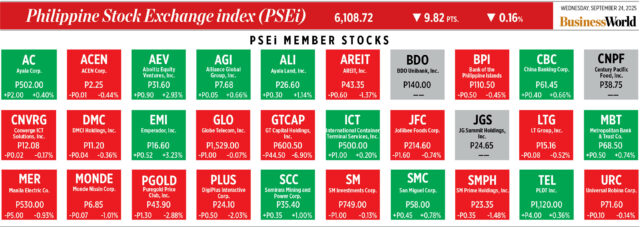
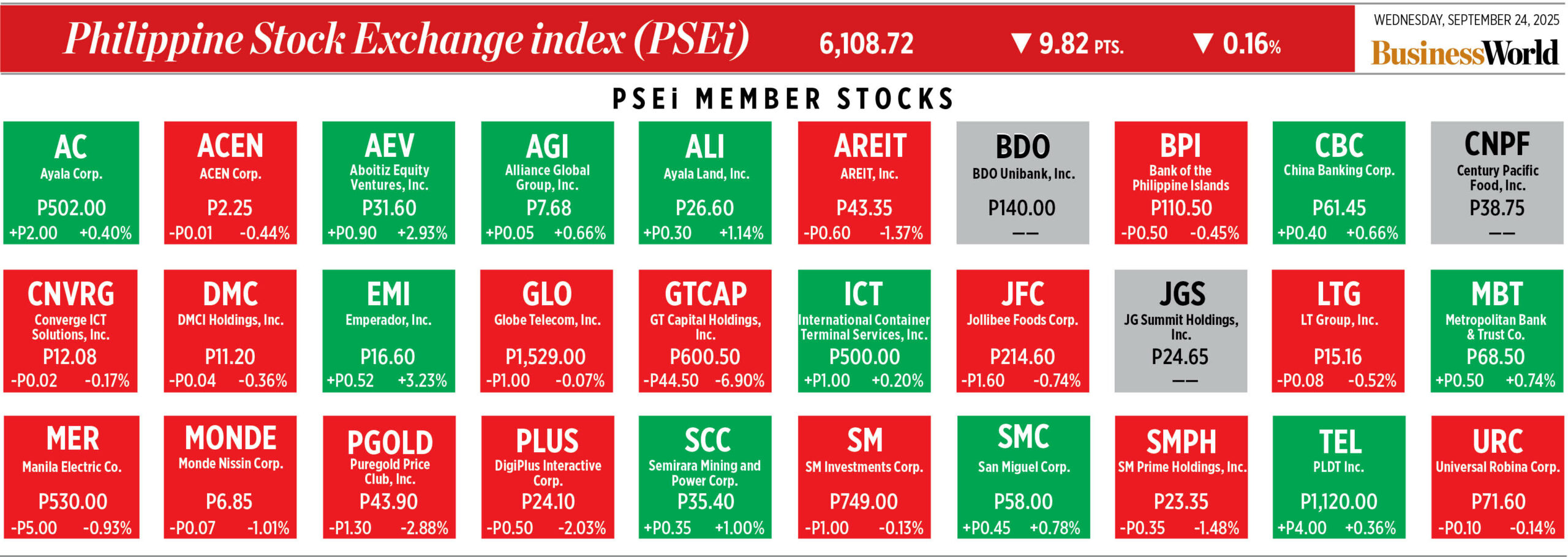
How PSEi member stocks performed — September 24, 2025

Here’s a quick glance at how PSEi stocks fared on Wednesday, September 24, 2025.


PHL stocks slip on weak sentiment, lack of leads

PHILIPPINE STAR/KRIZ JOHN ROSALES

PHILIPPINE STOCKS continued to decline on Wednesday due to the absence of fresh trading drivers and after Wall Street ended lower overnight.

The Philippine Stock Exchange index (PSEi) slipped by 0.16% or 9.82 points to close at 6,108.72, while the broader all shares index went down by 0.3% or 11.38 points to end at 3,682.29.

“The local market declined further as dismay over the Philippines’ corruption issues continued to dampen investors’ sentiment,” Philstocks Financial, Inc. Research Manager Japhet Louis O. Tantiangco said in a market report. “The negative cues from Wall Street, the weakening of the peso against the US dollar, and the recent rise in long-term local Treasury yields also weighed on the local bourse.”

“Bearish sentiment in the market continues to prevail as there is no firm catalyst in sight at the moment. Moreover, international developments are also weighing on Philippine market sentiment, as Fed Chair Powell indicated that slow hiring and persistent inflation are creating a challenging situation for the US economy,” Regina Capital Development Corp. Head of Sales Luis A. Limlingan said in a Viber message.

US stocks finished lower on Tuesday, breaking a three-session string of record closing highs, as US Federal Reserve Chair Jerome H. Powell said the US central bank needs to balance inflation concerns with a weakening job market in its coming interest rate decisions, Reuters reported.

In comments on Tuesday, Mr. Powell offered little hint of when he thinks the Fed might next cut interest rates. The Fed last week cut rates for the first time this year and indicated further cuts may be coming.   

The Dow Jones Industrial Average fell 88.76 points or 0.19% to 46,292.78; the S&P 500 lost 36.83 points or 0.55% to 6,656.92; and the Nasdaq Composite lost 215.50 points or 0.95% to 22,573.47.

Mr. Powell’s colleagues earlier gave comments on both sides of the policy argument. Fed Vice Chair for Supervision Michelle Bowman said the Fed could downplay concerns about persistent inflation and needed to make a commitment to cut rates in support of the job market.

At home, all sectoral indices ended in the red on Wednesday. Property fell by 0.37% or 8.96 points to 2,394.07; industrials went down by 0.33% or 29.85 points to 8,843.17; holding firms sank 0.21% or 10.81 points to 5,012.23; services dropped by 0.17% or 3.93 points to 2,235.86; mining and oil declined by 0.15% or 18.49 points to 12,275.03; and financials slipped by 0.13% or 2.73 points to 2,065.82.

Value turnover fell to P5.26 billion on Wednesday with 5.37 billion shares traded from the P22.69 billion with 2.72 billion stocks that changed hands on Tuesday.

Decliners outnumbered advancers, 103 to 88, while 63 names closed unchanged.

Net foreign selling was at P370.63 million on Wednesday, a reversal of the P7.05 billion in net buying recorded on Tuesday. — Alexandria Grace C. Magno with Reuters

Rice import freeze could be extended; tariff hike studied

PHILIPPINE STAR/MIGUEL DE GUZMAN

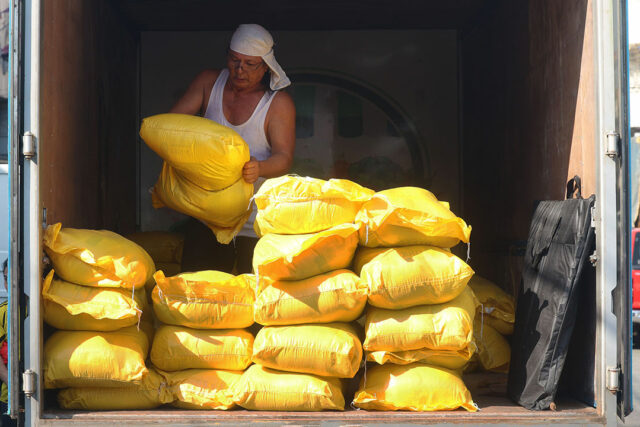
PRESIDENT Ferdinand R. Marcos, Jr. ordered the Department of Agriculture (DA) to be ready to extend the 60-day freeze on rice imports, which started on Sept. 1, and consider a possible tariff increase on foreign rice.

Agriculture Secretary Francisco P. Tiu Laurel, Jr. made the announcement Wednesday, saying the President directed the DA to make the necessary arrangements to extend the import freeze.

“The duration of the import freeze and the possible increase in taxes on imported rice will be determined once we have more accurate data on supply and prices of palay at the farm gate,” Mr. Laurel said after meeting with Mr. Marcos.

The import suspension, which is set to end on Nov. 2, was initially imposed to provide relief to hit by falling prices of palay (unmilled rice), which is competing on the market with imported rice.

Palay prices briefly rose from a low of P8 a kilo to around P14 per kilo before dropping again as the harvest came in, with rice quality affected by recent heavy rains.

Rice import tariffs are currently at 15%, lowered as an inflation-containment measure. The tariff had been 35% previously for Southeast Asian grain. — Andre Christopher H. Alampay

Legislator says Finance department open to discussing tax on billionaires

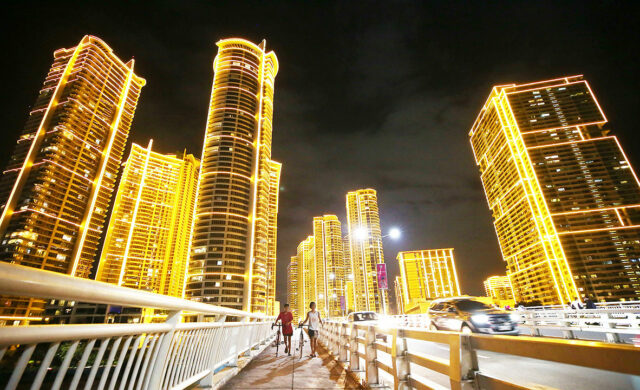
Pedestrians along the Estrella-Pantaleon Bridge are dwarfed by the towering buildings in Makati City, Dec. 5, 2022. — PHILIPPINE STAR/MIGUEL DE GUZMAN

THE Department of Finance (DoF) is open to discussing a “wealth tax,” a legislator said at the DoF’s budget hearing, which could signal greater willingness by the government’s chief fund-raiser to consider new sources of revenue after a longstanding no-new-taxes position.

Sultan Kudarat Rep. Bella Vanessa B. Suansing, speaking at the hearing late Wednesday with Finance Secretary Ralph G. Recto seated near her, said: “The DoF is very open to discussions relating to the wealth tax to be integrated into the revenue program of the National Government,” she said at the hearing.

Mr. Recto’s position on new taxes has subtly evolved after ruling them out entirely last year. In August, he said he will support any tax law passed by Congress.

Wealth tax proposals have ranged from 1-3% of net assets held by billionaires in recent sessions of Congress, though no such bills have been filed in either chamber during the current 20th Congress.

“Ever since the 19th Congress, (the DoF) has been very open with proposals for wealth taxes… because the agency is not just mandated, but has pursued progressive taxation,” Ms. Suansing said.

A bill proposing a 1-3% tax on taxpayers with a net value of taxable assets exceeding P1 billion failed to gain traction in the House of Representatives at the 19th Congress. No counterpart proposal was filed in the Senate.

House Deputy Minority Leader Antonio L. Tinio of the Makabayan party-list said in July that he plans to file calling for a 3% wealth tax on billionaires, and estimated the potential collections from such a bill at P98 billion each year at least.

In early September, Batangas Rep. Leandro Antonio L. Leviste proposed a wealth tax based on land holdings to offset his proposed reduction in value-added tax (VAT) to 10% from 12%.

“We can focus the tax on high-end land because that is harder to hide and transfer compared to other forms of wealth… it comes down to really what’s the easiest way to collect a wealth tax,” he said.

The government should consider pursuing a tax on high-net worth individuals to make the government’s tax system more equitable, according to Jose Enrique A. Africa, executive director at think tank IBON Foundation, speaking to BusinessWorld via Viber.

“The biggest fiscal effort now comes from regressive consumption taxes, like VAT or excise duties, and withholding on wages,” he said, claiming that the financial sector and the wealthy are “lightly taxed.”

Legislators should consider a tiered wealth tax with rates starting at 1% for those holding P1 billion in assets, rising to 3% for those whose wealth exceeds P3 billion, Mr. Africa said.

Luis F. Dumlao, an economics professor at the Ateneo de Manila, said the standard practice for countries implementing wealth taxes typically ranges from 1% to 2% per billion dollars in net worth.

“The current tax system on paper is progressive with a maximum tax of 35%,” he said via Messenger chat. “The fiscal policy is even more progressive with government expenditures disproportionately favoring the poor despite corruption.”

“Before any congressman talks about taxes, politicians must do something first to restore public trust in tax collection and utilization,” John Paolo R. Rivera, a senior research fellow at the Philippine Institute for Development Studies, said via Viber. — Kenneth  Christiane L. Basilio

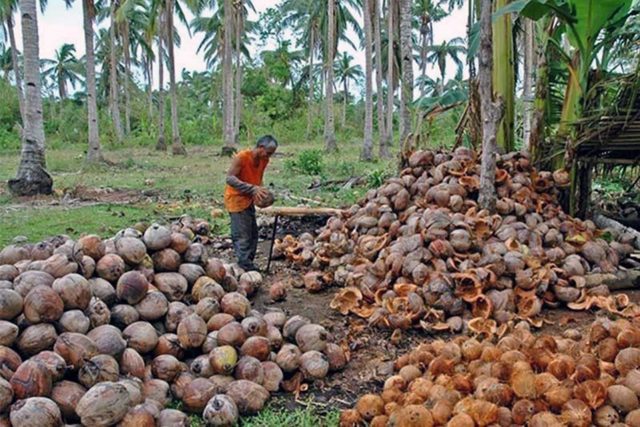
Coconut demand from Europe blunting threat from US tariffs — industry official

PHILSTAR FILE PHOTO

THE strength of the European market for coconut products will mitigate the disruption brought about by US tariffs, according to Marco C. Reyes, chairman of the United Coconut Association (UCA).

Mr. Reyes said at a briefing during the 2025 World Coconut Congress at the SMX Convention Center in Pasay City that the industry must seize opportunities presented by the “surging” demand for “sustainability and healthy products,” noting that the coconut “is at the heart of this moment. Our mission is to bridge that international demand with innovation and sustainable practices to ensure that the entire value chain continues to thrive.”

Mr. Reyes said concerns about US tariffs can be allayed somewhat because Europe is actually the top importer of coconut products, with coconut oil being highly profitable.

China and Japan are also growing partners in the trade in coconut products, he said.

Mr. Reyes also said that while negotiations are ongoing to lower tariffs for certain Philippine products, the coconut industry is focusing on other opportunities.

Mr. Reyes said the industry is in contact with other industries, including livestock and rice farming, to make the broader agricultural sector more sustainable.

Agriculture Undersecretary Roger V. Navarro said at the congress that the industry needs to be sustained through a replanting program in the face of threats from climate change, the ageing tree stock, and waning interest in farming among the younger generations.

Mr. Navarro, who oversees operations for the Department of Agriculture (DA), added: “We must act urgently” in “taking out all policies and regulations that hinder development.”

“You mustn’t just accept what your farmers give you. You must make sure farmers can replant.” Mr. Navarro said.

Mr. Navarro called for protecting the industry during years of low yields, citing the industry’s importance to around 3.2 million Filipinos across 82 provinces.

The congress gathers coconut farmers, processors, exporters, researchers, policymakers and investors, drawing representatives from 20 countries.

The Philippines was among the top exporters of coconut products in 2024, with output valued at $2.66 billion, mostly coconut oil, which accounted for $2.2 billion.

Coconut oil is currently the Philippines’ fifth-leading exported commodity by value, with exports amounting to $1.38 billion in the first half.

The congress runs until Sept. 26. — Andre Christopher H. Alampay

PHL wins seat on IAEA board as emerging user of nuclear power

REUTERS

THE PHILIPPINES won a seat on the board of the International Atomic Energy Agency (IAEA), putting it in position to influence policy as it gears up to integrate nuclear power into its energy mix,  the Department of Energy (DoE) said.

In a statement on Wednesday, the DoE said the Philippines will serve on the IAEA board of governors until 2027.

Energy Secretary Sharon S. Garin said the Philippines will play a role in “shaping global policies on nuclear safety, security, and the peaceful use of atomic energy.”

“As one of only 35 member-states represented on the board, the Philippines will help steer key decisions on safeguards (and) technical cooperation,” she said.

According to the Department of Foreign Affairs (DFA), the Philippines was chosen by acclamation during the 69th Regular Session of the IAEA General Conference in Vienna on Sept. 19.

The Philippines previously served on the board between 2015 and 2017.

Science and Technology Undersecretary Maridon O. Sahagun, head of the delegation to Vienna, said: “The long-standing position of the Philippines is that the peaceful uses of atomic energy are not ancillary to disarmament and non-proliferation — they are foundational pillars of peace, health, and prosperity. We aim to advance these initiatives at this key policy-making body of the IAEA.”

Ambassador to Austria Evangelina Lourdes A. Bernas, permanent representative of the Philippines to the IAEA, said: “Member-states like us who are just embarking on our nuclear energy program and rely on a rules-based international order have a chance to advocate for others like us on the Board.”

Ms. Garin added that the Philippines will be in a position to access to technical cooperation in nuclear medicine, agriculture, food security, and energy.

According to the Philippine Energy Plan, the Philippines’ first nuclear power plant is set to be built by 2032. — Sheldeen Joy Talavera

PHL urged to harness peso to maintain edge in services

BW FILE PHOTO

By Justine Irish D. Tabile, Reporter

THE PHILIPPINES must use foreign exchange to its advantage in response to growing investor interest in the service sector, as manufacturing loses favor due to tariffs, an economist said.

Aris D. Dacanay, HSBC economist for ASEAN, said the manufacturing outlook is currently clouded by uncertainty due to the reciprocal tariffs imposed by the US.

“Ever since US President Donald J. Trump came into power in 2016, the number of trade restrictions on goods we produce has been increasing,” he said at the International Information Technology and Business Process Management (IT-BPM) Summit on Wednesday.

“If you are an investor, why invest in something uncertain when you can invest in something that is more certain, and that is services,” he added.

He said over the last six years foreign direct investment in services has exceeded that of manufacturing, with India and the Philippines among the beneficiaries.

“Since we are a service-oriented economy, we are insulated… Manufacturing as a percentage of total jobs in the Philippines is around 7% because most are in services,” he said.

“Because of that, job creation in the Philippines has remained intact,” he added, citing the weaker job creation trend in manufacturing countries like Vietnam, Thailand, and Malaysia.

Mr. Dacanay said Philippine IT-BPM needs to remain competitive vis-a-vis India, whose own currency has weakened.

“We are among the top two in the world; we are competing with India,” he said.

He noted, however, that India has been able to take market share away from the Philippines because of currency factors.

“If you look at the average peso exchange rate, it has been stable since 2023, but for India (the rupee) depreciated by as much as 6%,” he said.

“By currency movements alone, Indian services have become cheaper… And that, I think, is a wake-up call for us,” he added.

He said that the Philippines should be more accepting of a weaker peso as a service exporter.

He also said that India’s IT-BPM services are much more diverse compared to the services being offered by the Philippines.

“The IT-BPM industry is too big not to innovate; it is too big not to diversify. And to be able to keep ourselves on our toes, we need to be accepting of a weaker peso, and at the same time diversify and make sure that we innovate to the best extent,” he said.

“We are moving in the right direction, moving towards global capability centers and moving towards artificial intelligence,” he added.