

Home Blog Page 9214

DICT tapping ARTA to minimize LGUs cell-site delays

By Arjay L. Balinbin
Reporter

THE Department of Information and Communications Technology (DICT) said it is seeking the aid of the Anti-Red Tape Authority (ARTA) to expedite cell-site projects delayed by local government units (LGUs).

ARTA is the agency authorized to enforce the Ease of Doing Business Law, which sets deadlines for government agencies to act on permit applications, with the time allowed depending on the complexity of the transaction.

“We are now closely coordinating with ARTA para at least man lang mapabilis ‘yung pag process ng mga permits (to at least hurry along the permit process),” Undersecretary Eliseo M. Rio, Jr. told BusinessWorld in a phone interview Saturday.

He noted that some LGUs have been using the cell site projects of telecommunications companies to “generate income.”

“Pinapahirapan nila ang telcos, ‘yung real estate tax na kinukuha nila every year pataas ng pataas, at pinapasa lang ng mga telcos sa kanilang mga customers (The LGUs are giving the telcos a hard time, and their estate tax collections are rising every year. The added costs are getting passed on to the telco customers),” he said.

President Rodrigo R. Duterte signed into law in 2018 Republic Act No. 11032 or the Ease of Doing Business and Efficient Government Service Delivery Act.

The law requires applications or requests for government services to be acted upon within three days for simple transactions, seven days for complex transactions, and 20 days for highly technical transactions.

The law applies to all government offices and agencies in the Executive Department including LGUs, government-owned or -controlled corporations and other government instrumentalities.

Mr. Rio said that currently there are at least “27 requirements” that telecommunications companies have to comply with to get permits to erect cell sites.

Minsan nagiging cause pa ng corruption (The applications are opportunities for corruption),” he added.

He said only around five of those requirements are the responsibility of the national government.

Madali lang naman ang sa national [government]. Ang problema talaga ay dyan sa ibaba (processing applications with the national government is easy. The problem is worse the lower you go),” he noted.

Only about 400 cell sites were erected in the first quarter , Mr. Rio said, well below the government’s target of building 1,785 each quarter to meet the broader goal of 50,000 cell sites nationwide in seven years.

Ang problema LGUs have the Local Government Code; they can make their own local regulations at ‘yan ang more or less nagiging problema natin kailangan siguro i-amend ‘yung Local Government Code, na ang provision on infrastructure dapat standard ‘yan for all LGUs (Under the Local Government Code, LGUs have the power to set their own rules, and that has become a problem. Maybe the Code needs to be amended to standardize the rules for infrastructure projects),” he said.

ARTA Director-General Jeremiah B. Belgica was asked to comment but had yet to reply at deadline time.

On Thursday, the DICT appealed to LGUs and homeowner associations (HoAs) to simplify their permit procedures for telecommunications companies erecting cell sites.

The DICT said streamlining the permit process will “support the accelerated rollout of cell sites and other ICT infrastructure for telecommunications companies and Internet Service Providers to benefit constituents and residents.”

It said LGUs and HoAs must do their part to address the need for connectivity during the pandemic.
Senate bill lays out employment standards for ‘gig economy’

A BILL seeking to define employment standards for the ‘gig economy’ after the pandemic has been filed in the Senate.

Senator Juan Edgardo M. Angara said Senate Bill No. 1469, which if passed will be known as the National Digital Careers Act, said there is a need to institutionalize employment standards as businesses reconfigure their work forces in the wake of the coronavirus 2019 (COVID-19) emergency.

“We are seeing the growth of the so-called gig economy in the country and with the extended period of the lockdown being implemented because of COVID-19, there will be even more activity on this front as businesses adjust to the new normal,” he said in a statement Sunday.

The gig economy depends heavily on freelancers or independent contractors. The government has so far supported digital freelancers through the DigitalJobsPH program that helps them find projects.

Under the bill, the Department of Information and Communications Technology (DICT), the Department of Education (DepEd), the Commission on Higher Education (CHED) and the Technical Education and Skills Development Authority (TESDA) are required to develop programs that will give digital entrepreneurs access to training, market information and innovation strategies.

Such digitally-enabled services include online teaching and tutoring, content creation, digital marketing, mobile app development, and search engine optimization.

It also tasks the DICT and the Department of Public Works and Highways (DPWH) to ensure broader access to high-speed internet.

“A lot of our activities under the new normal will rely on internet connectivity-be it education or commerce, so this must be among our national priorities now,” Mr. Angara also said.

The Department of Labor and Employment (DoLE) and the Department of Trade and Industry (DTI), among other agencies, have been tasked to set the employment standards for digital career workers, particularly on the prescribed minimum wage.

The bill will also incentivize digital workers or freelancers through the grant of full or partial scholarships for training, both here and overseas, as well as subsidies on the use of state-owned facilities, office space, and equipment.

The government will also provide grants-in-aid for acquiring computers, hardware and software. — Charmaine A. Tadalan

Short-term financial management for COVID-19

COVID-19 is generating unprecedented levels of challenges in company ecosystems — including supply chains, customer demand, strategic planning and operations, and liquidity — alongside high levels of uncertainty and volatility. Given this, it has become more essential than ever for companies to focus on short-term financial management as part of their overall business continuity plans.

This article discusses methods of short-term financial management, specifically (1) generating cash and protecting liquidity; (2) preserving working capital; and (3) creditor and debt management.

GENERATING CASH AND PROTECTING LIQUIDITY
To generate cash and protect liquidity, companies can look into cash reserves in subsidiaries and business units, as well as ways to repatriate said cash to areas of the business where it is most needed. Untapped loan facilities and other lines of credit are also options, but these require communication with lenders to confirm availability given these challenging times.

Liquidating short-term securities and other non-essential assets can also be a source of cash. However, care must be taken as to which assets to sell, given the current all-time low in asset valuations. Government stimulus funds and moratoriums on payment of certain bills can also help companies stay afloat. Similarly, insurance claims specifically for business interruptions should be explored. However, given insurers’ recent experience with SARS and MERS, it should be noted that some insurance contracts may include specific exclusions on pandemics or epidemics.

Even so, the cash generation exercise should not be short-lived, given the continuing uncertainty of the COVID-19 situation. Companies need to identify and sequence longer-term cash sources and maintain discipline to perform daily cash tracking, cash flow planning, and determining liquidity strategies. These longer-term cash sources can involve identifying alternative revenue sources for the company and looking at areas within the business where costs can be further optimized.

PRESERVING WORKING CAPITAL
Another area that needs to be managed is how to preserve the company’s working capital reserves. This requires looking into the three aspects of working capital: suppliers (payables), customers (receivables), and inventories.

Delaying payments to suppliers is one possible way to manage working capital. However, care must be taken to distinguish which suppliers are considered essential and non-essential for business continuity. In the case of essential suppliers, open, clear, and transparent communication is key. Companies cannot unilaterally decide to delay all outstanding payments when such payments may make or break key supplier relationships in these challenging times and further worsen the state of an already troubled supply chain. For businesses that have healthy financials, the situation may present a potential opportunity to re-negotiate more favorable payment terms.

Our present situation requires company customer relationship management teams to be more proactive with customers. One approach is for companies to offer discounts on receivables to accelerate payment. As with suppliers, this situation presents an opportunity to re-negotiate pricing and payment terms for existing contracts with customers while taking into consideration their respective financial health. It is crucial to establish better levels of communication with existing customers to establish stronger relationships and generate longer term value that benefits both parties.

In the case of inventory, the general tendency is for companies to liquidate excess inventory to generate as much cash as possible. However, care should be taken given the uncertainty of the pandemic in terms of reliability of the supply chain. There may actually be a need to increase the amount of inventory at hand to decrease the risk of shortages and further damaging customer relationships. Companies will need to reassess their traditional assumptions on economic order quantity and optimal inventory levels, among others.

CREDITOR AND DEBT MANAGEMENT
In the wake of disruption brought about by COVID-19, company short and long-term cash flow forecasts will need to be taken into account and reassessed to determine the likelihood of breaching any debt covenants, as well as the potential inability to service debts as they come due.

Scenario planning and analysis should be considered when forecasting said cash flows, while aggressive, base, and conservative (ABC) assumptions must be developed to take into account indeterminate factors. As an example, “aggressive” can assume fast recovery post-COVID (V-shaped), “base” can assume slower recovery post-COVID (U-shaped), and “conservative” can assume a prolonged impact of COVID (L-shaped). It will be best for companies to be proactive when it comes to discussions with lenders, who will especially appreciate transparency as key stakeholders in the business. Practicing transparency may even open doors to negotiating for better terms or even additional facilities. This is, of course, provided that the negotiating company can clearly prove that they have robust financial management plans in place, and have substantial, well-thought out assessments of how COVID-19 has impacted them.

STAYING ONE STEP AHEAD
COVID-19 continues to present unique challenges for companies today, dampening demand while simultaneously disrupting supply. Staying one step ahead and being proactive in short-term financial management as well as long-term value creation will allow companies to emerge stronger and wiser after this global crisis comes to pass.

This article is for general information only and is not a substitute for professional advice where the facts and circumstances warrant. The views and opinions expressed above are those of the author and do not necessarily represent the views of SGV & Co.


Smith Lim is a Senior Director from the Transaction Advisory Services of SGV & Co.

Lawmaker says second wave of infections likely; cases at 12,513

By Vann Marlo M. Villegas and Gillian M. Cortez
Reporters

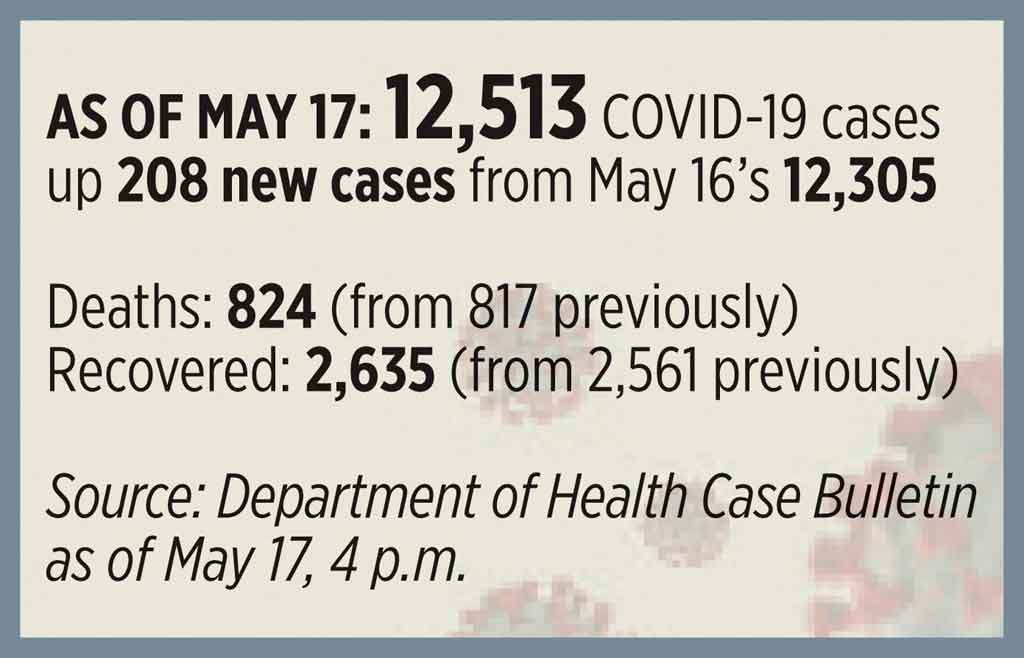
THE COUNTRY should expect a second wave of coronavirus infections as more industries reopen under a relaxed lockdown, a congressman said on Sunday, as 208 new cases were reported, raising the total to 12,513.

“A second wave is expected and we’re preparing for it,” Albay Rep. Jose María Clemente S. Salceda told DZBB radio, adding that the government had to count the economic costs of a lockdown.

The country has lost about P1.2 trillion in economic output because of the Luzon-wide lockdown that started in mid-March.

President Rodrigo R. Duterte locked down the main island, suspending classes, work and public transportation to contain the pandemic. He extended the so-called enhanced community quarantine for the island twice until May 15, and thrice for Metro Manila, key cities and regions until the end of the month.

The presidential palace yesterday warned the public not to be complacent after receiving reports of crowded malls on the first day of relaxed lockdown rules in many parts of the country at the weekend.

“We advise the public not to be complacent and to follow health protocols set by authorities,” presidential spokesman Harry L. Roque said in a statement.

“We must understand that we have started to slowly ease restrictions in order to revitalize the economy, and not because we are safe,” he added.

Also yesterday, the Department of Health (DoH) said the death toll from the virus rose to 824 after seven more patients died. Seventy-four more patients have gotten well, bringing the total recoveries to 2,635, it said in a bulletin.

Of the 208 new cases, 174 came from Metro Manila, one from Central Visayas and 33 were from the other regions, it added.

Thirty laboratories have been licensed to test COVID-19 samples, DoH said.

Meanwhile, the agency released return-to-work rules for places not under the enhanced community quarantine.

Under a memo dated May 11, employers must cut the number of people in the workplace by adopting work-from-home arrangements.

Employers must also measure the body temperature of their workers and monitor symptoms. Workers must wear protective equipment depending on work settings.

Companies must also check the travel history or exposure in the past 14 days of employees reporting for work.

The memo also includes quarantine guidelines for workers.

Under the rules, employers who choose to test employees may do so “in a representative sample of those who have returned to work physically and have a high risk of contracting COVID-19 due to the nature of the work,” citing frontliners as an example.

An inter- agency made up of Cabinet secretaries kept the cities of Cebu and Mandaue under an enhanced community quarantine.

Metro Manila — where the virus is concentrated — along with the provinces of Bataan, Bulacan, Nueva Ecija, Pampanga, Zambales and Laguna were placed under a modified lockdown until May 31.

The modified lockdown allows more sectors to reopen with a 50% skeletal workforce.

About 2% or 191,963 of more than 100 million Filipinos have been tested, according to DoH.

The government seeks to boost its testing capacity to 30,000 samples daily by the end of the month, as it more than doubles accredited labs 66.

The government will buy more than a million polymerase chain reaction and rapid antibody test kits, apart from receiving kits from donor countries including China.

Crop damage from Typhoon Vongfong reaches P185.83M

TYPHOON Vongfong caused about P185.83 million in damages across three regions, destroying rice, corn and high-value crops and killing livestock, according to the Agriculture department.

In a statement, the agency said losses had been reported in Calabarzon (Cavite, Laguna, Batangas, Rizal and Quezon), Bicol and Eastern Visayas regions.

The storm (locally named typhoon Ambo) affected more than 40,000 farmers, damaging 9,977 hectares of agricultural areas equivalent to 10,366 metric tons of volume loss, it said.

It added that some crops avoided damage after an early advisory issued by Agriculture Secretary William D. Dar to regional field offices.

More than 93,000 hectares of land have been harvested for rice and 75,467 hectares for corn in the Cordillera Administrative Region, Ilocos Region, Cagayan Valley, Central Luzon, Calabarzon, Bicol, Western Visayas, Central Visayas and Eastern Visayas regions, the agency said.

Almost 417,000 metric tons of rice worth P7.01 billion and 208,890 metric tons of corn worth P2.17 billion were also saved.

“The rain showers from Ambo were beneficial to the dams in Central Luzon, raising the water levels of Angat and Pantabangan dams,” the Agriculture department said.

As of Sunday morning, the water level of Angat Dam was at 190.62 meters, 0.43 meter higher, according to the local weather bureau.

Meanwhile, the water level of Pantabangan Dam rose by 0.28 meter to 185.32 meters.

The agency said aid was available to farmers affected by the typhoon such as its quick response fund worth P700 million allotted to rehabilitate affected areas, and provide 109,586 bags of rice seeds, 10,116 bags of corn seeds and 1,195 kilos of assorted vegetable seeds.

It put crop and livestock damage in the Bicol region at P79.9 million, covering 3,885 hectares with production loss amounting to 4,564 metric tons, said Rodel P. Tornilla, executive director of the agency’s field office in the region.

Among provinces, Masbate posted the biggest crop loss worth P36.9 million. It said it was still validating damages in affected regions. — Revin Mikhael D. Ochave

Duterte visits Davao amid travel limits caused by COVID-19

PRESIDENT Rodrigo R. Duterte’s spokesman on Sunday defended him from critics after he visited his family in Davao City on a private jet amid travel restrictions meant to contain a novel coronavirus pandemic.

In a statement, presidential spokesman Harry L. Roque said the President had arrived in the southern city “to visit his family whom he has not seen in months and to assess the coronavirus disease 2019 situation in Mindanao.”

He said the pandemic had affected not just one part of the country but the entire Philippines. “As a father of the nation, President Duterte — considering his age and comorbidities — is a hands-on working chief executive who spent his weekend to check how this global health scare impacted the lives of people on the ground, especially those living outside Metro Manila and Luzon,” he added.

Mr. Duterte would be back in Malacañang in time for the next inter-agency task force briefing, Mr. Roque said.

Thousands of Filipinos have failed to go back to their hometowns after Mr. Duterte locked down the entire Luzon island on March 17, suspending classes, work and public transportation to contain the pandemic.

The virus has sickened 4.7 million and killed almost 314,000 people worldwide, according to the Worldometers website, citing various sources including data from the World Health Organization. More than 1.8 million people have recovered, it added. — Gillian M. Cortez

#COVID-19 Regional Updates

Trade chief says failure to provide transport in MECQ areas not good for a company’s reputation

TRADE Secretary Ramon M. Lopez said failure to provide transportation assistance to employees within areas still under modified enhanced community quarantine (MECQ) does not reflect well on companies. Mr. Lopez sent the statement to reporters on Saturday, withdrawing his initial comments that employees who refuse to work due to public transport limitations could be at risk of losing their jobs. Metro Manila, Cebu City, and several provinces in Luzon remain under the MECQ policy, wherein public transport is still banned but more sectors and businesses are allowed to resume operations. Mr. Lopez, in a briefing Saturday, called on employers to provide onsite or near-site accommodations and transportation to workers. “Kung meron silang mga private vehicles, pwede rin pong gamitin ito (If employees have private vehicles, they are allowed to use these),” he said. The Management Association of the Philippines in April proposed a “demand-driven” transport system in Metro Manila, opening up public transport in phases for employees to gradually return to work. — Jenina P. Ibañez

125 more immigration officers at NAIA negative for COVID-19

ANOTHER 125 Bureau of Immigration (BI) officers posted at the Ninoy Aquino International Airport (NAIA) tested negative for coronavirus disease 2019 (COVID-19). These are on top of the 206 officers at the airport and 150 employees at the BI main office who were also negative for COVID-19 in results released earlier. Commissioner Jaime H. Morente said they are conducting mass testing for frontline officers, especially at the airport, as they are at risk of contracting the disease. “We are initially implementing this at NAIA, as well as our Main Office. We are planning to conduct testing in our other offices nationwide as well,” he said in a statement. Rapid testing has also been conducted at the BI detention facility for 159 at-risk inmates and personnel. “Thankfully, all tested negative during the rapid testing, but this does not mean that we will lower our guard,” Mr. Morente said. — Vann Marlo M. Villegas

Baguio City plans tax relief for local businesses

THE Baguio City council is preparing an ordinance that will provide local tax relief to businesses, including those that were allowed continued operations during the lockdown period. In a statement on Sunday, the local government said the draft law is set for publication, after which it will undergo hearings for consideration of additional suggestions. The current draft gives establishments until Nov. 30 to settle business taxes without interest or surcharges for delayed payment. The city administration said the council has requested the “local finance committee to submit recommendations on the pending measure for possible incorporation in the final version, which shall be tackled on the proposal’s third and final reading.” Section 192 of the Local Government Code of the Philippine (R.A. 7160) authorizes local governments to provide tax exemptions, incentives or reliefs. The tax relief is in line with the city’s economic recovery plan following the disruptions brought about by the coronavirus disease 2019 (COVID-19) outbreak. — MSJ

Nationwide round-up

Neighbors citing PHL court victory vs China in sea dispute

SOUTHEAST Asian nations, both with or without claims in the South China Sea, are now citing the 2016 international court ruling in favor of the Philippines to protest against China’s activities in the disputed waters, an expert said. Nguyen Hung Son, director general and head of the Institute for the South China Sea, Diplomatic Academy of Vietnam, said there is a new trend among Southeast Asian states of showing “greater recognition” of the ruling. The United Nations Permanent Court of Arbitration in the Haque favored the Philippines in its lawsuit against China in 2016, rejecting the latter’s nine-dash line claim to most parts of the South China Sea.“The Philippines after three years of keeping quiet on the tribunal’s ruling, this year did a remarkable thing of officially putting the tribunal’s ruling back onto its official policy in its note verbales sent with the UN,” Mr. Nguyen said Friday at the Virtual Speaker Series: Sailing a Course through Contested Waters, hosted by the United States Embassy in the Philippines. Mr. Nguyen also said the Philippine government’s action showed its neighbors that “the Philippines has not trashed the ruling as many suspected.” The Department of Foreign Affairs recently protested against the establishment of the “Nansha” and “Xisha” district in China’s self-declared “Sansha City,” which is within the Philippine territory. Malaysia and Vietnam had done the same in firing off note verbales against China, in which the two states committed to aligning their respective claims with the tribunal ruling. “What’s remarkable too, the recognition of the ruling of the tribunal also came from non-claimants,” he said, citing Indonesia and Singapore. Mr. Nguyen raised the importance of acknowledging the ruling, on top of demonstrating that the Association of Southeast Asian Nations (ASEAN) is not crippled by the coronavirus disease 2019 (COVID-19) pandemic. “We hear that the Chinese center for contemporary international relations submitted their report to the top leadership in Beijing, warning of an unprecedented international hostility towards Beijing after the pandemic,” he said. This, he said, “would indicate how insecure the Chinese leadership feels and the assessment of the negative strategic environment China is facing at the moment.” Moreover, he said the negotiation on the South China Sea Code of Conduct (CoC), which has been delayed by the pandemic, also lies on the willingness of China to modify its behavior in the disputed sea. China and the ASEAN had agreed to work on the completion of the CoC by 2022. — Charmaine A. Tadalan

OFWs required to sign at-your-own-risk form

THE Philippine Overseas Employment Administration(POEA) announced Friday that workers will not be deployed overseas unless they sign a declaration form indicating they understand the risks posed by the global coronavirus disease 2019 (COVID-19) pandemic. In its Advisory No. 60 dated May 15, the POEA said “Overseas Filipino Workers (OFWs) whether land-based or sea-based shall be allowed to be deployed abroad upon the execution of a Declaration signifying their knowledge and understanding of the risks involved as advised by the Philippine Government.” This comes after the national COVID-19 task force announced that OFWs will be allowed for deployment under the eased quarantine policies. POEA also said recruitment and placement agencies are now allowed to resume operations. Health care workers whose contracts were not signed before May 8 are still banned from deployment. — Gillian M. Cortez

Journalists group tells practitioners not to interview suspects without legal counsel

THE National Union of Journalists of the Philippines (NUJP) called on news organizations to include in their reporting manual the prohibition of interviewing persons who have been arrested without the presence of their legal counsels. NUJP noted that the media “may find themselves abetting possible miscarriages of justice” by interviewing those arrested without their lawyer. “As journalists, it is our duty not to cause or minimize harm,” NUJP said in a statement. The statement was prompted by the interviews of the media with Ronnel Mas, who was arrested for posting on Twitter that he will give a P50 million reward to anyone who can kill President Rodrigo R. Duterte. The prosecutor said the warrantless arrest of Mr. Mas was invalid but this defect in the arrest was “cured” when he admitted to the media that he posted the statement. He has been indicted for inciting to sedition. — Vann Marlo M. Villegas

NBA G League welcomes prospects like Kai Sotto

By Michael Angelo S. Murillo
Senior Reporter

MUCH has been said about what the NBA G League could do for Filipino prospect Kai Sotto and his quest to make it to the National Basketball Association. But the organization shared it is happy and excited in return to have the young player on board, seeing how he could further enhance the profile of the league, particularly in attracting more international talent.

Last week, just as he turned 18 years old, Sotto announced that he was joining the NBA minor league organization and becoming the first international player to be part of the G League’s select squad.

The former Ateneo high school stalwart joined top young American talents Jalen Green, Isaiah Todd and Daishen Nix, among others, in the team, which the league will help develop as the players gird for a possible career in The Association.

Seven-foot-two Sotto said he is looking forward to the opportunity to further grow as a player in the G League, honing his basketball skills, building up his body and gaining confidence with the end view of eventually landing in the NBA, which is a dream for him and his family.

On the part of the G League, to have Sotto commit to it is a welcome development and very significant for the organization as it continues with its mission of developing NBA-caliber talent not only from the United States but also outside of it.

“We want to see an NBA-level talent who is willing to be pushed, developed and challenged. There are a lot of talented players around the world, but not all of them would fit in this program because some may not be ready for the commitment of preparing for the NBA,” said Shareef Abdur-Rahim, former NBA All-Star and now G League president, in a video conference call with Filipino media on Thursday.

“We always have a plan to have our program to improve international players. We are excited to welcome Kai knowing how big basketball is in the Philippines. We hope Kai is an inspiration to younger Filipino players that aspire to play in the NBA and aspire to be in the G League,” he added.

Mr. Abdur-Rahim, who spent 12 years in the NBA, went on to say that he is high on the development of Sotto, recognizing the kind of skills set he has at this point and his willingness to learn.

“We think Kai in some ways can a little be under the radar and he is just new to the United States and the popular media of evaluating players. Folks have not seen him a lot, and if you have seen him, then you recognize that he has made tremendous progress,” Mr. Abdur-Rahim said.

In the G League, members of the select squad will be provided with NBA-level coaching and be trained and looked after accordingly.

Sotto has been in the United States for some time now and trained at The Skills Factory in Atlanta, Georgia.

He was previously reported to be considering playing collegiate ball there, getting offers from the University of Kentucky, Auburn and Georgia Tech, among others, until he broke the news that he was joining the G League instead.

Chooks-to-Go president roots for Sotto in G League journey

WHEN news broke out that Filipino prospect Kai Sotto was lacing his shoes in the NBA G League, the local basketball community celebrated and got excited, including Chooks-to-Go president Ronald Mascariñas, who said he is rooting for the young player to do well in his new journey.

Long a supporter of Sotto, Mr. Mascariñas commended the former for taking the challenge of making his family and the country proud by representing and parlaying his wares in the National Basketball Association minor league organization on his way to hopefully fulfilling his dream of playing in the NBA.

“In this time of a crisis, the news of him joining the G League was a development that brought light to our country. It is the road less taken but I know deep down that Kai had his family in mind when he made the decision to join the G League,” said Mr. Mascariñas.

“Being a Filipino, he has a sense of responsibility to give back to his parents. For Kai, this is his way of making Ervin and Pamela proud,” the Chooks-to-Go official added.

Mr. Mascariñas went on to say that he is hopeful that Sotto’s journey would be an inspiration to the Filipinos to not stop pursuing their dreams and making things happen just as he reiterated their group’s continued support for Sotto moving forward.

“Many Filipinos are dreaming of playing in the NBA. And Kai is no different. I can only wish that God will continue to bless Kai and his family in this very tough journey,” he said.

“May he continue to be an inspiration to not just Filipinos but all dreamers and aspirants all over the world.” — Michael Angelo S. Murillo

Eerie silence across stadiums on Bundesliga restart

BERLIN — From social distancing substitutes using airport stairs, to disinfected balls and a potential television audience of one billion, the Bundesliga enjoyed a checkered restart as the first major sports league to resume amid the COVID-19 pandemic.

The German top two divisions, suspended since mid-March due to the virus, returned on Saturday, including the Bundesliga’s showcase — the Ruhr valley derby between Borussia Dortmund and Schalke 04 — as football-starved fans around the globe tuned in to watch live action.

Despite the possible global audience of a billion as predicted by Bayern Munich boss Karl-Heinz Rummenigge, and the hope it gave other sports leagues, it was not what fans had been hoping for.

Instead of the 81,000 crowd packing in Dortmund’s Signal Iduna Park, it was a mere 300 people, including players, staff, team officials, broadcasters and security personnel, as in every stadium as part of a strict health protocol.

Fans have also been banned from inside and around the venues to minimize the risk of infection.

Every shout, scream and thud of the ball bounced off the concrete tribunes and was picked up by the pitchside microphones to create a haunting atmosphere.

In Dortmund, Europe’s biggest standing tribune, the Yellow Wall stood impressively empty as the latest episode of the fiercest German football rivalry unfolded on the pitch.

The games sounded more like Sunday kickabouts or high-intensity training sessions than the return to action of highly paid professionals in the world’s best attended football league with normally an average of about 42,000 spectators per game. The Bundesliga is desperate to complete the season for contractual reasons by June 30.

Police were present at the grounds prior to the start in order to deter fans from gathering outside to celebrate.

“The derby without fans is a new challenge for us but equally complex as a regular game,” Dortmund police said before the game, urging fans to stay at home. “Make it easy for us and stay at home.”

They did stay away from the derby, officials said as the game got under way.

Inside the stadiums masks were mandatory for everyone apart from the players.

Teams had to change their routines completely with Leipzig having brought in a set of airport stairs to keep substitutes at a distance in the tribunes, some three meters higher up than the bench.

The Bundesliga has allowed five substitutions in total per game to cope with the lack of match practice and the congested fixture schedule. — Reuters

UFC caps week of return to action; Overeem wins

THE ULTIMATE Fighting Championship capped a busy week of return to action with another event in Jacksonville, Florida, on Sunday (Manila time), which was highlighted by the second-round technical knockout victory by heavyweight contender Alistair “The Demolition Man” Overeem.

Its third event in eight days after taking a temporary break because of the coronavirus disease (COVID-19) pandemic, the UFC said it hoped that by staging the fights it could somehow give some semblance of normalcy and jump-start things for the return of sports in the United States, which is still struggling to battle the highly contagious respiratory disease.

Dutch Overeem (46-18) was hurt and busted open by American Walt Harris early in their scheduled five-rounder but managed to survive and swing the tide in his favor as the fight progressed.

In the second round, Mr. Overeem managed to land a solid leg kick to the head of Mr. Harris and followed it with a punch to the face that sent the latter to the canvas.

It signalled the end for Mr. Harris as once Mr. Overeem got on the back of his opponent he pounded him with a barrage of punches before the referee stopped the fight at the three-minute mark of the second round.

The win was a bounce-back victory for Mr. Overeem after losing in his previous fight while Mr. Harris (13-8) saw his two-fight winning streak come to an end.

Meanwhile in the co-main event, Brazilian Claudia Gadelha edged American Angela Hill in their women’s strawweight battle by split decision, 28-29, 29-28 and 29-28.

UFC on ESPN was held anew at the VyStar Veterans Memorial Arena behind closed doors with only essential personnel in attendance in accordance with the protocols set to help stop the spread of COVID-19. — Michael Angelo S. Murillo