Home Blog Page 9137

Why we should not ban liquor during ECQ

UNLIKE countries like South Africa and even Greenland, the Philippines is not technically under a total liquor ban during this COVID-19 crisis. However, it feels like it is. When President Duterte imposed the Enhanced Community Quarantine (ECQ, or a nicer way of saying “lockdown”) for Luzon on March 16 amid the threat of the pandemic, the actual guidelines do not include a call for a total liquor ban.

But many Local Government Units (LGUs) have enacted local ordinances to carry out liquor bans. And like dominoes, provinces and Metro Manila cities follow.

While Visayas and Mindanao were not included in the quarantine, Cabinet Secretary Karlo Nograles, the designated spokesperson of the Inter-Agency Task Force for the Management for the Emerging Infectious Diseases (IATF-EID), said these regions outside of Luzon can also impose ECQ as necessary. And, sure enough, almost every province implemented their own ECQ following the same guidelines as announced for Luzon. Almost immediately after the ECQ announcement, the Cebu City government imposed a liquor ban on March 16.

In Metro Manila, liquor bans were not immediately imposed. But it took just a week or after the ECQ was implemented for some of the capital region’s 17 cities to tighten things up. Mandaluyong and Parañaque were among the earliest cities to enforce liquor bans, making their announcements on March 23. They were followed soon by Quezon City, Pasig, and Valenzuela. By the end of March, almost every city — except Makati, Taguig, Malabon, Marikina, Navotas, and Pasay — were implementing liquor bans. But Marikina, Navotas, and Pasay caved in eventually by April. By mid-April, cities nationwide — from Baguio, Legazpi, and Cebu, to Bacolod, Davao, and Cagayan de Oro — were all under liquor bans, easily covering 95% of our population in my humble estimate. This is a bit weird given that even our Muslim neighboring countries like Indonesia and Malaysia, both also in the midst of combating COVID-19, have not imposed liquor bans.

LIQUOR BAN JUSTIFICATION
When a country like South Africa, which is among the top 10 wine producing countries in the world, imposed a liquor ban on its populace during this COVID-19 crisis, something must be really crucial to make this tough decision. Even South African Breweries (SAB), owned by the multinational Anheuser-Busch InBev group (of Budweiser and Michelob), which enjoyed a San Miguel-like beer monopoly in South Africa, ceased operations during this liquor ban. Beer is the overwhelming preferred liquor in the country, followed by wine. Thousands of jobs, and of course the drinking lifestyles, were affected by the ban considering that South Africa is also among the world’s highest per capita consumer of liquor. South African research showed that a significant percentage of these liquor consumers are known to be binge drinkers and severe alcoholics.

President Cyril Ramaphosa declared the outbreak of COVID-19 in South Africa as a State of National Disaster by early March and then a lockdown, which included a liquor ban, by March 27. Many of the reasons cited were health- and social distancing-related, like consumption of liquor affects one’s immune system, and that alcohol reduces a person’s ability to exercise social distancing and follow the personal hygiene measures necessary to limit the spread of person to person virus transmission.

But a more convincing argument being emphasized, especially by healthcare workers, is that hospitals normally have to attend to liquor-related abuses, including car accidents, domestic violence, stabbings, gunshots, and alcohol poisoning. With an alcohol ban, the emergency rooms freed up at least 25% of their capacity that were otherwise given to liquor-related victims. While I do not see this as being the case in the Philippines, if we at all have statics similar to the South African finding, one thing is for sure, our health care is also very vulnerable as that of South Africa is, and every hospital bed and every health care personnel should be attending to COVID-19 and other health emergencies, and not those induced by liquor.

REQUEST TO LIFT LIQUOR RESTRICTIONS
There are liquor bans and there is liquor restriction. The latter is more serious as manufacturing plants of non-essential products, among which liquor products have been classified, have to shut down too. The tiny window of liquor commerce in Taguig, Makati, and Malabon, can dry up soon if no new liquor production nor new liquor importation come through from the strict restrictions during this ECQ.

The problem with this window is it allows those with liquor businesses based in Makati, Taguig and perhaps in Malabon to continue to thrive, almost unfairly against all the other companies based in cities outside of these three outliers. Actually many of these traders are selling off their oldest inventory at good margins given the lack of competition from other cities and other traders.

I am also not surprised that many people attempt to cross city borders to buy liquor, or use Lalamove or Grab to do this maneuver. Finally, I am even tempted to say it appeared elitist that Makati and Taguig, arguably the two most expensive local cities to live in, have no liquor bans. I strongly believe that if any of these three cities can discipline themselves when it comes to liquor abuse during ECQ, then all cities could do so too.

But now, the liquor manufacturers are also crying for help. It took a month after the ECQ was imposed before the Center for Alcohol Research and Development (CARD) Foundation Inc., whose members are composed of the largest liquor companies in the country, from Ginebra San Miguel and Emperador Distillers to the Lucio Tan Group, sent a letter, dated April 16 to Secretary Ramon Lopez of the Department of Trade Industry requesting for the lifting of liquor restrictions, including liquor bans. As CARD Chairman Gerard Tee eloquently explained in his two-page letter and I quote here from his second to the last paragraph: “As already said, the Alcohol Beverage Industry bears already the agony of declining market demand due to the imposition of high excise taxes on alcohol. We are pleading to let us thrive as a business, by allowing our products to exist in the market, with the same freedom of trade given to other goods and products. We plead that you take into consideration the plight of our workers and the benefit that our industry provides to our nation’s economy. It bears stressing, even with pain of being called redundant, that the sale of our alcoholic beverages is not an illegal undertaking, not deserving of the prohibition and total ban imposed by the Government. Allow us a means to survive amidst the already difficult situation we are in.”

Just last January, Republic Act 11467 was signed by President Rodrigo Duterte, raising excise taxes on liquor products. While the business argument will always be a very strong case, as a regular responsible drinker, I feel that alcohol consumption can really calm the nerves, especially when we are dealing with so much stress (social and financial) and a lot of uncertainty. In the US, liquor sales were up in high double-digits during the last week of March.

Unfortunately, like in the case of South Africa’s liquor ban concerns, there will be Filipinos who will abuse alcohol and break ECQ protocols, and thus the worry is really warranted.

MODEST SUGGESTION ON HOW WE LIFT THE LIQUOR BAN
When I read the news that the Philippine National Police declared that the crime rate in the country has gone down over 50% since the ECQ, the statistics included cities with and without liquor bans. I do not think crime reduction was any different in Makati than in Quezon City, which means the ECQ works to deter crime, and may have nothing to do with alcohol. The key is for responsible alcohol consumption. As mentioned also in the CARD Foundation letter to the DTI, and I quote another portion which summed up my belief: “… alcohol consumption can be taken in moderation by responsible individuals of the society who are accustomed to drinking alcohol.”

In the same letter, CARD actually suggested a Partial Ban on Sale and Purchase of Alcoholic Beverages, which CARD equated to a ‘restriction of time that alcohol can be sold.’ I agree with this, but I want to add another equally important provision, a limit to alcohol purchases. It can be likened to airline duty free restrictions of ONLY two bottles of liquor, or only 1.5 liters of alcohol. The time restriction, say from noon to 4 p.m., plus a 1.5L total purchase ceiling per ECQ pass holder, would probably make more sense initially. But this one, if approved, should be implemented in all cities, including Makati, Taguig and Malabon. Again, for fairness and equality, all cities should follow the same rules and guidelines.

The author is a member of the UK-based Circle of Wine Writers (CWW). For comments, inquiries, wine event coverage, wine consultancy and other wine related concerns, please e-mail him at protegeinc@yahoo.com.

Philippines slips in press freedom ranking

Philippines slips in press freedom ranking

How PSEi member stocks performed — April 22, 2020

Here’s a quick glance at how PSEi stocks fared on Wednesday, April 22, 2020.


PSEi sinks for third straight day on profit taking

THE MAIN INDEX marked its third straight day of decline on Wednesday as the market was taken over by profit taking.

The benchmark Philippine Stock Exchange index (PSEi) shed 18.50 points or 0.33% to close at 5,573.75 yesterday, while the broader all shares index slid 1.57 point or 0.04% to 3,388.17.

“We saw heavy selling again at the open today which caused the PSEi to open much lower,” AAA Southeast Equities, Inc. Research Head Christopher John Mangun said in an e-mail on Wednesday.

The main index opened at 5,517.67 before trimming its losses throughout the trading session, reaching a high of 5,577.91 before settling at 5,573.75 at the close.

“After two days of consecutive losses, investors took a chance at current prices. It ended the day above the 5,500 support level and may start moving higher toward the end of the week,” Mr. Mangun said.

For Philstocks Financial, Inc. Research Associate Claire T. Alviar, the activity of investors yesterday was also driven by uncertainties on the extension of the enhanced community quarantine (ECQ) over Luzon.

“The local bourse…(ended) at the red territory as investors awaited the government’s decision whether to lift or to extend the enhanced community quarantine. It was evident on lower value flows today at P5.07 billion, compared with year-to-date average of P6.5 billion,” she said in a text message.

President Rodrigo R. Duterte is expected to make an announcement this week if the ECQ will be lifted or extended after its April 30 deadline. State leaders and experts have met on Monday to discuss options on how to balance containing the virus and kickstarting the recovery of the economy.

“Some investors were undecided on whether to pick up already or sell their position by now since this lockdown is still uncertain when to be lifted,” Ms. Alviar said.

Yesterday’s trading volume stood at 600.52 million issues valued at P5.07 million, down from Tuesday’s 764.34 issues worth P5.66 billion.

Sectoral indices were led by decliners: mining and oil dropped 88.48 points or 1.90% to 4,554.32; property lost 47.26 points or 1.65% to 2,813.66; holding firms trimmed 40.93 points or 0.73% to 5,510.91; and financials slipped 5.74 points or 0.48% to 1,189.60.

The only gainers were services, which added 28.36 points or 2.23% to 1,295.33; and industrials, which picked up 22.22 points or 0.30% to 7,277.63.

“[W]orries on oil prices were still on the table, despite the government’s comment that we are one of the net beneficiaries of it, because of dismal oil demand outlook. While BSP’s (Bangko Sentral ng Pilipinas’) tentative Philippine growth forecast between -1% and 0% dragged investors’ sentiment further,” Ms. Alviar said.

Decliners beat advancers, 101 against 67, while 54 names ended unchanged. Net foreign selling stood at P236.22 million, lower than Tuesday’s P763.35 million. — Denise A. Valdez

Peso inches lower as oil’s drop affects sentiment

THE PESO inched down as the decline in oil prices earlier this week continued to affect investor sentiment. — BW FILE PHOTO

THE PESO closed sideways on Wednesday due to weak investor sentiment because of worries over lockdowns amid the coronavirus disease 2019 (COVID-19) outbreak and after a drop in oil prices.

The local unit finished trading at P50.80 per dollar yesterday, depreciating by a centavo from its P50.79 close on Tuesday, according to data from the Bankers Association of the Philippines.

The peso opened the session at P50.85 per dollar. Its weakest showing was at P50.88 while its strongest was at P50.79 against the greenback.

Volume of dollars traded declined to $212.77 million from the $381.9 million logged on Tuesday.

A trader said the peso’s slight weakness came on the back of market jitters on the economic impact of lockdowns due to the pandemic.

“The peso slightly weakened as investors remained broadly cautious over the economic impact of the coronavirus-related lockdowns locally and abroad,” the trader said in an e-mail.

Meanwhile, Rizal Commercial Banking Corp. Chief Economist Michael L. Ricafort noted the peso’s slight depreciation came after a decline in global stock markets.

“Peso was slightly weaker after healthy downward correction in the US and local stock markets, as the collapse in global oil prices could adversely affect valuation of listed oil companies,” he said in a text message.

Reuters reported that Asian stock markets dropped to two-week lows on Wednesday due to lower crude prices caused by falling demand on the back of COVID-19.

MSCI’s broadest index of Asia-Pacific shares outside Japan slipped by 0.8% while Japan’s Nikkei slumped by 1.2%.

At home, the Philippine Stock Exchange index shed 18.50 points or 0.33% to close at 5,573.75 on Wednesday.

Oil prices found some respite on Wednesday as US oil futures rose more than 20% and Brent prices steadied after a two-day price plunge, as markets struggle with a massive crude glut amid the coronavirus outbreak.

After falling into negative territory for the first time in history amid record trading volumes, US crude futures rose 20% as contracts for May delivery expired and the June contract became the front month.

West Texas Intermediate was up $2.05 or 18% at $13.62 a barrel by 0034 GMT.

Brent crude, which settled down 24% in the previous session, was up 4 cents at $19.37 a barrel after rising more than $1 earlier.

Oil prices have slumped over 70% this year as the coronavirus has slashed demand for everything from jet fuel to gasoline, while storage tanks around the globe are filling rapidly.

For today, the trader gave a forecast range of P50.80 to P51 per dollar, while Mr. Ricafort sees the local unit moving around the 50.70 to P50.90 levels. — LWTN with Reuters

Gov’t recovery strategy takes shape in House

A MAJOR government bank told Congress that its economic stimulus lending programs will be issued under less stringent risk-assessment conditions to facilitate the release of liquidity into the economy during the coronavirus disease 2019 (COVID-19) crisis.

“I got assurances from LBP (Land Bank of the Philippines, or LANDBANK) that their stimulus loans will be off-balance sheet, so they can be administered without the usual rigorous risk-based assessments that banks do. In terms of bank processes, that’s as good as it gets, so our committee is quite encouraged by the assurance,” Albay Representative Jose Maria Clemente S. Salceda, who is also the House Economic Stimulus Cluster Co-Chairman, said in a statement Tuesday.

Bangko Sentral ng Pilipinas Governor Benjamin E. Diokno also told legislators during the virtual hearing of the House Defeat COVID-19 committee on Tuesday that the central bank has effectively eased liquidity conditions by allowing banks to count their loans to small firms as reserves.

“We have freed up from P180 billion to P200 billion and we asked banks to lend the money to MSMEs (micro, small and medium enterprises),” he said.

Finance Secretary Carlos G. Dominguez III said the Philippine Export and Foreign Loan Guarantee Corp., will guarantee part of the loans banks extended to MSMEs to boost lending to small borrowers.

The House economic stimulus sub-committee on Tuesday released a draft bill, the Philippines Recovery Act, which calls for a P613-billion stimulus package to help workers and businesses deal with the effects of COVID-19.

The draft bill classifies economic measures to address COVID-19 as transitional, sectoral and structural interventions.

Transitional interventions are economic relief measures to be implemented immediately after the lockdown to avert permanent damage to the economy. These include wage subsidies worth P110 billion for critical businesses, the self-employed, freelancers and Overseas Filipino Workers.

Compensation for COVID-19 victims will be provided by the Social Security System and the Government Social Insurance System with a total funding of P1 billion. Regulatory relief for all business entities through the suspension or waiving of fees for licensing and payment deadlines is also included.

Sectoral interventions are relief measures intended for MSMEs, tourism establishments, farms and fishing communities, and other critical businesses.

These include the P10 billion in MSME assistance by the Department of Trade and Industry, a separate P25-billion loan program for MSMEs, a P10-billion loan program for the agri-fishery sector, a P43-billion program for tourism assistance by the Department of Tourism and P66 billion worth of trade assistance from the Board of Investments.

Sectoral interventions also include industrial policies such as the imposition of zero tariffs on imported raw materials, the suspension of export percentage requirements, and grants for technological innovation for COVID-19 related products.

Structural interventions include P48 billion worth of credit mediation and refinancing; P300 billion in zero-interest loans to businesses by LANDBANK and the Development Bank of the Philippines; and P650 billion for enhancing the “Build, Build, Build” program.

The bill also proposes the creation of the National Emergency Investment Corp. with P350-billion capitalization which is tasked to “rescue firms that fail due to an unforeseen economic crisis” through convertible loans, debt-to-equity swaps, or outright government purchases.

The draft authorizes the President to reallocate and realign the General Appropriations Acts of 2019 and 2020, and allocate cash, funds and investments held by any government-owned or controlled corporations or any national government agency to provide funding support for the measure.

It also orders the Department of Budget and Management to identify programs, projects, and activities which cannot be implemented effectively as a result of the COVID 19 outbreak. — Genshen L. Espedido

No use allowing POGOs to resume if regulatory issues remain, legislator says

A SENIOR legislator said Wednesday that proposals to allow online gaming firms to resume operations “makes little sense” if it cannot properly document their foreign workers and account for their taxable earnings.

“In hearings in the House and the Senate, we have been told that one, we cannot even properly keep track of and document POGO workers; and two, that we have not been able to collect taxes from them,” House Minority Leader and Manila Representative Bienvenido M. Abante, Jr. said in a statement, referring to the part of the online gaming industry licensed under the Philippine Offshore Gaming Operator (POGO) program.

“If that is the case, then allowing them to resume operations ostensibly so the government can earn revenue to help battle the COVID-19 (coronavirus disease 2019) outbreak makes little sense,” he added.

Aside from unresolved issues in regulating the POGO industry, Mr. Abante said the government will be sending “conflicting signals” to the public regarding the enhanced community quarantine (ECQ) should it allow POGO employees to return to work.

“The government has suspended work in Luzon to keep people from going outside to prevent the spread of COVID-19, but has allowed essential industries like food production, manufacturing, and sales to continue.”

He said that “many of our countrymen want to go back to work because the ECQ has deprived them of their livelihoods, and we tell them that we cannot allow them to work for now for the good of the public’s health.”

Kung hayaan natin makabalik ang POGO sa gitna ng krisis na ito, tatanungin nila, bakit ang mga foreigner na ito pwede magtrabaho, kami hindi? (If we let POGOs return during the crisis, the people will ask why we allow foreigners to work while many of us cannot) That is a conflicting message government cannot send, not while it adopts more measures to strictly enforce the ECQ,” Mr. Abante said.

ACT-CIS Party-list Rep and vice chair of the House games and amusements committee Eric G. Yap earlier called for POGOs to return to work to boost government funds as it addresses the COVID-19 outbreak.

Philippine Amusement and Gaming Corp. (PAGCOR) Chair and Chief Executive Officer Andrea D. Domingo said she “fully supports” Mr. Yap’s petition. Finance Secretary Carlos G. Domiguez III, meanwhile, told reporters Monday that the department is still evaluating whether the POGO suspension should be lifted.

Meanwhile, Ang Probinsyano Party-list Rep. Ronnie L. Ong, who is also vice chairman of the House games and amusements committee, urged the Philippine Charity Sweepstakes Office (PCSO) to continue its operations by launching “secure and fraud-free” interactive mobile lottery games to help the government generate funds to address the COVID-19 crisis.

“Interactive and mobile lottery games can actually be very timely because of the ECQ. Many people are in their homes doing nothing. Instead of wasting money on some online games to fight boredom, they can actually support PCSO lotteries as their way of contributing in the war effort against this unseen enemy,” he said in a statement Wednesday.

Mr. Ong said that the government is losing at least P3.75 billion per month since PCSO decided to stop operations in March. — Genshen L. Espedido

Fuel marking program processes 6.88-B liters as of April 15

THE government has marked 6.88 billion liters of fuel products as of April 15, with 75% of the total marked in Luzon, the Department of Finance (DoF) said.

In a document sent to reporters on Wednesday, the DoF said the marking took place between September and April 15, with 20% marked in Mindanao and 5% marked in the Visayas.

Petron Corp. accounted for 1.618 billion liters of fuel marked or 23.53% of the total, followed by the 20.09% share of Pilipinas Shell Petroleum Corp. with 1.382 billion liters, Unioil Petroleum Philippines, Inc. had an 11.41% share with 785.191 million liters and Chevron Philippines accounted for 10.31% or 709.227 million liters.

Other oil companies that participated in the fuel marking program were Phoenix Petroleum, Seaoil Philippines, Inc., Insular Oil Corp., Filoil Energy Company, Inc. and PTT Philippines Corp.

Fuel marking is an anti-smuggling measure. Fuel that has passed the various stages of tax compliance is marked with a special dye. The absence of a marker dye can be taken as prima facie evidence that no taxes were paid on the fuel.

“Definitely the fuel marking program, as part of our tax reform (program), is having a positive effect on our revenues and therefore, on our ability to withstand the ill effects of the (coronavirus) contagion,” Finance Secretary Carlos G. Dominguez III told reporters in a Viber message Wednesday.

The DoF has estimated additional revenue of about P20 billion this year as due to the fuel marking program’s deterrent effect on smuggling. Before the marking program was implemented, the DoF estimated revenue losses due to fuel smuggling of between P20 billion and P40 billion a year. — Beatrice M. Laforga

DoE releases draft accreditation guidelines for energy-efficiency firms

THE Department of Energy (DoE) released the draft rules for the accreditation of energy service companies (ESCOs), which will help bring about greater efficiency and conservation in the energy industry.

The guidelines comply with a provision in the implementing rules and regulations (IRR) of Republic Act No. 11285, or the Energy Efficiency and Conservation Act.

Among other provisions, the law instructs the DoE to strengthen the current ESCO certification system.

The IRR, issued in November, ordered the department to draft guidelines for the certification requirements, review and evaluation process, and classification of ESCOs.

ESCOs are defined by law as offering “multi-technology services and goods towards developing and designing energy efficiency projects, delivering and guaranteeing energy savings, and ensuring cost-effective and optimal performance.”

The proposed rules state that ESCOs, which can be classified as either registered or certified, will have to undergo technical and legal evaluations as part of the accreditation process.

Certified ESCOs will also have to be evaluated for their financial capacity, and are required to submit financial statements as part of their applications.

Accredited firms may also be required to submit reports on their on-going and completed projects on April 30 of each year.

The draft rules were drawn up by a committee led by the DoE’s Energy Utilization Management Bureau. This panel consists of division chiefs of the department’s general legal services, power compliance, and energy efficiency and conservation division, along with the section head of the energy management advisory service sector.

The DoE is currently soliciting comments on the draft rules until April 30. — Adam J. Ang

US extends $5.3M in humanitarian assistance for COVID-19 containment effort

THE US has provided $5.3 million worth of humanitarian assistance to the Philippines in support of efforts to contain the coronavirus disease 2019 (COVID-19) outbreak.

“The US government approved an additional P269 million in health and humanitarian assistance to help support the Philippines,” the US Embassy in the Philippines said in a statement Wednesday.

US President Donald J. Trump on Sunday made a phone call to President Rodrigo R. Duterte, during which he offered another round of assistance to the Philippines.

“This newest tranche of US assistance will support laboratory and specimen-transport systems and intensify case-finding and disease surveillance.”

It also intends to assist Filipino and international experts in risk communication and infection prevention, among other measures.

The Philippines earlier received $4 million worth of assistance from the US.

The previous round of funding was meant to increase testing capacity to 3,000 samples per day from 200. It also included a donation of 1,300 cots for Philippine medical facilities.

The Department of Health said as of April 14, testing was available in 15 separate centers. — Charmaine A. Tadalan

PHL raw sugar output expected to decline amid liberalization worries

RAW SUGAR output in the Philippines during crop year (CY) 2020-2021 is expected to drop, as land planted to sugarcane continues to decline and producers remain cautious about plans to liberalize sugar imports, the United States Department of Agriculture (USDA) said.

In its Global Agricultural Information Network report for the Philippines, the USDA said that raw sugar production for CY 2020-2021 is estimated at 2 million metric tons (MT), against 2.025 million MT a year earlier.

“Sugar producers remain cautious about the impact of possible deregulation, as Philippine economic managers consider further trade liberalization beyond rice, such as the sugar and corn sectors,” the USDA said.

Meanwhile, sugar demand for CY 2020-2021 is expected to increase to 2.35 million MT due to increased usage of sugar by food and beverage manufacturers.

Sugar demand could also be spurred by the recovering global economy when it emerges from the coronavirus disease 2019 (COVID-19) crisis.

The report also estimated refined sugar imports in CY 2020-2021 at 450,000 MT, while exports of sugar to the US market are expected to grow to 140,000 MT.

Land planted to sugarcane in 2019-2020 fell to 406,500 hectares from 410,000 hectares a year earlier due to poor weather conditions. — Revin Mikhael D. Ochave

BIR rewards bayanihan spirit with tax advantages

With steadily increasing COVID-19 cases, major cities on lockdown, and most businesses closed, the government has appealed to the private sector to contribute to relief efforts in the spirit of bayanihan. The Bureau of Internal Revenue (BIR) released Revenue Regulations (RR) No. 9-2020 in line with Republic Act No. 11469, otherwise known as the Bayanihan to Heal as One Act, the main objective of which is to adopt urgently-needed measures to address the novel coronavirus outbreak. In particular, RR No. 9-2020 liberalizes the grant of incentives for certain donations in response to the COVID-19 crisis.

The Tax Code grants donor’s tax exemptions and full/partial income tax deductibility for qualified donations made to the national government for NEDA-approved projects, and to accredited non-stock, non-profit organizations (NSNP) formed and operated exclusively for social welfare and charitable purposes, among other purposes.

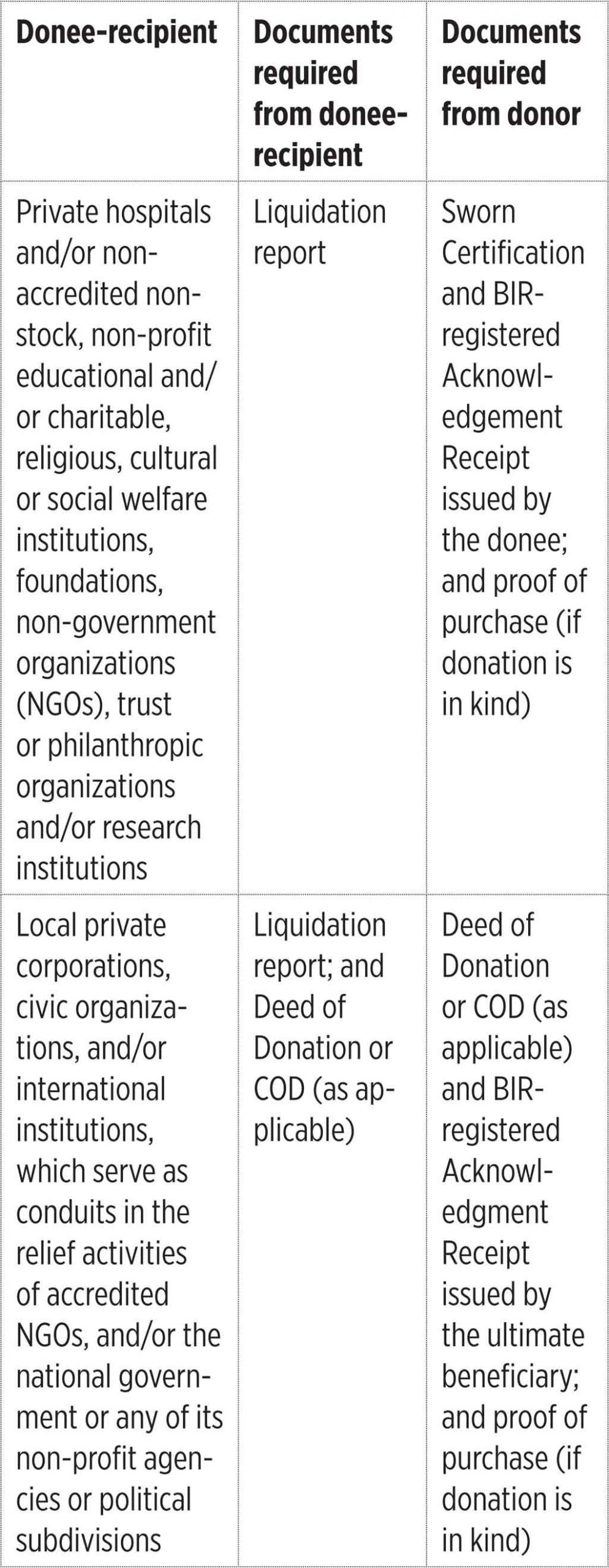
RR No. 9-2020 broadens the coverage further by granting full deductibility for COVID-19 related donations given to the national government during this state of emergency, even if not included in NEDA’s annual priority plan. More importantly, the RR allows donors to donate directly to other donees and still avail of donor’s tax exemption and full deductibility. These additional donees are: private hospitals, NSNPs (even if non-accredited); and entities which serve as conduits in the relief activities of accredited NGOs, and/or the national government.

The tax incentives under the RR cover donations for the sole purpose of combating COVID-19, given from March 16, the start of the Luzon-wide enhanced community quarantine (ECQ), until the end of the three-month effectivity period of the Bayanihan Act. The donations mentioned in the RR are not only limited to cash, but also include health care equipment or supplies, relief goods, and the use of personal and real property.

For donations in kind, the input VAT attributable to the purchase of goods may be creditable against the donor’s output VAT. Needless to say, such input VAT credits must be supported with official receipts or sales invoices. Such donations will not be treated as transactions deemed sales subject to VAT.

DOCUMENTARY SUPPORT FOR TAX-EXEMPT DONATIONS
The availment of the tax incentives is subject to the timely submission of the following required supporting documents by both the donor and donee:

As RR 9-2020 did not provide for a specific timeline, it appears that the COD must be filed by the donee with the BIR following the deadlines in other existing regulations. Normally, the COD must be filled within thirty days (30) from the receipt of the donation. Pursuant to RR No. 10-2020, the filing of the COD is extended for thirty (30) days from the lifting of the ECQ.

The donor’s obligation to file a Notice of Donation has been waived by the BIR during this period.

The above documents must be submitted by both parties within 60 days from the lifting of the ECQ to their registered Revenue District Offices.

Despite the seemingly stringent requirements, the RR leaves ample room for flexibility. For one, if the donee does not have any BIR-registered Acknowledgement Receipt, it may use the template for an acknowledgment receipt provided under the RR.

Also, the Sworn Certification may be executed by the donor, instead of the donee.

To curtail possible abuse, the BIR reiterated its right under the Tax Code to audit the exemption and deductibility of the donations by checking the documents submitted by the donor and donee.

While RR No. 9-2020 is a timely perk to taxpayers who want to join the fight against COVID-19, there is room to enhance the guidelines by clarifying a few points:

• In prescribing the documentary requirements for donations to the additional donees under Section 4, the RR appears to have erroneously included accredited NSNPs in the list. The supporting requirements on donations to accredited NSNPs are already separately discussed in Section 3 of the RR.

• The RR did not provide guidance on how the donor should determine the value of the deductible expense related to the use of his property (such as vehicles, lots, or buildings) and how this should be taken up in the liquidation report, Sworn Certification and BIR-registered Acknowledgment Receipt.

• It is not clear whether the input VAT incentive on donations in kind is also applicable to those made to the additional donees since the RR referred only to donations enumerated in Section 3.

• For donations coursed through another entity, it is not clear if the liquidation report must be filed by the donee-recipient or the ultimate beneficiary.

• It might be good if the RR can further clarify which donations may be classified as relief goods entitled to the incentives. For example, would items such as shampoo, toothpaste (or even deodorant) qualify? If not allowed, then such items may qualify for tax incentives only if donated to the National Government or accredited NSNPs.

Despite these inconsistencies which I hope will be clarified subsequently, the RR is still a welcome development to taxpayers who have aligned their resources with their values during these times. With these tax perks, hopefully more taxpayers will be encouraged to participate in social welfare initiatives.

The views or opinions expressed in this article are solely those of the author and do not necessarily represent those of Isla Lipana & Co. The content is for general information purposes only and should not be used as a substitute for specific advice.


Elyse O, Lui is a senior associate with the Tax Services Group of Isla Lipana & Co., the Philippine member firm of the PwC network.

(02) 8 845-27 28

elyse.o.lui@pwc.com