

Home Blog Page 8875

Nationwide round-up

Senators call to prioritize job generation in COVID measures

SENATORS ON Monday pushed for measures that will create and preserve jobs amid the coronavirus pandemic that has so far left 7.3 million Filipinos unemployed. Senator Imee R. Marcos, economic affairs committee chairperson, has filed Senate Bill No. 1590, the Trabaho sa Oras ng Pandemya bill, which mandates government agencies to integrate their job generation programs. “Ang unang-una natin kailangan gawin ‘yung (The first thing we should address is) joblessness,” Ms. Marcos said in an online briefing Monday. “Ang gobyerno may programang ganyan kaso watak-watak (The government’s current program is disorganized),” she said, citing the cash-for-work program under the Department of Social Welfare and Development and the cash assistance to displaced workers from the labor department, among others. The bill calls for the establishment of a council that will draft a national plan on job creation and provide assistance to unemployed Filipinos in coordination with various government agencies. It will also appropriate P200 million annually through the national budget. The bill was filed in light of the increasing unemployment rate after a lockdown was imposed since mid-March, suspending work, classes and public transportation. While the government has eased restrictions in most areas, the economic downturn due to the coronavirus outbreak lingers. “Our economy simply cannot afford another ECQ (enhanced community quarantine) or even a continued persistent lockdown,” Ms. Marcos said. For his part, Senator Sherwin T. Gatchalian asked state economic managers to increase spending for preserving jobs through a stimulus package. “Sa akin, iisa lang ang dapat tutukan ng (For me, the focus of the) stimulus package at ito ‘yung (should be) job preservation,” Mr. Gatchalian, who is vice chairman of the economic affairs committee, said in a statement Monday. The proposed Bayanihan to Recover as One law provided for a P140 billion standby fund for targeted sectors. The Senate was unable to pass the measure on final reading in the absence of a notice certifying the bill as an urgent measure from Malacañang. — Charmaine A. Tadalan

OVER 1.3M families served with cash aid round 2
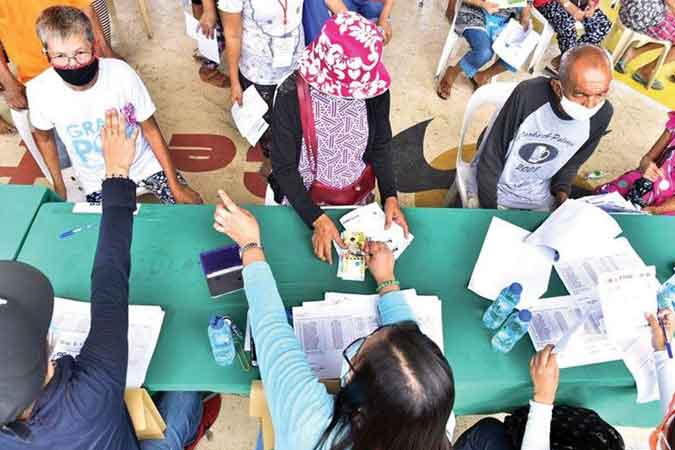
PHILSTAR/EDD GUMBAN

MORE THAN 1.3 million families have received their cash aid under the second round of the government’s social amelioration program (SAP), which targets 18 million low-income households affected by the lockdowns due to the coronavirus outbreak. “Ang total number na nabigyan na natin ng ayuda na second tranche ay (The total number of those given aid for the second tranche is) 1,345,102,” Presidential Spokesperson Harry L. Roque said in a briefing on Monday. He added the total amount distributed was P6.79 billion. The SAP is a two month financial subsidy program, ranging from P5,000 to P8,000 per month depending on the region’s minimum wage level, intended to help families during the strict quarantine period from mid-March to May. The first round of distribution has been widely criticized for delays, inefficiencies, and alleged corruption in several localities. The government vowed improvements in the second tranche with the use of electronic platforms for distribution. — Gillian M. Cortez

DA taps renewable energy for urban agriculture program

THE DEPARTMENT of Agriculture (DA) will maximize the use of renewable energy to sustain food production under its Urban Agriculture Project. In a statement on Monday, Agriculture Secretary William D. Dar said he has received 19 units of 30-watt solar panels from Weather Philippines Foundation Inc. President Maribeth L. Marasigan, which will be used to power water systems for vegetable production. Mr. Dar said the solar panels will generate electricity to sustain the DA’s aquaponics and hydroponics technologies located in the gardens of the Bureau of Plant Industry (BPI) in Malate, Manila. “We are promoting,in a big way, renewable energy in agriculture as this is the key to level up food production in the future,” Mr. Dar said. Mr. Dar encouraged other private companies to partner with the DA for projects involving primary production, secondary, and tertiary processing through their agribusiness efforts and corporate social responsibility programs. Meanwhile, BPI Director George Y. Culaste has collaborated with Aboitiz Equity Ventures, Inc. on various innovation activities and support in value-adding and agribusiness. — Revin Mikhael D. Ochave

POGOs’ pull out not an economic loss — senator

THE DEPARTURE of Philippine Offshore Gaming Operators (POGOs) is not considered a loss to the country’s economy, a senator said on Monday. The Philippine Amusement and Gaming Corp. disclosed over the weekend that two POGO firms have left the country over difficulties in securing tax clearance from the Bureau of Internal Revenue (BIR). “POGOs won’t be a loss to the Philippine economy. We should attract companies that invest in Filipino people. Good riddance,” Senator Joel J. Villanueva said in a phone message Monday. Senators have previously slammed POGO operations over violations such as the failure to pay taxes, illegal employment of foreign workers, and alleged link to the rise in human trafficking incidents. Mr. Villanueva and Senator Risa N. Hontiveros-Baraquel noted that the firms pulling out their operations from the country should still settle their tax dues. “The exiting POGO companies should still pay the taxes they owe us. Otherwise, we should blacklist them and name them publicly so that other countries will be warned about the behavior of these companies,” Mr. Villanueva said. POGOs are subject to a 5% franchise tax, in lieu of all kinds of taxes; normal income tax, value-added tax and other taxes on other related services income from non-gaming operations, among others. — Charmaine A. Tadalan

2020 bar exams postponed

THE 2020 Bar Examinations, annually held in November, has been moved to a still undetermined schedule next year, the Supreme Court announced Monday. Associate Justice Marvic M.V.F. Leonen, in a bulletin, said the postponement in consideration of the coronavirus outbreak “will definitely not be held at a date earlier than February 2021.” Mr. Leonen has previously said that the next bar exams will be held in Manila and Cebu City.

Past bar exams were held on the four Sundays of November at the University of Santo Tomas in Manila. In the 2019 exam for lawyers, 2,103 out of 7,685 takers passed. Their oath-taking was held online on June 25. — Vann Marlo M. Villegas

Justice chief again nominated for Supreme Court seat

JUSTICE SECRETARY Menardo I. Guevarra is again nominated for a seat in the Supreme Court to be vacated by Associate Justice Jose C. Reyes, Jr. who will retire on September 18. This is the second time Mr. Guevarra was nominated by retired Sandiganbayan Associate Justice Raoul V. Victorino to the Judicial and Bar Council, with the first nomination late last year for the associate justice post vacated by now Chief Justice Diosdado M. Peralta. Mr. Guevarra declined the nomination then, saying he is “still in love” with the Department of Justice. In his letter to the JBC, Mr. Victorino said Mr. Guevarra is a “person of proven competence, integrity, probity and independence and his sense of patriotism through his socio-civic engagements… This time, I believe, is that he will meet his true love to the other side part of Padre Faura, Manila. May his love for justice move the Secretary of Justice to the glorious and historic halls of the Supreme Court,” the nomination read. The JBC revised its rules effective June 8, including provisions specifying remaining years of service required for applicants prior to retirement. Applicants for associate justice or chief justice position must have at least 2.5 years remaining if they have served as associate justice or presiding judge of an appellate court, court administrator, chairperson of constitutional commission, solicitor general or department secretary, according to the revised rules. Five remaining years prior to retirement is required for applicants who have not served any of the said positions. Applicants to the high court must be at least 40 years old and have been a judge of the lower court or engaged in practice of law for 15 years. Mr. Guevarra is now 66 years old.— Vann Marlo M. Villegas

Inflation benign, reserve ratio cuts still on the table — Diokno

BANGKO SENTRAL ng Pilipinas (BSP) Governor Benjamin E. Diokno said monetary authorities continue to view the inflation environment as stable over the next three years, a key consideration in the decision to reduce rates last week.

He added that the bank retains the option to reduce reserve requirements for banks, signalling that the BSP continues to look for ways to increase the financial system’s liquidity to facilitate the economic recovery.

“The (inflation) risks are tilted to the downside from 2020 to 2022,” Mr. Diokno said in a text message to BusinessWorld.

“Downside risks are the deeper impact of the coronavirus on domestic growth with medium (50%) probability and global growth with medium probability too (50%),” he added.

The BSP’s Monetary Board reduced rates by 50 basis points (bps) Thursday, bringing the overnight reverse repurchase, lending, and deposit rates to record lows of 2.25%, 2.75% and 1.75%, respectively. Mr. Diokno said the current inflation trend gave the BSP leeway to lower rates.

The fourth easing round, which brings rate reductions this year to 175 bps, confirmed the BSP’s accommodative direction in bringing down cost of borrowing and ensure liquidity to kick-start the economic recovery.

The central bank revised its average inflation outlook for 2020 to 2.3% from 2.2% while the 2021 forecast was raised slightly to 2.6% from 2.5%. Both outlooks are closer to the lower end of the 2-4% inflation target set by the BSP.

“Upside risks to inflation are global rice price increases, pending electricity rate and water rate increase, all with low (25%) probability,” he said.

Headline inflation in May settled at 2.1%, against the 2.2% recorded in April and the year-earlier 3.2%. This brought the year-to-date inflation average to 2.5%.

“(W)e’re confident that inflation will be benign for the next three years and in fact that is one of the basis for the policy cut…You know, inflation is the least of our worries,” Mr. Diokno told ABS-CBN News Channel Monday.

As restrictions on movement are eased, some commodities may see manageable upticks in prices as demand picks up, according to Security Bank Corp. Chief Economist Robert Dan J. Roces.

“Gradual demand recovery may be clustered mostly on essentials (primarily food and medicines) in the short to medium term as consumers opt to preserve cash, and thus other items may offset any increases,” he said in a text message.

Meanwhile, Mr. Diokno also said reserve requirement ratio (RRR) cuts are also still being looked at to boost liquidity during the crisis.

“Let me be very clear that the option to cut RRR remains on the table but we’re monitoring the liquidity in the system,” he said in an interview with ABS-CBN News Channel on Monday.

Mr. Diokno is authorized to cut up to 400 bps this year in bank RRR. So far, the reserve requirement for big banks has been reduced by 200 bps. — Luz Wendy T. Noble

World Bank flags unmet goals in NCR wastewater project

THE project period for a Metro Manila wastewater collection and treatment management system is due to expire Tuesday with its main backer, the World Bank, noting that the project has yet to meet targets for the number of people reached, among others.

According to a World Bank implementation status and results report, the project is scheduled to close on June 30. It took in $275 million worth of financing starting in October 2012, with the original project expiration set for June 30, 2017 but was extended to June 30, 2020.

The bank gave a “moderate” overall risk rating for the project and issued a “moderately satisfactory” grade for the implementing agencies in as far as the objectives that were met.

It gave a ”moderately unsatisfactory” evaluation of overall implementation progress.

As of the end of May, the bank said Maynilad Water Services, Inc., one of the implementing agencies, exceeded its objective in reducing biological oxygen demand (BOD) in collected wastewater, after covering 2,484 tons per year, or well above its target of 1,848 tons per year.

Manila Water Company, Inc. (MWCI), the other implementing agency, partially achieved the BOD target at 76% completion rate as of May 31, with around 94% completion expected by September, according to the World Bank.

In terms of the number of people benefitting, it said the entire project has reached 72% of the 2.4 million target, with MWCI exceeding its goal of 1.2 million and Maynilad reaching 473,076 out of its 1.3 million goal.

“It is projected that with the completion of Cupang STP (sewerage treatment plant) by third or fourth quarter of 2020, an additional 13% (will be added to) the project’s total wastewater treatment capacity and an additional 353,846 people (will benefit) from the project,” it said.

It said the two water concessionaires exceeded their targets on private capital mobilized, an indicator of counterpart-funding availability.

Both companies failed to meet their targets for construction works as of May 31, due to the lockdown imposed in mid-March.

MWCI hit its target to increase the wastewater treatment capacity by 165,000 cubic meters according to the bank, while Maynilad raised capacity by 61,750 cubic meters at the end of May, underperforming the target of 187,500 cubic meters.

“An additional 46,000 cubic meters of wastewater treatment capacity is expected with the possible completion of Cupang STP by September 2020. This will possibly bring MWSI’s total treatment capacity to 107.75 cubic meters (57% of target),” it said.

The World Bank has disbursed 97% or $265.64 million of the $275-million loan facility.

The project aims to improve wastewater collection and treatment systems in selected sub-catchments in Metro Manila by backing MWCI and Maynilad’s enhancement projects through the Land Bank of the Philippines. — Beatrice M. Laforga

PhilMech seeks P5.6-billion budget for 2021 to fund farm mechanization

rice palay harvest
PHILSTAR/MICHAEL VARVCAS

THE Philippine Center for Postharvest Development and Mechanization (PhilMech) told Congress on Monday that it is proposing a P5.6-billion budget for next year to support mechanization programs under the Rice Competitiveness Enhancement Fund (RCEF).

In a presentation to the House Committee on the North Luzon Growth Quadrangle, PhilMech Executive Director Baldwin G. Jallorina said that the P5.6 billion includes allocations for programs under RCEF (P5.1 billion), personnel services (P133 million), overhead (P87 million) and research (P302 million).

RCEF is designed to help farmers better compete with imported rice and is funded with P10 billion per year in tariffs collected from rice imports.

RCEF also includes programs for seed development, propagation and promotion; credit assistance to farmers and cooperatives; and farmer training.

Asked by House Deputy Speaker Deogracias Victor B. Savellano if PhilMech has programs to repair machinery, Mr. Jallorina replied, “Right now the RCEF mechanization program gives away brand new equipment but no provisions for repair.”

Agriculture Undersecretary Rodolfo V. Vicerra said Agriculture Secretary William D. Dar has ordered regional offices to monitor farm machinery that can be repaired.

“In the last two weeks kasama po ito sa mga priority na in-order po ni Secretary William Dar sa lahat ng ating mga regions na i-monitor ‘yung mga pwedeng ma-activate na mga farm machineries. Dapat po talaga mabigyan natin ng tulong ’yung mga farmers natin kasi nga po farm machineries are not their primary area of competence and we need to be able to assist them (This was among the priorities set in the last two weeks by the Secretary — for the regions to look out for machinery that can be activated, to help the farmers, because repair is not their primary area of competence),” Mr. Vicerra said.

The Northern Luzon regional offices of the Department of Agriculture (DA) proposed budgets worth P24.3 billion for next year.

DA-Region I proposed a P8-billion budget, well above its actual P1.7 billion allocation this year. Personnel services will get P178 million, maintenance and other operating expenses (MOOE) P1.8 billion, and capital outlays P5.9 billion.

DA-Region II proposed an P11-billion budget, including personnel services of P225 million, MOOE P6.9 billion, and capital outlays of P4.8 billion. It had a budget of P1.74 billion this year.

DA-Cordillera Administrative Region proposed P5.34 billion, against its 2020 budget of P1.28 billion, with a personnel services allocation of P143 million, MOOE P1.39 billion, and capital outlays P3.80 billion.

Budget deliberations in Congress are usually held after the President’s State of the Nation Address in July. — Genshen L. Espedido

The resilient taxpayer: Not an ode

The longest busy season for income tax filing has finally come to a close. Amidst the sleepless nights and pandemic-induced stress, tax practitioners, tax authorities, and taxpayers alike can only remind themselves that the dictum “taxes are the lifeblood of the nation” rings ever more true.

As with the rest of the world, the Philippine economy is expected to shrink. COVID-19 has unleashed an economic contagion that has spread almost as fast as the virus itself. I do not need to be graphic in describing the damage the outbreak has unleashed, as I am sure we see and feel it around us. We are all heartsick over what is happening.

Our economic managers are working hard to find solutions to propel us through the crisis. Various fiscal initiatives, including several tax measures, are being implemented or proposed. Some are emergency measures, some are meant to bring in much-needed revenue, and some are being positioned to set the stage for recovery and rehabilitation.

The more current tax initiatives are meant to raise revenue to help mitigate the need to take on too much debt to fund the stimulus. One is the extension of the deadline for availing of the tax amnesty on delinquencies. Taxpayers with delinquencies, as defined in Bureau of Internal Revenue (BIR) Revenue Regulations No. 4-2019, covering the taxable years 2017 and earlier, still have the opportunity to avail of the tax amnesty until Dec. 31, 2020. At this writing, the BIR also still allows the online withdrawal of protests to qualify assessments as delinquent accounts, to enable taxpayers to avail of the amnesty.

A bigger measure is House Bill (HB) No. 6765 or the Digital Economy Taxation Act. HB No. 6765 seeks to institutionalize the tax rules for the digital economy, with provisions such as imposing value-added tax (VAT) on digital advertising services, subscription-based services, and other services rendered electronically. Another provision in the bill requires suppliers of digital services, network orchestrators, and electronic commerce platform providers to have a representative office or an agent in the Philippines. This measure seems to allow regulators to catch up with developments in electronic or technology-based transactions.

The digital economy is said to be the new frontier of taxation. Thus, it is to be expected that the government will adopt new tax measures to seek an allocation of taxing rights. However, challenges on the implementation of the related tax measures are expected, as transactions could cut across multiple countries. Perhaps some things must be threshed out before Netflix becomes more expensive.

Taxation does not always mean higher taxes; sometimes, it means less if it is to foster recovery and growth. With the Corporate Income Tax and Incentives Reform Act (CITIRA) repackaged as the Corporate Recovery and Tax Incentives for Enterprises Act (CREATE), there is a proposed outright cut in corporate income tax (from 30% to 25%) effective July, along with succeeding rate reductions (1 percentage point decrease at a time) starting with 24% in 2023 until the rate reaches 20% by 2027. The idea being that the cash savings from the tax cut could benefit workers in the form of higher wages or reduced layoffs. Companies may even be left with funds to invest in productive assets.

CREATE also has a proposed “enhanced” Net Operating Loss Carry Over (NOLCO) provision. The “enhanced” NOLCO will extend the carry-over period of net losses (for non-large taxpayers) in 2020 from the current three years to five years. This will allow non-large taxpayers to deploy their losses in 2020 as additional deductions to their taxable income between 2021 and 2025.

However, as the scale of the problems brought about by the pandemic is unprecedented, both large and non-large taxpayers may need the longer carryforward. Some might have considered five years not long enough. Even before the pandemic, other Asian countries were allowing five-year carryforwards of losses. Developed countries are allowing operating losses to be carried forward indefinitely. NOLCO provisions are built into the tax codes of most countries so that companies are taxed on average profitability over time. Through NOLCO, it is hoped that a business that sustains losses in a recession is able to deduct those losses against profits when the firm recovers.

How about a “loss carryback” provision? This would allow a taxpayer to carry its loss back to offset taxable income during the prior year, generating a refund of taxes paid in that earlier year. While carryforwards are good for times of recovery, carrybacks can provide added relief during a crisis — relief that is badly needed by our micro, small and medium enterprises.

Our tax policies are rapidly evolving along with the new norms. Who knows, tomorrow, we may be talking about VAT cuts for certain products and services, as other countries are doing.

There is no playbook to get us through the crisis. The most we can do is to anticipate, prepare for, respond, and adapt to the ever-changing landscape if we are to rebuild a better tomorrow. I believe the Filipino can do this. We are, after all, fabled for our resilience — maybe not by choice — but resilient nonetheless. Hang in there, taxpayer.

Let’s Talk Tax is a weekly newspaper column of P&A Grant Thornton that aims to keep the public informed of various developments in taxation. This article is not intended to be a substitute for competent professional advice.


Diana Elaine Bataller-Simbulan is a manager of the Tax Advisory & Compliance division of P&A Grant Thornton, the Philippine member firm of Grant Thornton International Ltd.

pagrantthornton@ph.gt.com

Make masks accessories, not annoyances

By Virginia Postrel

WHY ALL THE FUSS about masks? Why won’t people just wear them?

“Masking has become controversial. It shouldn’t be,” former Food and Drug Administration Commissioner Scott Gottlieb said on Face the Nation. To health experts, masks seem like a simple, apolitical precaution. In medical jargon, they’re personal protective equipment, or PPE, like surgeons’ gowns, gloves, and face screens. Nobody thinks a doctor, nurse, or emergency medical technician is a coward for gearing up.

On the streets of everyday life, however, masks are something more. They aren’t like safety glasses, life preserver vests, or seatbelts — special protection for a limited task in a specialized environment.

Masks are clothing. They cover your body and change how you appear to the world.

Once you understand masks as clothing, the controversy becomes entirely predictable. Clothes don’t just protect us from the elements. They aren’t purely functional. They provide pleasure and convey meaning. They tell the world, “I like that” and “I’m like that.” They help us stand out as individuals and fit in with our tribe.

Choosing your own clothes is a sign of autonomy and power. From toddlers to teens, kids fight their parents over what they wear. Iranian women brave the morality police by skirting veil requirements. School dress codes generate controversy after controversy.

From trouser-wearing feminists in the 1970s to calico prohibition in the 17th century, fashion history is full of people defying clothing regulation to assert their identities or indulge their tastes. The history of sumptuary laws, which banned luxury clothing or limited it to certain classes, is largely the story of people finding ways around the restrictions.

In short, people hate being told what they must or cannot wear. That’s as true for masks as it is for other garments. Mandates were bound to spark resistance. Ramping up enforcement will only intensify the pushback, and local police are wise not to make it a priority. Stopping mask scofflaws is just the sort of petty law enforcement that can lead to racially fraught harassment and abuse. When Joe Biden says he’d make mask wearing compulsory, he isn’t thinking about what that means on the street.

The good news is that people don’t wear clothes because it’s illegal not to (even though it is). They wear clothes to meet social expectations, express who they are, and add beauty, comfort, and style to their everyday lives. To encourage mask-wearing, we need to tap into those instincts.

Up to now, the primary weapon aside from legal requirements (and fear of COVID-19) has been shame. But, as epidemiologist Julia Marcus writes in the Atlantic, “trying to shame people into wearing condoms didn’t work — and it won’t work for masks either.” Lecturing people about their clothing choices just makes them mad. Instead, Los Angeles Times writer Adam Tschorn suggests humorous public service ads featuring “Darth Vader, Bane from The Dark Knight Rises and a cadre of Lucha Libre wrestlers playing it tough while urging guys to put on their own masks.”

Anthony Fauci had the right idea when he wore a Washington Nationals mask at a congressional hearing last week. He demonstrated that masks don’t have to be boring. They can express our passions. Instead of annoyances, they can be accessories.

Some people are already treating them that way. Black Lives Matter protesters have used “I Can’t Breathe” masks to amplify their message. On the victory stand at Talladega Superspeedway on Monday, Nascar driver Ryan Blaney wore a design featuring race car images, and at an earlier race he displayed Star Wars imagery, including a prominent Darth Vader mask. Custom masks are popular among his fellow drivers. Some display teams or sponsor logos, others patriotic imagery.

Blaney’s masks probably came from Etsy. The online marketplace sold more than $133 million in masks, or more than 12 million, in April — a number that has surely risen since then. Shops there offer styles ranging from colorful prints to Christian symbols to every sports team imaginable.

You can buy Trump 2020 masks, Make America Great Again designs, and masks that will make your lower face look like the president’s. (Joe Biden and Barack and Michelle Obama masks are also available.) You can buy masks expressing your hatred of masks, media, and government in words that won’t get past my editors.

The most important role models aren’t athletes or public officials. They’re the people we see everyday, especially the retail workers, delivery drivers, grocery clerks and other workers wearing masks to do their jobs. Unlike health care workers, they wear the same kinds of washable masks recommended for the rest of us: several layers of cloth, ideally with a filter in between, that can be washed after each wearing. (I use a UV sanitizer between washings, although there are questions about how well they work on cloth.)

Most of these frontline workers already wear uniforms, reducing their freedom to dress. To boost worker morale while encouraging the rest of us to embrace masks, public-spirited employers could help them personalize their masks. Depending on company size, that might mean buying a selection in bulk or handing out Etsy gift cards. Not every mask design is appropriate for the workplace, of course, but giving workers mask wardrobes would provide a much-needed note of individuality and cheer.

As someone who was wearing a mask back in March, when they were taboo signs of selfishness, I’m entirely sympathetic to efforts to encourage their use. But those efforts will succeed only if they acknowledge that people cherish the freedom to choose what to wear and that masks are clothes.

BLOOMBERG OPINION

The morning after

When business owners ask for help in clawing their way out of this pandemic-turned-economic crisis, they are making a very reasonable request.

The best way to appreciate their predicament is to understand the revenue cycle of a typical enterprise. I call it the “cash to cash” cycle.

Every enterprise starts with a certain amount of assets. These assets are then deployed in production or service delivery to create more valuable assets. If you are a restaurant, you use cash to buy fish, meat, vegetables, ingredients and cooking supplies to create meals that you can price at reasonable profit. If you are a tour bus operator, you use cash to hire bus drivers and intelligent guides to conduct tours that make the bus ride interesting. Along the way, the cash assumes other asset forms — from raw materials to goods in process to finished products to receivables — until they get converted back to cash, hopefully at amounts greater than the cash with which you started.

The length of this cash cycle depends on the type of enterprise. If your enterprise is a wet market stall, your cash to cash cycle is probably one day. If your enterprise is housing construction, the cash to cash cycle is way longer than a year.

When you are prevented from carrying out your business, as in an abrupt lockdown, your cash to cash cycle is interrupted. There is damage arising out of the business interruption. The amount of damage depends on the stage at which you are in the cash to cash cycle just before the interruption. If the cash cycle was interrupted before you could commence a new production or service delivery cycle, you are stuck with cash which you cannot deploy. If the cash cycle was interrupted before your production or service delivery cycle was completed, you are stuck with an unfinished contract which may never get completed. If the cash cycle was interrupted after you have delivered to your customer but before you could collect payment from him, you are stuck with a receivable which is at risk of not getting collected.

What happens when the cash cycle freezes? I cringe whenever non-entrepreneurs and armchair analysts oversimplify the problem. They naively argue that when the business stops for two months, the revenue lost is just 2/12 or 16.7% of its annual revenue. They’re missing the point. Whenever the cash cycle is interrupted for a significant length of time (and two months is definitely “significant”), the entire working capital of the business is put at risk. There emerges the possibility that the entrepreneur might lose the entire business.

What happens when you stop a business or even an economy in the middle of its production cycle? The assets stranded in the production process can become totally worthless. If you were in the catering business and had procured supplies to prepare an exquisite dinner for a 200-person convention and the event gets canceled at the last minute because of the lockdown, would those supplies be worth anything at all by the time you resume operations? When the economy reopens, do you think it will be business as usual for businessmen? Of course not. Re-starting a business is often many times more difficult than starting a new one because you are carrying baggage from the past.

When the economy reopens, the big task for the entrepreneur is to assess the damage. It is like inspecting your house the morning after a very strong typhoon.

Take a look at the symbolic representation of a typical company in the illustration on this page. This company is leveraged 4x which means that it uses P4 of borrowed money for every P1 of capital that the owner put in. The green boxes represent the assets that continue to be of value to the business: cash, good receivables, and realizable assets including inventory. The peach boxes represent the assets that have lost their value: the bad receivables from customers who probably ran into extreme difficulties themselves during the crisis and unrealizable assets including inventory that may have become worthless in the new production cycle (for example, inventory that could have been used only for a very specific order that was cancelled, inventory that perished during the company’s temporary closure, etc.).

On the other side of your balance sheet are your payables and capital: the yellow boxes. You can see from the illustration that the good assets (the green boxes) are no longer enough to settle the liabilities (the light yellow box) because some assets became uncollectible or unrealizable. The light blue box on the right tells you the extent to which the entrepreneur can re-start the business. The dark blue box represents the working capital that has become stranded because it is no longer supported by good assets.

It is obvious that the amount of cash that will re-circulate in the business after the crisis has considerably shrunk. It is also obvious that the entrepreneur needs to deal with payables that cannot be settled in the current operating cycle because of the shrinkage of the business. Again, the dark blue box represents the baggage that the entrepreneur has to carry going forward.

What should the entrepreneur do with this dark blue box?

He needs to engage with his creditors. He has four options.

Firstly, he can convince his creditors to stretch out the repayment of these liabilities (represented by the dark blue box) over a longer period, hopefully long enough for the business to generate surplus profits annually that can go into repayment of this debt.

Secondly, he can ask for full or partial debt forgiveness. Is this an unusual request? Yes, it is. But remember that the COVID-19 crisis is an unusual event that has brought about an extraordinary situation. Extraordinary problems call for extraordinary solutions. Countries and nations have asked for, and were granted, debt forgiveness in various forms. I recall that in the aftermath of the 1998 crisis, some of the country’s largest conglomerates defaulted on their debt and later, using conduits, bought back these debts at deep discounts. That is debt forgiveness no matter how you look at it. These companies continue to exist today and they continue to enjoy the respect of the business community.

Thirdly, he can get rid of the problem once and for all by drawing on his personal resources to infuse more capital into the company and liquidate the dark blue box. Only a small number of business owners have this capability today.

Fourthly, there are options that might open up to him if and when the stimulus programs being discussed today at executive and legislative levels see the light of day.

How successful the entrepreneur will be in pursuing these options will depend on his relationship with his creditors. From my experience, it is important for the entrepreneur to make the bank understand that the latter is better off keeping the enterprise alive by bending over during these extraordinary times than killing the business altogether by tightening the noose. Trite as it may sound, the saying that one should not kill the goose that lays the golden egg was probably never truer than today.

This article reflects the personal opinion of the author and does not reflect the official stand of the Management Association of the Philippines or the MAP.


Joey A. Bermudez is the Chair and CEO of the Maybridge Finance and Leasing, Inc. and past President of MAP.

map@map.org.ph

joeybermudez@yahoo.com

http://map.org.ph

Wirecard is a humiliation for Germany

By Ferdinando Giugliano

THE SCANDAL at Wirecard AG hasn’t just exposed a multi-billion dollar hole in the accounts of one of Germany’s most hyped fintech companies. It has also revealed a void at the heart of the country’s regulatory regime.

Angela Merkel’s government needs to ask itself some tough questions about the effectiveness of BaFin as a watchdog for its financial markets, including whether it should continue in its present form. But this is a European problem too.

The supervisory failures are so bad that the European Union is complaining about the possible damage to its own reputation as a safe place to invest. Brussels will rightly open an investigation into the Wirecard fiasco. One hopes that this will accelerate the process toward a stronger pan-European regulatory body that might overcome the tendency for national supervisors to go easy on their domestic companies.

The European Securities Markets Authority, the EU’s market regulator, needs to be given a central role in governing the continent’s companies, as has already happened with the European Central Bank’s oversight of banking. The ECB hasn’t been a perfect supervisor: It could have put more pressure on Deutsche Bank AG, Germany’s struggling flagship lender. But it has done a better job than BaFin, which failed to adequately monitor the German banking system before the financial crisis.

Wirecard’s collapse is certainly a humiliation for Germany’s supervisors. A number of short sellers, and a group of Financial Times (FT) journalists, have for years been reporting disturbing facts about the company and, in particular, the reliability of its accounts. BaFin failed to follow up speedily on their work, despite receiving tips from a whistleblower and complaints from other regulatory authorities. Instead, it pointed the finger the other way: banning the short selling of Wirecard stock temporarily and opening an investigation into the FT’s reporters.

Even after the company admitted that it couldn’t locate 1.9 billion euros ($2.1 billion) of cash, the German establishment was slow to acknowledge the gravity of the situation. Felix Hufeld, the head of BaFin, issued an apology, but he also said Wirecard was considered a technology company rather than a financial institution — a bizarre attempt to deflect blame given that Wirecard owned its own bank. Olaf Scholz, Germany’s finance minister, initially said that “the supervisory institutions worked very hard and they did their job.” He has since changed tack, demanding a rethink of Germany’s regulatory structure.

BaFin’s problems are structural and cultural. It is overseen by Germany’s finance ministry, meaning it lacks independence from political meddling. It may have also struggled to understand the world of fintech: Wirecard’s byzantine payment-transfers business was difficult for outsiders to make sense of. But shouldn’t that have raised its own concerns?

The EU is right to be putting the heat on Germany. Valdis Dombrovskis, the vice-president in charge of financial services, said in an FT interview on Friday that ESMA should lead a probe into BaFin’s behavior. The Commission could follow up with its own formal investigation. Provided these inquiries have teeth, they would show that even Germany is not beyond EU scrutiny.

The Commission should also accelerate plans to overhaul ESMA. At the moment, it is little more than a collection of national regulators, with no real powers of its own. Unsurprisingly, it failed to pick up what was happening in Germany. The Wirecard probe will be a key test of its independence. BaFin executives sit on the ESMA supervisory board.

A stronger, centralized markets regulator might even help deliver some EU states’ dream of a “capital markets union.” This aims to create a true pan-European equity market, and it would be a crucial step to strengthening the bloc’s financial stability.

A single market regulator would doubtless have its failings. It would be subject to national lobbying, especially if its executives weren’t independent enough. There would still be problems in how to oversee companies that operate in multiple jurisdictions beyond Europe. Still, a strong pan-European watchdog would have more muscle to deal with international counterparts.

Much like the financial crisis exposed the cozy links between lenders and banking supervisors, the Wirecard scandal is a reminder of what’s wrong with the balkanized regulation of the securities markets. The EU should seize on this opportunity — and Germany should not get in the way.

BLOOMBERG OPINION

TNT KaTropa’s Rosario, Pogoy making most of forced break

By Michael Angelo S. Murillo, Senior Reporter

HAVE NOT FLEXED their basketball muscles as much as they wanted to for the past three and a half months because of the “forced break” brought about by the coronavirus disease 2019 (COVID-19) pandemic, TNT KaTropa stalwarts Troy Rosario and Roger Pogoy said it has been tough for them but they are finding ways to make the most out of it.

With the Philippine Basketball Association still shut since suspending its current season in March because of COVID-19, Messrs. Rosario and Pogoy shared that the free time afforded them is being spent with family and preparing their bodies for the eventual resumption of PBA action.

For fifth-year player Rosario, 28, the COVID-10 induced break took some time to get used to but eventually grew on him since it gave him more time with his family.

“The break allowed me to have more time with my family. I think this is the longest time I am away from basketball and at first I really had to adjust. Before much of my time was on the court, practicing and playing,” said Mr. Rosario in Filipino in the recent episode of Tiebreaker Vods’ 2OT Podcast, where he and Mr. Pogoy were guests.

“So the first two months were about adjustments but eventually I got the hang of it and it has been great because I get to bond with the kids and do household chores that I don’t get to do when in practice,” added Mr. Rosario, who has two children with wife Michelle.

The former National University stalwart also used the timeout to launch a business of selling personal protective equipment like face masks and alcohol, which he was happy to report is doing well.

In the case of Cebuano Pogoy, meanwhile, since his family is not in Manila, his time is being spent resting, a welcome sea change, he said, because in the last few years it has been nonstop basketball for him, playing in the PBA and for Gilas Pilipinas.

He is hoping that with the long break he gets more spring back when he returns to the grind.

“I’m spending my time resting because it is something I did not get to do much in the past years because of my commitment to the PBA and Gilas. Of course, not being able to play or practice right now takes some toll but in the long run I think it will help,” said Mr. Pogoy, who is now in his fourth year in the league out of Far Eastern University.

But despite having adjusted to their current situations, both Messrs. Rosario and Pogoy were quick to say that like the rest of the PBA-dom they cannot wait to get back into action.

Adding to their longing to return is that they feel they have a team right now in TNT that could make waves in the league.

“We made some good trades. We have added height in Poy (Erram), so at least we have someone who is young and who we can pit against the big men of other teams,” said Mr. Rosario, referring to big man Poy Erram, whom they acquired from the NLEX Road Warriors.

Apart from Mr. Erram, also joining the team this season are Simon Enciso from Alaska, Jayjay Alejandro from Rain or Shine and Lervyn Flores from Northport.

Messrs. Rosario and Pogoy expressed hope that with their current team, which still boasts, aside from them, of mainstays Jayson Castro, Bobby Ray Parks, Ryan Reyes and Kelly Williams, they will get to have steady success moving forward.

Dustin Johnson hangs on to win Travelers Championship

NEW YORK — A pair of bogeys on the back nine and a rain delay were not enough to derail Dustin Johnson, who shot 19 under par to win the Travelers Championship by one stroke in Cromwell, Connecticut, on Sunday.

The 2016 US Open champion fended off fellow American Kevin Streelman after shooting a career-low 61 the day prior, claiming his 21st PGA title to mark his 13th consecutive season with at least one victory.

“I’m definitely proud of myself for continuing the streak… it was a long time between wins though — hopefully it won’t be that long for the next one,” Johnson said in a televised interview.

He narrowly avoided disaster on 15, when he was forced to remove his shoes and stand in a pond to hit his ball, which landed in the damp turf next to the water. He made par, only to bogey on the next hole, after rain forced a brief delay at the fanless tournament.

“Even though there’s no fans here, you can still feel the pressure,” said the 36-year-old American. “The rain delay didn’t help very much because then I actually had time to think about everything.”

American Will Gordon rocketed nine spots up the leaderboard to finish tied for third with Canadian Mackenzie Hughes.

Johnson, who finished second at both the Masters and the PGA Championship in 2019, failed to make the cut earlier this month at the Charles Schwab Challenge when the tour resumed after the COVID-19 forced a three-month suspension of play.

American Brendon Todd, who had been in the lead after a career-low nine-under 61 in the third round, self-destructed on 12 with a triple bogey and failed to recover, ending the tournament tied for 11th. — Reuters

Utah Jazz center Gobert still not fully recovered

UTAH JAZZ center Rudy Gobert, the first National Basketball Association player to reportedly test positive for COVID-19 and who drew the ire of numerous people when the league initially suspended the season, says he is still not fully recovered more than three months after his original diagnosis.

Speaking with French outlet L’Equipe last week, the All-Star and two-time Defensive Player of the Year said of his condition, “The taste has returned, but the smell is still not 100 percent. I can smell the smells, but not from afar. I spoke to specialists, who told me that it could take up to a year.”

Loss of taste and smell are among the symptoms of COVID-19.

Gobert was diagnosed with the virus on March 11, and the NBA suspended its season following play that night. Two days earlier, Gobert was seen touching every reporters’ microphone stationed at the podium at the end of a media session that addressed, in part, the coronavirus.

On March 12, the Jazz confirmed that All-Star guard Donovan Mitchell also tested positive, with ESPN’s Adrian Wojnarowski reporting at the time, “Jazz players privately say that Rudy Gobert had been careless in the locker room touching other players and their belongings. Now a Jazz teammate has tested positive.”

That led to a reported rift between Gobert and Mitchell, though Utah executive vice-president of basketball operations Dennis Lindsey said in May the two players were ready to “move on.”

Gobert also pledged to donate $500,000 for arena employees in Utah and Oklahoma City, as well as his native France. The Jazz were in Oklahoma City when Gobert tested positive.

“I still feel strange things, but I have never been so long in my life without playing a basketball game,” Gobert told L’Equipe.

“I don’t know if that is it or the aftermath of the virus. I’m starting to train thoroughly, I still haven’t played five-on-five, but I train individually, I do boxing, swimming, I run in the mountains. Today, I would not say that I feel more tired than before. But I had experiences, a month and a half ago, which scared me. I felt like ants in my toes and wondered what it could be. There were quite a few little things like that.”

The Jazz are among the 22 teams who will take part when the NBA resumes the season at the ESPN Wide World of Sports Complex near Orlando, Florida, beginning next month.

The Jazz are in fourth place in the Western Conference, 1 1/2 games behind Denver for third and 8 1/2 games behind the first-place Los Angeles Lakers. — Reuters

‘No Surrender’ to mark ONE Championship’s return in July

THE RETURN OF ONE Championship from COVID-19 pandemic-induced break has been set for July 31, with an event titled “ONE: No Surrender” happening in Bangkok, Thailand.

Sans a big live action event since last February in Singapore as the coronavirus disease 2019 pandemic took further root in different parts of the world and disrupted various affairs, ONE regrouped and is confident heading back into the swing of things.

“ONE Championship is BACK!!!” wrote ONE Chairman and CEO Chatri Sityodtong on his official Facebook page as he shared the welcome news.

“I would like to express my heartfelt gratitude to our superstar team at ONE Championship for everything. The world is suffering from the worst global crisis in a hundred years. Most national borders remain closed across Asia. With zero visibility and weekly COVID-19 policy changes in every country, it has been impossible to plan anything. Thank you to the greatest team in the world for your heart and hustle. #gratitude #WeAreONE,” he added, hoping that by coming back their group gets to offer some diversion from the gloom that COVID-19 has brought.

But since the pandemic is still a going concern, No Surrender will be held at a closed-door, audience-free venue and will be broadcast live all over the globe.

In recent weeks, ONE started the ball rolling for its possible return, successfully staging the ONE Hero Series 13 and 14 in Shanghai, China.

The promotion is set to make a return to the Philippines, conditions permitting, on Aug. 14 with “ONE: A New Breed.” — Michael Angelo S. Murillo