A bill that seeks to give workers in public hospitals hazard pay during the coronavirus pandemic has been filed at the Senate.
Senate Bill 1908 by Senator Ralph G. Recto will cover sanitation workers, housekeepers, food service workers, janitors, security guards and equipment and building maintenance staff, among others.
“They are low-paid workers but are still classified as employed, thus disqualifying them from receiving emergency government aid for the jobless,” Senator Ralph G. Recto said in the bill’s explanatory note.
“They are not allied medical and health workers and some are private employees under contract of service, they are not entitled to hazard pay as contemplated in the Bayanihan II law,” he added.
The law provided for a COVID-19 special risk allowance for all health workers in private and public hospitals, on top of a hazard pay.
The country was placed under a state of calamity for six months starting March 16, amid the pandemic. This was later extended for a year until Sept. 12, 2021.
Under Mr. Recto’s bill, the hazard pay may cost up to 25% of the daily salary, subject to available funds. It will be based on the number of days the support worker serves in the COVID-19 section of the hospital.
The fund will be taken from the 2020 savings in the national budget or any contingency funds for the first year of the measure’s implementation and later from the annual spending plan.
If enacted, the bill will be applied retroactively to cover services rendered since March 17, 2020. — Charmaine A. Tadalan
The Philippine government’s decision to extend the suspension of a military pact with the US on the deployment of troops for war games was “sound and strategic” considering the outcome of the US elections, a congressman said on Friday.
Muntinlupa Rep. Rufino B. Biazon said the move would give time for the US administration “to settle in and possibly pursue talks with the Philippines on issues concerning the visiting forces agreement (VFA).”
“The impending change in administration in the US offers the Philippines an opportunity to engage the new administration and discuss concerns pertaining to the Philippine-US relationship and come to a refresh or reboot of security arrangements in the region,” he said in a statement.
The extension of the suspension of the VFA termination showed that the Philippines was not abandoning its long-standing strategic alliance with its former colonizer, Mr. Biazon said.
Foreign Affairs Secretary Teodoro Locsin, Jr. this week said the suspension had been extended “to find a more enhanced, mutually beneficial, mutually agreeable, and more effective and lasting arrangement.”
“President-elect Joe Biden mentioned his desire to reinforce and strengthen alliances with Australia, Japan, and the Republic of Korea to maintain a secure and prosperous Indo-Pacific region when he took part in separate congratulatory calls from the leaders of the three nations,” he said.
The Philippine government extended the suspension of the VFA abrogation for six more months.
President Rodrigo R. Duterte in February said he was ending the military pact after the US Embassy canceled the visa of Senator Ronaldo O. Dela Rosa, his former police chief who led his deadly war on drugs. — Kyle Aristophere T. Atienza
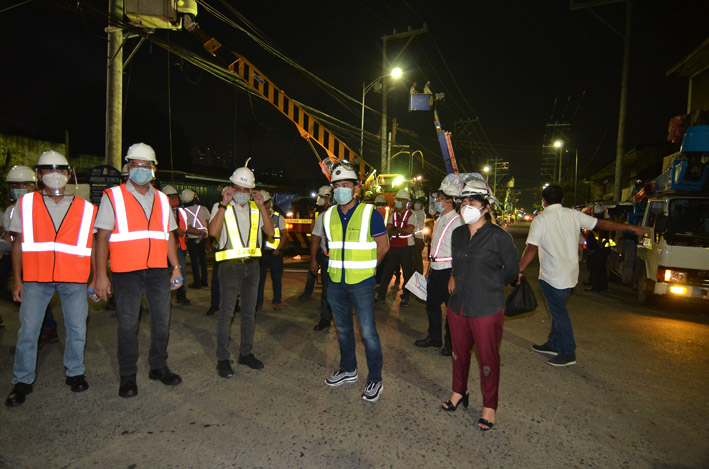
In support of the government’s on-going Build, Build, Build program, Meralco’s top executives, along with representatives from key stakeholders such as DPWH and NLEX Corporation, visited and inspected the major portion of the pole relocation activities for the NLEX-SLEX Connector Road construction site along various streets in Sta. Cruz Manila, on the evening of October 29. Despite working constraints caused by the pandemic and the effects brought about by typhoon Quinta, Meralco delivered on its commitment to this project, in partnership with NLEX Corp and DPWH.
Seen in photo are (from L-R): Meralco executives, Ferdinand Geluz, FVP, and Chief Commercial Officer and Ronnie Aperocho, SVP and Head of Networks; NLEX Corp. COO, Raul Ignacio; DPWH Secretary Mark Villar and Chairperson of the Build, Build, Build Committee, Anna Mae Lamentillo on-site during the relocation of the Meralco electric facilities which would ultimately pave the way for the speedy completion of the said vital infrastructure project which is an 8-kilometer all elevated 4-lane toll expressway connecting the NLEX to the Skyway Stage 3 and will benefit at least 35,000 motorists/vehicles per day, reducing travel time from SLEX to NLEX from 2 hours to just 20 minutes.
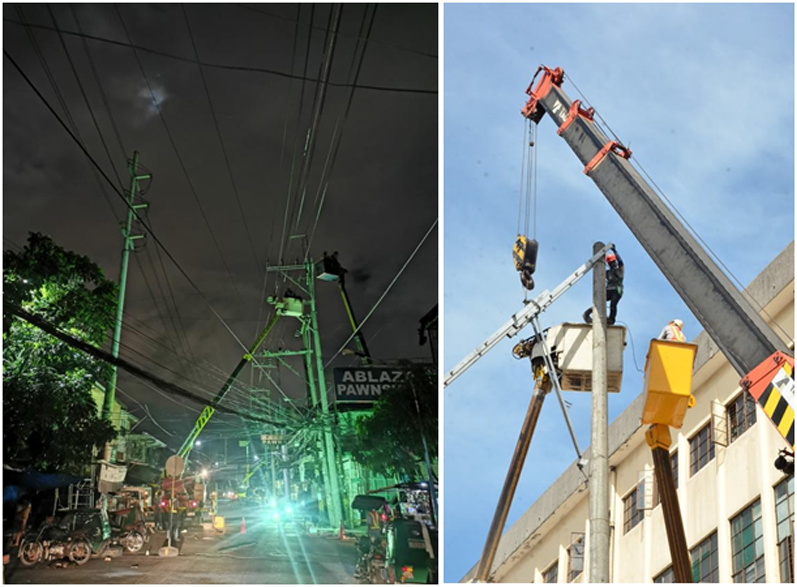
Several Meralco Networks crews, as shown in the right photo, are seen working double-time to clear the electric facilities affected by the construction of this infrastructure project. This consolidated one-time big-time interruption work involved322 personnel and 68 various line construction equipment and vehicles as they worked on the installation of 104 new poles, 32 spans of XPLE power cable, 78 spans of tree wire, and the retirement of 57 poles.
Real estate developer Suntrust Properties Inc. (SPI) once again proves its steadfast commitment to its communities with another international recognition from Global Economics Award for being the Most Innovative Residential Developer.
The award recognizes the property developer’s quality and distinction in the residential and commercial sectors along with its ability to compete globally. Suntrust takes pride in this momentous accomplishment as some of the criteria include past performance, achievements, innovation, growth, and sensitivity of the local environment.
“We are beyond honored to be chosen, once again, as this year’s Most Innovative Residential Developer. This award serves as a testament of how resilient we are, that amid the challenges brought by the pandemic, we still live up to our promise and commitment of providing quality and affordably priced homes to Filipino families,” said Atty. Harrison M. Paltongan, the company president.
Apart from the aforementioned criteria met by the company, SPI also proudly hosts a spectrum of project developments, from condominium to subdivisions and individual estate across the country.
“This moment is also an inspiration for the company to continue building the Filipino dream, staying true to our goal of being a home for every Filipino,” he added.
Along with its subsidiaries, Stateland Inc. (SLI), Sunrays Property Management Inc. (SPMI), and Suntrust Ecotown Developers, Inc. (SEDI), the company continues to rise above today’s challenges by continuously building dreams for millions of Filipinos here and abroad.
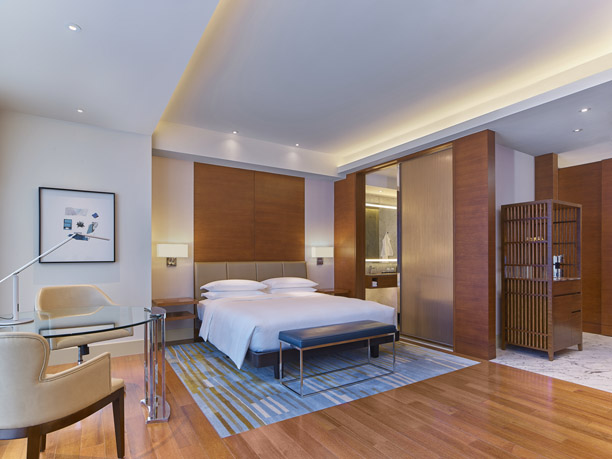
Get two complimentary Rapid Antigen Tests when you book a Grand Escape at Grand Hyatt Manila.
Delight in complimentary breakfast, 20% off dining, 50% off laundry services, and more with its Grand Escape promotion. Grand Hyatt Manila offers guests a worry-free stay by complying with strict international and local hygiene standards. By doing so, it is offering guests two complimentary Rapid Antigen Test when they choose to avail of our Grand Escape staycation package.
Book a room by Dec. 15, 2020, for stays through Oct. 1, 2020 to Aug. 31, 2021, for as low as P12,000 nett. Each reservation comes complete with the following:
Complimentary Rapid Antigen Test by Abbott for two guests (Additional tests are priced at P2,000)
Complimentary breakfast for all registered guests (Up to two adults and two children below 12 years old)
20% discount when dining at The Grand Kitchen, The Lounge or The Peak
50% discount on laundry services
Welcome amenity-filled with an array of beverages
Access to Illume Spa 24-hour fitness center and pool
The safety and well-being of Grand Hyatt Manila’s guests and colleagues is always a top priority. In response to COVID-19, it is taking multiple steps to care for your well being. Precautionary measures include enhanced cleaning and sanitization procedures in all guestrooms, dining outlets, and public spaces.
Grand Hyatt Manila is ISO 22000 certified and adheres to strict food safety management standards that ensure your food is sourced and prepared safely for consumption. Learn more about how we are focused on maintaining a safe environment for you and your loved ones.
TERMS AND CONDITIONS
Prior reservation is required. Call +632 8838 1234 or email sea.reservations@hyatt.com to avail of the offer. This offer cannot be used in conjunction with other promotional offers, privileges, or VIP cards. Discounts and privileges are not convertible to cash. Reservations may be canceled 24-hours prior to the check-in date to avoid a one-night fee. Bookings must be guaranteed by credit card. Blackout dates apply Dec. 30 and 31, 2020.
As of Oct. 6, 2020, the hotel has been granted with Certificate of Authority to Operate for Staycation by the Department of Tourism. In line with this, only guests residing within the National Capital Region and present a negative result from a Rapid Antigen Test conducted on the day of check-in are allowed to place a reservation for leisure. This promotion is inclusive of two complimentary Rapid Antigen Tests by Abbott, any succeeding test will be priced at P2,000. To avail of the complimentary tests, guests must call and confirm their schedule by 11 a.m., the day prior to their check-in date. Once the booking has been confirmed, the test will be scheduled and conducted at the hotel on the day of check-in.
All guests and customers are required to wear a face mask and face shield in all public areas of the hotel. A health declaration form must be accomplished prior to check-in and dining.
Native Union, a technology accessories company, cut its order processing time from three days to one by using cloud technology to accomplish important but repetitive tasks.
“Our staff were just spending their days entering orders into a spreadsheet. What kind of a career is that? Now, because we can see across an integrated ecosystem, they have the time to analyze what we do, think about how to improve the supply chain, and really add value to the business. Their roles have transformed overnight,” said Farouk Merzougui, chief operating and financial officer at Native Union, in a statement.
Using the AtomSphere Platform, a product by cloud-based integration platform-as-a-service (iPaaS) provider Boomi, Native Union was able to integrate its enterprise resource planning software, Shopify store, and multi-currency payment gateway processor.
Previously, employees would manually process, replicate, and compile orders from their Shopify store. They would then have to send the orders to the fulfillment warehouse themselves at the end of the day.
The AtomSphere Platform automates payments reconciliation and the receipt of orders. The status of an order is also automatically updated every five minutes, providing employees with real-time insights.
The platform has also allowed Native Union to scale through remote operation of a new overseas fulfillment warehouse. Typically, opening a warehouse entails site visits, staff training, and onboarding. But with cloud technology, Native Union is able to run the warehouse from abroad through electronic forms and procedures.
“Take this disruption and this fear… as a catalyst… When you take this in a different angle, you can really transform your business, you can really expand your business, but you need to accept the change,” said Mr. Merzougui, addressing companies that still doubt the benefits of cloud technology. — Mariel Alison L. Aguinaldo
Companies have been creating Viber Communities to communicate with their consumers over the pandemic. The messaging platform noted a 129% increase in community views and a 208% growth in messages sent to Communities in the first half of 2020 versus the same period last year. In the Philippines, Viber has a 71% penetration rate.
“People are now forced to shop from within their communities for the sake of convenience and safety,” said Veronica Feleo, Viber Rakuten’s business development manager, at a recent virtual roundtable. “On the brands’ end, there’s more of a willingness to connect with consumers.”
Brand representatives in attendance agreed on the importance of tailored messaging.
“There’s an intentional way of how we send messages,” said Brigette Villarin, director for operations at Megamobile, Inc., a member of the Inquirer Group of Companies. Inquirer Mobile shares information on current news, politics, and lifestyle topics to its 100,000+ strong community, and adapts its content curation based on trends.
“We noticed there was heavy engagement at mealtimes during the enhanced community quarantine (ECQ),” Ms. Villarin said. “After July, the engagement became more concentrated in the morning, so that’s when we published all relevant information. In the evening, we shared lifestyle stories to give everyone a breather from the news.”
Christina Lao, digital acceleration director of McDonald’s Philippines, added that the food chain’s Viber Community was set up to help ensure its patrons were maximizing their time whenever they went out. “People were looking for information [at the start of the pandemic], and the first thing they looked at was their phone. We want to earn our space in your app and provide information that’s relevant.”
For its part, the Department of Health decided to create its own community when it received a deluge of inquiries early March, or soon after the start of the first national lockdown. “It was clear to us with so many inquiries that people were panicking,” said Dr. Beverly Ho, the director of the Health Promotion Bureau at the Department of Health (DoH). “When we started, we weren’t that well-organized… We eventually rolled out surveys to ask members what information they wanted from this group.”
DoH shares both COVID and non-COVID information to its Viber Community, but it also takes care not to flood its more than two million subscribers with messages.
Meanwhile, SM Pasabuy is a means of satisfying the mall chain’s customer needs. Pasabuy is a play on the Filipino pasabay, a term used when requesting someone to get something at a store they plan to shop in.
At the start of the pandemic, SM promoted takeout, delivery, and curbside purchases in adherence to safety protocols. It also started offering personal shoppers in 71 of its 74 malls for those who wanted to shop from the comfort of their homes.
“We have many fulfillment partners who do deliveries,” said Joaquin San Agustin, senior vice president for marketing at SM Supermalls. “We tied up with 67 apps nationwide, as well as riders in communities and those out of a job with bicycles. It might not be necessarily Pasabuy in GenSan, but there’s an equivalent there. It’s taking a look at customer needs and finding a way to satisfy them.”. — Patricia B. Mirasol
THE Bank Secrecy Law is constraining the Bangko Sentral ng Pilipinas’ (BSP) ability to effectively supervise the banking industry, the International Monetary Fund (IMF) said.
In a financial sector assessment report released on Nov. 10, the IMF said the Bank Secrecy Law should be amended to allow the BSP full access to banks’ deposit and other data.
“BSP should be granted unimpaired access to information on all customer accounts, and the ability, without constraints, to employ and share depositor information for any prudential purpose (e.g., funding concentrations from related parties, intra-group dependencies, cash flow analysis, related-party transactions (RPT) and off-site anti-money laundering (AML) data and analysis) in order to fulfill its supervisory mandate to address safety and soundness concerns,” it said.
There are bills filed in Congress proposing to reinstate Presidential Decree 1792 which gave the BSP the mandate to examine bank deposits, provided it found reasonable grounds such as fraud, serious irregularity or unlawful activities.
The Wirecard AG scandal in June sparked renewed calls from the BSP and the Department of Finance to pass amendments to the Bank Secrecy Law. The German payments firm initially claimed it kept $2.1 billion in two local banks, but later admitted the funds did not exist.
In the report, the IMF said there is a need to strengthen the BSP’s ability to gauge the impact of mixed conglomerate structures on domestic systemically important banks (D-SIB) or those deemed as “too big to fail.”
“The BSP has to rely to a large extent on public information for assessing risks in the wider conglomerates as it does not have the power to supervise a bank’s parent or the wider group, or to review their activities to determine their impact on the safety and soundness of the bank and the bank groups within the conglomerates,” it said.
The BSP has identified several D-SIBs, most which belong to big Philippine conglomerates and some are foreign bank branches, the IMF said.
Based on the IMF’s assessment, Republic Act. No. 11211 or the New Central Bank Act only gave the BSP the additional power to obtain data and information relating to parent and affiliate companies of D-SIBs only for “statistical and policy development purposes.”
“Limited scope of this new authority does not provide the BSP with sufficient powers to assess any potential negative impact the activities of those companies may have on the safety and soundness of the banking group. Limitations on BSP’s enforcement powers also impair its ability to fully protect the bank from the actions of parent companies and affiliates,” the IMF said.
The IMF said the BSP should also strengthen its oversight on the assessment of ultimate beneficial ownership (UBO) of banks in the Philippines.
“BSP’s ability to assess the resolvability of banks, especially D-SIBs, and support the orderly resolution of a problem bank, including the preparedness for effectively dealing with a major bank failure needs to be developed,” it added.
Also, the IMF raised concern over the inclusion of a Cabinet member in the Monetary Board (MB). Under the New Central Bank Act, one of the MB’s government sector members should also be a member of the Cabinet designated by the President.
“Although the Cabinet member has only one vote and there is no evidence of any past political interference in the supervisory decisions taken by the MB, the presence of a senior political appointee to the MB, by definition, gives rise to a concern that the operational independence of the BSP is compromised,” it said.
The current MB includes Finance Secretary Carlos G. Dominguez III.
The IMF also said the central bank should continue to work on improving its prompt corrective action (PCA) framework to ensure bank failures are resolved promptly. It recommended that the framework should involve the transition procedures of problem banks with the Philippine Deposit Insurance Corp. to avoid losses to the deposit insurance fund and lessen moral hazard risks.
The report detailed the IMF and World Bank’s findings on the Philippines in relation to the observance of the Basel core principles for effective banking supervision, based on information available as of July 2019. — L.W.T.Noble
The Philippines improved one spot to 48th place in IMD World Competitiveness Center’s World Talent Ranking 2020. — REUTERS
By Jenina P. Ibañez, Reporter
THE Philippines inched up one spot in an annual global ranking of countries’ ability to attract and retain a skilled workforce, but continues to lag behind other Asia-Pacific economies.
The country ranked 48th out of 63 economies in the IMD World Competitiveness Center’s World Talent Ranking 2020 report published on Thursday, rising one spot from 49th in 2019 and seven places from 55th in 2018.
In an e-mail, IMD said the Philippines’ overall ranking improvement “is due to worse performance by other countries.”
The Philippines ranked 12th out of 14 economies in the Asia-Pacific, with Singapore, Australia, and Hong Kong taking the top spots.
In the region, Singapore’s ranking improved while Malaysia, Thailand, and Indonesia saw small declines. The region performed relatively poorly in investment and development, including Malaysia (34th), Thailand (51st), and Indonesia (52nd).
Asia-Pacific economies did well in the appeal factor, remaining attractive to foreign labor, IMD said in a press release.
The IMD report took into account three equally weighted factors: “investment and development” in homegrown talent, the “appeal” or the extent to which the country attracts overseas talent, and “readiness” or the availability of skills in the talent pool.
The Philippines’ rankings in these factors remained the same from the previous year, except for the “readiness” factor, which fell seven spots to 33rd place from 26th the previous year. Under “readiness,” the country fared poorly in inbound student mobility and educational assessment. The Philippines also dropped to 13th place in terms of availability of skilled labor, from third spot a year earlier.
The country ranked third, however, in labor force growth.
Country “appeal” remained at 31st place from the previous year, with the Philippines ranking 44th for the brain drain subfactor and 48th for quality of life.
“The country performs well in the personal income tax and cost-of-living subfactors, and shows an increase in the worker motivation subfactor,” IMD said in an e-mail.
The Philippines also retained its 61st spot in the “investment and development” factor.
“This is due to low ranks in most subfactors, with those related to education showing the worst performance,” IMD said. The Philippines ranked poorly in pupil-to-teacher ratio and public expenditure on education rankings.
Some of the country’s overall strengths were in effective personal income tax rate (8th), graduates in sciences (11th), and cost of living (15th).
European Chamber of Commerce of the Philippines President Nabil Francis said the business group welcomes the country’s improvements in terms of talent competitiveness.
“This demonstrates the immense potential of the country’s relatively young, dynamic, and highly literate population to be a globally competitive workforce,” he said in a mobile message.
To improve Filipino workforce talent given global competition, Mr. Francis said that the country should promote skills development, enact an apprenticeship reform bill, and incentivize businesses that invest in upskilling programs.
Switzerland and Denmark held the first and second position in the IMD World Talent Ranking for the fifth straight year. Luxembourg, Iceland, and Sweden rounded up the top five spots. European countries’ top performance was attributed by IMD to “the continent’s excellent education and good mobility.”
“For 2020, the most talent-competitive economies are those that invest in education… and those that appeal to an international talent pool,” IMD said.
THE Philippines inched up one spot in an annual global ranking of countries’ ability to attract and retain a skilled workforce, but continues to lag behind other Asia-Pacific economies. Read the full story.
AMENDMENTS to the Anti-Money Laundering Act (AMLA) will need to be approved by Congress before the Christmas break to give enough time for its implementation, if the Philippines wants to avoid being included in the Financial Action Task Force’s (FATF) so-called “gray list.”
“Our view is that this is an ‘all or nothing’ deal with the Financial Action Task Force. If they do not adopt our proposal, we will be gray-listed. It is that simple,” Anti-Money Laundering Council Executive Director Mel Georgie B. Racela said in a Viber message to BusinessWorld.
The FATF gave the Philippines up to February 2021 to address the deficiencies in Republic Act No. 9160 (Anti-Money Laundering Act) and implement regulations to improve its efforts to curb money laundering and terrorist financing activities. The original deadline was in October, but it was moved to February due to the pandemic.
Congress is hoping to tackle the amendments to the AMLA, after the approval of the 2021 national budget. However, the timeline appears to be tight as Congress is scheduled to go on another break on Dec. 19 and resume session on Jan. 17, 2021.
House Bill No. 6174 is up for second reading approval, while Senate Bill No. 1412 is still pending at the committee level.
President Rodrigo R. Duterte certified the urgency of the proposed anti-money laundering law amendments.
Once the AMLA amendments are signed into law, Mr. Racela said the government needs to issue implementing rules and regulations; disseminate information; and send letters to the new covered persons to immediately register with the AMLC, before February.
“If given two months to implement, we can do all these. We need, at the earliest, end of November but latest in December before the Christmas break,” he said.
Quirino Representative Junie E. Cua House, chairman of the House Committee on Banks and Financial Intermediaries, said the amendments can be passed before the holiday break.
“I’m sure it will be prioritized…The revisions are not complicated.If we devote enough time, it can be done,” Mr. Cua said in Filipino over a phone interview with BusinessWorld.
Mr. Cua said there is resistance to the bill’s expansion of covered persons under the AMLA to include real estate developers and brokers due to the amount of work involved in reporting transactions. He noted this can be addressed through an electronic reporting system that will make compliance easier.
“The consequence of not doing it [revisions] is also something that we should think about as a nation. If we get gray-listed, it will have a big implication for all,” Mr. Cua said.
Other proposed revisions to the AMLA include expanding AMLC’s investigative powers to include the issuance of subpoenas and the implementation of targeted financial sanctions — including freezing assets, among others.
In 2000, the Philippines was included in the FATF’s list of countries with lax safeguards against dirty money transactions. The country was removed from the list in February 2005.
In a worst-case scenario that the Philippines is gray-listed by the FATF, Mr. Racela said it may take around two to three years before it can be removed from the list.
“We are already under the 12-month observation period — this means we need to convince the FATF that we should be taken out from the observation period. This means that if we fail to act or deliver a different matter, gray-listing will naturally follow,” he explained.
The FATF’s recommendation in relation to counter-terrorism financing have already been addressed by the passage of the controversial R.A. No. 11479 or the Anti-Terror Act of 2020.
If the Philippines is included in the FATF’s gray list, officials have warned there may be a decline in remittances due to delayed processing of transactions, and possible reluctance from international financial institutions to conduct businesses in the Philippines due to increased paperwork involved.
THE board of AC Energy Philippines, Inc. has approved the proposal of Singapore-based GIC Private Limited’s affilate Arran Investment Pte Ltd. to invest around P20 billion in the Ayala-led company for a 17.5% ownership stake, it disclosed on Thursday.
The investment, which will be implemented through the subscription of 4 billion primary shares and the purchase of secondary shares from AC Energy, is priced at P2.97 per share on a post-stock rights offering basis. The price is also subject to agreed price adjustment and regulatory approval.
“The price represents a 25% premium to the board-approved stock rights offering (SRO) price of Php2.37/share, which is subject to regulatory approval, and is at par with the theoretical ex-rights price (TERP) using the 30-day VWAP (volume weighted average price) of Php3.51/share and the ACEN Board-approved SRO price of Php 2.37/share,” AC Energy said in a regulatory filing.
AC Energy, which is engaged in power generation and trading, and GIC’s subsidiary are scheduled to sign the transaction documents to implement the investment within this month.
Separately, the company told the stock exchange on Thursday that its net income out more than doubled to P953 million during the third quarter, as lockdown restrictions eased.
Revenues, which mostly came from the firm’s sale of electricity, rose by 49% to P5.28 billion. The company is a licensed retail electricity supplier.
Broken down, earnings from the sale of electricity increased by 51% from its previous value. Revenues from rental income, however, slumped by 80% from July to September.
During the third quarter, the cost of the sale of electricity went up 10% to P3.74 billion year-on-year. General and administrative expenses rose by 18 % to P446.63 million.
For the nine-month period ending September, AC Energy logged a consolidated net income of P3.02 billion, a leap from last year’s consolidated net loss of P216.98 million.
The firm’s revenues for the three quarters stood at P15.25 billion, a 28.5% increase from the previous figure.
AC Energy, which has expanded in the region through partnerships and greenfield projects, aims to exceed 5 gigawatts (GW) of renewables capacity and generate at least 50% energy output from renewables by 2025.
In 2019, its power portfolio registered an attributable capacity of more than 1.8 GW in operation and under construction, spanning projects in the Philippines, Indonesia, and Vietnam. Its attributable energy output last year rose by 25% to 3,500 gigawatt hours, of which half came from renewable energy sources.
This year, the company announced its investment in two Central Luzon solar plants, with an aggregate capacity of up to 150 megawatts (MW).
Shares in AC Energy on Thursday surged 5.4% to finish at P4.33 apiece. — Angelica Y. Yang



 “This moment is also an inspiration for the company to continue building the Filipino dream, staying true to our goal of being a home for every Filipino,” he added.