NOW PLAYING under a new name and organization, members of AURA Philippines are looking to sustain the current success they are having in esports.
Formerly played as Sunsparks, which won back-to-back championships at the Mobile Legends: Bang Bang Professional League-Philippines, the team is now bannering AURA PH, which is affiliated with an esports organization based in Indonesia.
The AURA PH roster is practically the same which ruled seasons 4 and 5 of MPL-PH.
The members are Chan “Rafflesia” Faura, Kielvj “Kielvj” Hernandez, Jaypee ‘Jaypee’ Dela Cruz, Ashley “Killuash” Cruz, Allen “Greed_”’ Baloy, Renzio “Renzio” Cadua. Head coach is Michael “Arcadia” Bocado with Mitch Liwanag as team manager.
The team said its decision to partner with Indonesia-based AURA is to get out of its comfort zone and challenge itself while also angling to explore other opportunities in the sport.
“Before going to AURA, we really thought hard about it. Then we decided that it’s time to go out of our comfort zones. The team wanted to embrace new challenges in a different environment,” said Arcadia in the team’s recent guesting on Tiebreaker Vods’ CPT Crossover podcast.
“[The transition has not been tough] The only difference is organization structure. It’s different from Sunsparks. But our routine is the same,” he added.
For Rafflesia, the move could open a chance for them to expand their reach and shore up their skills.
“[With AURA] we expand because it is already international. Our sponsor is from another country. This will be a new challenge and it is an opportunity for us to learn and showcase our strength as a team,” he said.
In the last edition of MPL-PH, members of AURA PH as Sunsparks defeated ONIC PH in the finals.
Greed_ lifted his team to the 3-1 victory and the title. Interestingly, Greed_ was once part of ONIC PH.
With the title-clinching Game Four heading into a fever pitch, both teams figured in a crucial clash near the lord pit. Greed_ (Natalia) found his former teammate Danerie “Wise” James (Hanzo) placed just beside the throne in his pinnacle form and erased him off the map right away.
With members of ONIC PH still far off, Greed_ immediately attacked the throne to seal the crown.
For his consistent finals brilliance though, Kielvj was named finals most valuable player.
Apart from making waves in the MPL scene, a goal also for the AURA PH members is to be able to represent the country in platforms like the Southeast Asian Games where esports made its successful debut last year here in the country.
“We want to experience it, to compete against other international teams on that level,” Rafflesia said.
Moving forward, AURA PH members said they see esports continuing to flourish even amid the ongoing coronavirus disease 2019 (COVID-19) pandemic albeit with challenges along the way.
“Actually esports fits in this kind of scenario because we don’t really have to be in the same place, conforming to social distancing. But it also has its challenges like many events being canceled,” Arcadia said.
ENTERING its fourth season, the Philippines Football League (PFL) is still building legs and continues to learn with the end view of presenting a product that all stakeholders would appreciate and be proud of, its commissioner said.
Speaking at an online media briefing last Wednesday, PFL Commissioner Coco Torre shared that the league is still in the process of learning, which is marked by hits and misses, he said, but something that only pushes them to strive to do better and succeed.
“The PFL is in its fourth year. Through the years there have been observations on what has worked and what hasn’t. The dynamics are always shifting and we are putting the best strategy for us moving forward,” said Mr. Torre.
Because of the ongoing coronavirus disease 2019 (COVID-19) pandemic, the start of season four of the PFL has been put on hold. The league though has been given traction in its return push with the Inter-Agency Task Force for the Management of Emerging Infectious Diseases giving its nod for PFL teams to resume conducting practices and conditioning although under strict health and safety protocols.
Despite the current setup, Mr. Torre said the league has been continuously working and finding ways to bring the PFL, and the sport of football in general, to more people and be appreciated better.
Among the strategies they are working on relate to the league’s stability by way of expansion and parity, and marketing.
“One key strategy is the expansion of the league where you have a more competitive and exciting league. And more clubs mean the stability of the league,” Mr. Torre said,
Adding, “Another strategy, in relation to stability, is how clubs can be at par in the competition, so certain regulations have to be put in place.”
Currently, the PFL has six teams competing with another club in the process of joining the league.
Ceres-Negros FC is still technically part of the league despite confirming reports that it is talks with investors who will be taking over the management and ownership of the club in the PFL.
And then there is marketing, which Mr. Torre said is very important for the sustainability of the league.
“And the last ingredient is marketing the league. As you all know football is not as popular in the Philippines and we have to raise the awareness, build more equity and entice more sponsors to come in and build on that,” he said.
For the fourth season of the PFL it is welcoming a major sponsor in Qatar Airways, which, Mr. Torre said, remains committed to the league despite the effects of COVID-19.
Mr. Torre said there is no definite time frame on when the PFL season would start but they are continuously monitoring the situation with COVID-19 and would make further announcements on it when the time comes even as he said they are committed to resuming action. — Michael Angelo S. Murillo
LOS ANGELES LAKERS star Anthony Davis is joining teammate LeBron James in passing on placing a social justice message on the back of his jersey when the National Basketball Association (NBA) season starts again, Yahoo Sports reported Sunday.
On Saturday, James told reporters that none of the 29 approved phrases appealed to him.
“It was no disrespect to the list that was handed out to all the players,” James said. “I commend anyone that decides to put something on the back of their jersey. It’s just something that didn’t really seriously resonate with my mission, with my goal.
“I would have loved to have a say-so on what would have went on the back of my jersey. I had a couple things in mind, but I wasn’t part of that process, which is OK. I’m absolutely OK with that.”
One player to go all in on the messaging is veteran Kyle Korver, who has spoken in the past about his “white privilege.” The 39-year-old Milwaukee Bucks guard has chosen Black Lives Matter as his message.
“I just think that in this moment in time, this is the message. Anything I would ever hope to convey on the back of a jersey is represented in these three words,” Korver told The Undefeated via text message on Sunday.
Activism among NBA players has increased since the death of George Floyd, a Black man, who died in May after a Minneapolis police officer kneeled on his neck for nearly nine minutes. The jersey messages allow players to continue making a statement while playing in the bubble atmosphere near Orlando.
“It’s a great opportunity. It’s a unique moment. We’re not able to interact with each other very much yet because of the safety protocols in place. But I think everyone is very aware of the opportunity and wants to capitalize on it,” said Korver, who is seeking his first NBA title in his 17th season.
The Undefeated reported that as of Saturday, all 350 players had decided whether to place a message on their jerseys, with at least 17 deciding against it. — Reuters
Collin Morikawa narrowly avoided another playoff heartbreak on Sunday, defeating Justin Thomas in a tightly contested bout at the Workday Charity Open in Dublin, Ohio.
The 23-year-old, who suffered a playoff loss at the Charles Schwab Challenge last month, hung on to claim his second PGA Tour win in just 24 starts after his fellow American Thomas bogeyed on 16 and 18 to send the pair into extra play.
“Justin wasn’t going to give it to me. He was fighting through the entire day,” said Morikawa after clinching the win. “I’m excited right now, I’m so happy.”
Tied at 19 under par after four rounds, the pair put on a putting masterclass on the first playoff hole for birdies, with Thomas letting out a roar after sinking a more than 50-foot putt.
But Thomas, the 2017 PGA Championship winner who had been flawless through the first three rounds at Muirfield Village Golf Club, missed the fairway on the third playoff hole and got stuck behind a tree, and it was Morikawa who kept his nerve for the win.
“Those three holes were a grind, obviously Justin making that birdie putt on that first playoff hole, I had to make it, or else we go home again,” said Morikawa. “I just got a little more comfortable throughout the playoff… Two playoffs now, and finally got one done.”
It was a bitter loss for Thomas, however, who had a two-stroke lead over Norwegian Viktor Hovland going into Sunday and had appeared nearly unstoppable as only the third player ever to go bogey-free through 54 holes at Muirfield.
“I just can’t beat myself up, although it’s going to be pretty hard not to, at least the rest of this afternoon,” Thomas told reporters. “I just need to execute better.”
Third place finisher Hovland, who has not finished outside the top 25 since the tour returned from COVID-19 hiatus, called the tournament “a learning experience.”
“I’ve just got to go back to what I do and get a little bit better at putting and just get a little bit better with my whole game,” he said.
The Muirfield Village Golf Club event was added to the PGA Tour’s calendar after the John Deere Classic, which was supposed to be held in Illinois, was cancelled due to the COVID-19 pandemic. — Reuters
So you’ve successfully laid the foundation for your startup. It’s time to move on to the next phase: building a team.
Your employees will help determine not only the quality of your product but also the kind of growth that your startup will have through the years.
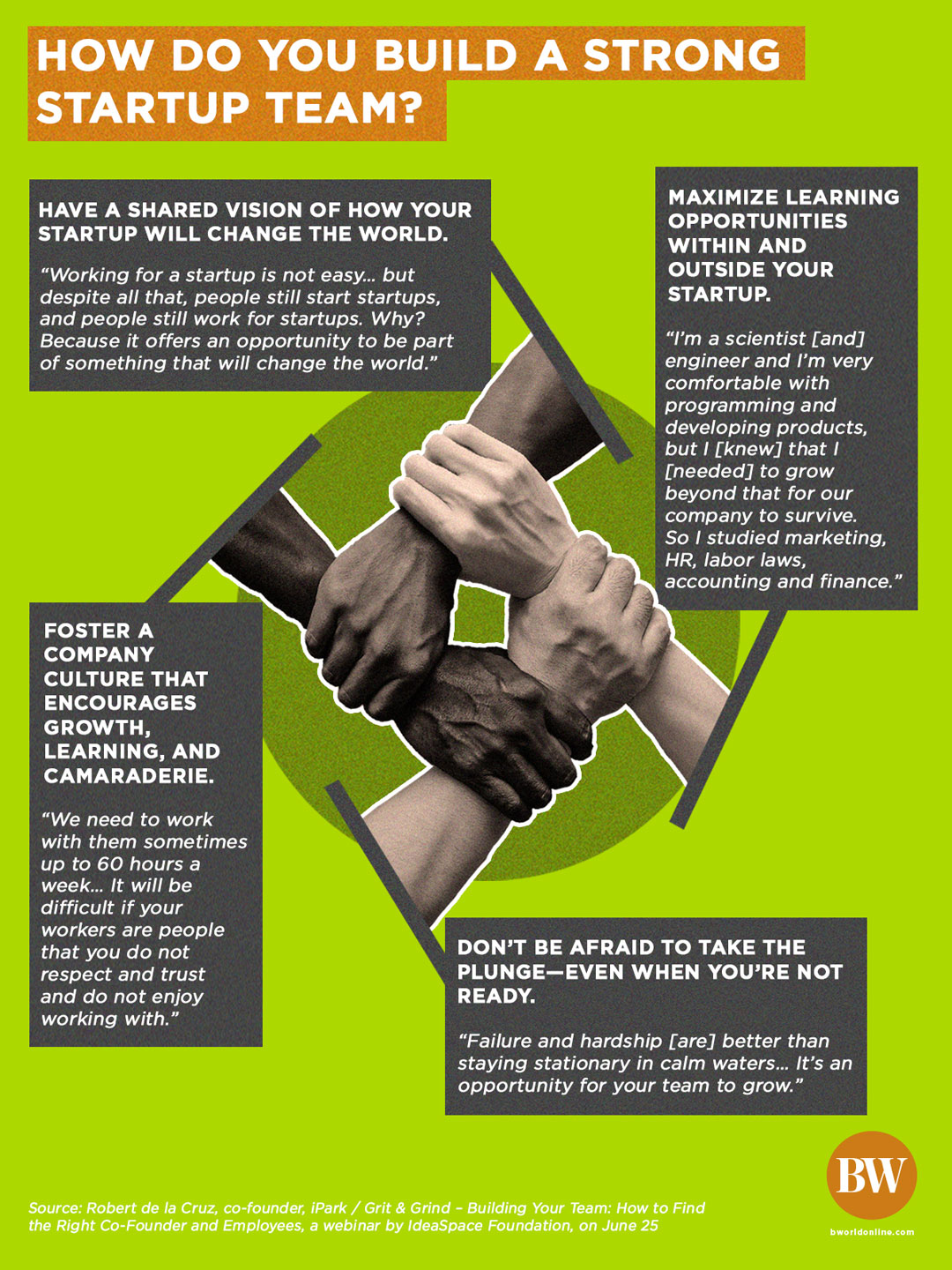
Robert de la Cruz, co-founder of iPark, a parking automation company, shared four steps during Grit & Grind—Building Your Team: How to Find the Right Co-Founder and Employees, a webinar by IdeaSpace Foundation, on June 25.
1. Have a shared vision of how your startup will change the world.
Startups are built on a vision, whether it’s helping marginalized communities or providing cost-friendly, innovative solutions. When hiring employees, discuss your vision with them and ensure that they feel passionate about it.
Mr. de la Cruz shared how he was able to hire a managing director of a BPO company for a fifth of his previous salary. How? The man was excited to be a part of an endeavor that he could be proud of to his children.
“Working for a startup is not easy. Working long hours is the norm, pay is not guaranteed, but despite all that, people still start startups, and people still work for startups. Why? Because it offers an opportunity to be part of something that will change the world,” he said.
2. Foster a company culture that encourages growth, learning, and camaraderie.
A grand vision will surely get people to join your startup. But for Mr. de la Cruz, what makes them stay is a nurturing and supportive company culture with members that listen to each other, make their voices heard, and work hard together to reach a common goal.
One way to do this is by building genuine relationships with your teammates. Get to know their stories and hang out with them after work (yes, it’s possible even during this pandemic).
“We need to work with them sometimes up to 60 hours a week… It will be difficult if your workers are people that you do not respect and trust and do not enjoy working with,” said Mr. de la Cruz.
3. Don’t be afraid to take the plunge—even when you’re not ready.
Sometimes, a great opportunity arrives in the form of a customer who desperately needs your product and is willing to pay for it no matter the cost. But then, you find that your product isn’t ready yet. What do you do?
According to Mr. de la Cruz, you seize the chance anyway. “Time is not your friend. It doesn’t care about you and just keeps moving forward… So form your team around taking advantage of these buying opportunities… When you realize that your customer is ready to buy, take the dive, and take action.”
But what if this attempt fails? Then learn from it and move on.
“Failure and hardship [are] better than staying stationary in calm waters… It’s an opportunity for your team to grow,” said Mr. de la Cruz.
4. Maximize learning opportunities within and outside your startup.
As a lean team, you and your members may have to take on roles outside of your skill set. While it may be intimidating at first, consider it a chance to broaden your knowledge.
Mr. de la Cruz, for instance, found himself learning about marketing, labor laws, human resources, and accounting during iPark’s initial pivot.
“I’m a scientist [and] engineer and I’m very comfortable with programming and developing products, but I [knew] that I [needed] to grow beyond that for our company to survive,” he said.
However, there are times when your team can only learn so much without sacrificing your deliverables. This is when you search for external learning opportunities, particularly through incubators, accelerators, and other members of startup communities. “The priceless contribution of IdeaSpace to us is access to mentors who are sincere in their desire to help the startup,” said Mr. de la Cruz.
The financial sector is the most prepared for Brexit, while manufacturers had the most to do, according to a survey by the Institute of Directors. — REUTERS
Only one-quarter of business leaders say their organizations are fully ready for the end of the Brexit transition period, according to a survey by the Institute of Directors.
Nearly half of the 978 company directors polled late last month said they weren’t able to prepare for a transition now, and one in seven said they were focused on the coronavirus pandemic, the survey said. Almost a third said they need more clarity about forthcoming changes before they make any adjustments.
“With so much going on, many directors feel that preparing for Brexit proper is like trying to hit a moving target,” Jonathan Geldart, director general of the Institute of Directors, said in the statement. “Jumping immediately into whatever comes next would be a nightmare for many businesses.”
The financial sector is the most prepared, while manufacturers had the most to do, the survey said.
As many as 69% of respondents said reaching a deal was important for their organizations. And even more, 89%, highlighted its importance to the overall economy. Even among the directors who favored shifting away from EU rules, 71% said a resolution was important for the economy.
The Institute of Directors also reiterated its call for financial support for small firms to access specialist help and advice on a range of Brexit impact areas, such as tax credits or “Brexit vouchers.”
“A commitment to some form of reciprocal phasing-in of changes once clear is a long-standing ask from our members, and the benefits would be significant,” Mr. Geldart said. “At a time when government is rightly straining every sinew to help firms deal with widespread disruption, it would be counterproductive not to seek to minimize it at the end of the year.” — Bloomberg
Governments everywhere are struggling to figure out how much leeway they should allow for what economists call creative destruction—when outmoded companies and practices get replaced with new and more productive ones. In the US, historically more willing to let creative destruction take its course, there’s concern that unemployment may get stuck at the current high levels while bankruptcy courts clog up.
The US is usually better than Europe at reshaping its economy after recessions, partly because it’s easier for American entrepreneurs to streamline their business by firing workers, or even start a new one by going bankrupt.
In the coronavirus crisis, that advantage isn’t immediately apparent.
The speed and severity of the downturn—and the extraordinary uncertainty about what comes next—raises the costs of a rapid restructuring as the pandemic passes. Governments everywhere are struggling to figure out how much leeway they should allow for what economists call creative destruction—when outmoded companies and practices get replaced with new and more productive ones.
The argument against letting those forces loose right now is that firms with decent prospects of bouncing back, once the health emergency is over, will get swept away too.
In the US, historically more willing to let creative destruction take its course, there’s concern that unemployment may get stuck at the current high levels while bankruptcy courts clog up.
“We don’t want to have failures occur all at the same time because that’s catastrophic for the economy,” said former Federal Reserve Bank of New York President William Dudley, who is now a senior research scholar at Princeton University and a Bloomberg Opinion columnist. “It’s fine to have individual firms fail from time to time, but systemic failure imposes so much cost on everyone else.”
AMERICAN SPIRIT
In Europe, with a tradition of taking less risk on this front, governments are working on programs to turn emergency aid into long-term support for companies and jobs. Yet they still have a cautious eye on the regenerative powers that benefited America in the past.
Public investment should be accompanied by “the simplification of restructuring and liquidation procedures, in the spirit of the provisions in place in the US,” Bank of France Governor François Villeroy de Galhau said this month. “Reconstruction isn’t an identical restart.”
The right balance of preservation and reinvention will depend on things that are unknowable now, from the duration of the COVID-19 shock to whether changed consumer habits will prove durable. For now, policy makers are erring on the side of blanket support, even if some of the companies that get it turn out to be unviable.
“The idea that we can know with any kind of clarity who is solvent at this point, or who is going to be solvent, is really a stretch,” said Jeremy Stein, a Harvard professor and former Federal Reserve governor. That could make what Stein called America’s “bias toward indiscriminate liquidation” of smaller firms a problem, rather than a benefit for the post-virus economy.
CREDIT FOR ALL
During the COVID-19 crisis, policy makers have veered in the opposite direction. The US has tried to mimic European programs that pay businesses to retain staff, though it’s still seen a much bigger surge in unemployment.
Meanwhile the Federal Reserve’s program of corporate-bond buying has enabled even financially shaky companies to raise yet more debt, and spurred criticism that the policy is impeding a needed revamp of the economy. US corporations issued about $1.5 trillion in bonds in the first half of 2020, almost double the year-earlier figure.
At least some of the protections appear to be working. Bankruptcy filings fell 11% in the first half from a year earlier, even as those mostly lodged by big companies under Chapter 11 of the code rose, according to the American Bankruptcy Institute. But the organization’s chief, Amy Quackenboss, warned that “we anticipate filings to begin increasing” as crisis-era government supports are gradually withdrawn.
The trend is similar in Europe, where bankruptcies declined sharply during lockdown but are expected to jump in the coming months. Any increase may be smaller than in the US, as European governments double down on preserving both companies and jobs.
French President Emmanuel Macron, for example, has been hastily rewriting labor laws to avert lay-offs—even if that means shifting the emphasis away from the American-style flexibility promised under his signature economic reforms of 2017. The new measures offer companies help paying their wage bills, in exchange for guarantees that workers won’t be fired.
Finance Minister Bruno Le Maire has acknowledged that the government will eventually have to be more discriminating about who it props up.
“Putting too much public money in non-viable businesses will be a big economic mistake,” he said last month. “We will get help from the banking sector so that we can select the activities that are sound.”
‘FAILURE IS OK’
European countries vary widely in their fiscal capacity to offer this kind of support—and also in the red tape that insolvent companies have to negotiate. Some, like Finland and Germany, have flexible procedures similar to those in the US, according to World Bank and OECD indicators. Others are among the most complex in the developed world.
American entrepreneurs also benefit from easier rules governing personal bankruptcy as well as the corporate kind. That’s important because many small-business owners borrow on their own account, said Florida Atlantic University professor Douglas Cumming.
“In the US there’s this culture that failure is OK,” he said. “If you want to raise money from investors and you failed a few times, they say: ‘You’re experienced, that’s good.’”
Still, such trans-Atlantic gaps may be narrowing.
The emergence of dominant companies like the tech giants has made swaths of the US economy less competitive than they used to be, and “this hampers the creative destruction process,” said Ludovic Subran, chief economist at Allianz SE in Frankfurt. Meanwhile, Europe has responded more boldly and effectively than in the 2008 crisis, even if there’s a risk that governments “overstay their welcome” and end up propping up the wrong industries.
“There’s an old economic belief that the more flexible you are, the faster you recover from crises,” he said. That usually translates into a US edge, but maybe not this time. “The jury is still out.” — Bloomberg
Britain, which is still in talks with the European Union about a post-Brexit trade deal, said it would shortly set out in detail how the British-EU border would operate. — REUTERS
LONDON — Britain will spend 705 million pounds ($890 million) on border infrastructure to help keep trade flowing after its transition deal with the European Union expires at the end of the year, Cabinet Secretary Michael Gove said on Sunday.
The funding includes 470 million pounds to build port and inland infrastructure, including in the south-east of England to serve major freight crossings to France.
“There will be specific pieces of infrastructure that we put in place in order to smooth the flow of traffic,” Gove told the BBC’s Andrew Marr.
Britain, which is still in talks with the European Union about a post-Brexit trade deal, said it would shortly set out in detail how the British-EU border would operate.
Mr. Gove’s cabinet colleague International Trade Secretary Liz Truss, in a leaked letter published by Business Insider, voiced concerns about legal challenges to the border proposals and the risk that ports will not be ready in time.
Asked whether Britain’s borders would be ready and secure by the end of the year, Mr. Gove said he thought they would be. “I am absolutely certain that everything that we do is compliant with the law, indeed is designed to ensure that we can not just comply with the law and keep people safe, but also facilitate trade as well,” he said.
Mr. Gove said there had been “movement” in the negotiations between Britain and the EU about a post-transition trade deal.
“There are hopeful signs, but I wouldn’t want to be over-enthusiastic,” he said.
The border between Northern Ireland, which is part of the United Kingdom, and EU member Ireland will be subject to specific guidance.
“We will be saying more about how we are going to implement the Northern Ireland protocol later this month,” Mr. Gove said. — Reuters
Nearly 25 million jobs and $3.4 trillion in income could be lost in the worst-case scenario due to the COVID-19 (coronavirus disease 2019) pandemic. Members of Mindcare Club, a network of mental health counselors offering video consultation, weighed in on how to cope with this chapter of your career.
By Patricia B. Mirasol
Getting laid off from work is a jarring jolt to one’s existence. The financial strain is exacerbated by the uncertainty of the current pandemic, heightening the emotional roller coaster of shock, sadness, shame, and grief associated with losing your job.
A study by the US National Center for Biotechnology Information found that laid-off workers are prone to experience a wide range of negative effects, including mental and physical health issues, lifestyle and social life impacts, and newly stressful family dynamics.
Members of Mindcare Club, a network of mental health counselors offering video consultation, weighed in on how to cope with this chapter of your career in an e-mail interview with BusinessWorld.
YOU ARE NOT YOUR JOB
Anthony Abala, a board-certified psychiatrist, active medical staff at Asian Hospital, and faculty member at the College of Medicine at De La Salle Medical and Health Sciences Institute, acknowledged that grief is a valid emotion. He emphasized that one’s identity should never be tied up with work for a corporation:
First, it’s important to acknowledge that grief is a valid emotion in this situation and that bereavement or the grieving process is not linear. Negative effects are going to be unavoidable. Often individuals will experience anxiety and uncertainty about the future, fear about how they will cope and deal with the future. A lot of these concerns are valid, unavoidable, and may not be minimized.
People are allowed to wallow, grieve, be afraid, be anxious, and the whole gamut of negative emotions. There is no ‘deadline’ or specific amount of time for this as it depends on each individual and his or her circumstances. If, however, they start to manifest signs that may indicate clinical depression or anxiety then that may be the time to seek professional help.
I think it’s important for a worker to remember that they are not their jobs; that is, their identity should never be tied up with their work for a corporation or company that will always prioritize profit and its own well-being over any individual cog in the machine. It’s important to remember that old adage that it’s a business and that it’s not a personal affront. I think it’s important for employees, in general, to remember that and to always maintain a healthy distinction between their work and the rest of their lives.
REACH OUT FOR SUPPORT
Carol Angeline P. Macawile, MA, a registered guidance counselor and Mindcare Club’s mental health counselor, meanwhile, advocated for reaching out for support as a way to move forward:
Although being laid off or losing your job may sometimes carry with it a sense of shame and fear of other people’s judgment, it is crucial for the person to be able to reach out and open himself to receiving help and support from the people around him.
To move forward, acceptance is very important. Sometimes people pretend that they’re already okay because they want to (or feel the need to) appear strong in front of other people. This may be the case for a parent or breadwinner who doesn’t want his family to worry about their financial problems, so he puts on a brave face in front of his spouse and children, when deep inside he’s devastated and panicking for the loss of income. For others, they may be afraid to acknowledge their feelings because it might then seem more “real,” and they are just not ready yet to accept their reality.
If your loved one has lost his job, be sure to express empathy, comfort and moral support. This will enable the person to activate hope and gather strength to shift his mindset by choosing to focus less on the negative aspects of the situation, and eventually help him to take positive action as he moves forward in life. While we cannot force people to grieve or to face their true emotions when they are not yet ready, the best we can do is affirm them of our support and remind them that “it’s okay not to be okay.”
COPING ADVICE
Dr. Abala also offered four insights for coping:
1. It’s ok to not be okay, to feel bad, to feel sad, to feel anxious. If these things become chronic and cause significant distress in numerous areas of functioning, then seek help.
2. Avoid quick-fix substances, especially alcohol; they’ll only make things worse in the long run.
3. Do not be afraid to rely on your support system, to admit feeling down or anxious, or to ask for help.
4. It will definitely feel terrible, but it’s important to maintain a schedule and be regular activities-oriented to keep you active, whether physically or mentally.
Ms. Macawile added a few more nuggets of advice:
1. Almost everyone is experiencing anxiety, fear, loss, and helplessness at this time. Be gentle with yourself and practice self-care.
2. Know that this, too, shall pass. Take comfort and have faith that this crisis will not last forever. For now, you can choose to focus on the things that are within your control. You may also use this time to assess your strengths and use your resourcefulness and creativity to find other sources of income.
3. Get in touch with your loved ones or friends and share with them your thoughts and feelings about what you’re going through. Stay physically distant but not disconnected. Remember that we’re in this together, and that there is hope for a better future.
CHICAGO — With COVID-19 ravaging the aviation industry, airlines and airports worldwide are reining in costs and halting new spending, except in one area: reassuring pandemic-wary passengers about travel.
“Whatever the new normal (…) it’s going to be more and more around self-service,” Sean Donohue, Chief Executive of Dallas-Forth Worth International Airport (DFW), told Reuters in an interview.
The airport is working with American Airlines—whose home base is DFW—to roll out a self-check-in for luggage, and all of its restrooms will be entirely touchless by the end of July with technology developed by Infax Inc. They will have hands-free sinks, soap, flushing toilets, and paper towel dispensers, which will be equipped with sensors to alert workers when supplies are low.
“One of the biggest complaints airports receive are restrooms,” Mr. Donohue said.
Dallas is piloting three technology options for luggage check-ins: Amadeus’s ICM, SITA, and Materna IPS.
DFW has become the world’s busiest airport, according to figures from travel analytics firm Cirium, thanks in part to a strategy by large global carrier American to concentrate much of its pandemic flying through its Texas hub.
Last year DFW rolled out biometric boarding—where your face is your boarding pass—for international flights and is taking advantage of the lull in international traffic to work with U.S. Customs and Border Protection to use the VeriScan technology for arriving passengers too, he said.
Delta Air Lines opened the first U.S. biometric terminal in Atlanta in 2018, and some airports in Europe and Asia also use facial recognition technology. It has spurred some concerns, however, with a US government study finding racial bias in the technology and the European Union earlier this year considered banning it in public places over privacy concerns.
The Dallas airport is also testing new technology around better sanitization, beginning with ultraviolet technology that can kill germs before they circulate into the HVAC system.
But it has also deployed electrostatic foggers and hired a “hit team” of 150 people who are going through the terminals physically sanitizing high-touch areas.
“Technology is critical because it can be very efficient,” Mr. Donohue said, but customers “being able to visualize what’s happening is reassuring as well.”
DFW has invested millions of dollars above its cleaning and sanitation budget since the pandemic broke out, while suspending about $100 million of capital programs and reducing its second-half operating costs by about 20% as it addresses COVID-19’s steep hit to the industry, which only months ago was preparing for growth.
Nearly 114,000 customers went through DFW on July 11, an improvement from a 10,000 per day trough in April, but still just about half of last year’s volumes.
The airport has also been testing touchless technology for employee temperature checks, but is not currently planning hotly-debated checks for passengers, barring a federal mandate for which there has yet to be any inclination by the US government.
Michael Davies, who runs the New Technology Ventures program at London Business School, said technology will be one of many changes to the airport experience going forward, with fewer overall travelers who will be seeking more space and spending less time dining and shopping.
“You put these things together and this feels in some interesting ways very much like back to the golden age of air travel,” said Mr. Davies. — Reuters
The Department of Health (DoH) on Monday confirmed 162 new coronavirus deaths, the country’s biggest single-day increase in casualties, as a health ministry official said authorities validated some earlier cases included in the tally.
The DoH said total deaths had reached 1,534, while confirmed infections rose by 2,124 to 56,259.
“As part of ongoing data harmonization, we cannot avoid seeing cases not yet included in our official death count,” Health Undersecretary Maria Rosario Vergeire told a news conference.
Of the 162 casualties, more than half died in June and a third in July, she said, adding that the ministry expects more to be reported because of our data reconciliation efforts. — Reuters
ABS-CBN Corp. shares were halted by the Philippine Stock Exchange on Monday after lawmakers rejected the bid of the nation’s biggest media company for a new 25-year franchise.
Trading in ABS-CBN’s common shares and Philippine depositary receipts is suspended and will be lifted one day after the company’s full disclosure to the public, the exchange said on its website. ABS-CBN’s shutdown of its free television and radio since May 5 to comply with a government order has affected 11,000 employees, and has cost the network as much as 35 million pesos ($707,000) in daily advertising sales, it said.
A House of Representatives committee on Friday adopted a sub-group’s recommendation to deny ABS-CBN’s franchise renewal application. Shares of the company have slumped 16% since May 5. ABS-CBN closed 2.6% lower on Friday while its depositary shares sank 7.9%.
“The non renewal of the franchise will cause the stock to collapse,” AP Securities Inc. analyst Rachelle Cruz said. “While ABS-CBN has been doing the transition to digital, this is still a very small part of the business and will take time to build up. The main revenue of traditional media is ads.” — Bloomberg