Home Blog Page 8747

This hearty sandwich will spice up same-old breakfasts — and lunches

By Kate Krader

RESTAURANTS across the country are starting to reopen, but there’s one popular dining category that remains out of commission: outdoor food markets. Places like Smorgasburg in Brooklyn’s Williamsburg neighborhood — where crowds line up for pizza cupcakes and ramen burgers — create an environment that’s impossible to manage under COVID-19 restrictions. While Smorgasburg is morphing into Smorg to Go for takeout only, another wildly popular destination in New York, the Queens Night Market, remains closed.

John Wang left his job as a corporate lawyer at Simpson Thacher & Bartlett to open Queens Night Market five years ago, with the mission of re-creating the stalls he remembered fondly from childhood trips to Taiwan. He’s recently been meeting with the Department of Transportation on ways to bring it back, “but it’s hard to see how to do it without eviscerating the experience,” Wang says. “One-way traffic that doesn’t allow for people to hang out doesn’t seem very fun. Plus, the vendors’ business depends on volume.” On the busiest nights, 20,000 people would come to the market, which had about 60 international stands offering food from Argentina to Kosovo to Nigeria to the Philippines.

For fans like me who badly miss the market, the consolation is an energetic new cookbook, The World Eats Here: Amazing Food and the Inspiring People Who Make It at New York’s Queens Night Market, by Wang and Storm Garner. There are profiles and recipes from such vendors as Alberto Richardson of Treat Yourself Jerk Chicken, whose smoker and Jamaican jerk recipe has been a major attraction at the market, and Maeda Qureshi, who runs Pakistand, a pop-up restaurant whose profits support childhood education charities in Pakistan.

Another go-to vendor is Amy Pryke, a Columbia Business School graduate who parlayed a class project into her Native Noodles stand, inspired by hawker stalls from her native Singapore. Pryke specializes in thick laksa noodles in coconut broth, and that recipe is included.

But there’s another selection in the book that she hasn’t yet served at the market: Roti John, a sandwich that personifies Singapore’s melting-pot cuisine.

Ground meat is stir-fried with cumin, onion, and garlic then fried again with chile-spiked eggs and loaded into a baguette. A final flourish of ketchup enhanced with spicy-sweet Sriracha takes it over the top. The omelet sandwich feels both familiar and adventurous, with spices jammed into every corner — a tasty treat for breakfast, lunch, or dinner.

“I didn’t serve them at Queens Night Market because they’re best made to order,” says Pryke, who’s opening a Native Noodles storefront in Manhattan’s Washington Heights neighborhood in the fall. “I have an academic background, so my focus was how do I bang out as many bowls as possible. But I saw that lines bring in more people, and people wait for something that’s worth waiting for.” She’ll serve Roti John on the lunch menu at her new spot.

For home cooks, Pryke notes that the recipe is very customizable: You can add cheese or spicy mayonnaise, or substitute sardines for meat.

Expert Roti John makers will spread the baguette halves on top of the eggs as they’re cooking and flip the whole thing over in the pan. It takes some practice; I didn’t get it exactly right my first try.

The following recipe is adapted from Pryke and reprinted from The World Eats Here.

ROTI JOHN (OMELET AND MEAT SANDWICH)

Serves 2

3 tbsp. ketchup

3 tbsp. Sriracha

1 tbsp. sugar

⅔ baguette or 2 hero rolls, about 8 inches long

2½ tbsp. canola oil

½ lb. ground beef or lamb, or beef/lamb mix

1 tsp. ground cumin

½ tsp. salt, plus more for seasoning

4 garlic cloves, minced

1 small white or yellow onion, sliced

6 large eggs

2 tbsp. sambal oelek (Southeast Asian chile paste, available at most supermarkets) or chopped seeded chiles

Large pinch of ground black pepper

In a small bowl, combine the ketchup, Sriracha, and sugar with 1 tablespoon of water; set aside.

Split the baguette or rolls lengthwise but do not cut all the way through, leaving a small hinge like a hot-dog bun. If using a baguette, cut in half crosswise for two sandwich buns. Lightly oil a nonstick skillet with ½ tbsp. of the oil and toast the inside of the bread halves, pressing down with a spatula until lightly browned, about 2 minutes.

In a bowl, combine the ground meat and cumin. Heat the remaining 2 tbsp. oil in the skillet. Add the garlic and fry over medium heat until fragrant, about 30 seconds. Add the onion and cook over low heat until translucent, about 6 minutes. Add the meat, raise the heat to medium, and stir-fry until cooked through, about 6 minutes. Season with salt.

In another bowl, lightly beat the eggs. Beat in the sambal oelek (of chilis), salt, and pepper. Pour the eggs into the skillet, covering the meat. When the eggs just start to firm up on the bottom and sides, turn the mixture over with a metal spatula and continue cooking to desired level of done. Transfer to a plate and keep warm. Press the inside of each bread half into the pan to pick up leftover scraps.

Pile the eggs and meat on the buns and spread the ketchup in the center. Close the sandwiches, cut into 4 pieces each, and serve.  Bloomberg

Philippine Arena interchange to reopen Aug. 1 — NLEX Corp.

AFTER being closed due to pandemic community quarantine restrictions, the Philippine Arena interchange in Bocaue, Bulacan will be open again to motorists on Saturday, Aug. 1, NLEX Corp. said.

The tollway company said there will be radio-frequency identification (RFID) sites at strategic areas of the interchange.

“To curb the spread of the coronavirus disease 2019 (COVID-19), the interchange requires contactless transactions through RFID,” NLEX Corp. said in a statement.

As for the cash-paying motorists, the company said they will be required to sign up for an RFID account and have an RFID tag on their vehicles.

“The interchange is surrounded by a mega quarantine facility, a prospective terminal for northern provincial buses — both are inside the Philippine Arena complex, and a molecular testing laboratory located at the western portion. For everyone’s safety, we are implementing the RFID-only policy at the interchange. This would ensure physical distancing through cashless payments,” NLEX Corp. President and General Manager J. Luigi L. Bautista was quoted as saying.

He added: “We are committed to provide our customers with safer and innovative payment solutions such as the RFID. We have several installation sites within the expressway and even offer 24/7 RFID installation for those who are not available during specified business hours.”

NLEX Corp. is under Metro Pacific Tollways Corp., the tollways unit of Metro Pacific Investments Corp., one of three key Philippine units of Hong Kong-based First Pacific Co. Ltd., the others being Philex Mining Corp. and PLDT, Inc.

Hastings Holdings, Inc., a unit of PLDT Beneficial Trust Fund subsidiary MediaQuest Holdings, Inc., has a majority stake in BusinessWorld through the Philippine Star Group, which it controls. — Arjay L. Balinbin

US colleges tap tech to calm students paying for remote classes

COLLEGES are rolling out new technology for a mostly online semester that begins next month, but these efforts are unlikely to impress students paying tens of thousands of dollars for in-person instruction.

The University of Michigan will provide stronger Wi-Fi and new cloud storage accounts to help students learn on campus while maintaining social distance. The University of Southern California (USC) plans virtual 3-D labs for some science courses, while the University of California at Berkeley is giving laptops, webcams and headphones to thousands of students in need.

As the COVID-19 (coronavirus disease 2019) pandemic rages across the US, many schools are making permanent plans to conduct classes virtually this fall. Administrators heeded complaints about lockdown learning during the previous semester and are tapping technology to try to improve the experience. Students doubt e-learning will pass what is shaping up to be the industry’s toughest test yet.

“Online classes kinda suck and there’s no technology that can fix that,” said Annie Tsan, a sophomore at the University of Massachusetts at Amherst.

Without technological updates that make the online classroom more accessible and enjoyable, there’s no guarantee students will stay at their institutions. Some are considering a gap semester or two, withholding tuition payments or transferring. This risks another blow to a higher eduction sector that was already struggling financially before the pandemic.

“70% of our revenue comes from tuition, room and board,” said Zach Messitte, president of Ripon College in Wisconsin. “If 30% of our students decide not to come back, that’s just an enormous revenue hit. This will impact the revenue of schools across the country.”

The University of Michigan’s new Wi-Fi shows the potential and the pitfalls of this technology push by colleges. There will be more bandwidth and the Wi-Fi signal will be extended through additional routers, so even without in-person classes, Michigan hopes students will come to the campus. One proposal even encourages students to park at the college and turn their cars into makeshift study halls.

“I don’t think it’s going to be as impactful as they think,” said Nicholas Silk, a senior at Michigan. “Most people who live on or off campus already have Wi-Fi in their residences. Plus, I don’t even have a car. I won’t be sitting outside of a building just to use campus Wi-Fi.”

Michigan is also partnering with Zoom Video Communications, Inc. and Canvas, a learning-management system from Instructure, Inc., to enable automated transcription during videoconferencing classes. This will help students follow lectures more easily in real time and let them refer back to material after the class ends. Students will also have access to cloud storage from Dropbox, Inc. and Adobe, Inc.’s Creative Cloud software for video and sound editing.

The University of Southern California in Los Angeles is teaming up with startup Labster ApS to provide virtual-reality science labs for students. The labs will function similarly to flight simulators, but be accessible remotely via laptop. Students can use Facebook, Inc.’s Oculus VR headsets to access the labs, though this device is not required. Labster’s 3-D labs focus on biology and cover dissections, medical diagnostic procedures, field sampling and other processes. Chemistry students will use VR software from startup Beyond Labz.

Since the pandemic began, Labster said it has partnered with dozens of colleges, including George Washington University, Fordham University and San Jose State University.

Schools are also using technology to keep less wealthy students connected. The University of California at Berkeley set aside more than $4 million to provide about 3,300 laptops, 800 Wi-Fi hot spots, webcams and headphones in August to those who qualify for a new Student Technology Equity Program.

The University of California at Irvine has sent hundreds of students laptops and Wi-Fi hot spots. Almost 40% of those who attend the college qualify for Federal Pell grants that are given to low-income candidates. Tom Andriola, chief information officer for the University of California System, hopes the effort brings “equity in terms of the ability to access the internet and to watch a livestream lecture, or be able to access systems.”

However, schools are often chosen based on physical resources, such as residence halls, research labs and media-production studios. For students counting on these assets, faster Wi-Fi, a free laptop and virtual reality may not be enough. Although some universities, like Princeton, have provided tuition discounts, many schools still expect students to pay the full amount. Some schools, like USC, even announced tuition increases before they released plans to go online.

A number of students are still deciding if it is worth it to attend classes at all this fall. “If I do not have access to the resources that make USC, USC, there is no reason as to why I should be paying full price to essentially now attend school in my living room,” said Casey Gardner, a senior studying theater at the school. — Bloomberg

Dining In/Out (07/30/20)

Yellow Cab marks National Wings Day

IT WAS National Wings Day yesterday but Yellow Cab is extending the celebration until Sunday.  From July 29 to Aug. 2, buy 16 pieces of wings and get extra four for free. Choose from up to four flavors from Yellow Cab’s options: original Hot Chix, Sweet Soy, Garlic Parmesan, or  Sriracha. Price starts at P649. This limited time offer is available in participating Yellow Cab stores nationwide for dine-in, Curbside pick-up, take-out, and delivery. This is also available via GrabFood, FoodPanda, and LalaFood. All Yellow Cab stores comply with proper operating guidelines to ensure customer safety. For more information, visit https://www.facebook.com/YellowCabPizzaOfficial.

Swiss Miss gives hot chocolate recipes

THERE ARE few things better when being stuck at home than a cup of hot chocolate. And since people are stuck inside for a long time, Swiss Miss has released chocolate drink recipes to shake things up a bit. First there is Peanut Butter Hot Cocoa: pour a sachet of Swiss Miss Milk Chocolate into a mug; add 180 ml hot water to dissolve the cocoa mix; add a tablespoon of creamy peanut butter, and gradually stir until well-mixed; top off with whipped cream. Then there is Caramel Hot Cocoa: pour milk into a mug and heat it in the microwave until it’s hot; add in half a teaspoon of caramel syrup and stir until fully dissolved; pour in a sachet of Swiss Miss Dark Chocolate; top with whipped cream and a drizzle of caramel. For Mocha Hot Cocoa: dissolve a sachet of Swiss Miss Chocolate Hazelnut into a mug of warm milk; add two teaspoons of instant coffee granules and stir until completely dissolved; for added flavor, top off with whipped cream and a sprinkle of cinnamon. For Strawberry Hot Cocoa: heat a glass of strawberry milk in the microwave until hot; stir in a sachet of Swiss Miss Milk Chocolate until well-blended; top off with whipped cream and a sprinkle of cocoa powder. Finally, there is Mallow-loaded Hot Cocoa: mix Swiss Miss Choco Milk Blends (which comes with marshmallows that can be mixed in the drink or used as toppings) with a warm cup of milk; add more mallows and top with whipped cream; coarsely break a Graham cracker into small pieces and sprinkle on top. Check out more recipes and updates by Swiss Miss Philippines on Facebook.

Outdoor dining at Ayala Malls’ The Patio and Stop Bite

DINING OUT has been given a new meaning at Ayala Malls, as The Patio and Stop Bite are now open. These are extended areas in lush gardens or spacious hallways where customers can safely eat outside confined spaces. With the opening of more spaces to accommodate dining, it consequently helps the restaurant merchants who are limited to the mandated seating capacity while providing options for customers who are out for work or on essential runs during the community quarantine. Both The Patio and Stop Bite areas are designed to follow social distancing protocols and strict sanitation measures are undertaken for the comfort and safety of the diners. Jennylle Tupaz, President of Ayala Malls, says that it is one of the initiatives taken to help bring more customer engagement within a safe haven. “We make sure that safety is still a priority inside our malls, while giving our customers more time to enjoy their day outside of their homes. Inside Ayala Malls, all health protocols are being followed, from the temperature checks and physical distancing practices, to our strict sanitation procedures such as regular cleaning. We want to be able to bring our customers safely to the next normal by giving them these little moments of leisure and respite that they have missed in the past months.” There are The Patio locations at the Ayala Malls Circuit Gallery Drive and Circuit Lane Connection, Ayala Malls Solenad Activity Park, and Alabang Town Center Corte and Corte Expansion. The Stop Bite locations are at the TriNoma Food Choices, Ayala Malls Vertis North Levels 2 and 3, UP Town Center Activity Center, Fairview Terraces Food Choices, Market! Market! Activity Center, Marquee Mall Exhibit Space, Ayala Malls Legazpi Food Choices, Ayala Malls Capitol Central Veranda, Abreeza Mall Food Choices.

McDonald’s offers Bold meets Cold combo

BOLD MEETS COLD as McDonald’s Philippines launches its newest combo: the Spicy McNuggets and McDo Shake. Spicy McNuggets have arrived in the Philippines and can be paired with the new McDo Shake which is now available in all McDonald’s stores nationwide. The chicken McNuggets’ classic golden-brown coating is infused with bits of dried pepper. Diner have a choice of sauce: BBQ or Sweet and Sour. Meanwhile, the McDo Shake, which has not been available in the Philippines for decades, is back. It is made from McDonald’s creamy soft-serve ice cream, combined with a rich chocolate sauce or strawberry syrup. This new #McDoBoldMeetsCold combo is available for a limited time only. It is available in all McDonald’s stores nationwide via dine in, take out, drive thru, pick-up, and McDelivery. Also available via GrabFood, foodpanda, and Mangan.ph.

Ayala group to invest more in COVID-19 fight

THE AYALA GROUP, led by healthcare unit Ayala Healthcare Holdings, Inc., has committed to further increase its efforts to support the government in the fight against the coronavirus disease 2019 (COVID-19).

In a statement, Wednesday, the group said it had made the commitment in a meeting with officials of the Inter-Agency Task Force for Emerging Infectious Diseases (IATF).

On July 25, AC Health offered a tour of Qualimed Sta. Rosa hospital and a discussion of Ayala’s COVID-related initiatives and collaboration efforts with the government.

The meeting was led by brothers Jaime Augusto Zobel de Ayala and Fernando Zobel de Ayala, who welcomed government officials, including Health Secretary Francisco T. Duque III, Defense Secretary Delfin N. Lorenzana and IATF Chief Implementer Gen. Carlito Galvez, Jr.

“Being one of the first private institutions to respond to COVID-19, the Ayala group continuously works with the IATF and the government in providing testing and treatment modalities for patients all over the country. Mabuhay po kayo!,” the Ayala group quoted Mr. Duque as saying.

As of June 30, the Ayala group and AC Health have provided support to the government and the public, with over P9 billion allocated for COVID-19 initiatives.

“We are very thankful to the Ayala group for heeding the call for greater collaboration between the government and private sector, and more importantly, for demonstrating the indomitable Bayanihan spirit of the Filipino people. This partnership between government and private sector is crucial in winning the battle against COVID-19, and making the successful transition to the ‘new normal,’” Mr. Galvez was quoted as saying.

Among the Ayala group’s initiatives were the construction and upgrade of treatment and quarantine facilities such as the World Trade Center “We Heal As One” facility, the Philippine Red Cross testing lab, and seven reverse transcription-polymerase chain reaction (RT-PCR) laboratories across the country.

Swabbing booths for the government’s four mega-swabbing centers and NAIA terminals were also provided. Monetary and in-kind donations were allocated for testing kits, RPT machines and personal protective equipment (PPEs), among others.

The Ayala group said it renews its commitment to support the Department of Health and IATF to address local healthcare needs during the pandemic.

“In the next few weeks, we will continue to ramp up our testing capacities, expand our treatment and isolation facilities, and roll out various innovations, including a lower-cost non-invasive ventilator, and an online healthcare platform,” Fernando Zobel de Ayala, chairman of the board of AC Health, said.

Throughout the crisis, AC Health has maintained operations of its FamilyDOC primary care clinics, Healthway multi-specialty clinics, and Generika drugstores, providing healthcare and medicine to patients.

It has also led the conversion of Qualimed Sta. Rosa into a COVID-19 referral hospital, and has capacitated four accredited COVID-19 laboratories located at the Tropical Disease Foundation (TDF) and Qualimed hospitals in Sta. Rosa, Laguna; San Jose Del Monte, Bulacan; and Iloilo City.

Testing equipment were also donated to the University of Cebu Medical Center and Southern Philippines Medical Center.

To further support the government, AC Health plans to double the capacity of TDF from 200 daily tests processed to 400 by purchasing additional equipment and increasing manpower.

In addition, the Daniel Mercado Medical Center in Batangas, a member of the Qualimed Health Network, was also accredited as a COVID-19 laboratory for an additional 1,000 tests per day.

The Ayala group said with these advances, it will provide a total daily testing capacity of 5,650 tests per day, in support of the government’s T3 (test, trace, treat) program.

In partnership with Qualimed Sta. Rosa, led by Dr. Edwin Mercado, AC Health is looking to expand the hospital’s isolation and quarantine facilities, as cases continue to rise in the Laguna area.

Qualimed Sta. Rosa has been able to screen nearly 3,000 suspect cases and has admitted over 100 confirmed cases since the beginning of March.

The Ayala group, through its subsidiaries, has planned additional investments in innovative COVID-related programs to help improve the country’s supply of ventilators and to promote teleconsultation.

“We remain committed to protecting our fellow Filipinos and will continue to invest in much-needed testing and treatment facilities for our communities, and look for even more innovative ways to help. This is a tremendous challenge but we are one with the government in fighting this virus.,” AC Health President and CEO Paolo Borromeo said.

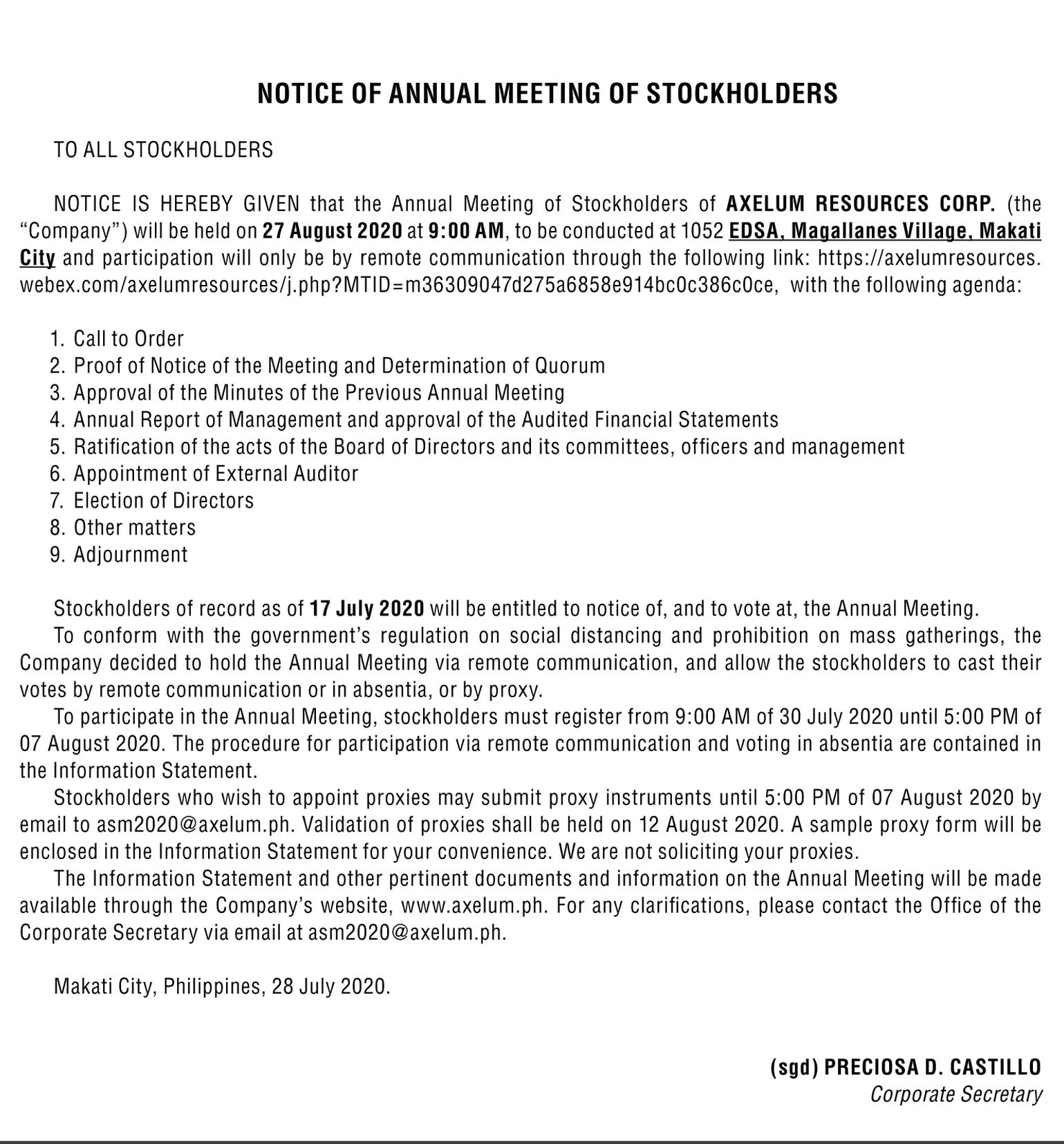
Axelum Resources Corp sets stockholders’ meeting via remote communication

LANDBANK rolls out new P10-billion loan program for LGUs

STATE-RUN Land Bank of the Philippines (LANDBANK) has set up another lending program worth P10 billion for local government units (LGUs) for development projects and recovery efforts amid the coronavirus pandemic.

LANDBANK said in a statement that all provincial, city and municipal LGUs can avail of the program meant to help them become self-sufficient.

The loanable amount will depend on LGUs’ project requirements and will carry a fixed interest rate of 4.5% per annum for the first year subject to an annual repricing after.

The loan amount plus the total loan exposure of the local government should not exceed its net borrowing capacity set by the Bureau of Local Government Finance, LANDBANK said.

“The ongoing public health crisis caused by the COVID-19 (coronavirus disease 2019) pandemic has highlighted the vital role of LGUs in managing the effects of unforeseen catastrophes. We hope that the…program will help them better serve their constituents and communities, while developing a stronger local economy that can withstand future crises,” LANDBANK President and CEO Cecilia C. Borromeo was quoted as saying.

The LGUs can use the borrowed funds to buy agricultural produce, equipment, and construct facilities that will help link their products to markets. These include the rehabilitation of market infrastructure, establishment of a “mobile palengke,” collection and buying stations, and other related facilities.

The loan can also fund programs and projects that support public services, social welfare, health care and other infrastructure projects to stimulate economic activity in their LGUs.

LANDBANK said the program also includes credit for permanent working capital with a three-year tenor and a term loan that can be paid within 10 years. The two credit facilities have a grace period on principal payments of up to one year.

The bank in April introduced a P10-billion loan program for LGUs with a fixed-rate of five percent per annum and payable in up to five years.

LANDBANK posted a P18.51 billion in net income in 2019, up 29% from P15.48 billion in 2018. — BML

How does the Philippines compare with its peers?

How does the Philippines compare with its peers?

How PSEi member stocks performed — July 29, 2020

Here’s a quick glance at how PSEi stocks fared on Wednesday, July 29, 2020.


Peso flat ahead of Fed decision

THE PESO closed flat against the greenback on Wednesday as the market awaits clearer signals from the US Federal Reserve following its policy meeting.

The local unit ended at P49.19 per dollar on Wednesday, unchanged from its Tuesday close, data from the Bankers Association of the Philippines showed.

The peso opened the session flat at P49.19 per dollar, which was already its strongest showing. Meanwhile, its intraday low was at P49.24 against the greenback.

Dollars traded dropped to $551.71 million on Wednesday from the $849.4 million seen on Tuesday.

The peso’s flat finish showed the market was on the sidelines as they awaited the policy decision of the Fed, a trader said.

“The peso closed flat amid uncertainty from the US Federal Reserve’s monetary policy decision this Thursday,” the trader said in an email.

The policy-setting Federal Open Market Committee is reviewing policy from July 30-31, with the market hoping the Fed will keep rates near zero to support economic recovery.

For his part, Rizal Commercial Banking Corp. Chief Economist Michael L. Ricafort said the local unit closed unchanged following “weaker US consumer confidence data”.

Reuters reported that the US’ consumer confidence index decreased to a reading of 92.6 in July coming from the 98.3 in June, data from The Conference Board showed. This is also lower than a 94.5 estimate for the month from a Reuters poll of economists.

For Thursday, the trader expects the peso to move around the P49.10 to P49.30 levels versus the dollar while Mr. Ricafort gave a forecast range of P49.15 to P49.30. — L.W.T. Noble with Reuters

Stocks climb as investors await US stimulus plan

By Denise A. Valdez, Reporter

THE MAIN INDEX closed in green territory for the second consecutive day as investors stayed on the sidelines while waiting for news on the United States’ second coronavirus stimulus package.

The bellwether Philippine Stock Exchange index (PSEi) ended Wednesday’s session higher by 39.16 points or 0.66% to 5,966.27. The broader all shares index also gained 14.60 points or 0.41% to 3,508.24.

However, the PSEi spent most of the day with losses, dropping to as low as 5,870.83 before it recovered in the last hour to reach a peak of 5,966.27.

Investors are focused on the US government’s decision regarding its stimulus efforts to combat the coronavirus disease 2019 (COVID-19) pandemic, Timson Securities, Inc. Trader Darren T. Pangan said in a text message.

The US continues to lead the world in most COVID-19 cases, reaching 4.35 million as of Wednesday. US deaths due to the virus are also the highest in the world at 149,258, based on data from Johns Hopkins University.

US stocks ended Tuesday’s session with losses: the Dow Jones Industrial Average, S&P 500 and Nasdaq Composite indices shed 0.77%, 0.65% and 1.27%, respectively.

Asian stocks were mixed as the PSE closed on Wednesday. Japanese and Taiwanese markets were trading in red territory while Hong Kong and Chinese markets were in the green.

Another factor that helped lift the PSEi was the easing of restrictions for more sectors starting next month. The government on Wednesday announced it will allow gyms, grooming centers, review centers and several other establishments to resume operations by Aug. 1.

“The easing of restrictions of local businesses have given optimism to investors but most remain cautious,” AAA Southeast Equities, Inc. Research Head Christopher John Mangun said in an e-mail.

“Most investors are still on the sidelines, evident in low trading volumes…, just half of the normal daily turnover,” he added.

Most sectoral indices at the PSE ended the session with gains. Industrials rose 128.92 points or 1.76% to 7,448.29; financials increased 11.98 points or 1.04% to 1,155.63; property added 20.55 points or 0.7% to 2,934.39; services climbed 7.19 points or 0.52% to 1,370.77; and holding firms improved 8.41 points or 0.13% to 6,199.70.

The only index with losses was mining and oil, which dropped 79.97 points or 1.47% to 5,335.45 at the end of session.

Value turnover stood at P3.57 billion with 1.18 billion issues switching hands, down from the previous day’s P4.31 billion with 1.96 billion issues.

Decliners outnumbered advancers, 103 against 74, while 47 names ended unchanged.

Net foreign selling continued to fall to P86.74 million from P415.60 million a day ago.

“Second quarter earnings continue to roll out as the week progresses. We’ll have to see if the index closes the week above the 6,000 area,” Mr. Pangan said.

COVID-19 audit sought as cases top 80,000

SEVEN senators have sought an audit of the government’s spending to fight a coronavirus pandemic that has sickened more than 80,000 and killed almost 2,000 people in the Philippines.

In a resolution, seven lawmakers asked the Commission on Audit to look at the expenditures as well as government loans and donations before Congress tackles the 2021 national budget.

“Congress early this year, through the Bayanihan Act, gave the government comprehensive powers, including the power to realign and allocate billions of taxpayers’ money to respond to the COVID-19 crisis,” Senator Risa N. Hontiveros-Baraquel said in a statement on Wednesday.

“We need to know if the help went to those who need it,” the opposition senator said in Filipino.

Senators Ralph G. Recto, Franklin M. Drilon, Juan Edgardo M. Angara, Panfilo M. Lacson, Francis N. Pangilinan and Leila M. de Lima also signed the resolution.

President Rodrigo R. Duterte on Monday asked lawmakers to pass stimulus measures to revive an economy on the brink of a recession caused by a coronavirus lockdown that is one of the world’s strictest and longest.

Analysts, business leaders and opposition lawmakers said he failed to say in his year address to Congress how exactly he planned to go about it.

The tough-talking Philippine leader urged lawmakers to support his economic recovery plan by fast-tracking the second version of the bill giving him special powers in dealing with the pandemic, including realigning government funds.

The first law that has since expired let him realign about P275 billion to state programs against the coronavirus. The second measure seeks to let him allocate another P140 billion for various programs during the health emergency.

Mr. Duterte, who is down to his last two years in office and barred by law from seeking reelection, is under pressure to revive the economy to keep his political capital and ensure the victory of his chosen candidate in the 2022 presidential elections. At least three presidents before him had either been sued or jailed for corruption.

The lawmakers cited issues of overpricing including in the purchase of a P4-million nucleic acid extractor compared with a similar equipment that the private sector bought for P1.75 million.

The government of President Rodrigo R. Duterte also bought personal protective equipment for P1,800 each, higher than the market price of P400 to P1,000, they said.

The senators also questioned the imports of COVID-19 test kits from China and Korea as locally made test kits that are cheaper, were left unused.

The special audit will help Congress decide on next year’s national budget, according to the Senate resolution. The Budget department is expected to submit a P4.5-trillion expenditure program to Congress next month.

“Anticipating that massive allocations will need to be made to address the health, economic and social impacts of COVID-19, it is of critical importance that there be audit findings to guide legislators,” the senators said in the resolution.

The resolution comes as the Senate starts a Committee of the Whole to probe alleged corruption at the Department of Health and Philippine Health Insurance Corp.

The chamber on Tuesday approved the bill extending Mr. Duterte’s special powers in dealing with the pandemic and easing procurement processes for medical supplies.

Also yesterday, the Department of Health reported 1,874 new coronavirus infections, bringing the total to 85,486.

The tally matched the projection made by University of the Philippines researchers on July 16. The researchers had said infections could top 85,000 by the end of the month, with 2,000 deaths.

The death toll rose to 1,962 after 16 more patients died, while recoveries increased by 388 to 26,996, it said in a bulletin.

Of the 56,528 active cases, 90% had mild symptoms, 9% did not show symptoms and less than 1% were either severe or critical, the agency said.

Of the new cases, 728 were from Metro Manila, 325 from Cebu province, 130 from Laguna, 67 from Iloilo and 53 from Rizal, DoH said. The data came from 83 out of 91 testing laboratories, it added.

There were now 166 candidate vaccines for COVID-19 and the number could reach more than 200, Food and Drug Administration Director General Rolando Enrique D. Domingo told an online news briefing, citing the World Health Organization.

Of these, about 140 were still in the early clinical trial phase, while 25 were in the clinical trial stage. Twenty of the 25 were in the first or second phases, where the drugs are tested using a smaller number of about 20 to 30.

Five of those in the clinical trial stage were in the third phase, where the drugs were being used on as many as 30,000 people, he said. Three of the drugs were from China, and one each from London and the US.

Mr. Domingo also said there are six candidate vaccines that could possibly undergo clinical trial in the Philippines, based on the update from the Department of Science and Technology.

The UP researchers earlier cautioned the government against “prematurely downgrading the quarantine status” in high-risk areas including Metro Manila and Cebu, where there had been a surge in COVID-19 infections.

They said Cebu City should remain under a strict quarantine, while the capital region should be kept under a general lockdown to ensure the gains made did not go to waste. The researchers also sought “more aggressive and effective localized lockdowns and stricter border controls.”

The targeted lockdowns in Manila and nearby cities should consider the health aspects of compliance, and the government should avoid treating it as a peace and order issue, they said. — Charmaine A. Tadalan and Vann Marlo M. Villegas