Home Blog Page 87

‘Too early’ to seek fuel excise tax cut

FREDERICK D. GO — DEPARTMENT OF FINANCE VIA FACEBOOK

By Justine Irish D. Tabile, Senior Reporter

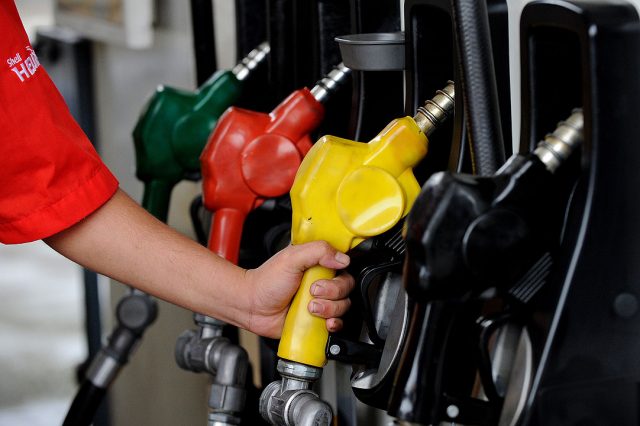
THE Department of Finance (DoF) said it is too early for the Development Budget Coordination Committee (DBCC) to recommend the reduction of the excise tax on fuel.

However, the DoF will pursue other means to provide relief from high fuel prices, including the procurement of 2 million barrels of oil from the global market to ensure a sufficient buffer stock.

“I think it is probably too early for us to say that the DBCC will recommend to the President to reduce excise taxes on fuel,” Finance Secretary Frederick D. Go said on Tuesday on the sidelines of the Philippine Stock Exchange’s InvestPH Conference in Taguig City.

“We have only entered the 17th day of the war, and Congress is still working on the bill,” he added. “My understanding is that the (House of Representatives) has already passed a bill, and the Senate has a draft.”

The House of Representatives approved on Monday House Bill No. 8418, which seeks to give the President the power to suspend or reduce the excise tax on fuel during national and global emergencies.

Its counterpart bill at the Senate, however, was still being discussed at the plenary level as of March 16.

“The Senate draft is completely aligned with the position of the DoF, so we will be very supportive of the bill that the Senate is coming up with,” Mr. Go said.

The Senate version of the bill gives the President the power to suspend excise tax collection for three months, while the House version specifies six months.

Economists said suspending the excise tax on fuel and reducing the value-added tax (VAT) to 10% are not enough to ease the cost-of-living burdens on households, with the oil price shock expected to cause inflation to spike.

According to the De La Salle University (DLSU) Report of the Philippine Economy for March, written by professors from the DLSU Department of Economics, “the per-barrel price of oil has rapidly climbed over the past weeks, with projections that it may reach $140 — a level that would drastically alter the inflation outlook and amplify the growth constraints.”

“This fuel price shock directly feeds into firms’ production costs, dampening business confidence and contributing to the contraction in capital formation. The cost will be passed on to households,” it added.

Apart from the war’s inflationary impact, it is also expected to physically endanger many overseas Filipino workers in the Middle East and dampen their remittances, which have been estimated at $30 billion.

“Threats to this critical consumption (lifeline) for millions of households compound their already-deteriorating purchasing power due to foreseen inflation spikes and further undermine the role of private consumption in ushering in rapid economic expansion,” it said.

In the report, the economy is expected to grow 2.5% in the first quarter, 3.8% in the second, 4.5% in the third, and 5.9% in the fourth. This will bring full-year growth to 4.19%, below the government’s revised target of 5%-6% gross domestic product (GDP) growth.

The Department of Economy, Planning, and Development warned last week that GDP growth could again fall below 5% if inflation is left unchecked. Economic growth slowed to 4.4% in 2025, the weakest in five years, as the flood control corruption scandal weighed on government spending, investment and consumer confidence.

The DLSU report recognized, however, the steps the government is taking to address the impending impact of the oil shock.

“Several legislative responses have been filed in Congress to mitigate these pressures,” the report said, pertaining to House Bill No. 8418 and the proposal to reduce the VAT rate.

“While aiming to ease household burden and support consumption, the effects of such measures are unlikely to immediately take effect. These policy responses are also not guaranteed to fully offset the inflationary impacts of the oil price shock,” it added.

Mr. Go said the government is pursuing targeted means of intervening in the market to provide immediate relief to the most vulnerable segments of society.

“These include expediting fuel subsidies for transportation, farmers, and fisherfolk,” he said. “We will also be implementing the ‘Libreng Sakay’ program to ease commuting costs. In addition, the budget for assistance to individuals in crisis situations will be released to the public.”

He said that the government is also working with oil companies to stagger their price increases, encouraging energy conservation in offices through remote work, and considering delays to non-urgent programs and capital outlays.

According to Mr. Go, a meeting on Sunday with oil companies discussed ways for the Philippines to access petroleum from markets not exposed to Persian Gulf disruption.

The Philippines gets a significant portion of its fuel from Singapore, where Middle Eastern oil is typically processed, as well as China, whose largest single supplier of crude is Russia.

“The Philippine National Oil Company Exploration Corp. (PNOC EC) will be procuring 2 million barrels of oil from the global markets as a precautionary measure to add to our oil buffer stock,” Mr. Go said.

“The PNOC EC has already started the procurement process and we should be able to procure about 2 million barrels of oil anytime now to dispel fears that we will have an oil shortage,” he added.

Mr. Go said the 2 million barrels, which the government plans to acquire within the week, is equivalent to about 10 days of fuel inventory.

“I believe that they have a lot of offers on the table, so they are just selecting which ones they will procure from,” he added, noting that the prudent thing to do is to buy from multiple sources.

“The primary objective is, of course, to create the additional buffer stock. Also, when you put out a big order into the global market, the belief is you should be able to achieve economies of scale and procure at lower prices,” he added.

He stressed that at the start of the war, the country had over 50 days’ worth of fuel inventory.

“We recognize that things are beyond our control, but we will not be defined by what we cannot change. Our focus is on what we can influence, the reforms that we implement, the programs that we launch, and the decisions we make for the domestic market,” he said.

“We aim to protect Filipinos from external shocks without compromising essential services,” he added.

Meanwhile, he said the crisis has highlighted the urgency of disposing of some government assets.

“The DoF, together with our privatization group and the privatization management office, had a meeting actually very recently to discuss the possible assets that we would like to accelerate its disposal of,” he said.

“The answer is yes. We should accelerate the disposition of assets,” he added.
Senate approves bill authorizing President to temporarily reduce or freeze fuel excise

PHILSTAR FILE PHOTO

By Adrian H. Halili, Reporter

THE Senate approved on Tuesday a measure granting President Ferdinand R. Marcos, Jr. emergency powers to lower or suspend the excise tax on petroleum products.

In a plenary session, 17 senators voted to approve on third reading Senate Bill No. 1982, which would give the President emergency powers to reduce or halt collection of taxes imposed on fuel and other petroleum product.

“We want to assure the public that we have taken time to assess this, not just because it was a certified measure,” Senator Pilar Juliana S. Cayetano, who heads the Ways and Means committee, told senators.

A day earlier, the House of Representatives had approved on third reading House Bill No. 8418, which also granted the President similar emergency powers.

The emergency powers contemplated by the Senate involve a three-month maximum for suspending the taxes on petroleum products. The triggers for setting such action in motion are $80 per barrel for the Dubai crude benchmark, as well as the recommendations of the Secretary of Energy and the Development Budget Coordination Committee (DBCC).

It added that the suspension or reduction of taxes can be applied to specific petroleum products and may be implemented either as a full suspension or a partial reduction.

The bill states that the excise taxes on petroleum products will be automatically restored a week after the one-month average of Dubai crude oil falls below $80, or after the lapse of three months.

According to the Senate measure, the President’s emergency power to adjust excise tax collections will expire on Dec. 28, 2028.

The measure also orders the DBCC and the Department of Energy (DoE) to submit monthly reports to Congress stating the factual basis for the suspension or reduction of taxes, estimates of forgone revenue, and projections on the impact on inflation, fuel prices, and other economic activity.  

The report will include recommendations on whether the suspension or reduction of excise taxes should be maintained, modified, or lifted.

Oil companies will also be required to submit monthly information on their cost structure to the DoE, DBCC and Congress.

President Ferdinand R. Marcos, Jr. last week certified as urgent the measure granting him temporary powers to mitigate surging fuel prices.

The Philippines imposes an excise tax of P10 per liter on gasoline, P6 on diesel and P5 on kerosene, as authorized by Republic Act No. 10963 or the Tax Reform for Acceleration and Inclusion (TRAIN) law.

The Philippines imports 98% of its fuel requirements. It currently has a fuel stockpile good for 50 to 60 days, the DoE has said.

Leonardo A. Lanzona, Jr., an economics professor at the Ateneo de Manila University, said any reduction or suspension of the fuel excise tax will result in only marginal relief.

“The maximum excise relief offsets perhaps a third to half of just one week’s price movement. The deeper structural problem is the Philippines’ import dependence,” he said via Messenger chat.

He added that the measure may not be the most efficient to counteract global oil price volatility, as it effectively serves as a “blanket subsidy.”

“Every peso of excise relief goes to every fuel consumer regardless of income — which means vehicle-owning households capture a disproportionate share,” Mr. Lanzona said, noting that the estimated foregone government revenue represent a “very large fiscal sacrifice.”

The Department of Finance has estimated the revenue to be foregone in suspending or reducing the fuel excise tax at up to P136 billion.

“It is time for the government to institute an honest-to-goodness energy program that reduces our dependence on foreign oil,” he said.

IBON Foundation Executive Director Jose Enrique A. Africa said the ongoing spikes in fuel prices may add at least 2-3 million Filipino families to the ranks of the poor.

“This will not mean very much amid a likely doubling of inflation to some 5% in the next three months and perhaps even higher beyond,” he said via Viber.

The Department of Economy, Planning, and Development has said that further global oil shocks could drive inflation above 4% this year.

Mr. Africa said subsidies for transportation, agriculture, and the poorer segments of society will be the fastest way to respond to rising oil prices, but are limited in scope.

“The supposed subsidies for the transport sector reach just a tiny share of them, are too small, and for too short a time. We haven’t even heard of any (aid) programs for at least 60 million poor Filipinos,” he added.

Employers doubt they can handle shift to legislated wage coupled with oil crisis

PHILSTAR FILE PHOTO

EMPLOYERS said a legislated minimum wage will be difficult to handle on top of the fuel price shock caused by the outbreak of fighting in the Persian Gulf.

“Our problem is not salary, our problem is the high cost of living, which I think is beyond the control of the enterprises,” according to Sergio R. Ortiz-Luis, Jr., honorary chairman of the Employers Confederation of the Philippines.

Speaking on the Money Talks with Cathy Yang program on One News on Tuesday, Mr. Ortiz-Luis said the proposal to legislate a single national minimum wage disregards the advantages of the current setup involving regional wage boards, which are in a better position to determine a suitable wage for their areas.

“Even if the regional wage boards are not perfect, we support (that system),” he said, alluding to criticism that wages have languished because such boards can only accept wage hike petitions on the anniversary of the previous wage action.

He warned that a single minimum wage removes the incentive to do business in less-developed areas.

“If salaries are the same, everybody will invest only on the in urban areas,” he said.

The Trade Union Congress of the Philippines once again declared its support to pass a bill imposing a P200 national wage hike, citing the likely impact of the Iran crisis on the prices of basic goods.

A legislated wage hike would “protect the purchasing power of Filipino workers amid inflationary pressures from escalating tensions in the Middle East,” the group said earlier this month.

However, many employers have long warned that a mandated wage increase could raise operating costs and result in job losses.

Mr. Ortiz-Luis said decisions issued by the Regional Tripartite Wages and Productivity Boards balance worker interests with those of employers, adding that the boards consider employers’ capacity to absorb added costs.

Last year, the House of Representatives passed on third and final reading a measure calling for a P200 across-the-board minimum wage hike for workers in the private sector.

However, senators failed to reconcile the House measure with their version, which supported a P100 wage hike, before the 19th Congress adjourned.

Mr. Ortiz-Luis also said that only the medium and large enterprises can provide transport allowances to ease the shock of rising oil prices.

Bigger firms have also been providing transportation services for its employees.

He said micro enterprises are the most vulnerable to external price shocks.

“Don’t expect anything from the micro (segment) because they’re just trying to survive,” he noted. “Many of them are really struggling even without this crisis.”

Despite this, Mr. Ortiz-Luis said providing temporary relief to consumers may not be enough. “We are not exactly fond of these dole outs and targeted giving,” he said.

He also favored a measure seeking to grant President Ferdinand R. Marcos, Jr. the authority to suspend or cut excise taxes on petroleum products.

Mr. Ortiz-Luis also supported proposals to reduce the value-added tax on petroleum products. — Beatriz Marie D. Cruz

PHL in talks with China to obtain more fertilizer

REUTERS

By Kenneth Christiane L. Basilio, Reporter

THE PHILIPPINES is in talks to source more fertilizer from China, agriculture officials told Congress, citing the need to sidestep supply disruptions arising from the Iran war.

Other possible suppliers are being sounded out, Agriculture Undersecretary Roger V. Navarro said on Tuesday.

The Philippines sources nearly one-fifth of imported fertilizer from Persian Gulf suppliers, Fertilizer and Pesticide Authority Executive Director Glenn DC. Estrada said.

Mr. Estrada said the Philippines imports 108,000 metric tons of fertilizer from Qatar and 33,000 metric tons from Saudi Arabia, accounting for 15% and 4% of inbound shipments respectively.

Such types of fertilizer depend on natural gas as a raw material for producing ammonia and urea. Saudi fertilizer is less exposed to Gulf disruptions because the kingdom has ports on the Red Sea.

“We need to diversify our sources of international fertilizer,” Mr. Navarro told legislators at a congressional hearing. “We need to explore government-to-government talks in areas where there are supplies for fertilizer.”

Mr. Estrada said other major Philippine fertilizer suppliers are Indonesia (24%) and Vietnam (6%). China currently accounts for 18% of Philippine fertilizer imports.

The Philippine dry-season harvest is coming up, with the ongoing Iran war threatening to disrupt the agricultural yields of import-dependent nations.

“As a country that imports a significant volume of key food commodities and agricultural inputs, disruptions in international markets can directly affect domestic production costs, food availability and consumer prices,” Mr. Navarro said.

More than one-third of global fertilizer exports and raw materials must transit the Strait of Hormuz at the mouth of the Persian Gulf. Iran has attacked merchant shipping seeking to use the Strait.

The Philippines has about 86,300 metric tons of urea-based fertilizer in stock, and traders are expected to begin searching for supplies soon, Mr. Navarro said.

“Since we are approaching the harvest season, our industry stakeholders are only now bringing in supplies because they do not stockpile large volumes,” he said. “What they practice instead is just‑in‑time arrival.”

Mr. Navarro said the Department of Agriculture plans to partner with local governments to stretch out the fertilizer supply by providing bacterial cultures that can be mixed and distributed directly to farmers.

He added that authorities are watching fertilizer prices closely to detect instances of overpricing. A bag of fertilizer currently costs P1,500.

NFA could raise palay buying price by end-March

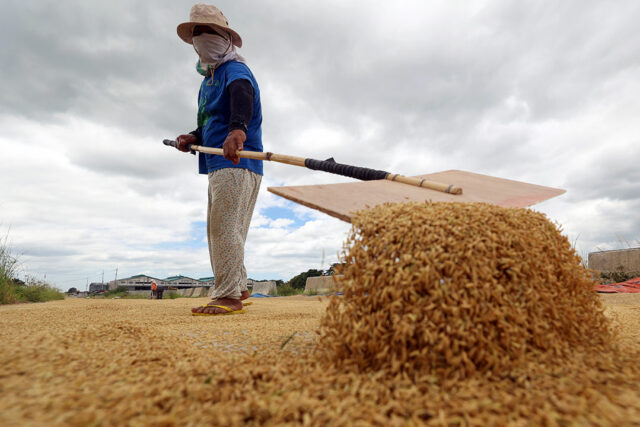
A farmer dries rice grains in Baliuag, Bulacan, Oct. 9, 2023. — PHILIPPINE STAR/KRIZ JOHN ROSALES

THE National Food Authority (NFA) said it is considering a “slight increase” in its buying price for palay (unmilled rice) by the end of March to replenish rice stocks during the dry-season harvest.

NFA Administrator Larry R. Lacson said the grains agency is struggling to compete with the high prices offered by private traders.

“Right now, traders are buying at very high prices, so we cannot keep up,” Mr. Lacson told reporters late Monday.

The Philippine Statistics Authority (PSA), citing preliminary data, reported that the farmgate price of dry palay rose 10.4% year on year in February to a national average of P22.47 per kilo, with prices reaching as high as P28.12 per kilo in the Cagayan Valley.

The NFA currently buys palay at P21 per kilo for dry palay and P17 per kilo for fresh palay. 

Mr. Lacson described the planned new buying price as slightly higher, but declined to provide a specific range, citing the need to discourage speculation.

He said the NFA has deliberately avoided raising its buying price for now to avoid costs from being passed on to the retail level.

The possible price change could take effect towards the end of March, when the harvest is nearing its peak, Mr. Lacson said.

“For now, prices are very good, and we want our farmers to enjoy that because they incurred losses previously. We may just step in toward the end of the peak of the harvest,” Mr. Lacson said.

He said the planned increase in buying price would allow the NFA to compete with private traders and procure a “sizable amount of palay to replenish stocks” that have already been released.

The NFA said it is also seeking temporary authority to sell rice directly to consumers as prices of the staple continue to rise.

Currently, the grains agency can only dispose of its stocks through public auctions and the P20-per-kilo rice program, under which state-run Food Terminal, Inc. (FTI) purchases rice and distributes it through Kadiwa stores and other designated outlets.

If granted approval, Mr. Lacson said the NFA plans to sell rice at P33 per kilo, the same price it charges FTI.

Meanwhile, the NFA assured the public that rice supply remains sufficient despite longer queues reported at outlets selling subsidized rice for the government’s P20-per-kilo program.

“Our message to the public is not to worry. We have enough supply. There is no need to (rush to line up) just to buy P20 rice,” Mr. Lacson said.

Mr. Lacson said the NFA currently holds about 2.6 million bags of milled rice in inventory. Of this, around 600,000 bags have been sold through auctions and are expected to enter the market soon.

He said the remaining two million bags in stock are being used to supply the P20 rice program, while milling operations continue to replenish supply.

Mr. Lacson said the NFA’s reserves are good for about 10.3 days, equivalent to around 6 million bags or 360,000 metric tons of milled rice.

He added that the NFA is also planning regional-level rice auctions in April to manage inventory on hand and ensure sufficient warehouse space for palay to be procured from domestic farmers. — Vonn Andrei E. Villamiel

Albay port upgrade designed to boost agri trade

ALBAY PIO/PNA

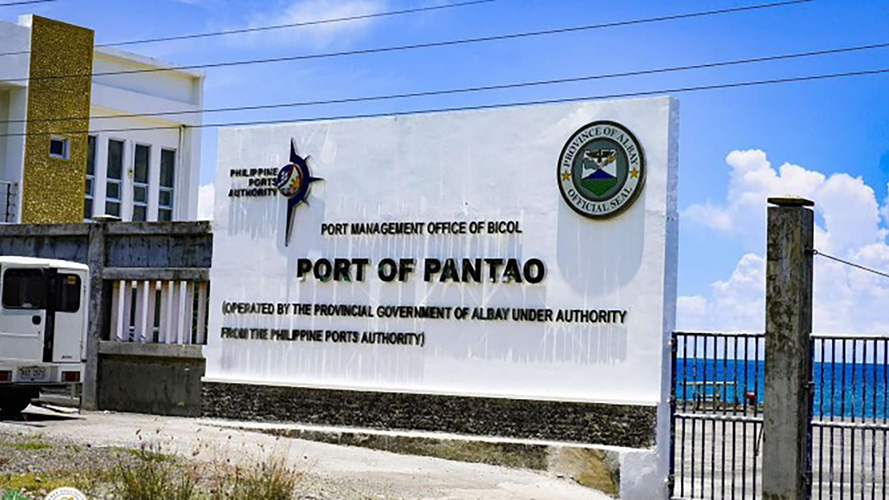
THE Department of Agriculture (DA) said it is planning a P500-million expansion of the Port of Pantao in Libon, Albay to develop an agricultural logistics hub and help raise the incomes of fisherfolk and farmers in the area.

Agriculture Secretary Francisco P. Tiu Laurel, Jr. said the DA is hoping that the port expansion and associated road improvements can be completed by early 2028 to help spur economic development in the area.

“This will really be a major advantage for Libon once we complete the port expansion, improve the road network, and install the ice plant and other facilities,” Mr. Laurel was quoted as saying in a statement.

Libon is on the western shore of Albay facing Burias Island and southeast of the Ragay Gulf.

The DA said funding for the port expansion and post-harvest facilities is included in the 2026 General Appropriations Act, while additional funds will be proposed in 2027 for the construction of a farm-to-market road to improve connectivity to the port.

Mr. Laurel said he will work with Public Works and Highways Secretary Vivencio B. Dizon to expedite repairs to the road linking the port to the Maharlika Highway.

The DA will also work with the Departments of Public Works and Highways and Transportation, as well as Albay province to support the expected increase in cargo and passenger traffic once the port’s facilities are expanded.

Mr. Laurel said “Better road access and post-harvest facilities such as ice plants and cold storage will allow fishers to bring their catch to more markets and earn more.” — Vonn Andrei E. Villamiel

Underspending after flood control scandal dampens 2025 gov’t cash utilization rate

WORKERS excavate a road in Quezon City. — PHILIPPINE STAR/MIGUEL DE GUZMAN

THE underspending in late 2025 following the flood control corruption scandal has brought down the National Government’s (NG) cash utilization rate to just under 98%, the Department of Budget and Management (DBM) said in a report.

The DBM said the NG, local governments and government-owned firms used P4.847 trillion, or 97.7%, of the notices of cash allocation (NCAs) issued to them in 2025. The year-earlier rate had been 99%.

Michael L. Ricafort, chief economist at Rizal Commercial Banking Corp., said the NG turned cautious and prudent after flood control-related corruption led to a shake-up in the Department of Public Works and Highways and implicated legislators and a small group of well-connected contractors.

He said that the underutilization amounts to a “sacrifice” by the government to keep corruption from spreading and undermining confidence in the government.

“However, the government’s catch-up spending to make up for the underspending since late 2025, now backed by anti-corruption measures and other reforms to better level up governance standards, will help increase budget utilization in 2026,” he said via Viber.

“This would help pump-prime or expedite economic growth and development that is more inclusive, as well as help (prop up) investment confidence,” he added.

The NCA is authorizes central, regional and provincial offices and their operating units to draw funds from government banks for their cash requirements.

The unused NCAs totaled P114.527 billion at the end of 2025, according to the report.

Line departments used 97% of their allotments, equivalent to P3.566 trillion of the P3.678 trillion NCAs issued.

In 2025, two offices — the Judiciary and the Ombudsman — hit 100% utilization.

Three agencies posted 99.9% utilization — the Office of the Vice-President, the Department of Foreign Affairs, and the Department of Social Welfare and Development.

Meanwhile, three agencies tallied utilization rates of below 80%: the Commission on Elections (72%), the Department of Energy (72.4%), and the Department of Information and Communications Technology (77.8%).

Budgetary support to government-owned and -controlled companies was 99.2% used, while the corresponding rate for local government units was 99.9%. — Justine Irish D. Tabile

Manufacturers agree to hold prices of basic goods steady for 30 days

PHOTO BY BERNARD HERMANT

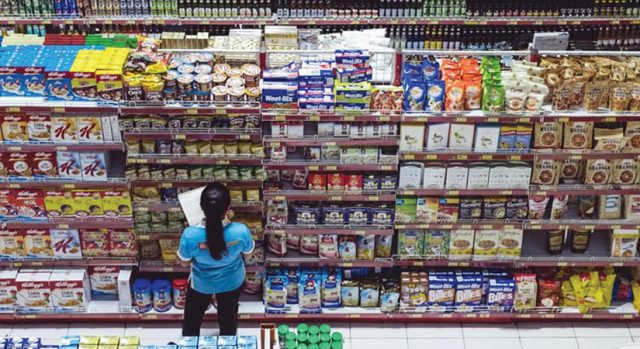
THE Department of Trade and Industry (DTI) said manufacturers of basic goods have agreed to hold prices steady over the next 30 days, even in the face of surging fuel prices.

“Manufacturers of basic necessities and prime commodities have confirmed that they can maintain current prices for the next 30 days, with some able to do so for up to 60 days,” the DTI said in a statement on Tuesday.

The commitments were made during a March 16 meeting of the DTI and 21 manufacturers, including makers of canned sardines, bread, bottled water, instant noodles, coffee, canned meat, toilet soap, and candles.

Citing the manufacturers, the DTI said it expects some price increases for items like canned sardines such as Unipak, 555, Ligo, Lucky 7, Fresca, Morjon, Golden Town, and Mega; bread products such as Pinoy Tasty and Pinoy Pandesal; and bottled water from the Wilkins and Nature’s Spring brands.

No price hikes are expected for toilet and laundry soaps such as Safeguard Pure White, Tide Bar Original Scent, and Green Cross Pure White; condiments such as Datu Puti soy sauce and vinegar, and Lorins Patis; CDO processed canned meat of CDO; and Liwanag candles.

Manufacturers also pledged to maintain prices for 60 days for instant noodle brands like Lucky Me, and Ho-Mi, as well as meat products from Argentina, Lucky 7, 555, Swift Premium, Wow!, and Shanghai.

Price hikes are not expected for instant coffee brands like Kopiko, Nescafé, and San Mig coffee 3-in-1 for the time being, the DTI said.

“We recognize the financial strain faced by consumers while also acknowledging the cost pressures confronting manufacturers,” Trade Secretary Ma. Cristina A. Roque was quoted as saying.

“Our priority remains to ensure fair and reasonable pricing,” she added. — Beatriz Marie D. Cruz

PSEi rises on bargain-hunting, Wall Street cues

BW FILE PHOTO

PHILIPPINE SHARES rebounded on Tuesday as investors picked up beaten-down stocks after three straight days of losses, taking cues from gains on Wall Street.

The benchmark Philippine Stock Exchange Index rose 0.32% or 19.46 points to close at 6,026.01, while the broader all-share index gained 0.24% or 8.06 points to 3,349.75.

“The local market bounced back as investors hunted for bargains following three straight days of decline,” Japhet Louis O. Tantiangco, research manager at Philstocks Financial, Inc., said in a Viber message.

He added that investors tracked Wall Street’s overnight advance, although trading remained subdued.

“Many investors stayed on the sidelines amid lingering uncertainties related to the conflict in the Middle East,” he added.

Luis A. Limlingan, head of sales at Regina Capital Development Corp., said sentiment improved as global markets rose and oil prices showed signs of easing, but caution persisted.

“The market remained cautious amid hints of a possible rate hike, with investors staying selective in buying,” he said.

US stocks climbed sharply on Monday, driven by gains in artificial intelligence-related shares, providing a positive lead for regional markets.

Most sectoral indexes in Manila closed higher. Services led the gains, climbing 1.03% to 2,750.51, followed by holding firms, which rose 0.54% to 4,654.33. Industrials added 0.22% to 8,676.22, while mining and oil edged up 0.18% to 17,171.37.

On the other hand, property stocks declined 0.86% to 1,981.25, while financials slipped 0.08% to 1,921.39.

Among index members, JG Summit Holdings, Inc. was the top gainer, rising 3.59% to P26. DigiPlus Interactive Corp. was the biggest loser, falling 3.89% to P17.30.

Market breadth was negative, with losers beating winners 95 to 92, while 53 stocks were unchanged.

Turnover thinned to P7.44 billion from P9.53 billion in the previous session, with 1.06 billion shares traded. Net foreign selling widened to P563.22 million from P400.15 million a day earlier. — A.G.C. Magno

Alex Eala’s bid to maintain elite stature faces immense pressure

ALEX EALA — ASBCLASSIC.CO.NZ

ALEXANDRA “ALEX” EALA will thread a steep, rocky and muddy road to the Miami Open glory just in order to defend her lucrative ranking points and stay inside the Top 30 of the world’s best.

Albeit getting a first-round bye as the No. 31 seed, Ms. Eala’s path in the lower bracket just to reach a must final four finish like last year goes through a slew of Top 10 players and Grand Slam champions.

The 20-year-old Filipina wunderkind, catapulted by a Last 16 finish in the Indian Wells Open considered as the “Fifth Grand Slam,” marches into Miami with a new career-best ranking of WTA No. 29, up from No. 32 last week.

But Ms. Eala’s bid to retain that elite stature faces immense pressure starting in Round 2 against either No. 53 Laura Siegemund of Germany or No. 76 Petra Marcinko of Croatia.

From a relatively unknown player last year who caught everybody by surprise as the No. 140 player, Ms. Eala is a marked woman now in Miami, needing to keep the 390 points she gained following a run for the ages from being a wildcard to the final four upon the expiration of points on Wednesday.

And one of those gladly waiting to exact vengeance on the lefty ace is world No. 3 Iga Swiatek, who is projected to take care of either compatriot Magda Linette (No. 50) or Varvara Gracheva of France (No. 60) to reach Round of 32.

Ms. Swiatek was among the three Top 25 players and former Grand Slam champions (along with Latvia’s Jelena Ostapenko and USA’s Madison Keys) beaten by Ms. Eala in Miami last year to become the first Filipina WTA semifinalist.

That campaign pushed her to Top 100 to qualify in all main draws of WTA 1000-level tours and all four Grand Slams before climbing the ranks this season to Top 50, Top 40 and now Top 30.

To say that the climb gets tougher for Ms. Eala, should all the stars align, from there on would be an understatement as an early exit would scratch the 390 points from 1525-point total as of Wednesday and drag her all the way to around Top 50-60 (1135 points) once again just like where she started this season.

By the fourth round, either world No. 13 Karolina Muchova of Czechia or No. 16 Clara Tauson of Denmark is tipped to challenge her then it would be one between world No. 9 Victoria Mboko of Canada or No. 10 Mirra Andreeva of Russia in the quarterfinals.

Ms. Eala has to beat all of those marquee names just to retain the said 390 points and get in the Final Four, where either her good friend and world No. 4 Coco Gauff or No. 6 Amanda Anisimova of the United States are expected to be waiting.

World No. 1 Aryna Sabalenka of Belarus and No. 2 Elena Rybakina of Kazakhstan lead the upper bracket, tipped to slug it out for a final ticket.

The battlelines are drawn, the goal is set and it’s on Ms. Eala — with a legion of Filipino fans behind once again — to either reach new heights as the world’s rising poster girl or drastically drop from the world’s list of elite of the elites.

And only time can tell, pitting Ms. Eala against a Czech or French foe in Round 2 on Thursday after the ongoing qualifiers and the start of the main draw. — John Bryan Ulanday

Pacesetting Terrafirma clashes with Blackwater in Commissioner’s Cup

TERRAFIRMA DYIP — PBA.PH

Games on Wednesday
(Ynares Center Antipolo)
5:15 p.m. – Terrafirma vs Blackwater
7:30 p.m. – Meralco vs Converge

TWO GAMES into the PBA Commissioner’s Cup Season 50, Terrafirma has already surpassed its woeful one-win showing in the previous Philippine Cup.

And for the rejuvenated Terrafirma Dyip, this is far from getting them satisfied.

“We are hungry,” coach Ronald Tubid said in local dialect after roaring to back-to-back romps at the expense of Titan (112-82) and contender Converge (111-100 in overtime).

Mr. Tubid’s charges led by efficient import Ali Mubashar and newly-minted PBA Press Corps Player of the Week Jerrick Ahanmisi have positioned themselves among the pacesetters of the week-old conference with a shot of taking the solo lead with No. 3 on Wednesday against Blackwater (0-1).

Mr. Mubashar carved his name in PBA history books over the weekend when he banged in 50 big points and hauled down 25 rebounds in the upset over the touted FiberXers, where the Dyip held the latter scoreless in extra time to seal the deal.

The 7-foot import quickly deflected credit, pointing to Mr. Ahanmisi, rookie Geo Chiu and the rest of the locals for their early success.

“I’m very fortunate to have the help and support of the team. At any time, I can call them for anything and they’d always come through. So shoutout to them,” said Mr. Mubashar.

The Bossing are out to get themselves on the board after dropping their opening assignment versus NLEX (81-84).

Meanwhile, the FiberXers (1-1) seek to wheel back on track as they take on a Meralco squad making its conference debut in the 7:30 p.m. main game.

The Bolts unleash new faces in American reinforcement Marvin Jones, rookies Jason Brickman and Vince Magbuhos and trade acquisition Javee Mocon in their bid to contend for the title in the mid-season tournament. — Olmin Leyba

Lady Bulldogs target quick reversal against free-falling UP

Games on Wednesday
(Smart Araneta Coliseum)
9 a.m. – UE vs FEU (Men)
11 a.m. – NU vs UP (Men)
1 p.m. – UE vs FEU (Women)
3 p.m. – NU vs UP (Women)

AFTER a deflating defeat against rival De La Salle University (DLSU), titleholder National University (NU) aims for a quick turnaround against the free-falling University of the Philippines (UP) to steady the ship in the start of the crucial UAAP Season 88 women’s volleyball on Wednesday at the Smart Araneta Coliseum.

A return to the winning column right away is up for grabs for the NU Lady Bulldogs (5-2) at 3 p.m. against the UP Fighting Maroons (3-4) to firm up hold of the second seed and stay on course of a vengeance bid against the unbeaten DLSU Lady Spikers (7-0) at the homestretch.

Far Eastern University (FEU), in joint third with University of Santo Tomas and Adamson University at 4-3, eyes a slight breather at 1 p.m. opposite the winless University of the East (UE) (0-7) in the middle of 21 straight losses since last season.

The charges of new coach Regine Diego over the weekend absorbed a 21-25, 19-25, 25-19, 17-25 loss to La Salle before over 18,000 fans to see its domination of five straight games against its fierce foe in the last two seasons.

Led by now pro players Bella Belen and Alyssa Solomon, the Lady Bulldogs have already matched their total losses last year just in the first round this time around and they have no plans of tasting another one.

Coincidentally, NU’s other loss came against UP in a thrilling five-setter marathon to pave the way for no less than a hammering revenge.

The Fighting Maroons since pulling the rug from under the Lady Bulldogs for a 2-0 start dropped four of their last five games, including three defeats in a row to trip all the way to sixth place.

Super rookie Sam Cantada alongside team captain Vange Alinsug, Arah Panique and Celine Marsh spearhead NU’s bounce back bid against the hungry Diliman spikers led by skipper Niña Ytang, Jelai Gajero, Joan Monares and Fina Ali following the season-ending ACL injury of ace Casiey Dongallo.

In the men’s play, FEU (7-0) wants no let-up from a first-round wipeout against UE (1-6) at 9 a.m. as five-peat champion NU and Santo Tomas, tied at 5-2, dispute solo second spot at 11 a.m. — John Bryan Ulanday