Home Blog Page 8421

BusinessWorld Virtual Economic Forum with Arch. Felino Palafox

Metro Manila ranks among the most densely populated cities in the world. How can we change it to become safer from any future health crises? In what ways can we expect our cities to change because of the COVID-19 pandemic?

Join Arch. Felino Palafox and 40 other local and international speakers on a two-day BusinessWorld Virtual Economic Forum to discuss the great economic reset as well as the future in a post-COVID era.

Check out the full lineup of speakers and conference programme at www.bworldonline.com/BWVirtualEcoForum

Secure your premium pass today!

#BWVirtualEcoForum
#Forecast2021

Clash of consoles: New PlayStation and Xbox enter $150 billion games arena—fight!

TOKYO/CHICAGO/STOCKHOLM — Think Michelangelo vs. Da Vinci. Muhammad Ali and Joe Frazier. Batman v Superman. Another epic rivalry is rejoined this week when Sony and Microsoft go head-to-head with the next generation of their blockbuster video-game consoles.

Sony, whose PlayStation 5 (PS5) takes on Microsoft’s Xbox Series X and Series S, is widely viewed as being in pole position to capitalize on a pandemic-driven boom in consumer spending that has buoyed the $150 billion video game industry.

The Japanese company’s deep bench of games and broader fan base—it has sold over 100 million PS4s, winning the battle of the previous generation—should see it retain its edge over its American archrival, according to industry experts.

“People who own Xbox tend to buy the new Xbox, while people who own PlayStation tend to buy the new PlayStation,” said Wedbush Securities analyst Michael Pachter.

Yet the industry is changing and cloud gaming is on the rise, allowing games to be streamed without bulky hardware. This could curb console sales in coming years, analysts say, a shift that could benefit Microsoft.

The two consoles—the first to be released by the two companies for seven years—are eagerly awaited; the Xbox will go on sale on Tuesday, and the PS5 two days later in core markets, costing about $300 to $500 apiece.

The race to order the devices in advance actually began weeks ago, though blink and you might have missed it. Pre-orders of Sony’s PS5 sold out within minutes on many retail sites, for example, frustrating fans.

Julian Mercado, 17, managed to reserve a PS5 from Walmart.com just minutes after pre-orders started on Sept. 16, knowing he’d be up against a legion of gamers.

“It’s exactly like shopping on Black Friday,” said the high school student from Dallas, who has been playing video games with his dad since he was five. “You show up early, you walk away with something good. You show up too late, you’ll walk away with nothing.” 

PLAYING IN A PANDEMIC
Sony might have the edge, but the stakes are high for the Japanese company. Its gaming business is its biggest cash cow; in its fiscal 2019 the division, which includes hardware, software and services, brought in close to a quarter of its roughly $77 billion group sales and nearly 30% of its $7.9 billion operating profit.

Microsoft does not break out the results of gaming, though it’s a smaller part of its business than for Sony. It also does not disclose hardware sales but the current Xbox One is estimated by analysts to have sold 50 million units.

For the other big hardware player, Japan’s Nintendo, sticking to consoles is paying off with it hiking forecasts last week following elevated demand for its Switch.

The PS5 will retail at $499.99 or $399.99 for a digital-only version, while the Xbox Series X will sell for $499.99 and the lower-spec Series S for $299.99.

About 5 million PS5s are forecast to be sold this year, versus 3.9 million of the new Xboxes, according to media research firm Ampere, with combined sales expected to be higher than the previous generation.

“The pandemic is expected to transform the US holiday shopping season,” said Jason Benowitz, a senior portfolio manager at Roosevelt Investment Group. “Playing from home has become a way for some to safely socialize.”

Sony’s games depth is supported by in-house studios behind exclusives such as Marvel’s Spider-Man: Miles Morales. By contrast, the new Xbox, say games experts, will lack killer launch titles, with the latest in its flagship “Halo” series pushed back to next year as the pandemic hits development.

Cloud gaming growth could, however, hand the US software giant an advantage in coming years. Although both companies have moved to offer services, Microsoft has been more aggressive.

Its Xbox Game Pass subscription service has grown rapidly; it offers more than 100 titles including brand-new games and has over 15 million users. Sony has been reluctant to make its hottest titles available on services like PlayStation Now, fearing this could cannibalize sales of big-budget games.

‘DEMAND OUTSTRIPS SUPPLY’
The pandemic, while fuelling some demand, has also constrained Sony and Microsoft’s production, according to industry experts, who see shortages stretching into 2021.

“Demand will outstrip supply so there’s going to be some people who won’t get a-hold of the console when they want to,” said Piers Harding-Rolls, director of Ampere’s games research.

Sony has announced that retailers like Walmart, Best Buy, and Target will sell the PS5 exclusively online when it launches on Nov. 12, to prevent people from camping outside stores during a pandemic.

Walmart stands to sell as much as $1.1 billion worth of new consoles by the end of January, according to Wedbush. It dominates the U.S. market along with GameStop, each with a roughly 30% share, while sales of consoles at Target and Best Buy comprise about 15% apiece, the research firm said.

Target said it was working closely with its vendors to secure enough inventory. Some shoppers who had reserved consoles told Reuters that Target had said they may receive them days after the launch date.

Walmart said it would start selling the new consoles at launch but declined to comment on whether it would have enough stock to meet demand. Best Buy also declined to comment on whether it would be able to meet demand, while GameStop did not respond to requests for comment.

For DeAnthony Thicklin, a casino attendant who reserved his PS5 on Target.com in September, the priority is to get their hands on a console on the launch day itself.

The 25-year-old offered some advice.

“Have all your card information set up so the only thing you have to do is click,” he said. “Don’t hesitate. Be quick.” — Sam Nussey, Richa Naidu and Supantha Mukherjee/Reuters

Nissan plots digital course for car sales in a post-pandemic world

BEIJING — As COVID-19 threw a wrench into the cogs of car retailing, a senior Nissan board member challenged the chief operating officer to explain what the automaker was doing to adapt to a new era where customers may be reluctant to roam showrooms.

The operating chief, Ashwani Gupta, told the board meeting in late July that Nissan was racing to create a “complete, end-to-end digital journey,” according to three people familiar with the discussions.

He said this would allow consumers to research cars online, have models delivered to their homes for test drives and make purchase plans without ever having to visit a dealership, if they chose not to do so, the sources told Reuters.

The meeting offers an insight into how the pandemic is pressuring automakers in all major markets to revamp their strategies to handle more vehicle sales online, veering away from the traditional showroom approach.

The change is being driven by a shift in consumer behavior.

The number of cars sold via Nissan’s websites in China, Europe and North America combined accounted for 11% of the company’s overall sales in those markets in the first half of this year, according to the sources, who declined to be named because they are not authorized to speak to reporters.

That compared with 4%–5% in the same period last year, although digital volumes were not as closely monitored then, said one of the three people, a senior Nissan executive.

“I would say these new buying behaviors, which have come up during the COVID era, are going to stick and become permanent,” the executive added. “The pandemic is changing the way we work, the way we communicate. The same is also true with buying cars.”

Some of the details and data are expected to be shared during a news conference on Nov. 12 when Nissan announces results for its fiscal second quarter ended Sept 30. Japan’s second-largest carmaker has warned of a record 470-billion-yen ($4.5 billion) loss this fiscal year ending March 2021.

A Nissan spokesman in Yokohama said there was strong demand for online shopping, which had become “irreversible with COVID-19” and the firm was addressing this in partnership with dealers.

“Nissan’s ‘Shop at Home’ experience puts customers in control at every step of the journey: to choose to shop both online and at physical dealerships,” he added.

The company’s drive is initially focused on North America and China, its biggest markets where digital sales are more advanced than elsewhere, according to the sources.

In the United States, online customers can search for a specific car from the inventories of all Nissan stores in a given area, not just one store’s stock.

In China, consumers can’t do the same, but they are open to buying cars online; in the first nine months of this year, 17% of the roughly 758,000 new Nissan cars sold there were bought online, the sources said.

They are what Nissan defines as digitally acquired buyers, who visit the company’s main e-commerce sites—Chebaba in China and NissanUSA.com—and leave their contact information, and then complete purchases either completely or partially online.

AKATSUKI COPPER, ANYONE?
Shifting more sales online is, however, a big challenge for the industry because it deviates markedly from the familiar showroom strategy, and could face resistance from franchise dealers, who have a symbiotic relationship with carmakers.

The stakes are especially high for Nissan, because it was struggling even before the pandemic struck and hammered auto sales. It was grappling with a host of financial woes that resulted from an aggressive expansion pursued by ousted leader Carlos Ghosn, and a consequent lack of new car models.

The digital drive is viewed by senior executives as being beneficial from a profitability angle because online sales allow the company to reduce operational waste in distributing and marketing cars, and improve data-gathering, two sources said.

For example, this summer Nissan opened a dedicated website for the new Ariya electric sport-utility vehicle, due to be launched globally next year.

In the first four days, 1.2 million people visited and Nissan learned, as customers gave their preferences, that the most popular features globally were a lounge-like interior and connected services, according to the senior Nissan executive.

In Europe, the most favored color was a two-tone black and Akatsuki copper option, the person said.

According to the source, 56% of European visitors preferred the four-wheel-drive version and 18% the two-wheel-drive, while the rest were undecided or did not leave preferences. US customers were more evenly split between the two drive options.

That data allowed Nissan to be more precise in ordering parts and systems for different regions to match demand, said the executive.

“Marketing for us is increasingly not dictated by gut feeling,” the person added. “It’s more data-driven and precise.”

‘IT’S THE WAY WE LIVE’
Chee-Kiang Lim, China managing director of Detroit-based consultancy Urban Science, said legacy carmakers were lagging pure electric vehicle companies in terms of online sales, with Tesla, NIO, XPeng, and WM the leading digital players.

Among traditional automakers, mass-market players like Nissan, Toyota, and Volkswagen are most advanced in China, with concrete initiatives to push online sales, he added.

“Volkswagen for example has trained their dealers to do live-streaming and they would even do a live-streaming of a test drive. A salesperson would be driving a car and live-stream directly to you.”

Another of the Nissan sources, who is close to the board, said the main purpose of the e-sales drive was to reduce the number of dealer visits an average customer makes to buy a car to one or two, from several.

Zhang Weichen, a Beijing primary school physical education consultant, bought his first car this summer, a Nissan Sylphy sedan, without visiting a dealer until deep into the process.

By the time he visited the dealer, to view the actual model he chose and negotiate a final price, the 32-year-old had studied the car by test-driving a friend’s Sylphy and using virtual-reality walkarounds available on Nissan’s Chebaba, and picked up a purchase rebate coupon for the car on the site.

“We already buy all sorts of things online. It’s the way we live,” Zhang said. “If I buy a car again to replace my Sylphy I would do so mostly online again.”

DEALERS DEALT DILEMMA
One big question looms, though: Will dealers who have invested millions of dollars in their showrooms see Nissan’s drive as a threat?

A board member put that to Mr. Gupta during the late July meeting, according to two of the people familiar with the discussions.

In response, Mr. Gupta said the new sales model was a hybrid closely coupled to physical dealers and was not an effort to cut franchise stores out or reduce their margins, the people said.

Mr. Gupta told the board Nissan needed dealers to deliver cars and provide maintenance and repair services—and that they represented a competitive edge over Tesla and other newcomers who were trying to sell cars directly to consumers without franchise stores, the sources added.

Several franchise store operators in China said in interviews with Reuters that most Nissan dealers were going along with the company’s online drive.

“Under the pandemic, customers are very dependent on online channels, and so are dealers,” said Yin Yufen, general manager of a big Nissan store in the southern city of Guangzhou.

She said about 30% of people who bought cars from her store came via online in recent months, versus 20% a year before.

“That’s not a problem because we have a final say on price, so it doesn’t really affect our profit margins and bonuses.”

Another dealership executive, the head of a large chain, said selling new Nissan cars was such a tough proposition under current conditions that many dealers were happy to hand over more control of the process.

“Dealers don’t want to unnecessarily take on more inventories from Nissan, because we’re not making money,” said the boss, who declined to be named due to the sensitivity of the subject.

“We don’t care if Nissan takes more control of the selling process, as long as they give us kind of a fixed margin for service,” he added.

“You do whatever you like, Nissan.” — Norihiko Shirouzu/Reuters

Global economy not expected to fully recover before 2022 — report

By Patricia B. Mirasol

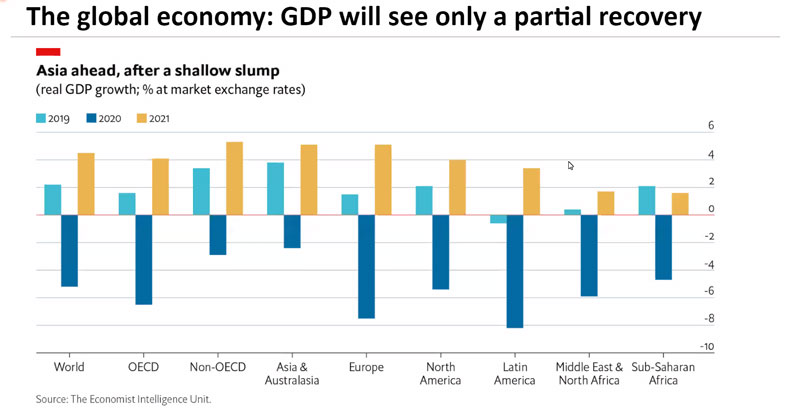
Mounting job losses and bankruptcies, more government support for a green recovery, disruptive trade spats and international disputes, and opportunities in digitalization are the key trends in 2021 according to The Economist Intelligence Unit (EIU), the research and analysis division of The Economist Group.

In its Industries in 2021: A Slow, Painful Recovery report, the EIU forecasts that the global gross domestic product (GDP) will increase by 4.5%—still not enough to return the global economy to pre-coronavirus levels, given the 5.2% contraction expected this year. A return to normalcy is not seen until a safe and effective vaccine is rolled out, and full recovery of the global economy is not expected before at least 2022.

Source: The Economist Intelligence Unit

“The main message is that 2021 should see a recovery, but it may only be a partial one, and there won’t be enough to lift all boats,” said Ana Nicholls, EIU director of industry operation, at a virtual event on the whitepaper held on Nov. 4. “Government support will be needed to stop some boats from sinking, and it won’t be even enough to do that unless they manage to latch on to one of the few uplifting trends, particularly green recovery and the wave of digitalization.”

JOB LOSSES AND BANKRUPTCIES

Some companies, like those in consumer goods, will experience job losses and bankruptcies as businesses go online. Retail bankruptcies will spill over to 2021, and department stores that have already been struggling pre-pandemic will be vulnerable. According to Barsali Bhattacharyya, EIU industry briefing manager, government support next year may come in two forms: targeted measures such as tax relief for specific industries, and raised taxes to repair weak public finances.

“We expect countries in developing Asia to raise taxes, but they will probably do this by focusing on specific products so as not to damage weak consumer sentiment. An increase in sin taxes on tobacco and sugary products is likely,” she said. 

SUPPORT FOR A GREEN RECOVERY

Source: The Economist Intelligence Unit

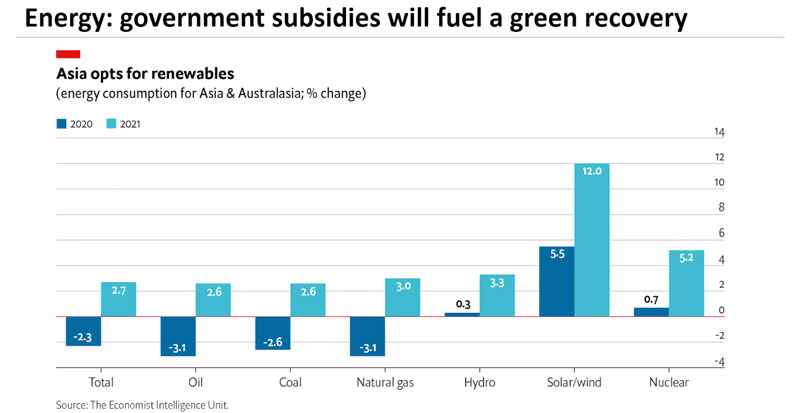
Governments with depleted tax revenues will focus support on sectors that either have the strongest growth prospects or feed into long-term policy goals. Markets in Southeast Asia will see a strong growth in renewables. China’s carbon-neutral goal is expected to be carried over in 2021. 

At a November 4, 2020 webinar discussing the aforementioned whitepaper, Ms. Nicholls said, “The big win for renewables would be if a Biden administration takes the US back into the Paris agreement and unleashes around $2 trillion in clean energy into that sector.”

TRADE SPATS AND DISPUTES

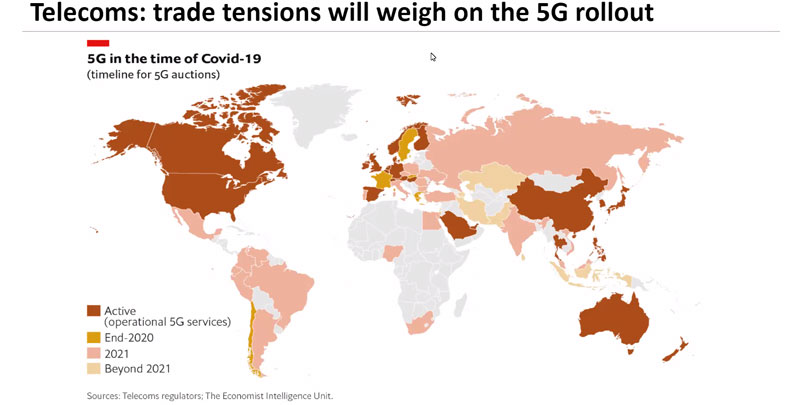
The US-China conflict will continue regardless of who wins this month’s US presidential election. The focus of the conflict will shift from tariffs to technology, affecting Chinese telecommunications companies like Huawei. 

According to Ms. Bhattacharyya, the latest round of US sanctions has cut off Huawei from crucial segments in the tech supply chain. “The outcome of the US elections will play a role, but both presidential candidates support efforts to curtail Huawei.” 

The automobile industry will also be affected by this spat. 

“Both [US presidential] candidates are prepared to impose heavy tariffs on auto parts imported from China to encourage US producers to source locally,” said Arushi Kotecha, a research analyst at the EIU’s industry briefing team. “We expect the US-China rivalry to spill over to technology, including in the high-tech parts necessary for electric vehicle development and self-driving vehicles.”

OPPORTUNITIES IN DIGITALIZATION

Online shopping will generate new companies and new jobs, thus making up for some of the losses in real-world retailing. Food and groceries will account for a lion’s share in online sales. Online shopping will also trigger the growth of new financial services such as digital payments, as well as the expansion of telehealth.

The main challenges in online retail include high risks of cyberattacks and data theft. “Regulatory scrutiny will also increase, especially for international e-commerce giants such as Amazon and Walmart,” added Ms. Nicholls. 

Source: Telecoms regulators; The Economist Intelligence Unit

The EIU anticipates growth in 5G and edge computing investments as well, the latter due to the enactment of data localization law in countries like China, India, Vietnam, Indonesia, and Russia. “These countries have either introduced or are in the process of finalizing the regulation of data localization in order to regulate cross-border data flows,” said Ms. Bhattacharyya. “These laws will mandate the local storage of data, unlike the current practice where data is stored in remote servers abroad.” 


It’s Christmas time at SM!

Christmas is almost here! Not even the pandemic can take away the beloved tradition of Filipino families to celebrate this joyous season at SM. Let the wonderful, magical and truly merry Christmas at SM drive away the blues! Sama sama tayo sa Pasko sa SM!
All throughout November and December, come and be dazzled by these exciting Holiday surprises that await you at SM:

  1. Christmas Launches. On November 6, SM Supermalls treats everyone to a virtual, magical feast! Twelve different SM malls will light up their magnificent Christmas displays — from SM Mall of Asia and SM Megamall to SM Seaside City Cebu and SM CDO Downtown Premier! SM truly brings the magic of Christmas online through fireworks, orchestra, and whimsical characters! All the SM malls nationwide follow suit with their own magical Christmas light up on November 7 and 8. Mallgoers will be delighted with a special lighting ceremony for hope and inspiration amid the pandemic, as well as singing flash mobs, cute Christmas characters, and surprise gifts.
  2. Christmas Chorale. What’s Christmas without some music? Feel the merriments of the season by watching Holiday choir performances at select SM malls this December. Meet up with your family and friends at SM and enjoy some Holiday tunes! It will surely be an awesome experience! No need to worry because strict safety protocols are in place at SM malls, so you can just focus on the magic of the celebration.
  3. Christmas Markets. It’s the season of giving! Help MSMEs bounce back from the negative impact of the pandemic by buying your Holiday essentials and gifts at SM’s nationwide Christmas Markets from November 9 to January 3. As part of the Kasama Ng SM campaign and DTI’s Buy Local, Support Local, the Christmas Markets will feature unique local products and goods so shoppers can buy from small businesses and help them bounce forward and recover.
  4. Selfie with Santa. Don’t fret – SM has made sure you won’t miss your annual selfie with Santa this year! You can pose with a virtual Santa Claus safely and via augmented reality at SM. Wanna give it a try? Simply scan the AR markers located in select areas in SM malls and have a photo with virtual Santa. Don’t forget to share your Holiday snaps online with your family and friends!
  5. SM Bears of Joy. Starting November 4 until Christmas Day, SM Supermalls is giving back through its annual Bears of Joy campaign. This time around, shoppers can collect special medical frontliner Bears of Joy. Throughout the Christmas season, you can buy a pair of bears for P200.00 – one bear for you to keep and the other for charity.
  6. TikTok Fam Contest. Have fun with your family and spread some Christmas joy by joining the TikTok Fam Contest. Simply showcase your dance moves to your favorite Christmas song in your favorite SM mall and you can get a chance to win exciting prizes!

For more information, visit www.smsupermalls.com or follow @smsupermalls on all social media platforms.

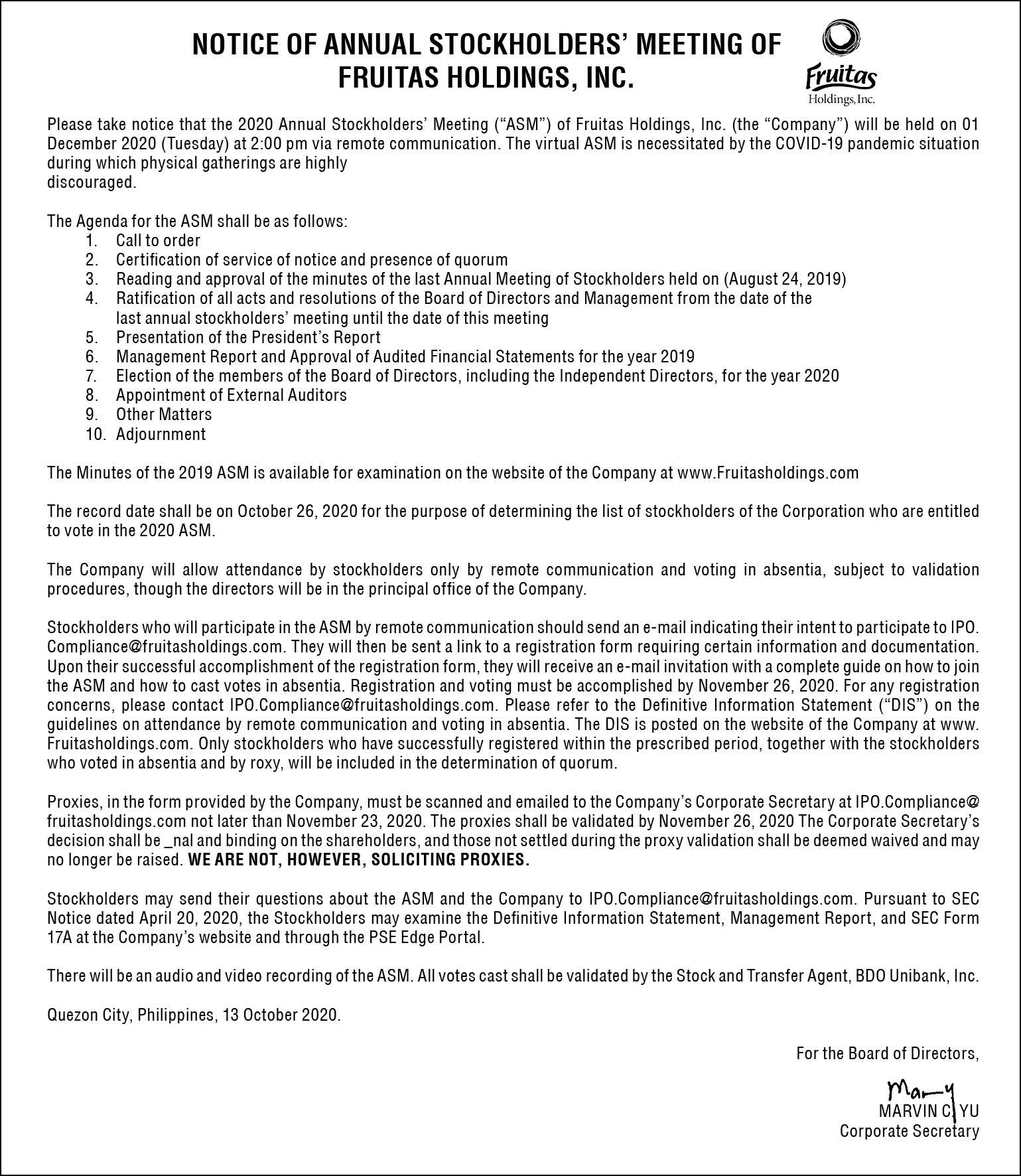
Fruitas Holdings, Inc. announces schedule of annual stockholders’ meeting via remote communication

[B-SIDE Podcast] Are you okay? Treating the workforce as human beings, not just human resources

Follow us on Spotify BusinessWorld B-Side

The eight-month lockdown, one of the longest in the world, has kept much of the country’s workforce at home. Separation from colleagues, coupled with fears of the virus, has raised the level of anxiety among the working population. 

Nikki Vergara, co-founder and chief well-being officer of Positive Workplaces, a training and consultancy organization, tells BusinessWorld reporter Jenina P. Ibañez what individuals and companies can do to promote psychological well-being in the workplace (whether that means the office or the home). 

TAKEAWAYS

The absence of mental illness is not the same as mental health.

Those who feel unable to function normally should be given access to psychology professionals that can help. 

This is particularly important because Filipinos are now experiencing additional stressors—such as worries about their health and the government’s response to the virus—while having fewer ways to cope because of the lockdown.

“Social ties help us cope with the most difficult parts of life. In the past, we could rely on hanging out with each other,” said Ms. Vergara. 

Workers have different ways of coping with a work-from-home environment.

Workers at home have been staying in the same space throughout the day, blurring the lines between their job and other parts of their lives.

The biggest complaint among employees, said Ms. Vergara, is that “people are unable to stop working. Citing a Google study, she advised knowing what kind of person you are—a segmentor or an integrator

Segmentors distinguish work hours from leisure time while intergrators switch back and forth throughout the day. The former must identify and communicate specific hours reserved for work, while the latter must ensure they get enough reset.

Companies must then measure the well-being of their employees and be aware of the well-being issues among their workforce. If the lockdown has removed positive reinforcement measures from the company, the organization must find new ways to commend their employees.

Managers must be open to feedback, intentional about praise.

Filipino workers are inclined to work hard despite low salaries or hard conditions because they are afraid to lose their jobs. They are also hesitant to talk about their needs to sustain mental health and offer feedback about tasks, especially given a hierarchical workplace.

Managers must be open to getting feedback from employees, especially because they need to find out if the tasks they assign are doable given the pandemic.

“In uncertainty, two-way feedback is important,” Ms. Vergara said, adding that managers should rethink the way they reassure employees. “Complimenting is no longer the natural thing. Under lockdown, managers should be more intentional about praise.”

Recorded remotely on October 22. Produced by Nina M. Diaz, Paolo L. Lopez, and Sam L. Marcelo.

Follow us on Spotify BusinessWorld B-Side

Meralco works round-the-clock to restore power in typhoon-hit areas

Meralco crews worked continuously to clear the debris and restore electric service in areas badly hit by two successive typhoons that recently hit the country: Typhoon Quinta, a category-3 typhoon that brought strong winds and rains from October 23 to October 27, followed by Super Typhoon Rolly, which was reported to be a category-5 typhoon, and considered the world’s strongest typhoon so far this year. As of Wednesday, November 4, 2020, Meralco announced that it has fully restored the electric service of all its customers affected by the said typhoons. Meralco is committed24/7 to respond to power outages caused by natural calamities such as these even with the threat of the COVID-19 pandemic.

Q3 economic drop likely less severe

The pace of economic recovery still appears uncertain, economists said, as the holidays approach. — PHILIPPINE STAR/MICHAEL VARCAS

THE PHILIPPINE ECONOMY is expected to have declined in the third quarter, though slower pace than the previous quarter, according to economists.

A BusinessWorld poll of 19 economists yielded a median gross domestic product (GDP) decline of 9.2% for the third quarter, easing from the record 16.5% plunge in the second quarter.

This will bring the GDP contraction to 8.8% in the first three quarters of 2020, exceeding projections made by the government and financial institutions for the full year.

Q3 2020 GDP growth forecast

In July, the Cabinet-level Development Budget Coordination Committee (DBCC) projected the economy to shrink between 4.5% and 6.6%, or an average of 5.5% this year.

At an online forum on Oct. 20, Finance Secretary Carlos G. Dominguez III said the DBCC expected the Philippine economy to contract “by about 6%” for the entire year.

Socioeconomic Planning Acting Secretary Karl Kendrick T. Chua had said the decline in third-quarter GDP was expected to be softer than in the second quarter. For the first half, the economy fell by 9% as economic activity was halted during the strict lockdown from mid-March to May.

The Philippine Statistics Authority will report third-quarter GDP data on Tuesday, a day after the release of third-quarter data on farm production.

Economists polled by BusinessWorld attributed the slower pace of economic contraction in the third quarter to relaxed lockdown restrictions.

“Given an easing of the quarantine measures, as well as a slower decline in production indices, the third quarter is expected to be better than the second quarter, but not by much,” said University of the Philippines School of Economics Associate Professor Sarah Lynne S. Daway-Ducanes in an e-mail.

Bank of the Philippine Islands Lead Economist Emilio S. Neri, Jr. pointed to monthly economic indicators such as employment, external trade and manufacturing purchasing managers’ index as supporting the likelihood of a slightly better performance in the third quarter.

“The significant decline may have been due to the decline in government spending in the [third quarter of 2020] vs. the same period last year, most pronounced in the 15% drop in National Government spending in September,” Mr. Neri said in an e-mail.

Bureau of the Treasury data showed NG spending stood at P1.009 trillion in the third quarter, 2.7% down from P1.037 trillion in the same quarter last year.

Economists also pointed out third-quarter GDP was dented by the return to a modified enhanced community quarantine in Metro Manila and in nearby areas from Aug. 4 to 18.

“Our estimate would have been closer to -5% than -10% if it had not been for the tighter August lockdown measures. After seeing the NG’s slow spending in the third quarter, our estimates approached the -10% level,” Mr. Neri said.

OUTLOOK
The economy may have bottomed out in the second quarter, but economists noted the pace of recovery remains uncertain.

“With government spending held back to close out the year, we expect GDP to remain in double-digit contraction with consumption and investment activity still well away from 2019 levels (we’re actually at 2016 levels),” said ING Bank N.V. Manila Senior Economist Nicholas Antonio T. Mapa in an e-mail.

“The lack of a potent and timely spending plan to counter the economic downturn will translate to a -9.8% GDP print for the year, with the Philippines likely not recovering to pre-pandemic growth momentum in the near term as potential output fades with investment momentum headed in the wrong direction,” he added.

In a separate e-mail, Security Bank Corp. Chief Economist Robert Dan J. Roces said he expects a gradual recovery given that some sectors continue to face challenges, and business and consumer confidence remain subdued.

“Uncertainties still prevail in this ‘post-lockdown, pre-vaccine’ phase, with the need to complement existing monetary policy with government spending and a larger fiscal stimulus,” Mr. Roces said.

Makoto Tsuchiya, an economist from Oxford Economics, said the recovery in private consumption will be held back by high unemployment, gloomy consumer sentiment and lower remittances.

BDO Unibank, Inc. Chief Market Strategist Jonathan L. Ravelas, estimated the full-year GDP slide to reach 8.3%, but noted it may be adjusted due to recent typhoons in the second half that affected agriculture — one of the few bright spots in second-quarter GDP performance.

Capital Economics’ Asia Economist Alex Holmes said improvements “are likely harder to come by in the quarters ahead.”

“With the virus still not under control, continued social distancing will be required and life is unlikely to be able to fully return to normal. Meanwhile, economic scars from the downturn, including business insolvencies, weaker household balance sheets and high unemployment will drag on the recovery,” he said.

“As such, we suspect that by the end of the year the Philippine economy will still be almost 7% smaller than its pre-crisis level,” he added.

The Health department reported 2,442 coronavirus infections on Sunday, bringing the total to 396,395. — A.O.A. Tirona

Q3 2020 GDP growth forecast

THE PHILIPPINE ECONOMY is expected to have declined in the third quarter, though slower pace than the previous quarter, according to economists. Read the full story.

Q3 2020 GDP growth forecast

Stronger PHL-US ties seen under Biden presidency

By Charmaine A. Tadalan, Reporter
and Denise A. Valdez, Senior Reporter

THE PHILIPPINES will likely see stronger relations with the United States after Joseph R. Biden, Jr. was elected US president on Saturday.

In his first speech as president-elect, Mr. Biden vowed to act swiftly against the coronavirus disease 2019 (COVID-19) pandemic and fix the ailing economy. (See ralated stories: Palace says Duterte to work with Biden based on respect, US president-elect Biden calls for healing, unity)

Under the Biden administration, economists and analysts see the United States rejoining the Trans-Pacific Partnership (TPP) trade deal, combating climate change and pushing economic initiatives in the Asia-Pacific region.

John D. Forbes, American Chamber of Commerce of the Philippines (AmCham) senior adviser, said the leadership of Mr. Biden would have a gradual positive impact on the Philippines.

“The US taking climate change and COVID-19 seriously will surely benefit the Philippines. US grant assistance for the Philippines should be steady, as will support for Philippine rights in the West Philippine Sea,” Mr. Forbes told BusinessWorld.

Mr. Biden has said that on his first day in office, the US would quickly rejoin the Paris climate accord.

“AmCham will continue to advocate for a bilateral or plurilateral free trade agreement and encourage the Philippines to join the CPTPP (Comprehensive and Progressive Agreement for TPP),” Mr. Forbes said.

But US investments in the country would depend on pending reforms that seek to open up the economy, he added.

The Obama administration had conducted negotiations for the TPP, which was touted to become the third-largest free trade area in the world by GDP. Under the Trump administration, the US pulled out of the trade deal in 2017. Only 11 countries signed the CPTPP in March 2018. The Philippines did not join the TPP as well.

Foreign policy expert Richard J. Heydarian said the Biden administration’s inclination to rejoin the TPP would likely benefit the Philippines even as he expects it to be “cautious and pragmatic.”

“Most likely Biden would push for the restoration of the Trans-Pacific Partnership agreement under US leadership. We already have a version of that under Japanese leadership, but a more expanded version of that, that could include Indonesia, Philippines or even Taiwan and South Korea, could be very much in the cards,” Mr. Heydarian said over the phone on Sunday.

Economist George Manzano of the University of Asia and the Pacific said Mr. Biden’s multilateralist foreign policy approach could lead to increased US participation in global institutions such as the World Trade Organization.

“So, in terms of dealing with the US economy on trade policy matters, we can bank on the WTO rather than just dealing with the US economy,” he said over telephone on Sunday.

Under Biden, the US is expected to take a less aggressive approach to China, which would open opportunities for the Philippines.

“The Biden administration will be less aggressive or less hawkish on China. In a sense, if there’s more trade between the US and China, the Philippines will also prosper… China will be importing more or building more subcontracting possibilities with the Philippines,” Mr. Manzano said.

Mr. Heydarian also expects the US to introduce infrastructure investments to counter China’s influence. The Philippines may benefit from increased trade and investment flows, but this will depend on President Rodrigo R. Duterte addressing possible US concerns.

“There will be an effort to restore and revitalize the alliance in the final year of President Duterte to set the tone for the next Philippine president come 2022,” he said.

‘BIDEN BOOST’
Meanwhile, the local stock market is hoping to get a boost from the positive investor sentiment surrounding Mr. Biden’s victory.

Philstocks Financial, Inc. Senior Research Analyst Japhet Louis O. Tantiangco said Mr. Biden’s global-centric approach would be better for the world economy and the Philippines, unlike Mr. Trump’s America-first policy.

Trade tensions with China will also likely ease under the Biden presidency.

“(The Philippines) already has strong investment and trade relationships with China. If (Mr.) Biden takes a soft stance on this one, then it’s going to help the Chinese economy, which in turn could be positive for the local economy,” Mr. Tantiangco added.

“(Mr.) Biden’s apparent softer stance on China will alleviate some pressures that have been hounding emerging markets since the trade war started some years ago,” Manuel Antonio G. Lisbona, president of PNB Securities, Inc., said in a mobile phone message.

Democrats are also historically supportive of free trade, Diversified Securities, Inc. Equity Trader Aniceto K. Pangan said.

“As seen in the past Democrat administrations, they are not disruptive on trade relationships, thus would not create uncertainty in terms of global growth including our local economy,” he said in a text message.

The Management Association of the Philippines (MAP) noted that Mr. Biden could help improve global relations during the pandemic.

“We nurture the hope that he will lead America with steady hands in this difficult time given the enormous challenges, like reviving the virus economy, healing the divide in the nation and across nations,…and strengthening global cooperation, peace and stability,” MAP President Francisco E. Lim said in a statement.

However, there is a possibility that the Biden administration may raise corporate and income taxes.

“If (Mr.) Biden eliminates current tax cuts, we may see a plateau in remittances from the US, which is the biggest source for the Philippines,” AAA Southeast Equities, Inc. Research Head Christopher John Mangun said in a text message. — with inputs from Jenina P. Ibañez

PDEx anticipates record bond listings next year

By Denise A. Valdez, Senior Reporter

BOND LISTINGS on the Philippine Dealing & Exchange Corp. (PDEx) are projected to set a new record in 2021 as the debt market operator targets to launch a digital portal before the year ends.

PDEx is also expecting to maintain last year’s record of P375.6-billion bond listings by the end of 2020, on the back of robust issuances amid the coronavirus pandemic.

The local debt market had its 30th listing for the year through Del Monte Philippines, Inc. on Oct. 30, bringing the total amount of new listings to P335.6 billion so far in 2020.

“We anticipate that by yearend, the new bond listings will be close to the same level as last year,” PDEx President and Chief Executive Officer Antonino A. Nakpil said in an e-mail.

He said the market’s performance exceeded PDEx’s projections for the year, considering how the coronavirus pandemic slowed economic activity.

“I would add that much credit for this resilience is due to the regulators, the Bangko Sentral ng Pilipinas and the Securities and Exchange Commission, the former for its preemptive tactics to provide liquidity to the market, and to both for their equally accommodative stances toward electronic submissions and other processes, which collectively reduced the risk of the financial and capital markets adding more problems to the national crisis,” Mr. Nakpil said.

The pandemic has pushed PDEx to accelerate its launch of a digital portal for issues before the year ends, with full operations expected in 2021.

“We are ambitiously targeting to exceed the 2019 record for new listings next year,” Mr. Nakpil said. “We are basing this on a number of returning bond issuers that have previously issued bonds within the two- to three-year tenors and would be likely to come back to market for fresh funding.”

“That target also factors in new corporate issuers coming to market, especially when the PDS Issue Portal would be in full operation within 2021,” he added.

The PDS Issue Portal is a digital platform that will allow the electronic submission of requirements for issuers, and on-boarding of client investors for securities salespersons. It is seen to facilitate more bond listings by simplifying the process for companies and investors.

“It is envisioned that the streamlined activities, shorter times and simpler processes for issuers and investors, would translate to extending the benefits of fixed-income securities to many more investors and generate capital funding for more corporate issuers,” Mr. Nakpil said.

In September, PDEx reported that corporate bonds stood at P1.48 trillion as of August, more than doubling its level four years ago. New listings continue to expand every year, reaching P375.6 billion in 2019, P256.4 billion in 2018, P207.4 billion in 2017 and P136.5 billion in 2016.