Home Blog Page 8289

BSP warns vs investment scams using gov’t agencies

THE CENTRAL BANK warned the public about investment schemes that use its name to lure investors into “too good to be true” offers.

The Bangko Sentral ng Pilipinas (BSP) said in a statement on Thursday that some fraudsters have been presenting fake documents which they claim to be under the custody of the central bank or other government agencies.

“The BSP does not hold or safekeep documents and other financial instruments for individuals, corporations, foundations, or nonprofit organizations,” it said, adding that the central bank does not engage in random, direct transactions with individuals and entities.

It noted that some schemes even include fabricated messages from the Society for Worldwide Interbank Financial Telecommunications (SWIFT) that facilitate international transactions.

“SWIFT messages between banks and counter-parties do not pass through the BSP,” it added.

The central bank noted the tell-tale signs of a fabricated SWIFT message, saying these usually involve an “extremely large” amount, unmatched name, codes and addresses of the sender and recipient, and messaging formats that do not conform to SWIFT standards.

The regulator said prospective investors should do a background check on companies offering investment schemes to see whether they are authorized to sell instruments such as securities, bonds, commercial papers.

“It is important to conduct the necessary due diligence prior to committing to an investment opportunity. Try to gather and verify as much information regarding the company offering the investment,” the BSP said.

It also urged the public to reach out to the BSP, Philippine National Police, National Bureau of Investigation, and the Securities and Exchange Commission to report cases of false claims, suspicious or potentially criminal activities.

Last year, the central bank received about 20,000 complaints from financial consumers, with the bulk about fraud and unauthorized transactions. — L.W.T. Noble

EDC, UK-based BGCI extend ties to conserve over 600 tree species

ENERGY Development Corp. (EDC) extended its existing two-year partnership with Botanic Gardens Conservation International (BGCI) for two more years to conserve an additional 600 tree species in a virtual signing of the agreement.

Some 200 Philippine endemic tree species and 470 near-endemic species found in two or three more countries will be included in the conservation effort.

“Just when you think you’ve accomplished your goals and reached the finish line, that line just keeps getting farther as you find out that what you have done is merely a drop in the bucket,” EDC President and Chief Operating Officer Richard B. Tantoco said in a statement on Thursday.

In May 2019, EDC through its BINHI regreening program was tapped by BGCI as its first and only partner for its Global Tree Assessment (GTA) program. The initial partnership was created to conduct conservation assessments on 800 Philippine endemic tree species, with a grant worth £16,160 or over P1 million.

“BGCI is delighted to be working with you and building on an already fruitful partnership, but we have a big job to do. We aim to persuade the government to use the regulatory levers and their incentives at their disposal to protect and restore what is left,” BGCI Secretary-General Paul Smith said.

BGCI is the International Union for Conservation of Nature (IUCN) secretariat for the GTA program, aiding in environmental conservation efforts via research and data gathering, field projects, and advocacy and education.

UK-based BGCI trained the BINHI team, partner organizations, and Department of Environment and Natural Resources (DENR) representatives on IUCN’s Red List methodology. The procedure covers strict guidelines and data requirements on extinction risk assessments.

Assessments for trees native to the Philippines grew to the current 1,225 from 248 assessments before 2019. Some 42% of these were conducted by EDC with University of the Philippines-Los Baños’ Pro-Seeds Development Association, Inc.

EDC further said that the partnership extension will provide a grant worth £3,000 for the second assessment of 200 Philippine endemic trees before September.

Following the submission of the final species and project report for the second assessments on Sept. 1., an additional £1,800 will be granted. Up to £11,280 will be granted for the “third assessment,” with the budget timeline to be decided by Sept. 1.

Lopez Group Foundation, Inc. (LGFI) will be accepting the funds, free of taxes. LGFI manages the various corporate social responsibility efforts of the Lopez Group.

“If we want to succeed, we really cannot do this alone, the task is too huge for any one entity. So with all humility, we are actually aggressively partnering [with as many] as many entities and individuals as we can throughout the country,” Mr. Tantoco said. — Keren Concepcion G. Valmonte

Pianists compete for prestigious prize with just a camera operator to listen

LONDON —  In a hall at London’s Royal Academy of Music, pianist Yuanfan Yang performed pieces by Frederic Chopin, Franz Liszt and Joseph Haydn with just a camera operator as his audience.

The 24-year-old is taking part in the Leeds International Piano Competition, hoping to win over a jury that will see his performance by video.

Held every three years, The Leeds has had to change its processes due to the COVID-19 (coronavirus disease 2019) pandemic, with no live jury or audience watching the pianists compete for the career-making prize package.

“I thought it might be a bit challenging at first, but once I started playing, I just forgot about everything,” the Edinburgh-born musician said. “It was just literally just me and the music.”

With travel restrictions in place, The Leeds invited some 60 competitors from around the world to its virtual first round held in 17 different cities.

From one competitor in Miami to 14 in Berlin, they all performed their 25-minute recitals under the same conditions: playing on a Steinway Model D grand piano and with identical camera set ups.

“We realized very quickly that we couldn’t do it in the way which we would love to do it… with an audience and the jury present,” Adam Gatehouse, The Leeds artistic director, told Reuters. “Clearly we were not going to be able to travel a jury from London to Berlin to wherever all around the world so we will watch the videos at home online and judge them in that way.”

First held in 1963, The Leeds offers its winner a recording and management deal, recitals at London’s Wigmore Hall and international tours.

“Up until the last minute I thought (The Leeds) would be canceled,” Italian pianist Giulia Contaldo, who practiced playing in front of a cameraman before the competition, said. “So many of my colleagues don’t have this opportunity, or don’t have any opportunities at the moment. So whatever happens, I am grateful.”

While the first round is virtual, organizers plan to hold the second round, semi-final and final in Leeds, northern England, in September, hopefully with a live audience.

“It’s not only about the music itself but it’s also about the people in the hall and that is how it’s supposed to be,” Israeli competitor Ariel Lanyi said. — Reuters

Rice farmer training program graduates top 25,000

RICE FARMERS and dependents who completed training programs offered by the Technical Education and Skills Development Authority (TESDA) have totaled 25,904 to date, TESDA said.

The various training programs offered in field schools are authorized by Republic Act No. 11203 or the Rice Tariffication Law, the goals of which include upgrading rice-planting know-how among farmers to make the industry more competitive.

TESDA said in a statement that some of the skills taught include production of rice from inbred seed, seed certification, farm mechanization, rice machinery operations, and drying and milling plant servicing.

“A number of the graduates also received training in carpentry, electrical installation and maintenance, welding and masonry which can help them in attending to their warehouses or their farm machinery especially when minor repair work is needed,” TESDA said.

Farmer training is funded by the P10-billion annual budget of the Rice Competitiveness Enhancement Fund (RCEF) created under the law. Funds are sourced from rice tariff collections.

The law liberalized the process of bringing in foreign rice, whose importers must pay a tariff of 35% on Southeast Asian grain. These tariffs are then applied to improving rice farmers’ skills to help them better compete with import competition.

TESDA said it is tasked by the Rice Extension Services Program (RESP) to teach rice production skills, modern farming techniques, and farm mechanization.

RESP scholars receive a P160 daily allowance, free training in farming skills, as well as entrepreneurship training and insurance.

TESDA Director-General Isidro S. Lapeña encouraged farmers and dependents to avail of RESP, adding that commitments are in place to work with other government agencies and the private sector for more training.

On March 16, Mr. Lapeña issued a memorandum instructing regional and provincial directors to organize farm field schools in their respective jurisdictions across 57 provinces targeted for RCEF assistance.

“The farm field schools shall provide applicable technologies needed to improve the capabilities of farmers as they shift from the traditional method to modernized system of rice planting. These schools will also boost their competitiveness to help make the country’s agriculture sector more viable,” Mr. Lapeña said. — Revin Mikhael D. Ochave

Monetary Board approves FMIC’s surrender of quasi-bank license

THE CENTRAL BANK has approved First Metro Investment Corp.’s (FMIC) voluntary surrender of its quasi-banking license, with the firm to continue operating as an investment house.

The BSP’s Monetary Board approved the voluntary surrender through Resolution No. 355 dated March 25, according to Circular Letter No. 2021-027 signed by Bangko Sentral ng Pilipinas (BSP) Deputy Governor Chuchi G. Fonacier.

“Just to clarify, what is being surrendered is just the quasi-banking license of FMIC and not its investment house license,” Ms. Fonacier said in a text message. “Quasi-banking license is a special authority granted by the BSP.”

Under the BSP’s Manual of Regulations for Non-Bank Financial Institutions, an entity with a quasi-banking function can borrow funds from 20 or more lenders at any one time through instruments such as acceptances, promissory notes, participations, certificate of assignment, trust certificates, and repurchase agreements. These borrowings can be used for re-lending, purchasing receivables, or other obligations. — LWTN

Filminera, Phil Gold win environmental awards

TWO COMPANIES jointly operating a gold mining project in Masbate province in the Bicol Region have been recognized for their efforts in achieving environmentally and socially responsible operations.

Filminera Resources Corp and Philippine Gold Processing and Refining Corp., the two firms behind the Masbate Gold Project, received four awards in the recent Presidential Mineral Industry Environmental Awards (PMIEA), in the Best Mining Forest and Safest Mine categories.

The 2020 PMIEAs are given to mining companies with the best practices in safety and health management, environmental protection and community development.

Both companies have active programs geared towards the conservation of nature, biological diversity and integrated approaches to land use planning.

As a result of these upland and coastal reforestation efforts, the reforested and rehabilitated areas are now home to a diverse range of flora and fauna species.

Aside from enhancing biodiversity through their environmental programs, the firms have also spurred social development in the surrounding communities through various livelihood programs.

Filminera is the recipient of the PMIEA Selection Committee Platinum Achievement Award in Surface Mining Operation Category, the Titanium Achievement Award, Mineral Exploration Category and the winner of the Safest Mineral Exploration – A Category.

Phil Gold, on the other hand, received the PMIEA Selection Committee Titanium Achievement Award in the Mineral Processing Category.

Women’s Month and empowerment principles

To culminate Women’s Month, a signing event of the UN Women Empowerment Principles (WEPs) was held at the end of March. The UN WEPs is a roadmap to business sustainability and growth. It is a framework of seven principles that provide guidance for companies to promote transformative change towards gender equality and women empowerment in the workplace, marketplace, and community. These principles will guide companies in evaluating and assessing their policies, projects, and practices, and in identifying areas for improvement.

Women Business Council Philippines Chairperson Monette Hamlin said women, even if they are leaders in their companies, also hold multiple roles such as mother, wife, daughter, sister, or caregiver, among others, usually unpaid or non-monetized.  The UN Women estimates the value of such roles to be over a total of 16.4 billion hours spent on unpaid work daily, roughly equal to 2 billion people working 8 hours a day without pay, at 9% of the global gross domestic product or $11 trillion.  She said women’s unpaid care work at home can be put to good use and can add to the economy if the burden is lifted from women and shared equally by men, noting that it is in the home that values formation and respect for women is first developed. It is also in the home where the next generation of women leaders are developed.

Currently, the Philippines ranks first globally in terms of women leadership positions, with about 48% of senior positions in companies held by women.

Katja Friewald, Regional Programme Manager for We Empower Asia from the UN Women, said the event is not just about signing a commitment document, but is also about making a strong call to action to all business leaders to start their rebuilding and recovery from the pandemic with the women and girl children in mind.  More than 40 million women and girls have fallen into poverty across the world amid the pandemic, and the business community has a huge role to help work against this. She emphasized the important role of the business leaders in facilitating the integration of gender equality and women empowerment in their  organizations’ DNA, including it in companies’ business operations. Signing the WEPs is just the first step for companies to do this — by being part of a global community that works together towards a common agenda which is to advance gender equality and women empowerment in the country.

The UN Women will continue to provide the necessary support in terms of capacity building and activities to the members of the WEPs community to sustain and heighten the momentum of the gender equality efforts in the Philippines. The UN Women will also soon launch an innovative program called Care Entrepreneurship Accelerator to help women entrepreneurs who are developing solutions to address the unpaid care work issue of women, which holds back many of them from active participation in the economy.

Rosalyn Mesinas, Philippines Programme Manager of UN Women, introduced the seven WEPs including the corresponding success indicators:

– Establish high-level corporate leadership for gender equality.

– Treat all women and men fairly at work. Respect and support human rights and nondiscrimination.

– Ensure the health, safety and well-being of all women and men workers.

– Promote education, training and professional development for women.

– Implement enterprise development, supply chain and marketing practices that empower women.

– Promote equality through community initiatives and advocacy.

– Measure and publicly report on progress to achieve gender equality.

Companies may adopt all or select a few specific principles and indicators that they would want to focus and report on. She said promoting and integrating WEPs is a winning situation for a company, as it does not only promote women’s rights as human rights and ensure the sustainability of the business, but it also enables the company to directly contribute to the UN Sustainability Development Goal No. 5 on Gender Equality. Moreover, advancing women’s empowerment drives economic growth and supports business performance and resilience through innovation, cost savings and productivity, market growth, and trust and credibility between and among employees, consumers, and other stakeholders

As of March, over 4,000 companies in 141 countries have signed and committed to implementing the WEPs. In the Philippines alone, a total of 70 individual companies and member companies of Women Business Council Philippines and the Filipina CEO Circle joined the WEPs global community; PNB is the only local universal bank that participated in the WEPs signing.

FCC President Sharon Dayoan and Chairman Cristina Concepcion together with WomenBizPH President Mylene Abiva also enjoined all women leaders to promote women empowerment and gender equality.

Equality means business!


Flor Gozon Tarriela is chairman of the Philippine National Bank, PNB Capital and PNB Mizuho Leasing & Finance Corporation. She is a former Undersecretary of Finance and the first Filipina vice-president of Citibank N.A. She is a trustee of FINEX and an Institute of Corporate Directors fellow.

From trash to plants at Robinsons Malls

PLANTITOS and plantitas received plants, seeds, and organic compost in exchange for their plastic bottles in a plant exchange held at Robinsons Magnolia last month. Robinson Malls has partnered with the Bureau of Plant Industry (BPI) to help and save Mother Earth through a series of exchanges where a bit of trash gets the giver a plant. During the exchange held at Robinsons Magnolia, mall visitors were invited to bring at least three 1.5-liter bottles or one 5-liter bottle to exchange for free seedlings, seeds, and organic compost. The BPI will use the collected bottles as pots for plants they grow for their community partners. The bottles-for-plants exchange will be held at Robinsons Magnolia again in the near future, and also at Robinsons Galleria, Robinsons Place Metro East, Robinsons Town Mall Malabon, and Robinsons Place Antipolo. For more information, visit www.robinsonsmalls.com or its Virtual Directory bit.ly/RMallsVirtualMallDirectory.

Is your boss an active listener?

Our department head is a busy man and yet he finds time to talk with the employees. He’s always listening to our ideas, complaints, even mundane stories about family life. The trouble is that nothing would happen. It’s as if he was never there when we discussed the issues. Is our boss a good listener or the workers asking too much? — Pine Blossoms.

The saying goes that we should do something every day to make other people happy, even if it means leaving them alone. But that’s not possible in the workplace where everyone must consult all interested parties to come up with a consensual decision. We also expect management pronouncements to take shape in concrete action. Otherwise, all this talk about proactive communication is for nothing.

So let’s examine your concerns. What does it mean if the boss is physically present when the employees discuss their issues? Could it mean he has delegated resolving those employee concerns to the line supervisors? How soon can you expect the boss’s lieutenants to resolve the issue? What are those issues that you prefer to be resolved personally by the department head alone? And why?

Regrettably, few people understand the dynamism of the so-called chain of command. Now and then, people are excited to see prompt action, except that they must also understand how the hierarchy works and how it responds to the complexity of employee ideas or grievances.

Many employees expect too much from management. They want to be coached, guided, and energized so they can work hard enough to achieve mutually-agreeable corporate goals. That’s a fair expectation that must be reasonably reciprocated by management.

QUESTIONS TO ASK
Theodore Woodward (1914-2005), a medical professor and researcher at the University of Maryland, told his students of an aphorism to guide them in diagnosing patients: “When you hear hoof beats behind you, think of horses and not zebras.” That’s because horses are more common than zebras.

That’s to tell aspiring doctors to seek out the most common and likeliest reasons for a given set of symptoms, rather than settle on an exotic explanation. With that as a preamble, let’s move on by diagnosing your communication issues with the following basic questions:

One, does your management initiate open discussion? This question is critical as most employees are too timid to initiate communication with management. Therefore, management must create a systematic program which everyone can use to ventilate their concerns, ideas, and complaints. It includes town hall meetings, birthday clubs, suggestion program, quality circles, or labor-management cooperation schemes, among others.

Two, does management have a timeline for resolving issues? Some dynamic organizations require their managers to solve employee (and customer) issues within one day. They call it as “the 24-hour rule.” If not solved, the unresolved issues automatically go up to the next level of management. It may be a tough rule, which is why sometimes there are accommodations to allow for resolution within two or three days, depending on the circumstances.

Three, does management ask probing, intelligent questions? The right questions must be asked for you to receive the right answers. If the questions are too broad and complex, more often than not, it could open the floodgates to ambiguity and misinterpretation. Management must be able to understand the issues by listening more and talking less. When a clarification is asked, it sets everyone on the path towards a friendly communication process.

Four, does management facilitate active discussion? Or does it monopolize the talking? Effective management should understand that for it to be respected and trusted by the workers, it must limit itself to asking questions and requesting other employees to participate. It must be conscious of the destructive effect of “groupthink,” in which workers become passive when their bosses talk.

Five, does management summarizes the issues or decisions? This can be done by recapitulating all discussions and capturing them in a one-page e-mail or via a bulletin board announcement. This ensures that all concerned are kept on the same page. When management discusses employee issues, it must be ready with the right answers or decisions as well so it does not create a back-and-forth situation.

Six, does management ensure face-to-face employee interaction? Having a physical, eyeball-to-eyeball set-up is ideal. However, during the pandemic, this can be done online. Note, however that management must be cognizant of certain professional rules when communicating online. It includes looking at the camera directly to simulate an eyeball-to-eyeball setting.

Last, does the human resource (HR) department monitor all employee issues? Is HR mandated to compile all complaints and how they’re being resolved by line leaders, supervisors and other managers? This is very important so best practices are emulated and lessons shared with other managers. It’s also good practice to monitor the issues in case there is a one-size-fits-all strategy for resolving them.

LEADERSHIP TRAINING
Management success or failure depends to a large extent on knowing all those issues at the earliest possible time. That way, trivial matters do not become major disasters. Further, the overall efficiency of the organization is improved if workers are focused on doing their jobs and to willingly contribute their energy and thoughts.

By and large, all supervisors and managers must be properly trained so they can effectively handle minor issues before they reach top management. Leadership training is essential so the time-consuming responsibility of managing the workers and their issues are addressed more promptly.

You don’t have much time to experiment on this. You don’t have all the time to commit those mistakes. Where practical and feasible, the burden of dealing with employees lies with line management and not the department head, who must handle bigger things.


Send anonymous questions to elbonomics@gmail.com or via https://reyelbo.consulting

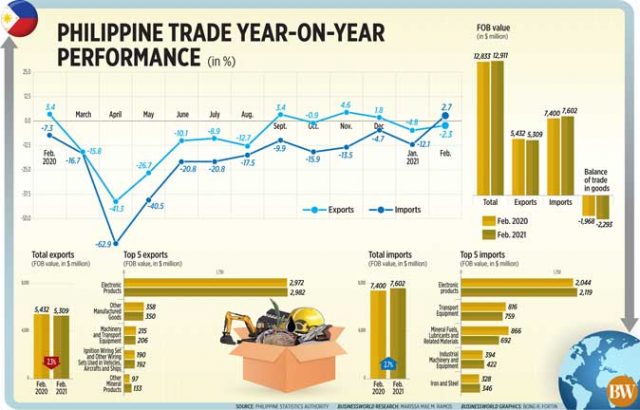
Philippine trade year-on-year performance (Feb. 2021)

THE COUNTRY’S trade-in-goods deficit widened in February as imports grew for the first time in 22 months and exports contracted albeit at a slower pace, the government’s statistical agency reported on Thursday. Read the full story.

Philippine trade year-on-year performance (Feb. 2021)

How PSEi member stocks performed — April 8, 2021

COURTESY OF PHILIPPINE STOCK EXCHANGE, INC.

Here’s a quick glance at how PSEi stocks fared on Thursday, April 8, 2021.


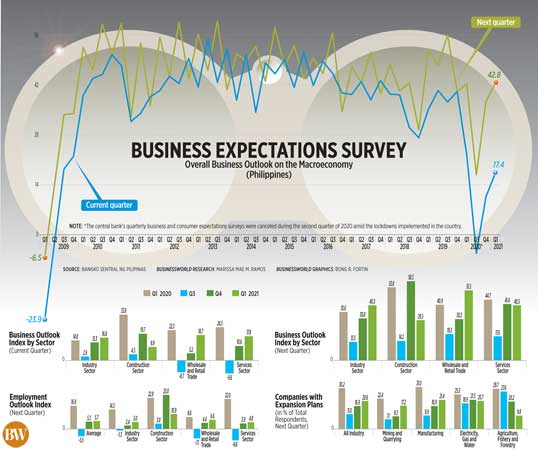
Business Expectations Survey

PHILIPPINE FIRMS are more optimistic for the rest of the year, a central bank survey showed, but the surge in coronavirus infections and the reimposition of a strict lockdown in the capital region threatens to dampen sentiment. Read the full story.

Business Expectations Survey

ADVERTISEMENT
ADVERTISEMENT