Home Blog Page 8234

Leaders in COVID fight praised in Forbes list of world’s powerful women

New Zealand Prime Minister Jacinda Ardern was among those recognized in the annual Forbes list of the world’s 100 most powerful women. -- Image via Reuters

NEW YORK — Female leaders who have stood out for their handling of the coronavirus earned honors on Tuesday in the annual Forbes list of the world’s 100 most powerful women, which highlighted women’s roles in battling the global pandemic.

Women from prime ministers to corporate executives earned spots in the list for their achievements helping mitigate and control the deadly contagious virus, which has infected more than 67 million people and caused 1.54 million deaths, Forbes said.

New Zealand Prime Minister Jacinda Ardern, Taiwan President Tsai Ing-wen, Finnish Prime Minister Sanna Marin, European Central Bank President Christine Lagarde, and Tokyo Governor Yuriko Koike were particularly effective, it said.

“Where they differ in age, nationality and job description, they are united in the ways they have been using their platforms to address the unique challenges of 2020,” Forbes said on its website.

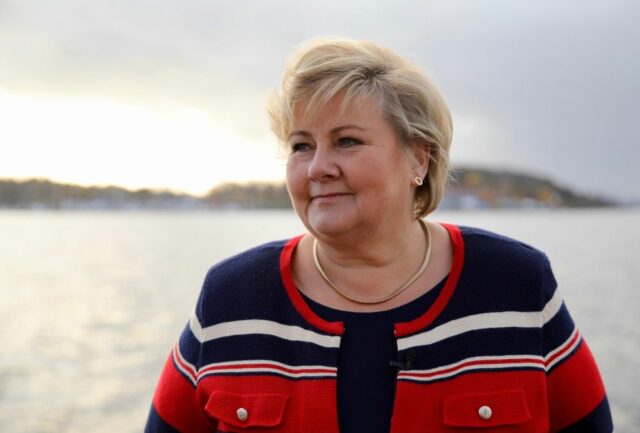
Prime Minister Erna Solberg. Image via Eirin Larsen/Office of the Prime Minister

It quoted Norwegian Prime Minister Erna Solberg, also on the list, who said recently that “countries where human rights are respected and where women are able to reach top positions in society are also the countries that are the best-equipped to handle crises by COVID-19.”

New Zealand eliminated coronavirus infections with a strict lockdown, reporting just over 2,000 cases of the virus and 25 deaths.

Taiwan kept the pandemic under control after instituting strict restrictions and largely closing its borders in January, long before Western countries, limiting cases of the virus to just over 700 and seven deaths, it said.

Of the 17 newcomers to the Forbes list, Carol Tomé, chief executive of United Parcel Service, where delivery volumes skyrocketed during lockdowns, and Linda Rendle, chief executive of Clorox, which boosted production of cleaning goods, were noted for their work.

At CVS Health, Karen Lynch, who becomes chief executive in February, took over the pharmacy giant’s COVID response and extensive network of testing sites. In 2021, she will be responsible for overseeing vaccine distribution at the company’s nearly 10,000 US locations.

Stacey Cunningham, the first woman to head the New York Stock Exchange, made the “swift” decision to shut down in-person trading as the virus was spreading in March, it said.

German Chancellor Angela Merkel for a tenth consecutive year headed up the group of 100 women that also included leaders in entertainment, technology, philanthropy, and finance from 30 countries.

Other honorees included US Vice President-elect Kamala Harris and Britain’s Queen Elizabeth. — Matthew Lavietes/Thomson Reuters Foundation

Poor countries seen missing out as rich nations hoard COVID-19 vaccines

Nine out of 10 people in dozens of poor nations could miss out on getting vaccinated against COVID-19 next year because rich countries have hoarded far more doses than they need, campaigners said on Wednesday.

Rich nations home to 14% of the global population had bought 53% of the total stock of the most-promising vaccines as of last month, said the People’s Vaccine Alliance, a coalition including Oxfam, Amnesty International, and Global Justice Now.

They said pharmaceutical companies working on COVID-19 vaccines should openly share their technology and intellectual property through the World Health Organization (WHO) so more doses can be manufactured.

“This shouldn’t be a battle between countries to secure enough doses,” Mohga Kamal-Yanni, an advisor for People’s Vaccine Alliance, told the Thomson Reuters Foundation.

“During these unprecedented times of a global pandemic, people’s lives and livelihoods should be put before pharmaceutical company profit,” she added.

While high-risk groups in Britain received on Tuesday the first shot of the vaccine developed by Pfizer and BioNTech, most people in 67 low- and lower middle-income countries including Bhutan, Ethiopia and Haiti, risk being left behind, they said.

Among the three COVID-19 vaccines for which efficacy results have been announced, almost all the available doses of two of them—Moderna and Pfizer/BioNTech—have been acquired by rich countries, the Alliance report said.

While AstraZeneca and the University of Oxford have pledged to provide 64% of their doses to people in developing nations, that would only reach 18% of the world’s population by next year “at most,” it added.

The campaigners used data from science information and analytics company Airfinity to analyze the deals done between countries and eight leading vaccine candidates, including China’s Sinovac and Russia’s Sputnik V.

The EU, United States, Britain, Canada, Japan, Switzerland, Australia, Hong Kong, Macau, New Zealand, Israel, and Kuwait have acquired 53% of these potential doses—with Canada buying enough to vaccinate its population five times over, Oxfam said.

“By buying up the vast majority of the world’s vaccine supply, rich countries are in breach of their human rights obligations,” Steve Cockburn, Amnesty International’s Head of Economic and Social Justice, said in a statement. — Thin Lei Win/Thomson Reuters Foundation

Singapore ‘cruise-to-nowhere’ turns back after COVID-19 case aboard

SINGAPORE — A passenger aboard a Royal Caribbean “cruise-to-nowhere” from Singapore has tested positive for COVID-19, forcing around 2,000 guests to be quarantined in their cabins and the Quantum of the Seas ship to return to dock on Wednesday.

Singapore has been piloting the trips, which are open only to residents, make no stops and sail in waters just off the city-state.

The global cruise industry has taken a major hit from the coronavirus pandemic, with some of the earliest big outbreaks found on cruise ships. In one case in February off the coast of Japan, passengers were stuck for weeks aboard the Diamond Princess with over 700 guests and crew infected.

“A guest was feeling unwell and tested positive for COVID-19 … We are asking all guests to remain in their state rooms to prevent the spread of illness,” the captain of the Quantum of the Seas told passengers over the public address system in a video shared on social media.

“We kindly ask all guests with urgent medical or health situations like diabetes, heart disease, etc. to contact guest services,” he said, adding that the ship had returned to Singapore a day before the end of its planned four-day sailing.

Confirming the positive test, Royal Caribbean said in a statement that all guests and crew who had close contact with the infected guest have subsequently tested negative for the virus.

“Emergency response plans have been activated according to guidelines including immediate isolation of close contacts, contact tracing and deep-cleaning of the ship,” Annie Chang, director of the cruise segment at Singapore Tourism Board said.

Passengers will be able to disembark and medical support will be provided if necessary, she added.

Royal Caribbean’s “cruises-to-nowhere” from Singapore began last week, marking the firm’s first sailing since it halted its global operations in March due to the pandemic.

The cruises are a part of Singapore’s plans to revive its tourism industry that has been battered due to the novel coronavirus, which has infected more than 67.72 million people globally and killed 1,548,575​.

Singapore, which has had just over 58,000 cases and 29 deaths, has been reporting less than a handful of local infections in recent weeks.

The case on board is another setback for Singapore after a plan to open a quarantine-free air travel bubble with Hong Kong last month was postponed at the eleventh hour.

Part of the precautions for the resumption of cruises in Singapore involves pre-departure testing and for guests to carry an electronic contact tracing device and to social distance at all times.

The infected case’s close contacts will be placed in quarantine or health surveillance, the Straits Times newspaper reported citing an advisory from the health ministry.

Others will need to monitor their health, while continuing regular activities including going to school or work, and undergo a swab test at the end of a 14-day monitoring period. — John Geddie/Reuters

Overcoming the challenges of change

BusinessWorld Virtual Economic Forum examines the new world created by COVID-19

By Bjorn Biel M. Beltran, Special Features Assistant Editor

Change happens both very slowly and very suddenly. Nothing could be truer in the reality of the COVID-19 pandemic, which has sent the world reeling from its massive social, political, economic, and cultural impact.

Almost overnight, the business world has had to adapt to a new paradigm that limits its freedom of movement, its trade, and how it operates. Digital transformation, which has been slowly building momentum in the years prior 2020, suddenly became a core strategy for both private and public organizations.

Proof of this change is the BusinessWorld Economic Forum, BusinessWorld’s flagship and award-winning event, which went virtual for the first time this year, to take on the theme, “Forecast 2021: ReBoot. ReThink. ReShape.” The two-day virtual forum aimed to gather insights from the world’s foremost business experts and leaders to attempt to chart and navigate the future of a world that has been wracked by change.

Headlining the forum were international keynote speakers Børge Brende, president of the World Economic Forum, and Bernardo Mariano, Jr., chief digital and information officer of the World Health Organization (WHO), last Nov. 25; and Ndiamé Diop, country director for Brunei, Malaysia, Philippines and Thailand of the World Bank, and Kelly Bird, country director of the Asian Development Bank (ADB) last Nov. 26.

In his address, Mr. Brende highlighted the importance of international cooperation amidst this time of uncertainty, to foster a better world after the pandemic in The Great Reset.

“We know that we are still in the middle of the worst health crisis that we have seen in a century, and we know that if there is COVID anywhere, it will be everywhere. There really is a global responsibility to fight this pandemic and I think that in many places in the world, we are still in the crisis mode. We are not in the recovery phase yet. We are still fighting the pandemic,” he said.

The Great Reset, a movement led by the World Economic Forum, seeks to take advantage of the unique window of opportunity to shape the future state of global relations, the direction of national economies, the priorities of societies, the nature of business models, and the management of a global commons. Mr. Brende noted Asia’s part in shaping this new world.

“This year marks the entry into the Asian century. This year is the first one where Asia is more than 50% of the world’s GDP, Asia is also 50% of the world’s population. We have seen that the first economies that have started to revive are the Asian ones. We know that China, the world’s second largest economy is expecting to grow this year. We also know that other Asian countries have fared better because they were faster in fighting the pandemic and keeping it under control,” he said.

The Philippines, in fact, is in a great position relative to other nations. Mr. Diop of World Bank, in his own keynote address which tackled the economic growth prospects to keep in mind as the world enters 2021, said that the country had one of the strongest growth momentums in Asia, along with a strong fiscal position, low fiscal deficits, low public debt, low inflation, and a robust banking system.

“That such a strong economy like the Philippines pre-COVID suffers so much is the best illustration of the unique destructive scale of this pandemic,” Mr. Diop said.

Mr. Diop noted that the COVID-19 pandemic is more recessionary than any other large crisis the world has seen over the past 50 years, such that a majority of the world’s economies will sink into recession this year.

“No other previous shock that has buffeted the world economy over the past 100 years has all these features at the same time,” he said.

In addition, the pandemic hit the poor and the aspiring middle class harder. In absence of a strong policy response, inequality is likely to increase.

“Despite the rising middle class the past 10 years, millions in the Philippines have not yet reached the economic security of the middle class and remain vulnerable to falling into poverty. The pandemic therefore boldens the risk of rising inequality today, rising inequality tomorrow if poor families stop investing in the health, education, and nutrition of their children,” he said.

“In short, because this disproportionately affects the non-economically secure in society, the big risk in the pandemic is for the short-term damages to prevail for a long time, pushing the inequality of all.”

The pandemic also aggravated unfavorable situations. Individuals with morbidity and families without savings are hit harder. Firms with high number of debts pre-COVID are in higher likelihood of insolvency, banks with poor asset quality will struggle more, governments with weak fiscal positions, and limited external factors will struggle to recover.

Looking for the light
Understanding the scale of the pandemic is a critical part of understanding the impact it will have on society at large. Mr. Mariano of WHO pointed out in his keynote address that herein lies the opportunity.

“The COVID pandemic is an unprecedented crisis that will shape our world for years and decades to come. It is the first pandemic in the digital age, therefore digital technologies are playing a great role during it, including enabling people to work from home or participate in meetings such as this one virtually,” he said.

“As we speak, digital technologies are helping screen populations track people who have been infected and monitor the flow of supply of critical health resources.”

Such developments can both expand primary healthcare, strengthening the fight against the surge of new diseases like COVID, and ensure that those affected by the current pandemic greatly benefits. It is in keeping these benefits in mind did the WHO recently launched and approved its Global Strategy on Digital Health 2020-2024 at the World Health Assembly.

“What we call today digital health will be known in the future as simply the way we deliver healthcare services. While we recognize that advanced digital transformation can move us into the next stage of healthcare services, let’s not forget that currently, we live in a world where equity, access to health, access to broadband is far from ideal. Almost half of the world don’t have access to broadband, half of the world don’t have access to essential healthcare services,” he said.

“Let’s make sure that as we go through digital transformation, we do not amplify these inequalities, that we ensure that digital solutions are accessible to low and underserved communities, that they are accessible to everyone. Let’s make sure that those inequities and inequalities are reduced and not amplified with the digital transformation of the healthcare sector.”

Proper governance of the digital transformation of the healthcare sector, in addition to larger initiatives led by the government, can kickstart recovery. Mr. Bird of ADB said in his keynote address that understanding the benefits and consequences of such innovations will be central to navigating the post-pandemic world.

For instance, remote work will spell new challenges for the global real estate industry, and will likely create changes in the development of cities of the future.

“What remote work means is that this will have implications for how we work in the office. And this is going to have spillover effects on property use on the commercial business districts. This is going to be one of the challenges for the property markets not just for the Philippines but globally, how best now to use central business districts. We might expect demand for that space to slow down over the next decade or so, and this is a discussion that’s just beginning over in other countries,” he said.

The hope for recovery is on the horizon, but such hopes need planned and coordinated action on the part of the public and private sectors to see fruition.

“The pandemic has devastated global economies but we are seeing strong results to address the fallout. I’m confident that with improved public health policies, continuously agile and sound fiscal and monetary policies, the determination to implement structural reforms, the Philippines may be well placed to bounce back,” Mr. Diop said.

“But again, it will not be over for the Philippines, nor any individual country in the world, until it is over for the rest. It will not be over for the balance sheets of any firm, household, banks, or the governments until it is over for everyone.”

A clearer post-COVID path

Insights from BusinessWorld Virtual Economic Forum’s
panel discussions shed light on next steps toward recovery

By Adrian Paul B. Conoza, Special Features Writer

In the past months since the coronavirus disease 2019 (COVID-19) impacted the economy, individuals, organizations, and governments have been trying to make sense of all the downturns the pandemic has brought.

As the Philippine economy gradually proceeds into the new normal, it is vital for organizations, businesses, and stakeholders to look into the next steps the country should make in responding to the pandemic’s widespread implications.

During the BusinessWorld Virtual Economic Forum held on Nov. 25 and 26, two panel discussions have brought a clearer picture on the current situation and the outlook ahead — formed by insights from experts and leaders representing medical, nongovernment, public, and private sectors.

The Conversation Panel on the first day, with the theme “Responding to the Pandemic,” gathered insights from Karl Kendrick T. Chua, Acting Secretary of National Economic and Development Authority (NEDA); Dr. Edsel T. Salvaña, director of Institute of Molecular Biology and Biotechnology at National Institutes of Health-University of the Philippines Manila (NIH); Dr. Selva Ramachandran, resident representative of United Nations Development Programme (UNDP) Philippines; Michael Peiyung Hsu, representative of Taipei Economic and Cultural Office in the Philippines (TECO); and Guillermo M. Luz, chief resilience officer of Philippine Disaster Resilience Foundation (PDRF).

The CEO Panel, on the other hand, had Jaime Augusto Zobel de Ayala, chairman and CEO of Ayala Corp., and Doris Magsaysay-Ho, president and CEO of Magsaysay Group of Companies conversing on “Valuable Leadership and the Country’s Road to Recovery.”

Sustaining, improving the response
Sharing the government’s response to the economic implications of the crisis, Mr. Chua of NEDA pointed out that the country’s economy, grounded on positive macroeconomic fundamentals before COVID-19, is strong enough to recover if it is enabled to do so.

The Secretary also stressed the economy’s flexibility to the policies, as shown by the GDP falling by 16.9% in the second quarter and then contracting by 11.5% when lockdowns were eased. The unemployment rate, meanwhile, was observed to have slowed down to 10% upon the general community quarantine (GCQ) from the 17% at the height of the enhanced community quarantine (ECQ).

In moving towards recovery, Mr. Chua continued, the key is to manage the risks instead of avoiding them. Opening the economy as safely as possible serves as the main intervention, he added, yet this should be coupled with additional policy support, such as the Corporate Recovery and Tax Incentives Reform (CREATE), Financial Institutions Strategic Transfer (FIST), and GFIs Unified Initiatives to Distressed Enterprises for Economic Recovery (GUIDE) bills, as well as the fast-tracking of the National ID System.

“It is not really a debate between economic recovery and health, but about saving people’s lives both from COVID and other cases such as hunger and diseases is the priority of the government,” Mr. Chua added.

NIH’s Dr. Salvaña, meanwhile, recalled the actions taken to mitigate the spread of COVID-19 in the country, especially the lockdowns imposed since March.

According to the NIH director, the lockdown was implemented lest the country’s healthcare system, with its low capacity, might become overwhelmed. While the lockdown helped control the spread, however, cases surged when the lockdown was relaxed to GCQ, coupled with the multiple introduction of the disease from returning OFWs and the introduction of a potentially more infectious variant of COVID-19.

Nonetheless, the current situation shows the curve apparently flattening, with the r-naught at less than one, the positivity rate going down, and the death rate relative low compared to other countries.

The director looks forward for the case numbers to remain manageable if minimum health standards are still observed. He also expressed high hopes for a much improved case management that leads to high survival rates even for severe cases. “As long as we keep our hospital system from being overwhelmed, we will continue to do better in managing these severe cases,” Dr. Salvaña said.

UNDP Philippines’ Mr. Ramachandran stressed that inequality and poverty should not be overlooked in the continued response to the pandemic.

“Inequality and poverty became visible to the naked eyes as never before,” Mr. Ramachandran pointed out. “It revealed that there are those who have access to healthcare and those who don’t. There are those who can work from home and those who can’t.”

Mr. Ramachandran also recognized that fighting COVID-19 requires strong multi-sector collaboration and whole-of-society approach. “No one can beat the virus on their own. None of us is safe until everyone is safe,” he said.

The representative added that UNDP, in close partnership with its partners and other stakeholders, is developing integrated solutions to uproot inequalities, renew social contract, and rebalance nature, climate, and economy.

The main way UNDP does this is by optimizing digitalization and innovation to help speed up and scale transformations, according to Mr. Ramachandran.

Moreover, he encourages stakeholders to put women at the “center of the response plan”, as well as include green recovery in the process.

Sharing Taiwan’s quick and successful response to COVID-19, Mr. Hsu of TECO noted that the country has long learned from its experience with Severe Acute Respiratory Syndrome in 2003.

According to the representative, the epidemic caused their government to formulate relevant policies such as the establishment of the Central Epidemic Command Center. Mr. Hsu also noted the country’s comprehensive measures upon the activation of the command center last January, which include border control, stockpiling of medical supplies, and increased production of necessary equipment, and applying advanced ICT research and development for tracing efforts.

What Mr. Hsu finds vital in their response, nonetheless, is their government’s transparency in information that has drawn trust from citizens. “The government of Taiwan cannot do it alone. It’s the people who trust our government and are willing to cooperate and share the burden… to win the battle together,” he said.

Mr. Luz of PDRF highlighted the need for stronger public-private partnerships (PPP) in what he observes as a balancing act between saving lives and saving livelihood. “We felt that as a country we needed to put the all the resources at the country’s disposal to work on addressing the problem,” the PDRF official said.

It was through this partnership, he continued, that the country’s testing capacities have been improved, from an initial estimate of 4,000 to over 30,000 tests per day.

With the recent developments in COVID-19 vaccines, Mr. Luz also sees PPPs playing a large role, especially with the complex challenges of handling and transporting. “When we take a look at the volume the delivery date and the distribution challenges across the country, we’re going to need some PPP effort to be able to handle vaccines,” he said.

Leading towards recovery
The second day’s CEO Panel shed light on what some of the country’s top company executives thinks should be the next steps for businesses and the country in general towards recovery.

Mr. Zobel advises the business community to have a ‘hyper-strong sensitivity’ to the changes occurring in their stakeholders as a starting point towards steering an organization’s stability and growth while making meaning impact.

Moreover, he proposed a ‘stakeholder-centric and discovery-driven’ approach to planning, which involves rethinking how companies reach their customers, redesign how they work and operate, and revisiting and renewing their commitment to the broader communities around them.

He stressed that companies these days need to support the community around them, especially those left behind due to lost jobs, meager incomes, and lack of access to utilities like the Internet. “We all need to share in the adversities so we too can benefit from shared prosperity,” Mr. Zobel said.

“We have a golden opportunity to actively reshape the future that is fast approaching. Leading through the unknown requires reimagination, commitment, and discipline, guided by the many signs and clues around us,” Mr. Ayala added.

Ms. Magsaysay-Ho, on the other hand, highlighted the need for companies to remain relevant, resilient, and purposeful — the things that keep CEOs like her awake at night.

She also emphasized the need to maximize “the greatest potential of our people” by cultivating clusters the country excells at, such as manufacturing, agricultural, and services clusters.
Furthermore, she stressed that COVID-19 should compel the country to undergo a systemic change that allows every citizen to benefit from the country’s economic reboot. She expressed fear that amid the disruptions of COVID-19, many will go back to the same normal ‘poor and wiped out.’

“Resilience is in the Filipino heart, but not in the Filipino life. We can however change our mindset to compete, to be prepared, to be productive, to create wealth for our people — [towards] an ambitious national plan which we can rally around so that we truly form an inclusive new normal in the long term,” Ms. Magsaysay-Ho said.

Charting the path to a reshaped world

By Bjorn Biel M. Beltran, Special Features Assistant Editor

When the COVID-19 pandemic hit, it was as if the world changed overnight. With its impact felt in every part of human life, society needed to make expansive changes to ensure the safety of the population, from how they work down to how they got their food.

To help the business community grasp the extent of these changes, BusinessWorld Virtual Economic Forum held Fireside Chats with experts in various fields to talk about the impact of the COVID-19 pandemic and how the world is reshaping in response.

First and foremost, addressing the question on everyone’s minds, Dr. Jean-Antoine Zinsou, country general manager of Sanofi Pasteur Philippines, talked about the development of the COVID-19 vaccine.

Sanofi is among the companies pursuing work in COVID-19 vaccine development with two candidate vaccines. With a partnership with GSK, Sanofi is developing an antigen (the protein that stimulates the body’s immune response against the virus), based on recombinant DNA technology. GSK meanwhile is contributing an adjuvant, an ingredient added to enhance the immune response, which reduces the amount of vaccine protein required per dose and improves the chances of delivering an effective vaccine that can be manufactured at scale.

The second COVID-19 vaccine candidate, in partnership with Translate Bio, is pursuing a clinical-stage messenger RNA (mRNA) biotechnology company.

Yet, Dr. Zinsou pointed out that the vaccine development is only half the battle.

“Yes, we can develop the vaccine and it can be ready for registration and market authorization. But if there is no manufacturing capacity, this is useless,” he said.

“This is why, for Sanofi, for this candidate vaccine, in parallel with development, we are increasing our production capacity by a significant level because we aim to produce roughly one billion doses by the end of next year.”

He further noted that the world has more than a hundred candidate vaccines in development, but all of them need to pass through rigorous processes to guarantee their safety and efficacy.

Meanwhile, Felino A. Palafox, Jr., principal architect — urban Planner of Palafox Associates, echoed the sentiment, adding that there is a great opportunity for the Philippines to right the wrongs of the past and build a better future for all Filipinos.

“As Churchill has said, ‘Never let a good crisis go to waste’,” he said.

Mr. Palafox talked about how Philippine cities are being reshaped by the crisis, and he mentioned the growing trend of revisiting plans and programs that were overlooked and ignored in the past, such as those proposing for more walkable bike-friendly cities with more open public spaces.

He pointed out that pandemics of the past were instrumental in enacting huge changes to how cities were built, from improving sewerage and water sanitation in Paris during its cholera outbreak, and creating central parks in the United States.

To create such changes in Metro Manila, Mr. Palafox proposed structural audits of the megacity and retrofitting structures to better equip cities for incoming hazards such as the expected increase in the number of super-typhoons caused by climate change.

The collision of the real and the virtual
Accelerated digitalization has been one of the most obvious impact of COVID-19. Cezar P. Consing, president and CEO of Bank of the Philippine Islands, noted that digital transactions in the Philippines surged with the outbreak.

“The thesis that COVID accelerated cashless society is true. It was all very slow at first, very gradual, incremental growth. All of a sudden we saw daily digital enrollments from our customer base to the tune of 20 thousand to 30 thousand a day. Because of all of these enrollments, more than half of our 8-9 million customers are now enrolled digitally,” he said.

Transactions with physical banking branches have come down and so have the use of ATMs, leaving banks to consider and reevaluate their network strategies. Digital transformation has reached a tipping point, and Mr. Consing said that things are not likely to go back to how things were before COVID-19 hit.

“For the longest time there were a couple of factors that prevented the growth of digital and online banking. First of all, it was the cost of the mobile phone. Smartphones are very expensive, especially several years ago. But over time this has come down,” he said.

“Second, the digital rails haven’t been built yet. In our case at BPI, we decided to start investing in digital three or four years ago. You take those two factors and the fact that the Filipino is so adept at using these new technologies, and so prepared to try them out, and this is why we are seeing this massive growth in cashless banking.”

James Matti, head of Willis Towers Watson Philippines, in his talk highlights how this sense of collaboration and community is evolving in the workplace. Their data show that in the nine months of the pandemic, more than half or 63% of companies responded with agility, redeploying and reskilling their workers to support other functions and focus on their business.

What’s more companies have started to lean into the broader ecosystem, with 20% of companies either borrowing or lending talent to other organizations to either bring their businesses up to speed or help out businesses who have low capacity.

“People are committed to companies that have shown empathy and compassion during the pandemic. Companies who have not laid off and took care of their people at the height of the crisis,” he pointed out.

Collaboration between the public and private sectors is included in creating this new world. To talk about the economic side of things, Francisco Dakila, Jr., deputy governor of the Monetary and Economics Sector at the Bangko Sentral ng Pilipinas, noted that the uncertainty created by COVID-19 has left many people uncertain about their economic prospects.

“There is still elevated uncertainty because of the COVID-19 cases, and that’s something that we are seeing globally. If we look at economic prospects, we are still seeing recovery next year, but due mostly to that uncertainty, multilateral organizations such as the International Monetary Fund have moderated or downgraded their outlook for 2021,” he said during his talk.

In the Philippines, there is still considerable fear and hesitation on the part of both consumers and the financial sector. Mr. Dakila said that the BSP has so far done its part to kickstart the economy back up, reducing its policy rates to the lowest it has been historically, as well as reducing reserve requirements for universal and commercial banks, but unless consumer confidence recovers true economic recovery will not come.

“Gaining confidence really means that the public should be able to go out and not be afraid of contracting COVID. That is the most important part. Once that confidence builds in, we can expect economic activity begin to pick up,” he said.

Satish Shankar, regional managing partner of Bain & Company Asia-Pacific, highlighted how the private sector have changed in the light of the pandemic and how it can do its part to recover consumer confidence.

Mr. Shankar noted the key differences between the companies that can successfully take advantage of the pandemic from companies that will struggle in its wake: an ability to predict and anticipate change ahead of time; an adaptability that will allow them to course-correct depending on the situation; and resilience, the ability to withstand further shocks to their system.

Consumers have become more discerning and aware of bad actors in the market, he said, and that to survive in this new world companies should reimagine their culture and purpose, putting sustainability at the heart of their business model, and create strategies that would allow for the agility needed to make the right decisions.

COVID-19’s widespread disruptions and accelerations

Recent transformations across industries explored in breakout sessions

By Adrian Paul B. Conoza, Special Features Writer

The impacts of the coronavirus disease 2019 (COVID-19) pandemic has spread across many industries and demographics. At the same time, it has brought about accelerated disruptions that are expected to benefit many in the long term. These disruptions were further explored in the eight breakout sessions of the BusinessWorld Virtual Economic Forum last Nov. 25 and 26.

Bright spots for travel, tourism
Travel and tourism sectors were massively hit by the pandemic, resulting in halted operations and reduced workforces. Nonetheless, a panel representing the concerned sectors finds ‘bright spots’ on which travel and tourism can start bouncing back.

Tiffany Misrahi, vice-president of policy at the World Travel & Tourism Council, sees a sustainable future for the two sectors, pointing to the rehabilitation of Boracay Island as an example. “There’s going to be demand for more remote, off-the-beaten-path destinations. The pandemic has also got everyone thinking about outdoors and the environment,” Ms. Misrahi added.

Alex B. Cabrera, chairman and senior partner of PwC Philippines, added that concentrating on partnerships and promoting the innate traits of the country will help boost the reopening of tourism and travel. “The natural assets of the Philippines should be more promoted and invested in. What has already been promoted is the Filipino people, [whose] traits have attracted a lot of tourists,” he said.

Bernadette Romulo Puyat, Secretary of the Department of Tourism, finds that reopening tourism involves a careful process. “[T]he strict implementation of health guidelines will serve to encourage tourists,” she said. “We do not take the reopening of tourism lightly. [We should reopen] only when destinations are ready.”

For the travel industry, meanwhile, AirAsia Philippines CEO Ricky P. Isla also hopes for comprehensive measures to boost a reboot in travel. “There’s still a lot of things we should collaborate on to boost air traffic. More health guidelines for hotels and restaurants for tourists to regain confidence in traveling,” Mr. Isla said.

Boosting e-commerce, logistics
The pandemic has both accelerated and challenged e-commerce and logistics, yet representatives from these industries find their businesses continuing to boost and innovate in the new normal.

Ray N. Alimurung, CEO of Lazada Philippines noticed the numerous impacts it was able to deliver in an accelerating e-commerce trend in the past few months, noting that the surge in online shopping “has driven large capacity to the market”. For him, Lazada’s move to a ‘customer first’ mindset will influence its direction moving forward.

Observing developments in last-mile logistics, Martin Cu, country head of Ninja Van Philippines, looks forward to their sector encountering increased client base, innovating delivery process, elevating sustainable safety protocols, and providing online sellers with effective business solutions. He looks forward to logistics player helping small businesses. “It’s important that we find ways for growth on behalf of our SMEs,” he said.

Ramakrishna Maganti, senior vice-president for marketing and innovation of Holcim Philippines, stressed how beneficial it was for their firm to take the opportunity at hand to embrace digitalization, which they applied in bridging customers through their own purchasing and tracking portal. “We’re looking forward to 2021 to be a more exciting year for us as far as digitalization is concerned,” Mr. Maganti said.

Meeting young generations
In reaching out to the Gen Z and millennials in the new normal, businesses should take note of their current ‘pulse’ and meeting them there.

Gary C. de Ocampo, CEO of the Insights Division of Kantar Philippines, recognized that the Gen Z is being shaped by the pandemic and he sees this segment dictating how businesses move forward. “The Gen Z does not expect brands to be invisible. They expect brands to be involved in the national conversation,” Mr. de Ocampo said.

Pauline G. Fermin, managing director of Acumen Strategic Consulting, Inc., recognized the value of the Gen Z in directing the actions of businesses. “As decision-makers in the workplace, Gen Z will be the prime movers of digital transformation and the champions of agility as a culture,” Ms. Fermin said, encouraging organizations to let this segment lead them to rethink and reshape their future.

Elly V. Puyat, CEO of Ogilvy & Mather Philippines, emphasized authenticity and clarity in how businesses reach the younger consumers. “Even in this situation, you have to be clear what your brand personality is, and apply it to the current environment,” she said. “It’s not so much about the message, but how you convey it and deliver it to your audience.”

Prioritizing cybersecurity
As many workforces have transitioned to remote work, cybersecurity threats should not be taken for granted by any organization.

Raymund E. Liboro, commissioner and chairman of the National Privacy Commission, urged businesses as they reboot to put privacy “at the cornerstone” as this enables trust between users. “We can prevent cybersecurity and privacy issues by building business resilience,” he added.

Andres Jomas Capellan, security services sales leader at IBM Philippines, recognized the need for businesses to elevate their response to cyberthreats amid the pandemic. “For systems to be prevented from getting hacked, make sure the [tools used] are safe at development phase and tested at the early onset,” Mr. Capellan advised.

On the other hand, Angel T. Redoble, first vice-president and chief information security officer of ePLDT Group, PLDT Group, and Smart Communications, added that a need arises for cybersecurity people who can provide necessary end-to-end management. He also advised users to be vigilant as they work online. “If you’re connected, be paranoid. If you are not paranoid enough, you’ll be a victim,” he said.

Mobility reimagined
The pandemic has been pushing reimagination for many aspects of our lives, including mobility. Executives and thought leaders shared their visions of how transforming transportation and connectivity.

Christophe Vicic, country head of JLL Philippines, Inc., pointed out that transit-oriented developments will be part of solving transportation and connectivity issues in the country. Such developments will involve potential solutions such as dual-location strategies and flexible workspace solutions for occupiers, as well as improving sidewalk use and creating new bike lanes for landlords.

Regarding connectivity, Alfredo S. Panlilio, president and CEO of Smart Communications, Inc. and chief revenue officer of PLDT, Inc., shared that the crisis opens up opportunities to improve the digital ecosystem, with consumers using more digital for education, work, and other functions. “Connectivity is critical in crossing the digital divide,” he added.

On the other hand, Dr. Ting Wu, partner at McKinsey & Company, China, sees transportation and connectivity intertwining, thus necessitating solutions that simultaneously meet these concerns in a ‘next normal’ characterized by customers becoming more digital and sustainable and businesses aiming for zero emissions while still ensuring profitability. “Transportation and connectivity should go hand-in-hand in value creation,” Dr. Wu said.

Agriculture and food security
One of the issues the pandemic further stressed is food security. For an agriculture-rich country like the Philippines, the sector must be constantly supported to help the country become more food-secure.

Yet, for Shahidur Rashid, director for South Asia at International Food Policy Research Institute, addressing a declining agriculture trend needs a deeper solution. “We have to think about a cultural transformation when we talk about food transformation,” Mr. Rashid said.

Furthermore, Paul Teng, senior fellow and adviser in food security at S. Rajaratnam School of International Studies, stressed that farmers are “at the center of how we can boost the agriculture sector.”

“We have to change the paradigm from being reactive to being preemptive,” he added.

Tamara Palis-Duran, assistant representative for Programmes at Food and Agriculture Organization of the United Nations, also sees meeting farmers’ needs as an important solution. “To reach farmers, we have to improve the extension system, improve information and communication to convince non-tech-savvy farmers to try out new technologies, and improve infrastructure support.”

Sustaining the digital shift
Digital transformation is a vital shift that the pandemic has either caused or encouraged in various sectors. Experts in this field see the need to sustain the changes that have been initiated.

Khor Chern Chuen, chief operating officer of SAP Southeast Asia, recognized the ripeness for digitalization in Southeast Asia, observing great penetration of internet, mobile, and connectivity in the region, including the Philippines. “Filipino companies are not afraid to launch digital transformation projects during downturn,” he further observed.

Dorjee Sun, CEO of Perlin.net and co-founder of International Chamber of Commerce AOKpass, added that the pandemic has served as another evolutionary step towards digitalization. “What COVID has done is disrupting the bastions of paper to move to digital,” Mr. Sun noted.

Eduardo V. Bringas, deputy director-general of Anti-Red Tape Authority, shared that before digitalization is pushed through, there should be streamlining first. While technologies are there, he added, partnerships between sectors is important to harness them effectively.

Enabling cash-lite economy
Another acceleration that has occurred amid the pandemic is that of cashless and contactless payments, which players and experts in the sector are very optimistic about.

Mamerto E. Tangonan, a digital payments expert who joined a project that helped the country’s transition to e-payments, recognized that “the country is on its way towards a cashless and contactless payments ecosystem.”

To push further forward a cash-lite Philippine economy, he recommends expanding digital payments services through interoperable bills payments and account-to-account payments for digital commerce transactions; expanding the market for digital payments; and consistently applying the National Retail Payments System framework.

Eduardo V. Francisco, president of BDO Capital & Investment, highlighted the need to strengthen the country’s connectivity as banks and financial services experienced a spike in digital payments adoption, which might disadvantage limited connectivity capacities. “We [providers] need the telcos and broadband services to really improve their services. Otherwise, we’re getting disadvantaged,” he said.

Another concern, noted by Hans B. Sicat, country manager of all-digital bank ING Philippines, is that of rolling out the national ID system to make digital transactions more efficient, removing the need for additional know-your-customer measures. “If the national ID is rolled out, it would be better for all of us, given that there would be a central repository of information,” Mr. Sicat said.

Martha M. Sazon, president and CEO of GCash, added that driving users to adopt the use of smartphones for e-wallets and democratizing financial services are also crucial factors. “If you obsess about the what the population really needs and you give it to them, they will really come,” Ms. Sazon said.

Paolo Azzola, COO of PayMaya Philippines, shared that improving volume and value in e-payments also involves meeting the needs of communities and empowering merchant bases. “If you do not have a merchant base outlet that believes in financial inclusion and digital adoption the same as the consumer base does, then we’re back at square one,” Mr. Azzola said.


Experts’ thoughts on the road ahead for businesses and reimagining the future

By Adrian Paul B. Conoza, Special Features Writer

As the current pandemic caused widespread impacts across various industries and demographics, consulting firms have taken a deeper look into these impacts and thereafter have assessed the direction ahead for businesses and consumers.

The “Ask The Experts” segment during the BusinessWorld Virtual Economic Forum last Nov. 25 and 26 gathered insights from executives of two consulting firms regarding the findings and outlook of their firms in light of the coronavirus disease 2019 (COVID-19) pandemic. Kristine A. Romano, managing partner of McKinsey & Company, Philippines, and Anthony Oundjian, managing director and senior partner at Boston Consulting Group (BCG), each shared their perspective on the road ahead for businesses in the new normal, aside from presenting what their firms discovered about the pandemic’s impacts.

Agility in boosting consumer confidence
During the virtual forum’s first day, Ms. Romano of McKinsey & Company highlighted the macroeconomic scenarios and consumer and corporate trends spotted by the firm.

Regarding the macroeconomic scenario, Ms. Romano shares that the most likely scenario for the Philippines shows the country’s gross domestic product staying below the previous growth trajectory. It is projected to return to pre-pandemic levels at around the third quarter of next year and past the county’s growth targets starting 2022.

This outlook, as the managing partner shared, is based on an outlook that integrates an effective public health response amid recurring adverse health impacts and ‘partially effective economic interventions.’

Ms. Romano pointed out two reasons for this scenario. One is the expected distribution of vaccines in the country by end-2021 or early-2022. The other concerns a lowered consumer confidence observed among Filipinos in the past months — which was further highlighted during Ms. Romano’s discussion.

McKinsey’s study highlights that Filipinos are found to be less optimistic of their own country’s economic recovery than neighbors around the world. Only 42% of Filipinos considered themselves optimistic, 9% are pessimistic, and 49% are unsure. Ms. Romano also added that “40-60% are strongly agreeing that their jobs, their livelihood, and [they] personally have been affected by the pandemic.”

Furthermore, she shared that since March, the country experienced a decline in consumer confidence. At March, confidence among Filipinos was at 57%, then it dropped to 42% in April and October. This was compared to China, which recorded a steady increase in confidence — from 48% in March to 56% in April then 58% in September.

“Consumer confidence has taken a hit, and it will require a big jolt for us to get that back into 2021. I am really hoping that the Christmas season will put us back in the mood to spend again,” Ms. Romano said.
She also shared several behavioral changes among Filipino consumers, such as increased use of contactless and mobile payments.

Trends in the ASEAN region, which are seen to propel the economic region’s growth in the coming years, were also shared. Ms. Romano shared that there is an opportunity for the region to advance as manufacturing hubs, to invest more in basic and green infrastructure, to build high-value food industries, to prepare companies for a digital future, and to facilitate reskilling and redeployment at scale.

Ms. Romano advised decision-makers to put in place longer-term interventions to boost consumer confidence. “On one hand, you could give away money, which, yes, works. But at the end of the day, what brings confidence is also how we communicate and how we create lighthouses of success,” she said.

For businesses, meanwhile, safety and localization are considered the biggest drivers of consumer consumption.

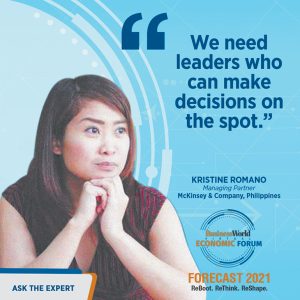
Furthermore, businesses are encouraged to adapt fast. “We need to have leaders who can make judgment calls on the spot… We need to be much more dynamic and not hierarchical,” she said. “Every company now needs to be equally agile, because you’re getting thrown so much uncertainties… that decision-making cannot be just done by one brilliant guy at top, but we have to figure out a way to empower the frontline.”

Imagination as a key to recovery
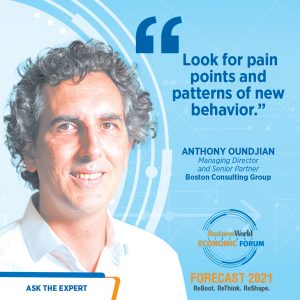
BCG’s Mr. Oundjian, meanwhile, stressed that after efforts of reacting and responding to the pandemic’s disruptions, it is time for businesses to reimagine their new future. “Reimagination is the next step, which is about acknowledging that the world is going to be different [so we should] rethink of business accordingly,” Mr. Oundjian said.

He shared several triggers of unlocking ideas and reinventing a business. This includes the notion of seeking surprise, wherein organizations spot accidents, anomalies, and analogies and developing an idea out of patterns. Other triggers include ‘probing the world’ to find new pain points; ‘facilitating contagion’ by creating a contagious culture of innovation and sharing ideas; and ‘writing the recipe’, wherein organizations codify successful practices to form new systems.

In addition, Mr. Oundjian shared ‘firestarters’ to rekindle imagination, which include: using the current crisis, getting into the real world by getting feedback from consumers, establishing an ideal, encouraging dreaming, making heroes of internal entrepreneurs, and trying bold new things.

“The crisis is really a time to reinvent yourself,” Mr. Oundjian shared. “I’ve seen that in many of our clients here in the Philippines, who have been forced to accelerate their digital transformation, who have changed their delivery model, who have changed their engagement model with their employees, and after this react, they actually put in place stronger processes,” he said.

For Mr. Oundjian, reimagining will help businesses in planning for recovery and ensuring resilience in the future. “We’re already past the react phase. We’re at least in the rebound, and I think we need to be more and more in the reimagine phase,” the BCG managing partner stressed.

As the country waits for COVID-19 vaccines to come in the country, he continued, companies are advised to bear the next six to 12 months while ensuring the employee safety and positive cash flow, alongside making the right adjustments.
“It’s really time to think about what kind of changes in consumer behavior will last beyond this crisis and to adopt and to prepare for this new normal,” Mr. Oundjian added.

He also expressed his confidence in the Philippines returning to a trajectory of growth and opportunities for its citizens. “We’re still a young population, we’re still very digital… we’re resourceful. So, we’re going to get back. The question is how quickly and how much,” Mr. Oundjian said, adding that Filipinos have a bright future ahead given that businesses have shown that they can adapt and create new opportunities for themselves.

Military, police say ceasefire ineffective for peace, anyway

TOP military and police officials vowed support to President Rodrigo R. Duterte’s pronouncement that there will be no ceasefire between the government and communist rebels during the holidays — and until he steps down in 2022.

“There will be no more ceasefire ever again under my term… For all intents and purposes, the ceasefire is dead,” Mr. Duterte said in a televised talk late Monday.

Earlier this year, the United Nations (UN) called for a worldwide armistice in consideration of the global coronavirus pandemic. The Philippine government backed the appeal, but said the New People’s Army (NPA), the armed group of the Communist Party of the Philippines (CPP), continued attacks on security forces and civilians.

Major Gen. Edgard A. Arevalo, military spokesperson, reiterated on Tuesday that their recommendation not to have the traditional Christmas truce was based on the NPA’s history of violating agreements.

“We’re thankful the President heeded AFP’s (Armed Forces of the Philippines) recommendation not to declare holiday ceasefire & beyond — not because we don’t want peace, but because what we advocate is a genuine & lasting peace that can’t be achieved with NPA that is notoriously insincere,” Mr. Arevalo said in a statement.

Police chief Gen. Debold M. Sinas, in a briefing, said they will carry on with operations against the armed rebels, especially those with warrants of arrest for various crimes. — Gillian M. Cortez and Emmanuel Tupas/PHILSTAR

NLEX Corp. seeking ‘dialogues’ with Valenzuela on permit, RFID

NLEX CORP. on Tuesday said it will seek “a series of dialogues” with Valenzuela City Mayor Rex T. Gatchalian after the local government revoked the toll operator’s business permit over the heavy traffic caused by the implementation of its cashless toll payment system.

“We are reviewing the situation and are doing everything necessary to address the issues,” NLEX Corp. President J. Luigi Bautista said in an e-mailed statement.

He said the company would seek “amicable and cooperative initiatives between the tollway company and the City of Valenzuela.”

On Monday, Valenzuela City suspended NLEX Corp.’s business permit for Karuhatan-Mindanao Avenue Toll Plaza, Karuhatan-Harborlink Toll Plaza, Karuhatan-MacArthur Highway Sub-Exit, Mindanao Avenue Toll Plaza, Paso de Blas Toll Plaza North Bound, Paso de Blas Toll Plaza South Bound, and Lawang Bato Toll Booth.

Mr. Gatchalian said without a business permit, NLEX Corp. cannot collect fees at the seven toll plazas within the jurisdiction of Valenzuela City.

NLEX Corp. had requested Valenzuela City on Dec. 5 for an extension of 15 days within which to respond to the concerns raised by the local government, Mr. Gatchalian said in his Dec. 7 letter to Mr. Bautista.

The Valenzuela City government rejected the tollway firm’s request.

“As I have already stated, I have been calling the attention of your higher-ups regarding the technical glitches and inefficiency of your then EasyTrip (and later, RFID) for the past seven years. You, therefore, had more than enough and reasonable time to make your system stable and reliable,” Mr. Gatchalian said in his letter posted on the official Facebook page of Valenzuela City.

On Tuesday, Mr. Bautista said: “These glitches that are occurring at the toll booths are simply a result of some adjustments that should be expected because the RFID implementation took effect only eight days ago.”

The tollways firm said it would “continue to pursue a series of consultations and dialogues with the Valenzuela Mayor in good faith.”

A resolution asking the Senate to review concession deals of toll operators has been filed in the chamber following issues in implementing the cashless payments system.

Senate Resolution No. 587 asks the body to exercise its oversight function to look into existing concession agreements as well as the Toll Regulatory Board (TRB).

“There is a need to review the concession agreements of existing tollway operators to check if the operation of their toll collection system conforms to the minimum standard specifications for operations and maintenance under toll operations certificate or agreement,” Senator Sherwin T. Gatchalian, vice chairman of the economic affairs committee, said in a statement on Tuesday.

The lawmaker also recommended that the TRB impose a toll holiday due to glitches in the radio frequency identification device (RFID) system. The mandatory electronic toll collection was implemented since Dec. 1 to lessen human contact amid the coronavirus pandemic.

“These malfunctioning RFID sensors and installation of RFID stickers exacerbated the already dismal traffic situation in the tollways and nearby roads since the start of the shift to a purely cashless toll collection system,” he said.

Mr. Gatchalian said NLEX Corp. Senior Vice President for Communications Romulo S. Quimbo, Jr. had admitted there were defective RFID sensors as reported by motorists, and had committed to address concerns.

The lawmaker however said there is gross negligence on the part of the toll operator.

“Thousands of motorists have been suffering from the horrendous traffic that has been going on for a week now and which could have been prevented had they exercised prudence before setting a deadline on the implementation of the RFID system,” he said.

NLEX Corp. is under Metro Pacific Tollways Corp., a unit of Metro Pacific Investments Corp., which is one of the three Philippine units of Hong Kong-based First Pacific Co. Ltd. The two others are PLDT, Inc. and Philex Mining Corp. Hastings Holdings, Inc., a unit of PLDT Beneficial Trust Fund subsidiary MediaQuest Holdings, Inc., maintains interest in BusinessWorld through the Philippine Star Group, which it controls. — Arjay L. Balinbin and Charmaine A. Tadalan

WB sees fragile, uneven PHL recovery

THE WORLD BANK (WB) is expecting the Philippine economy to miss the government’s growth targets for the next two years, amid a slow and fragile recovery from the coronavirus pandemic.

In its latest Philippines Economic Update released Tuesday, the multilateral lender once again lowered its gross domestic product (GDP) forecast for the Philippines this year to an 8.1% contraction, from the 6.9% slump penciled in last October.

To compare, the Philippine government’s economic team expects GDP to shrink by 8.5-9.5% this year.

The World Bank said it cut growth projections for the Philippine economy after GDP fell by a faster-than- expected 11.5% in the third quarter, and the damage caused by strong typhoons in November. Damage to infrastructure and agriculture caused by the recent string of typhoons reached P24 billion or 0.1% of GDP, according to preliminary estimates.

The Washington-based multilateral lender also noted the recession could push 2.7 million more Filipinos into poverty by year’s end.

The World Bank noted the economy’s recovery “remains fragile, uneven, and incomplete,” as GDP shrank by 10% in the first three quarters of 2020 — the deepest contraction since the debt crisis in 1985.

For the next two years, the World Bank expects the economy to grow by 5.9% in 2021 (slightly higher than the previous forecast of 5.3%) and by 6% in 2022.

“These projections hinge on China’s early recovery, among the Philippines’ main export destinations, alongside the expected rebound in the global economy in 2021,” it said.

However, these medium-term projections are well below the revised 6.5-7.5% GDP target for 2021 and 8-10% goal for 2022 set by the Development Budget Coordination Committee (DBCC).

“On the DBCC assumptions, we do agree in the path of the recovery that the contraction will be deep in 2020 and the recovery is smooth, not a fast rebound but a gradual recovery given that containment measures will still be on for some months next year,” said Rong Qian, a senior economist at the World Bank, during a press conference on Tuesday.

The economy is seen to post a “moderate growth rebound” next year on base effects, a pickup in household consumption, and new jobs as more businesses are allowed to reopen.

“As the government ramps up its infrastructure spending in the fourth quarter of 2020 and even more in 2021, the construction sector will rebound contributing to job creation as well. Finally, pre-election activities in the run-up to the national election in 2022 will give an additional boost to demand as early as in the second half of 2021,” the World Bank said.

After an estimated 28.7% contraction this year, capital formation is expected to show a modest recovery in the next two years, the World Bank said.

“The expansion of private investments is likely to be dampened by weakness in the balance sheets of some large corporations that have been severely impacted by the pandemic. Moreover, the fall in foreign direct investment (10.9% contraction, year on year, in the first seven months of 2020), alongside the decline in bank lending for production activities (average of 1%, month on month, contraction between April and August), preclude full access to externally sourced funds to finance investment plans,” it said.

RISKS TO OUTLOOK
However, a potential resurgence of coronavirus disease 2019 (COVID-19) infections is the “most significant downside risk” to the growth outlook, the World Bank said.

“Should a second wave of infections materialize and remain unchecked, a reversal to strict lockdown measures would lead to the closure of more businesses and a spike in unemployment, lowering business and consumer confidence and investment levels, which could push the economy into a deeper recession in 2020 and lead to a more protracted recovery in the medium term,” it said.

While an early and successful rollout of the COVID-19 vaccine in the country will be an upside risk to the baseline growth projections, the World Bank does not expect the vaccine to be widely available very soon.

“The vaccine rollout will build confidence not only in the Philippines but also globally, which will also have an impact on the country’s path of recovery through external channels,” Ms. Qian said.

Natural disasters such as typhoons, earthquakes and floods also pose downside risks to the growth outlook.

“The extent of the impact of these natural events on the pace of economic recovery is highly uncertain as government post-disaster response is hampered by its effort to manage the pandemic,” the World Bank said.

POVERTY
Poverty in the Philippines is likely to rise in the near term due to the pandemic’s impact on household income and jobs.

“The COVID-19 pandemic threatens to partly reverse the gains made in poverty reduction and shared prosperity in recent years,” the World Bank said.

The country’s poverty rate, based on the lower-middle income threshold of the number of population living below $3.2 a day, is expected to increase to 22.6% this year from 20.5% last year. This is equivalent to 2.7 million more Filipinos slipping back into poverty, the World Bank said.

The poverty rate is seen to decline through 2022, as the impact of the pandemic subsides and economic activity returns to normal.

“To build a resilient recovery, the government needs to protect the poor, improve preparedness and post-disaster response effectiveness while continuing the effort to flatten the infection curve in the short term,” the World Bank said.

The impact of the recent natural disasters highlighted the importance of adopting better disaster risk reduction efforts and policies responsive to climate change, according to Ndiame Diop, World Bank’s country director for Brunei, Malaysia, Thailand and the Philippines.

“While the Philippines is financially resilient, stronger coordination, execution and implementation will help further improve social and physical resilience to frequent shocks,” he said.

The World Bank estimates the country suffers an average of $3.5 billion (P168.28 billion) in asset losses or around 1.1% of GDP each year due to typhoons and earthquakes. — Beatrice M. Laforga

Telco firms improving quality of signal, service

THE PALACE SAID telecommunication firms must improve their services further to put themselves at par with the connection quality in other countries. — BW FILE PHOTO

THERE IS A long way to go for telecommunications firms to put their services at par with those in our Asian neighbors, the Palace said, despite improvements made to boost signal quality amid the coronavirus pandemic.

Palace Spokesperson Harry L. Roque said in a briefing on Tuesday that despite steps made by local companies to improve their services, the goal to give the “best” to the Filipinos has yet to be attained by the main telecommunication players.

This is after National Telecommunication Commission (NTC) Commissioner Gamaliel A. Cordoba said the Philippines ranked 32nd in fixed broadband and 34th in mobile broadband in the Asian region.

“What our countrymen want is not only for Globe and Smart’s services to improve. What our countrymen want is for services to be world-class. Let’s be honest but at number 34 in Asia, I don’t think we are world-class,” Mr. Roque said.

Mr. Cordoba said services and prices are expected to be better for consumers once the third telco firm Dito Telecommunity Corp. starts commercial operations next year as competition will make current players step up their game.

“Competition will drive the services to improve and drive prices to go down,” he said in the same briefing.

On Tuesday, telecommunication providers Globe Telecom, Inc., Smart Communications, Inc., Dito Telecommunity, and Converge ICT Solutions, Inc. all gave updates on their services after the Palace last week criticized the companies for their services despite the faster cell tower application process mandated by President Rodrigo R. Duterte.

Smart President and CEO Alfred S. Panlilio said a lot of work needs to be done “if we really want to improve our coverage.” This includes upgrading its fiber services, he said.

“What we really want is to elevate the Philippines to global standards,” he said in the same briefing. He said that in August, the company began to migrate its legacy DSL copper subscribers to fiber.

Globe President and CEO Ernest L. Cu said Mr. Duterte’s order to hasten the process for building cell towers allowed the company to “exceed its rollout targets for the year” despite lockdown measures.

“We will be able to make our target of 1,300 additional sites for the year,” Mr. Cu said.

Dito Telecommunity Spokesperson Adel A. Tamano said the company has built about 1,900 cell towers, with its 5G services already in place ahead of its March 2021 commercial rollout.

“We have a government commitment to have 84% coverage by our fifth year so those underserved areas will be met… but internally we are going for 90% within five years,” he said.

Converge ICT Solutions Chief Operating Officer Jesus C. Romero said the company has added 3.5 million ports to its network this year.

“We plan to add more for 2021. That’s an additional 1.8 million, bringing us to 5.3 million ports nationwide,” Mr. Romero said.

He added that Converge is building its domestic backbone from Aparri to General Santos. While the Luzon area is already operating, it is also looking to serve the Visayas and Mindanao. — G.M. Cortez