Home Blog Page 8148

Samsung windfall gives richest Korean woman $7B fortune

REUTERS

Hong Ra-hee, the wife of the late Samsung Group Chairman Lee Kun-hee, boosted her fortune to more than $7 billion after receiving billions of dollars in stocks in the much-awaited transfer of her husband’s assets.

Hong, 75, inherited about 83 million shares in Samsung Electronics Co., making her the largest individual shareholder in the tech giant with a 2.3% stake, according to a filing last week. Hong is the richest woman in South Korea with a net worth of $7.4 billion as of Monday’s stock-market close, according to the Bloomberg Billionaires Index.

It’s another consequence of the massive passing of wealth after Lee’s death, which saw his son Jay Y. cement control over the group after his holdings rose significantly in key affiliates. The late Lee’s only son is worth $12.6 billion, according to the index, while his sisters Boo-jin and Seo-hyun saw their wealth swell to $5 billion and $4.4 billion, respectively.

“It’s a win-win situation for the family members,” said Park Ju-gun, head of Seoul-based research firm Leaders Index. “It has ensured more stable control for Jay Y. Lee, while other family members get more of a voice with their increased stakes.”

A Samsung Electronics spokeswoman declined to comment on the family’s net worth.

The drama over succession at South Korea’s largest company has roiled the country since the late Lee, the patriarch and longtime head of Samsung Electronics, suffered a heart attack in 2014. Jay Y. Lee has been accused in two different lawsuits of illegal behavior to ensure control over the conglomerate and is currently serving a jail sentence after a conviction for bribery in the first case.

Hong received the biggest slice of the late Lee’s stake in Samsung Electronics as it was divided in a 3:2:2:2 ratio between her and her three children. Hong got about 33% of the shareholding, while her children each received about 22%, according to the legally prescribed ratio.

Stock holdings in the conglomerate’s other key affiliates, its de facto holding company Samsung C&T Corp. and Samsung SDS Co., were transferred according to the same ratio.

But Jay Y. was able to tighten his grip as he received half his father’s shares in Samsung Life Insurance Co., raising his stake to more than 10% from 0.06%. Samsung Life owns 8.5% of Samsung Electronics.

Last week, the family announced its plan to pay one of the largest inheritance-tax bills at more than 12 trillion won ($10.7 billion), as well as its intention to donate 1 trillion won for medical facilities and about 23,000 works of art, including pieces by Pablo Picasso and Claude Monet.

Hong led Samsung’s Leeum museum, which houses works such as Jean-Michel Basquiat’s “Untitled (Black Figure)” and Gerhard Richter’s “Two Candles.” She resigned as director in 2017, and hasn’t taken any management roles at Samsung companies.

“It’s an extraordinary concentration of wealth,” Park said. “This single family’s fortune creates inequality even among conglomerates.” — Bloomberg 

Hong Kong leader flags ‘fake news’ laws as worries over media freedom grow

HONG KONG – Hong Kong leader Carrie Lam said on Tuesday the government was working on “fake news” legislation to tackle “misinformation, hatred and lies,” as worries grow over media freedoms in the global financial hub.

Under Beijing’s directions, Hong Kong has taken a swift authoritarian turn following the imposition of a sweeping national security law in 2020, with a fresh drive for “patriotism” spilling into most aspects of life in the city.

A major overhaul of public broadcaster RTHK, led by a newly appointed bureaucrat with no media experience, is widely seen as a signal that government red lines will soon encircle journalism as they have other sectors, such as education.

Speaking at her weekly news conference, Lam said the government was researching “fake news”, but added she had no timetable for the legislation.

“The fake news law needs a lot of research, especially (on) how overseas governments are tackling this increasingly worrying trend of spreading inaccurate information, misinformation, hatred and lies on the social media,” she said.

“We will continue to be very serious about this issue because of the damage it is doing to many people.”

Her comments come a day after RTHK reported the broadcaster would not renew the contract of its journalist Nabela Qoser, known for her tough questioning of Lam and other officials during mass 2019 anti-government protests.

RTHK has also begun removing some of its archives from its Youtube and social media channels, prompting online activists to back up some of the content on blockchain platforms.

Another RTHK journalist, Bao Choy, was found guilty by a court last month of improperly accessing public records for a documentary on the police handling of a mob attack on pro-democracy protesters, reporters and bystanders in 2019.

Her documentary won a local press award the day before the verdict, which RTHK did not accept.

The July 2019 attack in northern Yuen Long district, when more than 100 men in white T-shirts hit people with sticks and poles at a train station, sparked widespread criticism of the police including allegations of collusion with triad gangsters, which police deny.

Courts have yet to convict any of the attackers.

Reporters Without Borders ranks Hong Kong 80th out of 180 in terms of press freedom, in freefall over the past decade. – Reuters

Myanmar parcel bomb blasts kill five including ousted lawmaker

Blasts from at least one parcel bomb in Myanmar have killed five people, including an ousted lawmaker and three police officers who had joined a civil disobedience movement opposing military rule, media reported on Tuesday.

Since the elected government led by Nobel laureate Aung San Suu Kyi was overthrown in a coup on Feb.1, Myanmar has seen an increasing number of small blasts in residential areas, and sometimes targeting government offices or military facilities.

The latest blasts were in a village in the southern central part of Myanmar in Western Bago and occurred at around 5 pm on Monday, the Myanmar Now news portal reported, citing a resident.

Three blasts were triggered when at least one parcel bomb exploded at a house in the village, killing a regional lawmaker from Suu Kyi’s National League of Democracy (NLD) party, as well as the three police officers and a resident, the report said.

Another police officer involved in the civil disobedience movement was also severely wounded after his arms were blown off by the explosion, the resident was cited as saying. He had been hospitalised and was receiving treatment, it said.

Khit Thit media also reported the blasts, citing an unnamed NLD official in the area.

Reuters could not independently verify the reports and a military spokesman did not answer a phone call seeking comment.

Violence has escalated since the coup, with hundreds reported killed by security forces, trying to quell pro-democracy protests in cities and rural towns. Ethnic militias have also backed opposition to the junta, and the military is fighting these groups on the fringes of Myanmar.

On Monday, the Kachin Independence Army, an ethnic rebel group, said it had shot down a military helicopter as fighting in the country’s northern and eastern frontier regions intensified.

Domestic media also reported that a junta-appointed local administrator had been stabbed to death in the main city, Yangon.

Police and the military did not respond to requests for comment.

The Assistance Association for Political Prisoners (AAPP) advocacy group says security forces have killed at least 766 civilians since the coup. The junta disputes the figure and says at least 24 members of security forces have been killed during the protests. Reuters is unable to verify casualties because of the curbs placed on media by the junta. Many journalists are among the thousands of people who have been detained.

The junta said it had to seize power because its complaints of fraud in a November election won by Suu Kyi’s party were not addressed by an election commission that deemed the vote fair.

Suu Kyi, 75, has been detained since the coup along with many other members of her party. The AAPP says more than 3,600 people are currently in detention for opposing the military. – Reuters

Gates’ marital split follows Melinda’s long journey away from Bill’s shadow

FILE PHOTO: Bill and Melinda Gates attend a debate on the 2030 Sustainable Development Goals in Brussels January 22, 2015. REUTERS/Francois Lenoir

When Melinda French Gates asked her husband, Microsoft Corp co-founder Bill Gates, to let her co-author the 2013 annual letter about their foundation, the conversation blew up into a fight.

“It got hot,” Melinda wrote in her 2019 book, “The Moment of Lift.” “Bill said the process we had for the Annual Letter had been working well for the foundation for years, and he didn’t see why it should change.”

Ultimately, Bill agreed for her to write a separate piece about contraceptives, while he penned the main letter about the Bill & Melinda Gates Foundation’s work. In the next year’s letter, Melinda wrote about one of three myths that “block progress for the poor,” while Bill handled the other two.

Come 2015, they both signed the letter.

“He’s had to learn how to be an equal, and I’ve had to learn how to step up and be an equal,” Melinda wrote, adding earlier in the book that she was naturally “shy” and “private.”

Melinda’s long journey away from Bill’s shadow is set to enter a new phase after the billionaire benefactors announced on Monday that they would divorce after 27 years, saying in a court filing that “this marriage is irretrievably broken.”

The 56-year-old Texas-raised computer scientist, who met Bill Gates, 65, at a company dinner in New York, will continue to run the foundation with him. But she has also positioned herself, in a solo capacity, as an activist for women’s rights.

In 2015, she founded Pivotal Ventures, an investment company focused on women and families, while her book is centered on issues of female empowerment.

“The world is finally waking up to the fact that none of us can move forward when half of us are held back. The data is clear: empowered women transform societies,” she wrote in a note about her book.

Her Facebook page includes shout-outs to caregivers and concerned posts about care for newborns, as well as an Easter post featuring an old photo of her smiling as she holds a little girl, presumably one of her two daughters, next to a costumed Easter bunny.

The extent of Melinda’s impact will likely be determined in part by what happens to Bill Gates’ fortune, estimated by Forbes at around $130.5 billion. In their divorce filing, the spouses said they had agreed on division of assets, but did not disclose details.

MacKenzie Scott’s 2019 divorce from Amazon.com Inc founder Jeff Bezos left her with a 4% stake in Amazon, which she has used to become a leading philanthropist. In December, Scott said she had donated over $4.1 billion in the four previous months to food banks and emergency relief funds amid the COVID-19 pandemic.

Tech journalist Kara Swisher tweeted she was “seeing a lot of funny” memes about MacKenzie Scott and Melinda Gates road-tripping, “but FYI: Melinda has done a ton of investing via her Pivotal Ventures and has been the key player in the Gates Foundation with Bill for long time, so not sure much will change.” – Reuters

Mexico hopes to finish vaccinating its population in early 2022

STOCK PHOTO

MEXICO CITY – Mexico hopes to finish vaccinating its entire population against COVID-19 by the end of next year’s first quarter, Mexico’s deputy health minister, Hugo Lopez-Gatell, said Monday evening.

The projection takes into consideration global delays in vaccination production and vaccine delivery to Mexico, said Lopez-Gatell, who has spearheaded the country’s response to the coronavirus.

“We hope to have vaccinated the entire population, those that hope to get vaccinated, by the end of the first quarter 2022,” he said at a regular news conference.

So far Mexico has administered one vaccine dose to some 10% of its 126 million inhabitants. Lopez-Gatell said that by mid-July, 20% of the population will have received at least one dose.

The Health Ministry earlier in the day reported 1,027 new confirmed coronavirus cases and 112 more deaths, bringing the total number of cases to 2,349,900 and fatalities to 217,345.

Separate government data published in March suggested the real death toll may be at least 60% above the confirmed figure. – Reuters

International Finance Awards hails Globe as fastest growing 5G network, Ernest Cu as best CEO

REUTERS

The 2021 International Finance Awards (IFA) recognized Globe Telecom as the “Fastest Growing 5G Network Service Provider” and hailed Globe President and Chief Executive Officer Ernest L. Cu as the “Best Telecommunications CEO.”

The IFA Awards for Telecom seeks to validate the efforts of every contender that is technologically advanced and provides cutting-edge connectivity to customers all over the world.

Globe is a pioneer in 5G supremacy in the Philippines covering 1,383 areas nationwide as of end-March.  This latest generation in wireless technology provides faster speeds, low latency, higher bandwidth, and more stable internet connection.

Globe’s 5G rollout is part of its strategy to improve the data experience of its customers and use the most advanced technology to spearhead the country’s digital transformation.

On the other hand, Cu was hailed as the Best Telecommunications CEO as part of the Leadership Awards recognizing exceptional and extraordinary individuals, both existing and aspiring leaders.

“The endeavor is to identify the emerging stars of tomorrow, keeping in mind unique leadership characteristics and give them due recognition for the spectacular efforts they have made. Leadership Awards are the definitive awards celebrating the spirit of excellence in business leadership across the globe,” the International Finance Awards said.

The publication said the recipients of the awards are visionaries behind today’s outstanding businesses.

“They are stellar individuals who epitomize strength, ingenuity, knowledge, foresight and who drive the growth of their businesses with vision and inspiration,” it added.

This is the second straight year Globe was feted as it was also hailed as the “Most Socially Responsible Company” and “Most Innovative CSR Initiative – Digital Thumbprint Program” during the 2020 International Finance Awards.

Globe was also named the “Best Telecommunications Company” in 2019 and “Best Telecom Service Provider” in 2017.

International Finance is a premium business and finance magazine published by UK’s International Finance Publications Ltd. It acknowledges corporate excellence through the annual International Finance Awards.

To know more about Globe, visit www.globe.com.ph.


PANA, CDM hold successful COLLAB 2021 webcon

The Philippine Association of National Advertisers (PANA) partnered with digital training and transformation pioneer, Certified Digital Marketer (CDM), on the first ever COLLAB 2021 web conference, held last April 20.

With over 300 attendees, Collab 2021: Ecommerce and Collaboration was the first time industry pioneers and trailblazers have come together and discuss partnership opportunities between brands, agencies, and solutions providers, to push for the industry’s collective growth.

The event opened with Quanta Digital CEO Ash Mandhyan providing the attendees with an overview of the new Ecommerce Go-To Market and Value Chain. Here, he covered global and local trends driving the boom of e-commerce in the country, such as social commerce, logistics improvements, and innovations in payment.

A 360 online conversation was opened to eight e-commerce experts to share elevator pitches and perspectives on e-commerce and collaboration to help business recovery and growth. This was followed by panel discussions focusing on each segment: brand, agency, and enabler.

Taking the stage were:

  • Arthur Pena, Group Director for Media or P&G, and responsible for the FMCG brand’s E-commerce initiatives;
  • Daniel Lim, Vice-President of SM Investments Corporation, who currently spearheads SM Malls Online, the omnichannel e-commerce arm of SM Malls;
  • Chad Sotelo, General Manager of Electrolux, who held previous stints at Samsung, L’Oreal, and P&G;
  • Steve Sy, CEO of Great Deals, which is a full-suite Ecommerce enabler working with the largest brands in the country;
  • Neil Trinidad, Country CMO of Lazada Philippines, with over 16 years of experience across FMCG (Unilever) and Tech (Google);
  • Jeff Saez, Chairman and President of Nuworks, an Innovations agency that created Nuworks Commerce in 2020 to meet rising Ecommerce demand; and
  • Constantine Robertz, CEO and Co-founder of LOCAD, with 10 years of experience in e-commerce and Logistics industry with Zalora, Entrego and Rocket Internet

Facilitating the discussions was Maye Yao-Co Say, COO of Richwell Phils. Group of Companies, who is also a licensed teacher and columnist for at The Business Mirror and contributing writer for The Asian Parent.

The four-hour virtual conference surfaced some recurring themes, such as opportunities in conversational commerce, breakthroughs in delivery logistics and payments that have lowered the barriers for Filipino consumers, the growth of shoppertainment, and the importance of offering a seamless customer experience. It also showcased how brands, agencies, and enablers are very much looking for new partnerships to help them accelerate their growth.

COLLAB 2021 was made possible by the support of its Gold Sponsors, PMFTC and Locad.

For attendees, Locad also offered to waive subscription fees for three months for its logistics solutions.

Special thanks go to Nuworks and Future Proof PH, and Media Partners, adobo Magazine, CNN Philippines, The Philippine Star, BusinessWorld, 96.3 Easy Rock, Philippine Daily Inquirer and Inquirer Mobile, Inquirer.NET, DOOH, and Rappler.

Missed the session? Recordings now available until May 30

If you missed COLLAB 2021, the organizers are making the full four-hour event recording available until May 30. Get access to the lecture, panel discussions, elevator pitches, and Q&A session, at https://collabph.futureproof.ph/on-demand.

BDO Foundation builds training facility for underserved youth

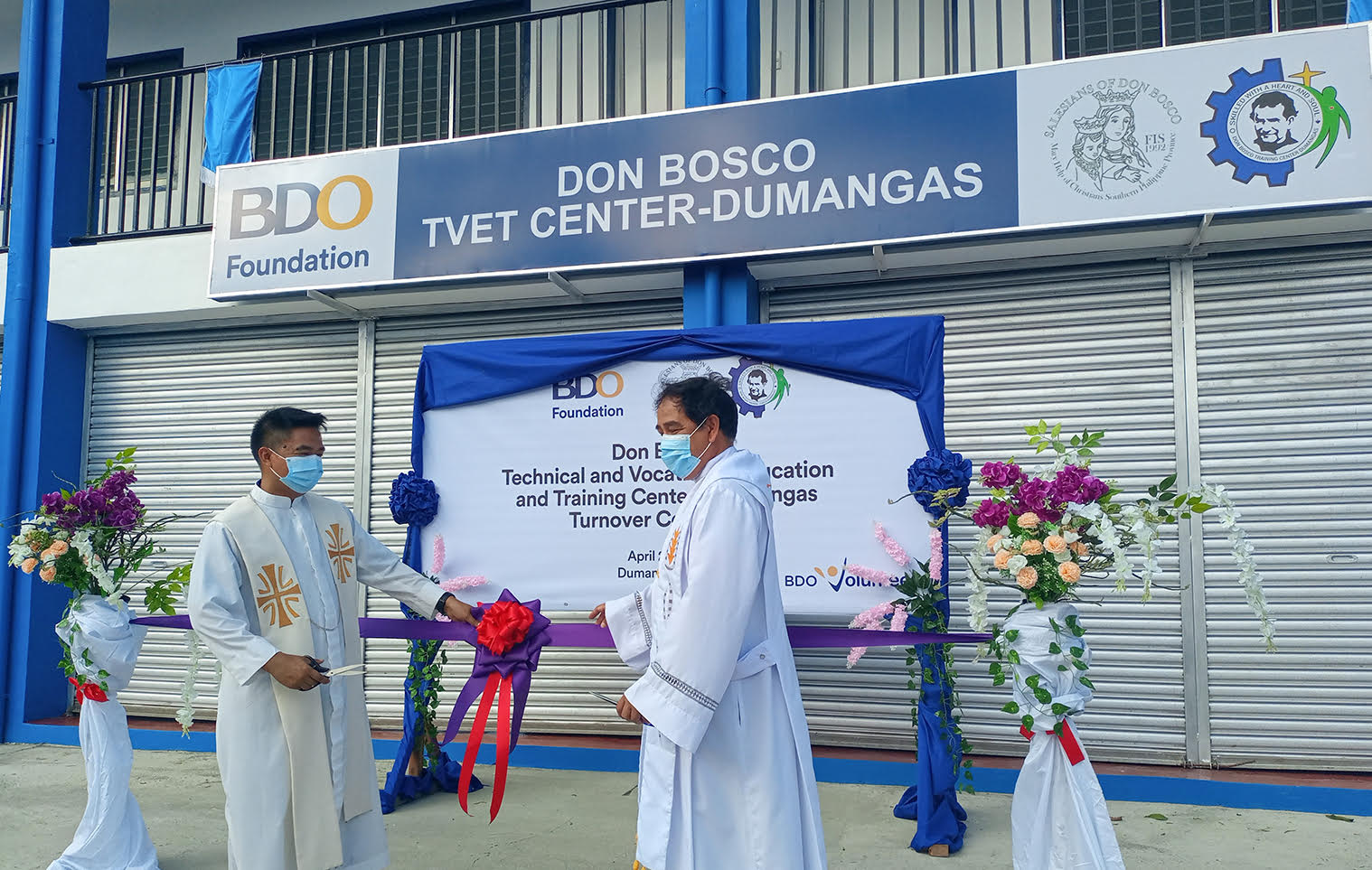
The new training facility BDO Foundation built for the Don Bosco Boys Home and Vocational Training Center in Iloilo helps Don Bosco in its efforts to make marginalized youth employable in the Philippines and abroad.
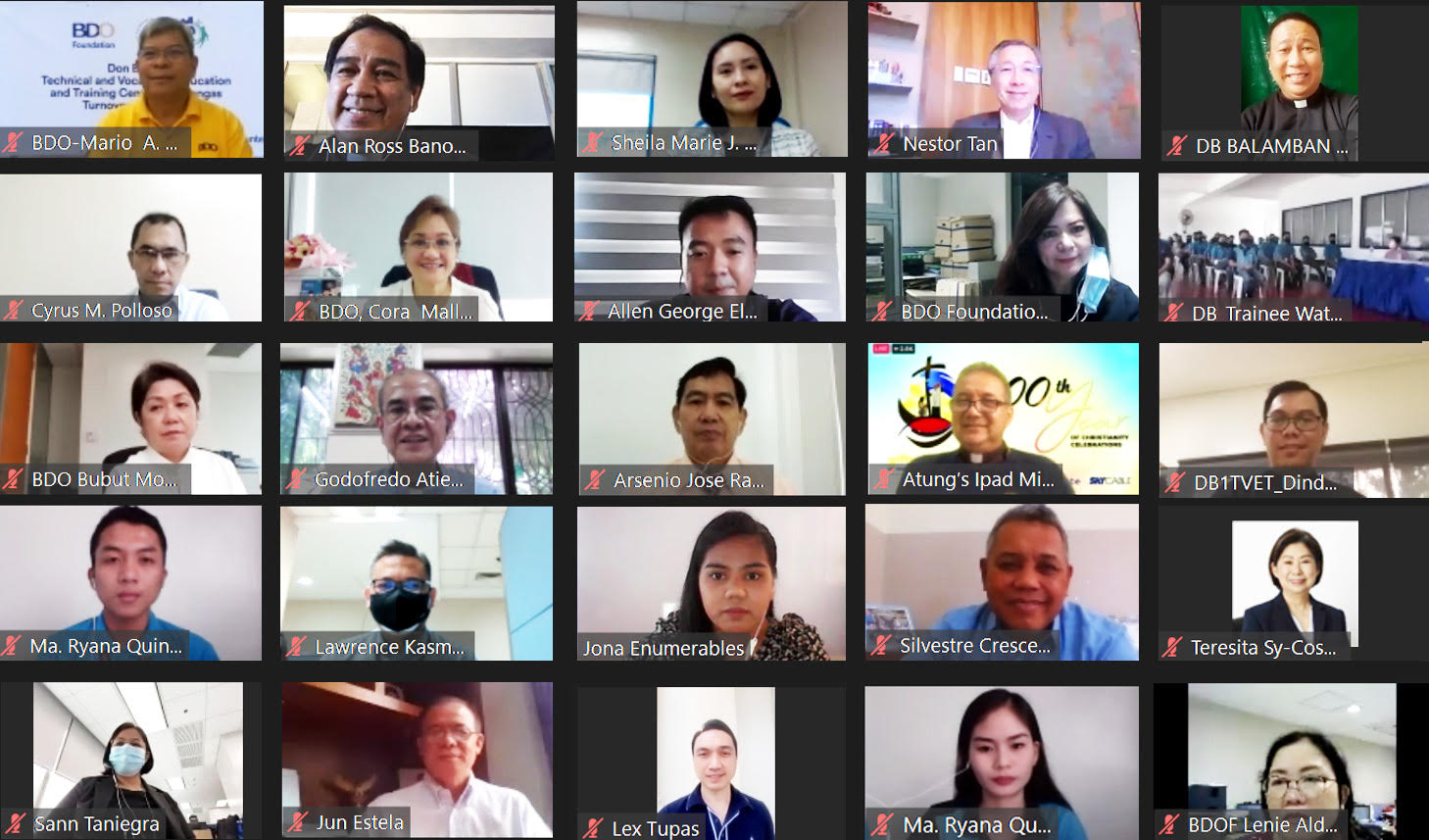
In support of Don Bosco’s mission to educate, evangelize and capacitate Filipino youth, BDO Foundation has constructed a new technical-vocational training facility for the Don Bosco Boys Home and Vocational Training Center in Iloilo. To mark the completion of the project, the foundation recently turned over the two-storey structure to the Salesian Society of St. John Bosco in a virtual event attended by BDO leadership.
The turnover was witnessed by BDO Unibank and BDO Foundation chairperson Teresita Sy-Coson, BDO Unibank president and CEO, and BDO Foundation trustee Nestor V. Tan, BDO Foundation president Mario A. Deriquito, BDO Foundation trustees Ma. Corazon Mallillin and Ismael Estela Jr., BDO Central Operations Group Facilities and Procurement head Aurea Imelda Montejo, BDO Visayas, and Mindanao region head Cyrus Polloso, and BDO Iloilo area head Sheila Marie Uygongco.
The facility was graciously accepted by administrators led by Fr. Dindo Vitug, Fr. Godofredo Atienza, Fr. Alan Ross Banogon, and Don Bosco Boys Home and Vocational Training Center technical director Fr. Allen George Elevado.
According to Fr. Elevado, “We prayed for a building that would help us in our growing ministry of providing skills training, attitude transformation and spiritual renewal for underserved youth. Without hesitation, BDO Foundation gave us a new building with facilities, equipment, and tools. It’s a complete package. What a great gift!”
This is BDO Foundation’s second partnership project with the Salesians. In 2019, the corporate social responsibility arm of BDO Unibank built a similar structure for the Don Bosco Training Center in Mati City, Davao Oriental. The construction of both buildings, as well as the provision of tools, equipment, and furniture for the training of students, were made possible by BDO employees through BDO Exclusives, a program that enables employees to contribute to the foundation’s corporate citizenship initiatives.
Located in the first-class municipality of Dumangas in Iloilo, the Don Bosco Boys Home and Vocational Training Center educate economically disadvantaged and out-of-school youth in the Visayas, preparing them for gainful employment in the Philippines and abroad.
The building BDO Foundation constructed at the center will serve as a place where senior high school students can learn technical-vocational livelihood skills through workshops and classroom instruction. The new building will also enable administrators to introduce new courses, accommodate more enrollees, and teach more learners. More than 140 students per school year will benefit from the facility.
BDO Foundation’s initiative in Iloilo contributes to the achievement of the United Nations Sustainable Development Goal no. 8 to promote sustained, inclusive, and sustainable economic growth, full and productive employment, and decent work for all. It also fulfills the foundation’s advocacy to support areas affected by disasters. Dumangas was one of several towns placed under a state of calamity in the wake of Super Typhoon Yolanda.

Lockdown pushes Philippines’ April PMI into contraction

REUTERS
REUTERS

By Beatrice M. Laforga, Reporter

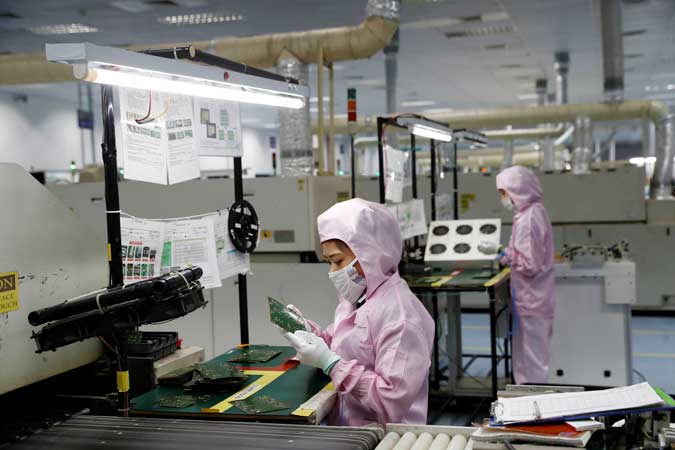
PHILIPPINE factory activity slumped anew in April, as renewed lockdown restrictions in Metro Manila and nearby provinces hampered manufacturers’ operations and dampened demand, a survey by IHS Markit showed.

The Philippine Manufacturing Purchasing Managers’ Index (PMI) sharply fell to 49 in April from 52.2 in March, “to signal a marginal contraction in operating conditions across the Filipino manufacturing sector.”

Last month’s PMI slipped below the 50 neutral mark that separates deterioration from expansion, ending three consecutive months of growth or since December’s 49.2.

Manufacturing purchasing managers’ index of select ASEAN economies, April (2021)

The government began tightening quarantine restrictions in Metro Manila, Bulacan, Cavite, Laguna and Rizal in mid-March, to curb a fresh spike in COVID-19 infections. The modified enhanced community quarantine (MECQ) remains in place until May 14.

“April survey data revealed a setback for the Filipino economy, with operating conditions falling back into contraction territory after only one full quarter of growth. Tightening restrictions led to another round of factory and business closures, with output particularly hard-hit. Meanwhile, labor force cuts extended into the second quarter of 2021,” Shreeya Patel, economist at IHS Markit, said in a statement.

The country’s PMI contraction was in contrast to the broad improvement in most Southeast Asian nations where data is available, including Indonesia, Malaysia and Myanmar.

Overall output of Philippine manufacturers dropped sharply in April, with the rate of decline among the steepest in survey’s history.

The lockdown prompted many factories to suspend operations after demand weakened for the first time since December, IHS Markit said.

The drop in local demand was among the steepest decline to date, but partially offset by a pickup in orders from European markets as the rest of the region starts to slowly reopen.

The muted demand forced some companies to trim their hiring plans last month, while voluntary resignations pulled down the employment rate further.

IHS Markit noted that firms continued to lay off workers for fourteen months straight or since February 2020, with the rate of job shedding in April being the fastest in four months.

Despite reduced manpower, the survey showed that there is still enough capacity among local manufacturers as they continue to keep up with the backlog.

Respondents also noted that the performance of their suppliers also worsened last month after pandemic-related restrictions resulted in longer lead times and tighter supply of raw materials. This resulted in companies shouldering additional surcharges and higher freight costs.

“Supply-side pressures and rising costs were again evident throughout the latest survey period with material shortages and transportation bottlenecks widely reported. Firms will hope that these issues are resolved, but with the full impact of the Suez blockage yet to take effect, the disruption to global trade is expected to reverberate,” Ms. Patel said.

Inflation in input costs quickened for six months straight and by its fastest pace in more than two and a half years. Companies partially passed these higher costs to customers, pushing output prices up.

Lower production and muted new orders also dampened business confidence, bringing optimism levels to an eight-month low. However, IHS Markit said the overall outlook still remained positive on hopes that the government’s mass vaccination program will soon gain traction.

The decline in PMI last month was widely expected given the renewed lockdowns, according to ING Bank N.V. Manila Senior Economist Nicholas Antonio T. Mapa.

However, Mr. Mapa said the gloomy data released signaled that the country’s recovery prospects remain fragile.

“The IHS Markit report highlighted that the drop off in manufacturing activity was the steepest on record, even more dramatic compared to last year’s plunge during the height of the pandemic, indicating the fragility of the recovery. Hopes at the start of the year remain intact but firms are pinning these rosy projections on expectations that vaccination efforts will be underway soon,” he said.

For May, Rizal Commercial Banking Corp. (RCBC) Chief Economist Michael L. Ricafort said the manufacturing PMI will likely contract further with the extension of MECQ in the capital region and COVID-19 cases remain elevated.

“Going forward, any extension of the lockdowns in NCR (National Capital Region) Plus in an effort to help reduce new COVID-19 local cases, still relatively higher on a daily basis recently, could result to continued significant reduction in production, sales, net income, jobs, and other business and economic activities, especially for hard-hit sectors,” Mr. Ricafort said in a note on Monday.

While manufacturing activity picked up in most Asian economies in April, Oxford Economics said tighter mobility restrictions is dimming the outlook for the Philippines, India and Thailand.

“While the more open economies should continue to benefit from rising external demand, rising numbers of new coronavirus cases, restrictions to contain the infections and slow vaccine rollout have led us to lower our 2021 growth projections for India, Philippines, and Thailand,” it said in a note on Monday.

Gov’t debt stock hits P10.77 trillion as of end-March

BW FILE PHOTO

THE National Government’s outstanding debt reached P10.774 trillion as of end-March, after the sale of retail Treasury bonds (RTB), the Bureau of the Treasury (BTr) reported on Monday.

The BTr said the country’s debt stock went up 3.5% from the P10.405-trillion level recorded in February, and rose 27% from P8.477 trillion seen in the period ending March 2020. Since the year started, the debt pile grew by 10% from P9.795 trillion.

The total comprised 72% of local debt and 28% in foreign borrowings.

The increase in outstanding debt was attributed to the 5.2% month-on-month growth in domestic debt to P7.745 trillion, after the BTr raised P411.8 billion in fresh funds from the sale of three-year RTBs on March 4.

Year on year, local debt stock rose 33% from P5.813 trillion as of March 2020. The total debt grew by 16% year to date.

This included P7.204 trillion in government securities and P541 billion in outstanding loans from the central bank.

Meanwhile, the country’s foreign debt stock dipped by 0.45% month on month to P3.03 trillion as of end-March due to the net impact of local- and third-currency fluctuations against the greenback.

“These were more than enough to offset the net availment of foreign loans amounting to P15.15 billion,” the Treasury said.

Outstanding external debt was still 13.7% higher than the P2.665 trillion recorded a year ago, but 2.3% lower since the start of 2020.

The P3.03 trillion foreign debt pile includes P1.368 trillion in loans from external lenders, and P1.66 trillion in global bonds issued so far.

Meanwhile, the total guaranteed obligations of the government went down by 2.4% to P435.8 billion as of March from P446.7 billion as of end-February.  This was also 9.5% lower than the P481.8 billion in March 2020.

“The lower level of guaranteed debt was due to the net redemption of both local and foreign guaranteed obligations amounting to P4.84 billion and P1.69 billion, respectively,” the Treasury said.

Domestic guaranteed debt slipped 2% month on month to P239.3 billion, which was also 6% lower from the previous year.

Foreign guaranteed obligations also declined by 3% to P196.5 billion as of end-March from P202.6 billion the month before.

Local- and third-currency exchange rate fluctuations also trimmed the peso value of the external guaranteed debt by P450 million and P3.93 billion, respectively.

The sustained rise in overall debt stock was due to the widening budget deficit as the government has to hike borrowings to make up for low revenues and to ramp up spending, said Rizal Commercial Banking Corp. (RCBC) Chief Economist Michael L. Ricafort.

The country’s fiscal gap almost tripled year on year to P191.4 billion in March, based on separate data from the BTr. Month on month, this was 65% higher than the P115.97-billion deficit in February.

The higher deficit was due to the 22% increase in total spending and a 17% drop in revenues.

“Tighter quarantine standards recently [in Metro Manila and nearby provinces] could further slow down economic and business activities, reduce the government’s tax collections that could result in wider budget deficits, more government borrowings that lead to higher outstanding debt,’” Mr. Ricafort added.

The government is planning to raise P3 trillion this year from domestic and external lenders to help fund its budget deficit seen to hit 8.9% of gross domestic product.

Official estimates showed the government’s debt stock could rise to P11.98 trillion by end-2021. — Beatrice M. Laforga

Prolonged pandemic dims outlook for PHL retailers’ recovery this year

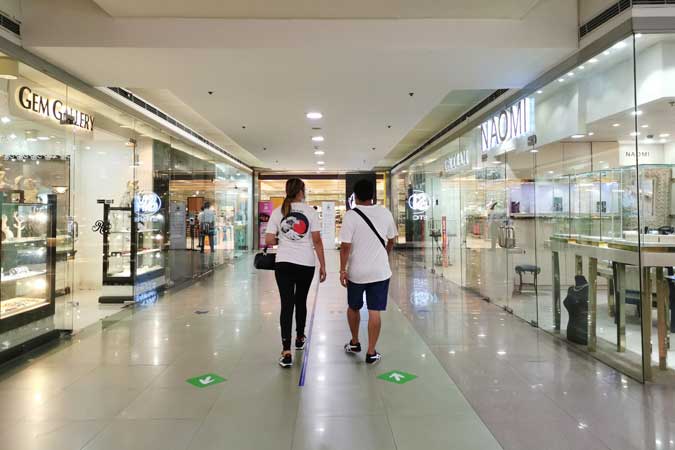
MALL FOOT TRAFFIC has drastically dropped amid a rise in the number of coronavirus infections in Metro Manila. — BW FILE PHOTO

By Jenina P. Ibañez, Reporter

A RETAILERS industry group now expects sales to remain flat this year, as the outlook for recovery dims with the renewed lockdown restrictions in Metro Manila and nearby provinces.

The Philippine Retailers Association (PRA) in January projected 10% growth this year compared with 2020, when initial lockdowns dampened brick-and-mortar sales. This projection would have still been 20-30% lower than the 2019 or pre-pandemic level.

But the extended strict lockdowns and the recent surge in coronavirus disease 2019 (COVID-19) cases have since muted retail sales.

“All bets are off now for any growth from 2020 results. At best, it will be flat for 2021,” PRA Vice-Chairman Roberto S. Claudio said in an e-mail.

The modified enhanced community quarantine (MECQ) in Metro Manila and its neighboring provinces has been extended to end on May 14 while the Philippines continues to have one of the worst COVID-19 outbreaks in the region.

Active cases stood at 69,466 as of Monday, Health department data showed.

Under MECQ, nonessential retail like clothing, books, toys, and jewelry stores can operate at 50% capacity.

Mr. Claudio said lower consumption would delay the sector’s sales recovery to the second half of the year.

“This now moves our estimates for recovery to the second half of this year, assuming we will finally revert to GCQ or MGCQ on May 14. Otherwise, we are looking at 2022 as a start of any recovery among retailers and restaurants,” he said. The general community quarantine (GCQ) and the modified general community quarantine (MGCQ) are looser lockdown measures that allow 100% retail capacity.

Retailers are rotating manpower and requesting rental reprieves to manage their operation costs, Mr. Claudio added.

Alegria Sibal-Limjoco, chairperson of the Philippine Chamber of Commerce and Industry, said that business recovery will “definitely” be delayed amid the MECQ.

But the surge in cases while vaccination has reached just below 2% of the population could have slowed down foot traffic regardless of the lockdown level.

Ms. Limjoco said in a mobile message that she expects more COVID-19 vaccines to arrive in June. Even if the country was placed under GCQ now, she said, consumers “may not want to go out.”

Around 2.3 million doses of the Pfizer and BioNTech vaccine could arrive by June, vaccine czar Carlito G. Galvez, Jr. said last week.

The team behind Certified Calm, a brand that sells wellness products at Makati and Taguig shops, was expecting some recovery from the end of last year to the first quarter of 2021, depending on factors like the COVID-19 daily case tally and the vaccine rollout.

Jedd Ezechiel C. Ong, digital operations lead of Upward Ideas Apparel Corp., said in an e-mail that Certified Calm’s sales compared with physical retail projections fell after foot traffic declined. Upward Ideas is a retail and distribution company that runs Certified Calm.

To adapt, he said the company had to manage excess inventory and increase its responsiveness to customers, especially online.

“We’ve flipped the script organization-wise and made ‘instant responses’ a key business thrust of ours these past few weeks, rather than sales target preservation,” he said. “Everyone in the organization…(is) slowly being asked to take time out of their day to day to entertain as many customer questions and concerns online as they can.”

To support retail recovery, Mr. Ong said that there needs to be clearer information on COVID-19 testing, isolation facilities, and vaccination.

The public sector should also have social safety nets, he said, “to ensure that struggling businesses can still continue to take care of workers in need, especially when workers are afflicted by COVID-19.”

Customs exceeds April target by 4%

THE Bureau of Customs (BoC) exceeded its April collection target by 4.2%, as the majority of its collection districts reported higher revenues despite tighter quarantine restrictions in Metro Manila and nearby provinces.

In a statement on Monday, BoC said preliminary data showed it collected P51.277 billion in April, P2.077 billion more than its P49.2-billion goal and 50% higher than the P33.97 billion in April 2020.

This marked the fourth consecutive month the bureau exceeded its monthly target this year.

Additional revenues included collections from the Tax Expenditure Fund (TEF) amounting to P121 million, and Post Clearance Audit Group (PCAG) with P13.65 million.

“Based on the preliminary report from the BOC-Financial Service, eleven out of the seventeen collection districts surpassed its April 2021 collection target; namely, the Port of San Fernando, Port of Manila, Manila International Container Port, Port of Iloilo, Port of Tacloban, Port of Surigao, Port of Zamboanga, Port of Davao, Port of Subic, Port of Aparri, and Port of Limay,” the agency said.

Using data from the April preliminary collection report, the BoC said it has collected P200.459 billion in the first four months of 2021, 9.4% higher than the P183.174-billion target and 11.5% more than the P179.7 billion during the same period in 2020.

“The bureau continues to improve its efficient collection performance through the improvement in volume of importation while maintaining border security and enhanced trade facilitation,” it said.

The BoC is hoping to meet its full-year revenue target of P616.7 billion this year, as the economy reopens.

ADVERTISEMENT
ADVERTISEMENT