Home Blog Page 8091

Yields on government debt fall on GDP, inflation bets
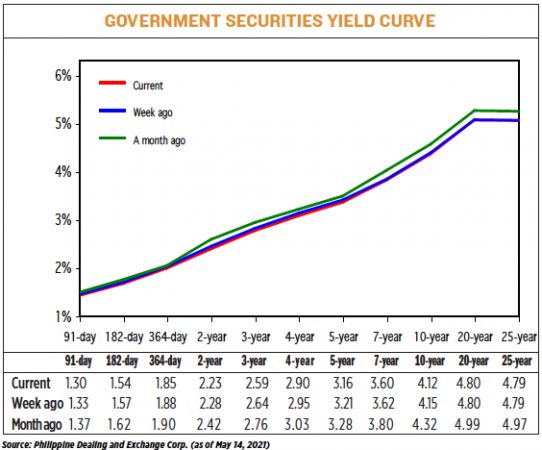
YIELDS on government securities (GS) fell across the board last week following the worse-than-expected decline in economic output in the first quarter and the central bank’s downward revision of its inflation forecast for this year.

GS yields fell by an average of 2.99 bp (bps) week on week, based on the BVAL Reference Rates published on the Philippine Dealing System’s website as of May 14.

Financial markets were closed on Thursday in observance of Eid’l Fitr.

At the secondary market on Friday, yields of all tenors were lower than week-ago levels.

The 91-day Treasury bill (T-bill) went down by 2.39 bps to yield 1.304%. Likewise, the 182- and 364-day papers declined by 2.44 bps and 3.31 bps, respectively, to fetch 1.5447% and 1.8504%.

At the belly, yields on the two-, three-, and four-year bonds went down by 4.67 bps (2.234%), 5 bps (2.5934%), and 5.27 bps (2.8956%), respectively. The rates of the five- and seven-year papers also dropped 4.42 bps (3.1609%) and 2.13 bps (3.5996%).

At the long end of the yield curve, the yield on the 10-year notes fell by 2.87 bps to 4.1221%. Meanwhile, the rates of the 20- and 25-year bonds inched down by 0.23 bp (4.8006%) and 0.19 bp (4.7893%).

“The local bond market had a full plate [last] week, starting off with the Philippine GDP (gross domestic product) print showing a deeper-than-expected contraction of 4.2% in the first quarter,” Robinsons Bank Corp. peso sovereign debt trader Kevin S. Palma said in a Viber message.

“Moreover, the Monetary Board of the BSP (Bangko Sentral ng Pilipinas) kept its policy rate as widely expected by the market but lowered its 2021 inflation forecast to 3.9%, which helped improve appetite for local GS, pushing bonds yields lower week-on-week,” he added.

A bond trader noted that the first-quarter GDP data “confirmed the continued slowdown” in the economy, helping drive yields lower last week.

“However, inflation pressures from across the globe put a cap on [last] week’s rally,” the bond trader said in a Viber message.

The BSP held its key interest rate at a record low for a fourth straight meeting on Wednesday, as it continues to support the economy’s recovery from the pandemic.

The Monetary Board maintained the overnight reverse repurchase rate at a historic low of 2%, in line with expectations of 15 out of 17 analysts in a BusinessWorld poll last week. Both the lending and deposit rates were also kept at 2.5% and 1.5%, respectively.

The BSP’s decision to keep rates steady came a day after release of disappointing first-quarter GDP data. For the first three months of 2021, economic output shrank by an annual 4.2%, keeping the economy in a recession for a fifth consecutive quarter.

Meanwhile, the central bank lowered its inflation outlook this year to 3.9%, from a previous estimate of 4.2%. On the other hand, the forecast for 2022 was raised to 3%, from 2.8% previously. This will put inflation back within the BSP’s 2-4% annual target range.

Yield will likely move sideways this week and track developments here and overseas, the traders said.

“For [this week], yields may continue with its consolidation phase given the mixed developments we have onshore and abroad,” Robinsons Bank’s Mr. Palma said.

He said Monday’s T-bill auction should “guide direction” for the shorter-dated papers. Meanwhile, those in the belly and long end of the yield curve would be driven by the reissuance of seven-year bonds on Thursday and the release of the minutes of the US Federal Open Market Committee’s April 27-28 meeting on May 19.

For the bond trader: “We expect yields to trade sideways with an upward bias [this] week as market reassesses the fate of the economy amid new quarantine classification.”

Metro Manila and nearby provinces are under general community quarantine with “heightened restrictions” from May 15 to 31. – A.M.P. Yraola

French cuisine with your French ride

PHOTO FROM PEUGEOT PHILIPPINES

PEUGEOT PHILIPPINES and French specialty restaurant Metronome cook up an experience to remember for Peugeot buyers. From May through June 2021, every purchase of a Peugeot 3008 SUV or a Peugeot 5008 SUV will come with gift vouchers that can be used for up to two visits to Metronome.

Peugeot Philippines Director for Sales Dodie Gañac said, “While we’ve always seen the purchase of a Peugeot as a reward in itself, we felt that offering something that people have been missing would be an added treat. Partnering with Metronome, a French fine-dining restaurant, which has also gained its fair share of followers, was a natural course of action. We’re very excited to offer our customers a great ride and a great dining experience in one.”

Metronome is a French fine-dining restaurant owned by noted restaurateur Elbert Cuenca. It is located at the ground floor of The Grand Midori along Bolaños Street in Legaspi Village, Makati City.

“On top of these, our dealerships have come up with some fantastic ownership packages that will surely be of interest to discerning car buyers. We’d like to invite people to come to our branches and check out our products,” added Mr. Gañac. Peugeot sales outlets are located in Pasig, Alabang Town Center, Quezon Avenue, Pampanga and Iloilo.

PSE posts gains in market cap in April

PSE posts gains in market cap in April

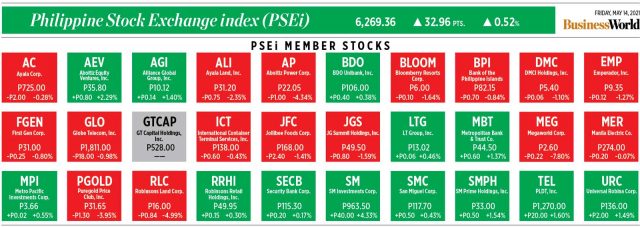
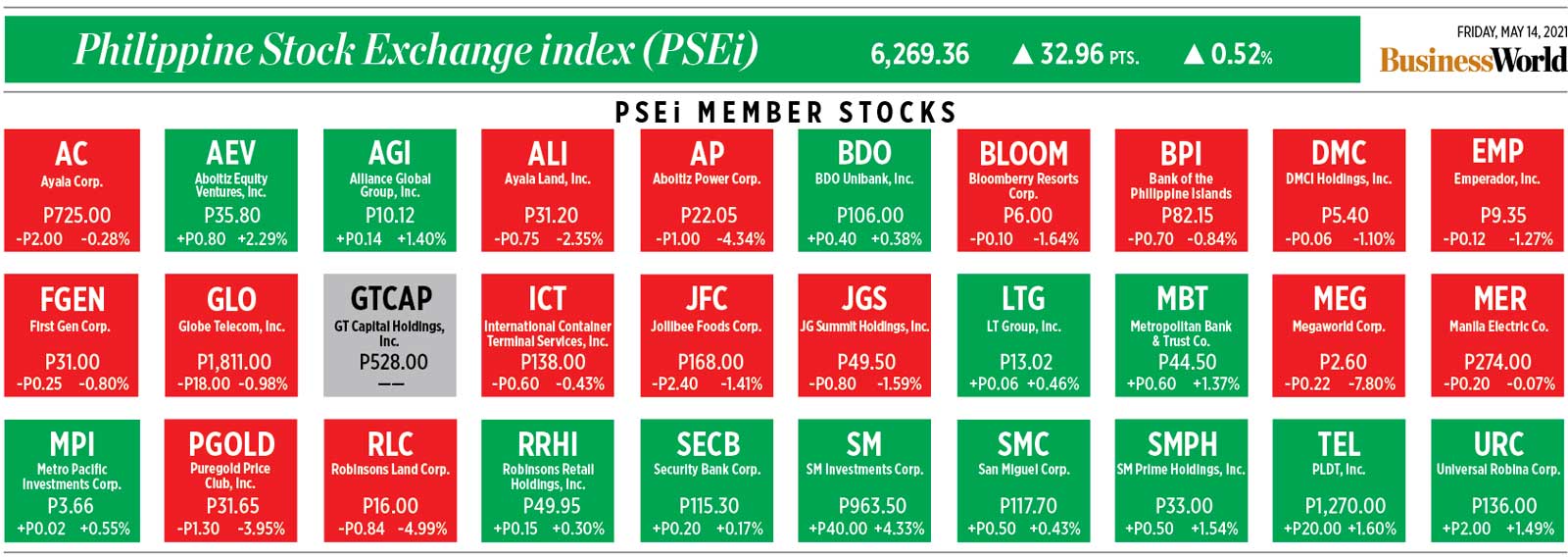
How PSEi member stocks performed — May 14, 2021

Here’s a quick glance at how PSEi stocks fared on Friday, May 14, 2021.


PHL stocks to rise further on eased restrictions

STOCKS are expected to climb this week after the government eased quarantine restrictions in Metro Manila and its nearby provinces of Bulacan, Cavite, Laguna, and Rizal on the back of lower daily coronavirus cases in the country.

The Philippine Stock Exchange index (PSEi) went up by 32.96 points or 0.52% to close at 6,269.36 on Friday. Meanwhile, the broader all shares index declined by 7.02 points or 0.18% to end at 3,850.98. Week on week, the PSEi gained 10.65 points from its 6,258.71 finish on May 7.

AAA Southeast Equities, Inc. Research Head Christopher John J. Mangun said Friday was “the most interesting trading day due to the increased volatility” in the market. He said bargain hunters held off as they were expecting the weakness of the market after restrictions were extended until the end of the month.

“Buyers waited until selling pressure had subsided and prices were significantly lower, which coincidentally was right before trading ended,” Mr. Mangun said via e-mail on Friday. “Dismal economic figures, which were released [last] week, also contributed to the deterioration of the sentiment.”

President Rodrigo R. Duterte approved the recommendation of an interagency task force to place National Capital Region and the provinces of Bulacan, Cavite, Laguna and Rizal under a general community quarantine with heightened restrictions from May 15 to 31, presidential spokesman Herminio L. Roque, Jr. said in a statement on Thursday night.

Meanwhile, the country’s gross domestic product (GDP) fell by an annual 4.2% in the quarter ending March. This marked five consecutive quarters of GDP decline, marking the longest recession since the Marcos era.

“With the further easing of restrictions, we may see the market to recover somehow but it will continue its [volatility] after the release of strong US inflation figures last week,” Diversified Securities, Inc. Equity Trader Aniceto K. Pangan said in a text message on Saturday.

“Any [sustained] inflationary pressures from the US will affect the global market including the Philippines,” Mr. Pangan added.

The US producer price index (PPI) rose 0.6% in April after surging 1.0% in March, Reuters reported. In the 12 months through April, the PPI shot up 6.2%. That was the biggest year-on-year rise since the series was revamped in 2010 and followed a 4.2% jump in March.

Meanwhile, AAA Southeast Equities Mr. Mangun said the recent downward trend of the PSEi may continue “until investors gain confidence that the economy would roar back to life.”

“[It] will only happen once the public health threat has been neutralized, mainly by developing herd immunity through mass vaccination. The PSEi’s next major support is at 6,000 which it could test in the coming trading days,” he said.

“Despite the lower prices, we encourage investors to start taking positions as the potential long-term upside of prices outweigh the potential downside risks in the short term,” Mr. Mangun added. — Keren Concepcion G. Valmonte with Reuters

Peso to strengthen vs dollar on remittances, central banks’ policies

BW FILE PHOTO

THE PESO is expected to continue strengthening versus the dollar this week on expectations of continued easy monetary policy from the US central bank and the Bangko Sentral ng Pilipinas (BSP), as well as bets of improved remittance data.

The local unit closed at P47.81 per dollar on Friday, strengthening by 0.5 centavo from its P47.815 finish on Wednesday. Trading was suspended on Thursday in view of Eid’l Fitr.

Week on week, the peso also gained 4.5 centavos from its P47.855-per-dollar close on May 7.

The peso’s Friday finish was its best in more than four years or since Sept. 15, 2016, when it closed at P47.695 a dollar.

The local unit appreciated on Friday due to the continued weakness of the dollar against other currencies, a trader said in a text message.

The dollar weakened on signals from the US Federal Reserve that there would be no imminent move to tighten monetary policy, Reuters reported.

Federal Reserve Board member Christopher Waller on Friday said rates would not increase until policy makers see above target inflation for a long time or an excessively high inflation.

Meanwhile, UnionBank of the Philippines, Inc. Chief Economist Ruben Carlo O. Asuncion attributed the peso’s strength last week to the BSP’s decision to continue supporting the economy by keeping interest rates low.

The BSP maintained the overnight reverse repurchase rate at a historic low of 2% on Wednesday. Both the lending and deposit rates were also kept at 2.5% and 1.5%, respectively.

For this week, Mr. Asuncion expects the peso to sustain its climb versus the dollar on expectations of upbeat remittance data.

The BSP is set to release March remittance data on Monday, May 17. Latest data showed cash remittances increased 5.1% to $2.477 billion in February from a year earlier, ending two consecutive months of annual contraction.

Mr. Asuncion said the market is also waiting for April balance of payments (BoP) data, which is scheduled for release on May 18, Tuesday.

The country’s BoP position in March stood at a $73-million deficit, a reversal of the $448-million surplus seen a year earlier but improving from the $2.019-billion gap in February.

This week, the trader expects the local unit to appreciate further and trade within the P47.50 to P47.75 levels versus the dollar, while Mr. Asuncion gave a forecast range of P47.65 to P47.95. — L.W.T. Noble with Reuters

Senate committee studying options to boost GUIDE funding

PHILSTAR

By Vann Marlo M. Villegas, Reporter

A SENATE committee is seeking to give Congress the option to increase the assistance to be provided to businesses affected by the pandemic, beyond the P10 billion currently being considered in current legislation.

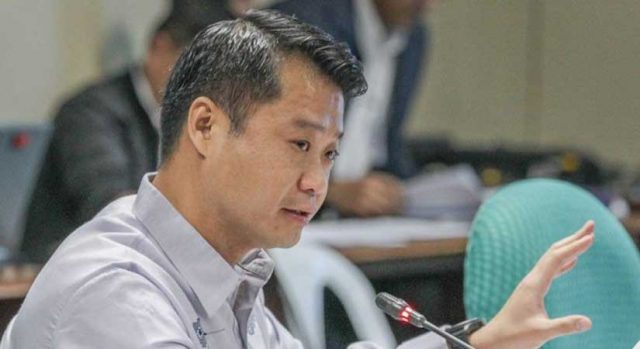
Senator Sherwin T. Gatchalian said the senate banking committee retained the P10 billion to be provided to government financial institutions to assist businesses affected by the pandemic under the proposed Government Financial Institutions Unified Initiatives to Distressed Enterprises for Economic Recovery (GUIDE) Act.

“P10 billion pa rin siya (It’s still at P10 billion) because that’s the available cash and then Congress can add more,” Mr. Gatchalian, the vice chairman of the committee on Banks, Financial Institutions and Currencies, said in a phone interview.

Ang importante dito (The important thing is), the special holding company (proposed in GUIDE) will be incorporated and then after that, Congress, because of its power of the purse… can add more,” he added. “So if it deems necessary to add more capital, it can add more capital.”

Mr. Gatchalian said the panel is hoping to sponsor the bill to the plenary session this week.

The committee also wants to waive transaction fees and documentary stamp tax for micro, small and medium enterprises seeking to borrow from government financial institutions.

“That’s approximately 20% of the borrowing cost, so malaking bagay ‘yan na mawe-waive siya (It would be a big thing if those were waived),” he said.

The measure will also authorize the incorporation of a special holding company that will invest in “strategically important companies,” or those employing many workers with extensive supply networks.

“The government now can invest in those companies for purposes for retaining employment, retaining their employees and for purposes of stabilizing the company until the pandemic ends,” he said.

GUIDE legislation provides P10 billion to government banks as assistance to businesses, with P2.5 billion allocated to the Development Bank of the Philippines and P7.5 billion to the Land Bank of the Philippines.

The amount will be invested in a special holding company which will lead the rehabilitation of distressed firms.

Mr. Gatchalian in March said the Senate is looking into increasing the P10 billion, calling it “miniscule” relative to the economic losses suffered by businesses.

The House of Representatives approved the GUIDE bill on third and final reading in March.

Congress will resume session on Monday and will adjourn on June 5.

Refinery output in 2020 falls on plant shutdowns

PETRON

REFINERY OUTPUT in 2020 fell 42% to 5,504 million liters (ML) following refinery shutdowns by Petron Corp. and Pilipinas Shell Petroleum Corp., the Department of Energy (DoE) said in a report.

Petron temporarily halted operations at its 180,000 barrels per day (bpd) Bataan refinery in May, while Shell announced in August that it will be permanently closing its 110,000-bpd refinery in Batangas.

“Based on the actual reports of the local refiners… 2020 refinery production output of 5,504 ML was significantly down by 41.8%… Average refining output for the period was 15.04 ML per day,” the DoE-Oil Industry Management Bureau (OIMB) said in its year-end report which was posted on the energy department’s website last week.

The OIMB said it received notices of shutdown from Petron and Shell who cited lower fuel demand due to the public health emergency. Both companies said “there will not be any supply disruption as supply will be restored by finished product imports.”

The OIMB said Shell’s decision to permanently shutter its oil refinery has reduced the industry’s maximum distillation capacity to 180,000 bpd.

Shell said its Tabangao refinery will close due to weak regional refining margins, which worsened as a result of “demand destruction from the global health emergency.”

Last year, crude oil exports rose by more than 150% to 402 ML in 2019. “The increase is attributed to exported excess crude oil of Pilipinas Shell due to its closure, or conversion of its refinery,” the OIMB said in its report.

Refinery capacity utilization in 2020 stood at 33.6%, against 2019’s 58.8%.

Crude oil imports declined 45.7% to 5,238 ML in 2020 due to the idling of the refineries.

In its report, the OIMB said that Petron and Shell’s refineries accounted for 40.6% or 21,301 MB (thousand barrels) of the industry’s storage capacity.

“The remaining country storage capacities of 24,006 MB or 49 import terminals are capable to receive imported finished petroleum products while the 7,090 MB or 130 depots are distribution facilities or networks and owned by various downstream oil players,” the OIMB said. — Angelica Y. Yang

Gov’t agencies improve budget usage in April

GOVERNMENT AGENCIES raised their cash utilization rates to 89% in April, up from 63% a year earlier, according to the Department of Budget and Management (DBM).

The DBM said the National Government, local governments and state-owned firms used P1.082 trillion of the P1.219 trillion worth of notices of cash allocation (NCAs) issued to them in the first four months of the year, leaving P136.57 billion unused.

NCAs are a quarterly disbursement authority from the DBM issued to agencies, allowing the later to withdraw funds from the Treasury to support their spending needs.

“This improvement in NCA usage rate is an indication of the government’s faster cash utilization to mobilize its programs and projects,” Asian Institute of Management Economist John Paolo R. Rivera said via Viber on Sunday.

“This may have something to do with government taking steps to make improvements in its social amelioration programs, efforts to curb the impact of the pandemic, and execution of other pressing initiatives to boost spending during the ECQ (enhanced community quarantine) to at least mitigate its negative impact on the economy,” Mr. Rivera added.

Line departments used 85% or P699.97 billion in NCAs released to them as of April.

The Joint Legislative-Executive Councils recorded the top utilization rate of 97%, followed by the Energy department with 96%.

After the government placed Metro Manila and nearby provinces under lockdown last month, it provided one-time cash aid to affected poor households of P1,000 per person, up to P4,000 per household. The emergency cash aid program had a total budget of P23 billion.

The DBM had released P3.613 trillion or 80.2% of this year’s P4.5-trillion spending plan as of April. — Beatrice M. Laforga

GOCC regulator backs proposed dividend hike

THE Governance Commission for Government-Owned and -Controlled Corporations (GOCCs) said it supports a proposal to increase the dividend contributions of state-owned firms to 75% of their net profit from 50% currently.

“Governance Commission fully supports the joint efforts of the Executive and the Legislature to arrive at a stimulus package that provides substantial support to the economy in the midst of the pandemic, without compromising the government’s long-term debt sustainability,” the commission said in an e-mail last week.

“In these extraordinary times, the role of GOCCs as significant tools for economic development indeed becomes even more paramount,” it added.

Economic managers and legislators are currently working to finalize a third stimulus package to help the economy recover from the economic downturn. However, the Department of Finance (DoF) stipulated that any additional spending not exceed the deficit cap equivalent to 8.9% of gross domestic product.

The Department of Budget and Management has said that possible sources include early remittance of dividends from GOCCs and realignment of budget funds.

To fund the stimulus package, the DoF proposed last month to amend Republic Act No. 7656, which will increase the minimum dividend contribution of GOCCs to the National Government to 75% of earnings from 50%.

The DoF said these changes will cover the profits of GOCCs starting 2020.

BusinessWorld asked the council to comment on the impact on government revenue of the proposal but it had not responded at deadline time.

GOCCs remitted P21.44 billion in dividends to the Treasury in the first quarter of 2021. — Beatrice M. Laforga

House tax panel girds for ‘painful’ showdown on military pensions

PHILSTAR

THE HOUSE Committee on Ways and Means said its priorities on resuming session Monday include grappling with out-of-control pension liabilities for military and uniformed personnel (MUP).

In a statement Saturday, Committee Chairman Jose Ma. Clemente S. Salceda said: “MUP pension reform will be painful but crucial. It’s some pain now or very big pain in the future. The unfunded pension liabilities, according to the GSIS, amount to some P9.6 trillion based on 2019 data. It’s a serious threat to our economic prospects in the long term.”

Pension reform proposals are contained in House Bill No. 9271, or the Fiscal Framework for Military and Uniformed Personnel (MUP) Pensions.

Four tax other measures processed by the committee are up for plenary debate:  House Bill 6135 or the proposed law Establishing The Fiscal Regime For The Mining Industry;  House Bill 7881, or the proposed Ease of Paying Taxes Act; House Bill 6765, or the proposed Digital Economy Taxation Act of 2020; and a “general tax amnesty (measure) with automatic exchange of information.”

Mr. Salceda said priority legislation in the area of tax enforcements are measures addressing the illicit tobacco trade; sugar tax violations; agricultural trade anomalies; and the use of economic zones for smuggling.

Improving the tax payment process is expected to involve more Bureau of Internal Revenue use of Public Private Partnerships and overseas development assistance.

Mr. Salceda said the committee is also looking to work with the Department of Finance (DoF) on the implementing rules and regulations (IRR) of the Corporate Recovery and Tax Incentives for Enterprises (CREATE) Law.

“The DoF committed to an IRR date of May 17. I hope we get it by then, because CREATE is only really as good as implementation,” he said.

The House of Representatives overall is also pushing for the immediate passage of the proposed P405.6-billion economic stimulus package, known as the Bayanihan to Arise as One Bill or Bayanihan III. The bill has been approved by the House Committees on Social Services; Economic Affairs; and Ways and Means. It is up for referral to the Committee on Appropriations.

In a statement Sunday, Majority Leader Martin G. Romualdez said: “We only have three weeks to pass this vital measure that will help our fellow Filipinos who are all affected by the pandemic, and we are confident that before we adjourn, we will be able to pass the measure.”

Bayan Muna Representative Carlos Isagani T. Zarate said in a radio interview Sunday that with the passage of the bill, talks on how to fund it need to move forward. “We are looking at the NTF-ELCAC budget (National Task Force to End Local Communist Armed Conflict (NTF-ELCAC) which could be discontinued by the executive to (generate) savings… there are also other large funds in infrastructure, in the Build, Build, Build. Those are not needed by our countrymen but food is.”

Legislators are also looking into increasing the dividend remittances of government-owned and -controlled corporations (GOCCs) as another funding source. A bill proposed by Mr. Salceda would revise the current law to temporarily increase GOCC dividends to 75% from 50%.

Mr. Romualdez said: “the House of Representatives will continue deliberating Resolution of Both Houses (RBH) Number 2 to amend the restrictive economic provisions of the Constitution.”

House Committee on Constitutional Amendments Chairman Alfredo A. Garbin, Jr. said it will push for this measure’s passage in plenary. The proposed changes are meant to revitalize the economy after the pandemic by inserting the phrase “unless otherwise provided by law” to economic provisions of the Constitution. This will give lawmakers authority to legislate the relaxation of economic restrictions.

“We still have seven interpellators. Hopefully before sine die adjournment, we will be able to vote on the measure on third reading,” Mr. Garbin said. — Gillian M. Cortez

No basis for proposed adjustments to rice import tariffs, farmers say  

REUTERS

THE justification for lowering of tariff rates on imported rice under Executive Order (EO) No. 135 has no basis and is “deceptive,” because there is no current shortage of imported rice, the Federation of Free Farmers (FFF) said.

Raul Q. Montemayor, FFF National Manager, said in a statement Sunday that the EO amounts to a “cruel joke” on farmers, noting that importers are already free under Republic Act No. 11203 or the Rice Tariffication Law to import rice from any country as long as quarantine regulations.

“Aside from Vietnam and other ASEAN countries, we have been consistently importing from nine other countries, including India and Pakistan, and more recently China. Similarly, there is no urgent need to augment our rice supply,” Mr. Montemayor said.

“The Philippine Statistics Authority (PSA) pegged our March 1 national rice inventory at 2.08 million metric tons (MT), or only 4.5% lower than last year.  This stock level will have already been augmented by the recent dry season harvest,” he added.

Late Saturday, the President’s spokesman Herminio L. Roque, Jr. announced that President Rodrigo R. Duterte signed EO 135 which lowered the tariff on rice imports to 35% from 40% for one year.

According to Mr. Roque, the move to lower rice tariffs is to “diversify the country’s market sources, augment rice supply, maintain affordable prices, and reduce pressure on inflation.”

In a separate statement Sunday, Samahang Industriya ng Agrikultura Chairman Rosendo O. So said the decision to lower rice tariffs should also have been evaluated by the Senate and the House of Representatives.

“EO 135 was issued while everyone else was working on the pork tariff compromise,” Mr. So said.

FFF’s Mr. Montemayor said that unlike pork, there is no emergency to be addressed in terms of rice supply. He also noted the timing of issuing EO 135 over the weekend, just before the resumption of Congress on May 17.

“This is another slap in the face of the legislature. The power of the President to adjust tariffs is an authority delegated by Congress to allow the executive primarily to address urgent problems when Congress is not in session,” Mr. Montemayor said.

PORK IMPORTS
On Saturday, Mr. Roque also announced that Mr. Duterte signed EO 134, which sets the tariff on pork imports within the minimum access volume (MAV) quota at 10% for three months and up to 15% in the following nine months. The order also sets the tariffs of pork imports exceeding the MAV quota at 20% for three months, rising to 25% in the succeeding nine months.

EO 134 increased the tariff rates set by EO 128, signed on April 7, which had lowered the tariff of pork imports within the quota to between 5% and 10%; for imports beyond the quota the rates were set at between 15% and 20%.

Before EO 128, in-quota pork imports paid 30% tariff while out-of-quota pork was charged 40%.

Mr. Duterte also signed EO 133, which raised the MAV allocation to 254,210 MT from the previous ceiling of 54,210 MT, and Proclamation No. 1143, which declared a state of calamity due to the African Swine Fever (ASF) outbreak.

Edwin G. Chen, Pork Producers Federation of the Philippines, Inc., said in a mobile phone message that the government still has a lot of work to do to help pork producers.

“There is still a lot of work (to be done) like the Agricultural Commodity Examination Area (ACEA) inspection facility and the use of calamity funds by local government units in controlling ASF,” Mr. Chen said.

He also cited the need for “strict biosecurity protocols for (animals) coming in for repopulation. Backyard hog raisers as well as commercial hog farms should adopt an elevated biosecurity protocol before we allow them to repopulate (their herds) to avoid recurrence and resurgence of ASF,” he added.

Jesus C. Cham, Meat Importers and Traders Association president, said in a mobile phone message that the adjustment in tariff rates will most likely result in higher retail prices.

“With the compromise raising duty rates and lowering MAV plus, going forward we will see higher landed costs. New arrivals will be subject to higher duty.  Also, looser quarantine restrictions may see more demand and consumption. There will be more upward pressure on prices,” Mr. Cham said.

“Landed cost in the next three months will increase by 5%. I believe this can still be accommodated at current retail prices. After three months another 5% is added.  However, this will happen around the ‘ber months.’ So, the outlook is increased demand and reduced supply.  By that time the market will be more accepting of higher prices,” he added. — Revin Mikhael D. Ochave