Home Blog Page 776

BPI upgrading fraud systems to comply with anti-scam law

BW FILE PHOTO

BANK of the Philippine Islands (BPI) is working to comply with the enhanced fraud and risk management systems required under the Anti-Financial Account Scamming Act (AFASA), keeping it on track to meet the mid-2026 deadline.

“There are a lot of points that we need to [address] but by and large, we are already compliant. But… we need to make sure that we are compliant come day one of the implementation next year. That’s something the rest of the industry are all working towards,” BPI Enterprise Information Security Officer and Data Protection Officer Jonathan John Paz told reporters at an event last week.

“We are not totally compliant yet, but we are confident that we will be compliant.”

The Bangko Sentral ng Pilipinas (BSP) has given banks until June 25, 2026 to adopt new fraud management systems and upgraded security and authentication measures for consumers as part of the AFASA’s implementing rules. Lenders were also given six months to update their risk management frameworks.

Mr. Paz said as part of AFASA’s implementation, the banking industry as a whole also has to come up with common standards and rules, like terms and conditions for account openings, which are still being drafted.

“The thing is, the AFASA can only work when everyone is ready. Everyone has to be on the same page for AFASA to work. So, it’s not a matter of where is BPI in terms of compliance. The more important question is, is the whole industry ready for AFASA? Because we might be ready, but we can’t do anything if the other counterparties are not,” he said.

“The only thing left is really how the other banks will also respond. So, there are processes that can only be finalized once there’s an agreement among everyone… because we can’t word it in one way, and the other banks will word it differently. There will be gaps between banks.”

Fighting financial fraud requires collective effort, Mr. Paz said.

“Because if there is a weak link in the system, then that gets to be exploited. And then, fraud cannot be totally eliminated.

For example, if there’s a bank that is not able to properly screen their accounts… that exposes everyone to fraud risk. So, I understand where the BSP comes from. And definitely, we support these kinds of activities because fraud undermines the legitimacy of online commerce, of e-commerce. Online commerce, e-commerce, brought us along the path of inclusivity, financial products, innovation… It has done wonders for everyone in the Philippines,” he said.

“Fraud undermines the concept of online payments. And we can’t go back to where we were before… So, definitely, if you want this good thing to continue, we need to fight against what’s undermining it, which is fraud.” — AMCS

Cebu Pacific leases 2 aircraft from Bulgaria Air for peak travel season

AIR.BG

BUDGET CARRIER Cebu Pacific has entered into a damp lease agreement with Bulgaria Air to augment its fleet ahead of the expected surge in passenger traffic during the peak travel season.

“We are continuously exploring ways to expand our fleet and ensure operational resilience,” Cebu Pacific President and Chief Commercial Officer Alexander G. Lao said in a statement on Thursday.

Under the agreement, two Airbus 320 CEO aircraft from Bulgaria Air will service domestic routes between Manila and Cebu, Davao, Iloilo, and Cagayan de Oro from December 2025 to January 2026.

A damp lease allows the lessor to provide aircraft, crew, maintenance, and insurance to the lessee.

“This collaboration is yet another testament to the high level of trust and professionalism that our team delivers in the implementation of international leasing projects,” Hristo Todorov, chairman of the management board of Bulgarian Airways Group, said.

Each aircraft will have a 180-seat capacity. Bulgaria Air is the national carrier of the Republic of Bulgaria.

Cebu Pacific previously signed a similar agreement with Bulgaria Air in 2023 to service domestic routes such as Cebu and Davao from January to May 2024.

Cebu Pacific currently operates 37 domestic and 26 international destinations across Asia, Australia, and the Middle East.

For the third quarter, its listed operator Cebu Air, Inc. said passenger volume rose by 2.6% to 1.83 million, supported by strong domestic travel demand.

At the stock exchange on Thursday, shares in Cebu Air fell by 90 centavos, or 2.98%, to close at P29.30 each. — Ashley Erika O. Jose

Of monsters born from systemic cruelty

LEE BYUNG-HUN as Yoo Man-soo in No Other Choice.

By Brontë H. Lacsamana, Reporter

Movie Review
No Other Choice
Directed by Park Chan-wook
MTRCB Rating: R-13

GREED and self-preservation can devolve into carnage, be it in a metaphorical sense as men chase the necessity of capital, or in a literal sense as they seek to actually kill.

This movie takes us through that endless rat race.

No Other Choice follows veteran paper mill manager Yoo Man-soo (played by Squid Game antagonist Lee Byung-hun), who is laid off and humiliated by a ruthless job market. As he gets more and more desperate to reclaim his dignity and continue providing a comfortable lifestyle for his family, he gradually resorts to shocking acts of violence.

At the heart of this thriller is Lee’s riveting performance as a man who is fully subsumed by the endless climb to a stable career. Director Park Chan-wook, known for his creative and sometimes even playfully manic visual style, depicts this character’s wins bleakly as if they were losses. This film is the type where you wouldn’t know whether to laugh, feel sad, or gape at the screen in anguish or horror. Lee is perfectly cast, able to nail this precarious balance between humor and cruelty.

Ultimately, Park’s latest film does have echoes of the devilish heartbreak in Decision to Leave, the elaborate blossoming in The Handmaiden, and the brutal horseplay in Oldboy, but it stands on a unique platform of its own, as a singularly cutthroat capitalist tragedy. No Other Choice lives and breathes the exasperation of a man who refuses all other choices presented to him to keep climbing the ladder he is on, even as the journey disfigures him into something unrecognizable.

Son Ye-jin as his beautiful and lively yet dutifully loyal wife, Lee Mi-ri, also stuns. She conveys the full spectrum of emotion of a woman who will stand firm with the man she has married, even as he crosses the point of no return. In the hands of Park, both her and Lee’s acting talents shine.

Park Chan-wook doesn’t disappoint, though his usual formal playfulness is reeled in, even somewhat streamlined here to serve the story — like a match-cut transition from a family hug to water rushing down a drain, a cross-dissolve imposition of a man plotting over a bonfire and his wife searching for clues to his strange behavior — not as flashy as stuff from his previous work, but effective all the same.

The details are impeccable, reflected by the physical and mental tough love that goes into the characters’ care for plants, and the kinds of forests that are built on the extremes of this brutal nature. It’s no wonder this is South Korea’s official entry to the 98th Academy Awards.

Fans of director Park’s work will be impressed by how No Other Choice juxtaposes regular family struggles with the amoral actions that individuals have to make to prosper in a world of corporate greed. Perhaps the most striking thing about this film is how bleak and empty the successful moments feel, despite the main character’s visible triumph after each step of his elaborate scheme.

In the beginning, Min-soo talks a big game about justice and togetherness and the necessity of manual labor in their line of work. The ending, without spoiling, puts him in the largest and emptiest of spaces, thanks to the advancements of AI that have broken down the very principles he used to espouse.

This is about a man losing his soul, bit by bit, as he learns to adapt to the systemic cruelty that seeks to snuff him out, until he eventually regurgitates the same phrase that the higher-ups down to the middlemen have said to him time and again: that he simply has no other choice.

No Other Choice is now showing in Philippine cinemas nationwide.

Asia United Bank’s nine-month net earnings up 9%

BW FILE PHOTO

ASIA UNITED BANK Corp.’s (AUB) net profit rose by 9% year on year in the first nine months, backed by higher revenues.

AUB booked a net income of P9.4 billion in the nine months ended September, climbing from P8.6 billion in the same period a year ago, it said in a disclosure to the stock exchange on Thursday. This translated to a return on assets of 3.2% and a return on equity of 20.4%.

Its financial statement was unavailable as of press time.

“Sustaining our profitability is no mean feat, considering the heightened risks in our operating environment, both domestically and globally. But we managed to post double-digit growth rates in our core businesses,” AUB President Manuel A. Gomez said.

“We remain on the lookout for growth opportunities on the horizon, particularly in digital partnerships. It is through this that we can offer digital payment solutions such as our all-in-one digital payment acceptance product AUB PayMate, as well as revolutionize cross-border digital payments through our HelloMoney e-wallet, among others.”

The bank’s operating income rose by 10% to P17.2 billion in the period from P15.6 billion the previous year.

“Earning assets [grew] 22% to P390.6 billion from P319.2 billion, resulting in an 8% increase in net interest margin to P13.5 billion and a net interest margin ratio of 5% during the period,” it said.

AUB’s non-interest income jumped by 18% year on year to P3.7 billion, supported by trading and foreign exchange gains and higher fee-based revenues from credit cards,

AUB PayMate, HelloMoney and remittance transactions, trust operations, and other branch-related services.

Meanwhile, its operating expenses grew by 10% to P5.5 billion due to higher compensation, capital expenditures, and growth-related costs.

This resulted in a cost-to-income ratio of 32.2%, AUB said.

The bank’s loan book expanded by 29% year on year to P256.9 billion at end-September from P198.9 billion.

Despite this growth, its nonperforming loan (NPL) ratio improved to 0.36% at end-September from 0.53% a year ago.

“AUB set aside loan loss provisions 141% higher than the previous year to support its expanding loan portfolio… It also remains sufficiently covered, with an NPL coverage ratio at 117.14%.”

On the funding side, total deposits went up by 19% to P336.2 billion, 78% of which were low-cost current account, savings account deposits, up from the 76% ratio seen a year ago.

AUB’s total assets stood at P417.1 billion as of September, growing by 19% from the year-ago level.

Total equity was at P65.7 billion, up 16% from P56.6 billion in the same period last year, backed by its retained earnings.

“The bank is adequately capitalized with capital ratios well above regulatory requirements. It has an indicative common equity Tier 1 ratio of 18.75% and a capital adequacy ratio of 19.5%,” it said..

AUB shares dropped by 75 centavos or 1.98% to close at P37.10 apiece on Thursday. — A.M.C. Sy

SEC sanctions Surity Cash for violating lending circular on debt collection

BW FILE PHOTO

THE Securities and Exchange Commission (SEC) has imposed a P1-million fine on Surity Cash Lending Investors Corp. for what it said were violations of its rules on debt collection practices.

In a statement on Wednesday, the SEC said its en banc panel found Surity Cash in violation of three provisions under SEC Memorandum Circular (MC) No. 18, Series of 2019, which sets the guidelines against unfair debt collection practices for lending and financing companies.

“While this commission is not imposing the penalty of suspension or the supreme penalty of revocation at this time, unfair or abusive debt collection and recovery practices have no place in the lending/financing industry. These practices will never be considered reasonable and legally permissible means to collect a loan,” the SEC order dated Sept. 16 said.

The SEC said the decision should be considered by the company as “a stern and final warning” that any further or repeated violations of MC No. 18 and other applicable laws, rules, and regulations would be dealt with more severely.

According to the SEC, Surity Cash was found to have violated Section 1 of MC No. 18, which prohibits the use of threats, obscene or insulting language, and the disclosure of borrowers’ personal information in connection with debt collection.

The SEC also cited a violation of Section 4 of the circular for the delayed submission of the company’s sworn certification confirming compliance with the requirement to establish a customer service department or designate personnel to handle borrower concerns.

The SEC said it allowed Surity Cash to maintain its corporate registration but reminded the company to strictly observe regulatory requirements.

Surity Cash Lending Investors Corp. has yet to respond to BusinessWorld’s request for comment sent via e-mail. — Alexandria Grace C. Magno

Golden Haven Pet Crematorium showcases compassionate pet memorial services at World Pet Expo 2025

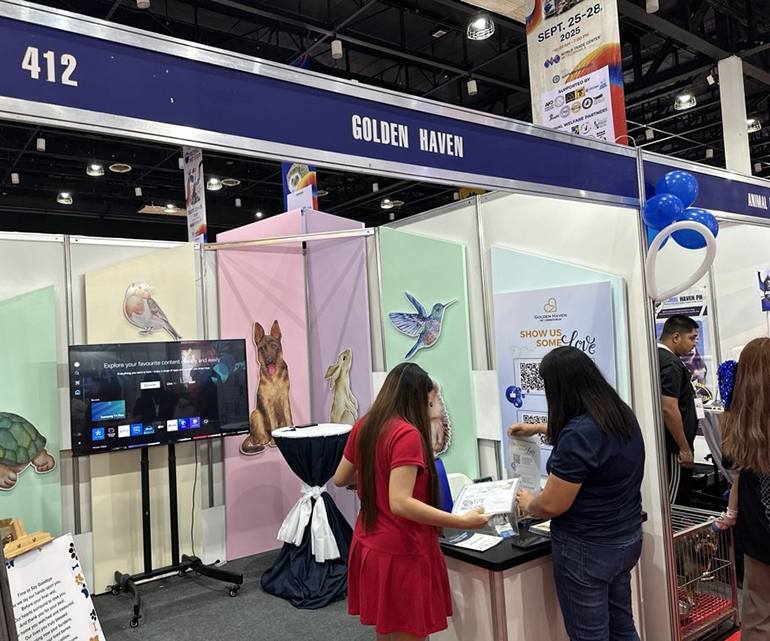
Golden Haven Pet Crematorium Pet Expo Booth

Golden Haven Pet Crematorium took part in the World Pet Expo 2025, held from Sept. 25 to 28 at the World Trade Center, Manila, offering furparents an intimate look into how beloved pets are memorialized with dignity and care.

At the exhibit, Golden Haven shared its heartfelt and detailed memorial process — from a gentle bath and grooming before pet viewing, to allowing furparents one final, peaceful moment with their companions before cremation. Visitors also saw the meaningful keepsakes each family receives after the process: a fur sample, tooth sample, pawprint, certificate of cremation, and an urn box complete with a picture frame.

The booth also presented options for personalized memorial upgrades such as pendants, metal urns, ceramic urns, and other custom memorabilia, allowing furparents to choose tributes that reflect their pet’s unique personality and place in the family.

Now in its second year of operation, Golden Haven Pet Crematorium has helped countless families find comfort and closure in saying goodbye to their pets with compassion and respect.

“Our work goes beyond service. It’s about honoring unconditional love,” said Analyn Anero, Golden Haven Pet Crematorium Operations Head. “Every day, we witness how deeply furparents love their pets, and it’s a privilege to provide a space and process that brings peace and remembrance. Over time, we’ve built not just a service, but a community rooted in empathy.”

Through its participation in the World Pet Expo, Golden Haven reaffirmed its mission to redefine pet memorial care in the Philippines — blending professionalism, compassion, and respect in every step of the journey from love to legacy.

Explore the products and services that Golden Haven Pet Crematorium offers today. Call or message 0999-886-4176 / 0920-967-5069  or visit their website at www.goldenhaven.com.ph.


Spotlight is BusinessWorld’s sponsored section that allows advertisers to amplify their brand and connect with BusinessWorld’s audience by publishing their stories on the BusinessWorld Web site. For more information, send an email to online@bworldonline.com.

Join us on Viber at https://bit.ly/3hv6bLA to get more updates and subscribe to BusinessWorld’s titles and get exclusive content through www.bworld-x.com.

Stuff to Do (10/31/25)


Spend Halloween night at Greenbelt

AYALA MALLS is holding “After Dark: Step Into the Unknown,” a night of music, mystery, and revelry on Oct. 31 at Greenbelt 3 Park, 6 p.m. onwards. Those who want to participate must present a receipt from any Greenbelt store dated Oct. 24 to 31 at the registration table. No minimum spend is needed. Upon entrance, partygoers can access games, craft drinks, live music, and a special surprise dance performance.


Go to a Halloween rave at Okada Manila

TOUTED as Manila’s biggest Halloween rave of the year, &FRIENDS HALLOWEEN, hosted by &Friends Fest, is inviting party people to come to the dance floor of The Cove at Okada, Manila, on Oct. 31. It will have three different stages, featuring mainstream DJs and club artists at the indoor area and open-air beat-makers at the garden area. Names include Rock2, Dabin, BEAUZ, SABAI, and Y3llo. Doors open at noon for the outdoor partygoers and 2 p.m. for the interior of The Cove. Tickets, with General Admission priced at P3,750 and VIP at P6,500, are available via TicketMelon.


Try out a Halloween maze at Solaire

SOLAIRE RESORT Entertainment City’s Grand Ballroom transforms into a maze perfect for kids and adults. On Oct. 31 at 2 p.m., families and children can wander through Solaire Street inside the Grand Ballroom for trick-or-treat, carnival games, arts and crafts, and meet enchanting characters from their favorite shows. Starting 9 p.m., the ballroom turns wicked where adults can enjoy cocktail lounges, themed bar experiences, and DJ performances by Mars Miranda, Patrick Oliver, Jimmy Nocon, and more. Families can complete all activities, get their passports stamped, and win special prizes at eight vignettes. These include the Velvet Manor, Wand & Whimsy, Castle Dracula, Blood Moob Den, Tomb of the Curse, the Abandoned Lab, House of Gwi-Ma, and the Wicked Hollow. Some of the attractions double as spooky grown-up places at night (including the Macabre Lounge Bar, Blood Bar, Crimson Bar, and Light Stick Bar). Secure tickets at https://sec.solaireresort.com/offers/entertainment/halloween-at-solaire-street#night.


Celebrate Halloween like a grown-up at Solaire Resort North

SOLAIRE RESORT North will host the Black Swan Halloween Soirée on Oct. 31 as the Skybar partners with Bacardí Philippines to create exclusive new cocktails for Halloween. For P1,000++ per person, guests get unlimited servings of the cocktails and luxury bottle packages made for the night. DJ Eva Smalls will provide the music. Slip into your best Black Swan-inspired outfit for the night and indulge in the dark. For more of a thriller, visit Quezon Club in your best costume, where the evening lines up a set of acts to spice up Friday festivities. Performers include French-Vietnamese harpist and singer Heloise La Harpe, an energetic dance routine by Quezon Club’s own in-house performers the Quezon Collective, high-octane beats by DJ Brenda Muñoz and DJ Earl Austin, and a special performance by impersonator Daryl “MJ” Jackson. For reservations and inquiries, visit sn.solaireresort.com/offers/dining/skybar-spirits-unleashed, call 8888-8888 or e-mail snrestaurantevents@solaireresort.com to book a table.


Celebrate Halloween party at City of Dreams

CITY OF DREAMS Manila has spooky surprises and dining and entertainment offerings at its entertainment center, DreamPlay. It is hosting “Troll or Treat” on Nov. 1, which has the standard trick-or-treating at stores in the complex, and a Best in Costume contest, where the winner is awarded an overnight stay at Hyatt Regency Manila with breakfast for two. DreamPlay’s regular participant and non-participant tickets are offered for P1,500 and P350, respectively.

The coming AI bubble

I keep hearing people say that the rise of artificial intelligence (AI) will change everything. And I agree. But I also think something else is happening in plain sight, something a lot of people don’t want to admit. We are building up to another bubble. An AI bubble. The kind that looks powerful and unstoppable at first, but sooner or later, winds up bursting.

We have seen this play before. I remember how people talked in the late 1990s. The internet was new, exciting, and full of promise. Every pitch sounded like the next big thing. Investors poured money into any startup that had “.com” in its name even if the business barely existed. Some founders didn’t even have a clear plan to earn money. They only needed a story that felt futuristic. It worked for a while, until reality stepped in. When the dotcom bubble collapsed, it wiped out companies and investments almost overnight. But the internet itself did not die. It continued growing and later became even more important. What failed was not the technology. It was the hype that pushed it too far and too fast.

Today, the same pattern is unfolding with AI. There’s so much excitement around tools that can write, talk, code, analyze, and even create art. Many people assume AI will solve every problem you can throw at it. Money is flooding in. Predictions of trillion-dollar gains appear in the news every day. New companies show up like mushrooms after rain. Some of them have solid products. Others hope that investors won’t notice their lack of real demand, as long as they use the right buzzwords.

The normal rules of business still apply, though. At some point, AI companies must show proof that people are willing to pay for their products and not just try them once out of curiosity. Some AI services are already losing money at a shocking rate because running large models consumes huge computing power. When revenue fails to catch up, the investors who were once cheering loudly start asking difficult questions. That’s when the air leaks out.

For businesses, the danger lies in getting carried away. Companies chase AI for the sake of saying they use AI. They buy systems they don’t need. They replace workflows even when the old ones remain more reliable. Others bet their entire strategy on something that no one has tested in real-world conditions. In the dotcom era, firms poured millions into fancy websites that delivered no results. They wanted to look modern. Today’s version is signing up for expensive AI tools and hoping they magically improve productivity without real planning.

Still, businesses that stay grounded can win big. In the long run, AI will be like the internet: not a trend, but a utility. The firms that build strong data foundations, focus on customer needs, and train their people to use AI properly will come out stronger once the hype settles. Those who buy into every promise may end up cleaning up the mess later.

Consumers face a different kind of risk. AI offers convenience like never before. It writes documents, gives advice, helps students study, and even suggests what to buy. But the more we depend on it, the more we accept answers without questioning how they were made. AI can make mistakes. It can invent facts. It can reflect biases hidden in its training data. If people forget to think for themselves, we may lose more than we gain. And once the bubble pops, users could be stuck with tools that no longer operate as promised or that suddenly cost much more than before.

This also affects jobs. Some fear mass layoffs. Others expect new jobs to appear. Reality will fall somewhere in between. When the dotcom bubble burst, workers in unstable companies suffered. But later, digital jobs flourished. With AI, jobs will shift rather than simply disappear. People who learn how to work with AI will find chances to grow. Those who ignore the changes may feel left behind.

Now, consider the Philippines. Many Filipino workers depend on the business process outsourcing industry. Customer service, transcription, and basic back-office tasks are now being automated. Some leaders claim AI will replace entire outsourcing operations. But that’s the bubble talking. Companies still value the Filipino ability to communicate clearly and understand customer emotions. What will change is the type of work outsourced here. Higher-value services, analytics, quality control, and roles that require judgment are more protected. We need to upgrade skills fast or risk losing ground. Government and business must invest in digital education, because once the AI bubble bursts, the world will move on to more mature uses of the technology. The Philippines should be ready for that shift rather than watch from the sidelines.

There’s also a growing number of local AI startups. Many of them hold real promise. Some new tech firms in the country seem to chase the same excitement we once saw in Silicon Valley. Big claims, big valuations, but not always a working business underneath. If they fall apart when the hype fades, the damage won’t just hit founders. It could scare off people who might fund real breakthroughs later, right when Philippine innovation is starting to take shape. We need investors who ask tough questions and insist on results, not just a flashy pitch deck.

We shouldn’t be scared of AI. In fact, I’m excited by what it can do. But I’ve learned not to trust hype. A bubble forming around a powerful idea doesn’t make the idea wrong. It only means people are expecting too much, too quickly. When the dotcom bubble burst, it cleaned out the noise and forced tech companies to grow up. I think AI will go through the same cycle. The real innovation will come after the excitement cools down. We can move forward with clear eyes. Think before we spend. Train people for the new jobs coming. And remember that once the excitement settles, the tools we’re amazed by now will simply be part of normal life. The bubble will pop, but what remains after could truly change how we live and work.

The views expressed herein are his own and do not necessarily reflect the opinion of his office as well as FINEX.


Reynaldo C. Lugtu, Jr. is the founder and CEO of Hungry Workhorse, a digital, culture, and customer experience transformation consulting firm. He is a fellow at the US-based Institute for Digital Transformation. He teaches strategic management and digital transformation in the MBA Program of De La Salle University. The author may be e-mailed at rey.lugtu@hungryworkhorse.com

SMDC to roll out four Nature housing projects in 2026

SMDCNATURE.COM

SM DEVELOPMENT CORP. (SMDC), the residential arm of SM Prime Holdings, Inc., said it plans to launch four new projects next year under its newly introduced Nature segment, which will integrate wellness and sustainability features into affordable housing developments outside Metro Manila.

“We have four projects lined up — in Davao, Angeles (Pampanga), and Bacolod,” SMDC Vice-President and Head of Nature Segment Susan G. Nicdao told reporters after the launch of the Nature brand on Thursday.

Ms. Nicdao said the company will develop mid-rise condominium projects in Davao and Pampanga, while the Bacolod project will feature horizontal housing.

Under the Nature segment, SMDC aims to offer sustainability-driven residential communities targeted at the affordable market.

“That has been the direction for the past three years — to expand outside of Metro Manila,” Ms. Nicdao said.

Jessica Bianca T. Sy, vice-president and head of design, innovation, and strategy at SM Prime and SMDC, said the shift toward sustainable residential projects will not result in higher prices.

“We are trying our best and working with different partners and different groups to keep costs down, so that we can make sure that the sustainable efforts that we put in are acceptable and can be adapted,” she said.

“From the person who wants to buy in our premium lines, all the way down to our economic and social housing, we want to make sure that they have access to affordable, sustainable measures,” Ms. Sy added.

During the launch, SMDC signed a partnership with Buskowitz Energy, Inc. to supply solar energy to its Nature-branded developments.

Earlier this year, SMDC introduced its Heights segment, which focuses on high-rise residential projects in key urban centers such as Quezon City, Makati, the Bay Area, and along EDSA-C5.

SM Prime reported a 10% increase in second-quarter net income to P12.8 billion, bringing its first-half earnings to P24.5 billion. Income from residential projects rose by 2% to P5.1 billion, contributing 21% to total earnings.

At the local bourse on Thursday, shares in SM Prime fell by 1.32% or 30 centavos to close at P22.40 each. — Beatriz Marie D. Cruz

Louvre heist suspects ‘partially admit’ involvement; stolen jewels still missing

A TIARA adorned with pearls worn by French Empress Eugenie, which was among the items stolen by thieves during a heist at Paris’ Louvre Museum on Oct. 19, on display in this undated still frame from a video. — LOUVRE MUSEUM/HANDOUT VIA REUTERS

PARIS — Two men arrested on suspicion of stealing jewels from the Louvre Museum have “partially admitted” their involvement in the daylight heist but the precious pieces remain missing, the Paris prosecutor said on Wednesday.

Four hooded thieves made off with their booty after breaking into the Louvre’s Apollo gallery, home to the French Crown Jewels, during opening hours on the morning of Oct. 19, exposing security lapses at the world’s most-visited museum.

Paris prosecutor Laure Beccuau said the two men in detention were suspected of breaking into the museum through an upstairs window, while two accomplices waited on the street below.

“Both have partially admitted their involvement to investigators,” she told a press conference.

“We do not rule out the possibility of a larger group, including a person who commissioned the theft and may have been the intended recipient of the stolen jewels,” Ms. Beccuau added.

There is no evidence at this stage in the investigation to suggest the heist was an inside job, she said.

“The jewels are not yet in our possession. But I want to remain hopeful that they will be found and returned to the Louvre Museum.”

ORGANIZED THEFT CHARGES
The two detained men were arrested on Saturday after being identified through DNA traces left at the crime scene.

One of them, a 34-year-old unemployed Algerian national living in France since 2010, was detained by police as he tried to board a flight to Algeria. The other man, 39, was already under judicial supervision in an aggravated theft case, Ms. Beccuau said.

Both men live in Aubervilliers, a low-income neighborhood in the deprived suburbs of northern Paris.

Ms. Beccuau said investigators would be asking magistrates to place the two men under formal investigation on suspicion of multiple organized theft offenses. Being placed under formal investigation in France does not imply guilt or necessarily lead to trial but shows judicial authorities consider there is enough evidence to pursue a preliminary probe.

Their lawyers, David Bocobcza and Reda Ghilachi, told TV station BFMTV they have demanded the investigation to be kept confidential. They said their clients will only speak to the investigative magistrates.

The thieves stole eight precious pieces worth an estimated $102 million from the Louvre’s collection on Oct. 19 before escaping on motorbikes.

They used an elevator truck stolen in the town of Louvres in Val-d’Oise, near Paris, two weeks before the heist, to access an outside balcony before smashing a window, the prosecutor said.

The museum’s cameras failed to detect the intrusion swiftly enough to prevent the robbery, which took between six to seven minutes.

The security shortcomings have forced the museum to transfer some of its most precious jewels to the Bank of France under secret police escort, according to French radio RTL.

News of the robbery reverberated around the world, prompting soul-searching in France over what some viewed as a national humiliation. — Reuters

The mouth speaks, the peso sinks

STOCK PHOTO | Image by Jcomp from Freepik

It seems the peso is no longer sinking merely because of market forces but also because of what some public policy and officials say. Indeed, it is no less than the open-mouth operations of many in government that continue to drive the peso down.

The other day, every major broadsheet bannered the Philippine currency’s latest fall: “slump” (BusinessWorld), “record low” (Philippine Star, Inquirer, Manila Times), “historic low” (Manila Bulletin), and “breaches P59” (Malaya Business Insight, Business Mirror).

We doubt the peso has reached bottom. The torrent of careless commentary on the nation’s prospects reflects the deeper malaise of governance: weak leadership, muddled policy, and the erosion of public trust. Poor leadership begets poor policy; bad policy leads to weak execution and stagnant innovation throughout the bureaucracy. The repeated plunder of public funds signals a steady decline in both public spending and productive investment. And the neglect of health and education reveals a poverty not merely of resources but of foresight — a failure to prepare the next generation for political and economic leadership.

For a potential investor conducting due diligence, such signals are disheartening. Why would anyone choose to place or keep money in a country that continually undermines its own credibility?

THE BSP’S MEASURED EXPLANATION
To its credit, the Bangko Sentral ng Pilipinas (BSP) has offered a calm and reasonable explanation for the peso’s weakness. It traced the slump to market concerns over weak economic prospects — aggravated by irregularities in flood control projects — and to expectations of sustained monetary easing.

The BSP also emphasized that it maintains ample foreign exchange (FX) reserves and allows the peso to seek its market level, intervening only to temper excessive volatility that could stoke inflationary pressures. It remains confident that “resilient OFW remittances, relatively fast economic growth, low inflation, and ongoing structural reforms” will support the peso. FX inflows from business process outsourcing (BPO), tourism, and overseas employment are cited as further buffers against external shocks.

These statements are fair. Yet they also gloss over a fundamental reality: the trade deficit remains enormous. Even when combined, BPO receipts, remittances, and tourism revenues cannot offset the shortfall. The current account deficit — a measure of our reliance on foreign savings — reached $18.3 billion last year, with another $9.2 billion shortfall in the first half of this year.

While the balance of payments (BoP) showed small surpluses in 2023 and 2024, due to substantial foreign borrowings, the first nine months of 2025 have already posted a $5.3-billion deficit. This structural gap in our external accounts lies at the core of the peso’s weakness — though not the only factor behind it.

WHEN FUNDAMENTALS FALTER
Even during years of modest BoP surpluses, the peso slid steadily — averaging P55.63 in 2023 and P57.29 in 2024. Economic growth flattened around 5.5%, inflation eased to 3.2% in 2024 after hitting 6% in 2023, and fiscal deficits remained stubbornly high at P1.5 trillion in both years. Consequently, National Government debt ballooned from P14.6 trillion in 2023 to P16.1 trillion in 2024.

With a larger share of the budget devoted to debt servicing, fewer resources remain for inclusive and sustainable growth. A weak fiscal position should have compelled our leaders to act responsibly, with integrity and prudence. Instead, we have witnessed the opposite: congressional insertions, budgetary diversions, and the alleged theft of 30-40% of infrastructure funds.

Perhaps it is worth recalling that many decades ago, Filipino children studied “Good Manners and Right Conduct.” The subject’s quiet disappearance from our classrooms may have left us vulnerable to the twin culture of greed and impunity now evident in public life. Or perhaps we failed to adhere to the Scripture which was more than clear in Proverbs 22:6 that we should train a child in the way he should go; and when he is old, he will not depart from it?

THE PESO AS A MIRROR
What, then, should we expect of the peso?

In a recent dialogue, eminent economists Maurice Obstfeld and Paul Krugman reaffirmed that exchange rates behave like asset prices — reflecting not just fundamentals but also confidence, risk, and credibility. When markets lose faith in a government’s ability to sustain growth, control inflation, and manage its finances, the currency has only one direction to go: down. Capital flight and investment hesitation follow swiftly.

The peso, in this light, is not merely a unit of exchange but a mirror of our national condition. It measures not only our trade position or fiscal balance but also our political will and institutional coherence.

GLOBAL HEADWINDS
External pressures add to the strain. The full effects of recent US tariff hikes have yet to be felt, while new trade tensions and protectionist moves cloud the global outlook. The International Monetary Fund itself warns that such developments could dampen investment and sentiment more than expected, tightening financial conditions worldwide and amplifying existing vulnerabilities.

For the Philippines, this means both monetary and fiscal policy must tread carefully. We cannot respond to slower growth with unrestrained easing; we must conserve credibility for when genuine shocks strike.

THE US FACTOR
Former US Treasury Secretary Larry Summers warned earlier this year that the US dollar faces risks such as volatile policy shifts under Trump, the politicization of the Federal Reserve, and potential erosion of global confidence. Yet even he concedes that the dollar’s dominance remains intact, given doubts over the Chinese renminbi’s viability and America’s enduring strategic influence.

This implies continued strength of the US economy and currency which, in turn, pressures the peso. Should the BSP persist with an easing bias, or even hint at it, market unease may deepen. The peso’s breach of P59 could be only the first hurdle in a longer slide.

To arrest further decline, should the BSP need to send a decisive signal? One as strong as Mario Draghi’s now-legendary 2012 declaration: “Within our mandate, the European Central Bank is ready to do whatever it takes to preserve the euro. And believe me, it will be enough.” Or simply allow market forces to collect tuition fees from those who take inappropriate positions in the foreign exchange market?

DEFENDING CONFIDENCE
Summers has also noted that inflation risks in the US remain real, and that Federal Reserve Chair Jerome Powell’s cautious stance, marked by flexibility and humility, is justified. Even after the recent rate cuts, a resurgence of inflation could push the Fed to tighten again. A firm Fed and a strong dollar will keep emerging-market currencies, including the peso, under pressure.

But our vulnerability is not inevitable. What weakens the peso most is not the strength of the dollar but the fragility of our institutions and the noise emanating from the incoherence of public policy and unscrupulous officialdom. When those in power speak without discipline, dismiss accountability, or trivialize corruption, they invite skepticism from investors and citizens alike.

Markets, like people, can tell the difference between serious leadership and mere performance. The more talk diverges from action, the deeper the credibility gap and the lower the peso sinks.

FINAL WORD
The peso’s decline is thus both a financial and moral story. It reflects not only deficits in our trade and fiscal accounts but also deficits of trust, competence, and integrity in governance.

Every careless statement from a public official reverberates through markets already strained by weak fundamentals. Every scandal left unpunished deepens the perception that reform is impossible.

Until our leaders learn to match words with deeds, the peso will continue to suffer the consequences of their rhetoric. For as long as the mouth keeps speaking but the hand refuses to act, the peso will keep sinking, not merely against the dollar, but against the weight of our own failures.


Diwa C. Guinigundo is the former deputy governor for the Monetary and Economics Sector, the Bangko Sentral ng Pilipinas (BSP). He served the BSP for 41 years. In 2001-2003, he was alternate executive director at the International Monetary Fund in Washington, DC. He is the senior pastor of the Fullness of Christ International Ministries in Mandaluyong.


Peso slumps anew on Fed’s hawkish tilt

BW FILE PHOTO

THE PESO weakened anew against the dollar on Thursday after the US Federal Reserve chief said their latest rate cut could be the last for the year amid a mixed economic picture.

The local unit closed at P58.85 versus the greenback, dropping by 16 centavos from its P58.69 finish on Wednesday, Bankers Association of the Philippines data showed.

The peso opened Thursday’s session slightly weaker at P58.73 versus the dollar. It logged an intraday high of P58.58, while its weakest showing was at P58.98 against the greenback.

Dollars traded rose to $2.23 billion from $2.01 billion on Wednesday.

“The dollar was generally stronger on Thursday after Fed Chair Jerome H. Powell said a December rate cut was not certain,” Rizal Commercial Banking Corp. Chief Economist Michael L. Ricafort said in a Viber message.

“The dollar-peso closed higher, tracking other currencies after the Fed cut rates but gave a hawkish tone. Fed Chair Powell questioned whether a December rate cut was needed,” a trader said in a phone interview.

A policy divide within the US central bank and a lack of federal government data may put another interest rate cut out of reach this year, Mr. Powell said on Wednesday, as he acknowledged the threats that officials see to the job market but also the risky nature of making further rate moves without a fuller picture of the economy, Reuters reported.

The Fed on Wednesday cut interest rates by a quarter of a percentage point, as expected, as a way to temper any further weakening of the job market. But the central bank’s new policy statement included several references to the lack of official data during a federal government shutdown, and Mr. Powell told reporters later that policymakers are likely to become more cautious if it deprives them of further job and inflation reports.

“We’re going to collect every scrap of data we can find, evaluate it and think carefully about it. And that’s our job,” Mr. Powell said in a press conference after a two-day policy meeting, as he ticked off private data the Fed can use, along with its own in-house surveys of business executives and less formal interviews with a range of contacts around the country.

“If you asked me could it affect… the December meeting, I’m not saying it’s going to, but yeah, you could imagine that. You know, what do you do if you’re driving in the fog? You slow down.”

His comments show the developing dilemma for the Fed as a budget dispute between the Trump administration and Democrats in Congress extends into a second month, with the government unable to carry out surveys and produce reports that are key to central bankers’ policy decisions — in this case possibly delaying rate cuts that President Donald J. Trump himself wants.

Beyond the data issues, Mr. Powell said there were “strongly differing views” among his Fed colleagues about the appropriate path for monetary policy moving forward, with “a growing chorus now… feeling like maybe this is where we should at least wait a cycle” before cutting rates again.

Financial markets responded to Mr. Powell’s remarks by reducing bets on another rate cut at the Fed’s Dec. 9-10 meeting, a prospect now given roughly two-to-one odds.

Mr. Powell still called the Fed’s 10-2 vote in favor of lowering the benchmark interest rate to the 3.75%-4% range a “solid” endorsement of easing policy to help support a gradually cooling labor market.

But “there were strongly differing views about how to proceed in December,” Mr. Powell said, an unusually blunt comment about an upcoming meeting, something Fed chiefs usually shy away from.

“A further reduction in the policy rate at the December meeting is not a foregone conclusion. Far from it, policy is not on a preset course,” he said.

PESO SUPPORT
Still, the Fed’s latest rate cut could help stabilize the peso against the dollar in the near term after the local unit hit a new record low of P59.13 on Tuesday, analysts said.

This is as the reduction effectively widened the differential between the US central bank and the Bangko Sentral ng Pilipinas’ (BSP) key rates to 75 basis points (bps). Earlier this month, the BSP likewise lowered benchmark interest rates by 25 bps for a fourth consecutive meeting to bring its policy rate to 4.75%.

The wider rate gap “points to additional support for the Philippine peso, all else constant,” Metropolitan Bank & Trust Co. Chief Economist Nicholas Antonio T. Mapa said in a Viber message.

“[With] seasonal inflows on the way, we could see the Philippine peso enjoy a modest appreciation before yearend.”

Michael L. Ricafort, chief economist at Rizal Commercial Banking Corp., also said the bigger differential “should help stabilize the peso for now,” but noted that other factors like domestic corruption concerns have also contributed to the peso’s recent slide.

The Fed’s latest move and cautious policy outlook, as well as the weak peso, are unlikely to affect the BSP’s own easing path, the analysts said.

Unlike the Fed, BSP policymakers have said that another 25-bp cut is possible at the Monetary Board’s Dec. 11 meeting, with more reductions beyond that also on the table amid benign inflation and a softening growth outlook as they expect a widening graft scandal involving state flood control and infrastructure projects to affect both public and private investments.

“The BSP will take into account the full range of data on domestic inflation, financial conditions and growth outlook at its upcoming policy meeting,” Mr. Mapa said.

“The BSP-Fed policy rate differential is not a major concern, despite differing views on monetary policy. This is because the US is also facing its own issues such as Fed independence, tariff-induced inflation, and political issues that may impact confidence on the US dollar. Thus, we may see the BSP monetary policy easing path to remain intact despite the exchange rate reaching P59 this week,” Reinielle Matt M. Erece, an economist at Oikonomia Advisory and Research, Inc., said in a Viber message. — A.M.C. Sy and K.K. Chan with Reuters