Home Blog Page 7757

Small is not beautiful
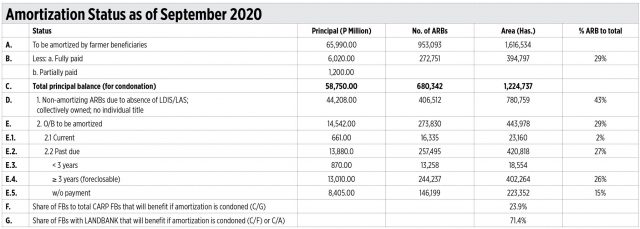
If you ask agricultural economists what’s wrong with Philippine agriculture, they will cite the following causes: a.) overconcentration of the agriculture budget toward a low-value commodity, rice; b.) failure to integrate with international supply chains and to enjoy the benefits of international trade, again due to protectionism and obsession with self-sufficiency in all agricultural commodities; c.) a meagre agricultural budget; d.) lack of public goods, from farm to market roads to research and development, in the agricultural sector; and, e.) historical policy bias against agriculture, from overvalued exchange rates to protectionism for strategic industries, such as shipping and ports, which raises the cost of transporting rural produce to the market.

However, they will also tell you that the single biggest structural problem of agriculture is land fragmentation. The average farmland size has been falling due to CARP (Comprehensive Agrarian Reform Program), rapid population growth, and the death of farm owner-beneficiaries, which causes the already small farms to be subdivided among multiple heirs. The average farm size has been falling from 3.5 hectares in the 1960s to 1.2 hectares in 2012, for which the latest figures are available. It’s not unreasonable to assume that the average land size is less than a hectare today.

So what, you say? Isn’t small beautiful?

Perhaps not to the small farmer himself, who is unable to raise the productivity of his land and therefore remains shackled to poverty. For urban-based armchair do-gooders and bleeding-heart activists, anything big is bad, and automatically, exploitative. On the contrary, bigness is good if it raises productivity, because individual and community prosperity depends on productivity.

My friend and fellow columnist, National Scientist Dr. Raul Fabella and I have been saying for the past 20 or more years that the restrictions imposed on agrarian reform land in particular, and the rural land market in general, have a deleterious effect on agricultural productivity. Simply put, presently, efficient farmers can’t buy out or even rent, from inefficient ones.

Recent international economic literature is backing up our conclusions.

Canadian economists Diego Restuccia and Tasso Adamopoulos in an April 2019 publication in the prestigious National Bureau of Economic Research, titled “Land Reform and Productivity: A Quantitative Analysis with Microdata,” concluded that the 1988 Comprehensive Agrarian Reform Program (CARP) caused average land size to fall by 37% and farm productivity by 17%. In other words, CARP made farmers poorer.

Comes now another recent study by Keijiro Otsuka, a professor from the Graduate School of Economics of Kobe University, a member of the Japanese Academy of Sciences, renowned agricultural economist, and a former Chairman of the Board of Trustees of the International Rice Research Institute.

His January 2021 study is titled “Changing Relationship between Farm Size and Productivity and its Implications for Philippine Agriculture.”

According to Otsuka, the observed inverse relationship (IR) between farm size and productivity, i.e., small farms are more efficient than large farms, holds true only when wage rates are low, and labor-intensive farming methods are adopted. In high wage countries, where farm sizes are large and mechanization takes place, the opposite is true: there’s a positive relationship between farm size and productivity. On the other hand, a U-shaped relationship occurs where small and large farms co-exist.

However, where wage rates are rising and mechanization (use of power tillers and combine harvesters) is taking place, as observed in a study of Central Luzon farmers, there’s a positive relationship between farm size and productivity.

He warns that because small farm sizes are the norm in Southeast Asia and even in Japan, where average farm size is three hectares, compared to the average of 100 hectares or more in Europe, over time, agriculture will lose its comparative advantage in Asia, food production will fall, and from self-sufficiency, the region will see food shortages and rising imports, as can be seen presently in the Philippines.

According to Otsuka, “the decrease in farm size is particularly pronounced in the Philippines partly because of rapid population growth and partly because of the failure of growth of non-farm sectors, which can absorb rural labor. If this trend in farm size reduction continues and the economy sustains a fairly high growth rate, the agricultural sector’s inefficiency can be a major constraint to further economic growth.”

In a note on the need to redesign land reform in the Philippines, he states that, “In the face of the changing relationship between farm size and productivity, it is critical to recognize the role of land rental markets in reallocating land from the less productive to the more productive farms. It should not be government law but the market that ought to determine the desirable allocation of land. The Philippines is no exception, and if the land market continues to be distorted, increasing large and serious inefficiencies will arise because of inefficient land resource allocation in this country.”

Otsuka doesn’t provide the details, but to my mind, this is why the land market in the Philippines is distorted:

First, the land market is distorted due to the land retention limit of five hectares. Successful farmers are prohibited from expanding via ownership of land beyond five hectares. If farmers aren’t allowed to expand, they have no incentive to mechanize and increase efficiency. Because of the restrictions in land transfer, inefficient farms will forever be inefficient farms, condemning its owner-cultivators to perpetual poverty.

Second, land misallocation is also due to a law that made share tenancy illegal. The law incentivized landowners to eject the peasants and be an owner-cultivator relying on hired labor. Share tenancy, however, is rational, enabling landless farmers to cultivate the land on a sharing basis, rather than on fixed rentals. Fixed rentals can be onerous and unjust in agriculture because of the vagaries of production due to weather disturbances or pestilence. Share tenancy used to be exploitative and feudal but that was when there was no labor scarcity and capitalist relations (industry and agribusiness) were absent.

Third, the Comprehensive Agrarian Reform Law (CARL) has put on so many restrictions on the rural land market and established an inefficient and corrupt Department of Agrarian Reform (DAR) to supervise these restrictions and overregulate the land market. CARL saddled the agrarian reform beneficiaries with debt, prohibited them from selling or renting the land without approval from DAR, and when they can sell, limited the market to those whom the DAR chooses they can sell to.

What do we do?

One is to remove the land retention limit of five hectares. Ideally, there should be no cap. The market should be allowed to determine what the most efficient size is. However, if there will be political resistance, especially from the Left and the politicians behind the Comprehensive Agrarian Reform Law, the upper limit can be set at 24 hectares, the old limit for homesteading in the 1935 and 1987 Constitutions. A progressive land tax can also be set to discourage large speculative land holdings.

Two is to increase land size by enabling a free and vigorous rural land rental market. It’s about time to separate land ownership from farm management if the lessees will be more efficient.

One idea is to condone the debt of agrarian reform beneficiaries. Why? Because of the total unpaid debt of agrarian reform beneficiaries, amounting to P65.9 billion, P58.7 billion or 89% remain unpaid. The unpaid debt covers 1,224,737 hectares of rich, fertile land that can’t be part of the rural land rental market because the rules prohibit the leasing of lands with unpaid debt. Of the 1.2 million hectares, some 780,759 hectares representing 44% of agrarian reform beneficiaries (ARBs) don’t even have LDIS/LAS (Land Distribution Information Sheet/Land Amortization Schedule), and therefore, the farmers can’t even begin to start paying off their debt. The 10-year period under which agrarian reform beneficiaries are prohibited from selling and renting out the land hasn’t even started yet!

One argument against debt condonation is the moral hazard argument. However, when it comes to tax amnesty, which benefits rich tax evaders, this argument isn’t raised by these critics. On the contrary, the moral argument can be raised on behalf of the farmers because all those restrictions imposed by the government degraded the value of their lands and have prevented them from paying their debt. As for that small number of farmers who have paid some of their debt, a reverse mortgage program in LANDBANK can be established for them.

The final reform is to remove DAR oversight of the rural land market. Make Certificate of Land Ownership Awards (CLOAs) and all lands acquired through agrarian reform laws fee simple titles. Instead, the Land Registration Authority, which has a computerized data of all land records, should monitor the ceiling of land ownership, if there will be one.

Let’s face it: the single biggest binding constraint to agricultural development is land fragmentation. The next administration must confront this fact, lest poor agricultural productivity and food insecurity act as a brake to our economic growth.

Small is not beautiful. It’s ugly, if associated with poverty.


Calixto V. Chikiamco is a member of the board of IDEA (Institute for Development and Econometric Analysis).

totivchiki@yahoo.com

The real priorities of the Duterte Administration

PCOO

The old adage, “put your money where your mouth is,” is as true today as it was when it was first written in 1930. One can make promises and profess support for all sorts of causes until they are blue in the face. None of it matters until they put money behind their words. The areas and causes where one spends their money are the definitive reflection of their true priorities.

President Duterte is a difficult character to figure out. Not only is he inclined to utter words impulsively to pander to the crowd, we have also learned that he has a penchant for denying things he said before (even if they were recorded). When trapped by his own utterances, it is not beyond him to claim that they were all a joke.

During the election campaign and up to his first year in office, President Duterte made grand populist promises to hypnotize the nation into a euphoric state of optimism. He promised a golden age of infrastructure where spending on roads, bridges, and ports would amount to no less than 7% of GDP. He promised to elevate our quality of life by increasing spending on mass housing and social development projects, including education. He promised to end corruption, end illegal drugs, end social injustice, end political dynasties, and to enforce judicial reforms.

By his own admission, he failed to control corruption and failed to end the drug trade. Two keystone promises broken, right there. Ironically, corruption is worse today than it had been in decades, while the war on drugs proved to be destructive and damaging rather than restorative.

He also failed to end social injustice and political dynasties. Social injustice (and inequality) is at its worst since the Marcos years and political dynasties are more entrenched than ever. That makes four keystone promises broken.

On the surface, it would seem that the Duterte Administration succeeded in infrastructure development. But looking at the statistics, it is not the case. At the beginning of its term, the Duterte government promised that infrastructure spending, as a percentage to GDP, would reach 5.4% in 2017, 6.1% in 2018, 6.8% in 2019, and 6.9% in 2020. After reneging and lowering the spending quota two times, data shows that the actual spending ratio stood at only 5.1% in 2017, 6.3% in 2018, 5.5% in 2019, and 4.6% in 2020.

While actual spending on infrastructure falls short of its twice-adjusted targets, it is even over stated. This is because this government re-defined what constitutes infrastructure. “Infrastructure,” in the context of nation building has always referred to transport and logistics-related projects. What they did was to include science-related and technology-related projects as well (which are separate line items in the national budget). Thus, the real spending roads, bridges, and ports is really much lower than what government purports it to be.

The Duterte administration has also claimed credit for projects that were signed and sealed well before its time. This includes the Skyway stage 3 (approved 2014), LRT-2 Extension (approved 2012), NLEX-SLEX Connector Road (approved 2013), CALAX (approved 2015) … and the list goes on.

What is most disturbing, however, is that infrastructure spending was used as a tool for patronage politics. The General Appropriations Acts shows that the budget of the Department of Public Works and Highways (DPWH) increased from P580.87 billion in 2020 to P694.82 billion in 2021 (a P113.95 billion increase). But looking closely at the line items, you will find that “Local Programs,” which is another word for pork barrel funds, increased from P198.82 billion to P280.62 billion, an P81.8 billion increase! Pork barrel finances patronage-driven projects by local politicians, like basketball courts. Appropriating 40% of the DPWH budget for this purpose is scandalous. It is the amount Mr. Duterte is effectively paying to buy loyalty.

Again, I emphasize — the areas which this administration appropriates the national budget for is a reflection of its priorities. That said, it is clear that social development and social welfare are at the bottom of this government’s concerns.

Spending on education actually decreased by P30 billion in 2019 compared to the year prior. It increased by a small increment in 2020 and 2021. Meanwhile, the budgets of the Departments of Social Welfare and Development (DSWD) and Health (DoH) remained practically static from 2017 to 2020.

What stings acerbically is that following the pandemic, government appropriated the lowest budget among our ASEAN peers to ease the plight of our people. Financial assistance (ayuda) last year was grossly insufficient and painfully scarce. Economic relief to micro-, small-, and medium-sized enterprises (MSMEs) was hardly felt. Worse, the conditional cash transfers program of government was cancelled for 2021.

For perspective, Mr. Duterte’s government spent 3.5% of GDP on its COVID-19 response and civilian support. Thailand spent 9.6% of GDP, Malaysia 4.9%, Indonesia 3.8% and Vietnam 3.6%. I reckon we have the most unsympathetic government in the region.

Even today, government remains liberal in enforcing restrictions but is unable to provide financial subsidies to displaced workers and MSMEs. Civil society is left on its own to survive the financial pangs of the pandemic.

So which sector received the sharpest increases in budget appropriation?

Topping the list is President Duterte’s contingency fund which increased five-fold. From P2.5 billion in 2016 (last year of the Aquino administration), it catapulted to a whopping P13 billion in 2020. These funds are used for intelligence, communications, and other “confidential operations.”

The second office that received a sharp budget spike is the Philippine National Police (PNP). The PNP’s budget increased by 123% from P76 billion in 2016 to P169.7 billion in 2021.

The third largest beneficiary is the Armed Forces of the Philippines (AFP) whose budget increased from P62.2 billion in 2016 to P120.7 billion in 2021, a 94% increase.

So, why did the AFP and PNP receive the highest increase in budget appropriations? A noted political analyst opined that it is only the military and the National Police (along with Supreme Court) that have the power to neutralize President Duterte’s abuses. By filling their coffers with more funds than they have ever seen before, Malacañang had effectively neutralized them.

As I look at how the nation’s financial resources are spent, it is clear to me that the national budget is/was used not as a tool for social or economic development, as it should be. Rather, the budget has always revolved around President Duterte himself. It served his needs, his political agenda, his personal operations, and the perpetuation of the Duterte brand.

***

Thank you to the Institute for Leadership, Empowerment and Democracy for providing facts and figures for this piece.


Andrew J. Masigan is an economist

andrew_rs6@yahoo.com

Facebook@AndrewJ. Masigan

Twitter @aj_masigan

I had the ‘twisties’ just like Simone

SIMON BILES INSTRAGRAM

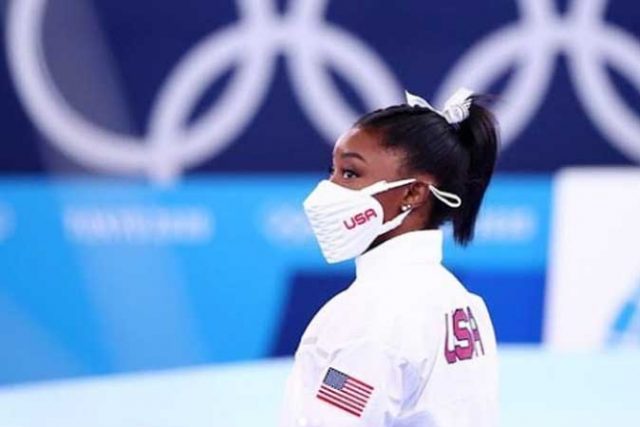
THE WORLD was shocked when Simone Biles withdrew from the women’s Olympic gymnastics team finals on Tuesday.

I wasn’t.

As soon as she completed only a one-and-a-half twisting Yurchenko vault instead of her normal two-and-a-half, I immediately knew something was not right and wondered, should she continue in the competition?

Simone, the most decorated female gymnast on the world stage, has a history of toughing it out. She won six medals — the maximum possible for a female gymnast — at the 2018 World Championships while suffering kidney stones.

My “gymnast instinct” told me this time was different. I was a competitive gymnast for well over a decade, and although I was far off elite level, I can attest to the mental aspect of the sport.

The official statement from USA Gymnastics said Simone withdrew from the event to focus on her mental health, raising more questions than answers for some. But as soon as I heard her mention the “twisties,” it made complete sense to me — because I have unfortunately experienced them.

When you have the twisties, you suddenly have no idea where you are or what your body is doing. Confusion mounts. In some cases, especially if performing a vault as difficult as Simone’s, the mental block could cause severe injury or even death.

The twisties damaged my relationship with floor exercise. In my teens, I competed with three tumbling passes. The first and last ones were both round-off, back handspring, back laid-out full twist. The sequence had never been a struggle since I learned it. I could do it in jeans with no warm-up if I had to. I could even do a double twist at one point.

Then one day when I was a senior in high school, I started twisting to my face. I would take off from the floor into my back full and then a second later be on my hands and knees. I thought maybe I was off in practice one day, but it kept happening.

Every now and then I would make a good one, but I could never tell whether a good or bad one was coming. I was never able to identify what exactly I did differently during the successful attempts.

I felt lost in the air. Was I trying to twist too early? Too late? Was I not getting enough air? Am I suddenly trying to twist the wrong way? These confusing thoughts compounded in my head almost to the point I became afraid of the skill.

Any gymnast at any point can get the twisties. The worst part is that it is sudden and unexplainable. A gymnast may or may not overcome them, but usually it requires a break from whatever skill or event is causing the issue.

Gymnastics is as much a mental sport as it is physical, and split-second mental errors can have devastating consequences, much more than in most other sports.

I was fortunately never injured on my full twist, but I stopped doing twisting tumbling after high school and I still don’t understand the whole thing to this day. The twisties forever ended my enjoyment of floor.

Front twisting was not a problem. I did a front laid-out full twist off the end of the balance beam for my dismount. I competed that all the way through college on the club gymnastics team.

I was also able to twist on the vault in college. It wasn’t a flipping twist, but a twist nonetheless. I never figured out the floor though and to be honest, I never tried. I was too traumatized.

Twisting is not the only element where gymnasts have mental blocks. But the problem skills are often the flipping or twisting ones where you briefly lose sight of the apparatus.

Luckily, the floor twisties were never too consequential in my career. I was a much bigger fan of the beam, anyway. But I can’t imagine something similar happening on the biggest stage like it did to Simone.

My experience in the sport suggests to me that if the twisties were a main reason for Simone’s withdrawal, then she made the right choice in prioritizing physical and mental safety over anything else.

And a difficult decision like that should never take away from the inspiring and unmatched contributions she has made in the sport of gymnastics.

Simone, thank you. Take care of yourself.

The opinions expressed here are those of the author, normally a markets columnist for Reuters who was also a competitive gymnast.

REUTERS

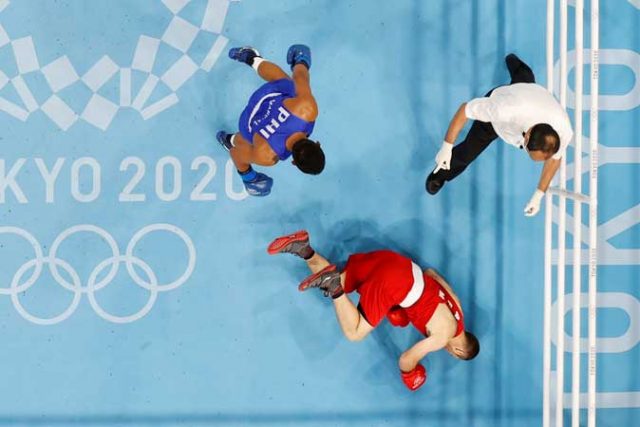
Filipino boxer Marcial in knockout win to secure a spot in semifinals

ARMAN Darchinyan of Armenia lies on the ground after being knocked down during his fight against Eumir Marcial of the Philippines. — REUTERS

FILIPINO middleweight boxer Eumir Felix D. Marcial advanced to the semifinals of the Tokyo Olympic Games after knocking out Armenian Arman Darchinyan in the opening round of their quarterfinal clash at the Kokugikan Arena, Sunday.

The Zamboanga native Mr. Marcial stopped his opponent with a well-timed right hook with 49 seconds left in the first round that instantly sent Mr. Darchinyan to the canvas.

The win assured the Philippines of another medal in Tokyo after the gold medal won by weightlifter Hidilyn F. Diaz and the gold or silver up for boxer Nesthy A. Petecio in the finals of the featherweight division on Tuesday.

Twenty-five-year-old Mr. Marcial was in his element right from the opening bell, pounding on Mr. Darchinyan with combinations to the head and body that hurt the latter and resulted in an early standing eight count.

When the fight resumed, the Filipino bet continued to pummel the Armenian eventually landing a two-punch combination with a right hook straight to Mr. Darchinyan’s head and that sent him down.

The referee checked on Mr. Darchinyan before declaring the fight over.

In the semifinals on Aug. 5, Mr. Marcial will face Oleksandr Khyzhniak of Ukraine.

“My next opponent will be strong, but I’m confident that I can hold my own and be ready,” said Mr. Marcial of his semifinal fight.

After Mr. Marcial’s win, the Association of Boxing Alliances of the Philippines (ABAP) hailed his impressive performance so far. “Eumir’s back and he’s ready,” said ABAP Secretary-General Ed Picson in an interview with TV5.

Sending its congratulations to Mr. Marcial, meanwhile, was Malacañang, which also urged him to go for the gold.

“We congratulate Eumir Marcial for securing the Philippines’ third Olympic medal when he defeated his opponent in the men’s boxing middleweight quarterfinals today, Aug. 1, 2021, at the Tokyo Olympics,” read a statement from Presidential Spokesperson Herminio “Harry” L. Roque, Jr.

“Let us continue supporting and cheering Eumir and other Filipino athletes in their quest for gold. Mabuhay ka (Long live), Eumir. Go for gold!”

Meanwhile, Filipino golfer Juvic Pagunsan finished his Tokyo Games campaign at solo 55th place as of this writing with a 1-over-par 285 across four rounds at the Kasumigaseki Country Club. — Michael Angelo S. Murillo

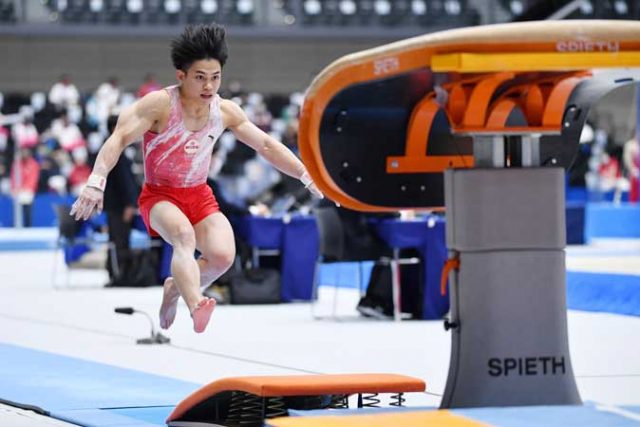
Gymnast Yulo makes a go at lone shot at Olympic gold; Knott debuts

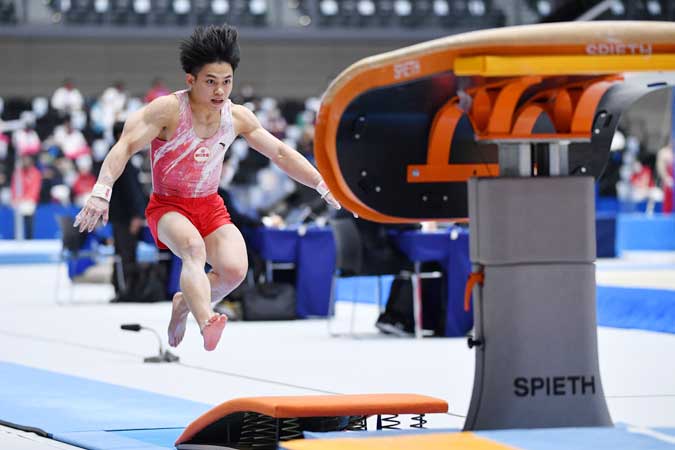
CARLOS YULO at the 74th All Japan Artistic Gymnastics Individual All-Around Championship Men’s Vault Final at Takasaki Arena, Gunma, Japan. — REUTERS

FILIPINO gymnast Carlos H. Yulo resumes his Tokyo Olympic Games campaign on Monday and looks to succeed in his lone shot at winning a gold medal.

Manila native Mr. Yulo, 21, will be competing in the vault finals of the gymnastics event set at 5:51 p.m. (Manila time) at the Ariake Gymnastics Center in Tokyo.

The Philippine bet only qualified for the finals of the men’s vault out of a possible seven events during the qualification phase on July 24.

Mr. Yulo made the cut in vault by scoring 14.712 points, good for sixth and inside the top 8 that was needed to qualify.

He, however, fell short in the all-around (47th), his pet event floor exercise (44th), pommel horse (69th), rings (24th), parallel bars (55th) and horizontal bar (63rd).

Mr. Yulo lamented not being able to advance to more gymnastics events, but vowed to perform better in the vault finals even as he said it is going to be tough.

“I was surprised that I was able to qualify [in vault],” said Mr. Yulo in Filipino after the qualification round, taking note of how the vault event is not among his stronger suits.

“It’s going to be tough as there are many good competitors in the event. But I can still improve on my performance. So let’s see,” he added.

Gymnastics Association of the Philippines President Cynthia Carrion-Norton shared to Filipino sports journalists in Japan that Mr. Yulo is moving on and will be coming in the vault finals prepared and determined.

Meanwhile, also on Monday, Filipino-American track athlete Kristina C. Knott will begin her Olympic campaign in the 200m run in qualifying heats beginning at 10:18 a.m. at the Olympic Stadium.

Ms. Knott, 25, born to a Filipino mother who hails from Cavite, qualified for the Olympics by gaining a universality place from World Athletics.

In the lead-up to her campaign, she worked out at the Transcosmos Track and Field stadium in Isahaya City in southern Nagasaki.

Her preparation was overseen by coach Rohsaan Griffin and strength and conditioning coach Carlo Buzzichelli.

Ms. Knott is the second athletics athlete to represent the Philippines in the Tokyo Games after pole-vaulter Ernest John Obiena, who is through to the finals of his event. — Michael Angelo S. Murillo

Rain or Shine comes back to beat Terrafirma, halts slide

THE Rain or Shine Elasto Painters came from behind to beat the Terrafirma Dyip, 83-77, on Sunday to halt their losing streak in the PBA Philippine Cup. — PBA IMAGES

By Michael Angelo S. Murillo, Senior Reporter

THE Rain or Shine Elasto Painters came back from a double-digit deficit to beat the Terrafirma Dyip, 83-77, in PBA Philippine Cup action at the Ynares Sports Arena in Pasig City, Sunday.

Rain or Shine used a strong charge back late in the third quarter and early in the payoff canto to turn things around and defeat the Dyip to halt their losing streak in the season-opening Philippine Basketball Association (PBA) tournament to two games.

Ray C. Nambatac and veteran Gabe V. Norwood showed the way for the Elasto Painters in the comeback win, finishing with 17 and 15 points, respectively.

Terrafirma was threatening to pull away in the game, building a 14-point cushion, 61-47, with 6:51 left in the third quarter.

But Rain or Shine steadily narrowed its deficit as the quarter drew to a close, with the team down by just four points, 65-61, heading into the final frame.

In the fourth quarter, the Elasto Painters maintained the momentum they built, seizing the lead, 68-67, with 8:34 left and never looking back from there.

Adrian Wong also scored 15 for Rain or Shine, which improved to 4-2 in the Philippine Cup, good for solo fifth spot. Mark R. Borboran added nine points, all coming from beyond the arc.

For Terrafirma, which remains winless in four matches, it was Juami B. Tiongson who led the way with 20 points and seven assists. Sophomore Roosevelt Adams, meanwhile, added a double-double of 13 points and 16 rebounds while guard JP Calvo had 11 points and eight boards.

Next for Rain or Shine is a clash against Philippine Cup defending champions Barangay Ginebra San Miguel Kings on Friday, Aug. 6, at 3 p.m., while Terrafirma returns on Wednesday, Aug. 4, against the Phoenix Super LPG Fuel Masters in a game set for 6 p.m.

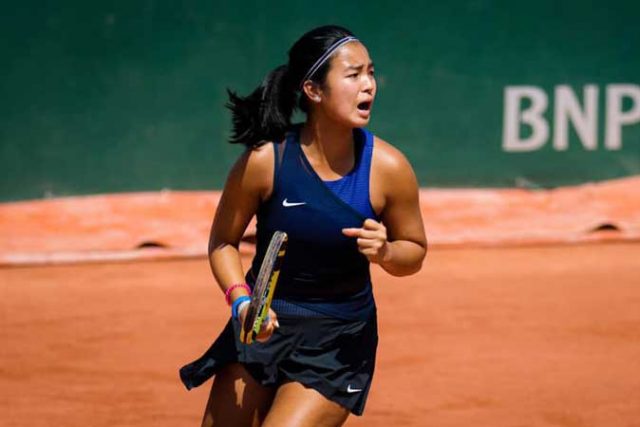
Alex Eala to see action at WTA 250 event in Romania as a wild card

FILIPINO teen tennis ace Alex Eala is set to compete in her first WTA 250 event this week as a wild card entry. — ALEX EALA FB PAGE

FILIPINO teen tennis ace Alex M. Eala is set to compete in her first Women’s Tennis Association (WTA) 250 event this week after earning a wild card berth.

Ms. Eala, 16, a Rafa Nadal Academy scholar, is part of the roster for the clay tournament Winners Open 2021 at Cluj-Napoca in Romania happening from Aug. 2 to 8.

She herself announced the welcome development in a Facebook post on Saturday, expressing her excitement over the new challenge she will be taking on.

The long-time Globe ambassador is coming off a successful outing in an International Tennis Federation Juniors tournament in Milan in July where she captured both the singles and doubles titles.

Ms. Eala, currently ranked 634th in the WTA and the world’s number two juniors player, now looks to sustain the same form previously as she continues to build on the gains she has had for the year, which also include winning the girls’ doubles title at the French Open.

In Romania, she will face a still-to-be-named qualifier in the Round of 32. — Michael Angelo S. Murillo

Chery Tiggo holds down Petro Gazz in three sets

The Chery Tiggo Crossovers improved to 5-2 in the PVL Open Conference after beating the Petro Gazz Angels in straight sets on Sunday. They also earned a playoff for a semifinal berth. (PVL Media Bureau) 

The Chery Tiggo Crossovers won their second straight victory in the Premier Volleyball League Open Conference on Sunday, defeating the Petro Gazz Angels in three sets, 25-18, 25-20, 25-22, at the PCV Socio-Civic & Cultural Center in Bacarra, Ilocos Norte.

Jaja Santiago led the way for Chery Tiggo as the Crossovers bucked a slow start in the third set and made a spirited attack late to complete the shutout win.

It was the fifth victory in seven games for the currently third-running Crossovers, who also secured a playoff for a semifinal berth in the process.

Ms. Santiago tallied 20 points, 16 off kills, three from blocks and one ace.

Her sister, Dindin Santiago-Manabat, added 12 points while Mylene Paat and Maika Ortiz had nine and seven points each for Chery Tiggo.

“We have some challenges along the way but we were still able to work on them,” said Chery Tiggo coach Aaron Velez after their win.

For Petro Gazz, it was Ria Meneses who top-scored with 11 points, followed by Ces Molina and Myla Pablo with nine points apiece.

The loss stopped a three-game winning streak for the Angels, who now sport a 4-2 card.

Chery Tiggo takes on Black Mamba Army on Wednesday before closing out its elimination campaign against Choco Mucho on Sunday, Aug. 8.

Petro Gazz, for its part, returns to action against the Bali Pure Water Defenders on Tuesday at 3 p.m. — Michael Angelo S. Murillo

Basketball: US clinches playoff spot; France and Australia go 3-0

TOKYO — The United States clinched a quarterfinal berth in Olympic men’s basketball on Saturday as seedings for next week’s last-eight showdowns took shape.

Kevin Durant led Team USA to a commanding 119-84 victory against the Czech Republic in the final group game at the Saitama Super Arena, north of Tokyo.

The US ended the preliminaries 2-1 after dropping their first match to France, the first Olympic loss for the Americans since 2004.

“We’re all just trying to figure each other out. This is literally our third game with all of us together,” said Jrue Holiday, who plays for the National Basketball Association’s (NBA) Milwaukee Bucks. “But we knew KD would come in and do what he always does.”

Team USA started slowly against the Czech team and were trailing at the end of the first quarter. But the Americans pulled away in the second half on a barrage of three-pointers from Durant and Jayson Tatum.

In earlier matches, France and Australia completed sweeps of their preliminary groups.

Real Madrid’s Thomas Heurtel led with 16 points in France’s 79-62 victory over Iran. They went 3-0 in Group A, including their shock defeat of Team USA on Sunday.

Despite his team’s dominant showing so far, Evan Fournier would not speculate on France’s chances of a medal.

“Quarterfinal first. Focus on that,” said Fournier, who plays for the NBA’s Boston Celtics. “Too many times we’ve beaten very, very good teams and we lost in the semifinal, so no more of that.”

SCINTILLATING MILLS
Australia’s Patty Mills was scintillating behind the 3-point line, powering his team to an 89-76 victory over Germany in Group B.

Australia will go into the quarterfinals without forward Aron Baynes who aggravated a neck injury after a bathroom slip and is out of the Games.

Germany and the Czech Republic finished 1-2, but the Germans advance to the quarterfinals on Tuesday based on the relative scoring records. One final last-eight slot remains and will go to winner of Argentina against Japan in Group C on Sunday.

Italy finished 2-1 in the preliminaries and will advance. Nico Mannion drained a three-pointer in the last 30 seconds to fend off a comeback from Nigeria, with his team holding on to win 80-71.

“Honestly, it felt good just to see one go in. I shot it terrible the whole night,” said Mannion, who plays for the NBA’s Golden State Warriors. “But you know, shooters keep shooting.”

Team USA has historically been the team to beat, with a 139-6 record and 15 gold medals since 1936.

But as the sport has grown in popularity around the globe, many national teams can field players with NBA experience, and the US’s talent advantage has shrunk.

Before losing to France at these Olympics, the US dropped two straight exhibition games this month, including a defeat by world 22nd-ranked Nigeria.

Both Iran and Nigeria finished their Olympic journeys winless, and offered bitter parting words.

Arsalan Kazemi said travel restrictions on Iran prevented the team playing in friendly matches, while Nigeria’s Chimezie Metu blasted the nation’s government for lack of support.

“Our government and the Olympic committee of Nigeria, they make it extremely difficult for us to go out there and just focus on performing our sport,” he said. — Reuters

Swiss Bencic clinches gold as Djokovic exits without medal

TOKYO — Belinda Bencic became the first Swiss woman to win a tennis gold medal at the Olympics with a victory in the singles final on Saturday, while Novak Djokovic went home empty-handed for the third successive Games.

Djokovic withdrew from his mixed doubles contest with a shoulder injury shortly after being beaten (6-4, 6-7(6), 6-3) by Spain’s Pablo Carreño Busta in the singles bronze-medal match.

The Serbian world number one’s exit came a day after he failed in his bid to complete the Golden Slam.

World number 12 Bencic outlasted Markéta Vondroušová of the Czech Republic (7-5, 2-6, 6-3) in a nervy final to become the first Swiss to win an Olympic singles title since Marc Rosset won the men’s event in 1992.

Bencic dedicated her win to former Swiss number ones Roger Federer and Martina Hingis as neither player ever won a singles gold at the Olympics.

“I think I accomplished it for them (Federer and Hingis),” she told reporters.

“They did so much in their careers. I’m not sure I will be ever be able to do what they did, but maybe I could help them to accomplish this one with giving them this Olympics. So it’s both for Martina and for Roger.”

Bencic could claim another gold in Tokyo as she and Viktorija Golubic will take on Czech top seeds Barbora Krejčíková and Kateřina Siniaková in the women’s doubles final on Sunday.

In the bronze medal match, Ukraine’s Elina Svitolina fought back to prevail (1-6, 7-6(5), 6-4) over Elena Rybakina of Kazakhstan.

The victory ends a whirlwind month for Svitolina, who lost in the second round at Wimbledon before marrying French tennis player Gael Monfils a week before the Games began.

“It was extremely tough and that’s why… when I finally won that match point, it was just the explosion of the emotions,” Svitolina said.

MISSED OPPORTUNITIES
Djokovic had arrived in Tokyo aiming to become the first man to win all four majors and an Olympic gold medal in the same calendar year, after securing victories at the Australian Open, the French Open and Wimbledon.

But that quest came to an end after he was beaten by German Alexander Zverev in Friday’s semifinal.

Djokovic’s withdrawal from Saturday’s mixed doubles, along with partner Nina Stojanović, resulted in an automatic bronze for Australian pair Ash Barty and John Peers.

“I do have a regret for not winning a medal for my country and opportunities missed both in mixed doubles and singles. I just didn’t deliver yesterday and today,” Djokovic said, adding that he was still aiming to play at the 2024 Paris Games.

“The level of tennis dropped also due to exhaustion, mentally and physically.”

Saturday’s loss to Carreño Busta marked Djokovic’s third appearance and second defeat in a singles bronze medal match.

He won the bronze at the Beijing Games in 2008 before losing to Argentina’s Juan Martin Del Potro in London four years later. Del Potro beat him again in the first round of Rio 2016.

Carreño Busta’s win capped a giant-killing week for the 30-year-old, after he took down world number two Daniil Medvedev in the quarterfinals.

“This has been an exceptional match… This is even more incredible than winning a tournament. I have won the Davis Cup, gone far in other tournaments, but winning an Olympic medal is amazing. Words fail me,” said Carreño Busta.

His victory also extends Spain’s remarkable Olympic record, having secured a tennis medal at every Games but one since 1988.

In the women’s doubles, Brazilians Laura Pigossi and Luisa Stefani saved four match points against Veronika Kudermetova and Elena Vesnina of the Russian Olympic Committee to snatch the bronze medal. It was Brazil’s first medal in tennis. — Reuters

McKeon gets record seventh medal; Dressel clinches sprint double

TOKYO — Australia’s Emma McKeon became the first female swimmer to win seven medals at a single Olympic Games on Sunday after completing the sprint double with victory in the 50m freestyle and then winning another gold in the women’s 4×100 medley relay.

American Caeleb Dressel confirmed his dominance in men’s sprint swimming, powering to victory in the 50 free to go with his 100 gold and clinching a fifth medal of the Games as Team USA triumphed in the men’s medley relay.

There was more gold joy for the United States with Robert Finke completing the distance double, producing another late push to win the 1,500 freestyle to add to his 800 gold.

The United States ended what has been an enthralling swimming competition in Tokyo with 11 gold medals, five less than in Rio and London.

Australia won nine, their most swimming golds at a Games, and Britain left with four golds as part of a record haul of eight total medals.

McKeon, who has pocketed four golds in Tokyo, swam the butterfly leg as part of Australia’s “Awesome Foursome” in the medley relay, with Cate Campbell’s superb final leg pushing the United States into silver.

That saw McKeon join Michael Phelps, Mark Spitz and Matt Biondi as the only swimmers with seven medals at a Games. Russian gymnast Maria Gorokhovskaya, in 1952, is the only woman to have won seven in any other sport.

“It still feels pretty surreal. I never thought I would win two golds in one session… I’m very proud of myself,” she said.

Teammate Campbell was full of praise for McKeon’s performances in Tokyo.

“Full credit to Emma… I think that we just need to acknowledge what an incredible job she has done,” Campbell said.

“She walks away from these Games with four gold medals now and I honestly could not be happier for her. She is such an important part of this team and I think that needs to be recognized.”

McKeon outsprinted the field in the 50m freestyle, with Swede Sarah Sjöström taking silver and Rio 50m champion Pernille Blume of Denmark bronze, and was then quickly back in the pool for the medley relay.

The Australians were second all the way to the final turn when Campbell pulled away from Abbey Weitzeil to secure the ninth gold medal for the country in the Tokyo pool — eight of which have come from the women’s squad.

PRETTY FATIGUED
Dressel, the 100m free and butterfly champion, completed his sprint double with a huge margin of 0.48 second over France’s Florent Manaudou, the London gold medal winner and silver medalist in Rio. Bruno Fratus of Brazil took the bronze medal.

The 24-year-old Floridian then produced the defining butterfly leg in the United States’ medley relay victory, powering ahead of Britain’s James Guy to set up Zach Apple, who sped home on the freestyle anchor leg to touch first.

Britain took silver, to secure their most successful Games in the pool, with Italy taking bronze.

Finke delivered a repeat performance of his success in the 800 free with another perfectly timed late sprint to grab his second gold. His last 50 metres was almost two seconds faster than German Florian Wellbrock, who had led going into the final turn.

Wellbrock opened up a lead at the 300 mark and held it until the final length but then Finke put in a stunning surge to grab victory with Ukraine’s Mykhailo Romanchuk taking silver and the German bronze.

“I was pretty fatigued, but then I realize everyone else in the field is feeling the same way I was confident in my ability to come home,” Finke said.

“I came in not really expecting to get a medal or anything and to come out of it with two golds — so I’m just going to do my best to process things.” — Reuters

New partnership

Make no mistake: The Lakers swung a trade for Russell Westbrook because resident All-Stars Anthony Davis and LeBron James wanted to welcome the California native into the fold. Never mind the former Most Valuable Player awardee’s seemingly questionable fit as a low-efficiency volume shooter who requires the ball in order to thrive. Meeting at the Space Jam: A New Legacy thespian’s home two weeks ago, they resolved to iron out evident kinks in their disparate styles of play, committing to make the requisite sacrifices on the process.

Whether promise turns to practice remains to be seen, but the Lakers have always been moved by star power. And, certainly, Westbrook carries heavy wattage. It isn’t that they need any more reasons to entice their already intensely loyal fans. It’s that they fervently believe the formula leads to championships, and there can be no disabusing them of the notion given the 17 banners hanging high at Staples Center. The roster of players having donned the purple and gold reads like a Who’s Who of the sport’s greats, and their latest addition doesn’t so much as add to its luster as continue the tradition for which it stands.

The bottom line is clear, of course, and remains the only validating factor for the Lakers. Having been used to, and spoiled by, success, they acknowledge that the new partnership will ultimately be judged by its capacity to claim the Larry O’Brien Trophy when the battlesmoke clears. Nothing else matters. Thusly, going for Westbrook cannot but be regarded as a high-risk, high-reward move; his contract runs for two more years, which means he’s tied to them until James’ own deal expires. The latter must have been convinced enough of the pluses of the development to commit to it.

Indeed, the Lakers could have acquired sharpshooter Buddy Hield vice Westbrook for much less. That they sprung for the nine-time All-Star instead speaks volumes of their willingness to go all in and accept the results. No doubt, they were spurred by the presence and endorsement of James, whose singular skill set and vast experience figure to make the transition easier. That said, it won’t come without pitfalls; not for nothing is their new recruit playing for his fourth team in as many seasons. His polarizing personality has been both a boon and a bane; it fuels his dynamism, but likewise his refusal to compromise.

The hope is that Westbrook will listen to James and, to a lesser extent, Davis in pursuit of the one thing his resume still lacks. If that hope is answered, then well and good; it means he truly values the ring to agree to change. If not, then the Lakers are in trouble. They stand to waste the twilight years of arguably the league’s greatest player of all time just to learn these: not all purple is good, and not all that glitters is gold. Some are from eminently avoidable beatings, and some are from fools.


Anthony L. Cuaycong has been writing Courtside since BusinessWorld introduced a Sports section in 1994. He is a consultant on strategic planning, operations and Human Resources management, corporate communications, and business development.

ADVERTISEMENT
ADVERTISEMENT