Home Blog Page 7654

Rediscovering investment opportunities in real estate

Abreeza Davao

Moving closer into the second half of 2021, the notion of economic recovery is on everyone’s minds, particularly as the government’s COVID-19 vaccination program commences. In the real estate market, where office and commercial spaces have borne the brunt of the pandemic, such a recovery could be close, both in and out of the metro.

BusinessWorld Insights, in partnership with Alveo Land, hosted a webinar titled “Investing on Next Wave Cities: Emerging Potential for Real Estate” that attempted to chart the immediate future of the country’s property sector, especially that of emerging markets outside of the National Capital Region.

Claro Cordero, head of research for Cushman & Wakefield, said that foreign companies, particularly those in the Information Technology Business Process Management sector, are attracted to the upcoming infrastructure projects in areas like Pampanga, Laguna, Cebu, and Davao.

Markets like Pampanga, Laguna, Cebu, and Davao are attracting investments from major developers. Claro Cordero, head of research for Cushman & Wakefield, said during the exclusive webinar that foreign companies, particularly those in the Information Technology Business Process Management (IT-BPM) sector, are attracted to the upcoming infrastructure projects in these areas, along with their young and educated workforce.

“The Philippines is still one of the most attractive emerging markets, not only in the Asia-Pacific region but also in the rest of the global economy. Especially since the Philippines’ very young population is expected to provide an ample source of healthy workforce for at least the next twenty years,” he said.

Ongoing government projects like the NLEx Harbor Link, Metro Manila Skyway Stage 3, Metro Manila Subway, North-South Commuter Railway Project, Malolos-Clark Railway Project, and the Laguna Lake Highway, Mr. Cordero noted, are pushing investors to the north and south of the capital.

“The IT-BPM industry continues to be a strong demand driver for office space in the country, averaging 500,000 square meters. The industry also continued to expand in 2020 amidst the COVID-19 pandemic,” Phillip G. Añonuevo, executive director for commercial leasing at Leechiu Property Consultants, Inc., added.

In 2020, he pointed out, IT-BPM demand in the provinces accounted for a record 43% of the total IT-BPM take-up in the country. The appeal of such markets are bolstered by the availability of PEZA buildings, pushing companies to acquire office spaces there. Iloilo accounted for the biggest take-up in the country, with Cebu, Clark, and Davao following behind.

“Last year, the demand for office space was just around 182,000 square meters. We’re hoping that would normalize to maybe half a million square meters next year, and three or four years down the road. It’s entirely possible that we go back to the higher levels of demand, which would be in the million square meters every year that we experienced in 2018 and 2019,” he said.

Mr. Añonuevo specifically cited three key areas that show great investment potential in the near future: Cebu, Pampanga, and Davao.

“Cebu makes for a good case study with regards to real estate investments. It has all the fundamentals in place: very good government support, and available real estate. Cebu is a good example of a city that is prepared, and has investors who are confident in developing properties there. As a result, Cebu is host to many of the world’s largest companies,” he said.

Phillip G. Añonuevo, executive director for commercial leasing at Leechiu Property Consultants, Inc., cited three key areas that show great investment potential in the near future: Cebu, Pampanga, and Davao.

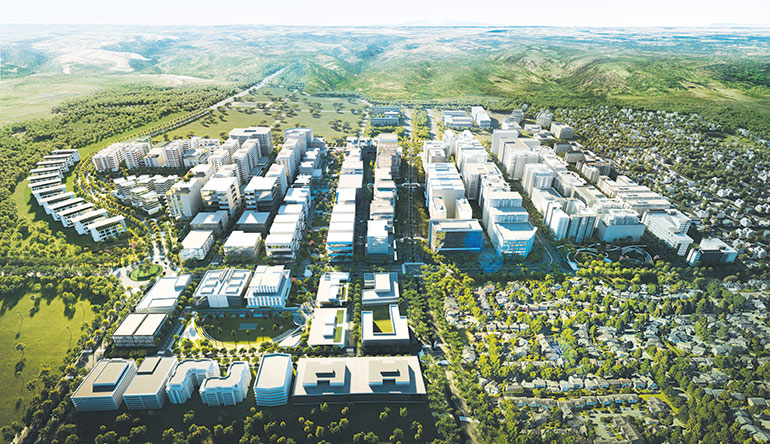
Pampanga, meanwhile, benefits from a slew of recent infrastructure developments, most notably the upcoming Clark International Airport, and its proximity to Metro Manila. Davao has continually proven itself as a city with solid fundamentals and the rise in the number of master-planned townships in these areas further enhances their foreign appeal.

“Outsourcing to the Philippines will continue to be a viable business strategy for many companies in the next ten or twenty years,” Mr. Añonuevo said.

“I believe that master-planned communities are a very attractive real estate investment, primarily because employers would want to be able to provide the best environment for their employees. It’s just a matter of time before companies become confident again in investing in new office buildings, and we will see the same growth in real estate in the office sector as in previous years.”

The makings of an emerging city

Moving past the pandemic, Mr. Cordero pointed out opportunities in the real estate industry that investors can take advantage of, aside from the expected surge brought about by IT-BPM activities.

The high-end residential segment is expected to ride out the crisis, as such developments provide a safe environment that can support various lifestyles. The industrial segment, meanwhile, is propped up by the boom in e-commerce, increasing the demand for developments near sources of labor. Retail and hospitality segments, however, should expect recovery to take much longer.

“We think that there are various drivers of success in a city that will enable investing in these new wave cities a worthwhile endeavor,” he said.

“We need to look out for these cities that have a lot of investment activities being poured in, cities that put a premium on social inclusion and urban well-being, health equality, cultural and environmental diversity. We need to look at cities with environmental and climate resilience. Cities should have proactive and coordinated prevention, adaption, mitigation strategies to address climate change to safeguard investments,” he added.

Cities with competitive advantages that increase their capacity to generate talent, knowledge, and innovation, meanwhile, are cities that will attract not only co-minded investors but aspiring residents and locators, making it a self-sustaining development. He encouraged investors to look for such developments outside Metro Manila as they would provide a more stable investment than the currently-volatile equity market.

“Investing in real estate during this pandemic also entails a social responsibility as it helps in accelerating economic recovery and growth. Right now, we need to grab the opportunity while interest rates are still very attractive and we need to take advantage of the massive fiscal stimulus that the government is also offering. Take advantage of that and we can do our share in helping the economy regrow in no time,” he said.

Alveo Land, the country’s leading innovative real estate developer, offers a vibrant portfolio of groundbreaking property developments that provides upscale living and working spaces within various thriving and emerging growth centers around the country. Outside the National Capital Region, it has noteworthy projects located in Cagayan de Oro, Cavite, Cebu City, Davao City, Laguna, and Pampanga. For more details, visit www.alveoland.com.ph.




50-MW BulacanSol power plant: Powering the good life through sustainable energy

MERALCO PowerGen Corp. (MGen) is taking serious strides on the renewable energy front with the start of commercial operations of its first solar power plant.

Now called BulacanSol, the newly completed power station now provides clean and renewable power to the Luzon grid.

Located in San Miguel, Bulacan, the P4.25-billion project is a joint undertaking of MGen Renewable Energy, Inc. (MGreen), which owns 60% of the project; and PowerSource Energy Holdings Corp., with 40%.

BulacanSol last February reached 1.5 million safe man-hours without lost time incident, reflecting the commitment to safety and security in all its activities.

This was achieved notwithstanding hurdles encountered including delays brought about by the COVID-19 pandemic and a string of weather disturbances that limited movements at the power plant site.

“We share this achievement with our employees, engineers, contractors, and partners in the government and private sector who worked together to bring this project into reality. With their perseverance, determination and hard work, we are finally going to see the light,” said PowerSource Chairman Aloysius B. Colayco.

“Not even the COVID-19 pandemic and lockdowns we experienced during the construction period hindered us from completing this renewable project. We are confident that this solar plant will help the much needed power requirements of our country especially during these challenging times,” said Ricardo G. Lazatin, PowerSource president & CEO, said.

MGen President & CEO Rogelio L. Singson acknowledged the very strong support BulacanSol received from national government agencies including the Department of Energy, Energy Regulatory Commission, and the Department of Public Works and Highways; as well as from the local government unit of San Miguel.

BulacanSol signifies the commitment of MGen to help ensure energy security through clean, cost-competitive, and sustainable power.

“We pledge to continue building more environmentally conscious projects as part of our commitment to a sustainable energy transition for the future generations,” said Mr. Singson.

“As the first operational project of MGreen, BulacanSol is a very important milestone that drives us to aggressively pursue more projects that will help us achieve our target of building a renewable energy portfolio with a capacity of up to 1,500MW in the next five to seven years,” he added.

BulacanSol now plays a significant role in One MERALCO Group’s long-term sustainability agenda.

“This is a modest step into renewables but a significant one for MERALCO. We look forward to many more investments in renewables, particularly solar, as we attempt to achieve that balance in fuel sourcing, which will ultimately be biased towards renewables,” MERALCO Chairman Manuel V Pangilinan said.

“In June 2019, MERALCO made the first announcement that it would join the shift to renewable energy and it will adopt sustainable practices for the One MERALCO Group. And today, we realize the very first renewable power plant — the first of several that One MERALCO has lined up for investment and sourcing,” added MERALCO President & CEO Atty. Ray C. Espinosa.

Pru Life UK remains strong on its 25th year as it claims number 1 spot1 in life insurance industry ranking for 2020

Pru Life UK remains strong on its 25th year as it claims number 1 spot[1] in life insurance industry ranking for 2020

Pru Life UK has been introducing innovations in the industry since its inception in the Philippines in 1996. Its rich history of product and service excellence for Filipinos now culminates with a number one spot, according to the Insurance Commission’s latest ranking of local life insurers in terms of New Business Annual Premium Equivalent (NBAPE) in 2020.

The timing of this momentous feat could not have come better as this year, Pru Life UK also celebrates its 25th year. Befitting its new position and landmark anniversary, it offers customers more reasons to celebrate with the company through a weeks-long treat.

25th Anniversary Celebration, raffle bonanza

To celebrate its silver anniversary and number 1 success, Pru Life UK currently holds the We DO Health & Wealth: 25th Anniversary Celebration, featuring a 25-week free raffle bonanza.

Pru Life UK President and CEO Antonio ‘Jumbing’ De Rosas

“Last year was especially challenging because of the pandemic, but thanks to the remarkable resilience and strength of our people, coupled with the continued loyalty of our new and existing customers, we thrived. This celebration is our simple way of thanking our customers for letting us be their trusted life insurance partner for two-and-a-half decades. In the years to come, we will continue to uphold our promise to be a company that listens and responds to the financial needs of our fellow Filipinos on their journey to achieve their health and wealth goals, and helps them get the most out of life,” added Pru Life UK President and CEO Antonio “Jumbing” De Rosas.

The 25-week raffle draw will award over P6 million worth of prizes to more than 600 winners, including a grand prize winner of P2.5 million cash, 25 winners of an iPhone 12 mini and 24 winners of an e-gift certificate worth P2,500.

Participants can join via the Pulse app available for free on the Apple Store and Google Playstore. Users can increase their chances of winning by being active on the app. Official announcements will be posted on Pru Life UK’s website and official Facebook page one day after the draw.

Rising to the Challenge of the pandemic

As one of their initiatives amidst the COVID-19 pandemic, Pru Life UK embraced digital solutions and channels early on to propel its business further and expand its customer touchpoints. In 2020, it introduced Pulse. As a wellness ecosystem, the app educates and encourages users to lead a healthy lifestyle, enables them to interact with each other and offers rewards for completing health-related challenges. At the height of the pandemic, the company offered free Personal Accident insurance and COVID-19 protection through Pulse as an additional measure to safeguard users against the virus. As of today, the app has been downloaded over four million times.

In 2020, Pru Life UK was also the first insurer to operate digitally, with nearly 100% work-from-home capability. It also further promoted Pulse for customers to easily access digital life protection solutions and payments safely. Meanwhile, the company’s agency force grew by 21% from 2019 to over 44,000 agents in 2020.

New products and services for Filipinos

Pru Life UK continues to provide its customers protection against COVID-19 with its latest PRUPersonal Accident with COVID-19 and vaccine protection cover for adverse reactions that is valid for one year. This free insurance is available to the first 250,000 registrants on the Pulse app before May 31. It is the first-of-its-kind that offers the most comprehensive coverage in the industry. It builds on the company’s free Personal Accident and COVID-19 protection that was launched in April last year, with the added extension of post COVID-19 vaccination coverage.

Another first in the market, Pru Life UK launched its latest health protection product designed for the independent and empowered women in our lives, the PRUHealth Prime – Select Breast Cancer, through Pulse.

The PRUHealth Prime – Select Breast Cancer comes in two packages. With a one-time premium of P150, a lump sum amount of P10,000 is provided upon diagnosis. Meanwhile, a one-time premium of P425 offers a lump sum amount of P10,000 upon diagnosis and a guaranteed amount of P20,000 when undergoing Mastectomy or Lumpectomy. It is the first cancer-specific product offered in the market, and is valid for one year.

Last month, Pru Life UK also introduced two new optional supplemental critical illness (CI) benefits or riders, the Select Top 42 and Select 523 Critical Illness riders, to PRUHealth Prime. The new feature is an insuravest plan with critical illness coverage against all forms of cancer.

The Select Top 4 Critical Illness Benefit provides for top 4 covered late-stage critical illness conditions, while the Select 52 Critical Illness Benefit provides for 52 covered late-stage critical illness conditions.

Customers who are availing of PRUHealth Prime but would want to be covered against other critical conditions can purchase either of the two new critical illness riders during the new business application process and/or after policy issuances.

Pru Life UK is #1 For NBAPE

Meanwhile, in a disclosure by the Insurance Commission (IC), Pru Life UK recorded a total NBAPE of P7.95 billion last year, which represents a 3.7% increase from the company’s NBAPE in 2019.

“We are thrilled to finally announce that we are the new industry leader. I extend my congratulations to our PRULifers — agency leaders, agents, distribution partners, and employees for their relentless commitment to our We DO promise of delivering our products and services with excellence. More importantly, I express our utmost gratitude to all our policyholders for their continued trust in the company,” said Mr. De Rosas.

According to a media statement by the IC, the country’s life insurance industry as a whole recorded a 5.9% growth in premium income to P247.7 billion in 2020 from P233.9 billion in 2019.

The IC has adopted NBAPE, a global standard, to measure the Philippines’ life insurance industry’s sales performance more accurately. This yardstick helps the government body compare companies’ new sales by considering the two payment methods used in the industry — regular premium and single premium (also known as single-pay or one-time pay). A life insurer’s NBAPE is calculated by adding the value of regular premiums from products sold in a given year (or the initial annualized premiums) and 10% of single premiums written in the same period.

Pru Life UK first entered the top 10 list of life insurance companies in terms of First-Year Premiums in 1998. In 2007, it hit the P1-billion mark in terms of Annualized Premium Equivalent, a 130% growth from the previous year. Thirteen years later, it is now on top of the leaderboard, with a total net premium income of P30.9 billion, a 14% increase from P26.9 billion in 2019.

Pru Life UK’s unaudited Quarterly Reports on Selected Financial Statistics (QRSFS) for NBAPE in 2020 have been submitted and will be made available on the IC website https://www.insurance.gov.ph. For more information about Pru Life UK’s offerings and the raffle bonanza, visit www.prulifeuk.com.ph.

[1] In terms of New Business Annual Premium Equivalent (NBAPE) for 2020

Horizon Manila: Envisioning the ‘City of Tomorrow’

Scale model of Horizon Manila

The COVID-19 pandemic has changed the world as we once knew it. Not only did it force businesses and organizations all over the world to digitize and adopt new technologies, the crisis has also caused many people to reconsider the traditional values that the old world had cherished. More than ever, more people are thinking about social, humanitarian, and environmental issues. It is no longer enough to consider economic gains in this new world, but one must also choose that which would cause the greatest social good.

Horizon Manila, the biggest reclamation project in the City of Manila proposed by JBros Construction Corporation, stands by this philosophy, aiming to recognize the diversity of lifestyles, preferences, and needs among urban populations through its design and development by becoming the City of Tomorrow.

Horizon Manila’s President Jesusito “JR” Legaspi, Jr.

“Horizon Manila aims to serve as an extension of Manila, rather than a ‘New Manila’ altogether. Future residents and workers within Horizon will feel that they are in Manila, but more modern. It’s better. The fact that Horizon is three kilometers away from the ‘mainland’ Manila reinforces the notion that more than just being an extension of Manila, it’s almost a city in itself,” Horizon Manila President Jesusito “JR” Legaspi, Jr. said.

This city extension is built with social development in mind, as Mr. Legaspi pointed out that the 419-hectare reclamation project comes at no cost to the government. Only 49% of the area belongs to the private proponent, with the remaining 51% belonging to the local government. This government share includes roughly 30 hectares of green spaces, approximately 70 hectares of public roads (both of which the private proponent will build and pay for), and over 85 hectares of prime, developable land, comparable to that of Bonifacio Global City.

“The income from the sales or development of the government’s 85 hectares can fund multiple projects for the local community. The project will also generate billions from business and real estate taxes. It is projected that Horizon will create 400,000 new jobs for Filipinos. This mega project is also bound to attract foreign investors back to the country. With all these in mind, one can safely say that Horizon does not only benefit its proponent and its investors, but the community as well,” he added.

Cuervo Appraisers valued JBros’ share in the project to be at P321 billion today. Furthermore, Horizon Manila holds the honor of being the first reclamation project endorsed by Mayor Isko Moreno since he assumed office in 2019. He endorsed the solar reclamation project even before when he was a vice-mayor.

In designing Horizon Manila, JBros Construction enlisted the aid of WTA Architecture and architect William Ti.

“It was important to us that our modern city retains the character of Manila at its very core. It’s a blend of modern master-planning concepts and the rich culture and history of Manila. As someone who grew up in Tondo, William is intimately familiar with the intricacies and nuances of planning an extension of Manila,” Mr. Legaspi said.

There are 28 compact communities and districts within Horizon, which mirror the multiple compact and adjacent communities in Manila City. These districts are designed to cater to a variety of lifestyles, such as an Art District for the creatives, an Innovation & Tech Hub for the lovers of technology, and even a BioTech Campus, situated around Horizon’s Medical Center, for providing assisted living for the elderly. Community facilities within the master plan include an art museum, a theater, a skate park, basketball courts, and libraries.

Horizon Manila’s skate park

“The master plan for Horizon is aptly named ‘Manileño’ as it is people-centric. This is strongly reflected by the personal mobility options offered within Horizon. The goal is that, when you’re in Horizon, taking your car is the least convenient transportation option,” Mr. Legaspi added.

Mobility options like bike routes, pedestrian-only and pedestrian-priority zones, water taxis, bus rapid transit (BRTs), and water ferries are available for all residents. However, Horizon is also designed to make walking convenient, pleasant, and interesting with various points of interests scattered around Horizon’s three main islands.

The inland canal and interconnected green network that will ensure pedestrians can walk around Horizon while constantly being surrounded by water and greens. Horizon’s three-island configuration gives it 21 kilometers of water-frontage.

“It is long documented that being around, near, at, or underwater has a therapeutic effect on the human mind. Now, imagine working in Horizon. Anywhere you may be, you are always, at most, five minutes away to the nearest water-frontage. The COVID pandemic has taught us to value our health — both physical and mental. With water in such abundance in Horizon, mental health will be a bit easier to care for,” Mr. Legaspi said.

In addition to the bayside views, Horizon will add over 30 hectares of public parks and green spaces to the City of Manila. Part of this interconnected ‘green network’ in Horizon will be two ‘sunset parks,’ designed to give the best views of the sunset in the area on the westernmost edge of the last island.

“Have you ever heard of people who regret passing up on the opportunity to buy real estate in Bonifacio Global City, ASEANA City, or Entertainment City years ago? They thought then that prices were too expensive,” Mr. Legaspi said.

“But lo and behold, the land prices just continuously went up and have been record-breaking. Horizon is the next big thing in real estate. The opportunity to change the map of Manila does not come often. Be a part of the future and seize the opportunity to make a change. Let’s make Manila better together,” he said.

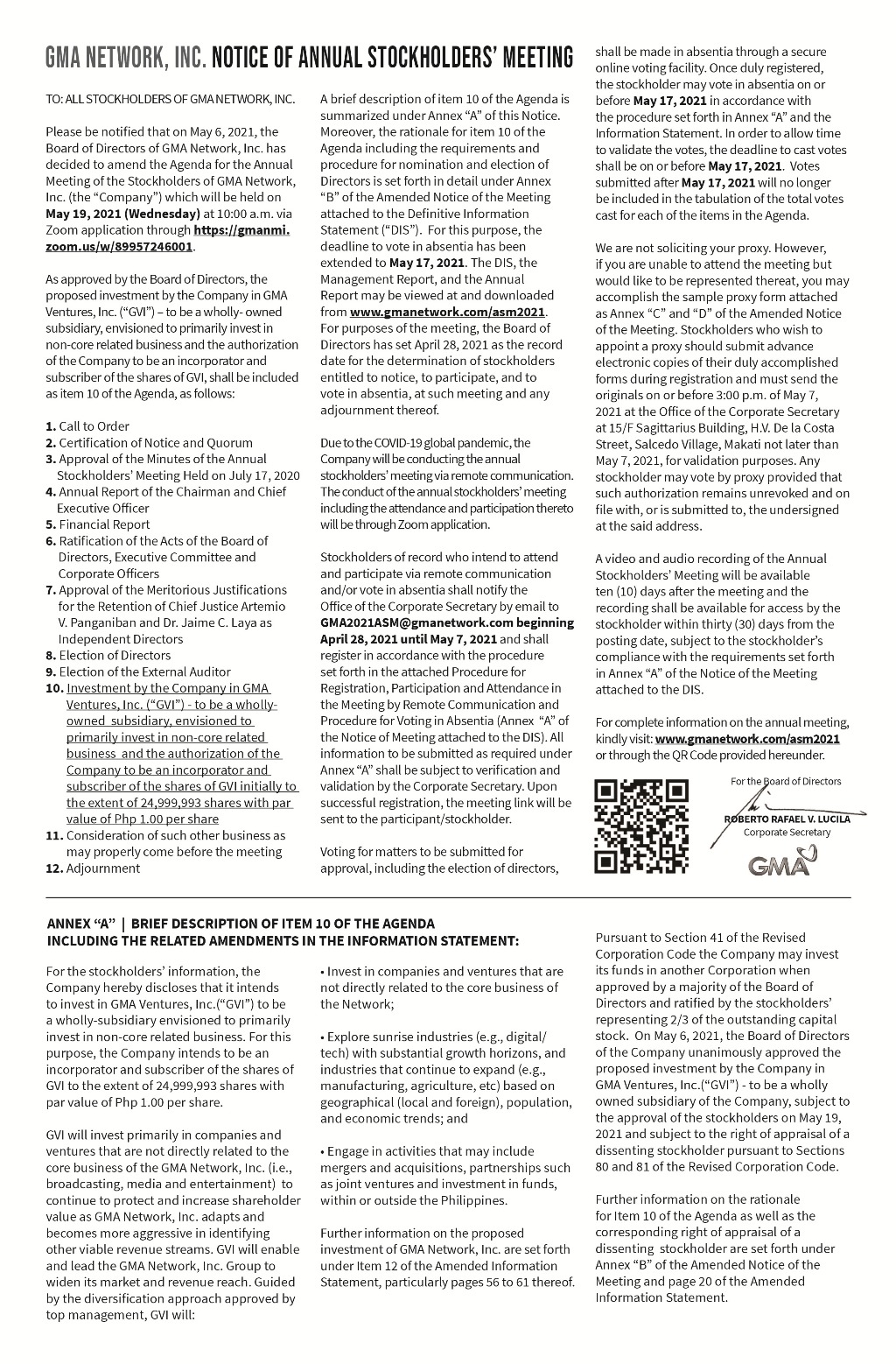
GMA Network, Inc. announces schedule of annual stockholders’ meeting

Click to enlarge.

Debt service bill surges in March 

BW FILE PHOTO

THE NATIONAL GOVERNMENT’S total debt service bill increased more than fivefold from a year ago to P268.41 billion in March as principal payments surged, data from the Bureau of the Treasury (BTr) showed.

The March debt service bill was significantly higher than the P49.29 billion recorded in the same month in 2020.

BTr data showed amortization payments made up 82.2% of the total, and the rest went to interest payments.

Principal payments spiked by 3,478% to P220.75 billion in March from just P6.17 billion a year ago.

Broken down, P202.96 billion was paid to domestic lenders while payments to foreign creditors grew by 188% from a year ago to P17.79 billion.

The government did not settle any principal payments for its local debt in March 2020.

Interest payments likewise rose by 10.6% to P47.67 billion in March from P43.12 billion a year earlier.

This consisted of P39.23 billion in payments for domestic debt, up by 15% year on year, and P8.44 billion for foreign obligations, down by 4%.

For the first quarter, the government’s debt service bill increased by 53.4% to P521.51 billion from P339.98 billion in the same period last year.

The quarter’s total accounted for 41.4% of the programmed P1.26-trillion debt service bill for the entire year.

Principal payments, which accounted for three-fourths of the total, surged by 80% to P395.65 billion. Of which, P252.85 billion went to pay off local debt and the remaining P142.8 billion went to settle external debt.

For the first three months of 2021, interest payments grew by 24% to P125.86 billion from P119.88 billion. This made up of P90.6 billion in interest paid for domestic debt and P35.24 billion for foreign loans.

The government’s overall borrowings reached P1.4 trillion in the first quarter, up by 44.45% year on year.

The Institute of International Finance (IIF) warned last week that debt service will likely become a “greater burden” for many emerging economies including the Philippines amid high spending and low state revenues.

IIF data showed the share of government interest expense over their overall revenues will increase the most in the Philippines among 15 emerging markets studied. The ratio is projected to jump by nearly six percentage points in 2021-2022 from the level in 2018-2019.

Interest payments by the government accounted for 13.3% of state revenues in 2020, up from 11.5% in 2019 and the highest in four years or since 2016’s ratio of 13.9%, based on latest data from the Treasury. — Beatrice M. Laforga

Bank lending likely to pick up by 2nd half of 2021

REUTERS
Credit activity may pick up in the second half of the year, once lockdown restrictions are eased. — REUTERS

By Luz Wendy T. Noble, Reporter

SLUGGISH BANK LENDING is expected to continue in the next few months, with improvements likely seen by late 2021 if the pandemic-related restrictions are further eased in the Philippines, according to analysts from credit rating firms.

Despite the liquidity boost and record low policy rates, lending has been muted in recent months as banks tightened credit standards amid uncertainty over the health crisis.

“Credit demand is likely to remain weak in the second quarter as well and could pick up in the second half of 2021. Credit off-take will primarily depend on lifting of restrictions in Manila and National Capital Region,” S&P Global Ratings analyst Nikita Anand said in an e-mail to BusinessWorld.

Strict lockdown measures have been eased in NCR and adjacent provinces, which are now under a general community quarantine (GCQ) but “with heightened restrictions” until May 31. This as the number of reported coronavirus disease 2019 (COVID-19) cases has gone down.

Bank lending declined for the third straight month in February, despite the Bangko Sentral ng Pilipinas’ (BSP) measures to incentivize lending and to infuse liquidity worth P2 trillion to the financial system.

“If you look at the liquidity injection of the BSP in the past year, it has been instrumental in supporting market function. What we’ve seen is that much of this liquidity has been absorbed back into the various facilities of the BSP,” BSP Deputy Governor Francisco G. Dakila, Jr. said at the monetary policy briefing on Wednesday.

“Once the economy starts recovering due to the control of the spread of the virus and the relaxation of restrictions, then we can see that liquidity will not then be a factor constraining growth,” he added, assuring “liquidity is already there.”

Joyce Ong, an analyst at the Financial Institutions Group of Moody’s Investors Service, expects lending to remain sluggish in the next few months before picking up pace later in the year.

“Lending will likely remain muted in the next few months, as businesses halt expansion plans due to the ongoing social-distancing measures and a resurgence in infection rates,” Ms. Ong said in an e-mail.

“Banks will remain cautious in lending to SME (small and medium enterprises) and retail borrowers due to their elevated default risk, because these borrowers tend to have less cash buffers to withstand prolonged financial stress,” she added.

In February, loans for production activities fell by 3.2%. Borrowings from consumers also dropped 9.9%.

“In times of greater uncertainty, lag in the transmission of monetary policy can be expected to be longer. Therefore, the implication of that is that monetary stimulus will be applied on a longer time period than what would have been in more normal times,” Mr. Dakila said on Wednesday.

More business activities are expected to resume with NCR now under a more relaxed GCQ.

S&P’s Ms. Anand said this may spur bank lending moving forward.

“As the economic activity picks up, capital expenditure and working capital requirements from corporate sector should increase. Ramp up of key infrastructure projects could also provide an upside,” she said.

She, however, warned that recurring waves of COVID-19 infections and a slow vaccination rollout could continue to hinder economic and credit growth.

For her part, Ms. Ong said a resumption of some kind of “state of normalcy in the Philippines” in terms of both business and consumer activities could help drive a gradual recovery in lending by the end of the year.

The economy shrank for the fifth consecutive quarter by 4.2% in the January to March period. Household spending continued to decline by 4.8% while capital formation slid by 18.3%.

ARTA aims for record Doing Business score

PHILIPPINE STAR/ MIGUEL DE GUZMAN

THE ANTI-RED TAPE Authority (ARTA) is aiming to reach the Philippines’ highest score yet in the next global Doing Business report, its top official said.

The World Bank’s annual Doing Business report assesses countries’ competitiveness by measuring regulations that enhance and constrain business activity. Countries with fewer regulations will have a higher ranking on the Doing Business index, which will then boost their attractiveness to foreign investors.

The Philippines rose to 95th place from 124th place among 190 economies in the latest report released in 2019 after improving its overall score to 62.8 points from 60.9 points, although it was seventh among 10 Southeast Asian Nations.

“We are hoping that the Philippines will have its highest ever EODB (Ease of Doing Business) score in the history since the survey started,” ARTA Director-General Jeremiah B. Belgica said in a mobile message on Saturday.

Although starting a business became easier after the country abolished the minimum capital requirement for domestic companies and made dealing with construction permits easier, the report showed that the country still needed to improve enforcing contracts, trading across borders, and registering property.

“We continue to work on and improve the ‘starting a business’ sector,” Mr. Belgica said. The rollout of a central business portal, he said, would aid in these efforts.

In a recent joint memorandum circular issued by ARTA and other government agencies, all local government units have to set up the electronic business one-stop shop or automate their business processing and licensing systems by June 17.

Local governments that have fully put up an online business registration service must cut the number of steps to one. Business registration must be processed within three business days, while the number of signatories on permits must be reduced to three people.

The Philippines continues to be plagued with red tape issues during the pandemic. ARTA recently issued a show-cause order to the Food and Drug Authority for alleged delays in processing 600 drug applications.

The World Bank faced recent criticism over reported irregularities regarding data changes in the 2018 and 2020 versions of its flagship report. It paused the release of the latest edition and noted corrections would be incorporated in the upcoming report.

ARTA also called for a review of the methodology of the report, raising concerns about the data collection method. The Doing Business survey team, Mr. Belgica said, should select respondents that are familiar with the processes or regulations being assessed.

The World Bank report measures competitiveness of economies in doing business using several indicators: starting a business, employing workers, dealing with construction permits, getting electricity, registering property, getting credit, protecting minority investors, paying taxes, trading across borders, enforcing contracts and resolving insolvency.

In 2019, the Philippines created the ARTA, one of the offshoots of an Ease of Doing Business Act that President Rodrigo R. Duterte signed in the year prior. — Jenina P. Ibañez

NLEX toll fees to increase on May 18

PHILIPPINE STAR/ MICHAEL VARCAS
USERS of the North Luzon Expressway (NLEX) will pay higher toll fees starting May 18. — PHILIPPINE STAR/ MICHAEL VARCAS

MOTORISTS USING the North Luzon Expressway (NLEX) will pay higher toll fees starting Tuesday (May 18), the tollway operator said over the weekend.

NLEX Corp. said in a statement the toll increase will take effect at 12:01 a.m. on May 18.

An additional P2 for Class 1 vehicles or ordinary cars (value-added tax included) using the open system, where a flat rate is charged, will be collected.

Quezon City, Caloocan City, Valenzuela City, Malabon City, Navotas City, Meycauayan City and Marilao, Bulacan are all part of the open system.

The closed system is between Bocaue, Bulacan and Mabalacat City, Pampanga, according to the company.

“For the entire NLEX journey end to end, Class 1 vehicles will pay an additional P6,” the company added.

For Class 2 vehicles like buses and small trucks, an additional P3 will be collected in the NLEX open system, while an additional P4 will be collected for large trucks or Class 3 vehicles.

“In summary, motorists traveling end-to-end between Metro Manila and Mabalacat City, Pampanga will be charged an additional P6, P14, and P16, respectively, depending on their vehicle class,” the company said.

NLEX Corp. also said the increase is part of the “approved” periodic adjustments due in 2012 and 2014.

The TRB (Toll Regulatory Board) and NLEX agreed to implement the increase on a staggered basis to cushion the impact of the adjustments,” it noted.

NLEX Corp. announced last week that it was testing an automatic license plate recognition system at its 25 toll lanes in Valenzuela City, partly to identify erring motorists who use cashless lanes without radio-frequency identification (RFID) stickers or with insufficient load balance.

The company continues to keep its toll barriers up at Mindanao, Karuhatan, and Paso de Blas toll plazas.

Among its ongoing projects are the NLEX Connector Road, an eight-kilometer toll road linking the tail of NLEX Harbor Link Segment 10 at C3 Road in Caloocan City to Polytechnic University of the Philippines in Sta. Mesa, Manila, and the Candaba Viaduct upgrade, which aims to ensure the bridge’s long-term serviceability.

NLEX Corp. is part of Metro Pacific Tollways Corp., the tollways unit of Metro Pacific Investments Corp. (MPIC). MPIC is one of three key Philippine units of Hong Kong-based First Pacific Co. Ltd., the others being Philex Mining Corp. and PLDT, Inc.

Hastings Holdings, Inc., a unit of PLDT Beneficial Trust Fund subsidiary MediaQuest Holdings, Inc., has a majority stake in BusinessWorld through the Philippine Star Group, which it controls. — Arjay L. Balinbin

P&G tackles its plastics usage

THE NEW bottles of Herbal Essences shampoo are now made with 25% post-consumer resin (recycled plastic).

IT’S a sobering thought that after our bones have been ground to dust, there’s going to be a piece of immortal plastic to replace one of us, remaining on earth until who-knows-when. To tackle this issue of the virtual immortality of plastic, Procter & Gamble (P&G) Philippines announced at a sustainability summit on May 6 the various steps it has been taking to reduce its own plastic use, as well as its ambitions for plastics in the future.

Anna Legarda, Commuinications Director of P&G Philippines, unveiled the company’s sustainability development goals program called Ambition 2030. “The goal is to be 100% recyclable, reusable, by 2030,” she said.

Why 2030? Ms. Legarda explained that the company — one of the world’s biggest manufacturers (among its many brands are Charmin, Crest, Downy, Febreze, Gillette, Head and Shoulders, Olay, Oral-B, Pampers, Pantene, Tide, Vicks, and Whisper) — is the intricacies of the packaging. “In itself, the packaging of any product, not just sachets, serves different vectors of functionality,” she said. Sachets are a particular concern due to the difficulty in recycling them, and they are frequently visible to the naked eye — and in documentaries as particularly bright colored liter on coastlines.

Ms. Legarda adds, “Plastic in itself as a material isn’t bad —  I just want to put that out there.

“It’s when it becomes waste… that’s when it becomes a problem.”

The factors that she cites for some of their practices in packaging include safety, quality, efficacy, scalability, and cost. She gives dishwashing liquid as an example: it’s dressed up in multiple layers of plastic to ensure its safety and efficacy throughout its life cycle. “Products have a certain promise and a claim, and they can deliver these when… they are preserved or well-packaged. If you alter a bit in the packaging, their efficacy and stability… can be compromised,” she said.

There have been some advances already though: for starters, the new bottles of Herbal Essences shampoo are now made with 25% post-consumer resin (recycled plastic). The boxes of Safeguard soap have been stripped of their plastic film overwrap, since they found out those can be substituted with recycled cartons. As well, their Cabuyao, Laguna plant has a goal of having zero manufacturing waste. Ms. Legarda says that the company globally pours about $2.5 billion into research and development —  “Twice more than our next competitor. ”

A company release said, “To further offset the unrecoverable emissions, the company is supporting natural climate solutions that help conserve, protect and restore forests with global partners such as Conservation International and its recently launched P&G Forests for Good program. Beyond helping in P&G’s net zero emissions goal, Forests for Good aims to actively protect nature, beginning with 12 pilot programs in 12 months across its Asia Pacific, Middle East, and Africa (AMA) region, by planting trees that help improve local ecosystems. The Philippines is one of the pilot countries supporting this natural climate solution and will help forestation efforts in the Sierra Madre Mountain Range. To establish its P&G Philippines Forest for Good, P&G entrusted each employee with trees, planted on their behalf by farmers in the Sierra Madre mountain range. Employees can name their tree, virtually travel to see it up close, check on it and learn more about it as it grows, and learn more about the farmer who planted it.”

“All of these things, we have to consider, because we’re trying to be accountable for it,” she said. “We’re very, very aware that anything that messes with our consumers will affect the whole brand, the whole company. We’re trying very, very hard to do it.” —  J.L. Garcia

‘Natural’ and ‘ethical’ are getting a divorce

PANDORA.NET

By Virginia Postrel

VEGAN silk and leather, mine-free diamonds, bioengineered perfumes: Lab-grown products with ethical appeal could be the future of luxury. Exemplified by the announcement the other week that giant jeweler Pandora A/S will no longer use mined diamonds in its products, the emergence of these high-tech luxury goods represents a significant cultural shift.

Since the first Earth Day a half-century ago, large industries have grown from the widespread conviction that “natural” foods, fibers, cosmetics and other products are better for people and the planet. It’s an attitude that dates back to the 18th– and 19th-century Romantics, who rejected industrialism in favor of sublime landscapes and rural nostalgia: What’s given is good; what’s made is suspicious, especially if it’s of recent origin.

That assumption is beginning to reverse, as entrepreneurs and consumers turn to cutting-edge artifice in search of more environmentally friendly, less ethically fraught materials. Substances grown in fermentation vats or built up atom by atom are replacing those wrenched from the earth, stripped from plants and animals or implicated in human suffering.

With their ethical appeal, these high-tech materials raise an interesting possibility. Maybe some ethical standards are themselves a form of luxury, at least until innovations make them less expensive. Democratizing diamonds, then, has the potential to produce not just cheaper bling but new mores about mining and energy use. Growing meat or silk or leather in a vat could make the “natural” alternatives someday seem repugnant.

Some new materials, such as Impossible Meat’s popular vegan burgers or the leather substitutes from companies including Modern Meadow, Bolt Threads and Ecovative Designs, are alternatives to traditional products. (Bolt also makes a bioengineered vegan silk, but not yet in commercial quantities.) Others are the real thing, produced in a new way.

Take those lab-grown diamonds. They are chemically, structurally and optically identical to the natural variety — a fact that irks mined-diamond purveyors no end. (They know what cultured pearls did to the price of those gemstones.) But even Anglo American Plc.’s De Beers, whose chief executive has called lab-grown stones “not real,”  has started its own division selling lab-made stones as lower-priced fashion jewelry.

Although synthetic industrial diamonds have been around since the 1950s, producing gem-quality diamonds is a recent phenomenon. It builds on technology that was originally developed to make computer chips and thin-film solar cells, but is much more challenging.

The semiconductor industry uses a process known as atomic layer deposition to build films around a hundred atoms thick. To get a diamond crystal large enough for jewelry, however, producers have to build up 10 billion layers.

“If something goes wrong in layer 1,000, it’s not going to self-correct,” said Martin Roscheisen, the founder and chief executive of San Francisco-based Diamond Foundry, Inc., in an interview. “You have to grow to 10 billion layers without things going wrong.” Now in its eighth generation, the company’s plasma reactor has an energy density 100 times that used in the semiconductor industry.

Diamond Foundry’s stones sell for an average of $282 a rough carat, more than twice the De Beers average of $133 for its mined versions. Yet at retail, lab-grown stones are much cheaper. The reason for the paradox is simple. Mined diamonds come in a hodgepodge of size and quality, with the small, flawed and discolored ones bringing down the average price. Lab-grown stones are all high-quality to begin with. But they’re less aggressively priced, making them cheaper to the consumer. (Both types go through the same cutting and polishing processes.)

Although every lab-grown stone is slightly different, they are all fairly large (about five carats before cutting and polishing) with good color. That consistency is also why even a plasma reactor takes significantly less energy for each gem-quality carat than a mining operation — a selling point to environmentally oriented customers. In announcing its plans to go mine-free, Pandora emphasized the appeal of both lower prices and environmental sustainability to its customer base.

The new luxury materials are grown, not extracted. It’s a much gentler-sounding process.

“A lot of luxuries and wonderful products are things that we squeeze out of natural things,” said Christina Agapakis, the creative director of Boston-based Ginkgo Bioworks, in an interview. “There will be a tiny amount of these molecules that make a beautiful fragrance in plants. We cut down the whole forest to extract them.” Ginkgo Bioworks instead bioengineers yeast to produce the right molecules. The goal, Ms. Agapakis said, is “a truly generative” process. “If you want a little more, you grow more,” she said. No killing animals or chopping down trees. But the molecules themselves are the same.

At least for now. Today, the company mostly replaces existing materials, from collagen for cosmetics to patchouli for perfume. In the future, biologists could invent new substances or recover old ones. Ms. Agapakis spearheaded a project in which company scientists worked with an artist and a fragrance expert to create possible scents of extinct flowers, starting with DNA sequences from samples stored at Harvard University.

Bioengineered molecules and lab-grown diamonds lack the provenance of traditional luxuries, but they aren’t fakes. Both chemical analyses and human senses deem them authentic. Once they’re in the world, telling the difference requires a paper trail.

“This is the fragrance of memory, my own and everyone else’s. This is the smell we have loved for thousands of years, that has beguiled the generations, the people I know and love, my grandmother,” Sudeep Agarwala, a yeast geneticist and program director at Ginkgo Bioworks, writes of agarwood, whose scent he hopes to create in yeast. He wonders, “Will the scent I create in yeast be real?” If it conjures those memories, it will be. — Bloomberg

Livestream shopping gaining more attention in PHL

SHOPPERTAINMENTLIVE.COM

LIVESTREAM shopping company Shoppertainment Live, Inc. said live shopping for e-commerce brands is on the rise in the Philippines, with Filipino consumers becoming more receptive to the new form of shopping amid the pandemic crisis.

“It takes 30 days to create a habit, and it’s been over a year [since the pandemic began] and people are still watching,” Shoppertainment Live Chief Executive Officer Hiyasmin Neri-Soyao told BusinessWorld in a recent online interview. “The average watching duration is still increasing, so I think live shopping is now part of the marketing mix.”

Shoppertainment Live combines shopping and entertainment to sell products on e-commerce platforms such as Lazada and Shoppee, as well as social media platforms like Facebook.

“We use celebrities. We’ve done a lot of activations with micro and macro influencers,” Ms. Neri-Soyao said.

“Actually, we had 200% growth year on year, and we’ve seen a lot of increase in demand for livestreams,” she added.

She noted that livestream shopping has been booming in China, and she sees potential for this industry in the Philippines.

“In China, this is a multibillion-dollar industry that really helps boost e-commerce conversion rates. There, they’ve been selling like $20-million worth of products for one hour,” she said.

In the Philippines, however, livestreaming is not yet the biggest driver in terms of e-commerce sales conversion.

“The role of the livestream right now is being part of the e-commerce marketing of our brands and stores,” Ms. Neri-Soyao said. “But we’ve seen a 2% to 10% increase in conversion rate for an hour stream.”

“The biggest benefit of a livestream shopping campaign is [the ability to convert] viewers into store followers, because these store followers are the ones who would see your promos and new products right away, and they are the ones who would be notified by the platforms right away,” she added. — Arjay L. Balinbin