Home Blog Page 7619

LANDBANK OK’s P20 billion in loans for firms affected by crisis

BW FILE PHOTO

LAND BANK of the Philippines (LANDBANK) has approved P20.07 billion in loans for firms, micro, small and medium enterprises (MSMEs) and cooperatives affected by the coronavirus disease (COVID-19) pandemic as of April.

The bank said in a statement that loans released through its I-RESCUE (Interim Rehabilitation Support to Cushion Unfavorably affected Enterprises by COVID-19) lending program, which it started in April 2020, benefitted 434 borrowers comprised of 292 MSMEs, 81 cooperatives, 56 large corporations, and five microfinance institutions (MFIs).

Some P18.21 billion of the P20.07 billion in approved loans has already been released.

LANDBANK in April doubled the I-RESCUE program’s fund to P20 billion from the initial P10 billion amid an increased number of loan applications from firms.

The lending program will be available until Dec. 31, 2022 and was set up by LANDBANK to provide credit and loan restructuring assistance to entities adversely affected by the COVID-19 pandemic.

Under the program, MSMEs, cooperatives, MFIs and large corporations may borrow up to 85% of their permanent working capital requirement, or the minimum amount required for their businesses to operate.

The loans carry an interest rate of 5% per annum for three years, subject to annual repricing afterwards, and will be payable for up to 10 years, with a maximum of two years grace period on the principal repayment.

The program also has a sub-credit facility for MSMEs, cooperatives, and self-employed individuals, where they can borrow a minimum of P100,000 or up to 85% of their permanent working capital requirement, but not exceeding P3 million, at a fixed rate of 3% per annum. This will be payable for up to three years and will not require hard collateral.

Existing LANDBANK clients may also avail of loan restructuring under the program via additional loans and extended repayment period.

SsangYong PHL ‘Lifestyle Elite’ program enables trade-up to brand-new vehicle

PHOTO FROM SSANGYONG PHILIPPINES

SSANGYONG PHILIPPINES makes buying a brand-new SsangYong vehicle for new customers a worry-free experience as it launches a new preferred customer incentive program. SsangYong Lifestyle Elite is the latest package for new SsangYong customers who intend to purchase any of the Korean car maker’s latest models — and future products.

Predicated on SsangYong Philippines’ “We Keep Your Life Moving” philosophy, this new package option entitles new SsangYong owners who purchase a vehicle from May 1, 2021 to trade-up their current SsangYong vehicle for a brand-new one any time within the next five years. This allows Lifestyle Elite members for an easy, hassle-free acquisition of a brand-new SsangYong vehicle.

The trade value for pre-owned SsangYong vehicles covered by the SsangYong Lifestyle Elite program will be based on SsangYong Philippines’ “own predetermined valuation schedule which ensures guaranteed pricing ranges according to the vehicle’s age and mileage at time of trade-up, compliance with regular maintenance schedule, and overall vehicle condition.”

New customers who opt-in to the program get a SsangYong Lifestyle Elite membership card as proof of their eligibility to the trade-up plan. Aside from being entitled to SsangYong’s three-year free periodic maintenance schedule and five-year warranty, cardholders will also receive a 20% discount on genuine SsangYong car parts not included in the scheduled free service package. Cardholders get an additional 20% discount on mobile service.

To further enhance the ownership experience, new SsangYong buyers availing of the package get a Cykel, an e-bike with a traditional cycling option, for free. The Cykel is a lifestyle e-bike brand “founded by a band of cyclists and bike enthusiasts who are committed to delivering products for urbanites who want to explore and enjoy moments of outdoor escape at their own leisure and pace.” Future purchases of SsangYong models may include other lifestyle gifts and opportunities.

“SsangYong Berjaya Motor Philippines, continues to develop ways to make vehicle ownership a rewarding and enjoyable experience for our customers,” said SsangYong Philippines President Japheth Castillo. “We believe customer-centric programs such as our SsangYong Lifestyle Elite can ultimately benefit our customers by completing their ownership journey as their cars transition from brand new to quality-assured vehicles in the future. The peace of mind in driving and maintaining one’s vehicle should also extend to the time a new car will be needed in the household. And this reassurance is just what SsangYong Lifestyle Elite intends to give to our future customers.”

For now, SsangYong vehicles purchased from SsangYong Sta. Rosa this month of May are eligible for inclusion in the program. For more information about the latest offerings and packages from SsangYong Philippines, customers may visit the following showrooms and service centers, all of which are now open to serve the public: SsangYong Sta. Rosa, SsangYong Davao, SsangYong Cagayan de Oro, SsangYong General Santos, and SsangYong Butuan.

Customers may also send an email to customer.care@autoasia.ph for sales and service inquiries. And to get the latest news about SsangYong Philippines, customers may visit its website at www.ssangyong.ph, or follow SsangYong Philippines on its Facebook and Instagram social media accounts.

Filipinos look forward to monthly online sales, compare prices across platforms when shopping online

WHETHER it be replenishing groceries and skin care supplies, investing in gadgets for a work-from-home setup, or taking advantage of promos and discounts on items for a newfound hobby, a year into the pandemic has brought more Filipinos to shopping online.

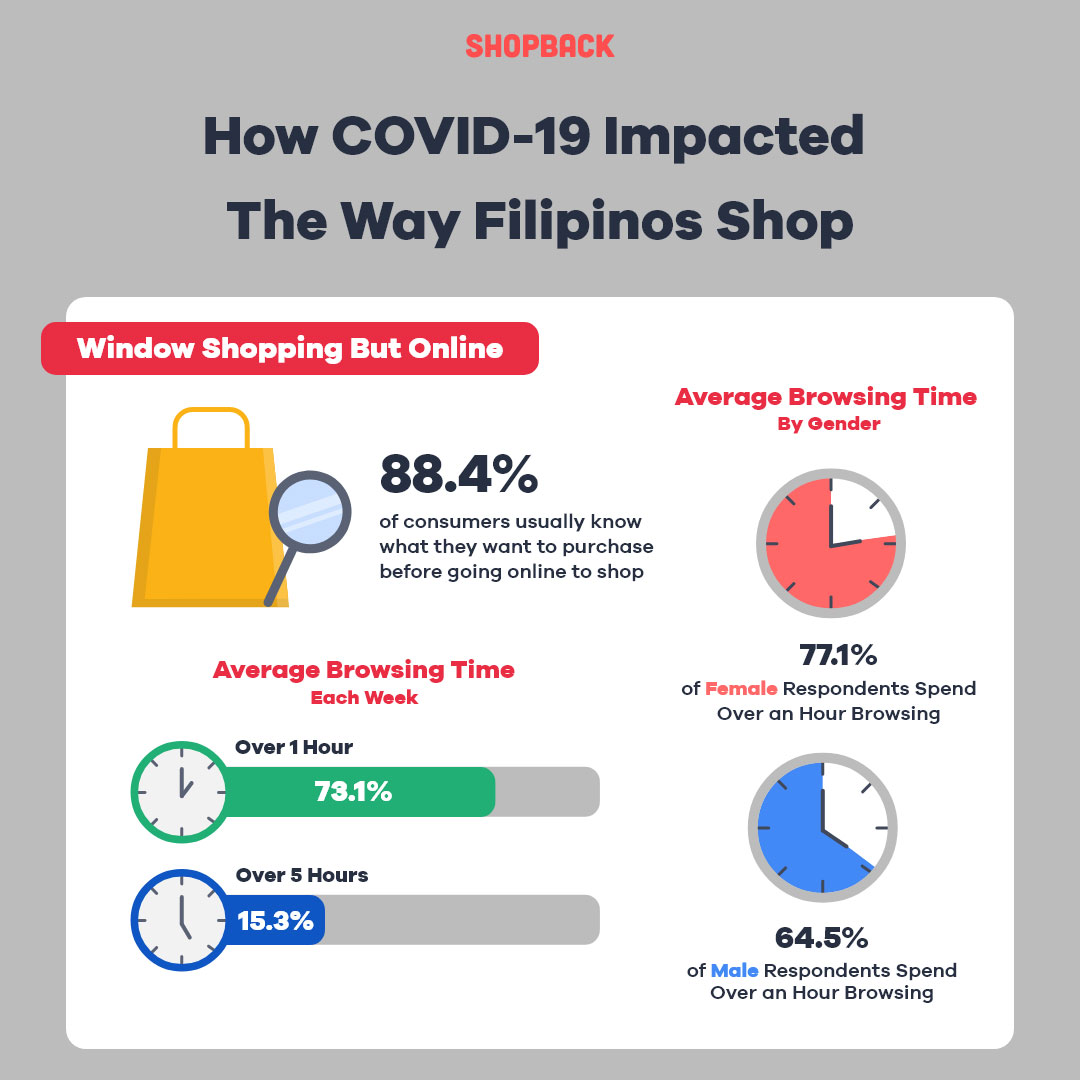
A recent survey, “How COVID-19 Impacted the Way Filipinos Shop,” was commissioned by ShopBack, a pre-shopping portal in Asia-Pacific.

With data collected from almost 2,000 ShopBack users, the survey showed that 88.4% of consumers usually know what they want to purchase prior to going online shopping. Based on the results, e-commerce will continue to thrive in the Philippines, with millennials as the biggest market.

In an e-mail to BusinessWorld, Country Manager of ShopBack Philippines Prashant Kala explained that ShopBack supports e-commerce platforms that “highlight their best deals by incentivizing users with cashback for each purchase made on the app.”

“Cashback is not a new trend per se but, what we wanted to do was to elevate the online shopping experience by partnering and housing all these e-commerce stores in one application and offer a reward system that will encourage users to keep on making online transactions because it’s convenient and also helps them save more money,” Mr. Kala said. 

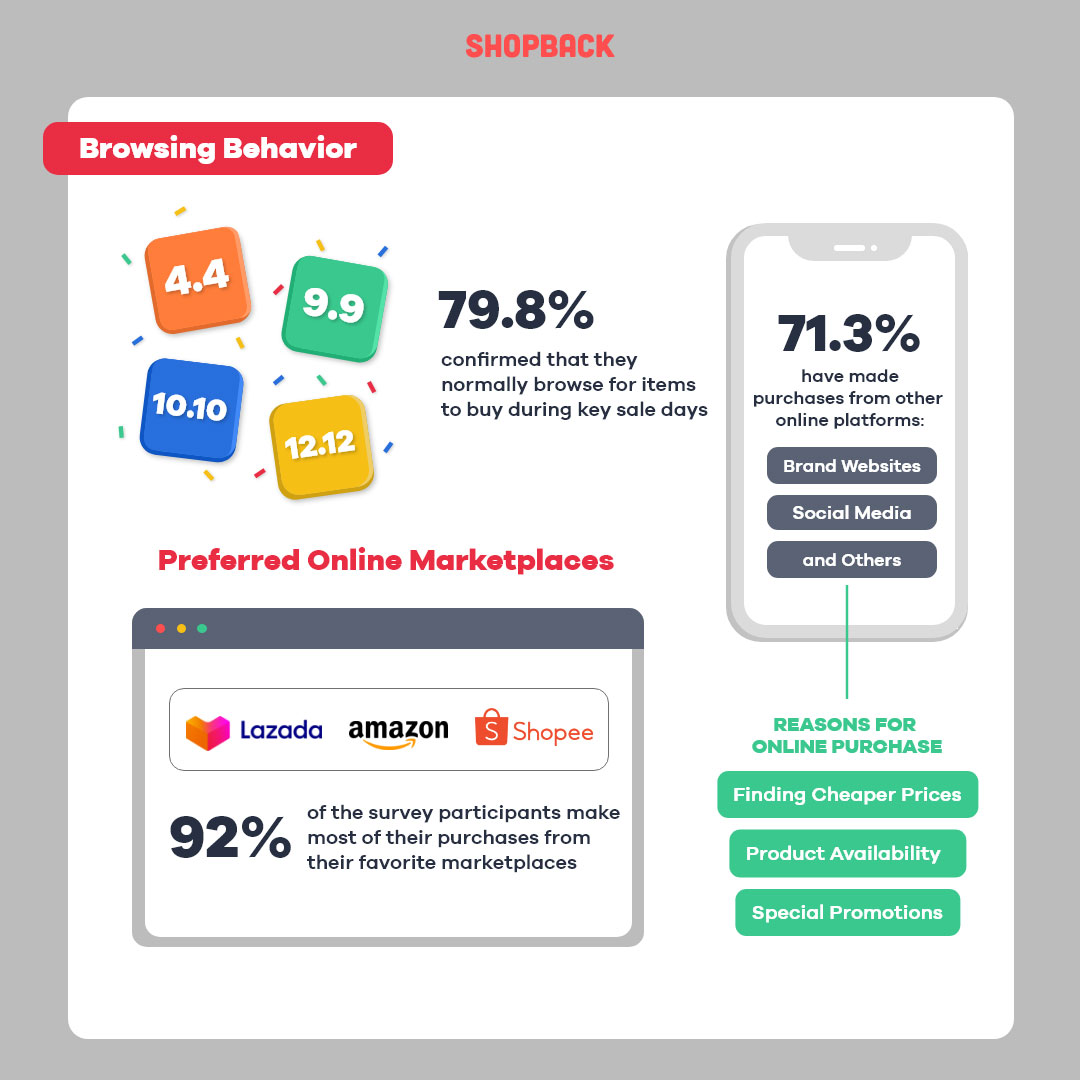
The survey found that major online sales had an impact on browsing behavior. It said 79.8% of respondents tend to spend more time browsing online during monthly sales such as the 11.11, and 12.12.

Mr. Kala noted that the top performing product categories include Mom and Baby, Health and Beauty, Tech and Electronics, Groceries and House Essentials, and Fashion.

“We have noticed a spike in baby essentials, and home and living products ever since the lockdown started,” he said.

Consumers tend to be loyal to a shopping platform but are platform-agnostic when it comes to lower prices or specific products. Around 92% of respondents indicated most of their online purchases were made at Shopee, Lazada, and Amazon citing cheaper products, convenient payment methods, and user-friendly platforms as reasons for their preference.

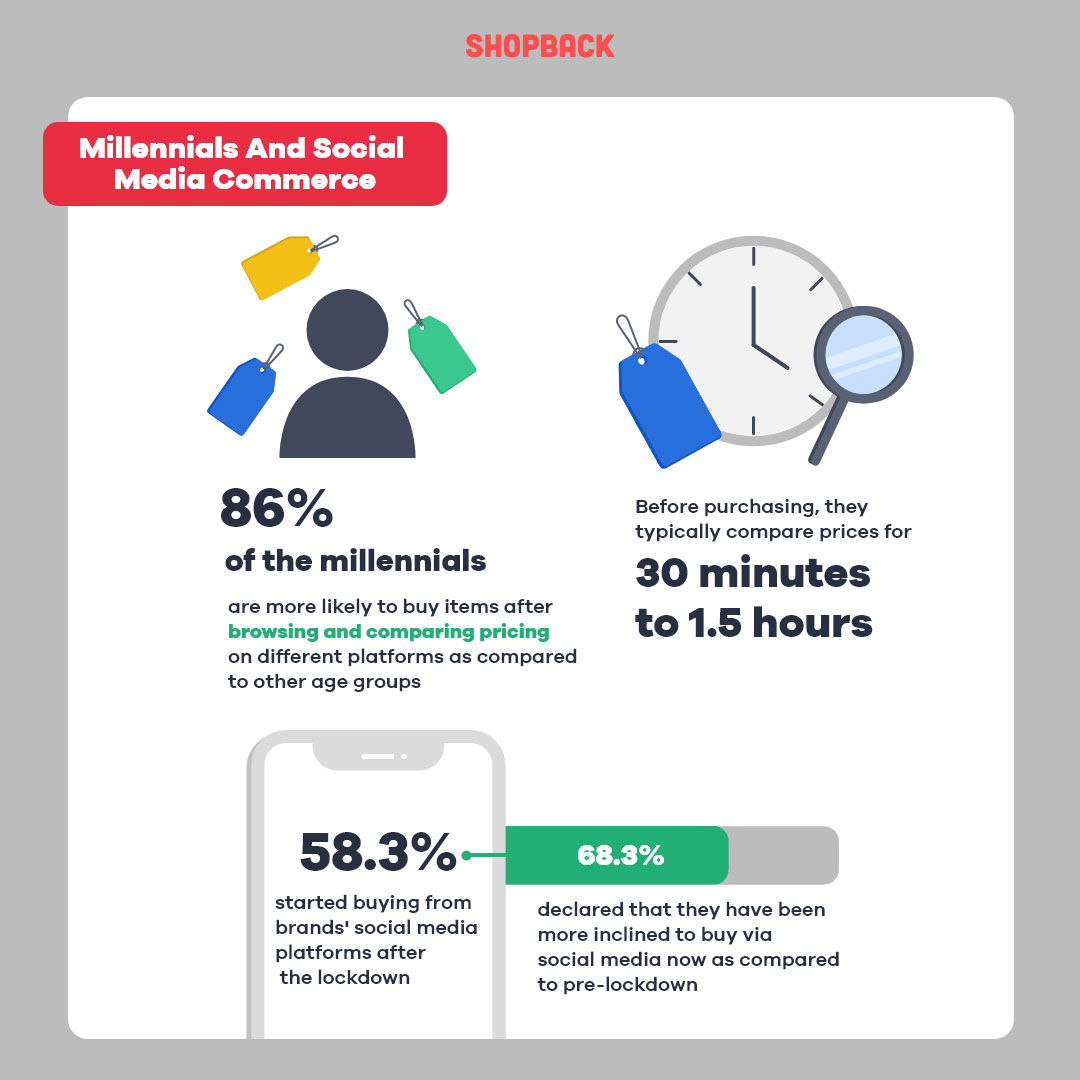
Meanwhile, 71.3% have made purchases on other online websites and official websites due to better discounts offered, wider product selections, and exclusive brand promotions; 58.3% of the participants have bought products directly from a brand’s social media platform.

With the survey results, Mr. Kala said that ShopBack plans to strengthen their app features to help users make better purchasing decisions.   

“We’re looking into improving our price comparison feature so that users don’t have to go outside the ShopBack platform to check product deals on different sites,” he said. — Michelle Anne P. Soliman

Hundreds line up for Jollibee’s West End store on opening day

JOLLIBEE recently opened its flagship Europe location at London’s West End to a huge crowd of customers patiently waiting in line for a taste of their Jollibee favorites.

JOLLIBEE Foods Corp.’s flagship store at London’s West End was greeted with hundreds of customers lined up on its opening day.

“It is heartwarming to see the long lines of customers at Jollibee’s London West End opening,” Jollibee President and Chief Executive Officer Ernesto Tanmantiong said in a statement on Saturday.

Customers were said to have flocked the store, with some lined up for seven hours before store hours. Around 300 were already in line by the time Jollibee opened doors.

Philippine Ambassador to the United Kingdom Antonio M. Lagdameo attended the opening and the ribbon-cutting ceremony, along with Jollibee Europe Business Head Adam Parkinson.

“Opening the restaurant now, during the first week Londoners can dine inside, was a fantastic moment of celebration for our community of Jollibee lovers and our amazing team,” Mr. Parkinson said.

Opening day sales for the West End branch breached records from recent Leeds, Leicester City, and Liverpool openings.

Jollibee West End’s menu will include an exclusive product, Tropical Chicken Burger, which is made with brioche bun with fried chicken breast, pineapple, cheese, lettuce, and Asian ginger chili sauce.

The company also debuted the new Spicy Chicken Burger, which is now available in all of its branches in the United Kingdom and Europe.

The store opening is part of Jollibee’s efforts to open 50 stores in five years across Europe. Jollibee is planning to launch six more stores in the UK before the year ends.

On Friday, shares of Jollibee at the stock exchange went up by 0.34% or P0.60 to close at P177.60 each. — Keren Concepcion G. Valmonte

Filinvest real estate leader passes away

ANDREW ‘BIBOT’ T. GOTIANUN, JR., vice-chairman of Filinvest Land, Inc. and director of Filinvest Development Corp.
ANDREW ‘BIBOT’ T. GOTIANUN, JR.,
vice-chairman of Filinvest Land, Inc. and director of Filinvest Development Corp.

ANDREW “Bibot” T. Gotianun, Jr., vice-chairman of Filinvest Land, Inc. and director of Filinvest Development Corp., passed away on Friday. He was 69 years old.

In a statement, the Gotianun family said his passing came “after a short bout with a non-COVID (coronavirus disease 2019) malignant illness.”

“He was instrumental in growing the Filinvest group into the multi-faceted corporation it is today and was a leader in the real estate field,” the family said.

Further information on his virtual memorial service will be announced soon.

The Gotianun family has asked for privacy. — KCGV

On-site processing, cold storage seen key to cutting food waste

By Kyle Aristophere T. Atienza, Reporter

THE GOVERNMENT needs to address post-harvest losses in agriculture by encouraging investment in facilities that process produce on-site or as near to the production area as possible, as well as investing in upgrades to the cold chain, analysts and industry stakeholders said.

Rizal Commercial Banking Corp. Chief Economist Michael L. Ricafort said: “There is a greater need to step up the harnessing of technology in terms of cold storage and processing facilities to at least prevent wastage in agriculture, especially if there is an excess from harvests when weather conditions are much more favorable,” he said in a Viber message.

Such investments will increase the likelihood that surpluses can be moved to areas suffering from shortages and to “prepare (for) seasons of the year when supplies are low,” he added.

“Processing facilities would also enable much longer shelf life for manufactured agricultural products that could also be sold locally as well as in export markets, by adopting global best practices in food processing technology.” 

Mr. Ricafort said adding value to surplus vegetables “would result in higher demand and (increased) profit margins as well.”

Tons of surplus vegetables from various farms were reportedly dumped during the pandemic as farmers struggled to sell them or were cut off from their markets by quarantines.

Asian Institute of Management (AIM) Economist John Paolo R. Rivera said the ultimate goal of increased processing is to allow “people to have more immediate access to agricultural products at a cheaper price benefitting both farmers and consumers.” 

Mr. Rivera said the government agencies concerned must also prioritize the “need to streamline the process of moving (agricultural) products, from farm to table, in the most efficient manner.” 

“There is a need to look into how to deal with middlemen or intermediaries. There is a need to evaluate whether they are facilitating seamless transport or causing delays,” he said.

“While middlemen exist, there must be an assessment on how they can be an engine of efficient distribution,” he added.

Mr. Rivera also said local processing and distribution facilities must also be encouraged “to serve communities in proximity.”

“Wastage will also be minimized and the majority, if not all, can be fed,” he added.

According to a survey conducted by the Science and Technology department between Nov. 3 and Dec. 3, 62.1% families experienced moderate to severe food insecurity during the pandemic.
Of the 5,717 households involved in the survey, almost 72% were forced to borrow money to obtain food, while 66.3% asked for food from their relatives, neighbors, and friends.

The survey found that 56.3% of respondents reported having problems accessing food during the community quarantine period due to a lack of money (22.1%), limited public transportation (21.6%), loss of livelihood (19.5%), and limited food stores (10.8%). It added that 5.1% of the respondents were seniors who had no other family members to buy food for them. 

The department said government services and benefits must be decentralized from cities and extended equitably to provinces with fewer resources to address food insecurity.

George T. Barcelon, chairman of the Philippine Exporters Confederation, Inc., said the government should also provide more common warehouses accessible to rural farms “to reduce transportation costs.”

Mr. Barcelon noted that “there are ongoing private initiatives to set up warehouses near the sources of produce.”

The warehouses established by the private sector currently “provide the washing and stacking facilitates to reduce spoilage,” he said in a Viber message. “This is linked up to e-commerce platforms for institutional buyers to coordinate their orders and deliveries.”  

Meanwhile, Mr. Rivera of AIM said the government must also invest in technology that allows farmers to make their products more competitive.

He said empowering the agriculture sector, especially rice farmers, is urgent with the influx of agricultural imports following the lowering of some trade barriers. 

President Rodrigo R. Duterte recently signed an executive order lowering the most-favored nation (MFN) tariff rates for rice to 35% for one year, putting the cost of importing from MFNs at par with the favorable rates charged on grain from Southeast Asia. The previous rate structure was 40% for rice within the minimum access volume  quota and 50% for shipments beyond the quota. 

Rates of Treasury bills to move sideways on lack of fresh leads

RATES of the Treasury bills (T-bills) on offer on Monday will likely move sideways and track US yields amid the lack of fresh leads.

The Bureau of the Treasury (BTr) is looking to raise P25 billion via its offer of Treasury bills (T-bills) on Monday, broken down into P5 billion from the 91-day securities, P8 billion via the 182-day debt and P12 billion in 364-day papers.

A bond trader said the yields of the T-bills will move sideways with a slight upward bias at Monday’s auction.

“For the factors to consider, the market looks at the movement of the US Treasury. On the T-bills, there is still strong demand to persist on the lack of fresh leads,” a trader said by phone on Friday.

US Treasury yields slid on Friday as the market shrugged off a report showing US factory activity rose in early May to its highest level in more than a decade and Federal Reserve officials talked about when to discuss tapering bond purchases, Reuters reported.

Data firm IHS Markit said its flash US manufacturing PMI increased to 61.5 in the first half of this month, a reading that was the highest since the survey was expanded in October 2009 to cover all manufacturing industries.

The IHS report is the latest news to show the US economy is roaring at the “highest” level or “largest” advance in some time, suggesting inflation is picking up more than the Fed would likely acknowledge, said Kevin Flanagan, head of fixed-income strategy at WisdomTree.

The yield on 10-year Treasury notes was down 0.9 basis point to 1.625%, well off a more than one-year high of 1.776% reached in late March.

The yield on the 30-year Treasury bond fell 1.2 basis points to 2.329%.

Minutes from the April meeting of Fed policy makers released on Wednesday revealed a contingent within the US central bank that feels a discussion may start sooner than expected about pulling back its accommodative monetary policy, Mr. Flanagan said.

The government last week fully awarded the T-bills it offered as rates dipped amid lower inflation expectations.

The BTr raised P25 billion as planned via the T-bills on Monday, with total tenders reaching P83.705 billion, making the offer over three times oversubscribed.

Broken down, the Treasury awarded the programmed P5 billion in 91-day T-bills as total bids reached P16.965 billion. The three-month papers fetched an average rate of 1.27%, a tad lower than the 1.278% seen previously.

The BTr also borrowed P8 billion as planned via the 182-day debt papers after the tenor attracted P25.11 billion in tenders. The average rate of the six-month debt dipped to 1.54% from 1.549% previously.

Lastly, the government made a full P12-billion award of the 364-day instruments as demand reached P41.63 billion. The one-year T-bills were quoted at 1.81%, down by 1.9 basis points from the previous rate of 1.829%.

The Treasury also opened its tap facility to raise another P5 billion via the 364-day papers to take advantage of the strong appetite for the tenor that caused its yield to drop.

At the secondary market on Friday, the 91-, 182- and 364-day T-bills were quoted at 1.3045%, 1.5436%, and 1.8385% respectively, based on the PHL Bloomberg Valuation Reference Rates published on the Philippine Dealing System’s website.

The Treasury wants to raise P170 billion from the local bond market this month: P100 billion via weekly offerings of T-bills and P70 billion from T-bonds to be auctioned off fortnightly.

The government is looking to borrow P3 trillion this year from domestic and external sources to help fund its budget deficit seen to hit 8.9% of gross domestic product. — with Reuters

Porsche global sales soar by 36% in Q1

PHOTO FROM PORSCHE PHILIPPINES

PORSCHE’s worldwide deliveries in the first quarter of 2021 increased by 36% compared to the same period last year. It sold 71,986 sports cars, SUVs, and sedans in Q1 2021 versus 53,125 units delivered during Q1 2020.

Significantly, the Taycan — the Stuttgart-headquartered sports car maker’s first all-electric model — moved almost as many units as the iconic 911. Porsche in the first quarter of the year sold 9,072 Taycan models, almost matching the 9,133-unit sales total achieved by the 911.

Asserted Porsche AG Executive Board Chairman Oliver Blume, “We will sell significantly more Taycan cars this year. In the first quarter, deliveries of our successful all-electric model were already almost half of the total for all of 2020. A particularly pleasing fact here is that around 50% of the buyers are new customers. The Taycan is therefore increasing the size of our fan base.”

The brand’s SUV models continue to drive global volume. In the first quarter, the Macan moved 22,458 units, followed by the Cayenne with 9,533 vehicles.

Meanwhile, the combined sales of the 718 Boxster and 718 Cayman mid-engine sports cars reached 6,190, while Porsche handed over 5,600 Panamera sport sedans to customers. Double-digit growth sales were achieved in all regions. Asia-Pacific, Africa, and the Middle East deliveries reached 32,129 units, representing 46% growth. China accounted for the bulk of these markets’ total with 21,991 vehicles sold — a 56% spike versus the same period last year.

Porsche sales in American markets also significantly grew with 20,468 units delivered, a 43% increase. Europe sold 19,389 vehicles — 16% more than the same period last year.

“We are extremely pleased that the community of Porsche customers continues to grow all over the world,” said Porsche AG Member of the Executive Board for Sales and Marketing Detlev von Platen. “Established models have supported this excellent result, along with the latest additions to our product range, above all the new model variants of the fully electric Taycan.”

Cleaning your hands like a lady

THE HEIGHT of chic (and good sense) these days is having very, very clean hands — after all, we’re still in the middle of a pandemic. Handwashing with soap and water helps defeat the spreading coronavirus, and a Philippine-made soap is going extra tough on them.

Meet Dr. Coco, a new hand soap from Consumer Care Products, Inc. (CCPI) It’s made with coconuts from the Philippines, and claims to kill 99.9% of viruses and bacteria on the hands. “Not just remove it,” said Mario Garcia, Marketing Lead for CCPI during a press conference on Zoom last week.

It is 100% sure about one thing: 100% of the product is nature-derived, said Star Estacio, General Manager for Food and Personal Care BU, CCPI, and 91% of it is made from coconuts.

The product works its ways through the use of Coco MCT (medium chain triglycerides) that are part of coconut oil. Ms. Estacio calls it a “natural moisturizer.” “Because it’s a medium chain triglyceride, the molecules are smaller. It can penetrate the skin. You are protected on the surface, and beneath the skin.”

Some of us have been handwashing overzealously with increasingly stronger products, leaving us with dry and cracked hands. Maybe you won’t cry like Scarlett O’Hara’s sister who wails, “You can always tell a lady by her hands,” but Ms. Estacio says, “Sure, but cracked hands can lead to skin infections.”

The MCT in Dr. Coco works two ways: it moisturizes and protects your hands — through a thin film, sure, but the thin film it leaves behind also becomes a microbial barrier, allowing it to kill 99% of bacteria for up to four hours. “That’s clinically proven,” added Mr. Garcia, discussing the product testing they have done.

So the O’Haras from Gone With The Wind can think they can tell a lady with her hands, but can they use them to tell a Miss? Former Miss Universe Pia Wurtzbach stepped into the call as the hand soap’s brand ambassador. She too complained about dry hands. “It happened to me, at the beginning of this whole craziness that we’re in. I’m really happy with Dr. Coco; hindi nga drying sa kamay (It doesn’t dry my hands). I also love the smell.” Dr. Coco comes in two scents: lavender and green tea.

Dr. Coco is available to order online from both Shopee and Lazada. A 250 ml bottle costs P114.75 on Lazada. For more information about the product, check the official website: drcoco.com.ph. One can also follow Dr. Coco’s official social media accounts: DrCoco.ph on Facebook, and @DrCOCO on Instagram. It is also now available in retail stores like Mercury Drug, Watsons, Landmark, South Supermarket, and Unimart. — JLG

Converge earnings whet investors’ appetite

By Lourdes O. Pilar, Researcher 

INVESTORS took positions on Converge ICT Solutions, Inc. last week after the release of its first-quarter earnings report.

A total of 47.16 million shares worth P924.87 million were traded from May 17 to 21, data from the Philippine Stock Exchange showed. This made the fiber internet service provider the seventh-most actively traded stock last week.

Week on week, its share price went up by 10.3% to P20.4 per share on Friday from its May 14 closing price of P18.5. Since the start of the week, the stock has increased by 35.3%.

“We attribute Converge’s rally to its favorable first-quarter 2021 performance which the company disclosed last May 17,” Philippine National Bank (PNB) Senior Equity Research Analyst Jonathan J. Latuja said in an e-mail, adding the stock outperformed the PSE index (-1% week on week) and the All Shares index (-0.2%).

In its disclosure to the stock exchange last Monday, Converge reported its attributable net income in the first quarter nearly tripled to P1.55 billion from P573.60 million in the same period last year, owing primarily to an increase in subscribers amid the ongoing pandemic crisis.

Total revenues, which include contributions from residential and enterprise, increased 83.2% to P5.55 billion in the first quarter from P3.03 billion in the same period in 2020.

It also reported its household coverage, calculated as the “total homes passed over total number of homes in the Philippines,” increased to 28.3% in the first three months of the year from 24.5% in the fourth quarter of 2020 and 14.5% in the first quarter of 2020.

Mr. Latuja said the growth in household coverage “reassured investors” that the company is on track to reach its target of having 55% household coverage by 2025.

On Converge’s outlook, he forecasts a 55% year-on-year increase in company’s revenues this year, given the company managed to grow its topline by almost 84% year on year in the first quarter.

He also noted the increase in its subscriber base to around 1.18 million during the period compared with 1.04 million in the previous quarter and 615,466 in the first quarter last year.

In a text message, Diversified Securities, Inc. Aniceto K. Pangan said the ongoing lockdowns will continue to drive the demand for broadband internet, to “dominate” the daily way of life, and that the company’s investment rollout to expand its business “will sustain their growth as seen from their revenue going forward.”

“[I]nvestor’s interest in the company will continue, but might be limited as most investors are on the sidelines due to the uncertainties in the market with its price near its [52-week high of P21.20],” he said.

Mr. Pangan placed the stock’s immediate support and resistance levels at P19.82 and P20.45, respectively.

PNB’s Mr. Latuja said the firm does not provide technical analysis for stocks, but he provided the stock’s target price of P22.6 per share “over the next six to 12 months.”

IRRI, biotech partner to develop rice varieties resistant to drought

PHILIPPINE STAR/KRIZ JOHN ROSALES

THE International Rice Research Institute (IRRI) has entered into a partnership with Bioseed Research Philippines, Inc. to develop rice varieties for the Philippines which are resilient in drought and flood conditions.  

Gururaj Guddappa Kulkarni, IRRI Bio-Innovation Center and Global head of Research Infrastructure and Compliance, said in an e-mail interview with BusinessWorld: “This research project aims to develop rice varieties that can better cope with environmental and man-made stresses, such as floods, droughts, etc., to bolster yields,” Mr. Kulkarni said.   

Mr. Kulkarni said Bioseed Research is based in General Santos City and is a wholly-owned subsidiary of Indian conglomerate DCM Shriram Consolidated Ltd.

“Bioseed owns one of the richest collections of germplasm in the world, which has sprouted one of the highest success rates in all of Asia. Its work is focused on research and development, field and lab testing, production, farm management and farmer interaction,” Mr. Kulkarni said.

Asked about the project’s timeline, Mr. Kulkarni said the pandemic has the prevented the start of laboratory work due to quarantine restrictions.

“We are still planning to start work as soon as possible, and are currently working on the seed movement and fine-tuning the milestones or deliverables of this project,” Mr. Kulkarni said.

“Researchers are currently working to import seeds and validate protocols to begin activities soon, with the end goal of developing rice varieties with multiple traits to address the biotic and abiotic challenges,” he added.

Mr. Kulkarni said the IRRI Bio-Innovation Center offers research, service, and resource sharing partnerships with public, private, and research institutes all over the world.

He added that the center allows the public and private sectors to tap IRRI’s research infrastructure and expertise.

“This most recent project is just one of 130 active projects initiated by IRRI with an overall value of around $225 million. Since 2015 to the present, IRRI has initiated some 390 projects (grants) with a total value of around US$310 million,” Mr. Kulkarni said. — Revin Mikhael D. Ochave

AMLC tweaks rules for registration of covered persons

THE ANTI-MONEY Laundering Council (AMLC) is revising its guidelines for covered persons under the amended Anti-Money Laundering Act to let more developers and brokers register with the regulator.

“Once the deadline has been set, appropriate penalties pursuant to existing regulations will be imposed for those who fail to register on time,” AMLC Executive Director Mel Georgie B. Racela said in a Viber message.

He said the draft guidelines set the new deadline on June 30. The AMLC has extended the registration period from the initial March 16 deadline to allow more covered persons to register and amid several proposals from the Professional Regulation Commission (PRC) and stakeholders for tweaks in the revised Anti-Money Laundering/Counter-Terrorism Financing Guidelines for Designated Non-Financial Businesses and Professions.

The revised guidelines will also outline the documentary requirements for the registration process with the AMLC and enforcement actions that could be faced by covered persons that fail to register within the deadline.

Mr. Racela said AMLC data as of April 30 showed 2,272 real estate brokers have registered so far. Meanwhile, some 501 real estate developers and 72 Philippine offshore gaming operator service providers also completed their registration as covered persons of the AMLC.

A certificate of registration with the AMLC is part of the Know Your Customer mandate for banks when dealing with real estate brokers and developers, Mr. Racela said.

“If the latter fail to submit this, then banks may be cited for violation of its Know Your Customer obligations. But because the deadline to register has not yet been set, Banks may be liberal to give them until the deadline has lapsed,” he said.

Real estate brokers and developers became covered persons of the AMLA through the passage of the Republic Act 11521 earlier this year. The measure tightened the country’s rules to battle dirty money and terrorism financing in view of recommendations set by the Paris-based Financial Action Task Force (FATF).

While the country passed the law before the Feb. 1 deadline set by the global “dirty money” watchdog, the country still needs to prove it is implementing tangible, stricter rules against money laundering and terrorism financing.

“The Philippines now needs to demonstrate that our anti-money laundering/counter-terrorism financing legal and institutional framework is producing the expected results over a sustained period,” Mr. Racela said.

In April, an assessment by the International Monetary Fund and the World Bank stated the country could still be back to the FATF’s “gray list” of countries with serious deficiencies on anti-money laundering and counter-terrorism financing “without major reforms by June 2021.”

The report cited the need to ease the country’s Bank Secrecy Law as another measure to boost the country’s guard against “dirty money.” — Luz Wendy T. Noble